REVIEW 4 major objections 4 minor 78 references
Emergence of giant vortices under nonlinear rotation with attractive interactions in a toroidal condensate
T0 review · 4 major / 4 minor · reviewed 2026-08-01 · deepseek-v4-flash
Pith's one-line read Increasing the strength of nonlinear rotation in a toroidal condensate drives a structural transition from a ring-shaped vortex lattice to a giant vortex, with circulation rising from six to fifteen quanta.
desk verdict A genuinely new geometry for the density-dependent gauge potential model, with a plausible giant-vortex transition—but the central numerical claim needs better support before I'd bet on it. read the letter →
The pith
A machine-rendered reading of the paper's core claim, the machinery that carries it, and where it could break.
The reading
What carries the argument
The engine of the paper is the density-dependent gauge potential, which enters the two-dimensional Gross–Pitaevskii equation as a rotation rate $\Omega_n = \Omega + \tilde{C} |\psi|^2$ multiplying the angular-momentum operator $L_z$. This term couples the local density to the effective rotation, so denser regions of the condensate rotate faster. The toroidal trap $V(r)=\frac{1}{2}(r-r_0)^2$ supplies the multiply connected geometry that quantizes circulation around a central hole. Three tools carry the analysis: a Thomas–Fermi density profile whose turning points come from a quartic equation and delimit the admissible parameter space; linearized quasiparticle equations that yield collective mode frequencies; and a phase–
What would settle it
Run an independent imaginary-time simulation of the two-dimensional Gross–Pitaevskii equation with fixed numerical parameters (grid spacing $\leq 0.05$, time step $\leq 10^{-5}$, and explicit boundary conditions) at $\Omega=0.45$, $g=250$, $r_0=4$, and check whether the ground-state circulation rises from 6 at $\tilde{C}=0$ to 15 at $\tilde{C}=12$, with the phase accumulating $15 \times 2\pi$ around a single central core; failure to reproduce that jump would falsify the claimed transition.
Extended reading notes
Core claim
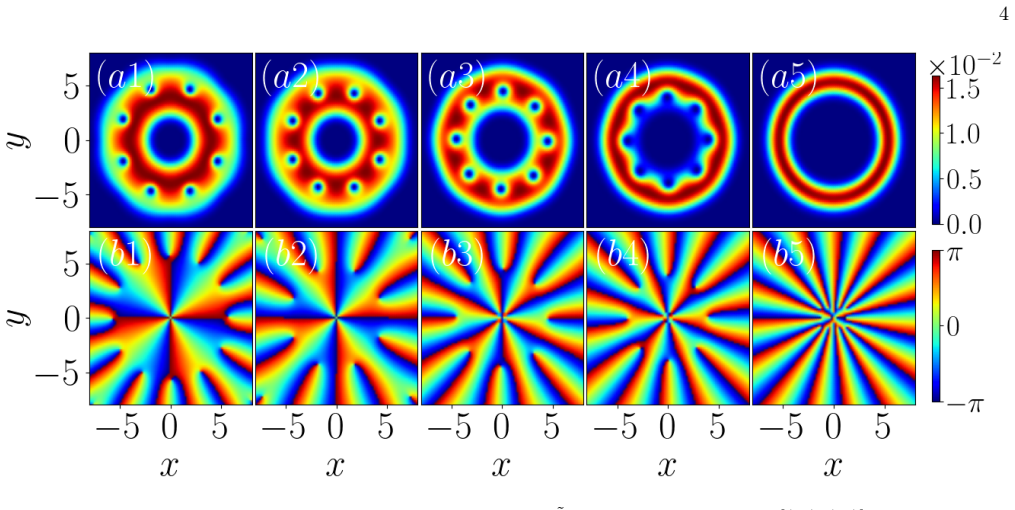
At fixed rigid-body rotation $\Omega=0.45$, interaction strength $g=250$, and toroidal radius $r_0=4$, the paper finds that the ground state of the generalized Gross–Pitaevskii equation changes from a ring-shaped vortex lattice of total circulation six at zero nonlinear rotation to a giant vortex of circulation fifteen at $\tilde{C}=12$. Positive nonlinear rotation drives annular vortices inward, enlarging the central hole; negative values push vortices outward and lower the circulation. The same trend appears when giant vortices are prepared either by atom removal or by a repulsive Gaussian potential, with the core area largest for positive $\tilde{C}$. The paper derives a Thomas–Fermi density profile and sh
Load-bearing premise
The central transition claim rests on the unstated assumption that the imaginary-time and real-time simulations behind the density and phase plots are properly converged solutions of the two-dimensional Gross–Pitaevskii equation—no grid size, time step, or convergence criterion is given—and the stability conclusion relies on a second implicit transfer of harmonic-trap results to the toroidal geometry.
Editorial extensions
If this is right
- Positive nonlinear rotation shrinks the annulus and funnels vortices into the central hole; negative rotation widens the annulus and pushes vortices toward the periphery.
- The giant vortex state sits in the negative chemical-potential regime, where the ring trap pins it against collapse, offering a route to stable high-circulation states without rapid external stirring.
- The Thomas–Fermi parameter map shows that the allowable nonlinear rotation strength shrinks as ring radius or rigid-body rotation grows, placing practical bounds on the giant-vortex transition.
- Dipole-mode softening with increasing nonlinear rotation is a direct signature of Kohn-theorem violation in this geometry, while the breathing-mode upturn marks radial compression accompanying the transition.
- Multiply quantized vortices can be made globally stable by positive nonlinear rotation, but the persistent negative-energy splitting mode means they will still dissociate locally unless an additional pinning mechanism is added.
Reading between the lines
- If the circulation is as tunable as the numerics suggest, the same gauge-field scheme could act as an in-situ control for persistent currents in atomtronic circuits, writing quantized flows without stirring lasers or phase imprinting.
- The appearance of the giant vortex at negative chemical potential suggests that effectively attractive systems—dipolar condensates or quantum mixtures—might support giant vortices at lower rotation rates than ordinary repulsive condensates; a scattering-length ramp could test this.
- The hydrodynamic equations derived here predict \tilde C-dependent collective-mode shifts that could be probed by Bragg spectroscopy, making the predicted Kohn-theorem violation an experimentally clean signature.
- Because local stability of multiply quantized vortices is not achieved, combining nonlinear rotation with a pinning potential or weak dissipation is a natural next step; closing the anomalous-mode gap could make high-circulation states long-lived and practically useful.
Editorial analysis
A structured set of objections, weighed in public.
Referee Report
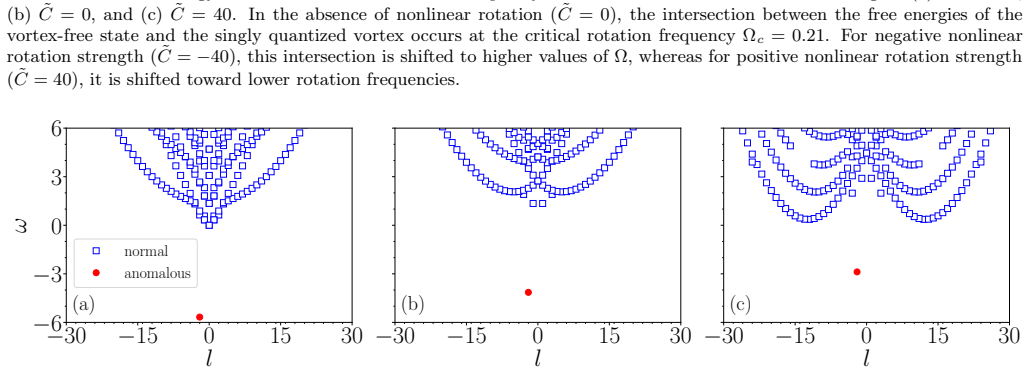
Summary. The paper studies a quasi-2D Bose-Einstein condensate in a toroidal trap, governed by the GP equation (9) with a density-dependent gauge potential that induces a nonlinear rotation term proportional to C n L_z. Ground states are computed for positive interaction strengths g = 250-1000 and rotation frequencies Omega = 0.45-0.9. The central claim is that increasing C drives a structural transition from a ring-shaped vortex lattice with total circulation six to a giant vortex with circulation fifteen at C = 12, accompanied by negative chemical potential (Figs. 1 and 5). The paper derives a Thomas-Fermi density (13), maps the allowed parameter region (Fig. 2), studies giant-vortex generation by atom removal and by a repulsive Gaussian beam (Figs. 6 and 7), computes collective excitations with BdG and hydrodynamic methods (Figs. 8-10), and analyzes the stability of multiply quantized vortices (Figs. 11 and 12). A violation of Kohn's theorem and mode softening across the transition are reported.
Significance. If the central transition is numerically robust, the result is significant: the density-dependent gauge field would provide a new control parameter for assembling high-circulation giant vortices in annular geometry. The analytic Thomas-Fermi solution-space mapping is explicit and useful, and the mutual consistency of the BdG and hydrodynamic spectra is a positive check. There is no fitting or prediction circularity. However, the central claim depends entirely on ground-state solutions whose numerical solver is not described, and the title's 'attractive interactions' is not supported by the simulations. The significance is therefore conditional on the numerical details and on corrected framing.
major comments (4)
- [Sec. II after Eq. (9); Figs. 1, 5, 8, 9] The numerical method used to solve Eq. (9) is never specified: no grid size or spacing, time step, imaginary-time or real-time propagation scheme, convergence criterion, or boundary treatment. This is load-bearing because the reported transition occurs near the upper termination of the Thomas-Fermi solutions for r0 = 4, where the circulation count (6 to 15 at C = 12) and the BdG frequencies are sensitive to numerical resolution. Please provide full numerical details and convergence tests, e.g., circulation and chemical potential versus grid spacing and time step, at least for the states in Fig. 1 and the spectra in Figs. 8 and 9. The reviewer agrees with the stress-test concern here.
- [Title and Sec. III (Fig. 5)] The title and parts of the text describe the problem as involving 'attractive interactions', but all simulations use repulsive contact interactions (g = 250, 500, 1000). The negative chemical potential shown in Fig. 5 is induced by rotation/nonlinear rotation, not by a negative scattering length. The manuscript should change the title/abstract or present actual negative-g results; otherwise the advertised attractive-interaction regime is not being studied.
- [Sec. V, Fig. 8] The l = 1 dipole mode is said to signal 'a deviation from Kohn's theorem'. Kohn's theorem applies to harmonic confinement, whereas the toroidal potential V = (r - r0)^2/2 is not a harmonic potential. A decreasing dipole frequency in this trap is therefore not a violation of a theorem that does not apply. Please remove this claim or define precisely which generalized Kohn theorem is being tested and why it should hold in the toroidal trap.
- [Sec. VI, Fig. 11; Conclusion] The multiply-quantized-vortex stability analysis is explicitly performed for a harmonically trapped condensate, but the abstract and conclusion state the global/local stability result without that qualifier. Because the paper's main context is toroidal, this transfer is not automatic. A toroidal MQV calculation, or a clear qualifier that the result refers to harmonic traps, is required.
minor comments (4)
- [Fig. 2 captions] The figures are referred to as 'Figure III' and 'Fig. III' in the text; the numbering should be corrected to Fig. 2.
- [Sec. V, after Eq. (22)] The text says the BdG equations are obtained using the perturbation ansatz in Eq. (18); it should refer to Eqs. (19) and (20), since Eq. (18) defines the laser potential.
- [Eq. (12) and Fig. 2(c)-(f)] The radial prefactors in Eq. (12) are typeset ambiguously. In addition, the term 'attractive regime' in the description of Fig. 2(c)-(f) should be replaced by 'negative chemical potential' to avoid implying negative g.
- [Abstract and Sec. IV/Conclusion] The conclusion says 'absorption techniques' while Section IV uses 'atom removal'; the terminology should be unified.
Circularity Check
No circular derivation: TF, BdG, and hydrodynamic results are derived from the same GP equation and used as consistency checks, not as fitted predictions.
full rationale
I walked the paper's derivation chain from the generalized GP equation (Eq. 9) through the Thomas-Fermi, BdG, and hydrodynamic analyses, and found no step in which an output is defined in terms of the quantity it is supposed to predict. The nonlinear rotation strength C˜ is an input parameter in Ωn = Ω + C˜ n, and the reported vortex-lattice-to-giant-vortex transition, circulation changes (6→15), and negative chemical potential are computed outputs of solving Eq. (9), not quantities fitted to reproduce those outputs. The Thomas-Fermi density in Eq. (13) is derived by minimizing the energy functional constructed from the same GP model, so the agreement between TF and numerical ground states in Figs. 4 and 5 is a consistency check between two methods applied to the same equations, not a circular prediction. Likewise, the BdG equations (Eqs. 22) and the hydrodynamic equation (Eq. 26) are both linearizations of the same underlying GP equation, so matching spectra in Figs. 8 and 9 are cross-method consistency rather than circularity. The self-citations, notably Ref. [22] by the same authors and Ref. [55] with an overlapping author, are used as background pointers or as references for the general functional form; the paper re-derives the TF functional and does not use these citations to forbid alternatives or to supply an otherwise unsupported conclusion. The absence of a detailed description of the numerical GP solver is a legitimate reproducibility and correctness concern, but it is not a circularity reduction: nothing in the derivation makes a predicted quantity equal to an input by construction. I therefore find no significant circularity and assign score 0.
Assumptions & free parameters
assumptions (5)
- domain assumption The dressed-state projection and adiabatic elimination leading to Eq. (5) are valid (mean-field interaction much weaker than light-matter coupling).
- domain assumption The quasi-2D reduction is valid: ω_z ≫ ω_⊥, so axial dynamics freeze out.
- domain assumption The Thomas-Fermi approximation (neglect of quantum pressure) holds in the parameter regimes explored.
- ad hoc to paper The numerical solutions reported are converged ground states of Eq. (9).
- ad hoc to paper Results from the harmonic-trap MQV analysis (Sec. VI) are representative of toroidal behavior.
Cite this review
Pith. "Pith review of Emergence of giant vortices under nonlinear rotation with attractive interactions in a toroidal condensate." pith.science (2026). https://pith.science/paper/I4SRYQGQ
@misc{pith2026260719840,
  author       = {Pith},
  title        = {Pith review of: Emergence of giant vortices under nonlinear rotation with attractive interactions in a toroidal condensate},
  year         = {2026},
  howpublished = {\url{https://pith.science/paper/I4SRYQGQ}},
  note         = {Machine review of arXiv:2607.19840}
}
read the original abstract
We numerically investigate the effects of a density-dependent gauge potential which induces nonlinear rotation on a Bose-Einstein condensate confined in a toroidal trapping geometry. By focusing on the resulting vortex lattice configurations, we demonstrate that increasing the strength of the nonlinear rotation leads to a structural transition from a ring-shaped vortex lattice to a giant vortex state. The quantum circulation associated with the giant vortex is found to be highly sensitive to the strength of the nonlinear rotation and the giant vortex appears in the regime of negative chemical potential. Additionally, we identify the parameter regime in which the Thomas-Fermi density profile remains valid by mapping the solution space based on the strength of the nonlinear rotation and the radius of the confining potential. Based on the Bogoliubov de Gennes analysis, we investigate the impact of nonlinear rotation on the collective excitation spectrum. Our results reveal a violation of the Kohn theorem, accompanied by changes in the breathing mode frequency that indicate radial deformation of the condensate. Our findings are further substantiated through a comprehensive hydrodynamic analysis. Finally, we analyze the stability of multiply quantized vortices under nonlinear rotation. Our findings indicate that while nonlinear rotation can enhance the global stability of these states, it does not necessarily ensure their local stability.
Figures


Figures from the paper (8 more)


Reference graph
Works this paper leans on
-
[1]
This approach is similar in spirit to the creation of spin-angular-momentum-coupled condensates using Laguerre-Gaussian laser beams [58–60]. To obtain the quasi-two-dimensional Gross-Pitaevskii (GP) equation, we factorize the condensate wave function asΨ(r, t) = ψ(x, y, t) exp −z2/2σ2 z / πσ 2 z 1/4 , and assume that the condensate is confined in a highly...
-
[2]
R. J. Donnelly,Quantized vortices in helium II, Vol. 2 (Cambridge University Press, 1991)
1991
-
[3]
B. A. Malomed, D. Mihalache, F. Wise, and L. Torner, Spatiotemporal optical solitons, J. Opt. B: Quantum Semiclass. Opt.7, R53 (2005)
2005
-
[4]
V. Zapf, M. Jaime, and C. D. Batista, Bose-einstein con- densation in quantum magnets, Rev. Mod. Phys.86, 563 (2014)
2014
-
[5]
E. B. Sonin, Vortex oscillations and hydrodynamics of rotating superfluids, Rev. Mod. Phys.59, 87 (1987)
1987
-
[6]
P. W. Anderson, Quantum liquids: Bose condensa- tion and Cooper pairing in condensed-matter systems, Physics Today60, 57 (2007)
2007
-
[7]
A. J. Leggett,Quantum Liquids: Bose condensation and Cooper pairing in condensed-matter systems(Oxford University Press, 2006)
2006
-
[8]
A. L. Fetter and A. A. Svidzinsky, Vortices in a trapped dilute Bose-Einstein condensate, J. Phys.: Condens. Matter13, R135 (2001)
2001
Show all 78 references
-
[9]
J. A. Estrada, M. E. Brachet, and P. D. Mininni, (2025), arXiv:2506.16358 [cond-mat.quant-gas]
2025 arXiv
-
[10]
Gupta, K
S. Gupta, K. W. Murch, K. L. Moore, T. P. Purdy, and D. M. Stamper-Kurn, Bose-Einstein condensation in a circular waveguide, Phys. Rev. Lett.95, 143201 (2005)
2005
-
[11]
S. E. Olson, M. L. Terraciano, M. Bashkansky, and F. K. Fatemi, Cold-atom confinement in an all-optical dark ring trap, Phys. Rev. A76, 061404 (2007)
2007
-
[12]
Henderson, C
K. Henderson, C. Ryu, C. MacCormick, and M. G. Boshier, Experimental demonstration of painting arbi- trary and dynamic potentials for Bose–Einstein conden- sates, New J. Phys.11, 043030 (2009)
2009
-
[13]
Javanainen, S
J. Javanainen, S. M. Paik, and S. M. Yoo, Persistent currents in a toroidal trap, Phys. Rev. A58, 580 (1998)
1998
-
[14]
Dubessy, T.Liennard, P
R. Dubessy, T.Liennard, P. Pedri,and H. Perrin, Critical rotation of an annular superfluid Bose-Einstein conden- sate, Phys. Rev. A86, 011602 (2012)
2012
-
[15]
L. A. Toikka, J. Hietarinta, and K.-A. Suominen, Exact soliton-like solutions of the radial gross-pitaevskii equa- tion, J. Phys. A: Math. Theor.45, 485203 (2012)
2012
-
[16]
L. A. Toikka and K.-A. Suominen, Snake instability of ring dark solitons in toroidally trapped Bose-Einstein condensates, Phys. Rev. A87, 043601 (2013)
2013
-
[17]
Ramanathan, K
A. Ramanathan, K. C. Wright, S. R. Muniz, M. Zelan, W. T. Hill, C. J. Lobb, K. Helmerson, W. D. Phillips, and G. K. Campbell, Superflow in a toroidal Bose-Einstein condensate: An atom circuit with a tunable weak link, Phys. Rev. Lett.106, 130401 (2011)
2011
-
[18]
K. C. Wright, R. B. Blakestad, C. J. Lobb, W. D. Phillips, and G. K. Campbell, Driving phase slips in a superfluid atom circuit with a rotating weak link, Phys. Rev. Lett.110, 025302 (2013)
2013
-
[19]
Oliinyk, I
A. Oliinyk, I. Yatsuta, B. Malomed, and A. Yaki- menko, Symmetry breaking in interacting ring-shaped superflows of Bose-Einstein condensates, Symmetry11, 10.3390/sym11101312 (2019)
2019 doi
-
[20]
A. L. Fetter, B. Jackson, and S. Stringari, Rapid rotation of a Bose-Einstein condensate in a harmonic plus quartic trap, Phys. Rev. A71, 013605 (2005)
2005
-
[21]
Fu and E
H. Fu and E. Zaremba, Transition to the giant vortex state in a harmonic-plus-quartic trap, Phys. Rev. A73, 013614 (2006)
2006
-
[22]
E. O. Karabulut, F. Malet, G. M. Kavoulakis, and S. M. Reimann, Rotational properties of nondipolar and dipo- lar Bose-Einstein condensates confined in annular poten- tials, Phys. Rev. A87, 033615 (2013)
2013
-
[23]
Boral, S
R. Boral, S. K. Sarkar, M. Edmonds, P. Muruganandam, and P. K. Mishra, Excitation spectrum of vortex-lattice modes in a rotating condensate with a density-dependent gauge potential, Phys. Rev. A112, 043308 (2025)
2025
-
[24]
C. Ryu, M. F. Andersen, P. Cladé, V. Natarajan, K. Helmerson, and W. D. Phillips, Observation of per- sistent flow of a Bose-Einstein condensate in a toroidal trap, Phys. Rev. Lett.99, 260401 (2007)
2007
-
[25]
A. D. Jackson and G. M. Kavoulakis, Bose-einstein- condensed atoms in toroidal traps, Phys. Rev. A74, 065601 (2006)
2006
-
[26]
Cozzini, A
M. Cozzini, A. L. Fetter, B. Jackson, and S. Stringari, Oscillations of a Bose-Einstein condensate rotating in a harmonic plus quartic trap, Phys. Rev. Lett.94, 100402 (2005)
2005
-
[27]
Cozzini, B
M. Cozzini, B. Jackson, and S. Stringari, Vortex signa- tures in annular Bose-Einstein condensates, Phys. Rev. A73, 013603 (2006)
2006
-
[28]
S. J. Woo and Y.-W. Son, Vortex dynamics in an annu- lar Bose-Einstein condensate, Phys. Rev. A86, 011604 (2012)
2012
-
[29]
K. Sun, K. Padavić, F. Yang, S. Vishveshwara, and C. Lannert, Static and dynamic properties of shell- shaped condensates, Phys. Rev. A98, 013609 (2018)
2018
-
[30]
Padavić, K
K. Padavić, K. Sun, C. Lannert, and S. Vishveshwara, Physics of hollow Bose-Einstein condensates, Europhys. Lett.120, 20004 (2018)
2018
-
[31]
Shimodaira, T
T. Shimodaira, T. Kishimoto, and H. Saito, Connec- tion between rotation and miscibility in a two-component Bose-Einstein condensate, Phys. Rev. A82, 013647 (2010)
2010
-
[32]
Z. Wu, E. Zaremba, J. Smyrnakis, M. Magiropoulos, N. K. Efremidis, and G. M. Kavoulakis, Mean-field yrast spectrum and persistent currents in a two-component Bose gas with interaction asymmetry, Phys. Rev. A92, 15 033630 (2015)
2015
-
[33]
Mäkelä and E
H. Mäkelä and E. Lundh, Excitation spectrum of a toroidal spin-1 Bose-Einstein condensate, Phys. Rev. A 88, 033622 (2013)
2013
-
[34]
A. I. Yakimenko, K. O. Isaieva, S. I. Vilchinskii, and M. Weyrauch, Stability of persistent currents in spinor Bose-Einstein condensates, Phys. Rev. A88, 051602 (2013)
2013
-
[35]
Kunimi, Metastable spin textures and nambu- goldstone modes of a ferromagnetic spin-1 Bose-Einstein condensate confined in a ring trap, Phys
M. Kunimi, Metastable spin textures and nambu- goldstone modes of a ferromagnetic spin-1 Bose-Einstein condensate confined in a ring trap, Phys. Rev. A90, 063632 (2014)
2014
-
[36]
Dalibard, F
J. Dalibard, F. Gerbier, G. Juzeli¯ unas, and P. Öh- berg, Colloquium: Artificial gauge potentials for neutral atoms, Rev. Mod. Phys.83, 1523 (2011)
2011
-
[37]
Goldman, G
N. Goldman, G. Juzeli¯ unas, P. Öhberg, and I. B. Spiel- man, Light-induced gauge fields for ultracold atoms, Rep. Prog. Phys.77, 126401 (2014)
2014
-
[38]
M. J. Edmonds, M. Valiente, G. Juzeli¯ unas, L. Santos, and P. Öhberg, Simulating an interacting gauge theory with ultracold Bose gases, Phys. Rev. Lett.110, 085301 (2013)
2013
-
[39]
Keilmann, S
T. Keilmann, S. Lanzmich, I. McCulloch, and M. Roncaglia, Statistically induced phase transitions and anyons in 1D optical lattices, Nat. Commun.2, 361 (2011)
2011
-
[40]
Greschner, D
S. Greschner, D. Huerga, G. Sun, D. Poletti, and L. San- tos,Density-dependentsyntheticmagnetismforultracold atoms in optical lattices, Phys. Rev. B92, 115120 (2015)
2015
-
[41]
Jamotte, N
M. Jamotte, N. Goldman, and M. Di Liberto, Strain and pseudo-magnetic fields in optical lattices from density-assisted tunneling, Commun. Phys.5, 30 (2022), 2104.13394
2022 arXiv
-
[42]
L. W. Clark, B. M. Anderson, L. Feng, A. Gaj, K. Levin, and C. Chin, Observation of density-dependent gauge fields in a Bose-Einstein condensate based on micromo- tion control in a shaken two-dimensional lattice, Phys. Rev. Lett.121, 030402 (2018)
2018
-
[43]
F. Görg, K. Sandholzer, J. Minguzzi, R. Desbuquois, M. Messer, and T. Esslinger, Realization of density- dependent Peierls phases to engineer quantized gauge fields coupled to ultracold matter, Nat. Phys.15, 1161 (2019)
2019
-
[44]
Lienhard, P
V. Lienhard, P. Scholl, S. Weber, D. Barredo, S. de Léséleuc, R. Bai, N. Lang, M. Fleischhauer, H. P. Büchler, T. Lahaye, and A. Browaeys, Realization of a density-dependent peierls phase in a synthetic, spin-orbit coupled rydberg system, Phys. Rev. X10, 021031 (2020)
2020
-
[45]
K.-X. Yao, Z. Zhendong, and C. Chin, Domain-wall dynamics in Bose-Einstein condensates with synthetic gauge fields, Nature602, 68 (2022)
2022
-
[46]
Frölian, C
A. Frölian, C. S. Chisholm, E. Neri, C. R. Cabrera, R. Ramos, A. Celi, and A. Tarruell, Realizing a 1d topo- logical gauge theory in an optically dressed bec, Nature 608, 293 (2022)
2022
-
[47]
C. S. Chisholm, A. Frölian, E. Neri, R. Ramos, L. Tarru- ell, and A. Celi, Encoding a one-dimensional topological gauge theory in a raman-coupled Bose-Einstein conden- sate, Phys. Rev. Res.4, 043088 (2022)
2022
-
[48]
Iacovelli, J
C. Iacovelli, J. Cabedo, L. Tarruell, and A. Celi, Encod- ing a topological gauge theory on a ring-shaped raman- coupled bose gas, Phys. Rev. Res.8, 023242 (2026)
2026
-
[49]
M. J. Edmonds, M. Valiente, and P. Öhberg, Elemen- tary excitations of chiral Bose-Einstein condensates, Eu- rophys. Lett.110, 36004 (2015), 1408.6886
2015 arXiv
-
[50]
Zheng, B
J.-h. Zheng, B. Xiong, G. Juzeli¯ unas, and D.-W. Wang, Topological condensate in an interaction-induced gauge potential, Phys. Rev. A92, 013604 (2015)
2015
-
[51]
Chen and Q
L. Chen and Q. Zhu, Chaotic dynamics of Bose–Einstein condensate induced by density-dependent gauge field, New J. Phys.24, 053044 (2022)
2022
-
[52]
Butera, M
S. Butera, M. Valiente, and P. Öhberg, Quantized vor- tices in interacting gauge theories, J. Phys. B: At. Mol. Opt. Phys.49, 15304 (2015)
2015
-
[53]
Butera, M
S. Butera, M. Valiente, and P. Öhberg, Vortex dynamics in superfluids governed by an interacting gauge theory, New J. Phys.18, 085001 (2016)
2016
-
[54]
Butera,Synthetic gauge potentials and analogue grav- ity in Bose-Einstein condensates, Ph.D
S. Butera,Synthetic gauge potentials and analogue grav- ity in Bose-Einstein condensates, Ph.D. thesis, Heriot- Watt University (2017)
2017
-
[55]
Correggi, R
M. Correggi, R. Duboscq, D. Lundholm, and N. Rougerie, Vortex patterns in the almost-bosonic anyon gas, Europhys. Lett.126, 20005 (2019)
2019
-
[56]
Edmonds and M
M. Edmonds and M. Nitta, Vortex patterns of atomic Bose-Einstein condensates in a density-dependent gauge potential, Phys. Rev. A102, 011303 (2020)
2020
-
[57]
I. A. Bhat, T. Mithun, and B. Dey, Vortex nucle- ation in rotating Bose-Einstein condensates with density- dependent gauge potential, Phys. Rev. E107, 044210 (2023)
2023
-
[58]
I. A. Bhat and B. Dey, Hidden vortices and feyn- man rule in Bose-Einstein condensates with density- dependent gauge potential, Phys. Rev. E110, 024208 (2024)
2024
-
[59]
Chen, K.-Y
H.-R. Chen, K.-Y. Lin, P.-K. Chen, N.-C. Chiu, J.-B. Wang, C.-A. Chen, P. Huang, S.-K. Yip, Y. Kawaguchi, and Y.-J. Lin, Spin–orbital-angular-momentum coupled Bose-Einstein condensates, Phys. Rev. Lett.121, 113204 (2018)
2018
-
[60]
Chen, L.-R
P.-K. Chen, L.-R. Liu, M.-J. Tsai, N.-C. Chiu, Y. Kawaguchi, S.-K. Yip, M.-S. Chang, and Y.-J. Lin, Rotating atomic quantum gases with light-induced az- imuthal gauge potentials and the observation of the Hess- Fairbank effect, Phys. Rev. Lett.121, 250401 (2018)
2018
-
[61]
Zhang, T
D. Zhang, T. Gao, P. Zou, L. Kong, R. Li, X. Shen, X.- L. Chen, S.-G. Peng, M. Zhan, H. Pu, and K. Jiang, Ground-state phase diagram of a spin-orbital-angular- momentum coupled Bose-Einstein condensate, Phys. Rev. Lett.122, 110402 (2019)
2019
-
[62]
Aftalion and P
A. Aftalion and P. Mason, Rotation of a Bose-Einstein condensate held under a toroidal trap, Phys. Rev. A81, 023607 (2010)
2010
-
[63]
Cidrim, F
A. Cidrim, F. E. A. dos Santos, E. A. L. Henn, and T. Macrì, Vortices in self-bound dipolar droplets, Phys. Rev. A98, 023618 (2018)
2018
-
[64]
M. N. Tengstrand, P. Stürmer, E. O. Karabulut, and S. M. Reimann, Rotating binary Bose-Einstein conden- sates and vortex clusters in quantum droplets, Phys. Rev. Lett.123, 160405 (2019)
2019
-
[65]
Y. Li, Z. Chen, Z. Luo, C. Huang, H. Tan, W. Pang, and B. A. Malomed, Two-dimensional vortex quantum droplets, Phys. Rev. A98, 063602 (2018)
2018
-
[66]
Sabari, R
S. Sabari, R. Sasireka, R. Radha, A. Uthayakumar, and L. Tomio, Vortices in tunable dipolar Bose-Einstein con- densates with attractive interactions, Phys. Rev. A111, 053320 (2025)
2025
-
[67]
Banerjee, K
S. Banerjee, K. Zhou, S. K. Tiwari, H. Tamura, R. Li, P. Kevrekidis, S. I. Mistakidis, V. Walther, and C.-L. 16 Hung, Collapse of a quantum vortex in an attractive two-dimensional Bose gas, Phys. Rev. Lett.135, 073401 (2025)
2025
-
[68]
T. P. Simula, A. A. Penckwitt, and R. J. Ballagh, Gi- ant vortex lattice deformations in rapidly rotating Bose- Einsteincondensates,Phys.Rev.Lett.92,060401(2004)
2004
-
[69]
Engels, I
P. Engels, I. Coddington, P. C. Haljan, V. Schweikhard, and E. A. Cornell, Observation of long-lived vortex ag- gregates in rapidly rotating Bose-Einstein condensates, Phys. Rev. Lett.90, 170405 (2003)
2003
-
[70]
T. P. Simula, P. Engels, I. Coddington, V. Schweikhard, E. A. Cornell, and R. J. Ballagh, Observations on sound propagation in rapidly rotating Bose-Einstein conden- sates, Phys. Rev. Lett.94, 080404 (2005)
2005
-
[71]
Zhang, S.-C
J.-Y. Zhang, S.-C. Ji, Z. Chen, L. Zhang, Z.-D. Du, B.Yan, G.-S.Pan, B.Zhao, Y.-J.Deng, H.Zhai, S.Chen, and J.-W. Pan, Collective dipole oscillations of a spin- orbit coupled Bose-Einstein condensate, Phys. Rev. Lett. 109, 115301 (2012)
2012
-
[72]
Chen and H
Z. Chen and H. Zhai, Collective-mode dynamics in a spin-orbit-coupled Bose-Einstein condensate, Phys. Rev. A86, 041604 (2012)
2012
-
[73]
Dalfovo, S
F. Dalfovo, S. Giorgini, L. P. Pitaevskii, and S. Stringari, Theory of Bose-Einstein condensation in trapped gases, Rev. Mod. Phys.71, 463 (1999)
1999
-
[74]
T. P. Simula, S. M. M. Virtanen, and M. M. Salo- maa, Stability of multiquantum vortices in dilute Bose- Einstein condensates, Phys. Rev. A65, 033614 (2002)
2002
-
[75]
K. E. Wilson, E. C. Samson, Z. L. Newman, and B. P. Anderson,Generationofhigh-winding-numbersuperfluid circulation in Bose-Einstein condensates, Phys. Rev. A 106, 033319 (2022)
2022
-
[76]
Muñoz Mateo, A
A. Muñoz Mateo, A. Gallemí, M. Guilleumas, and R.Mayol,Persistentcurrentssupportedbysolitarywaves in toroidal Bose-Einstein condensates, Phys. Rev. A91, 063625 (2015)
2015
-
[77]
S. Jia, J. Xu, Q. Jia, H. Qiu, and A. M. n. Mateo, Hys- teresis loops in spinor Bose-Einstein condensates sub- ject to synthetic gauge fields, Phys. Rev. E111, 014217 (2025)
2025
-
[78]
Ostrovskaya, Vortex excitation in a stirred toroidal Bose- Einstein condensate, Phys
A.I.Yakimenko, K.O.Isaieva, S.I.Vilchinskii,andE.A. Ostrovskaya, Vortex excitation in a stirred toroidal Bose- Einstein condensate, Phys. Rev. A91, 023607 (2015)
2015
Reviewed August 1, 2026 · model on record in the stance chip above.
Discussion (0). Continue with ORCID to comment.