REVIEW 3 major objections 7 minor 51 references
Ascend to Science: Exploration of AI Chips for Scientific Computing
T0 review · 3 major / 7 minor · reviewed 2026-08-01 · deepseek-v4-flash
Pith's one-line read Scientific workloads can run on AI-native NPUs when numerical formulation, execution placement, and data movement are coordinated.
desk verdict A useful state-of-the-practice study of five scientific workloads on Ascend NPUs, but the LRSVD baseline is described inconsistently and one of the five evidence pillars is compromised; worth a serious referee if that is fixed. read the letter →
The pith
A machine-rendered reading of the paper's core claim, the machinery that carries it, and where it could break.
The reading
What carries the argument
The DaVinci architecture's asymmetric execution model is the central mechanism: Cube Units provide dense tensor throughput, Vector Units handle flexible but slower element-wise work, and a software-managed memory hierarchy (UB, L0/L1 buffers, L2, HBM) makes data movement explicit. The paper's key insight is that scientific workloads must be split into stages matched to these resources, with precision-sensitive or control-heavy stages placed on the CPU, and that memory traffic must be orchestrated through tiling, fusion, and prefetching. The five application mappings are the concrete machinery that turns this insight into validated outcomes.
What would settle it
Running a sparse, communication-heavy iterative solver (e.g., conjugate gradient on an unstructured mesh) on the same Ascend stack while applying the paper's stated principles; if it fails to achieve numerical robustness, competitive throughput, or scaling beyond a few dies, the central claim that the three gap-bridging techniques are sufficient for scientific computing would be falsified.
Extended reading notes
Core claim
The paper's central claim is that scientific codes can be made to run efficiently and robustly on AI-native NPUs through coordinated treatment of numerical formulation, execution placement, and data movement. On the Ascend 910 series, the authors demonstrate this by mapping five workloads to the DaVinci architecture's Cube and Vector units: HPL-MxP uses mixed-precision LU factorization with CPU-side refinement and communication overlap; LRSVD partitions precision-sensitive QR onto the CPU while offloading data-parallel sketching to the NPU; SGEMM-cube emulates FP32 GEMM by splitting operands into FP16 components and accumulating on Cube units; PQSim applies gate fusion and cache-blocking to
Load-bearing premise
The five studied applications are assumed to be representative of scientific computing, but the paper itself concedes that highly irregular, communication-dominated, or control-flow-heavy applications are underrepresented, so the claimed transferability of the principles is only established for these five workloads.
Editorial extensions
If this is right
- Mixed-precision iterative refinement can be made to work on NPUs, enabling HPL-MxP-class benchmarks to scale to hundreds of dies with near-linear scaling and FP64-accurate solutions.
- FP32-level accuracy is achievable on FP16-native tensor engines through mantissa-splitting emulation, offering a path to run legacy dense linear algebra without hardware FP64 support.
- Bandwidth-bound workloads like quantum state-vector simulation can outpace higher-bandwidth GPUs when gate fusion and on-chip tile reuse reduce HBM traffic.
- Irregular Monte Carlo simulations can be regularized into vectorized kernels that approach GPU throughput on NPUs, at least for local-energy-dominated workloads.
- The paper's principles are transferable to other tensor-centric accelerators, though specific tuning for memory hierarchy and software stack remains necessary.
Reading between the lines
- The same 'three-gap' framing could serve as a portability checklist for moving any scientific code to a tensor-centric accelerator, potentially reducing trial-and-error in future deployment efforts.
- Compiler and runtime support that automates stage partitioning, precision emulation, and memory orchestration could make these expert-driven mappings broadly accessible; the paper's manual approaches hint at what such automation would need to handle.
- The success of SMC-X on NPUs suggests that even inherently sequential algorithms can be stripped of their irregularity when the underlying data dependencies are localized, which may extend to other rejection-sampling or agent-based simulations.
- The energy-to-solution measurements, though limited, imply that NPUs could offer efficiency advantages for specific scientific workloads, which would become more significant as AI-centric HPC systems proliferate.
Editorial analysis
A structured set of objections, weighed in public.
Referee Report
Summary. This paper investigates whether AI-oriented NPUs can support scientific workloads, using the Ascend 910 family as a case study. The authors characterize Cube- vs Vector-/memory-bound kernels with roofline analysis, then present five application studies—HPL-MxP, LRSVD, SGEMM-cube, PQSim, and SMC-X—that combine mixed-precision reformulation, heterogeneous CPU/NPU execution, precision emulation, memory-hierarchy orchestration, and communication–computation overlap. The central claim is that AI-native NPUs can achieve numerical robustness, competitive performance, and satisfactory scalability when numerical formulation, execution placement, and data movement are coordinated. The paper is explicitly positioned as a state-of-the-practice synthesis rather than a claim of new optimization primitives, and it acknowledges in its Limitations section that the five workloads do not cover highly irregular, communication-dominated, or control-flow-heavy applications.
Significance. If the results hold, the paper provides one of the most complete public case studies of scientific computing on Ascend NPUs, with credible kernel-level roofline analysis, a within-NPU gate-fusion comparison for PQSim, FP32-emulation error measurements for SGEMM-cube, and HPL-MxP scaling across 8–128 dies. The paper also explicitly separates transferable optimization principles (heterogeneous stage partitioning, precision emulation, hierarchical data orchestration, communication overlap) from Ascend-specific implementation details, which is valuable for the HPC community. However, the evidence is partly self-referential: three of the five application studies (HPL-MxP, SGEMM-cube, SMC-X) are based on the authors' prior work, and the LRSVD comparison contains a baseline inconsistency that weakens one of the five pillars. The central claim is defensible only after those comparison issues are repaired.
major comments (3)
- [§6.1.2 / §6.3 / Fig. 9] The LRSVD GPU baseline is described inconsistently. Section 6.1.2 states the baseline is 'a GPU-accelerated randomized SVD on NVIDIA H800/A800 using cuSOLVER,' while Section 6.3 says the same GPU baseline is 'cuSOLVER full-rank SVD.' These cannot both be true. If the baseline is full-rank SVD, the order-of-magnitude speedup in Fig. 9(a) at N=10,000 is mostly the algorithmic complexity difference between low-rank randomized SVD and full-rank SVD, not evidence of NPU efficiency. The energy-to-solution comparison in Fig. 17 has the same problem. Please specify the exact cuSOLVER routine, target rank, tolerance, and whether a matched randomized low-rank GPU baseline was used; if not, recompute the performance and energy comparisons against a matched baseline or clearly label them as algorithmic comparisons.
- [§6.1.3 / Eq. (4) / Fig. 11(b)] Two issues. First, the SGEMM-cube implementation is evaluated on a 910A, while the 'cann sgemm' baseline is measured on a 910B. The conclusion that 'sgemm-cube outperforms the vendor implementation' conflates algorithmic advantage with hardware-generation differences; please provide a same-generation comparison (e.g., CANN sgemm on 910A, or sgemm-cube on 910B) or explicitly frame the result as cross-generation. Second, Eq. (4) drops the A_L B_L term without an error bound. The empirical 1e-7 relative error is suggestive, but the 'negligible' claim is an ad hoc assumption; please add an error analysis or a sensitivity study over matrix sizes and value ranges.
- [Abstract / §6.1.1 / §6.2.2] The abstract's 'satisfactory scalability' claim is supported mainly by HPL-MxP, which shows scaling from 8 to 128 dies. The other four studies are single-chip or four-chip evaluations: LRSVD and SGEMM-cube are single-chip, PQSim is single-die, and SMC-X uses four NPUs with no scaling curve. If the claim is that the coordinated methodology yields scalability across the workload classes, please provide at least one additional multi-node scaling result (e.g., SMC-X or PQSim) or qualify the scalability claim to HPL-MxP only. The current wording overgeneralizes from a single scaling study.
minor comments (7)
- [§6.1.3 / Fig. 11] Figure 11(b) compares SGEMM-cube on 910A with CANN sgemm on 910B; the caption should state the platform difference explicitly and should also show the FP32 peak line for the corresponding platform.
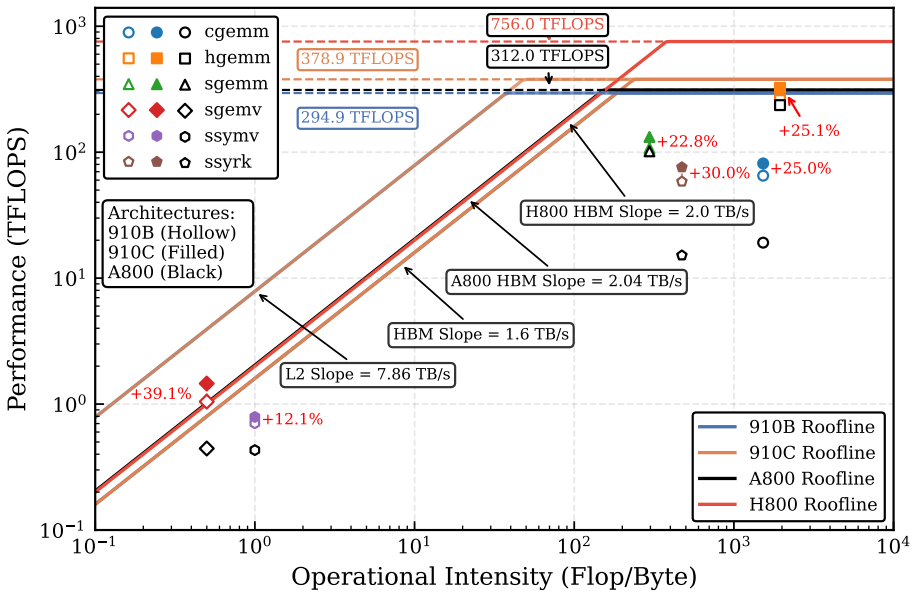
- [§5 / Fig. 5] The sgemv point lies above the drawn roofline. The text explains this as effective bandwidth above the simple GM→L1 assumption, but a roofline plot should either use the effective memory hierarchy or annotate why the point is not a roofline violation; otherwise the 'reproducible' OI model in Table 4 is unclear.
- [§6.1.2 / Fig. 9] Figure 9 caption and labels contain unicode/font artifacts in the submitted PDF, making the legend and axis labels unreadable. Please regenerate the figure with a standard font embedding.
- [§6.1.2 / Eq. (3)] The QR convergence tolerance epsilon=0.005 appears arbitrary. Please justify this value or provide a sensitivity analysis; the manuscript already reports that nloop=2 works best, but the tolerance choice is not discussed.
- [§4.3 / §6.1.2] LRSVD validation is described qualitatively ('stable convergence,' 'numerically consistent,' 'under single-precision constraints'). Please report a quantitative accuracy metric for LRSVD, such as relative reconstruction error or subspace distance, so that the numerical-robustness claim is verifiable.
- [§3.4.1 / §3.4.2] Section 3.4.1 appears to duplicate the CANN paragraph already given in Section 3.4; please merge or remove the redundant subsection.
- [Appendix 7] The paper says artifacts are described in Appendix 7, but the appendix is an environment description, not an artifact or code repository. If code is available, provide a DOI or repository link; otherwise state that no artifact is released.
Circularity Check
No significant circularity; self-citations are not load-bearing. LRSVD baseline inconsistency is a validity issue, not circularity.
full rationale
This is a state-of-the-practice empirical evaluation rather than a derivation whose outputs are built from its own inputs. The five application studies report direct measurements against external references (OpenBLAS FP32, CANN sgemm, cuQuantum, cuSOLVER/MKL, published SMC-GPU), so the performance and accuracy claims are not constructed from the paper's own fitted values. The optimization primitives (Ozaki splitting, mixed-precision iterative refinement, gate fusion, dynamic link-cell Monte Carlo) are either standard or explicitly attributed to prior work, and the paper disclaims novelty of the primitives themselves. HPL-MxP, SGEMM-cube, and SMC-X draw on same-group prior results, but HPL-MxP (SC24) and SMC-X (npj Comput. Mater., JCTC) are peer-reviewed and externally falsifiable, while SGEMM-cube's key accuracy and throughput data are re-presented with external baselines, so these self-citations do not carry the argument independently. The LRSVD study has a serious non-circular flaw: Section 6.1.2 describes the GPU baseline as 'a GPU-accelerated randomized SVD on NVIDIA H800/A800 using cuSOLVER,' but Section 6.3 states that 'the GPU baseline uses cuSOLVER full-rank SVD' and admits the energy comparison reflects 'the algorithmic difference between the evaluated implementations.' If the Fig. 9 baseline is full-rank SVD, the order-of-magnitude speedup may reflect randomized low-rank versus full-rank complexity rather than NPU competitiveness. This is a benchmark-validity and reproducibility issue that weakens one of five evidence pillars, but it is not a circular reduction of the paper's claims to its inputs. Overall, the central claim retains independent empirical content, so circularity is minimal.
Assumptions & free parameters
free parameters (5)
- LRSVD QR convergence tolerance epsilon =
0.005
- LRSVD iterative orthogonalization loop count nloop =
2 (or 3)
- PQSim cache-blocking tile size (tileSize)
- SMC-NPU local-energy vector assignment
- HPL-MxP GEMM fusion window size
assumptions (6)
- domain assumption The five applications are representative of the scientific workload classes relevant to AI-oriented NPUs.
- domain assumption The Ascend 910A/B/C hardware specifications and DaVinci architecture description in Table 1 and Fig. 1 are accurate.
- domain assumption HPL-MxP GMRES-based iterative refinement recovers FP64-accurate solutions on the tested matrices.
- ad hoc to paper The omitted A_L B_L term in SGEMM-cube is negligible for the claimed FP32-accuracy across the tested matrix-size range.
- domain assumption The SMC-X restructuring preserves Monte Carlo semantics and detailed balance.
- standard math The single-level global-memory roofline model is adequate for interpreting kernel performance.
Cite this review
Pith. "Pith review of Ascend to Science: Exploration of AI Chips for Scientific Computing." pith.science (2026). https://pith.science/paper/BZ6UYWTU
@misc{pith2026260720120,
  author       = {Pith},
  title        = {Pith review of: Ascend to Science: Exploration of AI Chips for Scientific Computing},
  year         = {2026},
  howpublished = {\url{https://pith.science/paper/BZ6UYWTU}},
  note         = {Machine review of arXiv:2607.20120}
}
read the original abstract
The rapid rise of AI-oriented accelerators has reshaped compute systems around low-precision tensor engines, raising a practical question for the HPC community: under what conditions can such hardware support scientific workloads that demand numerical robustness, irregular memory access, and scalability? Using the Ascend 910 NPU series as a representative tensor-centric platform, we characterize precision, execution, and memory-hierarchy bottlenecks that hinder the direct deployment of scientific codes. We then develop and evaluate workload-specific mappings across five application studies -- HPL-MxP, LRSVD, SGEMM-cube, PQSim, and SMC-X -- combining heterogeneous execution, mixed-precision numerical formulations, precision emulation, hierarchical memory orchestration, and communication--computation overlap. These studies show that AI-native NPUs can achieve numerical robustness, competitive performance, and satisfactory scalability when numerical formulation, execution placement, and data movement are addressed in a coordinated manner. Our results provide a state-of-the-practice case study of how scientific workloads can be adapted to tensor-centric architectures, while distinguishing transferable optimization principles from Ascend-specific implementation details.
Figures


Figures from the paper (13 more)



Reference graph
Works this paper leans on
-
[1]
High-performance computing at a crossroads.Science, 387(6736):829–831, 2025
Ewa Deelman, Jack Dongarra, Bruce Hendrickson, Amanda Randles, Daniel Reed, Edward Seidel, and Katherine Yelick. High-performance computing at a crossroads.Science, 387(6736):829–831, 2025
2025
-
[2]
The co-evolution of computational physics and high-performance computing
Jack Dongarra and David Keyes. The co-evolution of computational physics and high-performance computing. Nature Reviews Physics, 6(10):621–627, 2024
2024
-
[3]
The design process for google’s training chips: Tpuv2 and tpuv3.IEEE Micro, 41(2):56–63, 2021
Thomas Norrie, Nishant Patil, Doe Hyun Yoon, George Kurian, Sheng Li, James Laudon, Cliff Young, Norman Jouppi, and David Patterson. The design process for google’s training chips: Tpuv2 and tpuv3.IEEE Micro, 41(2):56–63, 2021
2021
-
[4]
Heng Liao, Jiajin Tu, Jing Xia, Hu Liu, Xiping Zhou, Honghui Yuan, and Yuxing Hu. Ascend: a scalable and unified architecture for ubiquitous deep neural network computing : Industry track paper.2021 IEEE International Symposium on High-Performance Computer Architecture (HPCA), pages 789–801, 2021
2021
-
[5]
Serving large language models on huawei cloudmatrix384, 2025
Pengfei Zuo, Huimin Lin, Junbo Deng, Nan Zou, Xingkun Yang, Yingyu Diao, Weifeng Gao, Ke Xu, Zhangyu Chen, Shirui Lu, Zhao Qiu, Peiyang Li, Xianyu Chang, Zhengzhong Yu, Fangzheng Miao, Jia Zheng, Ying Li, Yuan Feng, Bei Wang, Zaijian Zong, Mosong Zhou, Wenli Zhou, Houjiang Chen, Xingyu Liao, Yipeng Li, Wenxiao Zhang, Ping Zhu, Yinggang Wang, Chuanjie Xiao...
2025
-
[6]
Distributed training of large language models on aws trainium
Xinwei Fu, Zhen Zhang, Haozheng Fan, Guangtai Huang, Mohammad El-Shabani, Randy Huang, Rahul Solanki, Fei Wu, Ron Diamant, and Yida Wang. Distributed training of large language models on aws trainium. In Proceedings of the 2024 ACM Symposium on Cloud Computing, SoCC ’24, pages 961–976, New York, NY , USA,
2024
-
[7]
Harrison, David Carlson, Smeet Chheda, Anthony Curtis, Firat Coskun, Raul Gonzalez, Daniel Wood, and Nikolay A
Eva Siegmann, Robert J. Harrison, David Carlson, Smeet Chheda, Anthony Curtis, Firat Coskun, Raul Gonzalez, Daniel Wood, and Nikolay A. Simakov. First impressions of the sapphire rapids processor with hbm for scientific workloads.SN Computer Science, 5(5):623, 2024
2024
-
[8]
Nvidia hopper h100 gpu: Scaling performance.IEEE Micro, 43(3):9–17, 2023
Jack Choquette. Nvidia hopper h100 gpu: Scaling performance.IEEE Micro, 43(3):9–17, 2023
2023
Show all 51 references
-
[9]
Hpl-mxp benchmark: Mixed-precision algorithms, iterative refinement, and scalable data generation.Int
Jack Dongarra and Piotr Luszczek. Hpl-mxp benchmark: Mixed-precision algorithms, iterative refinement, and scalable data generation.Int. J. High Perform. Comput. Appl., 40(1):52–62, January 2026. 26
2026
-
[10]
Hardware trends impacting floating-point computations in scientific applications.arXiv preprint arXiv:2411.12090, 2024
Jack Dongarra, John Gunnels, Harun Bayraktar, Azzam Haidar, and Dan Ernst. Hardware trends impacting floating-point computations in scientific applications.arXiv preprint arXiv:2411.12090, 2024
2024 arXiv
-
[11]
Implementation and numerical techniques for one eflop/s hpl-ai benchmark on fugaku
Shuhei Kudo, Keigo Nitadori, Takuya Ina, and Toshiyuki Imamura. Implementation and numerical techniques for one eflop/s hpl-ai benchmark on fugaku. In2020 IEEE/ACM 11th Workshop on Latest Advances in Scalable Algorithms for Large-Scale Systems (ScalA), pages 69–76. IEEE, 2020
2020
-
[12]
Climbing the summit and pushing the frontier of mixed precision benchmarks at extreme scale
Hao Lu, Michael Matheson, Vladyslav Oles, Austin Ellis, Wayne Joubert, and Feiyi Wang. Climbing the summit and pushing the frontier of mixed precision benchmarks at extreme scale. InSC22: International Conference for High Performance Computing, Networking, Storage and Analysis...
2022
-
[13]
Unlocking high performance with low-bit npus and cpus for highly optimized hpl-mxp on cloud brain ii
Weicheng Xue, Kai Yang, Yongxiang Liu, Dengdong Fan, Pengxiang Xu, and Yonghong Tian. Unlocking high performance with low-bit npus and cpus for highly optimized hpl-mxp on cloud brain ii. InSC24: International Conference for High Performance Computing, Networking, Storage and ...
2024
-
[14]
Error-free transformations of matrix multiplication by using fast routines of matrix multiplication and its applications.Numerical Algorithms, 59(1):95– 118, 2012
Katsuhisa Ozaki, Takeshi Ogita, Shin’ichi Oishi, and Siegfried M Rump. Error-free transformations of matrix multiplication by using fast routines of matrix multiplication and its applications.Numerical Algorithms, 59(1):95– 118, 2012
2012
-
[15]
Egemm-tc: accelerating scientific computing on tensor cores with extended precision
Boyuan Feng, Yuke Wang, Guoyang Chen, Weifeng Zhang, Yuan Xie, and Yufei Ding. Egemm-tc: accelerating scientific computing on tensor cores with extended precision. InProceedings of the 26th ACM SIGPLAN symposium on principles and practice of parallel programming, pages 278–291, 2021
2021
-
[16]
Efficiently emulating high-bitwidth computation with low-bitwidth hardware
Zixuan Ma, Haojie Wang, Guanyu Feng, Chen Zhang, Lei Xie, Jiaao He, Shengqi Chen, and Jidong Zhai. Efficiently emulating high-bitwidth computation with low-bitwidth hardware. InProceedings of the 36th ACM International Conference on Supercomputing, pages 1–12, 2022
2022
-
[17]
Sgemm-cube: Emulating fp32 gemm on ascend npus using fp16 cube units with precision recovery.arXiv preprint arXiv:2507.23387, 2025
Weicheng Xue, Baisong Xu, Kai Yang, Yongxiang Liu, Dengdeng Fan, Pengxiang Xu, and Yonghong Tian. Sgemm-cube: Emulating fp32 gemm on ascend npus using fp16 cube units with precision recovery.arXiv preprint arXiv:2507.23387, 2025
2025 arXiv
-
[18]
Xu, Samuel Rodriguez, Sebastien Cayrols, Pawel Tabaszewski, and Victor Podlozhnyuk
Angelika Schwarz, Anton Anders, Cole Brower, Harun Bayraktar, John Gunnels, Kate Clark, RuQing G. Xu, Samuel Rodriguez, Sebastien Cayrols, Pawel Tabaszewski, and Victor Podlozhnyuk. Guaranteed dgemm accuracy while using reduced precision tensor cores through extensions of the ...
2026
-
[20]
Malone, Joonho Lee, Adam G
Ryan Pederson, John Kozlowski, Minkyu Cho, Fionn D. Malone, Joonho Lee, Adam G. M. Lewis, Jackson Beall, Martin Ganahl, Markus Hauru, V olker Blum, and Guifré Vidal. Large-scale quantum chemistry with tensor processing units.Journal of Chemical Theory and Computation, 19(1):25...
2023
-
[21]
Adam G. M. Lewis, Jackson Beall, Martin Ganahl, Markus Hauru, Shrestha Basu Mallick, and Guifre Vidal. Large-scale distributed linear algebra with tensor processing units.Proceedings of the National Academy of Sciences, 119(33):e2122762119, 2022
2022
-
[22]
High performance implementations of the 2d ising model on gpus.Computer Physics Communications, 256:107473, 2020
Joshua Romero, Mauro Bisson, Massimiliano Fatica, and Massimo Bernaschi. High performance implementations of the 2d ising model on gpus.Computer Physics Communications, 256:107473, 2020
2020
-
[23]
Bezgin, Aaron B
Deniz A. Bezgin, Aaron B. Buhendwa, and Nikolaus A. Adams. Jax-fluids: A fully-differentiable high-order computational fluid dynamics solver for compressible two-phase flows.Computer Physics Communications, 282:108527, 1 2023
2023
-
[24]
Buhendwa, and Nikolaus A
Deniz Bezgin, Aaron B. Buhendwa, and Nikolaus A. Adams. Jax-fluids 2.0: Towards hpc for differentiable cfd of compressible two-phase flows.Computer Physics Communications, 308:109433, 3 2025
2025
-
[25]
Hardy, et al
Anda Trifan, Defne Gorgun, Zongyi Li, Alexander Brace, Maxim Zvyagin, Heng Ma, Austin Clyde, David Clark, Michael Salim, David J. Hardy, et al. Intelligent resolution: Integrating cryo-em with ai-driven multi-resolution simulations to observe the sars-cov-2 replication-transcr...
2022
-
[26]
Fastattention: Extend flashattention2 to npus and low-resource gpus.arXiv preprint arXiv:2410.16663, 2024
Haoran Lin, Xianzhi Yu, Kang Zhao, Lu Hou, Zongyuan Zhan, Stanislav Kamenev, Han Bao, Ting Hu, Mingkai Wang, Qixin Chang, et al. Fastattention: Extend flashattention2 to npus and low-resource gpus.arXiv preprint arXiv:2410.16663, 2024
2024 arXiv
-
[27]
Elsevier, 2020
Xiaoyao Liang.Ascend AI Processor Architecture and Programming: Principles and Applications of CANN. Elsevier, 2020. 27
2020
-
[28]
Harnessing gpu tensor cores for fast fp16 arithmetic to speed up mixed-precision iterative refinement solvers
Azzam Haidar, Stanimire Tomov, Jack Dongarra, and Nicholas J Higham. Harnessing gpu tensor cores for fast fp16 arithmetic to speed up mixed-precision iterative refinement solvers. InSC18: International Conference for High Performance Computing, Networking, Storage and Analysis...
2018
-
[29]
The linpack benchmark: past, present and future.Concur- rency and Computation: practice and experience, 15(9):803–820, 2003
Jack J Dongarra, Piotr Luszczek, and Antoine Petitet. The linpack benchmark: past, present and future.Concur- rency and Computation: practice and experience, 15(9):803–820, 2003
2003
-
[30]
Finding structure with randomness: Probabilistic algorithms for constructing approximate matrix decompositions.SIAM review, 53(2):217–288, 2011
Nathan Halko, Per-Gunnar Martinsson, and Joel A Tropp. Finding structure with randomness: Probabilistic algorithms for constructing approximate matrix decompositions.SIAM review, 53(2):217–288, 2011
2011
-
[31]
Randomized block krylov methods for stronger and faster approximate singular value decomposition.Advances in neural information processing systems, 28, 2015
Cameron Musco and Christopher Musco. Randomized block krylov methods for stronger and faster approximate singular value decomposition.Advances in neural information processing systems, 28, 2015
2015
-
[32]
Streaming low-rank matrix approximation with an application to scientific simulation.SIAM Journal on Scientific Computing, 41(4):A2430–A2463, 2019
Joel A Tropp, Alp Yurtsever, Madeleine Udell, and V olkan Cevher. Streaming low-rank matrix approximation with an application to scientific simulation.SIAM Journal on Scientific Computing, 41(4):A2430–A2463, 2019
2019
-
[33]
Fast algorithms for singular value decomposition and the inverse of nearly low-rank matrices.National Science Review, 10(6):nwad083, 2023
Chen Xu, Weiwei Xu, and Kaili Jing. Fast algorithms for singular value decomposition and the inverse of nearly low-rank matrices.National Science Review, 10(6):nwad083, 2023
2023
-
[34]
Quantum computing: A taxonomy, systematic review and future directions.Software: Practice and Experience, 52(1):92–136, 2022
Sukhpal Singh Gill, Shreshth Tuli, Muhan Xu, Inderveer Chana Singh, Schahram Dustdar, and Rajkumar Buyya. Quantum computing: A taxonomy, systematic review and future directions.Software: Practice and Experience, 52(1):92–136, 2022
2022
-
[35]
Nielsen and I
M. Nielsen and I. Chuang.Quantum Computation and Quantum Information. Cambridge University Press, Cambridge, 10th anniversary edition edition, June 2010
2010
-
[36]
Thomas Häner and Damian S. Steiger. 0.5 petabyte simulation of a 45-qubit quantum circuit. InProceedings of the International Conference for High Performance Computing, Networking, Storage and Analysis, SC ’17, New York, NY , USA, 2017. Association for Computing Machinery
2017
-
[37]
Harun Bayraktar, Ali Charara, David Clark, Saul Cohen, Timothy Costa, Yao-Lung L. Fang, Yang Gao, Jack Guan, John Gunnels, Azzam Haidar, Andreas Hehn, Markus Hohnerbach, Matthew Jones, Tom Lubowe, Dmitry Lyakh, Shinya Morino, Paul Springer, Sam Stanwyck, Igor Terentyev, Satya ...
2023
-
[38]
Bardin, Rami Barends, Rupak Biswas, Sergio Boixo, Fernando G
Frank Arute, Kunal Arya, Ryan Babbush, Dave Bacon, Joseph C. Bardin, Rami Barends, Rupak Biswas, Sergio Boixo, Fernando G. S. L. Brandao, David A. Buell, Brian Burkett, Yu Chen, Zijun Chen, Ben Chiaro, Roberto Collins, William Courtney, Andrew Dunsworth, Edward Farhi, Brooks F...
2019
-
[39]
Revealing nanostructures in high-entropy alloys via machine-learning accelerated scalable monte carlo simulation.npj Computational Materials, 11(1):267, 2025
Xianglin Liu, Kai Yang, Yongxiang Liu, Fanli Zhou, Dengdong Fan, Zongrui Pei, Pengxiang Xu, and Yonghong Tian. Revealing nanostructures in high-entropy alloys via machine-learning accelerated scalable monte carlo simulation.npj Computational Materials, 11(1):267, 2025
2025
-
[40]
Smc-x: A distributed, scalable monte carlo simulation method for chemically complex alloys.Journal of Chemical Theory and Computation, 21(24):12784–12795, 12 2025
Xianglin Liu, Kai Yang, Fanli Zhou, and Pengxiang Xu. Smc-x: A distributed, scalable monte carlo simulation method for chemically complex alloys.Journal of Chemical Theory and Computation, 21(24):12784–12795, 12 2025
2025
-
[41]
Schneider
Tobias Preis, Peter Virnau, Wolfgang Paul, and Johannes J. Schneider. Gpu accelerated monte carlo simulation of the 2d and 3d ising model.Journal of Computational Physics, 228(12):4468–4477, 2009
2009
-
[42]
High performance monte carlo simulation of ising model on tpu clusters
Kun Yang, Yi-Fan Chen, Georgios Roumpos, Chris Colby, and John Anderson. High performance monte carlo simulation of ising model on tpu clusters. InProceedings of the International Conference for High Performance Computing, Networking, Storage and Analysis, SC ’19, New York, NY...
2019
-
[43]
Gpu-accelerated gibbs ensemble monte carlo simulations of lennard-jonesium.Computer Physics Communications, 184(12):2662– 2669, 2013
Jason Mick, Eyad Hailat, Vincent Russo, Kamel Rushaidat, Loren Schwiebert, and Jeffrey Potoff. Gpu-accelerated gibbs ensemble monte carlo simulations of lennard-jonesium.Computer Physics Communications, 184(12):2662– 2669, 2013. 28
2013
-
[44]
Scalable parallel monte carlo algorithm for atomistic simulations of precipitation in alloys.Physical Review B, 85(18):184203, May 2012
Babak Sadigh, Paul Erhart, Alexander Stukowski, Alfredo Caro, Enrique Martinez, and Luis Zepeda-Ruiz. Scalable parallel monte carlo algorithm for atomistic simulations of precipitation in alloys.Physical Review B, 85(18):184203, May 2012
2012
-
[45]
Thompson, H
Aidan P. Thompson, H. Metin Aktulga, Richard Berger, Dan S. Bolintineanu, W. Michael Brown, Paul S. Crozier, Pieter J. in ’t Veld, Axel Kohlmeyer, Stan G. Moore, Trung Dac Nguyen, Ray Shan, Mark J. Stevens, Julien Tranchida, Christian Trott, and Steven J. Plimpton. Lammps - a ...
2022
-
[46]
Machine learning for high-entropy alloys: Progress, challenges and opportunities.Progress in Materials Science, 131:101018, 2023
Xianglin Liu, Jiaxin Zhang, and Zongrui Pei. Machine learning for high-entropy alloys: Progress, challenges and opportunities.Progress in Materials Science, 131:101018, 2023
2023
-
[47]
Designing complex concentrated alloys with quantum machine learning and language modeling.Matter, 7(10):3433–3446, 2026/02/01 2024
Zongrui Pei, Yilun Gong, Xianglin Liu, and Junqi Yin. Designing complex concentrated alloys with quantum machine learning and language modeling.Matter, 7(10):3433–3446, 2026/02/01 2024
2026
-
[48]
Willman, Stan G
Kien Nguyen-Cong, Jonathan T. Willman, Stan G. Moore, Anatoly B. Belonoshko, Rahulkumar Gayatri, Evan Weinberg, Mitchell A. Wood, Aidan P. Thompson, and Ivan I. Oleynik. Billion atom molecular dynamics simulations of carbon at extreme conditions and experimental time and lengt...
2021
-
[49]
Extending the limit of molecular dynamics with ab initio accuracy to 10 billion atoms
Zhuoqiang Guo, Denghui Lu, Yujin Yan, Siyu Hu, Rongrong Liu, Guangming Tan, Ninghui Sun, Wanrun Jiang, Lijun Liu, Yixiao Chen, Linfeng Zhang, Mohan Chen, Han Wang, and Weile Jia. Extending the limit of molecular dynamics with ab initio accuracy to 10 billion atoms. InProceedin...
2022
-
[50]
Scaling the leading accuracy of deep equivariant models to biomolecular simulations of realistic size
Boris Kozinsky, Albert Musaelian, Anders Johansson, and Simon Batzner. Scaling the leading accuracy of deep equivariant models to biomolecular simulations of realistic size. InProceedings of the International Conference for High Performance Computing, Networking, Storage and A...
2023
-
[51]
29-billion atoms molecular dynamics simulation with ab initio accuracy on 35 million cores of new sunway supercomputer.IEEE Transactions on Computers, pages 1–14, 2025
Xun Wang, Xiangyu Meng, Zhuoqiang Guo, Mingzhen Li, Lijun Liu, Mingfan Li, Qian Xiao, Tong Zhao, Ninghui Sun, Guangming Tan, and Weile Jia. 29-billion atoms molecular dynamics simulation with ab initio accuracy on 35 million cores of new sunway supercomputer.IEEE Transactions ...
2025
-
[2024]
Association for Computing Machinery
Reviewed August 1, 2026 · model on record in the stance chip above.
Discussion (0). Sign in to comment.