REVIEW 3 major objections 6 minor 115 references
Quantum Fisher Information in semiclassical magnon systems
T0 review · 3 major / 6 minor · reviewed 2026-08-01 · deepseek-v4-flash
Pith's one-line read This paper claims that momentum-resolved QFI, extracted from neutron scattering, diverges across a line of wavevectors as a frustrated magnet approaches an emergent quantum phase with no classical counterpart, turning QFI into a practical h
desk verdict A clean, honest paper that proposes line-divergent QFI in LSWT as a harbinger of emergent quantum phases; the idea is suggestive, not proven, and the Kitaev example shows the exact QFI can be finite where LSWT diverges. read the letter →
The pith
A machine-rendered reading of the paper's core claim, the machinery that carries it, and where it could break.
The reading
What carries the argument
The Bogoliubov transformation—a hyperbolic rotation that mixes creation and annihilation operators to diagonalize a quadratic bosonic Hamiltonian—is the engine of the argument. In linear spin wave theory the ground state is obtained from the classical Néel state by momentum-dependent squeezing, |Ψ⟩₀ = ∏_k S(r_k)|Néel⟩, with u_k = cosh(r_k), v_k = sinh(r_k). The QFI is proportional to the energy-integrated dynamic structure factor, which in LSWT reads S^{yy}(Q,ω) = S(A_Q − B_Q)/(2ℏω_Q); integrating over ω gives a denominator √(A_Q² − B_Q²), so QFI diverges exactly where a magnon mode softens to zero. This connects the QFI divergence to the breakdown of the quasiparticle picture and to strong
What would settle it
Compute the exact QFI at the Kitaev point of the honeycomb Kitaev model (φ=π/2) from its known exact spectrum, which is gapped. Since the exact dynamic structure factor is gapped, the exact QFI will be finite, whereas linear spin wave theory predicts a line of diverging QFI; if the exact QFI is indeed finite while the state is a spin liquid, the claim that the LSWT line divergence is a reliable harbinger is falsified in the one case where an exact comparison exists.
Extended reading notes
Core claim
The central claim: the normalized momentum-resolved QFI, nQFI[Q] = f_Q[Q]/4S² with f_Q[Q]=4∫dE S^{αα}(Q,E), equals the energy-integrated inelastic neutron scattering intensity. In linear spin wave theory the antiferromagnetic ground state is a squeezed vacuum ∏_k S(r_k)|Néel⟩, and nQFI at Q grows with the squeezing r_Q, which diverges when the magnon energy ℏω_Q = √(A_Q² − B_Q²) → 0. For a conventional gapless antiferromagnet this occurs at a single ordering wavevector; in each of four frustrated models (square-lattice J1-J2, triangular J1-J2, pyrochlore, Kitaev-Heisenberg) tuned toward an emergent quantum phase, the QFI diverges along a continuous line of wavevectors. The authors state this
Load-bearing premise
The result rests on the premise that a divergence in the linear-spin-wave QFI—which occurs precisely where the approximation breaks down—faithfully predicts the nearby presence of a truly quantum phase without a classical counterpart, a premise supported by four examples but not proven.
Editorial extensions
If this is right
- A momentum-resolved QFI extracted from neutron data becomes a practical diagnostic: strong enhancement across a range of wavevectors, not just at one ordering vector, flags nearness to an emergent quantum phase.
- A QFI divergence at a single wavevector is generic to any gapless antiferromagnet—it reflects the squeezed, entangled magnon vacuum—so it should not be read as exotic physics.
- The two counterexamples (field-driven dimer ladder, pyrochlore ferromagnet in a field) show that quantum phase boundaries without an extended non-ordering region do not produce line divergences, so QFI can distinguish two classes of quantum critical boundaries.
- For the 1D Heisenberg chain, nQFI(Q=π) grows as [log(cN/2)]^{3/2}, a slower-than-linear growth that distinguishes stable critical states from unstable cat states with volume-law QFI.
- Because nQFI > m witnesses at least (m+1)-partite entanglement, existing neutron time-of-flight data can be re-analyzed to produce momentum-resolved maps of entanglement depth in bulk materials.
Reading between the lines
- A decisive next test is to compute the QFI from exact or tensor-network spectra for one of the same models, e.g., the square-lattice J1-J2 model inside the nonmagnetic phase, and see whether the multi-wavevector enhancement survives beyond linear spin wave theory; the paper itself notes the exact Kitaev spectrum is gapped where LSWT diverges, so this is genuinely open.
- If the diagnostic holds, neutron time-of-flight data on candidate spin-liquid materials can be re-examined across tuning parameters (pressure, field, chemical substitution) for a line-like QFI enhancement—a cheap screening step before searching for fractionalized excitations.
- The link between QFI and magnon squeezing extends beyond magnets: any quadratic bosonic system (phonons, triplons in coupled dimers, photons) may support a momentum-resolved QFI witnessing entanglement, since the identity f_Q = 4∫dE S(Q,E) only needs the relevant susceptibility.
- The log^{3/2} scaling of nQFI in the Heisenberg chain suggests that QFI finite-size scaling may be a fingerprint of universality classes, and it is natural to ask whether other conformal critical points show logarithmic QFI growth—a question the paper leaves open.
Editorial analysis
A structured set of objections, weighed in public.
Referee Report
Summary. The paper studies momentum-resolved quantum Fisher information (QFI) in spin systems. It first uses finite-size examples (cat states, GHZ/W states, Ising chains) and numerical scaling of the 1D Heisenberg chain (Lanczos/DMRG, up to L=1024) to argue that nQFI has wavevector-dependent meaning beyond a simple entanglement-depth bound. The main part computes linear spin-wave theory (LSWT) dynamical structure factors and nQFI for four frustrated models: square-lattice J1-J2, triangular-lattice J1-J2, anisotropic pyrochlore, and Kitaev-Heisenberg honeycomb models. In each case, as the tuning parameter approaches a putative 'emergent quantum phase' at a classical phase boundary, the semiclassical nQFI diverges along a line in momentum space. Two control systems (a field-driven dimer ladder and a pyrochlore ferromagnet in a field) show no such line divergence. The paper concludes that momentum-dependent QFI, extractable from neutron scattering, can act as a 'harbinger' of emergent quantum phases.
Significance. If the central claim were established, the paper would provide a valuable, experimentally accessible momentum-resolved entanglement witness for frustrated magnets. The analytic LSWT derivations in Appendix A are clean and explicit; the finite-size scaling study in Appendix D is careful; and the inclusion of negative control transitions is a strength. The paper is also honest in places, explicitly conceding that the semiclassical divergence does not necessarily imply diverging entanglement depth in the quantum limit. However, the headline claim is an inductive generalization from four examples, and one of those examples—the exactly solvable Kitaev point—explicitly contradicts the inference from LSWT to exact QFI. As stated, the abstract and conclusion overreach; with a careful reframing to an LSWT-level heuristic, the paper could be a useful contribution.
major comments (3)
- [III.B and Appendix B4] The central interpretive claim is undercut by the Kitaev example. In Fig. 10(f), LSWT nQFI at φ=π/2 diverges along the line connecting (010) and (100), yet the paper itself states that the exact dynamical susceptibility at this point is gapped (Ref. [91]). By Eq. (2), the exact QFI is therefore finite for every Q. This is not a peripheral counterexample: it is the only exactly solvable positive example, and it demonstrates that the semiclassical line divergence can be an artifact of the truncated non-interacting magnon approximation rather than a property of the exact ground state. The Discussion concedes this, but the Abstract and Conclusion still present line-divergent QFI as a 'harbinger'. The claim must either be explicitly restricted to the LSWT level or supported with an argument that this failure is exceptional.
- [III.C and IV] The proposed distinction between a single-wavevector divergence (ordinary antiferromagnet) and a continuum/line divergence (emergent quantum phase) is not established. In LSWT both phenomena arise from zero-energy modes: a gapless antiferromagnet has soft modes at the ordering wavevector, while near a classical instability the zero-energy manifold can become a line for purely classical reasons, as in the J1-J2 square lattice at δ=1/2. Thus the line pattern may track the classical instability surface rather than a quantum emergent phase. The paper provides no cross-check: no case where LSWT shows a line divergence but no emergent phase is known to be absent, and no case where an emergent phase exists but LSWT does not show a line divergence. Without such controls, the statement in Section IV that 'a continuum of wavevectors does [indicate exotic physics]' is not supported.
- [Abstract and Conclusion] The wording 'harbinger' and 'when these emergent phases are approached, QFI diverges across multiple wave vectors in momentum space' overstates the strength of the evidence. The Discussion explicitly says 'Our study does not provide a rigorous proof that QFI divergences across multiple wavevectors always accompany exotic phenomena.' This disclaimer is more accurate than the abstract and conclusion. The manuscript as a whole would be internally more consistent if the abstract and conclusion used language such as 'within the semiclassical LSWT approximation, line-divergent QFI is a heuristic indicator of proximity to emergent quantum phases' rather than presenting it as a general diagnostic.
minor comments (6)
- [Eq. (6)] At κ=0, Eq. (6) gives 0/0; the text says the nQFI is infinite. It would be clearer to state that the expression is the κ→0 limit and diverges as 1/sqrt(|κ|).
- [Fig. 2 caption] Typo: 'semi-calssical' should be 'semiclassical'.
- [Section II.C and Appendix D] The fit parameters a, b, c in Eq. (4) are first introduced in the main text but defined only in Appendix D. Define them, or refer to the appendix at first use.
- [Section III.B] The heading 'F rustrated lattices' has an extra space.
- [Conclusion] Typo: 'phyics' should be 'physics'.
- [Appendix B4 Eq. (A26)] The inline equation (A26) in Appendix A3 is rendered with unclear notation: the numerator and denominator are not visually separated. Please format it as a proper fraction for readability.
Circularity Check
No structural circularity: QFI is computed from unparameterized LSWT spectra and the emergent-phase labels come from independent phase diagrams.
full rationale
The paper's derivation chain is self-contained rather than circular. QFI is computed from Eq. (2) as an energy integral of the LSWT dynamical structure factor, with no free parameters tuned to produce the reported divergences; the divergences follow directly from the 1/omega soft-mode behavior in the LSWT spectra (Section III.A, Appendix A). The classification of 'emergent quantum phases' is taken from independent literature on quantum phase diagrams (e.g., Refs. [46-53,55-57,61,88,90-93]), not derived from the QFI calculation, so the QFI result is not defined in terms of the target claim. Self-citations (Refs. [11,12,23,62,68-70]) are contextual or experimental and are not load-bearing for the central derivation; no uniqueness theorem from the authors' prior work is invoked. The closest issue is that the line-divergence coincides with the breakdown of LSWT, and the Kitaev example is explicitly noted to disagree with the exact gapped susceptibility: 'It is worth noting that the dynamical magnetic susceptibility at phi=pi/2 can be calculated exactly [91], yielding a spectrum with finite spin gap, unlike the LSWT prediction' (Appendix B4). The paper also disclaims proof: 'Our study does not provide a rigorous proof that QFI divergences across multiple wavevectors always accompany exotic phenomena' (Section IV). These are limitation/induction concerns about whether LSWT divergences are physically meaningful, not circularity, because the computations do not assume the 'harbinger' conclusion. Thus no circular step can be exhibited by the paper's own equations or self-citation chain.
Assumptions & free parameters
free parameters (2)
- a, b, c (finite-size scaling of nQFI) =
Multiple fits: e.g., DMRG OBC a=0.072, b=0.375, c=3.246; Lanczos PBC a=0.076, b=0.149, c=9.774 (Fig. 12)
- Easy-plane anisotropy ε (triangular lattice) =
10^-5 S_z^2
assumptions (5)
- domain assumption Linear spin wave theory is valid (⟨a†a⟩ ≪ 1) in the ordered phases.
- standard math QFI equals the energy-integrated dynamical spin structure factor: fQ = 4∫dE S^{αα}(Q,E) (Eq. 2).
- domain assumption The 1D Heisenberg chain nQFI follows the log-cube ansatz nQFI ≈ 4[b + (4/3)a (ln(cL/2))^{3/2}].
- domain assumption The cited quantum phase diagrams (spin liquids, valence bond solids, Kitaev spin liquid) are correct for the models studied.
- domain assumption The LSWT ground state is a squeezed vacuum, connected to the Néel state by a Bogoliubov transformation (Eq. A25).
Cite this review
Pith. "Pith review of Quantum Fisher Information in semiclassical magnon systems." pith.science (2026). https://pith.science/paper/HLK4AZAY
@misc{pith2026260720424,
  author       = {Pith},
  title        = {Pith review of: Quantum Fisher Information in semiclassical magnon systems},
  year         = {2026},
  howpublished = {\url{https://pith.science/paper/HLK4AZAY}},
  note         = {Machine review of arXiv:2607.20424}
}
read the original abstract
Quantum Fisher Information (QFI) is a powerful spectroscopic tool to witness many-body quantum entanglement in solid state materials, but it is not always obvious how to relate it to other characteristics of condensed matter systems. In this study we elaborate on the meaning and interpretation of QFI in condensed matter by examining simple theoretical spin systems. We use finite sized spin systems to illustrate that QFI quantifies the momentum- dependent degree of quantum entanglement (that is the entanglement depth at a given wave vector) within a wave function. We subsequently use semiclassical frustrated spin models to show that, in the context of linear spin wave theory (LSWT), QFI quantifies the momentum-dependent degree of magnon squeezing in the ground state. In antiferromagnets with a zero-energy Goldstone mode, LSWT breaks down and QFI (and entanglement depth) diverges at the magnetic ordering wave vector. We also show examples of emergent quantum phases in frustrated spin systems that do not appear in classical phase diagrams. When these emergent phases are approached, QFI diverges across multiple wave vectors in momentum space. Taken together, QFI is not only helpful as a lower bound for entanglement depth, but serves as a momentum-resolved probe of entanglement that offers a novel perspective on quantum critical phenomena.
Figures


Figures from the paper (8 more)


Reference graph
Works this paper leans on
-
[91]
V. A. Sidorov, M. Nicklas, P. G. Pagliuso, J. L. Sarrao, Y. Bang, A. V. Balatsky, and J. D. Thompson, Supercon- ductivity and Quantum Criticality in CeCoIn5, Physical Review Letters89, 157004 (2002)
2002
-
[1]
This is illustrated in Fig
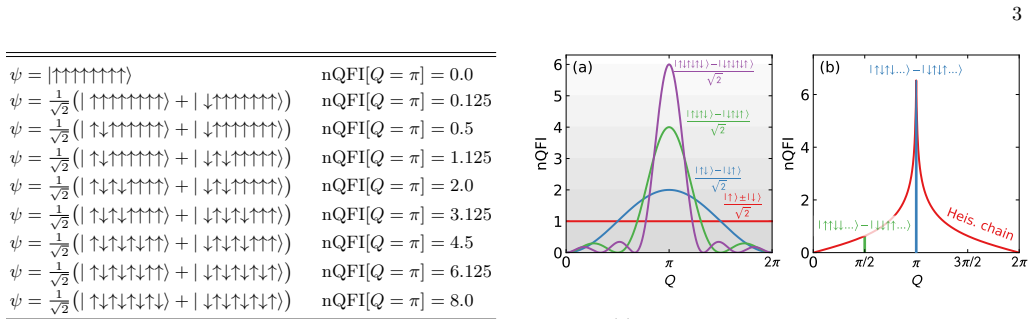
Maximal nQFI as a bound of entanglement depth To give the most stringent bound on entanglement depth, one must choose the momentum transferQwhere nQFI is maximal. This is illustrated in Fig. 1(a), where we compute the momentum dependentT= 0nQFI for small (lengthN= 1, 2, 4, and 6 spin) Ising spin chains with HamiltonianH= P i(Sz i Sz i+1 + ∆S x i Sx i+1)wh...
-
[2]
However, forN→ ∞the QFI at values other thanQ=πis suppressed (see above)
Degree of entanglement at multiple periodicities Figure 1(a) shows nonzero QFI at values other than Q=πfor one-dimensional (1D) Ising chains. However, forN→ ∞the QFI at values other thanQ=πis suppressed (see above). A generic quantum ground state, however, is not a cat state and can involve superposition of more than two spin configurations. This is illus...
-
[3]
quantum correlation length
Quantum correlation length Ref. [23] defined a “quantum correlation length” from the spatial decay of the QFI matrix (QFIM). Equiva- lently, this is represented by the sharpness of the features innQFI[Q]: a sharp peak indicates long-ranged entangle- ment; a broad peak indicates short-ranged entanglement (collective superposition only with neighboring spin...
-
[4]
S. J. Freedman and J. F. Clauser, Experimental Test of Local Hidden-Variable Theories, Physical Review Letters 10 28, 938 (1972)
1972
-
[5]
J. Yin, Y. Cao, H.-L. Yong, J.-G. Ren, H. Liang, S.- K. Liao, F. Zhou, C. Liu, Y.-P. Wu, G.-S. Pan, L. Li, N.-L. Liu, Q. Zhang, C.-Z. Peng, and J.-W. Pan, Lower Bound on the Speed of Nonlocal Correlations without Locality and Measurement Choice Loopholes, Physical Review Letters110, 260407 (2013)
2013
-
[6]
[010] J1 / |J3| (g) (h) (b) J2 /J 1 J2 / J1 0 1/2 0 1/2 (1/2,1/2) (1/2,0) (1/2,1/2) (1/2,0) emergent quantum phase (i) (j) (k) (l) emergent quantum phase emergent quantum phase FIG. 2. QFI in prototypical frustrated spin systems with quantum phase transitions. (a) Square lattice antiferromagnet with nearest and next-nearest neighbor Heisenberg interaction...
-
[7]
worldview
and with wave-vector k= ( 1 2 , 0)for dominant next-nearest neighbor exchange (J2/J1 ≪ 1 2), respectively. In (f) antiferromagnetic120 ◦ order is seen for small values ofJ2/J1 and stripe AFM order for large values ofJ2/J1. In the pyrochlore lattice ferromagnetic and antiferromagnetic order are stabilized for small and large values ofJ1/|J3|,respectively. ...
Show all 115 references
-
[8]
Here we consider a simple model of a spin-1 2 Heisenberg ladder in tetragonal symmetry under external magnetic field along[001][see Fig
Field-driven quantum dimer ladder Quantum dimers in a magnetic field (B) are prototypi- cal examples of quantum phase transitions [64, 65], where a quantum singlet atB= 0is separated from a long- ranged ordered antiferromagnet at finite field [65, 66]. Here we consider a simpl...
-
[9]
squeezed states
Pyrochlore Lattice under Field A cubic pyrochlore ferromagnet in a magnetic field is another system with a zero-temperature phase bound- ary without an emergent quantum phase where static order breaks down in an extended parameter space. We consider a pyrochlore lattice ferrom...
-
[10]
External field was applied along the tetragonal[001]axis
We considered the intra-chain couplingsJ1 (purple bond) andJ2 (blue bond) as well as relatively weak inter-chain couplingJ 3 (orange bond). External field was applied along the tetragonal[001]axis. For semiclassical simulations accounting for singlet and triplet states, we des...
-
[11]
Einstein, B
A. Einstein, B. Podolsky, and N. Rosen, Can Quantum- Mechanical Description of Physical Reality Be Consid- ered Complete?, Physical Review47, 777 (1935)
1935
-
[12]
Schrödinger, Discussion of Probability Relations be- tween Separated Systems, Mathematical Proceedings of the Cambridge Philosophical Society31, 555 (1935)
E. Schrödinger, Discussion of Probability Relations be- tween Separated Systems, Mathematical Proceedings of the Cambridge Philosophical Society31, 555 (1935)
1935
-
[13]
J. S. Bell, On the Einstein Podolsky Rosen paradox, Physics Physique Fizika1, 195 (1964)
1964
-
[14]
Scheie, P
A. Scheie, P. Laurell, A. M. Samarakoon, B. Lake, S. E. Nagler, G. E. Granroth, S. Okamoto, G. Alvarez, and D. A. Tennant, Witnessing entanglement in quantum magnets using neutron scattering, Physical Review B 103, 224434 (2021)
2021
-
[15]
Scheie, P
A. Scheie, P. Laurell, A. M. Samarakoon, B. Lake, S. E. Nagler, G. E. Granroth, S. Okamoto, G. Alvarez, and D. A. Tennant, Erratum: Witnessing entanglement in quantum magnets using neutron scattering [Phys. Rev. B 103, 224434 (2021)], Physical Review B107, 059902 (2023)
2021
-
[16]
J. S. Bell,Speakable and Unspeakable in Quantum Me- chanics: Collected Papers on Quantum Philosophy, 2nd ed. (Cambridge University Press, 2004)
2004
-
[17]
Horodecki, P
R. Horodecki, P. Horodecki, M. Horodecki, and K. Horodecki, Quantum entanglement, Rev. Mod. Phys. 81, 865 (2009)
2009
-
[18]
H. Y. Yuan, Y. Cao, A. Kamra, R. A. Duine, and P. Yan, Quantum magnonics: When magnon spintronics meets quantum information science, Physics Reports965, 1 (2022)
2022
-
[19]
Huang, M
J. Huang, M. Zhuang, and C. Lee, Entanglement- enhanced quantum metrology: From standard quantum limit to Heisenberg limit, Applied Physics Reviews11, 031302 (2024)
2024
-
[20]
Keimer and J
B. Keimer and J. E. Moore, The physics of quantum materials, Nature Physics13, 1045 (2017)
2017
-
[21]
Laurell, A
P. Laurell, A. Scheie, E. Dagotto, and D. A. Tennant, Witnessing Entanglement and Quantum Correlations in Condensed Matter: A Review, Advanced Quantum Tech- nologies8, 2400196 (2025)
2025
-
[22]
Scheie, P
A. Scheie, P. Laurell, W. Simeth, E. Dagotto, and D. A. Tennant, Tutorial: Extracting entanglement signatures from neutron spectroscopy, Materials Today Quantum , 100020 (2024)
2024
-
[23]
emergent quantum phase
and potentially also to quantum entanglement. Still further, recent studies report that semiclassical models can have large values of QFI [12]. This raises the press- ing question: how to interpret QFI results to diagnose emergent quantum phases? In this study we elaborate on ...
2026 arXiv
-
[24]
Hauke, M
P. Hauke, M. Heyl, L. Tagliacozzo, and P. Zoller, Mea- suring multipartite entanglement through dynamic sus- ceptibilities, Nature Physics12, 778 (2016)
2016
-
[25]
Hyllus, W
P. Hyllus, W. Laskowski, R. Krischek, C. Schwem- mer, W. Wieczorek, H. Weinfurter, L. Pezzé, and A. Smerzi, Fisher information and multiparticle entan- glement, Phys. Rev. A85, 022321 (2012)
2012
-
[26]
Laurell, A
P. Laurell, A. Scheie, C. J. Mukherjee, M. M. Koza, M. Enderle, Z. Tylczynski, S. Okamoto, R. Coldea, D. A. Tennant, and G. Alvarez, Quantifying and Controlling Entanglement in the Quantum Magnet Cs2CoCl4, Phys- ical Review Letters127, 037201 (2021)
2021
-
[27]
Although it is a superposition of three basis states, each term differs only locally from the others
exemplifies this. Although it is a superposition of three basis states, each term differs only locally from the others. nQFI with respect toO= P j Sz j is in fact zero, while the maximal value 7 3 (witnessing entangle- ment depth3) can be obtained withO=P j Sx j [28]. We also ...
-
[28]
L. L. Kish, A. Weichselbaum, D. M. Pajerowski, A. T. Savici, A. Podlesnyak, L. Vasylechko, A. Tsvelik, R. Konik, and I. A. Zaliznyak, High-temperature quan- tum coherence of spinons in a rare-earth spin chain, Na- ture Communications16, 6594 (2025)
2025
-
[29]
T. Hong, I. Makhfudz, X. Ke, A. F. May, A. A. Podlesnyak, D. Pajerowski, B. Winn, M. Deumal, Y. Takano, and M. M. Turnbull, Coexistence of symmetry-protected topological order and Neel order in the spin-1/2 ladder antiferromagnet C9H18N2CuBr4 (2024), arXiv:2306.06021 [cond-mat]
2024 arXiv
-
[30]
Y. Fang, M. Mahankali, Y. Wang, L. Chen, H. Hu, S. Paschen, and Q. Si, Amplified multipartite entangle- mentwitnessedinaquantumcriticalmetal,NatureCom- munications16, 2498 (2025)
2025
-
[31]
Mazza, S
F. Mazza, S. Biswas, X. Yan, A. Prokofiev, P. Stef- fens, Q. Si, F. F. Assaad, and S. Paschen, Quantum Fisher information in a strange metal, Nature Physics https://doi.org/10.1038/s41567-026-03298-0 (2026)
2026 doi
-
[32]
A. O. Scheie, E. A. Ghioldi, J. Xing, J. a. M. Paddi- son, N. E. Sherman, M. Dupont, L. D. Sanjeewa, S. Lee, A. J. Woods, D. Abernathy, D. M. Pajerowski, T. J. Williams, S.-S. Zhang, L. O. Manuel, A. E. Trumper, C. D. Pemmaraju, A. S. Sefat, D. S. Parker, T. P. Dev- ereaux, R....
2024
-
[33]
A. O. Scheie, M. Lee, K. Wang, P. Laurell, E. S. Choi, D. Pajerowski, Q. Zhang, J. Ma, H. D. Zhou, S. Lee, C. Huan, S. M. Thomas, M. O. Ajeesh, P. F. S. Rosa, A. Chen, V. S. Zapf, M. Heyl, C. D. Batista, E. Dagotto, J. E. Moore, and D. A. Tennant, Spectrum and low- temperature...
2026
-
[34]
Scheie, P
A. Scheie, P. Laurell, E. Dagotto, D. A. Tennant, and T.Roscilde,Reconstructingthespatialstructureofquan- tum correlations in materials, Phys. Rev. Research6, 033183 (2024)
2024
-
[35]
Menon, N
V. Menon, N. E. Sherman, M. Dupont, A. O. Scheie, D. A. Tennant, and J. E. Moore, Multipartite entangle- ment in the one-dimensional spin-1 2 Heisenberg antifer- romagnet, Physical Review B107, 054422 (2023)
2023
-
[36]
Tóth, Multipartite entanglement and high-precision metrology, Phys
G. Tóth, Multipartite entanglement and high-precision metrology, Phys. Rev. A85, 022322 (2012)
2012
-
[37]
W. Dür, G. Vidal, and J. I. Cirac, Three qubits can be entangled in two inequivalent ways, Physical Review A 62, 062314 (2000)
2000
-
[38]
Ozaydin, Phase damping destroys quantum Fisher information of W states, Physics Letters A378, 3161 (2014)
F. Ozaydin, Phase damping destroys quantum Fisher information of W states, Physics Letters A378, 3161 (2014)
2014
-
[39]
Caux, Correlation functions of integrable models: A description of the ABACUS algorithm, Journal of Math- ematical Physics50, 095214 (2009)
J.-S. Caux, Correlation functions of integrable models: A description of the ABACUS algorithm, Journal of Math- ematical Physics50, 095214 (2009)
2009
-
[40]
C. Chen, P. Wang, and R.-B. Liu, Effects of local de- coherence on quantum critical metrology, Phys. Rev. A 104, L020601 (2021)
2021
-
[41]
C. Zhou, Z. Zhou, F. Desrochers, Y. B. Kim, and Z. Y. Meng,QuantumFisherinformationasathermalprobein frustrated magnets through insights from quantum spin ice, Nature Communications 10.1038/s41467-026-74589- 6 (2026)
2026 doi
-
[42]
C. W. Helstrom, Quantum detection and estimation the- ory, Journal of Statistical Physics1, 231 (1969)
1969
-
[43]
A. S. Holevo,Probabilistic and Statistical Aspects of Quantum Theory(Springer Science & Business Media, 2011)
2011
-
[44]
Tóth and I
G. Tóth and I. Apellaniz, Quantum metrology from a quantum information science perspective, Journal of Physics A: Mathematical and Theoretical47, 424006 (2014)
2014
-
[45]
D. R. Baykusheva, M. H. Kalthoff, D. Hofmann, M. Claassen, D. M. Kennes, M. A. Sentef, and M. Mi- 11 trano, Witnessing nonequilibrium entanglement dynam- ics in a strongly correlated fermionic chain, Phys. Rev. Lett.130, 106902 (2023)
2023
-
[46]
C. Lanczos, An iteration method for the solution of the eigenvalue problem of linear differential and integral op- erators, Journal of Research of the National Bureau of Standards45, 255 (1950)
1950
-
[47]
K. A. Hallberg, P. Horsch, and G. Martínez, Numeri- cal renormalization-group study of the correlation func- tions of the antiferromagnetic spin-1/2 Heisenberg chain, Physical Review B52, R719 (1995)
1995
-
[48]
Cardy and P
J. Cardy and P. Calabrese, Unusual corrections to scaling in entanglement entropy, Journal of Statistical Mechan- ics: Theory and Experiment2010, P04023 (2010)
2010
-
[49]
Vidal, J
G. Vidal, J. I. Latorre, E. Rico, and A. Kitaev, Entan- glement in quantum critical phenomena, Phys. Rev. Lett. 90, 227902 (2003)
2003
-
[50]
Vitagliano, A
G. Vitagliano, A. Riera, and J. I. Latorre, Volume-law scaling for the entanglement entropy in spin-1/2 chains, New Journal of Physics12, 113049 (2010)
2010
-
[51]
Eisert, M
J. Eisert, M. Cramer, and M. B. Plenio, Colloquium: Area laws for the entanglement entropy, Rev. Mod. Phys. 82, 277 (2010)
2010
-
[52]
Kamra, E
A. Kamra, E. Thingstad, G. Rastelli, R. A. Duine, A. Brataas, W. Belzig, and A. Sudbø, Antiferromagnetic magnons as highly squeezed Fock states underlying quan- tum correlations, Physical Review B100, 174407 (2019)
2019
-
[53]
Wuhrer, N
D. Wuhrer, N. Rohling, and W. Belzig, Theory of quantum entanglement and structure of the two-mode squeezed antiferromagnetic magnon vacuum, Physical Review B105, 054406 (2022)
2022
-
[54]
Rózsa, D
L. Rózsa, D. Wuhrer, S. A. Díaz, U. Nowak, and W. Belzig, Hidden quantum correlations in the ground states of quasiclassical spin systems, Phys. Rev. B111, 174441 (2025)
2025
-
[55]
V. Murg, F. Verstraete, and J. I. Cirac, Exploring frus- trated spin systems using projected entangled pair states, Physical Review B79, 195119 (2009)
2009
-
[56]
Chandra and B
P. Chandra and B. Doucot, Possible spin-liquid state at largeSfor thefrustratedsquareHeisenberg lattice,Phys- ical Review B38, 9335 (1988)
1988
-
[57]
L. B. Ioffe and A. I. Larkin, Effective action of a two- dimensional antiferromagnet, International Journal of Modern Physics B02, 203 (1988)
1988
-
[58]
Dagotto and A
E. Dagotto and A. Moreo, Phase diagram of the frus- trated spin-1/2 Heisenberg antiferromagnet in 2 dimen- sions, Phys. Rev. Lett.63, 2148 (1989)
1989
-
[59]
Ferrer, Spin-liquid phase for the frustrated quantum Heisenberg antiferromagnet on a square lattice, Physical Review B47, 8769 (1993)
J. Ferrer, Spin-liquid phase for the frustrated quantum Heisenberg antiferromagnet on a square lattice, Physical Review B47, 8769 (1993)
1993
-
[60]
Jin, H.-H
H.-K. Jin, H.-H. Tu, and Y.-H. Zhang, Dirac and chiral spin liquids on spin-1/2 square-lattice Heisenberg anti- ferromagnet, Phys. Rev. B112, 035159 (2025)
2025
-
[61]
Haghshenas and D
R. Haghshenas and D. N. Sheng,u(1)-symmetric infi- nite projected entangled-pair states study of the spin- 1/2 squareJ 1−J2 Heisenberg model, Phys. Rev. B97, 174408 (2018)
2018
-
[62]
Qian and M
X. Qian and M. Qin, Absence of spin liquid phase in the J1–J2 Heisenberg model on the square lattice, Physical Review B109, L161103 (2024)
2024
-
[63]
Wang and A
L. Wang and A. W. Sandvik, Critical Level Crossings and Gapless Spin Liquid in the Square-Lattice Spin- 1/2Heisenberg Antiferromagnet, Physical Review Let- ters121, 107202 (2018)
2018
-
[64]
Hu, S.-S
W.-J. Hu, S.-S. Gong, W. Zhu, and D. N. Sheng, Com- peting spin-liquid states in the spin-1 2 Heisenberg model on the triangular lattice, Phys. Rev. B92, 140403(R) (2015)
2015
-
[65]
Jolicoeur, E
Th. Jolicoeur, E. Dagotto, E. Gagliano, and S. Bacci, Ground-state properties of theS=1/2 Heisenberg anti- ferromagnet on a triangular lattice, Physical Review B 42, 4800(R) (1990)
1990
-
[66]
D. A. Huse and V. Elser, Simple Variational Wave Func- tions for Two-Dimensional Heisenberg Spin-1 2 Antiferro- magnets, Physical Review Letters60, 2531 (1988)
1988
-
[67]
P. W. Anderson, Resonating valence bonds: A new kind of insulator?, Materials Research Bulletin8, 153 (1973)
1973
-
[68]
K. A. Ross, L. Savary, B. D. Gaulin, and L. Balents, Quantum Excitations in Quantum Spin Ice, Physical Re- view X1, 021002 (2011)
2011
-
[69]
H. Yan, O. Benton, L. Jaubert, and N. Shannon, The- ory of multiple-phase competition in pyrochlore magnets with anisotropic exchange with application to Yb2Ti2O7, Er2Ti2O7, and Er2Sn2O7, Physical Review B95, 094422 (2017)
2017
-
[70]
Benton, L
O. Benton, L. D. C. Jaubert, H. Yan, and N. Shannon, A spin-liquid with pinch-line singularities on the pyrochlore lattice, Nature Communications7, 11572 (2016)
2016
-
[71]
Gresista, D
L. Gresista, D. Lozano-Gómez, M. Vojta, S. Trebst, and Y.Iqbal,Quantumeffectsonpyrochlorehigher-rankU(1) spin liquids: Pinch-line singularities, spin nematics, and connections to oxide materials, Phys. Rev. Research7, 033109 (2025)
2025
-
[72]
Zhang, A
S.-S. Zhang, A. Bhardwaj, S. Koohpayeh, D. Pajerowski, J. G. Rau, H. Changlani, and A. Scheie, Intrinsic quan- tum disorder in Yb2Ti2O7 and the quantumS= 1/2 pyrochlore phase diagram, arXiv:2511.15678 (2025)
2025
-
[73]
Dahlbom, H
D. Dahlbom, H. Zhang, C. Miles, S. Quinn, A. Niraula, B. Thipe, M. Wilson, S. Matin, H. Mankad, S. Hahn, D. Pajerowski, S. Johnston, Z. Wang, H. Lane, Y. W. Li, X. Bai, M. Mourigal, C. D. Batista, and K. Barros, Sunny.jl: A Julia Package for Spin Dynamics, The Jour- nal of Ope...
2025
-
[74]
Sachdev, Quantum phase transitions, Physics world 12, 33 (1999)
S. Sachdev, Quantum phase transitions, Physics world 12, 33 (1999)
1999
-
[75]
Zapf, Bose-Einstein condensation in quantum mag- nets, Reviews of Modern Physics86, 563 (2014)
V. Zapf, Bose-Einstein condensation in quantum mag- nets, Reviews of Modern Physics86, 563 (2014)
2014
-
[76]
Rüegg, N
C. Rüegg, N. Cavadini, A. Furrer, H.-U. Güdel, K. Krämer, H. Mutka, A. Wildes, K. Habicht, and P. Vorderwisch, Bose–Einstein condensation of the triplet states in the magnetic insulator TlCuCl3, Nature423, 62 (2003)
2003
-
[77]
D. A. Dahlbom, J. Thomas, S. Johnston, K. Barros, and C. D. Batista, Classical dynamics of the antiferromag- netic HeisenbergS= 1 2 spin ladder, Phys. Rev. B110, 104403 (2024)
2024
-
[78]
Scheie, J
A. Scheie, J. Kindervater, S. Säubert, C. Duvinage, C. Pfleiderer, H. J. Changlani, S. Zhang, L. Harriger, K. Arpino, S. M. Koohpayeh, O. Tchernyshyov, and C. Broholm, Reentrant phase diagram ofYb 2Ti2O7 in a⟨111⟩magnetic field, Phys. Rev. Lett.119, 127201 (2017)
2017
-
[79]
Säubert, A
S. Säubert, A. Scheie, C. Duvinage, J. Kindervater, S. Zhang, H. J. Changlani, G. Xu, S. M. Koohpayeh, O. Tchernyshyov, C. L. Broholm, and C. Pfleiderer, Ori- entation dependence of the magnetic phase diagram of Yb2Ti2O7, Phys. Rev. B101, 174434 (2020). 12
2020
-
[80]
Scheie, J
A. Scheie, J. Kindervater, S. Zhang, H. J. Changlani, G. Sala, G. Ehlers, A. Heinemann, G. S. Tucker, S. M. Koohpayeh, and C. Broholm, Multiphase magnetism in Yb2Ti2O7, Proceedings of the National Academy of Sci- ences117, 27245 (2020)
2020
-
[81]
A. T. Boothroyd,Principles of neutron scattering from condensed matter(Oxford University Press, 2020)
2020
-
[82]
L. Lyu, D. Chandorkar, S. Kapoor, S. Takei, E. S. Sørensen, and W. Witczak-Krempa, Multiparty entan- glement loops in quantum spin liquids, Nature Commu- nications17, 5650 (2026)
2026
-
[83]
Pezzè, M
L. Pezzè, M. Gabbrielli, L. Lepori, and A. Smerzi, Mul- tipartite entanglement in topological quantum phases, Phys. Rev. Lett.119, 250401 (2017)
2017
-
[84]
P. Cha, N. Wentzell, O. Parcollet, A. Georges, and E.- A. Kim, Linear resistivity and Sachdev-Ye-Kitaev (SYK) spin liquid behavior in a quantum critical metal with spin-1/2 fermions, Proceedings of the National Academy of Sciences117, 18341 (2020)
2020
-
[85]
A. A. Husain, M. Mitrano, M. S. Rak, S. Rubeck, B. Uchoa, K. March, C. Dwyer, J. Schneeloch, R. Zhong, G. D. Gu, and P. Abbamonte, Crossover of Charge Fluc- tuations across the Strange Metal Phase Diagram, Phys- ical Review X9, 10.1103/PhysRevX.9.041062 (2019)
2019 doi
-
[86]
Custers, P
J. Custers, P. Gegenwart, H. Wilhelm, K. Neumaier, Y.Tokiwa, O.Trovarelli, C.Geibel, F.Steglich, C.Pépin, and P. Coleman, The break-up of heavy electrons at a quantum critical point, Nature424, 524 (2003)
2003
-
[87]
Proust and L
C. Proust and L. Taillefer, The Remarkable Underlying Ground States of Cuprate Superconductors, Annual Re- view of Condensed Matter Physics10, 409 (2019)
2019
-
[88]
Keimer, S
B. Keimer, S. A. Kivelson, M. R. Norman, S. Uchida, and J. Zaanen, From quantum matter to high-temperature superconductivity in copper oxides, Nature518, 179 (2015)
2015
-
[89]
N. P. Armitage, P. Fournier, and R. L. Greene, Progress and perspectives on electron-doped cuprates, Reviews of Modern Physics82, 2421 (2010)
2010
-
[90]
Wirth and F
S. Wirth and F. Steglich, Exploring heavy fermions from macroscopictomicroscopiclengthscales,NatureReviews Materials1, 16051 (2016)
2016
-
[92]
M. A. Tanatar, J. Paglione, C. Petrovic, and L. Taillefer, Anisotropic Violation of the Wiedemann-Franz Law at a Quantum Critical Point, Science316, 1320 (2007)
2007
-
[93]
Y. Fang, L. Chen, M. Mahankali, F. Xie, Y. Wang, S. Sur, and Q. Si, Quantum Fisher information of mag- netic quantum phase transition on Kondo lattice (2026), arXiv:2607.16150 [cond-mat.str-el]. [84]https://doi.org/10.32469/10355/97710
2026 arXiv
-
[94]
T. A. Kaplan, Some Effects of Anisotropy on Spiral Spin- Configurations with Application to Rare-Earth Metals, Physical Review124, 329 (1961)
1961
-
[95]
Toth and B
S. Toth and B. Lake, Linear spin wave theory for single-Q incommensurate magnetic structures, Journal of Physics: Condensed Matter27, 166002 (2015)
2015
-
[96]
A. L. Chernyshev and M. E. Zhitomirsky, Spin waves in a triangular lattice antiferromagnet: Decays, spectrum renormalization, and singularities, Physical Review B79, 144416 (2009)
2009
-
[97]
J. G. Rau, E. K.-H. Lee, and H.-Y. Kee, Generic Spin Model for the Honeycomb Iridates beyond the Kitaev Limit, Physical Review Letters112, 077204 (2014)
2014
-
[98]
We do not consider the stripy phase for3π 2 ≤ϕ≤ 7π 4 in this work
-
[99]
Chaloupka, G
J. Chaloupka, G. Jackeli, and G. Khaliullin, Zigzag Mag- netic Order in the Iridium Oxide Na2IrO3, Physical Re- view Letters110, 097204 (2013)
2013
-
[100]
Knolle, D
J. Knolle, D. L. Kovrizhin, J. T. Chalker, and R. Moess- ner, Dynamics of a two-dimensional quantum spin liquid: Signatures of emergent Majorana fermions and fluxes, Phys. Rev. Lett.112, 207203 (2014)
2014
-
[101]
Rusnačko, D
J. Rusnačko, D. Gotfryd, and J. Chaloupka, Kitaev-like honeycomb magnets: Global phase behavior and emer- gent effective models, Physical Review B99, 064425 (2019)
2019
-
[102]
Georgiou, I
M. Georgiou, I. Rousochatzakis, D. J. J. Farnell, J. Richter, and R. F. Bishop, Spin-SKitaev-Heisenberg model on the honeycomb lattice: A high-order treatment via the many-body coupled cluster method, Phys. Rev. Research6, 033168 (2024)
2024
-
[103]
Pandey, B
B. Pandey, B. Xiao, S. Okamoto, G. Alvarez, G. B. Halász, E. Dagotto, and P. Laurell, Kinetic obstruc- tion to pairing in the doped Kitaev-Heisenberg ladder, arXiv:2603.12198 (2026)
2026
-
[104]
Kawamura, K
M. Kawamura, K. Yoshimi, T. Misawa, Y. Yamaji, S. Todo, and N. Kawashima, Quantum lattice model solverHϕ, Computer Physics Communications217, 180 (2017)
2017
-
[105]
K. Ido, M. Kawamura, Y. Motoyama, K. Yoshimi, Y. Ya- maji, S. Todo, N. Kawashima, and T. Misawa, Update of Hϕ: Newly added functions and methods in versions 2 and 3, Computer Physics Communications298, 109093 (2024)
2024
-
[106]
S. R. White, Density matrix formulation for quantum renormalization groups, Physical Review Letters69, 2863 (1992)
1992
-
[107]
S. R. White, Density-matrix algorithms for quantum renormalization groups, Physical Review B48, 10345 (1993)
1993
-
[108]
Alvarez, The density matrix renormalization group for strongly correlated electron systems: A generic im- plementation, Computer Physics Communications180, 1572 (2009)
G. Alvarez, The density matrix renormalization group for strongly correlated electron systems: A generic im- plementation, Computer Physics Communications180, 1572 (2009). Appendix A: Bogoliubov transformation and Quantum Fisher Information In the following, we demonstrate tha...
2009
-
[109]
[85–87], we start with bosonic op- eratorsˆai,ˆa† i associated with creation and annihilation at siter i
General procedure To solve the LSWT by the common procedure, as ac- counted for in Refs. [85–87], we start with bosonic op- eratorsˆai,ˆa† i associated with creation and annihilation at siter i. The operators satisfy[ˆai, ˆa† j] =δ ij. The two- dimensional square lattice can b...
-
[110]
Spin structure factor in the two antiferromagnetic phases The spin structure factor may in both antiferromag- netic phases be written as Syy (q,ω) =: S2 2 · Zq Nq (A18) In the(ππ)antiferromagnetic limit, nominator and de- nominator are given by: Zq =2J2 ·cos((e x +e y)·q) + 2J...
-
[111]
QFI for the square lattice We now demonstrate that the enhancement of QFI across multiple wave vectors translates to higher degree of entanglement in the semiclassical square lattice ground state. FIG. 7. Momentum-space dependence of nQFI in the square- lattice antiferromagent...
-
[112]
Calculations were done on the smallest possible system size that reflects the translational properties of magnetic ground states
T riangular lattice The dynamical structure factor for the triangular lat- tice was calculated with the software packageSunny[63]. Calculations were done on the smallest possible system size that reflects the translational properties of magnetic ground states. In the120◦ phase...
-
[113]
2(e) and normalized to the num- ber of atomsN at = 16
Pyrochlore lattice Dynamical magnetic susceptibility,Syy, was calculated inSunnyusing a unit cell that corresponds to the crys- tallographic cell in Fig. 2(e) and normalized to the num- ber of atomsN at = 16. Ground states calculated by theSunnyinternal minimization procedure ...
-
[114]
For a given external magnetic field,µ 0H, ground state parameters were first randomized and subsequently determined with theSunny internal minimization procedure
Spin ladder In order to account for entangled ground states in the system, we used theSunny-internal entanglement mode in which neighboring spins can have a joint wave function given by|Ψ⟩ S1,S2 (SU(4)→C). For a given external magnetic field,µ 0H, ground state parameters were ...
-
[115]
Heisenberg-Kitaev Model We also calculated the LSWT and QFI of theS= 1 2 Kitaev-Heisenberg model on the honeycomb lattice [see Fig. 10(a)]. We consider Heisenberg interactionsJ= cos(ϕ)and Kitaev interactionsK= cos(ϕ)parametrized by an angle0≤ϕ <2π. The Ising direction is chose...
2000
Reviewed August 1, 2026 · model on record in the stance chip above.
Discussion (0). Sign in to comment.