REVIEW 2 major objections 4 minor 22 references
Frieze patterns and aperiodic tilings of the plane
T0 review · 2 major / 4 minor · reviewed 2026-08-01 · deepseek-v4-flash
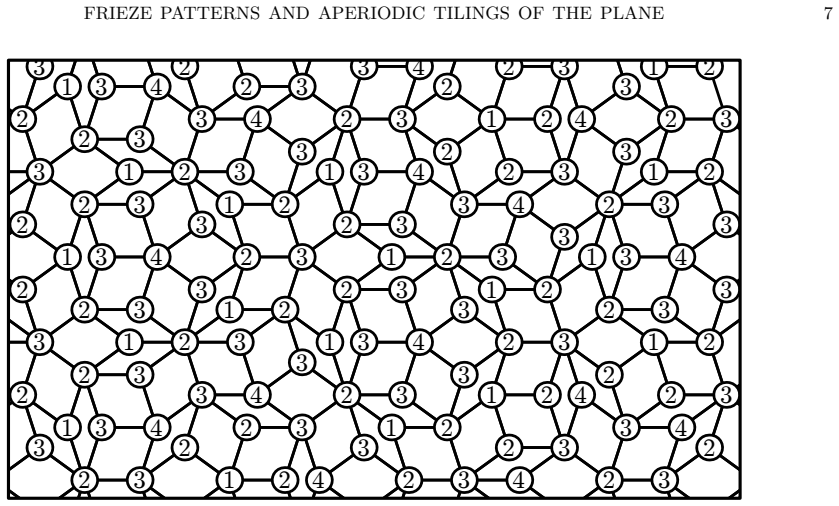
Pith's one-line read The paper establishes that frieze patterns—positive-integer vertex labellings obeying the diamond rule bc−ad=1 on every rhombus—can be placed on two famous aperiodic tilings: the Penrose rhombic tiling uses only four distinct values and the
desk verdict Penrose construction is new and sound; the GLB proof has a real gap and needs referee scrutiny. read the letter →
The pith
A machine-rendered reading of the paper's core claim, the machinery that carries it, and where it could break.
The reading
What carries the argument
The load-bearing identity is the diamond rule itself, bc−ad=1, together with the algebraic fact (n+1)²−n(n+2)=1, which makes any rhombus decorated with values n, n+1, n+1, n+2 satisfy the rule. For the Penrose tiling, the mechanism is a residue function r(v)=Σnᵢ mod 5 on the dual lattice A₄*, with vertices never having residue 0 and every tile containing exactly one shallow hole; this forces each thick or thin rhombus into one of two allowed label patterns. For the GLB tiling, the mechanism is the unique decomposition into supertiles, which yields a global 1/2/3 classification of vertices with no ambiguity across supertile boundaries. In both cases the argument is local: once the finite list
What would settle it
Enumerate all rhombi in a large patch of a GLB tiling and check the local rule: every rhombus must carry labels of the form {n, n+1, n+1, n+2} with the smallest and largest labels opposite each other; a single rhombus with the smallest and largest labels adjacent would violate the diamond rule. For the Penrose tiling, compute the residues mod 5 from pentagrid coordinates of every vertex in a finite patch; finding a vertex with residue 0, or a tile with zero or two shallow holes, would disprove the construction.
Extended reading notes
Core claim
On the Penrose rhombic tiling, every vertex can be expressed as an integer combination of four dual-lattice generators, and reducing the sum of coefficients modulo 5 gives a value r(v) that is never zero, hence takes only the values 1, 2, 3, 4. Each rhombus has exactly one shallow-hole vertex, and when a tile is oriented so that this vertex plays the role of a in the diamond rule, the four labels are always of the form {n, n+1, n+2} with the shallow hole at n, for n=1 or 2; the two possible decorations per rhombus type are checked directly and satisfy bc−ad=1. On the GLB tiling, the unique supertile decomposition, guaranteed by the primitive substitution rule, gives a globally consistent lab
Load-bearing premise
For the GLB half, the load-bearing premise is the cited unique-decomposition property: if a GLB tiling could be grouped into supertiles in two different ways, or if one vertex were both one edge from a supertile corner and an interior point of another, the 1/2/3 labelling could conflict and the diamond rule could fail.
Editorial extensions
If this is right
- Frieze patterns are not tied to periodic geometry: aperiodic rhomb tilings can carry global positive-integer labellings satisfying the diamond rule on every tile.
- Every one of the uncountably many locally indistinguishable Penrose tilings carries the same four-value decoration, so the frieze is an invariant of the local isomorphism class.
- Every GLB tiling carries a three-value frieze despite having singular continuous diffraction and no known higher-dimensional projection description, so frieze existence does not require pure-point diffraction.
- Shifting all labels by an integer gives infinitely many frieze patterns on each tiling; for the Penrose tiling, even real shifts preserve the diamond rule.
- The concluding questions—whether every aperiodic rhomb tiling admits a frieze, and whether the Ammann–Beenker tiling can be labelled—are now concrete open problems with a clear local-check condition to test.
Reading between the lines
- Since two distinct positive integers a<b cannot satisfy b²−a²=1, three values is the theoretical minimum for any positive-integer frieze on any rhombus tiling; the GLB construction therefore sits at the absolute lower bound.
- The Penrose construction suggests a general recipe for cut-and-project tilings: a residue function modulo N that never vanishes and separates shallow from deep vertices. A natural test is the Ammann–Beenker tiling, where a suitable modulus or shallow-hole definition might work even though a direct analogue of the present attempt did not.
- Because the labels depend only on vertices' positions relative to the supertile structure, the GLB frieze is compatible with the substitution rule and may lift to a continuous function on the tiling space, potentially encoding a cohomological invariant analogous to height functions in other substitution tilings.
- Combining the two constructions suggests a classification question: aperiodic rhomb tilings admitting a finite-label frieze may be exactly those with a hierarchical vertex classification of bounded radius—mod-5 residues for Penrose, one-edge distance from supervertices for GLB.
Signed reviews
Editorial analysis
A structured set of objections, weighed in public.
Referee Report
Summary. The paper introduces frieze patterns supported on aperiodic rhombic tilings, i.e. positive-integer decorations of the vertices so that every rhombic tile satisfies the diamond rule bc−ad=1. It gives two constructions. For every Penrose rhombic tiling, a function r defined from A*_4 coordinates labels vertices by residues mod 5; each tile is claimed to have exactly one shallow hole, and the resulting local patterns are {1,2,2,3} or {2,3,3,4}, yielding a frieze pattern with four values (Theorem 2.1). For the Godrèche–Lançon–Billard tiling, the unique decomposition into supertiles is used: supervertices are labelled 1, vertices one edge away from a supervertex are labelled 2, and all remaining vertices are labelled 3; the paper claims this gives a frieze pattern with three values (Theorem 3.1). Corollaries assert infinitely many friezes by shifting the numerical labels.
Significance. If established, these are the first frieze patterns on aperiodic rhombic tilings, connecting Conway–Coxeter friezes with aperiodic order. The Penrose construction is explicit and parameter-free, and the GLB construction attempts to use the hierarchical decomposition in a genuinely new way. The paper is short and readable, and the Penrose part is plausible. However, the GLB proof is incomplete at a load-bearing point: the argument does not verify the diamond rule for rhombi in the interior of a supertile. Because the central construction is likely correct and the gap is repairable by a finite local check, the appropriate outcome is a major revision rather than acceptance as written.
major comments (2)
- [§3, paragraph 'Since the GLB tiling can be grouped into supertiles...'] The proof of Theorem 3.1 does not rule out rhombi whose four vertices all receive label 3. With the stated rule (supervertices = 1, vertices one edge from a supervertex = 2, remaining = 3), a rhombus in the interior of a supertile can have all its vertices at graph distance at least 2 from every supervertex. For such a rhombus the diamond rule gives 3·3−3·3 = 0, not 1. The unique decomposition property cited from [21] guarantees a unique grouping into supertiles but imposes no lower bound on the distance from interior vertices to supertile corners. The 'three simple steps' only discuss supervertices and the midpoint of a super-edge; they say nothing about interior rhombi or about rhombi elsewhere along a super-edge. The authors need to supply a finite verification, for example from the GLB substitution atlas, that every rhombus inside a supertile contains a supervertex or a vertex adjace
- [§2, 'One can easily check...' and Figure 4] The proof of Theorem 2.1 rests on the assertion that every tile has exactly one shallow hole and on the enumeration of possible decorations for thick and thin rhombuses. This is a finite check, but the paper only says it is easy. Because this local verification is the entire content of the Penrose theorem, the authors should list the possible residue patterns around each tile type, or give a precise citation that includes this statement. In addition, the definition of r(v)=Σ n_i mod 5 assumes that the representation v=Σ n_iπ(a_i) gives a well-defined residue; since the π(a_i) are linearly dependent in R^2, a sentence explaining uniqueness of the lift (or a reference to [18]) is needed.
minor comments (4)
- [Corollaries 2.2 and 3.2] The phrase 'n may as well be an arbitrary real number' conflicts with the definition of a frieze pattern as positive integers. Either restrict n to positive integers or explicitly extend the definition to real labels.
- [Figure 7 and surrounding text] The text says 'This labelling is indicated in Figure 7', but the figure caption describes only black points and arrows. Please provide a labelled version or a table showing the label pattern for each tile type within a supertile.
- [§1, definition of frieze patterns on tilings] The notion of a frieze pattern on a rhombic tiling is clear from context, but it would help to state formally: a vertex labelling such that every tile's opposite vertex pairs (a,d) and (b,c) satisfy bc−ad=1. The diamond rule orientation should be specified once in full generality.
- [§2, notation] The paragraph on the A*_4 construction is terse. The statement 'Since V∈A*_4\A_4, we always have Σn_i not≡0 mod 5' is a known fact, but the exact page reference [18] could be expanded to a theorem statement so the reader does not have to consult the source.
Circularity Check
No significant circularity: both frieze patterns are explicit constructions; no fitted parameter is renamed as a prediction, and the cited external facts do not assume the target results.
full rationale
The paper's two constructions are explicit rather than fitted. For the Penrose tiling, the labelling is the fixed function r(v) = sum n_i mod 5 derived from the A4* dualisation construction, and the diamond rule is checked tile-by-tile from the two possible decorations of thick and thin rhombuses; no parameter is fitted to make the rule hold. The citation to [18] (one of the authors' earlier papers) is used only for a standard lattice fact about A4* and does not assume the existence of frieze patterns. For the GLB tiling, the labelling is defined by supertile-distance classes (1 for supervertices, 2 for vertices one edge away, 3 for all others) and the argument invokes Solomyak's unique decomposition property [21], an external result that neither assumes nor constructs frieze patterns. The self-citations in the paper are contextual or supply standard background facts; they are not load-bearing in a circular sense. The skeptic's concern about GLB interior rhombi possibly receiving only label 3 is a possible correctness gap in the three-step consistency argument, but it is not circularity: the labelling is not defined in terms of the diamond rule, and the missing verification is an omitted local check rather than a reduction of the theorem to its own assumptions.
Assumptions & free parameters
assumptions (4)
- domain assumption Penrose tilings are obtainable by dualisation of A*_4 and every vertex V∈A*_4∖A4 has Σn_i not ≡0 mod 5.
- domain assumption On every thick/thin Penrose rhombus the four r-values are exactly {n,n+1,n+1,n+2} with the shallow hole placed consistently so that the diamond rule holds.
- domain assumption The GLB substitution is primitive and hence every GLB tiling has the unique decomposition property [21].
- ad hoc to paper The GLB vertex classification (1 at supervertices, 2 at distance-one vertices, 3 otherwise) is globally unambiguous; in particular no vertex is simultaneously of two classes and every tile sees the pattern {1,2,2,3}.
Cite this review
Pith. "Pith review of Frieze patterns and aperiodic tilings of the plane." pith.science (2026). https://pith.science/paper/XQ3DAC6V
@misc{pith2026260721348,
  author       = {Pith},
  title        = {Pith review of: Frieze patterns and aperiodic tilings of the plane},
  year         = {2026},
  howpublished = {\url{https://pith.science/paper/XQ3DAC6V}},
  note         = {Machine review of arXiv:2607.21348}
}
read the original abstract
This short note provides two examples of aperiodic frieze patterns of the plane, supported on the rhombic Penrose tiling and the Godr\`eche--Lan\c{c}on--Billard tiling. That is, we provide a decoration of their vertices with positive integers which satisfy the diamond rule, in analogy to the usual (in)finite frieze patterns as defined by Conway and Coxeter.
Figures


Figures from the paper (6 more)




Reference graph
Works this paper leans on
-
[21]
Solomyak, Non-periodicity implies unique composition property for self-similar translationally finite tilings,Discr
B. Solomyak, Non-periodicity implies unique composition property for self-similar translationally finite tilings,Discr. Comput. Geom.20(1998), 265–279
1998
-
[13]
¨O. Esentepe and E. Faber, Penrose tilings, infinite friezes, and theA ∞-singularity,preprint(2025), arXiv:2511.07530
arXiv 2025
-
[18]
Maz´ aˇ c, Patch frequencies in Penrose rhombic tilings,Acta Cryst
J. Maz´ aˇ c, Patch frequencies in Penrose rhombic tilings,Acta Cryst. A79(5) (2023), 399–411; arXiv:2212.09406
arXiv 2023
- [1]
-
[2]
Baake and U
M. Baake and U. Grimm,Aperiodic Order. Vol. 1: A Mathematical Invitation, Cambridge University Press, Cambridge (2013)
2013
-
[3]
Baake, P
M. Baake, P. Kramer, M. Schlottmann and D. Zeidler, Planar patterns with fivefold symmetry as sections of periodic structures in 4-space,Int. J. Mod. Phys. B.4(15-16) (1990), 2217–2268. 10 DIRK FRETTL ¨OH AND JAN MAZ ´A ˇC
1990
-
[4]
K. Baur, E. Faber, S. Gratz, Kh. Serhiyenko, G. Todorov, Mutation of friezes,Bull. Sci. Math.142 (2018), 1–48;arxiv:1612.05374
arXiv 2018
- [5]
Show all 22 references
-
[6]
Baur, M.J
K. Baur, M.J. Parsons and M. Tschabold, Infinite friezes,Eur. J. Comb.54(2016), 220–237; arXiv:1504.02695
2016 arXiv
-
[7]
Broline, D.W
D. Broline, D.W. Crowe and M. Isaacs, The geometry of frieze patterns,Geom. Ded.3(1974), 171–176
1974
-
[8]
Conway and H.S.M
J.H. Conway and H.S.M. Coxeter, Triangulated polygons and frieze patterns,Math. Gaz.57(400) (1973), 87–94
1973
-
[9]
Conway and H.S.M
J.H. Conway and H.S.M. Coxeter, Triangulated polygons and frieze patterns,Math. Gaz.57(401) (1973), 175–183
1973
-
[10]
Conway and N.J.A
J. Conway and N.J.A. Sloane,Sphere Packings, Lattices and Groups, 3rd ed., Springer, New York (1999)
1999
-
[11]
Coxeter, Frieze patterns,Acta Arith.18(1971), 297–310
H.S.M. Coxeter, Frieze patterns,Acta Arith.18(1971), 297–310
1971
-
[12]
de Bruijn, Algebraic theory of Penrose’s non-periodic tilings of the plane
N.G. de Bruijn, Algebraic theory of Penrose’s non-periodic tilings of the plane. I & II,Kon. Nederl. Akad. Wetensch. Proc. Ser. A84(1981), 39–52 and 53–66
1981
-
[14]
Frettl¨ oh, F
D. Frettl¨ oh, F. G¨ ahler, E. Harriss: The Tilings Encyclopedia, online:https://tilings.math.uni-bielefeld.de
-
[15]
Godr´ eche and F
C. Godr´ eche and F. Lan¸ con, A simple example of a non-Pisot tiling with five-fold symmetry, J. Physique I2(1992) 207–220
1992
-
[16]
Lan¸ con, L
F. Lan¸ con, L. Billard, Two-dimensional system with a quasicrystalline ground state.J. Physique49 (1988) 249–256
1988
-
[17]
Ma˜ nibo,Lyapunov exponents in the spectral theory of primitive inflation systems, PhD thesis, Univ
N. Ma˜ nibo,Lyapunov exponents in the spectral theory of primitive inflation systems, PhD thesis, Univ. Bielefeld (2019); available electronically aturn:nbn:de:0070-pub-29359727
2019
-
[19]
Maz´ aˇ c,Fractal and Statistical Phenomena in Aperiodic Order, PhD Thesis, Univ
J. Maz´ aˇ c,Fractal and Statistical Phenomena in Aperiodic Order, PhD Thesis, Univ. Bielefeld (2025); available electronically aturn:nbn:de:0070-pub-30062996
2025
-
[20]
Penrose, The rˆ ole of aesthetics in pure and applied mathematical research,Bull
R. Penrose, The rˆ ole of aesthetics in pure and applied mathematical research,Bull. Inst. Math. Appl. 10(1974), 266–271
1974
-
[22]
Tschabold, Arithmetic infinite friezes from punctured discs,preprint(2015),arXiv:1503.04352
M. Tschabold, Arithmetic infinite friezes from punctured discs,preprint(2015),arXiv:1503.04352. Technische F akult¨at, Bielefeld University Postfach 100131, 33501 Bielefeld, Germany Email address:dfrettloeh@techfak.de Department f¨ur Mathematik, Friedrich-Alexander-Universit¨a...
2015 arXiv
Reviewed August 1, 2026 · model on record in the stance chip above.
Discussion (0). Continue with ORCID to comment.