REVIEW 3 major objections 7 minor 76 references
Radio Core Size of Low-luminosity Active Galactic Nuclei under the MAD-jet model
T0 review · 3 major / 7 minor · reviewed 2026-08-01 · deepseek-v4-flash
Pith's one-line read A magnetically arrested disk plus jet model reproduces the observed radio core size scaling of low-luminosity active galactic nuclei and predicts that nonthermal electrons in the disk are radiatively suppressed above a narrow luminosity thr
desk verdict A useful MAD-jet framework for radio core sizes, but the synchrotron-boiler threshold claim has a load-bearing internal inconsistency that should be fixed before publication. read the letter →
The pith
A machine-rendered reading of the paper's core claim, the machinery that carries it, and where it could break.
The reading
What carries the argument
The operative mechanism is the cooling-break Lorentz factor γ_cooling, computed by equating the synchrotron cooling time to the inflow time of the disk (or the dynamical time of the jet). It sets how much of any power-law electron population survives to radiate. Around this, the model assembles an analytic magnetically arrested disk (with thermal and optional power-law electrons) plus a conical internal-shock jet, and computes core size as a VLBI-like cumulative intensity radius for the disk and a FWHM of the jet emissivity along its axis. The relative fluxes and sizes of the two components then produce the frequency-dependent core size and core shift.
What would settle it
Measure the radio core size-frequency slope in a jet-dominated LLAGN whose spectrum independently shows nonthermal jet emission; if the slope is distinctly shallower than about −1 (for example near −0.2) for such a source, the claim that more than 50% power-law electrons produce size∝ν^(−1) is wrong. Conversely, for a LLAGN near L_bol/L_Edd ≈ 10^(−5)–10^(−6), a flat MAD-like size slope or a hard X-ray tail from power-law electrons would indicate that the synchrotron-boiler suppression threshold is too aggressive.
Extended reading notes
Core claim
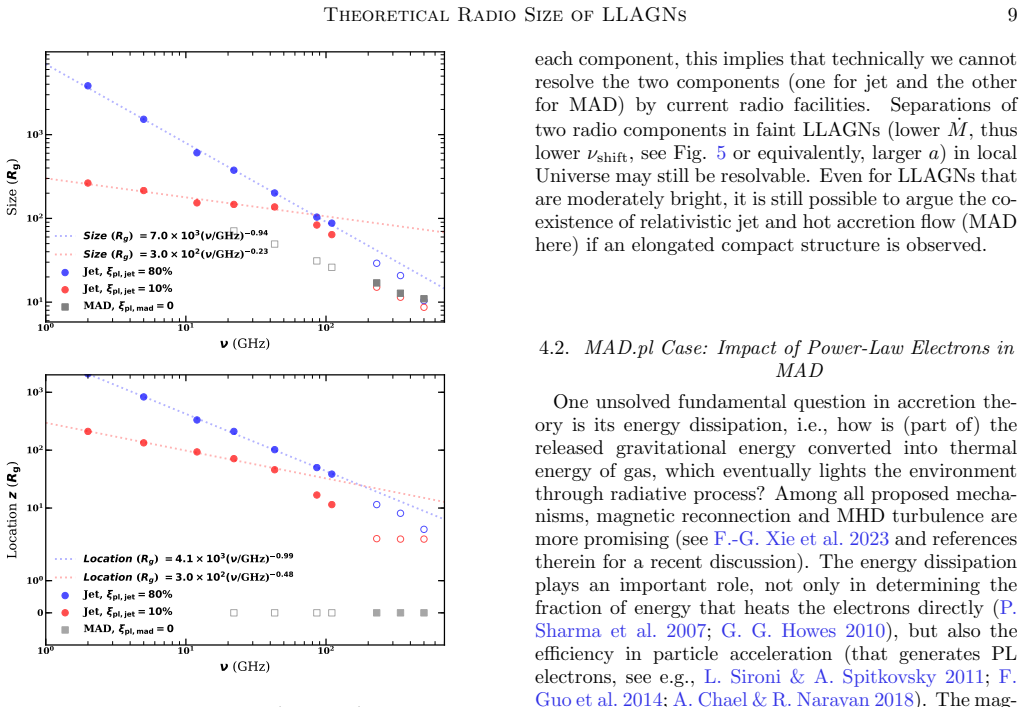
On the paper's own terms, the central claim is that the MAD-jet model explains the size-frequency relation of LLAGN radio cores as a two-component story: below a shift frequency (~30–40 GHz for M104) the jet dominates, and its size scales as ν^(−0.9) to ν^(−1) only if at least half of the jet electrons are nonthermal; a thermal jet gives a much shallower slope (~ν^(−0.23)). Above the shift frequency the magnetically arrested disk dominates, with a flatter size slope. The same model reproduces M104's broadband spectrum and core size. The second claim is that in the disk, strong radiative cooling ('synchrotron boiler') thermalizes power-law electrons whenever L_bol/L_Edd ≳ (3–8)×10^(−6), so mo
Load-bearing premise
The claimed luminosity threshold for killing power-law electrons rests on an assumed disk thickness H/R = 0.5 and a viscous radial-velocity formula; since the threshold scales as (H/R)^3, a thinner magnetically arrested disk would move the threshold up by roughly an order of magnitude, weakening the headline suppression claim.
Editorial extensions
If this is right
- The measured slope of radio core size versus frequency below the shift frequency becomes a composition diagnostic: a slope near −1 means the jet is dominated by nonthermal electrons, while a slope near −0.2 suggests a mostly thermal jet.
- Above the shift frequency, the MAD dominates and the size slope flattens, giving observers a direct way to identify the frequency at which the accretion disk overtakes the jet in radio.
- For systems above L_bol/L_Edd ≈ (3–8)×10^(−6), the synchrotron-boiler effect predicts power-law electrons in the disk are strongly suppressed, so thermal-only disk models should suffice for most LLAGNs and hard-state X-ray binaries.
- The shift frequency ν_shift depends mainly on black hole mass and the jet-to-disk mass-loss ratio, varying only weakly with X-ray luminosity, so high-frequency core-size observations can probe the accretion–ejection coupling.
- M104's observed core size and spectrum, including the break near 30–40 GHz, are reproduced by the coupled model, supporting the MAD picture over a conventional weak-field hot flow for this source.
Reading between the lines
- I infer that the size-slope diagnostic could be tested immediately with existing VLBI data on a few nearby LLAGNs below their shift frequency, since the predicted difference between a −0.2 and a −1 slope is large enough to distinguish.
- Because γ_cooling is independent of black hole mass, the same thermalization threshold should apply to stellar-mass black holes in the hard state; radio core-size and X-ray observations of X-ray binaries could extend the test across mass scales.
- The quantitative threshold is sensitive to disk thickness; if a thinner MAD (H/R ≈ 0.3) is closer to reality, the luminosity above which power-law electrons are killed shifts up by almost an order of magnitude, leaving a wider population of sources in which nonthermal disk electrons might be visible.
- The general LLAGN predictions inherit the empirical radio–X-ray–mass correlation for jet power, so sources that deviate from that correlation should have different shift frequencies and are natural targets for checking the assumed jet–disk coupling.
Editorial analysis
A structured set of objections, weighed in public.
Referee Report
Summary. The paper constructs a coupled magnetically arrested disk (MAD) plus internal-shock jet model and uses it to predict the broadband spectrum and the frequency-dependent radio core size of LLAGNs. The model is first applied to M104, where the accretion rate is adjusted to reproduce the radio luminosity and the resulting SED and size are compared with observations. The authors then generalize to a 10^9 Msun black hole, normalizing the jet power through the empirical Merloni et al. (2003) Fundamental Plane. They report that a size–frequency slope d ∝ nu^{-0.94} is obtained when more than ~50% of the jet electrons follow a power-law distribution, that a jet-to-MAD transition occurs at a few tens of GHz, and that power-law electrons in the MAD are radiatively suppressed for L_bol/L_Edd ≳ (3–8)×10^-6, favoring a purely thermal MAD.
Significance. The paper is valuable because it makes concrete, falsifiable predictions that link the growing high-frequency VLBI/ALMA observations of LLAGNs to the physics of MADs and jets. If the central claims hold, the radio size–frequency slope becomes a diagnostic of the non-thermal electron fraction in jets, and the luminosity threshold identifies the regime in which thermal MAD models suffice. The M104 comparison is a genuine two-observable check (SED plus size), and the jet size–frequency slope is an actual model output rather than a fitted relation. The model is fully specified and the assumptions are largely transparent. The main weakness is that the quantitative suppression threshold, one of the headline conclusions, rests on a simplified cooling estimate that is not self-consistent with the MAD stress model used elsewhere in the paper.
major comments (3)
- [§4.2, Eq. (6), Fig. 7] The central suppression threshold quoted in the abstract and §5 is based on gamma_cooling computed with the viscous radial velocity V_R ≈ −alpha_vis(H/R)^2 R Omega_K (Eq. 5). This is inconsistent with the MAD stress model of §2.1, where accretion is driven by the ordered B_z B_phi stress and interchange instability, with alpha_vis only mimicking unresolved turbulent stress. The inflow time in a MAD need not be the alpha-viscosity time, so Eq. (6) is not a consequence of the model. Moreover, H/R = 0.5 and beta_tot = 6 are fixed in §4.2 without derivation, although §2.1 describes a MAD whose structure varies with radius and accretion rate. Because gamma_cooling ∝ alpha_vis^2 (1+beta_tot) (H/R)^3 R/Mdot, the threshold L_bol/L_Edd ≈ (3–8)×10^-6 can shift by a factor of several under plausible changes (e.g., lowering H/R from 0.5 to 0.3 changes gamma_cooling by a factor of 4.6). The acknowled
- [§2.3, Fig. 2 caption, §4.1] The general predictions in Figs. 3–6, including the shift frequency nu_shift and the claim that MAD emission dominates at high radio frequencies with a flatter size slope, depend on normalizing the jet power through the empirical M03 Fundamental Plane. The jet power is manually adjusted to satisfy this relation, and for M104 the accretion rate is adjusted to fit the radio luminosity, with xi_pl,jet = 80% adopted because it is difficult to constrain. The size–frequency slope in Fig. 6 is a genuine model output and is not compromised by this normalization, but the relative jet/MAD fluxes, and hence nu_shift and the high-frequency size behavior, are. The paper should include a sensitivity test showing how nu_shift and the high-frequency size slope change when mdot_jet is varied within the FP scatter or deviates from the FP; without this, the claimed generality of the jet-to-MAD transition i
- [§3 and §4.1, Fig. 6] The abstract states that the model 'successfully reproduce[s] a size ∝ nu^{-1} scaling'. The model’s jet-dominated size for xi_pl,jet = 80% is d_jet ∝ nu^{-0.94} (Fig. 6, top panel), whereas the observed M104 size below ~30–40 GHz is d_core ∝ nu^{-1.13±0.04} (Sec. 3). The difference of ~0.2 in the power-law index is not discussed and the model slope lies outside the reported observational error. The claim of consistency is therefore quantitatively loose. Please provide a more careful comparison, e.g., fitting the model and the data over the same frequency range, including the MAD contribution, and stating the model uncertainty, before claiming successful reproduction of the size–frequency relation.
minor comments (7)
- [Table 1 vs §2.1] Table 1 lists p_pl,mad = 2.2, but §2.1 states that the intrinsic MAD power-law index is fixed to p_mad = 2.5. Please reconcile this inconsistency.
- [§3] Typo: 'an testbed' should be 'a testbed'.
- [§2.1] Typo: 'which is an good approximation' should be 'which is a good approximation'.
- [§4.2] The text says cooling is important 'as long as mdot_0 > 1×10^-7', while Fig. 7 and the abstract quote a threshold of L_bol/L_Edd ≈ (3–8)×10^-6. Clarify the conversion between mdot_0 and L_bol/L_Edd used to obtain the stated luminosity threshold.
- [Fig. 8 caption] Mathematical notation such as 'νL ν ∝ν ∼+0.23' and 'νL ν ∝ν ∼−0.246' should be typeset as νL_ν ∝ ν^{+0.23} and νL_ν ∝ ν^{-0.246}.
- [§4.1, Fig. 6] The text says 'the jet size show no significant differences if xi_pl,jet ≳ 50%', but only the 10% and 80% cases are shown. It would be helpful to show a 50% case or state the range over which the slope is insensitive.
- [§2.4] The size definition differs between MAD (diameter at half-maximum of cumulative flux) and jet (FWHM of dL/dz), and observed core sizes are usually obtained from Gaussian fits. A brief discussion of how these definitions compare to observational size measurements would improve the quantitative comparison.
Circularity Check
Headline size∝ν^-1 condition is partly imposed: ξ_pl,jet=80% is chosen 'to ensure' the slope, so the abstract's 'if >50% PL' is an input condition rather than an independent prediction.
-
fitted input called prediction
[Sec. 3 (M104 setup) and Sec. 4.1 / Fig. 6; cf. Abstract]
"With our own preference, we adopt ξ_pl,jet = 80% (see Figure 6 below.) … In this work, our fiducial jet model takes ξ_pl,jet = 80% (adopted as a representative of the 50−100% range), to ensures a d_jet ∼ν−1 size-frequency relationship below∼30 GHz."
The abstract advertises 'We successfully reproduce a size∝ν^{-1} scaling between 1 GHz and tens of GHz, if more than 50% of electrons in jet follow a power-law (PL) distribution' as the paper's headline success. But the body states that the fiducial jet model adopts ξ_pl,jet=80% precisely 'to ensures a d_jet ∼ν−1 size-frequency relationship.' Thus the >50%-PL condition is not an independent prediction; it is the input value selected to make the claimed scaling come out. The size calculation itself is a genuine radiative-transfer output (slope −0.94 at 80% vs −0.23 at 10%), so the circularity is partial: the scaling is not forced by an identity, but the headline condition is imposed rather than derived.
full rationale
The paper's main derivation chain is largely self-contained: the MAD and jet spectra are computed from the stated radiative-transfer equations, and the size-frequency slope is an output rather than a re-statement of an input. The M104 mdot_0 is fitted to the radio luminosity, but the size prediction uses that same fit in a non-trivial way, so this is standard model calibration, not circularity. The MAD model is adopted from prior work by the same authors (Xie & Zdziarski 2019; Xie et al. 2023), but that work is grounded in external GRMHD simulations and standard jet models, so the self-citation is not load-bearing in a circular sense. No uniqueness theorem or imported ansatz is used to forbid alternatives. The synchrotron-boiler suppression threshold rests on fixed assumptions (H/R=0.5, β_tot=6, α-viscosity radial velocity in a MAD), which is a correctness/robustness concern rather than a circular one. The one genuine circular element is the jet composition claim: ξ_pl,jet=80% is chosen 'with our own preference' and specifically to produce the d_jet∼ν^{-1} scaling, while the abstract presents the resulting 'if >50% PL' condition as a successful reproduction. Because this concerns a headline claim but the underlying calculation is independent and transparent, a score of 4 is appropriate.
Assumptions & free parameters
free parameters (11)
- ξ_pl,jet =
80% fiducial (threshold >50%)
- mdot_0 (M104) =
(6.5/8.5/11)×10^{-4} for s = 0.5/0.3/0.1
- s =
0.1, 0.3, 0.5 tested; 0.1 for general LLAGNs
- H/R =
0.5 fixed
- β_tot =
6
- ξ_pl,mad =
1% and 5% scenarios
- mdot_jet =
8.1×10^{-7} (ξ=80% case)
- ϵ_e, ϵ_B =
0.02, 0.02
- α_vis =
0.3
- Γjet =
10 (general), 1.02 (M104)
- δ =
0.1
assumptions (7)
- domain assumption Xie & Zdziarski (2019) analytic MAD structure: B_z ∝ R^{-1.1}, P_m = 2, κ_φ = −0.5, β_z0 = 1, separate electron/ion energy equations
- domain assumption Internal-shock conical jet (Spada 2001; Yuan 2005; Xie 2016): constant Γ, half-opening 0.1 rad, no acceleration/collimation
- domain assumption M03 Fundamental Plane log L_R = 0.6 log L_X + 0.78 log M_BH + const sets the MAD-jet coupling
- standard math Blandford & Königl (1979) self-absorbed jet scalings z ∝ ν^{-1}
- domain assumption Synchrotron boiler: PL electrons below the thermal-peak energy are totally thermalized (Malzac & Belmont 2009)
- standard math Standard synchrotron self-absorption and Compton formulae (Rybicki & Lightman 1979)
- domain assumption Pseudo-Newtonian potential, non-spinning BH (Xie & Zdziarski 2019)
Cite this review
Pith. "Pith review of Radio Core Size of Low-luminosity Active Galactic Nuclei under the MAD-jet model." pith.science (2026). https://pith.science/paper/XFKHY43I
@misc{pith2026260721966,
  author       = {Pith},
  title        = {Pith review of: Radio Core Size of Low-luminosity Active Galactic Nuclei under the MAD-jet model},
  year         = {2026},
  howpublished = {\url{https://pith.science/paper/XFKHY43I}},
  note         = {Machine review of arXiv:2607.21966}
}
abstract
After decades of efforts, there are now fruitful high-resolution radio observations of low-luminosity active galactic nuclei (LLAGNs), and the observed frequency has extended from $\sim$10 GHz up to $\sim$200 GHz. In this work, based on a model that combines a magnetically arrested disk (MAD) and a Blandford-Znajek-like jet, we carried out detailed analysis on size and location of the radio core of LLAGNs. The radio core size of nearby LLAGN M104 is re-visited based on this new model. We successfully reproduce a $size\propto\nu^{-1}$ scaling between 1 GHz and tens of GHz, if more than $50\%$ of electrons in jet follow a power-law (PL) distribution. We further confirm that, at high radio frequencies emission from MAD exceeds that from jet, and a flatter size-frequency slope is observed. The impact of PL electrons in MAD is also investigated. For those $L_{\rm bol}/L_{\rm Edd} \gtrsim (3-8)\times 10^{-6}$ LLAGNs and black hole binaries in their hard state, PL electrons are expected to be highly suppressed due to strong radiative cooling (so-called `synchrotron boiler' effect).
Figures


Figures from the paper (6 more)




Reference graph
Works this paper leans on
-
[1]
C., Balokovi´ c, M., Chandra, S., et al
Algaba, J. C., Balokovi´ c, M., Chandra, S., et al. 2024, A&A, 692, A140, doi: 10.1051/0004-6361/202450497 ALMA Partnership, Brogan, C. L., P´ erez, L. M., et al. 2015, ApJL, 808, L3, doi: 10.1088/2041-8205/808/1/L3
-
[2]
1993, ARA&A, 31, 473, doi: 10.1146/annurev.aa.31.090193.002353
Antonucci, R. 1993, ARA&A, 31, 473, doi: 10.1146/annurev.aa.31.090193.002353
arXiv 1993
-
[3]
2012, ApJL, 745, L28, doi: 10.1088/2041-8205/745/2/L28
Asada, K., & Nakamura, M. 2012, ApJL, 745, L28, doi: 10.1088/2041-8205/745/2/L28
-
[4]
Bandyopadhyay, B., Xie, F.-G., Nagar, N. M., et al. 2019, MNRAS, 490, 4606, doi: 10.1093/mnras/stz2874
-
[5]
E., Tzioumis, T., Uttley, P., et al
Bell, M. E., Tzioumis, T., Uttley, P., et al. 2011, MNRAS, 411, 402, doi: 10.1111/j.1365-2966.2010.17692.x
arXiv 2011
-
[6]
Blandford, R. D., & K¨ onigl, A. 1979, ApJ, 232, 34, doi: 10.1086/157262
doi:10.1086/157262 1979
-
[7]
Blandford, R. D., & Payne, D. G. 1982, MNRAS, 199, 883, doi: 10.1093/mnras/199.4.883
-
[8]
Blandford, R. D., & Znajek, R. L. 1977, MNRAS, 179, 433, doi: 10.1093/mnras/179.3.433
Show all 76 references
-
[9]
C., Falcke, H., Herrnstein, R
Bower, G. C., Falcke, H., Herrnstein, R. M., et al. 2004, Science, 304, 704, doi: 10.1126/science.1094023
2004 doi
-
[10]
C., Markoff, S., Dexter, J., et al
Bower, G. C., Markoff, S., Dexter, J., et al. 2015, ApJ, 802, 69, doi: 10.1088/0004-637X/802/1/69
2015 doi
-
[11]
2018, in American Astronomical Society Meeting Abstracts, Vol
Chael, A., & Narayan, R. 2018, in American Astronomical Society Meeting Abstracts, Vol. 231, American Astronomical Society Meeting Abstracts #231, 311.04
2018
-
[12]
2022, ApJ, 941, 30, doi: 10.3847/1538-4357/ac9d97
Chatterjee, K., & Narayan, R. 2022, ApJ, 941, 30, doi: 10.3847/1538-4357/ac9d97
2022 doi
-
[13]
2015, Astrophysics and Space Science Library, Vol
Contopoulos, I., Gabuzda, D., & Kylafis, N., eds. 2015, Astrophysics and Space Science Library, Vol. 414, The Formation and Disruption of Black Hole Jets, doi: 10.1007/978-3-319-10356-3
2015 doi
-
[14]
2010, ApJ, 708, 1545, doi: 10.1088/0004-637X/708/2/1545
Ding, J., Yuan, F., & Liang, E. 2010, ApJ, 708, 1545, doi: 10.1088/0004-637X/708/2/1545
2010 doi
-
[15]
A., & Flohic, H
Eracleous, M., Hwang, J. A., & Flohic, H. M. L. G. 2010, ApJS, 187, 135, doi: 10.1088/0067-0049/187/1/135 Event Horizon Telescope Collaboration, Akiyama, K.,
2010 doi
-
[16]
2019, ApJL, 875, L1, doi: 10.3847/2041-8213/ab0ec7 Event Horizon Telescope Collaboration, Akiyama, K.,
Alberdi, A., et al. 2019, ApJL, 875, L1, doi: 10.3847/2041-8213/ab0ec7 Event Horizon Telescope Collaboration, Akiyama, K.,
2019 doi
-
[17]
2022, ApJL, 930, L12, doi: 10.3847/2041-8213/ac6674
Alberdi, A., et al. 2022, ApJL, 930, L12, doi: 10.3847/2041-8213/ac6674
2022 doi
-
[18]
Falcke, H., K¨ ording, E., & Nagar, N. M. 2004, NewAR, 48, 1157, doi: 10.1016/j.newar.2004.09.029 Fern´ andez-Ontiveros, J. A., L´ opez-L´ opez, X., & Prieto, A. 2023, A&A, 670, A22, doi: 10.1051/0004-6361/202243547 G¨ ultekin, K., Cackett, E. M., Miller, J. M., et al. 2009, A...
2004 doi
-
[19]
2014, in APS Meeting Abstracts, Vol
Guo, F., Li, H., Daughton, W., Liu, Y.-H., & Li, X. 2014, in APS Meeting Abstracts, Vol. 2014, APS Division of Plasma Physics Meeting Abstracts, GM10.005
2014
-
[20]
2013, ApJ, 779, 6, doi: 10.1088/0004-637X/779/1/6
Hada, K., Doi, A., Nagai, H., et al. 2013, ApJ, 779, 6, doi: 10.1088/0004-637X/779/1/6
2013 doi
-
[21]
Ho, L. C. 2008, ARA&A, 46, 475, doi: 10.1146/annurev.astro.45.051806.110546
2008 arXiv
-
[22]
C., Filippenko, A
Ho, L. C., Filippenko, A. V., & Sargent, W. L. W. 1997, ApJ, 487, 568, doi: 10.1086/304638
1997 doi
-
[23]
Howes, G. G. 2010, MNRAS, 409, L104, doi: 10.1111/j.1745-3933.2010.00958.x
2010
-
[24]
Jones, S., McHardy, I., & Maccarone, T. J. 2017, MNRAS, 465, 1336, doi: 10.1093/mnras/stw2810
2017 doi
- [25]
-
[26]
L., Miller, J
King, A. L., Miller, J. M., Reynolds, M. T., et al. 2013, ApJL, 774, L25, doi: 10.1088/2041-8205/774/2/L25
2013 doi
-
[27]
L., Miller, J
King, A. L., Miller, J. M., Cackett, E. M., et al. 2011, ApJ, 729, 19, doi: 10.1088/0004-637X/729/1/19
2011 doi
-
[28]
1981, ApJ, 243, 700, doi: 10.1086/158638
Konigl, A. 1981, ApJ, 243, 700, doi: 10.1086/158638
1981 doi
-
[29]
M., Sokolovsky, K
Kutkin, A. M., Sokolovsky, K. V., Lisakov, M. M., et al. 2014, MNRAS, 437, 3396, doi: 10.1093/mnras/stt2133
2014 doi
-
[30]
S., & Toma, K
Kuze, R., Kimura, S. S., & Toma, K. 2024, ApJ, 977, 22, doi: 10.3847/1538-4357/ad88f4
2024 doi
-
[31]
M., Kravchenko, E
Lisakov, M. M., Kravchenko, E. V., Pushkarev, A. B., et al. 2021, ApJ, 910, 35, doi: 10.3847/1538-4357/abe1bd
2021 doi
-
[32]
2018, MNRAS, 474, L81, doi: 10.1093/mnrasl/slx174
Liska, M., Hesp, C., Tchekhovskoy, A., et al. 2018, MNRAS, 474, L81, doi: 10.1093/mnrasl/slx174
2018 doi
-
[33]
L., Cohen, M
Lister, M. L., Cohen, M. H., Homan, D. C., et al. 2009, AJ, 138, 1874, doi: 10.1088/0004-6256/138/6/1874
2009 doi
-
[34]
2013, ApJ, 764, 17, doi: 10.1088/0004-637X/764/1/17
Liu, H., & Wu, Q. 2013, ApJ, 764, 17, doi: 10.1088/0004-637X/764/1/17
2013 doi
-
[35]
1997, ApJ, 490, 605, doi: 10.1086/304908 14
Mahadevan, R., & Quataert, E. 1997, ApJ, 490, 605, doi: 10.1086/304908 14
1997 doi
-
[36]
2009, MNRAS, 392, 570, doi: 10.1111/j.1365-2966.2008.14142.x
Malzac, J., & Belmont, R. 2009, MNRAS, 392, 570, doi: 10.1111/j.1365-2966.2008.14142.x
2009
-
[37]
1997, ApJ, 489, 791, doi: 10.1086/304817
Manmoto, T., Mineshige, S., & Kusunose, M. 1997, ApJ, 489, 791, doi: 10.1086/304817
1997 doi
-
[38]
C., Tchekhovskoy, A., & Blandford, R
McKinney, J. C., Tchekhovskoy, A., & Blandford, R. D. 2012, MNRAS, 423, 3083, doi: 10.1111/j.1365-2966.2012.21074.x
2012
-
[39]
B., & Steiner, J
Menezes, R. B., & Steiner, J. E. 2015, ApJ, 808, 27, doi: 10.1088/0004-637X/808/1/27
2015 doi
-
[40]
B., Steiner, J
Menezes, R. B., Steiner, J. E., & Ricci, T. V. 2013, ApJL, 765, L40, doi: 10.1088/2041-8205/765/2/L40
2013 doi
-
[41]
2003, MNRAS, 345, 1057, doi: 10.1046/j.1365-2966.2003.07017.x
Merloni, A., Heinz, S., & di Matteo, T. 2003, MNRAS, 345, 1057, doi: 10.1046/j.1365-2966.2003.07017.x
2003
-
[42]
V., & Abramowicz, M
Narayan, R., Igumenshchev, I. V., & Abramowicz, M. A. 2003, PASJ, 55, L69, doi: 10.1093/pasj/55.6.L69
2003 doi
-
[43]
1998, in Theory of Black Hole Accretion Disks, ed
Narayan, R., Mahadevan, R., & Quataert, E. 1998, in Theory of Black Hole Accretion Disks, ed. M. A
1998
- [44]
-
[45]
1994, ApJL, 428, L13, doi: 10.1086/187381
Narayan, R., & Yi, I. 1994, ApJL, 428, L13, doi: 10.1086/187381
1994 doi
-
[46]
1995, ApJ, 452, 710, doi: 10.1086/176343
Narayan, R., & Yi, I. 1995, ApJ, 452, 710, doi: 10.1086/176343
1995 doi
-
[47]
W., Doeleman, S
Raymond, A. W., Doeleman, S. S., Asada, K., et al. 2024, AJ, 168, 130, doi: 10.3847/1538-3881/ad5bdb
2024 doi
-
[48]
B., & Lightman, A
Rybicki, G. B., & Lightman, A. P. 1979, Radiative processes in astrophysics
1979
-
[49]
I., & Sunyaev, R
Shakura, N. I., & Sunyaev, R. A. 1973, A&A, 24, 337
1973
-
[50]
W., & Stone, J
Sharma, P., Quataert, E., Hammett, G. W., & Stone, J. M. 2007, ApJ, 667, 714, doi: 10.1086/520800
2007 doi
-
[51]
2011, ApJ, 726, 75, doi: 10.1088/0004-637X/726/2/75
Sironi, L., & Spitkovsky, A. 2011, ApJ, 726, 75, doi: 10.1088/0004-637X/726/2/75
2011 doi
-
[52]
Lobanov, A. P. 2011, A&A, 532, A38, doi: 10.1051/0004-6361/201016072
2011 doi
-
[53]
2001, MNRAS, 325, 1559, doi: 10.1046/j.1365-8711.2001.04557.x
Spada, M., Ghisellini, G., Lazzati, D., & Celotti, A. 2001, MNRAS, 325, 1559, doi: 10.1046/j.1365-8711.2001.04557.x
2001
-
[54]
2022, ApJ, 941, 47, doi: 10.3847/1538-4357/ac9d8f
Sutter, J., & Fadda, D. 2022, ApJ, 941, 47, doi: 10.3847/1538-4357/ac9d8f
2022 doi
-
[55]
Tchekhovskoy, A., Narayan, R., & McKinney, J. C. 2011, MNRAS, 418, L79, doi: 10.1111/j.1745-3933.2011.01147.x
2011
- [56]
-
[57]
2015, MNRAS, 448, 939, doi: 10.1093/mnras/stu2737
Veledina, A., & Poutanen, J. 2015, MNRAS, 448, 939, doi: 10.1093/mnras/stu2737
2015 doi
-
[58]
J., Stone, J
White, C. J., Stone, J. M., & Quataert, E. 2019, ApJ, 874, 168, doi: 10.3847/1538-4357/ab0c0c
2019 doi
-
[59]
2023, ApJ, 942, 20, doi: 10.3847/1538-4357/aca534
Xie, F.-G., Narayan, R., & Yuan, F. 2023, ApJ, 942, 20, doi: 10.3847/1538-4357/aca534
2023 doi
-
[60]
A., & Yuan, F
Xie, F.-G., Nied´ zwiecki, A., Zdziarski, A. A., & Yuan, F. 2010, MNRAS, 403, 170, doi: 10.1111/j.1365-2966.2009.16135.x
2010
-
[61]
2014, MNRAS, 442, L110, doi: 10.1093/mnrasl/slu068
Xie, F.-G., Yang, Q.-X., & Ma, R. 2014, MNRAS, 442, L110, doi: 10.1093/mnrasl/slu068
2014 doi
-
[62]
2016, MNRAS, 456, 4377, doi: 10.1093/mnras/stv2956
Xie, F.-G., & Yuan, F. 2016, MNRAS, 456, 4377, doi: 10.1093/mnras/stv2956
2016 doi
-
[63]
2017, ApJ, 836, 104, doi: 10.3847/1538-4357/aa5b90
Xie, F.-G., & Yuan, F. 2017, ApJ, 836, 104, doi: 10.3847/1538-4357/aa5b90
2017 doi
-
[64]
Xie, F.-G., & Zdziarski, A. A. 2019, ApJ, 887, 167, doi: 10.3847/1538-4357/ab5848
2019 doi
-
[65]
A., Ma, R., & Yang, Q.-X
Xie, F.-G., Zdziarski, A. A., Ma, R., & Yang, Q.-X. 2016, MNRAS, 463, 2287, doi: 10.1093/mnras/stw2132
2016 doi
-
[66]
2024, ApJ, 965, 128, doi: 10.3847/1538-4357/ad31a2
Yan, X., Lu, R.-S., Jiang, W., et al. 2024, ApJ, 965, 128, doi: 10.3847/1538-4357/ad31a2
2024 doi
-
[67]
Yang, H., Yuan, F., Yuan, Y.-F., & White, C. J. 2021, ApJ, 914, 131, doi: 10.3847/1538-4357/abfe63
2021 doi
-
[68]
2024, Science Advances, 10, eadn3544, doi: 10.1126/sciadv.adn3544
Yang, H., Yuan, F., Li, H., et al. 2024, Science Advances, 10, eadn3544, doi: 10.1126/sciadv.adn3544
2024 doi
-
[69]
2025, ApJ, 980, 255, doi: 10.3847/1538-4357/adaea4
Yang, Q.-R., Liu, R.-Y., & Wang, X.-Y. 2025, ApJ, 980, 255, doi: 10.3847/1538-4357/adaea4
2025 doi
-
[70]
2005, ApJ, 620, 905, doi: 10.1086/427206
Yuan, F., Cui, W., & Narayan, R. 2005, ApJ, 620, 905, doi: 10.1086/427206
2005 doi
-
[71]
2014, ARA&A, 52, 529, doi: 10.1146/annurev-astro-082812-141003
Yuan, F., & Narayan, R. 2014, ARA&A, 52, 529, doi: 10.1146/annurev-astro-082812-141003
2014 doi
-
[72]
2003, ApJ, 598, 301, doi: 10.1086/378716
Yuan, F., Quataert, E., & Narayan, R. 2003, ApJ, 598, 301, doi: 10.1086/378716
2003 doi
-
[73]
2004, ApJ, 606, 894, doi: 10.1086/383117
Yuan, F., Quataert, E., & Narayan, R. 2004, ApJ, 606, 894, doi: 10.1086/383117
2004 doi
-
[74]
2014, Nature, 510, 126, doi: 10.1038/nature13399
Tchekhovskoy, A. 2014, Nature, 510, 126, doi: 10.1038/nature13399
2014 doi
-
[75]
A., Sikora, M., Pjanka, P., & Tchekhovskoy, A
Zdziarski, A. A., Sikora, M., Pjanka, P., & Tchekhovskoy, A. 2015, MNRAS, 451, 927, doi: 10.1093/mnras/stv986
2015 doi
-
[76]
A., Stawarz, L., Pjanka, P., & Sikora, M
Zdziarski, A. A., Stawarz, L., Pjanka, P., & Sikora, M. 2014, MNRAS, 440, 2238, doi: 10.1093/mnras/stu420
2014 doi
Reviewed August 1, 2026 · model on record in the stance chip above.
Discussion (0). Sign in to comment.