REVIEW 3 major objections 6 minor 46 references
VIREL: Route-Local Lattice Residual Compression for Exact and Error-Bounded Floating-Point Time Series
T0 review · 3 major / 6 minor · reviewed 2026-08-04 · deepseek-v4-flash
Pith's one-line read This paper claims that floating-point time-series compression improves when temporal prediction state is carried as route-local lattice-coordinate residuals rather than IEEE 754 words or a single integer stream.
The pith
A machine-rendered reading of the paper's core claim, the machinery that carries it, and where it could break.
The reading
What carries the argument
Route-local lattice-coordinate residual prediction. The mechanism has four parts: (1) conservative admission via binary64 reconstruction checks — exact mode uses R_X(q,s)=fl(double(q)/10^s) and error-bounded mode uses R_B(o,q,delta)=fl(o+fl(q*delta)), so only values that reproduce the input word or satisfy the bound enter the integer domain; (2) a resolution router that splits the page into up to three or four integer lanes, each with its own previous-value predictor, so a fine-resolution exception does not reset the coarse lane's history; (3) lattice-step normalization — exact affine lanes store z for q=dz+r, and EB lanes store q'=q/d only for divisible indices, turning physical steps into
What would settle it
Encode a page of doubles with random mantissas — for example, generated by hashing or from irrational constants — using VIREL and a strong XOR-based codec under identical 1,024-value page resets; if VIREL's admission rate is near zero and its compression ratio does not exceed the XOR baseline, the lattice premise fails for that regime.
Extended reading notes
Core claim
The central discovery is that decimal- and instrument-generated floating-point time series carry unused structure: once a value is admitted as an integer lattice coordinate q under a checked binary64 reconstruction, consecutive coordinates often differ by far smaller residuals than adjacent IEEE 754 words, especially when the physical step is normalized away (q=5z+4 stores z, so +5 becomes +1). The paper argues that a page codec should therefore keep its temporal prediction state in route-local lattice coordinates: separate lanes for different source resolutions preserve each lane's history when high-precision exceptions appear, and cost-based lattice-step normalization removes sparse physic
Load-bearing premise
The workload's values mostly lie on decimal or instrument lattice coordinates that pass bit-exact or error-bounded reconstruction; if they do not, the coordinate path is empty and VIREL falls back to raw XOR encoding, erasing its advantage over word-domain codecs.
Editorial extensions
If this is right
- Exact pages of smooth sensor and financial streams compress to roughly one-sixth to one-seventh of their raw size, and the compression-first profile beats all evaluated exact baselines on the canonical 14-stream suite with equal 1,024-value resets.
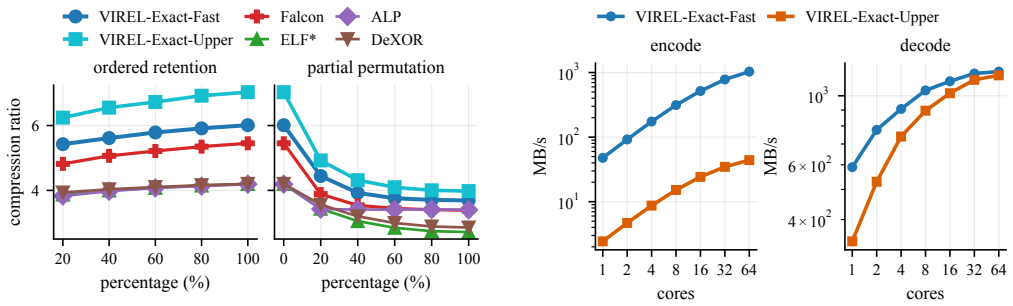
- On 48 larger real streams totaling 74.7M values, the exact profiles reach 8.06x and 9.65x compression, winning all 48 streams against a per-stream oracle of six exact baselines except one 0.54% loss.
- Error-bounded compression gains without consuming error budget: at epsilon=10^-3 the EB profile reaches 12.11x while preserving every pointwise bound, with q/d factoring alone contributing an 18.75% byte reduction over the routed unfactored variant.
- The page-streamable design — independent frames, deterministic decoding, bounded memory — transfers to a file format, writing 27.9–30.1% fewer complete-file bytes than the strongest exact baselines and scanning faster on full, range, and aggregate reads.
- Ablations attribute the largest single share (53.05% byte growth when removed) to integer-domain residual prediction rather than routing or normalization, confirming the representation-domain claim.
Reading between the lines
- Because the gain depends on how many values pass lattice admission, workloads with mostly random mantissas would see VIREL fall back to raw XOR; a cheap admission-rate histogram emitted per page could let a storage engine choose between VIREL and word-domain codecs dynamically.
- The route-local state idea is generic: any predictive codec that works in a transformed coordinate space — decimal, quantized, or learned — could adopt per-resolution lanes to keep fine exceptions from corrupting coarse histories.
- A direct testable extension is to feed VIREL synthetic streams with controlled fractions of lattice-representable values and map the break-even point where route-local prediction stops paying for its metadata cost.
- If the representation-domain claim generalizes, future storage engines could choose prediction domain from column metadata, such as sensor make/model or declared decimal precision, rather than per-page search.
Editorial analysis
A structured set of objections, weighed in public.
Referee Report
Summary. The paper proposes VIREL, a floating-point page codec that changes the representation domain that carries temporal prediction state. Instead of predicting over IEEE 754 words, erased words, decimal fields, or a page-wide integer stream, VIREL admits values to exact or error-bounded integer/lattice coordinates (Eqs. 4–9), routes them by source resolution, and optionally applies lattice-step normalization (affine q=dz+r for exact; q/d for error-bounded) before computing residuals. The authors claim large ratio gains over existing page codecs under equal 1,024-value page resets: 6.02–7.03× exact on the canonical 14-stream suite and 8.06–9.65× on 74.70 million values, plus 12.11× error-bounded at ε=10⁻³, with bit-exact and pointwise error verification, ablations, multicore scaling, and Apache TsFile integration.
Significance. If the results hold, this is a solid systems contribution: it identifies the representation domain of temporal prediction state as a first-class page-codec design choice, and it demonstrates that route-local lattice-coordinate residuals with cost-based normalization are effective on smooth, decimal/instrument-lattice workloads. The evaluation is unusually thorough: equal-reset protocols, complete encoded-size charging, verbatim losslessness and pointwise bound checks, a 48-stream and a 15-stream corpus, ablation isolating the key mechanisms, and an end-to-end TsFile comparison. The main weaknesses are the absence of a failure-mode evaluation on non-lattice data and the lack of a public artifact, both of which are needed to support the generality and reproducibility of the central empirical claims.
major comments (3)
- [§I, §IV-A, §VI] The central mechanism depends on the workload being lattice-like. §IV-A explicitly routes values that do not pass exact/EB admission (Eqs. 4–9) to the raw XOR lane, and §I asserts that 'many floating-point time series are generated on decimal or instrument lattices.' However, all evaluated corpora (ELF canonical suite, UCI, GeoLife, T-Drive, Serf) are smooth, decimal-like streams; the paper does not measure the failure mode where few values are admitted, e.g., random-mantissa scientific data or pseudo-random binary64. The generality claim is therefore unquantified. Please add experiments on non-lattice workloads reporting admission rate, compression ratio, and throughput against the same baselines, and discuss the boundary of applicability.
- [§VI-A, §IV-B, §IV-C] No code artifact is linked, and the manuscript omits implementation details needed to reimplement the headline compression-first profile: the 'fixed five-predictor integer family' in §IV-B is not enumerated, and the candidate divisor derivation and REFIT order in §IV-C are only described at a high level. Since the central claims are empirical and the harness is custom, a public artifact or a detailed reproducibility appendix is necessary for the results to be verifiable. Please provide an artifact, or at minimum a precise specification of the enumerated predictors and the descriptor search.
- [§IV-D, §VI-A] The primary exact results are described as 'independent 1,024-value calls,' yet §IV-D states that the Upper profile 'stores repeated stream metadata once per page group and applies Zstd-22 to the resulting length-delimited group.' If a 'page group' spans multiple pages, metadata is amortized across pages, which would not be an equal-reset comparison with baselines charged complete per-page output. Please define 'page group' and state its size in the independent-page experiment; if it comprises multiple pages, re-run the main ratio with strictly per-page metadata or clearly separate the page-group experiment from the equal-reset claim.
minor comments (6)
- [Abstract] The sentence 'VIREL-Exact-Fast reaches 6.0243× and VIREL-Exact-Upper reaches 7.0287×, emitting 22.4% fewer bytes than the strongest evaluated exact baseline' is ambiguous: the 22.4% figure applies to Exact-Upper versus Falcon (1 − 5.4527/7.0287), not to both profiles. Please rephrase to attribute the percentage explicitly.
- [§VI-A] The text uses both '1,000-value resets' (legacy, decimal-precision section) and '1,024-value pages' for the primary results. Please use consistent terminology or explicitly state that the 1,000-value protocol is a legacy harness used only where noted.
- [§VI-B] The binary32 results (20.38%/24.19% exact; 3.41% EB) are mentioned in prose but not shown in any table. Please add a table or appendix with these comparisons.
- [Table XI] The 'Plain' row reports ratios below 1 (0.9697/1.5398). Please add a sentence explaining that this is due to TsFile/page overhead, to avoid confusion.
- [§IV-C] The REFIT deterministic order ('lowest valid scale for Fast, fixed descriptor order for exact affine lanes, and largest selected divisor for EB') is not fully specified. Please list the exact descriptor order used for affine lanes.
- [§VI-A] The 'SElfStar artifact' is cited by name but no URL is given; please add a reference or footnote.
Circularity Check
No significant circularity: VIREL's compression claims are engineering measurements with self-contained, cost-based planning, not derivations that reduce to their inputs.
full rationale
The paper's central claims are comparative compression ratios, not derived predictions that are equivalent to their inputs. The codec's planning is explicit and self-contained: values are admitted only when the decoder-side reconstruction is checked (Eqs. 4, 6, 7 for exact; Eqs. 5, 8, 9 for error-bounded), prediction is the parameter-free previous-value rule (Eq. 13), and lane/route selection minimizes the complete emitted size (Eqs. 14, 15). No parameter is fitted to the reported compression ratios; the residual predictor is not learned from the target output. The ablations are controlled byte-size measurements that isolate mechanisms, and all headline numbers are comparisons against external baselines under shared page-reset protocols. The only workload assumption—that many time series lie on decimal or instrument lattices—is stated as an input premise (Section I), not derived from the results, and the paper explicitly includes a raw-XOR fallback for values that fail coordinate admission. References are to external prior work; there is no load-bearing self-citation chain or imported uniqueness theorem. The lattice-step normalization (q=dz+r, q/d) is a reversible coding transform whose correctness is separately argued from the admission checks, and it does not smuggle in the compression gains as a definitional identity. Thus the derivation chain is non-circular; a normal, honest non-finding is appropriate.
Assumptions & free parameters
free parameters (5)
- Scale set for exact admission {0,...,18} =
0..18
- Error-lattice step candidates Δ(ε) =
nextafter(2ε,0), nextafter(1.5ε,0), nextafter(ε,0)
- EB divisor alphabet (25 symbols) =
d ∈ {1,...,10^8}, biased to 2^a5^b
- Residual block size B =
16 (vs sweep 4–128)
- Maximum lane count =
3 (Fast/EB), 4 (Upper)
assumptions (4)
- domain assumption Target floating-point time series are generated on decimal or instrument lattices.
- domain assumption Encoder and decoder share identical binary64 rounding semantics for reconstruction functions R_X and R_B.
- domain assumption Full encoded-cost model C(P;Λ) correctly ranks alternative plans by emitted size.
- domain assumption Pointwise absolute error is the relevant fidelity contract for error-bounded mode.
Cite this review
Pith. "Pith review of VIREL: Route-Local Lattice Residual Compression for Exact and Error-Bounded Floating-Point Time Series." pith.science (2026). https://pith.science/paper/MO72GZPX
@misc{pith2026260722433,
  author       = {Pith},
  title        = {Pith review of: VIREL: Route-Local Lattice Residual Compression for Exact and Error-Bounded Floating-Point Time Series},
  year         = {2026},
  howpublished = {\url{https://pith.science/paper/MO72GZPX}},
  note         = {Machine review of arXiv:2607.22433}
}
abstract
Floating-point page codecs exploit temporal smoothness, but existing methods keep prediction state in different representation domains: IEEE 754 words, erased IEEE 754 words, decimal fields, or integer surrogates. Which domain should carry temporal prediction state inside a database page remains an open question. We present VIREL, a page codec that predicts route-local lattice-coordinate residuals for values admitted to exact or error-bounded integer coordinates. Separate routes preserve the history of mixed source resolutions, and cost-based lattice-step normalization stores compact coordinates such as $z$ for $q=dz+r$ or $q/d$ for divisible error-lattice indices while restoring the same lattice point before reconstruction. On canonical exact streams with independent 1,024-value pages, VIREL-Exact-Fast reaches 6.0243$\times$ and VIREL-Exact-Upper reaches 7.0287$\times$, emitting 22.4% fewer bytes than the strongest evaluated exact baseline. On 74.70 million values in 48 streams, the two profiles reach 8.0629$\times$ and 9.6490$\times$. At $\epsilon=10^{-3}$ on 15 Serf streams, VIREL-EB reaches 12.1094$\times$, emits 12.54% fewer bits than the strongest compliant error-bounded baseline, and preserves all pointwise bounds. Ablations show that integer-domain residual prediction and $q/d$ factoring reduce output by 53.05% and 18.75% in their respective settings. The Fast profile scales to 1,034/1,196 MB/s encode/decode at 64 cores. As an Apache TsFile codec, it writes 27.9-30.1% fewer complete-file bytes than DeXOR and ELF*, and with LZ4 reaches 105.80/102.32/110.30 MB/s on full-scan, range-scan, and aggregate queries, faster than the encoded baselines in all three read paths.
Figures


Figures from the paper (12 more)


Reference graph
Works this paper leans on
-
[1]
Gorilla: A fast, scalable, in-memory time series database,
T. Pelkonen, S. Franklin, J. Teller, P. Cavallaro, Q. Huang, J. Meza, and K. Veeraraghavan, “Gorilla: A fast, scalable, in-memory time series database,”Proceedings of the VLDB Endowment, vol. 8, no. 12, pp. 1816–1827, 2015
2015
-
[2]
Chimp: Efficient lossless floating point compression for time series databases,
P. Liakos, K. Papakonstantinopoulou, and Y . Kotidis, “Chimp: Efficient lossless floating point compression for time series databases,”Proceed- ings of the VLDB Endowment, vol. 15, no. 11, pp. 3058–3070, 2022
2022
-
[3]
Elf: Erasing-based lossless floating-point compression,
R. Li, Z. Li, Y . Wu, C. Chen, and Y . Zheng, “Elf: Erasing-based lossless floating-point compression,”Proceedings of the VLDB Endowment, vol. 16, no. 7, pp. 1763–1776, 2023
2023
-
[4]
Adaptive encoding strategies for lossless floating-point compression,
Z. Li, R. Li, X. Xu, Y . Wu, C. Chen, T. Liu, J. Shang, and Y . Zheng, “Adaptive encoding strategies for lossless floating-point compression,” IEEE Internet of Things Journal, vol. 12, no. 14, pp. 26 071–26 085, 2025
2025
-
[5]
Alp: Adaptive lossless floating- point compression,
A. Afroozeh, L. X. Kuffo, and P. Boncz, “Alp: Adaptive lossless floating- point compression,”Proceedings of the ACM on Management of Data, vol. 1, no. 4, pp. 1–26, 2023
2023
-
[6]
Camel: Efficient compression of floating-point time series,
Y . Yao, L. Chen, Z. Fang, Y . Gao, C. S. Jensen, and T. Li, “Camel: Efficient compression of floating-point time series,”Proceedings of the ACM on Management of Data, vol. 2, no. 6, pp. 1–26, 2024
2024
-
[7]
Dexor: Enabling xor in decimal space for streaming lossless compression of floating-point data,
C. Lv, H. Li, D. Yang, Z. Xie, L. Chen, and C. S. Jensen, “Dexor: Enabling xor in decimal space for streaming lossless compression of floating-point data,”Proceedings of the VLDB Endowment, vol. 19, no. 5, pp. 849–861, 2026
2026
-
[8]
Ant: An efficient lossless com- pression algorithm for iot time series data,
J. Li, G. Xu, H. Yang, and Y . Wu, “Ant: An efficient lossless com- pression algorithm for iot time series data,” in2023 IEEE Intl Conf on Parallel & Distributed Processing with Applications, Big Data & Cloud Computing, Sustainable Computing & Communications, Social Computing & Networking, 2023, pp. 766–771
2023
Show all 46 references
-
[9]
A high-throughput gpu framework for adaptive lossless compression of floating-point data,
Z. Li, W. Wang, R. Li, C. Chen, X. Long, L. Zheng, Q. Xu, and C. Yang, “A high-throughput gpu framework for adaptive lossless compression of floating-point data,”arXiv preprint arXiv:2511.04140, 2025
2025
-
[10]
Apache iotdb: Time-series database for internet of things,
C. Wang, X. Huang, J. Qiao, T. Jiang, L. Rui, J. Zhang, R. Kang, J. Feinauer, K. A. McGrail, P. Wang, D. Luo, J. Yuan, J. Wang, and J. Sun, “Apache iotdb: Time-series database for internet of things,” Proceedings of the VLDB Endowment, vol. 13, no. 12, pp. 2901–2904, 2020
2020
-
[11]
Time series data encoding in apache iotdb: Comparative analysis and recommendation,
T. Xia, J. Xiao, Y . Huang, C. Hu, S. Song, X. Huang, and J. Wang, “Time series data encoding in apache iotdb: Comparative analysis and recommendation,”The VLDB Journal, vol. 33, no. 3, pp. 727–752, 2024
2024
-
[12]
Integrating compression and execution in column-oriented database systems,
D. J. Abadi, S. R. Madden, and M. C. Ferreira, “Integrating compression and execution in column-oriented database systems,” inProceedings of the ACM SIGMOD International Conference on Management of Data, 2006, pp. 671–682
2006
-
[13]
Btrblocks: Efficient columnar compression for data lakes,
M. Kuschewski, D. Sauerwein, A. Alhomssi, and V . Leis, “Btrblocks: Efficient columnar compression for data lakes,”Proceedings of the ACM on Management of Data, vol. 1, no. 2, pp. 1–26, 2023
2023
-
[14]
Serf: Streaming error-bounded floating-point compression,
R. Li, Z. Chen, R. Lu, X. Xu, G. Yang, C. Chen, J. Bao, and Y . Zheng, “Serf: Streaming error-bounded floating-point compression,” Proceedings of the ACM on Management of Data, vol. 3, no. 3, 2025
2025
-
[15]
Machete: An efficient lossy floating-point compressor designed for time series databases,
Y . Shi, X. Zou, X. Chen, S. Jin, D. Tao, C. Deng, Y . Chen, and W. Xia, “Machete: An efficient lossy floating-point compressor designed for time series databases,” inData Compression Conference, 2024, pp. 532–541
2024
-
[16]
Sprintz: Time series compression for the internet of things,
D. Blalock, S. Madden, and J. Guttag, “Sprintz: Time series compression for the internet of things,”Proceedings of the ACM on Interactive, Mobile, Wearable and Ubiquitous Technologies, vol. 2, no. 3, pp. 1– 23, 2018
2018
-
[17]
Fast error-bounded lossy hpc data compression with sz,
S. Di and F. Cappello, “Fast error-bounded lossy hpc data compression with sz,” in2016 IEEE International Parallel and Distributed Processing Symposium, 2016, pp. 730–739
2016
-
[18]
Fixed-rate compressed floating-point arrays,
P. Lindstrom, “Fixed-rate compressed floating-point arrays,”IEEE Transactions on Visualization and Computer Graphics, vol. 20, no. 12, pp. 2674–2683, 2014
2014
-
[19]
Multilevel techniques for compression and reduction of scientific data—the univariate case,
M. Ainsworth, S. Klasky, and B. Whitney, “Multilevel techniques for compression and reduction of scientific data—the univariate case,” Computing and Visualization in Science, vol. 19, pp. 65–76, 2018
2018
-
[20]
Time series manage- ment systems: A survey,
S. K. Jensen, T. B. Pedersen, and C. Thomsen, “Time series manage- ment systems: A survey,”IEEE Transactions on Knowledge and Data Engineering, vol. 29, no. 11, pp. 2581–2600, 2017
2017
-
[21]
Time series compression survey,
G. Chiarot and C. Silvestri, “Time series compression survey,”ACM Computing Surveys, vol. 55, no. 10, 2023
2023
-
[22]
Survey on floating-point time series data compression,
M. Zhu, Z. Li, R. Li, C. Chen, and Y . Zheng, “Survey on floating-point time series data compression,”Journal of Software, vol. 36, no. 6, pp. 2844–2874, 2025
2025
-
[23]
Beyond com- pression: A comprehensive evaluation of lossless floating-point com- pression,
K. Hishida, C. Liu, J. Paparrizos, and A. J. Elmore, “Beyond com- pression: A comprehensive evaluation of lossless floating-point com- pression,”Proceedings of the VLDB Endowment, vol. 18, no. 11, pp. 4396–4409, 2025
2025
-
[24]
High throughput compression of double-precision floating-point data,
M. Burtscher and P. Ratanaworabhan, “High throughput compression of double-precision floating-point data,” inData Compression Conference, 2009, pp. 293–302
2009
-
[25]
Fast and efficient compression of floating-point data,
P. Lindstrom and M. Isenburg, “Fast and efficient compression of floating-point data,”IEEE Transactions on Visualization and Computer Graphics, vol. 12, no. 5, pp. 1245–1250, 2006
2006
-
[26]
TSXor: A simple time series compression algorithm,
A. Bruno, F. M. Nardini, G. E. Pibiri, R. Trani, and R. Venturini, “TSXor: A simple time series compression algorithm,” inString Process- ing and Information Retrieval, ser. Lecture Notes in Computer Science, vol. 12944, 2021, pp. 217–223
2021
-
[27]
How to make your duck fly: Advanced floating point compression to the rescue,
P. Liakos, K. Papakonstantinopoulou, T. Bruineman, M. Raasveldt, and Y . Kotidis, “How to make your duck fly: Advanced floating point compression to the rescue,” inProceedings of the 27th International Conference on Extending Database Technology (EDBT), 2024, pp. 826– 829
2024
-
[28]
ACTF: An efficient lossless compression algorithm for time series floating point data,
W. Wang, W. Chen, Q. Lei, Z. Li, and H. Zhao, “ACTF: An efficient lossless compression algorithm for time series floating point data,” Journal of King Saud University – Computer and Information Sciences, vol. 36, no. 10, p. 102246, 2024
2024
-
[29]
Dolphin: An adaptive lossless compression algorithm for oscillating floating-point time series,
W. Chen, L. Yan, H. Jung, and H. Zhao, “Dolphin: An adaptive lossless compression algorithm for oscillating floating-point time series,”Journal of King Saud University – Computer and Information Sciences, vol. 38, no. 10, p. 218, 2026
2026
-
[30]
AFC: An adaptive lossless floating-point compression algorithm in time series database,
H. Chen, L. Liu, J. Meng, and W. Lu, “AFC: An adaptive lossless floating-point compression algorithm in time series database,”Informa- tion Sciences, vol. 654, p. 119847, 2024
2024
-
[31]
Bitshuffle: Filter for improving compression of typed binary data,
K. W. Masui, “Bitshuffle: Filter for improving compression of typed binary data,” https://github.com/kiyo-masui/bitshuffle, 2015
2015
-
[32]
Floating-point data transformation for lossless compression,
S. Jamalidinan and K. Cheshmi, “Floating-point data transformation for lossless compression,” arXiv preprint arXiv:2506.18062, 2025
2025 arXiv
-
[33]
Change a bit to save bytes: Compression for floating point time-series data,
F. Taurone, D. E. Lucani R ¨otter, and M. Feh ´er, “Change a bit to save bytes: Compression for floating point time-series data,” inIEEE International Conference on Cloud Engineering, 2023, pp. 113–122
2023
-
[34]
LZ4: Extremely fast compression algorithm,
Y . Collet, “LZ4: Extremely fast compression algorithm,” https://github. com/lz4/lz4, 2011
2011
-
[35]
Zstandard: Fast real-time compression algorithm,
Y . Collet and M. Kucherawy, “Zstandard: Fast real-time compression algorithm,” RFC 8878, 2021
2021
-
[36]
Snappy: A fast compressor/decompressor,
Google, “Snappy: A fast compressor/decompressor,” https://github.com/ google/snappy, 2011
2011
-
[37]
DACs: Bringing direct ac- cess to variable-length codes,
N. R. Brisaboa, S. Ladra, and G. Navarro, “DACs: Bringing direct ac- cess to variable-length codes,”Information Processing & Management, vol. 49, no. 1, pp. 392–404, 2013
2013
-
[38]
Leco: Lightweight compression via learning serial correlations,
Y . Liu, X. Zeng, and H. Zhang, “Leco: Lightweight compression via learning serial correlations,”Proceedings of the ACM on Management of Data, vol. 2, no. 1, 2024
2024
-
[39]
Most: Model-based compression with outlier storage for time series data,
Z. Yang and S. Chen, “Most: Model-based compression with outlier storage for time series data,”Proceedings of the ACM on Management of Data, vol. 1, no. 4, 2023
2023
-
[40]
Learned com- pression of nonlinear time series with random access,
A. Guerra, G. Vinciguerra, A. Boffa, and P. Ferragina, “Learned com- pression of nonlinear time series with random access,” in2025 IEEE 41st International Conference on Data Engineering, 2025, pp. 1579– 1592
2025
-
[41]
Race: Time series compression with rate adaptivity and error bound for sensor networks,
H. Chen, J. Li, and P. Mohapatra, “Race: Time series compression with rate adaptivity and error bound for sensor networks,” inIEEE International Conference on Mobile Ad-hoc and Sensor Systems, 2004, pp. 124–133
2004
-
[42]
Lfzip: Lossy compression of multivariate floating- point time series data via improved prediction,
S. Chandak, K. Tatwawadi, C. Wen, L. Wang, J. Aparicio Ojea, and T. Weissman, “Lfzip: Lossy compression of multivariate floating- point time series data via improved prediction,” inData Compression Conference, 2020, pp. 342–351
2020
-
[43]
Sim- piece: Highly accurate piecewise linear approximation through similar segment merging,
X. Kitsios, P. Liakos, K. Papakonstantinopoulou, and Y . Kotidis, “Sim- piece: Highly accurate piecewise linear approximation through similar segment merging,”Proceedings of the VLDB Endowment, vol. 16, no. 8, pp. 1910–1922, 2023
1910
-
[44]
Decomposed bounded floats for fast compression and queries,
C. Liu, H. Jiang, J. Paparrizos, and A. J. Elmore, “Decomposed bounded floats for fast compression and queries,”Proceedings of the VLDB Endowment, vol. 14, no. 11, pp. 2586–2598, 2021
2021
-
[45]
ISABELA for effective in situ compression of scientific data,
S. Lakshminarasimhan, N. Shah, S. Ethier, S.-H. Ku, C. S. Chang, S. Klasky, R. Latham, R. Ross, and N. F. Samatova, “ISABELA for effective in situ compression of scientific data,”Concurrency and Computation: Practice and Experience, vol. 25, no. 4, pp. 524–540, 2013
2013
-
[46]
A survey on error-bounded lossy compression for scientific datasets,
S. Di, J. Liu, K. Zhao, X. Liang, R. Underwood, Z. Zhanget al., “A survey on error-bounded lossy compression for scientific datasets,”ACM Computing Surveys, vol. 57, no. 11, 2025
2025
Reviewed August 4, 2026 · model on record in the stance chip above.
Discussion (0). Continue with ORCID to comment.