REVIEW 3 major objections 5 minor 33 references
Coupling of Local and Nonlocal Problems Using Local Boundary Conditions
T0 review · 3 major / 5 minor · reviewed 2026-08-02 · deepseek-v4-flash
Pith's one-line read This paper constructs a local-to-nonlocal coupling for 1D diffusion that converges at first order for any smooth solution by making the discretized interface equation approximate the bulk local operator.
desk verdict The interface construction is genuinely new and the numerics are honest, but the 'arbitrary solution' claim overreaches—pure Neumann rectification needs boundary values that the method does not yet provide independently. read the letter →
The pith
A machine-rendered reading of the paper's core claim, the machinery that carries it, and where it could break.
The reading
What carries the argument
The load-bearing object is the discrete interface identity (Eq. 8.3): 1/(2h^2) [ -1 1 ] (u(e-h), u(e))^T + 1/(16h^2) [1 1]^T [5 -4 -1 0; -4 9 -4 -1] (u(e), ..., u(e+3h))^T = -Delta u(e) + O(h). It combines the one-sided local Neumann flux with the summed boundary rows of the nonlocal Galerkin stiffness matrix, using the flat-top kernel with horizon delta = Rh and scaling 3/delta^3. This identity is what makes the interface seamless: the interface equation is a bulk equation, and force equilibrium is enforced through Neumann fluxes on both sides. The second ingredient is rectification, writing the nonlocal solution as w + H with H a harmonic correction that absorbs the prescribed boundary con
What would settle it
Evaluate the left side of Eq. (8.3) for a smooth non-polynomial solution such as u(x) = sin(4 pi x) on a sequence of grids h -> 0 and compare with -Delta u(e); if the difference does not decrease linearly in h, the interface identity fails. Separately, run a pure Neumann problem without supplying u(a) and u(b) from the exact solution, estimating them by iteration; if the resulting error stops converging at O(h) or the iteration diverges, the rectification claim is not self-contained.
Extended reading notes
Core claim
The paper's core discovery is that a local-to-nonlocal (LtN) coupling can be built without any overlap or special interface transmission conditions. The nonlocal governing operator M_BC, a self-adjoint integral operator of Fredholm second kind, is constructed from eigenfunctions of the classical operator so that it enforces local boundary conditions through compatibility conditions between the solution and the forcing term. At the interface between a local and a nonlocal subdomain, the authors assemble the discrete Neumann flux from the local side and the summed boundary rows from the Galerkin projection on the nonlocal side; after rescaling, the combined expression equals the standard finit
Load-bearing premise
For pure Neumann problems, the rectification step assumes the boundary values of the unknown solution u(a) and u(b) are available before solving; the paper supplies them from the exact solution in experiments, so the claim that the method handles arbitrary Neumann problems rests on that unstated input.
Editorial extensions
If this is right
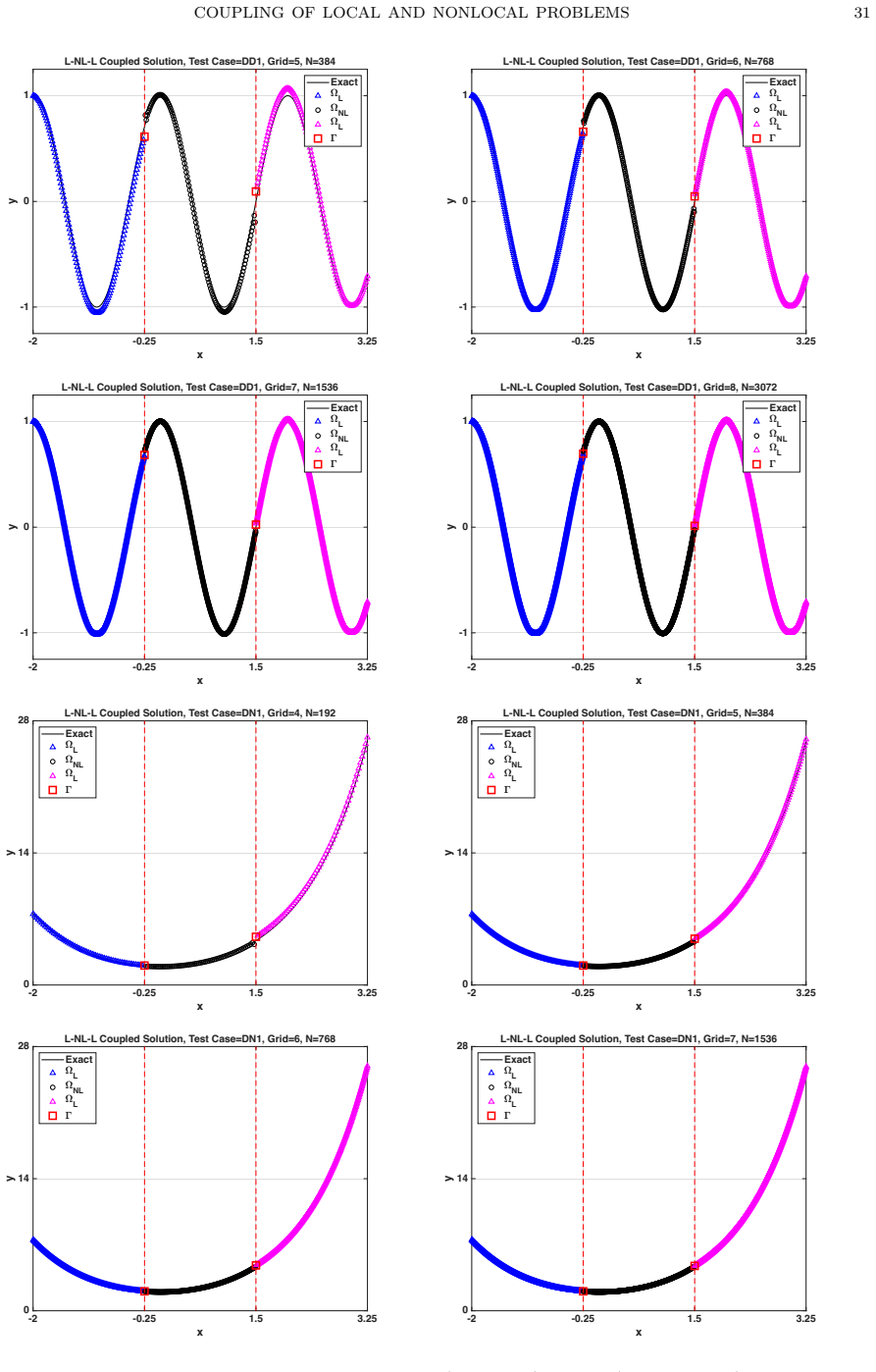
- For smooth solutions, the coupled scheme converges as O(h) in the L2 norm, independent of the solution family; the reported numerical rates are all 1.0 for the coupled problems.
- The interface condition requires no overlap layer or special transmission unknowns, only local boundary data, so standard finite-element and substructuring tools apply to the nonlocal subdomain.
- Configurations with a floating middle subdomain (L-NL-L and NL-L-NL) remain solvable, including pure Neumann problems after rectification.
- The same interface identity extends to horizon sizes delta = 2h and delta = 3h with the same O(h) leading error, so the coupling rate does not degrade as the horizon grows.
- The construction is proposed to generalize to rectangular or box domains in higher dimensions.
Reading between the lines
- The interface identity is essentially a local stencil whose coefficients come from the nonlocal matrix; the same construction may work for other symmetric kernels with suitable scaling, but the paper only tests the flat-top kernel.
- The NL-NL coupling achieves rate 2 in the special case where the Neumann compatibility conditions hold at the interface and rate 1 otherwise, suggesting the observed O(h) bottleneck is the incompatible Neumann interface condition rather than the nonlocal discretization itself; a corrected interface treatment might recover second order.
- For pure Neumann problems, the rectification system needs u(a) and u(b) before the solution is known; a practical implementation would have to estimate these values, for example by iteration, and whether that iteration converges is not addressed in the paper.
- The authors note their Galerkin basis cannot represent discontinuous solutions, the main motivation for nonlocal models; replacing the nodal basis with a discontinuity-capable approximation is an obvious test of whether the interface identity survives crack-like solutions.
Signed reviews
Editorial analysis
A structured set of objections, weighed in public.
Referee Report
Summary. The paper proposes a one-dimensional local-to-nonlocal (LtN) coupling method for diffusion problems, in which the nonlocal operator is designed to enforce local boundary conditions by construction. The method is inspired by domain decomposition and uses only local boundary conditions at the interface. The main claim is an O(h) convergent coupling for arbitrary solutions, with the interface equation approximating the bulk local operator. The authors verify the interface consistency via symbolic Taylor expansions (Eqs. (8.3)-(8.4)) and report extensive numerical experiments for L-NL-L, NL-L-NL, NL-NL, and L-L configurations across Dirichlet, mixed, and pure Neumann problems.
Significance. If the O(h) claim holds as stated, the method would be a valuable addition to the LtN coupling literature, particularly because it uses only local BCs and thus leverages standard FEM machinery on the local side. The explicit Taylor expansions showing that the discretized interface equation collapses to a bulk operator approximation are a nontrivial and reproducible contribution. The numerical experiments cover a variety of configurations and BCs, including floating subdomains, which strengthens the empirical case. However, the paper lacks a global convergence proof, and the rectification step for mixed and pure Neumann problems requires boundary values of the unknown solution, so the central claim must be substantially qualified.
major comments (3)
- [Sec. 10.1-10.2, Eqs. (10.6)-(10.7)] The rectification system for DN problems (Eq. (10.7)) and NN problems (Sec. 10.2) contains the unknown boundary values u(b) and u(a), u(b) on the right-hand side. The text acknowledges this as an 'inevitable additional cost' but gives no iterative or otherwise non-circular procedure to compute these values. The numerical experiments in Sec. 11 supply them from exact solutions, so Tables 11.2-11.4 cannot establish that the method is implementable for an arbitrary problem with BC=DN or NN. Since the abstract claims O(h) convergence for an arbitrary solution, this gap is load-bearing and must be addressed, e.g., by providing a practical algorithm or by restricting the claim to BC configurations where the rectification is computable.
- [Sec. 8.1, Eq. (8.3)] The paper states a 'quantifiable O(h) convergence' for the coupling method and identifies Eq. (8.3) as the mechanism. However, the analysis in Sec. 8 is purely local: a Taylor expansion shows that the discrete interface equation is consistent with -Δu(e)+O(h). No global error estimate is provided; there is no stability or coercivity analysis of the coupled discrete system, and no convergence theorem in H^1 or L^2. The numerical rates in Tables 11.2-11.4 are consistent with O(h), but they do not constitute a proof. The claim should be rephrased as a conjecture supported by numerical evidence, or a global convergence analysis should be added.
- [Abstract and Sec. 12] The phrase 'holds for an arbitrary solution' is too broad. The Taylor expansions require sufficient smoothness, and the numerical experiments only treat smooth exact solutions (cosines, exponentials, and trigonometric functions). The paper itself notes that discontinuous solutions are left for future work. The claim should be qualified to, at most, smooth (C^2 or better) solutions, and the regularity assumptions should be stated explicitly. Otherwise the abstract overstates what is rigorously or empirically supported.
minor comments (5)
- [Sec. 2.1 and passim] There are several typos: 'WeirstrassM-test' should be 'Weierstrass M-test', 'abilility' should be 'ability', 'stiffens' should be 'stiffness'. A proofreading pass is recommended.
- [Sec. 8.2] The color matrices in Figures 8.1 and 8.2 are difficult to read in monochrome. Reproducing the matrices in a typeset form or providing them in a machine-readable supplementary file would improve reproducibility.
- [Sec. 11] The description of the 'rank-one update applied to solve the singular system' for pure Neumann problems is too vague. To reproduce the NN experiments, the exact linear algebra procedure (e.g., enforcing orthogonality to the constant function) should be specified.
- [Sec. 10.1] In Eq. (10.7), the symbol h is used without a prior definition in that section; it is implicitly the mesh size. Clarify the notation.
- [Table 11.6] Table 11.6 is labeled 'nonlocal problem' but it reports DD, DN, NN1, NN2 cases. State explicitly that these are single-domain nonlocal problems solved without coupling, for comparison.
Circularity Check
Rectification for Neumann-type BCs requires unknown boundary values u(b), and for NN also u(a), which the experiments supply from exact solutions; the interfacial Taylor consistency itself is self-contained.
-
self definitional
[Sec. 10.1, after Eq. (10.7)]
"Rectification takes places after the solution w is obtained, hence, the value w(b) is known. Since at x=b, the Neumann BC is enforced, the value u(b) is not known. Rectification in weak form demands this extra information; see (9.7)."
Equation (10.7) determines the harmonic rectifier coefficients a0, a1 from a right-hand side containing (w(b)-u(b))/h. Here u(b) is the unknown nodal value of the very solution the method is supposed to compute, and the paper explicitly says it is 'not known.' No iterative or simultaneous procedure is given. The DN experiments use the exact solution exp(x)+exp(-x) to supply u(b), so the reported O(h) convergence for DN is not a test of a closed numerical method for an arbitrary DN problem: part of the answer is an input to the construction.
-
self definitional
[Sec. 10.2, NN rectification system]
"For the pure Neumann problem, the rectification process calls for the function values of the solution, i.e., u(a) and u(b), at the boundary. The need for these values is an inevitable additional cost of compatibility conditions in weak form; see Remark 2.2."
The NN rectification system has right-hand side entries containing (w(a)-u(a))/h and (w(b)-u(b))/h. Pure Neumann data prescribe only derivatives u'(a) and u'(b), not u(a) and u(b). The paper calls this an 'inevitable additional cost' but provides no fixed-point, continuation, or implicit-solving prescription for obtaining these values. The NN experiments use the exact solutions NN1 and NN2 to fill u(a) and u(b). Thus, for the NN case that is part of the paper's central claim ('O(h) convergence ... for an arbitrary solution'), the construction of the solution requires the solution's own boundary values, making the method partially self-referential.
full rationale
The paper's main constructive content, the interface Taylor expansions in Sec. 8 (Eqs. 8.3 and 8.4), is self-contained: it symbolically expands the Galerkin stencil arising from the local and nonlocal weak forms and shows it equals -Delta u(e)+O(h), with no fitted parameters and no dependence on the experiments. The convergence tables are measured against exact solutions, so the O(h) rate for the coupled stencil is not an invented fit. The operator construction and eigenvalue-convergence scaling are imported from self-cited prior work (Thms. 3.3, 3.4; [9, Sec. 4]), but these are external published mathematical results, not a reduction of the present result to its own input, so I do not count them as circular. The genuine circularity is in the rectification process for Neumann-type boundary conditions: the harmonic extension H that converts the 'wrong' nonlocal solution w into the target u is determined by equations whose right-hand sides contain u(b), and in the NN case also u(a), i.e., the boundary values of the unknown solution. The paper explicitly admits this need and calls it an 'inevitable additional cost,' but offers no algorithm to obtain those values in a general Neumann problem; the numerical experiments simply take them from exact solutions. Consequently, the DD case is closed and the O(h) interface claim is supported, whereas the claimed applicability to arbitrary DN and NN solutions is not established because the construction is partially self-referential. Score 6 reflects this partial circularity, limited to Neumann-type rectification, while the interface consistency analysis remains independent.
Assumptions & free parameters
free parameters (3)
- scl = 3/δ³ (operator scaling) =
3/δ³
- Horizon-to-grid ratio R = δ/h =
R = 3 in all experiments (δ = 3h)
- Boundary values u(a), u(b) for pure-Neumann rectification =
taken from the exact solutions in the experiments
assumptions (7)
- standard math Theorem 3.3: integral representation of the abstract convolution K_p with periodic/antiperiodic extensions on a general interval (proved in [2,5]).
- ad hoc to paper Theorem 3.4: M_orig = M_BC on Ω (for NN,p) or on Bulk (for a,DD,DN,ND), and M_BC enforces the local BC (proved in [5, Thm. 4.1]).
- domain assumption Eigenvalue convergence: lim_{δ→0} λ_k(scl M_DN) = λ_k(−∆_DN), used to justify rectification (Sec. 10.1).
- domain assumption Existence of boundary limits for w, f, v and nonzeroness of lim v at the boundary to divide by it (Sec. 9.1).
- domain assumption Kernel C is flat-top χ_δ with δ < L/2 and δ = Rh (Secs. 3, 5), and scl = 3/δ³ so eigenvalues converge to local ones (Sec. 6).
- domain assumption u and f are smooth enough for Taylor expansions at the interface (implicitly C³ or better).
- ad hoc to paper The rectification decomposition u = w + H with H a linear harmonic function is valid for the NL problem (Sec. 10).
invented entities (1)
-
Rectification (harmonic extension correction)
Cite this review
Pith. "Pith review of Coupling of Local and Nonlocal Problems Using Local Boundary Conditions." pith.science (2026). https://pith.science/paper/QU7PIMHQ
@misc{pith2026260722672,
  author       = {Pith},
  title        = {Pith review of: Coupling of Local and Nonlocal Problems Using Local Boundary Conditions},
  year         = {2026},
  howpublished = {\url{https://pith.science/paper/QU7PIMHQ}},
  note         = {Machine review of arXiv:2607.22672}
}
abstract
We present a novel coupling method for local and nonlocal diffusion problems in 1D. Unlike other methods, our coupling method exclusively uses local boundary conditions. This is possible because our nonlocal operators enforce them by construction. Leveraging this advantageous property, we construct a seamless coupling that is remarkably natural. The utilization of local boundary conditions allows for the transfer of well-established numerical methods from local problems to nonlocal ones. Our local-to-nonlocal coupling method is inspired by the domain decomposition method, which we would like to transfer to nonlocal problems. The main result of our study is the construction of a local-to-nonlocal coupling method with a quantifiable $O(h)$ convergence that holds for an arbitrary solution. For discretization of the local and nonlocal problems, the finite element method and the Galerkin projection are employed, respectively. We verify our convergence rate with extensive numerical experiments.
Figures


Figures from the paper (6 more)


Reference graph
Works this paper leans on
-
[1]
Aksoylu, B.: On four mutual properties of classical and nonlocal wave equations. J. Peridyn. Nonlocal Model. 5, 60–80 (2023). URLhttps://doi.org/10.1063/5.0038929
-
[2]
Aksoylu, B., Beyer, H.R., Celiker, F.: Application and implementation of incorporating local boundary conditions into nonlocal problems. Numer. Funct. Anal. Optim.38(9), 1077–1114 (2017). URLhttps://doi.org/10.1080/ 01630563.2017.1320674
arXiv 2017
-
[3]
Aksoylu, B., Beyer, H.R., Celiker, F.: Theoretical foundations of incorporating local boundary conditions into nonlocal problems. Rep. Math. Phys.40(1), 39–71 (2017). URLhttps://doi.org/10.1016/S0034-4877(17) 30061-7
-
[4]
Aksoylu, B., Celiker, F., Diehl, P.: Analysis and implementation of nonlocal governing operators with local boundary conditions on a general interval. J. Peridyn. Nonlocal Model.6, 802–823 (2024). URLhttps://doi. org/10.1007/s42102-024-00123-1
-
[5]
Aksoylu, B., Celiker, F., Diehl, P.: Construction of nonlocal governing operators with local boundary condi- tions on a general interval. J. Peridyn. Nonlocal Model.6, 773–801 (2024). URLhttps://doi.org/10.1007/ s42102-024-00124-0
2024
-
[6]
Aksoylu, B., Celiker, F., Gazonas, G.A.: Higher order collocation methods for nonlocal problems and their asymptotic compatibility. Comm. Appl. Math. Comput.2, 261–303 (2020). URLhttps://doi.org/10.1007/ s42967-019-00051-8
2020
-
[7]
Aksoylu, B., Celiker, F., Kilicer, O.: Nonlocal problems with local boundary conditions in higher dimensions. Adv. Comp. Math.45(1), 453–492 (2019). URLhttps://doi.org/10.1007/s10444-018-9624-6
-
[8]
Aksoylu, B., Gazonas, G.A.: On nonlocal problems with inhomogeneous local boundary conditions. J. Peridyn. Nonlocal Model.2, 1–25 (2020). URLhttps://doi.org/10.1007/s42102-019-00022-w
Show all 33 references
-
[9]
Aksoylu, B., Gazonas, G.A.: On the choice of kernel function in nonlocal wave propagation. J. Peridyn. Nonlocal Model.2, 379–400 (2020). URLhttps://doi.org/10.1007/s42102-020-00034-x
2020 doi
-
[10]
Beyer, H.R., Aksoylu, B., Celiker, F.: On a class of nonlocal wave equations from applications. J. Math. Phy. 57(6), 062,902 (2016). URLhttps://doi.org/10.1063/1.4953252
2016 doi
-
[11]
Bie, Y., Cui, X., Li, Z.: A coupling approach of state-based peridynamics with node-based smoothed finite element method. Comput. Methods Appl. Mech. Engrg.331, 675–700 (2018)
2018
-
[12]
Carraro, T., Wetterauer, S.: On the implementation of the eXtended Finite Element Method (XFEM) for interface problems. Arch. of Numer. Softw.4(2), 1–23 (2019). URLhttps://doi.org/10.11588/ans.2016.2. 22317
2019 doi
-
[13]
Journal of Peridynamics and Nonlocal Modeling4(3), 336–366 (2022)
Diehl, P., Prudhomme, S.: Coupling approaches for classical linear elasticity and bond-based peridynamic models. Journal of Peridynamics and Nonlocal Modeling4(3), 336–366 (2022)
2022
-
[14]
Society for Industrial and Applied Mathematics, Philadelphia (2015)
Dolean, V., Jolivet, P., Nataf, F.: An Introduction to Domain Decomposition Methods: Algorithms, Theory, and Parallel Implementation. Society for Industrial and Applied Mathematics, Philadelphia (2015)
2015
-
[15]
D’Elia, M., Li, X., Seleson, P., Tian, X., Yu, Y.: A review of local-to-nonlocal coupling methods in nonlocal diffusion and nonlocal mechanics. J. Peridyn. Nonlocal Model.4(1), 1–50 (2022)
2022
-
[16]
Galvanetto, U., Mudric, T., Shojaei, A., Zaccariotto, M.: An effective way to couple FEM meshes and Peri- dynamics grids for the solution of static equilibrium problems. Mech. Res. Commun.76, 41 – 47 (2016). DOI https://doi.org/10.1016/j.mechrescom.2016.06.006
2016 doi
-
[17]
Prentice Hall (1998)
Greenberg, M.D.: Advanced Engineering Mathematics; Second Edition. Prentice Hall (1998)
1998
-
[18]
Jiang, S., Glusa, C.: A splice method for local-to–nonlocal coupling of weak forms. Comput. Methods Appl. Mech. Engrg.430, 117216 (2024). URLhttps://doi.org/10.1016/j.cma.2024.117216
2024
-
[19]
Kilic, B., Madenci, E.: Coupling of peridynamic theory and the finite element method. J. Mech. Mater. Struct. 5(5), 707–733 (2010)
2010
-
[20]
Liu, W., Hong, J.W.: A coupling approach of discretized peridynamics with finite element method. Comput. Methods Appl. Mech. Engrg.245, 163–175 (2012) 30 BURAK AKSOYLU, F ATIH CELIKER, AND PATRICK DIEHL
2012
-
[21]
In: 2018 AIAA/ASCE/AHS/ASC Structures, Structural Dynamics, and Materials Conference, p
Madenci, E., Barut, A., Dorduncu, M., Phan, N.D.: Coupling of peridynamics with finite elements without an overlap zone. In: 2018 AIAA/ASCE/AHS/ASC Structures, Structural Dynamics, and Materials Conference, p. 1462 (2018)
2018
-
[22]
In: Peridynamic Theory and Its Applications, pp
Madenci, E., Oterkus, E.: Coupling of the Peridynamic Theory and Finite Element Method. In: Peridynamic Theory and Its Applications, pp. 191–202. Springer New York, New York, NY (2014)
2014
-
[23]
Springer, Springer-Verlag Berlin Heidelberg (2008)
Mathew, T.P.A.: Domain Decomposition Methods for the Numerical Solution of Partial Differential Equations. Springer, Springer-Verlag Berlin Heidelberg (2008)
2008
-
[24]
Ni, T., Zaccariotto, M., Zhu, Q.Z., Galvanetto, U.: Coupling of FEM and ordinary state-based peridynamics for brittle failure analysis in 3D. Mech. Adv. Mater. Struct.28(9), 875–890 (2021)
2021
-
[25]
Nikpayam, J., Kouchakzadeh, M.A.: A variable horizon method for coupling meshfree peridynamics to FEM. Comput. Methods Appl. Mech. Engrg.355, 308–322 (2019)
2019
-
[26]
Ongaro, G., Seleson, P., Galvanetto, U., Ni, T., Zaccariotto, M.: Overall equilibrium in the coupling of peridy- namics and classical continuum mechanics. Comput. Methods Appl. Mech. Engrg.381, 113,515 (2021)
2021
-
[27]
Oxford University Press, Oxford (1999)
Quarteroni, A., Valli, A.: Domain Decomposition Methods for Partial Differential Equations. Oxford University Press, Oxford (1999)
1999
-
[28]
Silling, S.: Reformulation of elasticity theory for discontinuities and long-range forces. J. Mech. Phys. Solids48, 175–209 (2000)
2000
-
[29]
Sandia Report (SAND2020-11382) (2020)
Silling, S.: Local-nonlocal coupling in Emu/PDMS. Sandia Report (SAND2020-11382) (2020)
2020
-
[30]
Silling, S., Littlewood, D., Seleson, P.: Variable horizon in a peridynamic medium. J. Mech. Mater. Struct. 10(5), 591–612 (2015)
2015
-
[31]
Sun, W., Fish, J.: Superposition-based coupling of peridynamics and finite element method. Comput. Mech. pp. 1–18 (2019)
2019
-
[32]
Springer Series in Compu- tational Mathematics
Toselli, A., Widlund, O.: Domain Decomposition Methods – Algorithms and Theory. Springer Series in Compu- tational Mathematics. Springer (2005)
2005
-
[33]
Zaccariotto, M., Mudric, T., Tomasi, D., Shojaei, A., Galvanetto, U.: Coupling of FEM meshes with Peridynamic grids. Comput. Methods Appl. Mech. Engrg.330, 471–497 (2018) COUPLING OF LOCAL AND NONLOCAL PROBLEMS 31 x -2 -0.25 1.5 3.25 y -1 0 1 L-NL-L Coupled Solution, Test Case...
2018
Reviewed August 2, 2026 · model on record in the stance chip above.
Discussion (0). Continue with ORCID to comment.