REVIEW 2 major objections 3 minor 30 references
Level-set entropy and sparse randomized embeddings
T0 review · 2 major / 3 minor · reviewed 2026-08-01 · deepseek-v4-flash
Pith's one-line read This paper proves that a k×n sparse random matrix with Bernoulli entries of mean p≈(log k)/k has spectral norm O(√kp) on every fixed r-dimensional subspace, for any k≥C r(log log r)^2.
desk verdict Genuine advance in sparse OSE upper bounds; the n-independent part needs referee verification of an external black box. read the letter →
The pith
A machine-rendered reading of the paper's core claim, the machinery that carries it, and where it could break.
The reading
What carries the argument
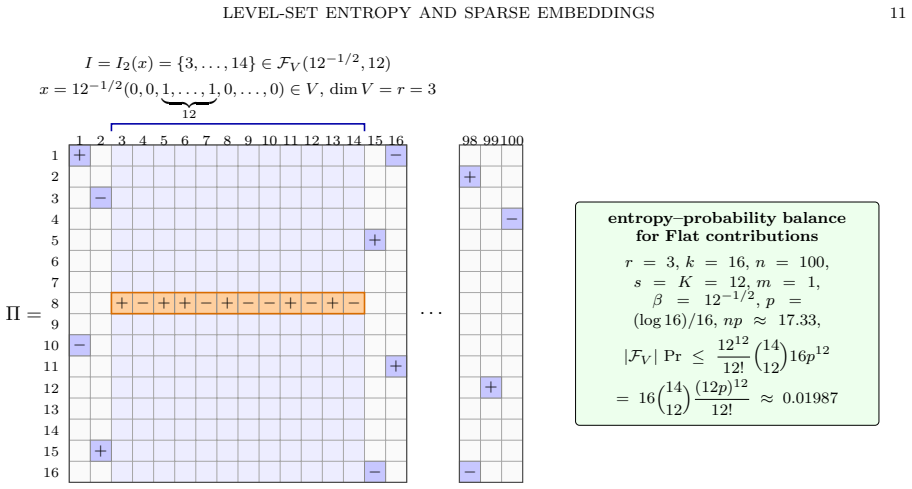
The load-bearing object is the level-set entropy family F_V(β,s), together with the exact entropy bound |F_V(β,s)|≤(β^{−2s}/s!)·binom(r+s−1,s). Counting is reduced to Bombieri–Weyl norms of the polynomials p_I(y)=∏_{i∈I}⟨y,P_V e_i⟩; the Parseval identity closes the count. The second mechanism is the canonical Tall–Flat decomposition: for each vector x, dyadic coordinate levels I_j(x) are assigned row-degree cutoffs K_j=L max{pr_*, p|I_j(x)|}; entries in rows whose mask-degree on a level exceeds K_j are moved to a Flat matrix whose ℓ₂ norm is bounded by a leaf square function of a two-level partition. The Tall matrix is handled by a modified Kahn–Szemerédi envelope summation in which entropy
What would settle it
Check whether the cited matrix universality theorem's hypotheses are satisfied in Proposition 7.7: for q=⌈c_0 log(ek)⌉, verify the moment comparison (49) for sums of Hermitized rank-two matrices with covariance v(I_k⊗U^*P_{H^c}U) and the stated Gaussian target. A concrete numerical check: take n≫r^10, choose V spanned by a random isometry, set k=C r(log log r)^2 and p=(log k)/k, and examine the distribution of ||ΠU_V||/(√kp); consistent values above, say, 10 with non-negligible frequency would contradict Corollary 1.6.
Extended reading notes
Core claim
On the paper's own terms, the central discovery is that the spectral norm of a sparse random map on a fixed low-dimensional subspace is governed by the number of coordinate patterns that unit vectors in that subspace can actually realize, not by the ambient dimension. Lemma 3.1 bounds the family F_V(β,s) of s-element subsets lying in a β-level set of some unit vector in V by (C(r+s)/(β²s²))^s, via the Parseval identity ∑ᵢ P_V e_i ⊗ P_V e_i = I_V. Combined with a Kahn–Szemerédi light/heavy decomposition, a Tall–Flat partition that zeroes rows that are too heavy on each dyadic level, and an entropy–probability balance for the Flat majorant, this yields Theorem 1.4: under n≤r^10, k≥r log²(en/r)
Load-bearing premise
The load-bearing premise is that the external matrix-universality inequality used in Proposition 7.7 remains valid with moment parameter q≈log k and the Gaussian comparator constructed there; if that black box fails at these parameters, the n-independent form of the main result no longer follows by this proof, though the n≤r^10 bound survives.
Editorial extensions
If this is right
- If correct, Corollary 1.6 gives the first upper spectral bound O(√kp) for Bernoulli-sparse embeddings at average column sparsity log k and k only a (log log r)^2 factor above the conjectured optimal k=Ω(r).
- For Rademacher entries, combining with the known lower-edge estimate yields a constant-distortion oblivious subspace embedding at p≍(log k)/k and k≍r(log log r)^2, a direct step toward the fixed-distortion form of the Nelson–Nguyen conjecture.
- The entropy method replaces trace/Gaussian comparison tools for the upper edge and extends to any support mask that is negatively associated, including fixed-column-degree and SparseStack^T models.
- For fixed-column-degree and unnormalized SparseStack^T models, Corollary 7.6 gives ||ΠU_V||≤C√d (resp. C√s) with failure probability k^{−B}, so the bound transfers to deterministic column sparsity.
Reading between the lines
- The weakest point of the paper is not the entropy method but the passage from n≤r^10 to arbitrary n: Corollary 1.6 absorbs an external matrix universality theorem at moment parameter q≈log k, whose full hypotheses are not reproduced in the text. A direct verification of that theorem's applicability is the step to scrutinize.
- The entropy bound is dimension-free and does not rely on negative association; the same level-set counting should control other rectangular random designs as long as the row-degree cutoffs can be defined, such as deterministic column sparsity or matrices with dependent amplitudes.
- A sharpening of the entropy–probability balance to remove the (log log r)^2 factor would resolve the upper-bound side of the fixed-distortion Nelson–Nguyen problem; the apparent obstruction lies in the Flat-majorant summation over leaf widths.
- A concrete numerical consequence of the claimed dimension independence: for n≫r^10 and a random r-subspace, the empirical distribution of ||ΠU_V||/(√kp) should concentrate below a universal constant when k=C r(log log r)^2 and p=(log k)/k.
Editorial analysis
A structured set of objections, weighed in public.
Referee Report
Summary. The paper develops an entropy-based method to bound the spectral norm of a sparse random matrix restricted to a fixed r-dimensional subspace. For an admissible sparse-entry model with a negatively associated support mask and centered entries bounded by one, it proves (Theorem 1.4) that if n≤r^10, k≥r log^2(en/r), and p≥log k/k, then ||ΠU_V||≤C sqrt(kp) with probability at least 1−k^{−B}. The proof combines a new level-set entropy estimate (Lemma 3.1), a Tall–Flat decomposition, a Kahn–Szemerédi envelope for the Tall part, and a leaf-square-function analysis for the Flat part. For the three concrete models (i.i.d., fixed-column-degree, SparseStack^T), a hybrid leverage-score argument (Corollary 1.6) removes the n≤r^10 restriction at the cost of k≥C r(log log r)^2, using a matrix universality theorem of Brailovskaya–van Handel.
Significance. If correct, the n-independent statement gives the first O(sqrt(kp)) upper spectral bound at near-logarithmic sparsity with k superlinear in r by only a (log log r)^2 factor, improving on prior proportional-dimension results. The level-set entropy bound is genuinely novel and dimension-free, and the main theorem's proof is largely self-contained: constants are existential or universal, there is no fitted-parameter circularity, and the central estimates are derived from first principles plus standard concentration lemmas. The main vulnerability is the black-box use of [6] in Proposition 7.7, on which the entire n-independent Corollary 1.6 rests.
major comments (2)
- [§7.4, Proposition 7.7 and Corollary 1.6] The n-independent conclusion depends on (49), an application of [6, Theorem 2.9] with q=ceil(c0 log(ek)), q_BvH=2q, and tau=q^{-4}. The hypotheses of [6, Theorem 2.9] are not reproduced, and the proof does not verify them for the specific Hermitian dilations Z_i at these parameters: the definition of R_BvH_{2q}(X), the allowed range of moment parameters, and the exact form of the additive q-dependent term are all taken on faith. The cancellation q^2 sqrt(tau)=1 and the estimate (53) fail if the additive term has a different q-power or if p_BvH=q is outside the theorem's range. Since this is the only step that removes n≤r^10, the authors must state the theorem and check its hypotheses explicitly. This is a load-bearing point, not a matter of presentation.
- [§7.4, proof of Corollary 1.6, parameter verification (50)] The verification of (50) is too compressed. The chain N≤k q^4 and the bound (k q^4)^{1/10} log^2(ek q^4) ≤ k are asserted without proof. For k below an absolute threshold the displayed inequality is false; the phrase 'after increasing the universal constant' can absorb this only if the small-k cases are explicitly discharged, e.g., by making the corollary's assumption empty for k below that threshold. Please make this quantitative or state that finitely many small k,r are handled by enlarging the final constant.
minor comments (3)
- [Title] The title page shows 'SP ARSE' with an extra space; it should read 'SPARSE'.
- [§7.4] In Corollary 1.6, 'R:=max{r, ceil(N^{1/10})}' is typeset with OCR artifacts ('l N 1/10 m'); restore the mathematical notation.
- [§7.3, Definition 7.4] The notation SparseStack^T appears both as 'SparseStack^T' and 'SparseStack T' in different places; unify the notation for clarity.
Circularity Check
No significant circularity: the main spectral bound is derived from internal entropy and Kahn–Szemerédi arguments plus external published theorems; the only self-citation is not load-bearing.
full rationale
The derivation chain is self-contained with respect to the claimed results. Theorem 1.4 is proved through the Tall–Flat decomposition (Definitions 1.9–1.13), the level-set entropy estimate Lemma 3.1, the subspace-sensitive edge-count Lemma 3.3, and internal Kahn–Szemerédi envelope arguments; none of these inputs assume the target O(sqrt{kp}) bound. Proposition 4.1 handles the Tall term and Section 6 handles the Flat term internally. Corollary 1.6 removes the n≤r^10 restriction by a leverage-score split: the large-leverage part re-applies Theorem 1.4 after extending the subspace to dimension R, while the small-leverage part invokes the external matrix universality theorem [6, Theorem 2.9] in Proposition 7.7, with q and τ chosen so that the q^2√τ factor cancels. The moment hypothesis (52) is derived from the actual column distribution via a binomial bound, not postulated as the desired spectral estimate. The cited universality theorem is external published work, not a self-citation. The only self-citation is [19], used in Definition 7.4 only to identify the unnormalized SparseStack^T model; the admissibility of that model is proved independently in Proposition 7.5, and [19] plays no role in the proof of the spectral bound. No fitted parameters, no renamed empirical pattern, and no imported uniqueness theorem appear. The possible unverified hypotheses of [6, Theorem 2.9] are a correctness or verification concern about an external black box, not evidence of circular dependence of the paper's conclusion on its own inputs.
Assumptions & free parameters
assumptions (7)
- standard math Negative-association decoupling: products of nonnegative non-decreasing functions on disjoint blocks factor (Lemma 2.7, eq. (7)).
- standard math Bombieri-norm estimate |p(y)|≤||p||_* ||y||_2^s and the Parseval identity ∑_i P_V e_i ⊗ P_V e_i = I_V (Lemma 3.1).
- standard math Chernoff and Bernstein concentration for negatively associated 0-1 variables (Lemma 2.7, eqs. (9)–(10)).
- domain assumption Brailovskaya–van Handel matrix universality comparison inequality [6, Theorem 2.9] applies at q=⌈c0 log(ek)⌉.
- standard math Gaussian concentration and Gordon-type norm bounds for GB_I via [18, Props. 10.1, 10.3].
- domain assumption Stated hypotheses: p≥(log k)/k, |ξ|≤1, Eξ=0, n≤r^{10}, k≥r log^2(en/r) for Theorem 1.4; Corollary 1.6 removes the n-restriction.
- domain assumption Lower-edge estimates of Tropp [28] for the constant-distortion OSE conclusion in Remark 7.8.
Cite this review
Pith. "Pith review of Level-set entropy and sparse randomized embeddings." pith.science (2026). https://pith.science/paper/TOFU5ILF
@misc{pith2026260723017,
  author       = {Pith},
  title        = {Pith review of: Level-set entropy and sparse randomized embeddings},
  year         = {2026},
  howpublished = {\url{https://pith.science/paper/TOFU5ILF}},
  note         = {Machine review of arXiv:2607.23017}
}
abstract
Let $\Pi$ be a $k\times n$ sparse random matrix. For a fixed $r$-dimensional subspace $V\subset{\mathbb R}^n$, let $U_V:{\mathbb R}^r\to{\mathbb R}^n$ denote an isometry from ${\mathbb R}^r$ onto $V$. The product $\Pi U_V$ is a central model in randomized dimension reduction and has been studied primarily through trace and Gaussian comparison inequalities. In this work, we develop an approach to the spectral norm of the matrix product $\Pi U_V$, based on entropy estimates for level sets of vectors $x\in V$. Combining the method with existing estimates, we show the following. Assume that \[ k\ge C\,r(\log\log r)^2,\qquad p\ge (\log k)/k. \] Let $\Pi$ be a $k\times n$ matrix with i.i.d. entries equidistributed with the product $b\,\xi$, where $b$ is a Bernoulli($p$) random variable and $\xi$ is mean-zero, independent of $b$, and satisfies $|\xi|\le1$ almost surely. Then with high probability \[ \|\Pi U_V\|\le C\sqrt{kp}. \] Matching results hold for other random models with negatively associated entries.
Figures


Figures from the paper (1 more)
Reference graph
Works this paper leans on
-
[12]
M. B. Cohen, Nearly tight oblivious subspace embeddings by trace inequalities, inProceedings of the 27th Annual ACM–SIAM Symposium on Discrete Algorithms, 2016, 278–287
2016
-
[9]
S. Chenakkod, M. Derezi´ nski, and X. Dong, Optimal subspace embeddings: Resolving Nelson–Nguyen conjecture up to sub-polylogarithmic factors, preprint, arXiv:2508.14234, 2025
arXiv 2025
- [19]
-
[6]
Brailovskaya and R
T. Brailovskaya and R. van Handel, Universality and sharp matrix concentration inequalities,Geom. Funct. Anal.34 (2024), no. 6, 1734–1838
2024
-
[1]
Achlioptas, Database-friendly random projections: Johnson–Lindenstrauss with binary coins,J
D. Achlioptas, Database-friendly random projections: Johnson–Lindenstrauss with binary coins,J. Comput. System Sci.66 (2003), no. 4, 671–687
2003
-
[2]
Ailon and B
N. Ailon and B. Chazelle, The fast Johnson–Lindenstrauss transform and approximate nearest neighbors,SIAM J. Comput.39 (2009), no. 1, 302–322
2009
-
[3]
Beauzamy, E
B. Beauzamy, E. Bombieri, P. Enflo, and H. L. Montgomery, Products of polynomials in many variables,J. Number Theory36 (1990), no. 2, 219–245
1990
-
[4]
Boucheron, G
S. Boucheron, G. Lugosi, and P. Massart,Concentration inequalities: A nonasymptotic theory of independence, Oxford University Press, Oxford, 2013
2013
Show all 30 references
-
[5]
Bourgain, S
J. Bourgain, S. Dirksen, and J. Nelson, Toward a unified theory of sparse dimensionality reduction in Euclidean space,Geom. Funct. Anal.25 (2015), no. 4, 1009–1088
2015
-
[7]
Cama˜ no, E
C. Cama˜ no, E. N. Epperly, R. A. Meyer, and J. A. Tropp, Faster linear algebra algorithms with structured random matrices, preprint, arXiv:2508.21189, 2025
2025 arXiv
-
[8]
Chenakkod, M
S. Chenakkod, M. Derezi´ nski, and X. Dong, Optimal oblivious subspace embeddings with near-optimal sparsity, in52nd International Colloquium on Automata, Languages, and Programming, LIPIcs 334, Schloss Dagstuhl– Leibniz-Zentrum f¨ ur Informatik, 2025, Art. 55, 55:1–55:20
2025
-
[10]
Chenakkod, M
S. Chenakkod, M. Derezi´ nski, X. Dong, and M. Rudelson, Optimal embedding dimension for sparse subspace embeddings, inProceedings of the 56th Annual ACM Symposium on Theory of Computing, 2024, 1106–1117
2024
-
[11]
K. L. Clarkson and D. P. Woodruff, Low-rank approximation and regression in input sparsity time, inProceedings of the 45th Annual ACM Symposium on Theory of Computing, 2013, 81–90
2013
-
[13]
Dasgupta, R
A. Dasgupta, R. Kumar, and T. Sarl´ os, A sparse Johnson–Lindenstrauss transform, inProceedings of the 42nd ACM Symposium on Theory of Computing, 2010, 341–350
2010
-
[14]
Dubhashi and D
D. Dubhashi and D. Ranjan, Balls and bins: A study in negative dependence,Random Structures Algorithms 13 (1998), no. 2, 99–124
1998
-
[15]
Feige and E
U. Feige and E. Ofek, Spectral techniques applied to sparse random graphs,Random Structures Algorithms27 (2005), no. 2, 251–275
2005
-
[16]
Friedman, J
J. Friedman, J. Kahn, and E. Szemer´ edi, On the second eigenvalue of random regular graphs, inProceedings of the 21st Annual ACM Symposium on Theory of Computing, 1989, 587–598
1989
-
[17]
Gordon, Some inequalities for Gaussian processes and applications,Israel J
Y. Gordon, Some inequalities for Gaussian processes and applications,Israel J. Math.50 (1985), 265–289. LEVEL-SET ENTROPY AND SPARSE EMBEDDINGS 53
1985
-
[18]
Halko, P.-G
N. Halko, P.-G. Martinsson, and J. A. Tropp, Finding structure with randomness: Probabilistic algorithms for constructing approximate matrix decompositions,SIAM Rev.53 (2011), no. 2, 217–288
2011
-
[20]
Joag-Dev and F
K. Joag-Dev and F. Proschan, Negative association of random variables with applications,Ann. Statist.11 (1983), no. 1, 286–295
1983
-
[21]
D. M. Kane and J. Nelson, Sparser Johnson–Lindenstrauss transforms,J. ACM61 (2014), no. 1, article 4, 23 pp
2014
-
[22]
R. H. Keshavan, A. Montanari, and S. Oh, Matrix completion from a few entries,IEEE Trans. Inform. Theory 56 (2010), no. 6, 2980–2998
2010
-
[23]
Martinsson and J
P.-G. Martinsson and J. A. Tropp, Randomized numerical linear algebra: Foundations and algorithms,Acta Numer.29 (2020), 403–572
2020
-
[24]
Nelson and H
J. Nelson and H. L. Nguyen, OSNAP: Faster numerical linear algebra algorithms via sparser subspace embed- dings, inProceedings of the 54th Annual IEEE Symposium on Foundations of Computer Science, 2013, 117–126
2013
-
[25]
Nelson and H
J. Nelson and H. L. Nguyen, Lower bounds for oblivious subspace embeddings, inAutomata, Languages, and Programming, Lecture Notes in Comput. Sci. 8572, Springer, 2014, 883–894
2014
-
[26]
Oymak and J
S. Oymak and J. A. Tropp, Universality laws for randomized dimension reduction, with applications,Inf. Infer- ence7 (2018), no. 3, 337–446
2018
-
[27]
T. Sarl´ os, Improved approximation algorithms for large matrices via random projections, inProceedings of the 47th Annual IEEE Symposium on Foundations of Computer Science, 2006, 143–152
2006
-
[28]
J. A. Tropp, Comparison theorems for the minimum eigenvalue of a random positive-semidefinite matrix,Comm. Amer. Math. Soc., to appear; arXiv:2501.16578, 2026
2026 arXiv
-
[29]
J. A. Tropp, Subspace injections, lecture at the Institute for Computational and Experimental Research in Mathematics (ICERM), Providence, RI, February 4, 2026, slides
2026
-
[30]
D. P. Woodruff, Sketching as a tool for numerical linear algebra,Found. Trends Theor. Comput. Sci.10 (2014), no. 1–2, 1–157. AppendixA.Proof of the standard envelope summation lemma We briefly recall the setup of Lemma 4.10. The parametersk≥d≥3 and 0< p≤1 determine the cutoffρ...
2014
Reviewed August 1, 2026 · model on record in the stance chip above.
Discussion (0). Sign in to comment.