REVIEW 2 major objections 7 minor 96 references
Quasistatic modeling of ultrarelativistic beam-plasma instabilities
T0 review · 2 major / 7 minor · reviewed 2026-07-31 · grok-4.5
Pith's one-line read A unified quasistatic model shows spatiotemporal current filamentation prevails near a relativistic beam front, and only later yields to oblique two-stream growth.
desk verdict Solid unified quasistatic theory that actually finds a new front-region spatiotemporal CFI and a clean CFI–OTSI handoff; math and PIC checks hold up. read the letter →
The pith
A machine-rendered reading of the paper's core claim, the machinery that carries it, and where it could break.
The reading
What carries the argument
The quasistatic master equation for the perturbed plasma density (Eq. 15 / reduced form Eq. 18), obtained by decoupling slow beam evolution from fast plasma response in comoving coordinates and retaining full electromagnetic coupling without the slowly varying envelope approximation; it supplies the Green’s function whose asymptotics separate front CFI from rear OTSI and recover narrow-beam modes.
What would settle it
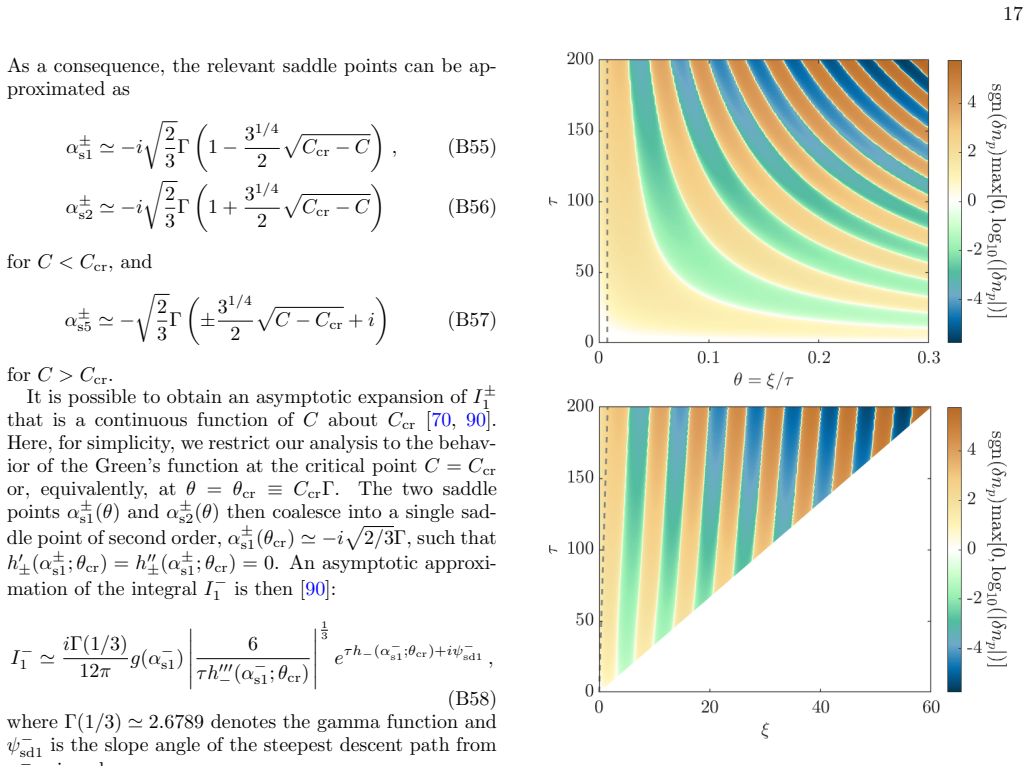
A high-resolution particle-in-cell run of a dilute ultrarelativistic pair beam should show magnetically dominated, non-oscillatory growth matching the spatiotemporal CFI formula near the front and electric-field-dominated oscillatory OTSI growth only past the predicted transition ξ_tr ≃ 0.385 Γ_CFI τ; failure of that spatial hierarchy would falsify the claim.
Extended reading notes
Core claim
Under conditions where standard temporal theory expects OTSI to dominate, a spatiotemporal CFI actually prevails in a front region ξ ≲ 0.385 Γ_CFI τ (precisely where the slowly varying envelope approximation fails) and is superseded by spatiotemporal OTSI only deeper in the beam; the same cold-fluid quasistatic master equation unifies this competition with longitudinal two-stream, self-modulation, and hosing modes.
Load-bearing premise
Plasma and field quantities must vary much faster along the beam than in time, so the analysis is restricted to a limited region behind the front and cannot capture purely temporal oblique growth farther back.
Editorial extensions
If this is right
- Near-front magnetic filaments of length ~0.4 N_e skin depths are generic for dilute ultrarelativistic beams, independent of small density ratio or large Lorentz factor.
- Short Gaussian beams (σ_x ~ plasma skin depth) can be treated with the same equation once Γ_CFI is allowed to vary with local density.
- Self-modulation and hosing share the identical spatiotemporal envelope equation as OTSI in the large-transverse-wavenumber limit, so narrow-beam accelerator instabilities are continuous with classical streaming modes.
- Quasistatic particle-in-cell codes become a viable large-scale tool for dilute astrophysical pair beams whose dynamical timescales are inaccessible to standard PIC.
Reading between the lines
- If the front CFI region is robust, laboratory diagnostics that sample only the beam head may systematically report magnetic rather than electrostatic signatures even when bulk theory predicts OTSI.
- The same master equation could be extended to mildly magnetized or warm beams to test whether the CFI–OTSI transition surface survives once thermal or cyclotron terms are restored.
- Astrophysical pair cascades from TeV blazars may filament over a larger fraction of the beam head than pure temporal CFI estimates suggested, altering the competition with inverse-Compton cooling.
Editorial analysis
A structured set of objections, weighed in public.
Referee Report
Summary. The manuscript develops a unified, fully electromagnetic, cold-fluid theory of the linear stage of streaming instabilities driven by bounded ultrarelativistic beams in unmagnetized plasma. Using the quasistatic approximation (QSA) in comoving coordinates and deliberately avoiding the slowly varying envelope approximation (SVEA), the authors derive a single master equation [Eq. (15)] for the spatiotemporal evolution of perturbations. For transversely wide beams they reduce it to Eq. (18), solve it by double Laplace transform and steepest descent (Appendices A–C, including an exact Bessel-function solution in the ∂²_ξ ≫ 1 limit), and find that spatiotemporal CFI — with a scaling distinct from the earlier SVEA result of Ref. [56] — dominates a front region ξ ≲ ξ_tr ≃ 0.385 Γ_CFI τ, while spatiotemporal OTSI takes over deeper in the beam; the transition corresponds to a coalescence of saddle points. The model is then extended to Gaussian longitudinal profiles [Eq. (32)], to longitudinal TSI for wide beams, and to SMI/HI for narrow beams, which are shown to share the OTSI spatiotemporal dynamics in the k_y → ∞ limit. 1D and 2D PIC simulations (CALDER) are used throughout to validate the asymptotic predictions. The central claims are (i) the previously unreported front-region spatiotemporal CFI under conditions where temporal theory predicts OTSI dominance, (ii) the parameter-free transition boundary, and (iii) the unification of SMI/HI with OTSI. The derivation is standard and透明ly
Significance. If it holds, this is a useful and genuinely new contribution to the theory of relativistic beam-plasma instabilities. The strengths are substantial: (i) a single parameter-free master equation spanning CFI, OTSI, TSI, SMI and HI; (ii) a quantitative, falsifiable prediction — the CFI/OTSI transition at ξ_tr = (2/√27)Γ_CFI τ and the ~0.4 N_e skin-depth extent of front filaments, independent of beam density and Lorentz factor; (iii) an exact Bessel-function Green's function in the sharp-front limit and fully worked steepest-descent asymptotics (including the second-order coalescing saddle at C = C_cr), cross-checked against direct numerical inversion (Figs. 10–12); (iv) independent PIC validation for flat-top and Gaussian beams with stated parameters, plus a consistent SMI/HI/OTSI unification in the k_y → ∞ limit. The results bear directly on AWAKE/FACET-II-class experiments, on pair-beam propagation in blazar/IGM debates, and they motivate quasistatic PIC as the practical tool for dilute ultrarelativistic beams. The departure from the earlier SVEA-based CFI picture [56] is derived, not asserted, and the conditions of validity (QSA, ξ ≲ τ/3, cold fluid, γ_b ≫ 1) are stated plainly.
major comments (2)
- [§III.C, Fig. 2(c)] The comparison in Fig. 2(c) of fixed-position simulation data (a window spanning 0 ≤ kpξ ≲ 4) against the critical-point solution Eq. (30) is not strictly justified as written. Eq. (30) describes an observer moving along the ray ξ = C_cr Γ_CFI τ; at fixed ξ, the asymptotics are Eq. (28) (with a time-dependent local rate d/dτ[2√(Γξτ)] = √(Γξ/τ)) or Eq. (29), depending on the sign of ξ − ξ_tr(τ). Since ξ_tr sweeps through the diagnostic window during the run, the observed constant slope ≈ 1.09 Γ_CFI plausibly reflects the window straddling the moving transition layer, but this should be demonstrated — e.g., by overplotting the local slope predicted by Eq. (28)/(29) evaluated at the windowed ξ, or by extracting the amplitude along the moving ray ξ = ξ_tr(τ) from the simulation. This point is load-bearing because Fig. 2(c) is the evidence for the transition region, one of the paper's central
- [§III.B–C and Appendix C: seeding of the instability] The analytical results are Green's functions for a front-localized impulse (Eqs. 24–30) or for an extended disturbance imposed at τ = 0 (Appendix C), whereas the PIC modes grow from particle-discreteness noise that is generated continuously and throughout the beam volume. Appendix C partially addresses this by showing robustness to an extended initial seed (including the neat cancellation of the e^{Γτ} terms between K and the J±_3 loop integrals), but a continuously generated volume source is a different convolution. Given that the theory–simulation agreement in Figs. 2–4 is the principal validation of the central claim, a short argument in §III.C that convolution of the Green's function with broadband volume noise is dominated by the same saddle contributions (or a direct numerical check along the lines of Figs. 10–12) would close this gap.
minor comments (7)
- [Appendix B.2 / Fig. 9] The caption of Fig. 9 states θ = 0.12 (C = 0.6 > C_cr), but the text of §B.2 says the saddle points 'move off the imaginary axis as illustrated in Fig. 9 for θ = 0.6'. One of the two values is wrong (presumably C = 0.6 with θ = 0.12); please reconcile.
- [§III.A, paragraph after Eq. (18)] The text states that 'the crossed derivative term ∂ξ∂τ in Eq. (18) does not vanish for large γ_b'. Eq. (18) contains the mixed operator ∂²_ξ∂²_τ, not ∂ξ∂τ; a genuine ∂ξ∂τ term appears only after the e^{−iξ} envelope substitution leading to Eq. (21). Please reword for precision.
- [§III.A] The sentence 'which is far more restrictive than the condition ξ/τ ≪ √(n_b/γ_b) associated with Eq. (20)' appears to misreference: Eq. (20) is the SVEA result of Ref. [56] whose validity condition is ξ/τ ≪ Q; the condition ξ/τ ≪ Γ_CFI ∼ √(n_b/γ_b) belongs to the solution of Eq. (19).
- [Figs. 2, 4, 7] Please state how the absolute normalization (vertical offset) of the theoretical curves relative to the PIC data is chosen in Figs. 2(b–d), 4(a), and 7. Also in Fig. 2 the caption symbols 'fEy²' and 'fBz²' appear to be formatting artifacts.
- [Fig. 7 caption; Fig. 4(a)] The caption refers to 'asymptotic analytical predictions from ... (c) Eq. (18)' for the OTSI panel; presumably the asymptotic solution Eq. (29) is meant. Similarly, Fig. 4(a) labels the ordinate |F_y| while the text defines and uses F_⊥; please unify the notation.
- [§II and §V: 2D restriction] The analysis is restricted to the x–y plane, with a claim of ready generalization to 3D. One or two sentences on whether the CFI–OTSI hierarchy and the ξ_tr ≃ 0.385 Γ_CFI τ boundary are unchanged when the transverse wavevector can take any azimuthal direction (and whether the k_y → ∞ SMI/HI connection acquires geometric factors in 3D) would strengthen §V.
- [§IV.A, Fig. 5] The TSI benchmark uses n_b/n_p = 0.6, which stretches the 'dilute beam' ordering underlying the fluid reduction. The good agreement with Eq. (37) is reassuring, but a brief remark on why the dilute-beam asymptotics remain quantitatively accurate at this density ratio would be useful.
Circularity Check
No significant circularity: master PDE and spatiotemporal asymptotics are derived from cold-fluid QSA; classical Γ coefficients and PIC are independent inputs.
full rationale
The load-bearing chain is self-contained. Linearized cold-fluid continuity/momentum plus Maxwell under the quasistatic approximation yield the master equation (15)/(18). Asymptotic solutions (spatiotemporal CFI ~exp(2√(Γ_CFI τ ξ)) for ξ≪ξ_tr, spatiotemporal OTSI for ξ≫ξ_tr, transition ξ_tr≃0.385 Γ_CFI τ) follow from double Laplace transforms and steepest-descent analysis of that PDE (Appendices A–C), not from fitting or from renaming prior envelopes. Γ_CFI and Γ_OTSI enter only as coefficients taken from classical unbounded cold-beam formulas; they are not adjusted to the paper’s PIC runs. PIC comparisons use stated beam/plasma parameters and particle-noise seeds as independent numerical experiments. Self-citations to the authors’ prior OTSI-SVEA work [55] and the companion quasistatic-PIC note recover known limits or supply context; they do not force the new front-region CFI result or the transition location. The QSA restriction ξ≲τ/3 is an explicit domain-of-validity caveat, not a circular definition of the predicted hierarchy. No step reduces a claimed prediction to its own fitted input or to an unverified self-citation uniqueness claim.
Assumptions & free parameters
assumptions (6)
- domain assumption Quasistatic approximation: plasma and field quantities vary much faster in the comoving coordinate ξ than in lab time τ, so ∂_τ is dropped relative to ∂_ξ for those quantities.
- domain assumption Cold-fluid closure for beam and plasma electrons (no thermal pressure or velocity spread).
- domain assumption Dilute beam: n_b ≪ n_p, with immobile neutralizing ions and initially unmagnetized plasma.
- domain assumption Ultrarelativistic beam γ_b ≫ 1, allowing neglect of γ_b^{-2} ∂_ξ² terms in the transverse-mode equation.
- domain assumption Linearized response: first-order perturbations only; nonlinear saturation is outside scope.
- standard math Standard Maxwell–fluid identities and residue/steepest-descent asymptotics for Laplace inversions.
Cite this review
Pith. "Pith review of Quasistatic modeling of ultrarelativistic beam-plasma instabilities." pith.science (2026). https://pith.science/paper/X3DOWUJQ
@misc{pith2026260724234,
  author       = {Pith},
  title        = {Pith review of: Quasistatic modeling of ultrarelativistic beam-plasma instabilities},
  year         = {2026},
  howpublished = {\url{https://pith.science/paper/X3DOWUJQ}},
  note         = {Machine review of arXiv:2607.24234}
}
read the original abstract
Relativistic particle beams propagating through dense ambient plasmas are susceptible to streaming instabilities that can govern the system dynamics in various astrophysical and laboratory settings. For an unmagnetized, collisionless plasma pervaded by a dilute, cold relativistic beam, the dominant instabilities are the quasielectrostatic, oblique two-stream (OTSI) and the essentially magnetic, current filamentation instability (CFI). While their linear and nonlinear properties have been researched for decades, most treatments assume unbounded, uniform systems and thus predict purely temporal instability growth. This assumption, however, is questionable for realistic configurations where a bounded beam continuously encounters fresh plasma. This feature causes instabilities to grow in a spatiotemporal manner. Whereas spatiotemporal perturbative treatments of streaming instabilities were derived as early as the 1960s, only recently have the spatiotemporal regimes of OTSI and CFI been addressed theoretically. Yet these models are restricted to a specific instability class, and hence cannot describe the competition between spatiotemporal OTSI and CFI. In this work, we present a unified, fully electromagnetic quasi-static model of all unstable modes arising throughout the beam. By not adopting the slowly varying envelope approximation (SVEA), we find that a previously unreported spatiotemporal CFI actually prevails near the front, precisely where the SVEA fails, and is only superseded by OTSI further back in the beam. Furthermore, we demonstrate that our model also captures the growth of the self-modulation and hosing instabilities excited by long, narrow beams. Comparisons with particle-in-cell simulations confirm the validity of the quasistatic approach for modeling streaming plasma instabilities triggered by relativistic dilute beams.
Figures


Figures from the paper (8 more)




Reference graph
Works this paper leans on
-
[56]
Evans Jr
K. Evans Jr. and E. A. Jackson, Instabilities in finite beam-plasma systems, Phys. Fluids13, 1885 (1970)
1970
-
[1]
(B17) To obtain the leading term of the time-asymptotic ex- pansion ofI − in Eq
Case ofC≪C cr To make analytical progress, we first consider theC≪ 1 limit, in which case the saddle points ofh ± can be approximated as α± s0 ≃ ± √ Γθ(1−θ/4Γ) , (B15) α± s1 =−α ± s3 ≃ −i √ Γθ(1 +θ/4Γ) , (B16) α± s2 =−α ± s4 ≃ −iΓ(1−θ2/2Γ2) . (B17) To obtain the leading term of the time-asymptotic ex- pansion ofI − in Eq. (B1), we replace the original Bro...
-
[2]
9 forθ= 0.6
Case ofC≫C cr In this parameter range, the non-real saddle points of h±, which will be shown to dominate the system dynam- ics, move off the imaginary axis as illustrated in Fig. 9 forθ= 0.6. For analytical tractability, we assume that C≳1, in which case the roots of Eq. (B7) can be ex- panded as z1 ≃ −e−iπ/3C 2/3 − 1 3 − eiπ/3 9C 2/3 , (B40) z2 ≃ −eiπ/3C...
-
[3]
num”, solid curves) and approximate (“app
Case ofC=C cr In the vicinity of the critical pointC cr, we have A1/3 ≃1 + 2 31/4 p C−C cr + 2√ 3 (C−C cr) , (B53) A−1/3 ≃1− 2 31/4 p C−C cr + 2√ 3 (C−C cr) . (B54) 17 As a consequence, the relevant saddle points can be ap- proximated as α± s1 ≃ −i r 2 3 Γ 1− 31/4 2 p Ccr −C , (B55) α± s2 ≃ −i r 2 3 Γ 1 + 31/4 2 p Ccr −C (B56) forC < Ccr, and α± s5 ≃ − r ...
-
[4]
Lemoine and G
M. Lemoine and G. Pelletier, On electromagnetic insta- bilities at ultra-relativistic shock waves, Mon. Not. Roy. Astron. Soc.402, 321 (2010)
2010
-
[5]
Case ofC≪C cr The Bromwich contourC α ofJ − can be deformed into the combination of contoursC − 0 ∪ C− 2 ∪ C3 ∪ C− 4 ∪ C− 1 , as defined in Fig. 8. Accordingly, the integral is decomposed asJ − =J − 0 +J − 2 +J − 3 +J − 4 +J − 1 . Each of these terms can be readily evaluated based on the results of Appendix B: •J − 0 : Following Eqs. (B18)–(B23), the meth...
-
[6]
Naturally, this result also holds for theJ ± integrals considered here
Case ofC≫C cr In Appendix B, we have demonstrated that the asymp- totic behavior of theI ± integrals is dominated by the integration along the steepest descent path from the sad- dle pointsα ± s5 ≃ ∓ΓC1/3e±iπ/3. Naturally, this result also holds for theJ ± integrals considered here. Given g(α± s5)≃ ±C/(Γθ2), we obtain J ± ≃J ± 5 ≃ S 2 √ 2π (Γτ) 1/3 ξ5/6 e...
-
[7]
R. N. Sudan, Collective beam-plasma interaction, in Handbook of Plasma Physics, Vol. 2, edited by M. N. Rosenbluth and R. Z. Sagdeev (North-Holland Physics Publishing, Amsterdam, 1984) Chap. 6.3, pp. 337–382
1984
Show all 96 references
-
[8]
A. Bret, L. Gremillet, and M. E. Dieckmann, Multidi- mensional electron beam-plasma instabilities in the rela- tivistic regime, Phys. Plasmas17, 120501 (2010)
2010
-
[9]
A. Bret, L. Gremillet, D. B´ enisti, and E. Lefebvre, Ex- act Relativistic Kinetic Theory of an Electron-Beam Plasma System: Hierarchy of the Competing Modes in the System-Parameter Space, Phys. Rev. Lett.100, 205008 (2008)
2008
-
[10]
Sironi and A
L. Sironi and A. Spitkovsky, Synthetic Spectra from Particle-In-Cell Simulations of Relativistic Collisionless Shocks, Astrophys. J. Lett.707, L92 (2009)
2009
-
[11]
M. V. Medvedev and A. Loeb, Generation of Magnetic Fields in the Relativistic Shock of Gamma-Ray Burst Sources, Astrophys. J.526, 697 (1999)
1999
-
[12]
Spitkovsky, On the Structure of Relativistic Collision- less Shocks in Electron-Ion Plasmas, Astrophys
A. Spitkovsky, On the Structure of Relativistic Collision- less Shocks in Electron-Ion Plasmas, Astrophys. J. Lett. 673, L39 (2008)
2008
-
[13]
S. F. Martins, R. A. Fonseca, L. O. Silva, and W. B. Mori, Ion Dynamics and Acceleration in Relativistic Shocks, Astrophys. J. Lett.695, L189 (2009)
2009
-
[14]
Lemoine, L
M. Lemoine, L. Gremillet, G. Pelletier, and A. Van- thieghem, Physics of Weibel-Mediated Relativistic Col- lisionless Shocks, Phys. Rev. Lett.123, 035101 (2019)
2019
-
[15]
Groˇ selj, L
D. Groˇ selj, L. Sironi, and A. Spitkovsky, Long-term Evo- lution of Relativistic Unmagnetized Collisionless Shocks, Astrophys. J. Lett.963, L44 (2024)
2024
-
[16]
Vafin, I
S. Vafin, I. Rafighi, M. Pohl, and J. Niemiec, The Elec- trostatic Instability for Realistic Pair Distributions in Blazar/EBL Cascades, Astrophy. J.857, 43 (2018)
2018
-
[17]
M. V. Medvedev, J. T. Frederiksen, T. Haugbølle, and ˚A. Nordlund, Radiation Signatures of Sub-Larmor Scale Magnetic Fields, Astrophys. J.737, 55 (2011)
2011
-
[18]
A. E. Broderick, P. Chang, and C. Pfrommer, The Cos- mological Impact of Luminous TeV Blazars. I. Implica- tions of Plasma Instabilities for the Intergalactic Mag- netic Field and Extragalactic Gamma-Ray Background, Astrophys. J.752, 22 (2012)
2012
-
[19]
Schlickeiser, D
R. Schlickeiser, D. Ibscher, and M. Supsar, Plasma Ef- fects on Fast Pair Beams in Cosmic Voids, Astrophys. J. 758, 102 (2012)
2012
-
[20]
Sironi and D
L. Sironi and D. Giannios, Relativistic Pair Beams from TeV Blazars: A Source of Reprocessed GeV Emission rather than Intergalactic Heating, Astrophys. J.787, 49 (2014)
2014
-
[21]
Rafighi, S
I. Rafighi, S. Vafin, M. Pohl, and J. Niemiec, Plasma ef- fects on relativistic pair beams from TeV blazars: PIC simulations and analytical predictions, Astron. Astro- phys.607, A112 (2017)
2017
-
[22]
A. P. L. Robinson, D. J. Strozzi, J. R. Davies, L. Gremil- let, J. J. Honrubia, T. Johzaki, R. J. Kingham, M. Sher- lock, and A. A. Solodov, Theory of fast electron transport for fast ignition, Nucl. Fusion54, 054003 (2014)
2014
-
[23]
Katsouleas, Physical mechanisms in the plasma wake- field accelerator, Phys
T. Katsouleas, Physical mechanisms in the plasma wake- field accelerator, Phys. Rev. A33, 2056 (1986). 21
-
[24]
Sentoku, K
Y. Sentoku, K. Mima, P. Kaw, and K. Nishikawa, Anomalous Resistivity Resulting from MeV-Electron Transport in Overdense Plasma, Phys. Rev. Lett.90, 155001 (2003)
2003
-
[25]
R. Jung, J. Osterholz, K. L¨ owenbr¨ uck, S. Kiselev, G. Pretzler, A. Pukhov, O. Willi, S. Kar, M. Borghesi, W. Nazarov, S. Karsch, R. Clarke, and D. Neely, Study of Electron-Beam Propagation through Preionized Dense Foam Plasmas, Phys. Rev. Lett.94, 195001 (2005)
2005
-
[26]
J. C. Adam, A. H´ eron, and G. Laval, Dispersion and Transport of Energetic Particles due to the Interaction of Intense Laser Pulses with Overdense Plasmas, Phys. Rev. Lett.97, 205006 (2006)
2006
-
[27]
Besides transverse modes, we have applied the model to longitudinal instabilities
These predic- tions are supported by excellent agreement with 2D PIC simulations. Besides transverse modes, we have applied the model to longitudinal instabilities. In a 1D geometry, the model successfully captures the spatiotemporal growth of the purely electrostatic (paralle...
2023
-
[28]
Fiuza, R
F. Fiuza, R. A. Fonseca, J. Tonge, W. B. Mori, and L. O. Silva, Weibel-Instability-Mediated Collisionless Shocks in the Laboratory with Ultraintense Lasers, Phys. Rev. Lett.108, 235004 (2012)
2012
-
[29]
H´ eron and J
A. H´ eron and J. C. Adam, Physics of the interaction of ultra intense laser pulses with cold collisional plasma using large scale kinetic simulations, Phys. Plasmas22, 072306 (2015)
2015
-
[30]
L. G. Huang, H.-P. Schlenvoigt, H. Takabe, and T. E. Cowan, Ionization and reflux dependence of magnetic in- stability generation and probing inside laser-irradiated solid thin foils, Phys. Plasmas24, 103115 (2017)
2017
-
[31]
C. M. Huntington, A. G. R. Thomas, C. McGuffey, T. Matsuoka, V. Chvykov, G. Kalintchenko, S. Kneip, Z. Najmudin, C. Palmer, V. Yanovsky, A. Maksimchuk, R. P. Drake, T. Katsouleas, and K. Krushelnick, Current filamentation instability in laser wakefield accelerators, Phys. Rev....
2011
-
[32]
Ruyer, L
C. Ruyer, L. Gremillet, and G. Bonnaud, Weibel- mediated collisionless shocks in laser-irradiated dense plasmas: Prevailing role of the electrons in generating the field fluctuations, Phys. Plasmas22, 082107 (2015)
2015
-
[33]
Grassi, M
A. Grassi, M. Grech, F. Amiranoff, A. Macchi, and C. Ri- conda, Radiation-pressure-driven ion Weibel instability and collisionless shocks, Phys. Rev. E96, 033204 (2017)
2017
-
[34]
Benedetti, M
A. Benedetti, M. Tamburini, and C. H. Keitel, Giant col- limated gamma-ray flashes, Nat. Photon.12, 319 (2018)
2018
-
[35]
Z. Gong, K. Z. Hatsagortsyan, and C. H. Keitel, Electron Polarization in Ultrarelativistic Plasma Current Filamen- tation Instabilities, Phys. Rev. Lett.130, 015101 (2023)
2023
-
[36]
Allen, V
B. Allen, V. Yakimenko, M. Babzien, M. Fedurin, K. Kusche, and P. Muggli, Experimental Study of Cur- rent Filamentation Instability, Phys. Rev. Lett.109, 185007 (2012)
2012
-
[37]
Gross, J
M. Gross, J. Engel, J. Good, H. Huck, I. Isaev, G. Koss, M. Krasilnikov, O. Lishilin, G. Loisch, Y. Renier, T. Rublack, F. Stephan, R. Brinkmann, A. Martinez de la Ossa, J. Osterhoff, D. Malyutin, D. Richter, T. Mehrling, M. Khojoyan, C. B. Schroeder, and F. Gr¨ uner, Observa-...
2018
-
[38]
Verra, C
L. Verra, C. Amoedo, N. Torrado, A. Clairembaud, J. Mezger, F. Pannell, J. Pucek, N. van Gils, M. Berga- maschi, G. Zevi Della Porta, N. Lopes, A. Sublet, M. Turner, E. Gschwendtner, P. Muggli, R. Agnello, C. C. Ahdida, Y. Andrebe, O. Apsimon, R. Apsimon, J. M. Arnesano, V. Be...
2024
-
[39]
C. D. Arrowsmith, P. Simon, P. J. Bilbao, A. F. A. Bott, S. Burger, H. Chen, F. D. Cruz, T. Davenne, I. Efthymiopoulos, D. H. Froula, A. Goillot, J. T. Gud- mundsson, D. Haberberger, J. W. D. Halliday, T. Hodge, B. T. Huffman, S. Iaquinta, F. Miniati, B. Reville, S. Sarkar, A....
2024
-
[40]
C. D. Arrowsmith, F. Miniati, P. J. Bilbao, P. Simon, A. F. A. Bott, S. Burger, H. Chen, F. D. Cruz, T. Dav- enne, A. Dyson, I. Efthymiopoulos, D. H. Froula, A. Goil- lot, J. T. Gudmundsson, D. Haberberger, J. W. D. Halli- day, T. Hodge, B. T. Huffman, S. Iaquinta, G. Marshall...
2025
-
[41]
J. W. D. Halliday, C. D. Arrowsmith, A. M. Goillot, P. J. Bilbao, P. Simon, V. Stergiou, S. Zhang, P. Alex- aki, M. Bochmann, A. F. A. Bott, S. Burger, H. Chen, F. D. Cruz, T. Davenne, A. Dyson, A. Ebn Rahmoun, I. Efthymiopoulos, D. H. Froula, J. T. Gudmundsson, D. Haberberger...
2026
-
[42]
G¨ ode, C
S. G¨ ode, C. R¨ odel, K. Zeil, R. Mishra, M. Gauthier, F.-E. Brack, T. Kluge, M. J. MacDonald, J. Metzkes, L. Obst, M. Rehwald, C. Ruyer, H.-P. Schlenvoigt, W. Schumaker, P. Sommer, T. E. Cowan, U. Schramm, S. Glenzer, and F. Fiuza, Relativistic Electron Streaming Instabiliti...
2017
-
[43]
G. Raj, O. Kononenko, M. F. Gilljohann, A. Doche, X. Davoine, C. Caizergues, Y.-Y. Chang, J. P. Coupe- rus Cabada˘ g, A. Debus, H. Ding, M. F¨ orster, J.-P. Goddet, T. Heinemann, T. Kluge, T. Kurz, R. Pausch, P. Rousseau, P. San Miguel Claveria, S. Sch¨ obel, A. Si- ciak, K. S...
2020
-
[44]
Ordyna, C
P. Ordyna, C. B¨ ahtz, E. Brambrink, M. Bussmann, A. Laso Garcia, M. Garten, L. Gaus, S. G¨ ode, J. Gren- zer, C. Gutt, H. H¨ oppner, L. Huang, U. H¨ ubner, O. Humphries, B. E. Marr´ e, J. Metzkes-Ng, T. Mieth- linger, M. Nakatsutsumi, ¨O. ¨Ozt¨ urk, X. Pan, F. Paschke- Br¨ uh...
2024
-
[45]
Schoenwaelder, A
C. Schoenwaelder, A. Marret, S. Assenbaum, C. B. Curry, E. Cunningham, G. Dyer, S. Funk, G. D. Glenn, S. Goede, D. Khaghani, M. Rehwald, U. Schramm, F. Tr- effert, M. Vescovi, K. Zeil, S. H. Glenzer, F. Fiuza, and M. Gauthier, Time-resolved X-ray imaging of the current filamen...
2026
-
[46]
S. A. Bludman, K. M. Watson, and M. N. Rosenbluth, Statistical Mechanics of Relativistic Streams. II, Phys. Fluids3, 747 (1960)
1960
-
[47]
Monochro- matic
Y. B. Fa ˇinberg, V. D. Shapiro, and V. I. Shevchenko, Nonlinear Theory of Interaction between a “Monochro- matic” Beam of Relativistic Electrons and a Plasma, So- viet Phys. JETP30, 528 (1969)
1969
-
[48]
B. N. Bre ˇizman and D. D. Ryutov, Quasilinear Relax- ation of an Ultrarelativistic Electron Beam in a Plasma, Soviet Phys. JETP33, 220 (1971)
1971
-
[49]
Lee and M
R. Lee and M. Lampe, Electromagnetic Instabilities, Fil- amentation, and Focusing of Relativistic Electron Beams, Phys. Rev. Lett.31, 1390 (1973)
1973
-
[50]
L. E. Thode and R. N. Sudan, Plasma heating by rela- tivistic electron beams. I. Two-stream instability, Phys. Fluids18, 1552 (1975)
1975
-
[51]
Molvig, Filamentary Instability of a Relativistic Elec- tron Beam, Phys
K. Molvig, Filamentary Instability of a Relativistic Elec- tron Beam, Phys. Rev. Lett.35, 1504 (1975)
1975
-
[52]
Califano, F
F. Califano, F. Pegoraro, and S. V. Bulanov, Spatial structure and time evolution of the Weibel instability in collisionless inhomogeneous plasmas, Phys. Rev. E56, 963 (1997)
1997
-
[53]
L. O. Silva, R. A. Fonseca, J. W. Tonge, W. B. Mori, and J. M. Dawson, On the role of the purely transverse Weibel instability in fast ignitor scenarios, Phys. Plasmas 9, 2458 (2002)
2002
-
[54]
Shukla, S
N. Shukla, S. F. Martins, P. Muggli, J. Vieira, and L. O. Silva, Interaction of ultra relativistice −e+ fireball beam with plasma, New J. Phys.22, 013030 (2020)
2020
-
[55]
R. J. Briggs,Electron-Stream Interaction With Plasmas (MIT Press, Cambridge, MA, 1964)
1964
-
[57]
Bers, Space-Time Evolution of Plasma Instabilities - Absolute and Convective, inHandbook of Plasma Physics, edited by M
A. Bers, Space-Time Evolution of Plasma Instabilities - Absolute and Convective, inHandbook of Plasma Physics, edited by M. N. Rosenbluth and R. Z. Sagdeev (North-Holland Physics Publishing, Amsterdam, 1983) Chap. 3.2, pp. 451–517
1983
-
[58]
M. E. Jones, D. S. Lemons, and M. A. Mostrom, Space- time evolution of the beam-plasma instability, Phys. Flu- ids26, 2784 (1983)
1983
-
[59]
A. Bers, A. K. Ram, and G. Francis, Relativistic Analy- sis of Absolute and Convective Instability Evolutions in Three Dimensions, Phys. Rev. Lett.53, 1457 (1984)
1984
-
[60]
E. V. Rostomian, Space-time evolution of beam-plasma instabilities, Phys. Plasmas7, 1595 (2000)
2000
-
[61]
San Miguel Claveria, X
P. San Miguel Claveria, X. Davoine, J. R. Peterson, M. Gilljohann, I. Andriyash, R. Ariniello, C. Clarke, H. Ekerfelt, C. Emma, J. Faure, S. Gessner, M. J. Hogan, C. Joshi, C. H. Keitel, A. Knetsch, O. Kononenko, M. Litos, Y. Mankovska, K. Marsh, A. Matheron, Z. Nie, B. O’Shea...
2022
-
[62]
V. B. Pathak, T. Grismayer, A. Stockem, R. A. Fonseca, and L. O. Silva, Spatial-temporal evolution of the current filamentation instability, New J. Phys.17, 043049 (2015)
2015
-
[63]
Sprangle, E
P. Sprangle, E. Esarey, and A. Ting, Nonlinear interac- tion of intense laser pulses in plasmas, Phys. Rev. A41, 4463 (1990)
1990
-
[64]
Mora and T
P. Mora and T. M. Antonsen, Jr., Kinetic modeling of in- tense, short laser pulses propagating in tenuous plasmas, Phys. Plasmas4, 217 (1997)
1997
-
[65]
Verra, G
L. Verra, G. Zevi Della Porta, J. Pucek, T. Nechaeva, S. Wyler, M. Bergamaschi, E. Senes, E. Guran, J. T. Moody, M. ´A. Kedves, E. Gschwendtner, P. Muggli, R. Agnello, C. C. Ahdida, M. C. A. Goncalves, Y. An- drebe, O. Apsimon, R. Apsimon, J. M. Arnesano, A. M. Bachmann, D. Ba...
2022
-
[66]
Verra, S
L. Verra, S. Wyler, T. Nechaeva, J. Pucek, V. Bencini, M. Bergamaschi, L. Ranc, G. Zevi Della Porta, E. Gschwendtner, P. Muggli, R. Agnello, C. C. Ah- dida, C. Amoedo, Y. Andrebe, O. Apsimon, R. Ap- simon, J. M. Arnesano, P. Blanchard, P. N. Bur- rows, B. Buttensch¨ on, A. Cal...
2023
-
[67]
C. B. Schroeder, C. Benedetti, E. Esarey, F. J. Gruner, and W. P. Leemans, Coupled beam hose and self- modulation instabilities in overdense plasma, Phys. Rev. E86, 026402 (2012)
2012
-
[68]
P. Chen, J. J. Su, T. Katsouleas, S. Wilks, and J. M. Dawson, Plasma Focusing for High-Energy Beams, IEEE Trans. Plasma Sci.15, 218 (1987)
1987
-
[69]
P. Chen, J. M. Dawson, R. W. Huff, and T. Katsouleas, Acceleration of Electrons by the Interaction of a Bunched Electron Beam with a Plasma, Phys. Rev. Lett.54, 693 (1985)
1985
-
[70]
C. A. Lindstrøm, S. Corde, R. D’Arcy, S. Gess- ner, M. Gilljohann, M. J. Hogan, and J. Oster- hoff, Beam-driven plasma-wakefield acceleration (2025), arXiv:2504.05558 [physics.acc-ph]
2025 arXiv
-
[71]
San Miguel Claveria, Q
P. San Miguel Claveria, Q. Labro, X. Davoine, A. Math- eron, M. Tamburini, , S. Corde, L. Gremillet, and F. Fi- uza, Modeling ultrarelativistic streaming plasma instabil- ities under the quasistatic approximation (2026), Com- panion paper submitted to Phys. Rev. Lett
2026
-
[72]
L. E. Thode, Energy lost by a relativistic electron beam due to two-stream instability, Phys. Fluids19, 305 (1976)
1976
-
[73]
B. B. Godfrey, W. R. Shanahan, and L. E. Thode, Linear theory of a cold relativistic beam propagating along an external magnetic field, Phys. Fluids18, 346 (1975)
1975
-
[74]
A. Bret, L. Gremillet, and D. B´ enisti, Exact relativis- tic kinetic theory of the full unstable spectrum of an electron-beam-plasma system with Maxwell-J¨ uttner dis- tribution functions, Phys. Rev. E81, 036402 (2010)
2010
-
[75]
D. G. Swanson,Plasma Waves, 2nd Edition(Institute of Physics Publishing, Bristol, 2003)
2003
-
[76]
K. E. Oughstun,Electromagnetic and Optical Pulse Propagation. Volume 2: Temporal Pulse Dynamics in Dispersive Attenuative Media(Springer International Publishing, 2009)
2009
-
[77]
Lefebvre, N
E. Lefebvre, N. Cochet, S. Fritzler, V. Malka, M.- M. Al´ eonard, J.-F. Chemin, S. Darbon, L. Disdier, J. Faure, A. Fedotoff, O. Landoas, G. Malka, V. M´ eot, P. Morel, M. Rabec LeGloahec, A. Rouyer, C. Rubbe- lynck, V. Tikhonchuk, R. Wrobel, P. Audebert, and C. Rousseaux, Ele...
2003
-
[78]
Yakimenko, L
V. Yakimenko, L. Alsberg, E. Bong, G. Bouchard, C. Clarke, C. Emma, S. Green, C. Hast, M. J. Hogan, J. Seabury, N. Lipkowitz, B. O’Shea, D. Storey, G. White, and G. Yocky, F ACET-II facility for advanced accelerator experimental tests, Phys. Rev. Accel. Beams 22, 101301 (2019)
2019
-
[79]
Walter, J
E. Walter, J. P. Farmer, M. S. Weidl, A. Pukhov, and F. Jenko, Wakefield-driven filamentation of warm beams in plasma, Phys. Rev. E110, 035208 (2024)
2024
-
[80]
Keinigs and M
R. Keinigs and M. E. Jones, Two-dimensional dynamics of the plasma wakefield accelerator, Phys. Fluids30, 252 (1987)
1987
-
[81]
L. I. Rudakov, Collective slowing down of an intense beam of relativistic electrons in a dense plasma target, Soviet Phys. JETP32, 1134 (1971)
1971
-
[82]
Cohen,Time-frequency Analysis, Electrical engineer- ing signal processing (Prentice Hall PTR, 1995)
L. Cohen,Time-frequency Analysis, Electrical engineer- ing signal processing (Prentice Hall PTR, 1995)
1995
-
[83]
R. J. Ewart, M. L. Nastac, P. J. Bilbao, T. Silva, L. O. Silva, and A. A. Schekochihin, Relaxation to universal non-Maxwellian equilibria in a collisionless plasma, Proc. Natl. Acad. Sci. U.S.A.122, e2417813122 (2025)
2025
-
[84]
Kumar, A
N. Kumar, A. Pukhov, and K. Lotov, Self-Modulation Instability of a Long Proton Bunch in Plasmas, Phys. Rev. Lett.104, 255003 (2010)
2010
-
[85]
C. B. Schroeder, C. Benedetti, E. Esarey, F. J. Gr¨ uner, and W. P. Leemans, Growth and Phase Velocity of Self- Modulated Beam-Driven Plasma Waves, Phys. Rev. Lett. 107, 145002 (2011)
2011
-
[86]
D. H. Whittum, Cumulative hose instabilities of a mag- netically self-focused slab electron beam, Phys. Fluids B 5, 4432 (1993)
1993
-
[87]
Krall and G
J. Krall and G. Joyce, Transverse equilibrium and stabil- ity of the primary beam in the plasma wake-field accel- erator, Phys. Plasmas2, 1326 (1995)
1995
-
[88]
Vieira, W
J. Vieira, W. B. Mori, and P. Muggli, Hosing Instability Suppression in Self-Modulated Plasma Wakefields, Phys. Rev. Lett.112, 205001 (2014)
2014
-
[89]
B. B. Godfrey and J.-L. Vay, Suppressing the numeri- cal Cherenkov instability in FDTD PIC codes, J. Comp. Phys.267, 1 (2014)
2014
-
[90]
J.-L. Vay, C. G. R. Geddes, E. Cormier-Michel, and D. P. Grote, Numerical methods for instability mitigation in the modeling of laser wakefield accelerators in a Lorentz- boosted frame, J. Comp. Phys.230, 5908 (2011)
2011
-
[91]
K¨ arkk¨ ainen, E
M. K¨ arkk¨ ainen, E. Gjonaj, T. Lau, and T. Weiland, Low- dispersion wake field calculation tools, inProc. Inter- national Computational Accelerator Physics Conference, Charmonix, France(2006) pp. 35–40
2006
-
[92]
Labro, X
Q. Labro, X. Davoine, L. Gremillet, and L. Berg´ e, Sim- ulating ultrarelativistic beam-plasma instabilities with a quasistatic particle-in-cell code, Comput. Phys. Com- mun.324, 110140 (2026)
2026
-
[93]
Perry and Y
R. Perry and Y. Lyubarsky, The role of resonant plasma instabilities in the evolution of blazar-induced pair beams, Mon. Not. Roy. Astron. Soc.503, 2215 (2021)
2021
-
[94]
C. J. McKinstrie and E. J. Turano, Spatiotemporal evo- lution of parametric instabilities driven by short laser pulses: One-dimensional analysis, Phys. Plasmas3, 4683 (1996)
1996
-
[95]
Abramowitz and I
M. Abramowitz and I. A. Stegun, eds.,Handbook of Mathematical Functions with Formulas, Graphs, and Mathematical Tables, tenth printing ed. (U.S. Govern- ment Printing Office, Washington, DC, USA, 1972)
1972
-
[96]
L. B. Felsen and N. Marcuwitz,Radiation and Scattering of Waves(Wiley-IEEE Press, 1994)
1994
Reviewed July 31, 2026 · model on record in the stance chip above.
Discussion (0). Continue with ORCID to comment.