REVIEW 3 major objections 5 minor 1 cited by
A Deep Look at the Ultra-Faint Milky Way Satellite Virgo III with Rubin Observatory Data Preview 2
T0 review · 3 major / 5 minor · reviewed 2026-07-31 · grok-4.5
Pith's one-line read Deep Rubin imaging multiplies Virgo III’s candidate stars by more than four and confirms it as an ultra-faint dwarf at about 151 kpc.
desk verdict Solid DP2 re-analysis that confirms Virgo III as a UFD and showcases LSST depth; the revised larger/more elliptical size is the only load-bearing soft spot and the paper already flags it. read the letter →
The pith
A machine-rendered reading of the paper's core claim, the machinery that carries it, and where it could break.
The reading
What carries the argument
The maximum-likelihood package ugali, which jointly fits an elliptical Plummer spatial profile and isochrone stellar-population parameters and assigns membership probabilities; forced-photometry light curves plus PLZ/PWZ relations supply independent RR Lyrae distances.
What would settle it
Spectroscopic radial velocities and metallicities for the high-probability members, or an independent deep imaging campaign, that either confirm the southern extension as bound stars or show it is foreground/background contamination would decide whether the revised morphology stands.
Extended reading notes
Core claim
Rubin DP2 coadds of the M49 field give N_* = 114^{+11}_{-11} candidate members for Virgo III—more than four times the discovery count—and best-fit parameters M_V = −2.72^{+0.49}_{-0.70}, r_{1/2} = 53^{+10}_{-8} pc, and D_⊙ = 151^{+8}_{-8} kpc that are consistent with an ultra-faint dwarf. Periods and PLZ/PWZ distances for the three known RR Lyrae are broadly consistent with earlier work, and the photometry is deep and precise enough to offset metal-poor members from the stellar locus in color–color space.
Load-bearing premise
The larger size and ellipticity relative to earlier work rest on a low-significance southern clump of faint stars that the authors themselves say still needs confirmation as real structure rather than residual contamination.
Editorial extensions
If this is right
- LSST-depth imaging can characterize ultra-faint systems at ~150 kpc with precise morphology and membership lists dominated by stars below the main-sequence turnoff.
- Color–color photometric metallicity separation is already usable at DP2 quality for faint satellites.
- Forced-photometry RR Lyrae periods and PLZ/PWZ distances provide an independent distance ladder for the same systems.
- The same analysis path is ready to apply to new southern-sky satellite candidates as the survey accumulates area.
Reading between the lines
- If the southern extension is real tidal debris, Virgo III becomes a useful nearby laboratory for disruption of the faintest galaxies, not only a static structural benchmark.
- Star–galaxy separation choice materially sets detection significance at the faint end; future all-sky searches will inherit that systematic as a leading uncertainty.
- Once similar member samples exist for many systems, stacked color–color offsets could map the metallicity distribution of the ultra-faint population without waiting for complete spectroscopy.
Editorial analysis
A structured set of objections, weighed in public.
Referee Report
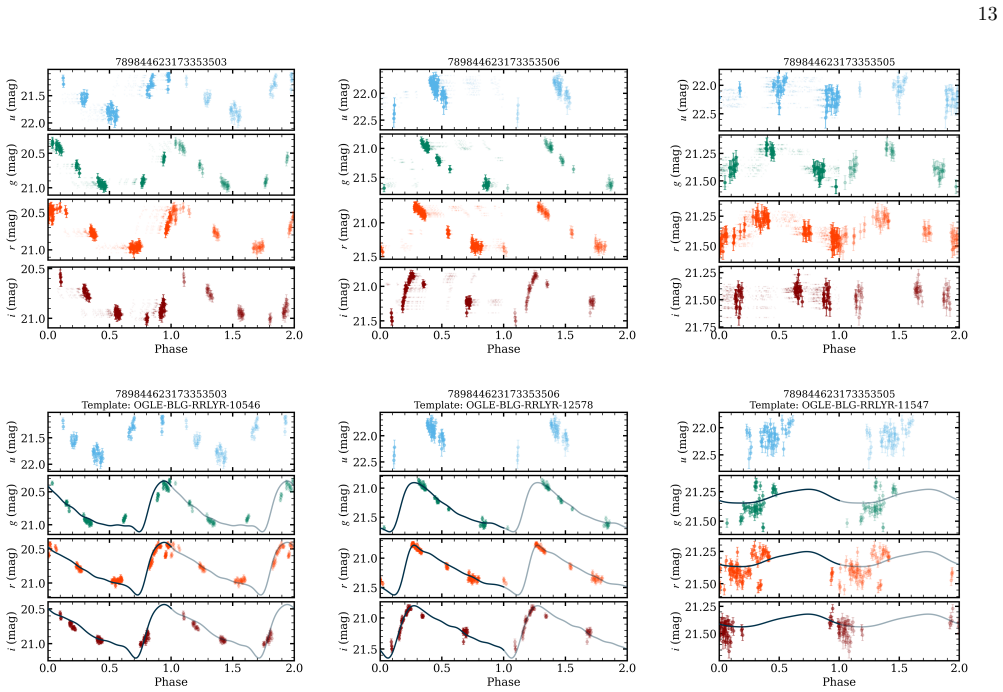
Summary. The authors re-analyze the ultra-faint Milky Way satellite Virgo III using the deep Rubin DP2 imaging of the M49 'Cosmic Treasure Chest' field (~924 coadded visits, 5-sigma depths ~25.2-26.5 mag). With ugali they fit the morphology and isochrone parameters, finding N*=114 candidate members (4x the HSC discovery sample), M_V=-2.72, r_1/2=53 pc, and D=151 kpc — distance and luminosity consistent with Homma et al. (2024), but a significantly larger semi-major axis (1.68 vs 1.0 arcmin), higher ellipticity (0.48 vs 0.29), and rotated PA, which they attribute to a low-significance southern overdensity of faint isochrone-selected stars, possibly tidal debris. They also show color-color separation of metal-poor members from the foreground locus, measure a systemic proper motion from three Gaia-matched RGB stars (too uncertain for orbital inference), and re-derive periods and PLZ/PWZ distances for the three known RR Lyrae, finding broad consistency with Ngeow & Bhardwaj (2024) though with >3-sigma internal tensions for RRL 1 and RRL 3 relative to the isochrone distance.
Significance. If the revised morphology holds up, this is a useful early demonstration that LSST-depth imaging can reveal sub-structure (tidal debris or extended halos) in ultra-faint dwarfs that shallower surveys miss — directly relevant to the tidal-disruption science case for LSST. The RR Lyrae results, while mostly confirmatory, provide a practical validation of DP2 forced photometry and template libraries for LSST time-domain work on standard candles. The explicit reporting of posteriors, systematic floors, and the limitations of the RRc fit is good practice. The main significance caveat is that the genuinely new contribution — the larger, more elongated morphology — is only as strong as the reality of the faint southern overdensity, which the current manuscript does not establish.
major comments (3)
- [§2.3 / §3.2 / Fig. 2, Fig. 3] The classifier used for the entire analysis (refExtendedness<0.5) is selected because it maximizes the ugali detection significance of Virgo III itself (Fig. 2). This is a selection tuned on the target signal, and it is most consequential exactly where it matters most: the paper's headline differences from HSC (a_h=1.68 vs 1.0 arcmin, epsilon=0.48 vs 0.29, PA=-68 vs -24 deg; r_1/2=53 vs 37 pc, ~2 sigma) are attributed to a low-significance southern overdensity of faint (g,r~25-26) isochrone-selected stars at (dRA,dDec)~(0,-0.06). The field is centered on M49 in the Virgo cluster, where the density of unresolved, point-like background galaxies is locally enhanced and spatially clustered, so misclassified galaxies could mimic a coherent 'tidal' feature; and ugali's background model is spatially uniform, so a clustered contaminant clump would be absorbed into the satellite model, inflating
- [§5.4-5.5, Table 4] The distance-modulus estimates use the PLZ/PWZ relations of Marconi et al. (2022) with [Fe/H] fixed to the 50th percentile of the ugali isochrone metallicity posterior. But that posterior piles up against the lower MCMC bound (Table 2 quotes only Z<0.00018, i.e., [Fe/H]<-1.94), so the adopted [Fe/H]=-2.08 is prior-bound-driven rather than measured. With gamma~0.2-0.3 mag/dex in the PLZ relations, the systematic metallicity uncertainty is comparable to the quoted distance-modulus errors and could account for part of the >3 sigma offset between the RRL 1 PLZ distance (110+/-7 kpc) and the isochrone distance (151 kpc). The authors should marginalize over a metallicity range (e.g., -2.5 to -1.5) or report the sensitivity of each distance to [Fe/H], and temper the abstract's 'broadly consistent' language for the RRL 1 and RRL 3 PLZ/PWZ results accordingly.
- [§5.2-5.3, Table 4] The template fit for RRL 3 returns a negative amplitude (-0.27 mag), which is unphysical, and its period (0.4907 d) disagrees with both the period-search value (0.4417 d) and the literature value (0.434 d, Ngeow & Bhardwaj 2024). Relatedly, RRL 2's period-search uncertainty is highly asymmetric (+0.0484/-0.0024 d), suggesting an alias peak near the ~1-day cadence of the seven-night observing window. The authors do appropriately caution against over-interpreting RRL 3, but Table 4 and Fig. 10 still present its PLZ/PWZ distance moduli (which are ~6 sigma from the isochrone distance) on equal footing with the RRab results, and the alias structure of the periodogram is never shown. Please (i) show the periodograms or phase-dispersion curves for all three stars, (ii) discuss the alias interpretation of RRL 2's upper error bar, and (iii) explicitly flag the RRL 3 distance moduli in Table 4 / F
minor comments (5)
- [§3.2 vs Table 2] The notation for the number of member stars is inconsistent: Table 2 and the abstract use N_*, while §3.2 introduces N_obs=114. Please unify.
- [§3.3] Two RR Lyrae receive low ugali membership probabilities because no magnitude spread is included in the HB model; since the HB drives the distance fit, it would be worth noting whether including an HB width changes the membership of these (and other) HB stars or the N_* estimate.
- [Fig. 3 caption / §3.3] Fig. 3 caption states the g-r isochrone filter selects 189 of 209 stars with membership probability >10%, but §3.3 says g-r selects 189 stars within the filter; please make the two statements consistent and state the final high-purity sample size (104) in the abstract or §3.3 alongside N_*=114 for clarity.
- [§5.1] §5.1: the per-band systematic calibration uncertainty is estimated from the zeropoint scatter of images in which each RR Lyrae was observed; since these stars are variable and observed in only 74-130 coadded visits, clarify that this estimator is not biased by the variability itself, and state the number of epochs used per star.
- [References / §4.2] Jethwa, Erkal & Belokurov (2018) appears twice in the reference list; Gaia Collaboration et al. (2023) is typeset as 'a' rather than A&A. Also, the proper-motion uncertainties in §4.2 (sigma~0.3-0.5 mas/yr) are described as precluding orbital constraints; consider one sentence noting how many member stars would be needed, or the Gaia DR4 improvement, for closure.
Circularity Check
No significant circularity: standard likelihood fits to new DP2 photometry compared against external HSC/RR Lyrae literature; only minor coupling of isochrone [Fe/H] into PLZ/PWZ distances.
-
fitted input called prediction
[Abstract; §5.4 Eq. (2); Table 4]
"we use theoretical Period-Luminosity-Metallicity (PLZ) and Period-Wesenheit-Metallicity (PWZ) relations to obtain independent distance estimates. ... As we do not have spectroscopic metallicity measurements, we use the 50th percentile value of the fitted systemic isochrone metallicity distribution (Z=0.00013; [Fe/H]=−2.08 dex) as a proxy."
The PLZ/PWZ distances are presented as independent of the isochrone distance, but [Fe/H] is taken directly from the same ugali isochrone fit that supplies (m−M)0. That couples the two estimators through a shared fitted input. The coupling is weak (periods and mean magnitudes are from forced photometry; the paper reports >3σ tension for some stars rather than forcing consistency) and does not underwrite the morphological/UFD claims.
full rationale
This is an observational characterization paper. Morphological and stellar-population parameters are obtained by fitting an elliptical Plummer + PARSEC-COLIBRI isochrone model to independent Rubin DP2 photometry via ugali/emcee; N*, MV, r1/2, and D⊙ are derived outputs of that fit, not inputs redefined as predictions. Comparisons to Homma et al. (2024) and Ngeow & Bhardwaj (2024) are external benchmarks. Self-citations to ugali (Bechtol/Drlica-Wagner) are methodological tool use, not load-bearing uniqueness theorems. The sole mild coupling is reuse of the fitted isochrone metallicity as the [Fe/H] proxy in theoretical PLZ/PWZ distance moduli that the abstract labels independent; even there the paper reports tension rather than forced agreement, and the structural UFD claim does not reduce to that choice. No self-definitional loops, ansatz smuggling, or renaming of known results.
Assumptions & free parameters
free parameters (4)
- ugali morphological set (α, δ, ah, ε, PA, λ) =
ah=1.68+0.39−0.30 arcmin; ε=0.48+0.11−0.13; PA=−68+12−10 deg; λ=5073+902−849
- isochrone (m−M)0, age τ, metallicity Z =
(m−M)0=20.90+0.10−0.11; τ>11.45 Gyr; Z<0.00018
- RR Lyrae periods and mean magnitudes =
P≈0.611, 0.675, 0.442 d (period search)
- per-visit photometric systematic floor =
0.02–0.03 mag
assumptions (5)
- domain assumption Stellar density follows an elliptical Plummer profile plus spatially uniform contaminants.
- domain assumption PARSEC-COLIBRI isochrones with Chabrier IMF in LSST bandpasses describe the CMD.
- ad hoc to paper refExtendedness<0.5 is an adequate star–galaxy separator at the faint end for this field.
- domain assumption Marconi et al. (2022) PLZ/PWZ coefficients apply to LSST bands for these stars; systemic isochrone [Fe/H] proxies RR Lyrae metallicity.
- standard math Schlegel dust maps with Schlafly & Finkbeiner 0.86 rescaling and Cardelli RV=3.1 Rb coefficients give correct extinction.
Cite this review
Pith. "Pith review of A Deep Look at the Ultra-Faint Milky Way Satellite Virgo III with Rubin Observatory Data Preview 2." pith.science (2026). https://pith.science/paper/E4OGDPVM
@misc{pith2026260725044,
  author       = {Pith},
  title        = {Pith review of: A Deep Look at the Ultra-Faint Milky Way Satellite Virgo III with Rubin Observatory Data Preview 2},
  year         = {2026},
  howpublished = {\url{https://pith.science/paper/E4OGDPVM}},
  note         = {Machine review of arXiv:2607.25044}
}
abstract
We analyze the ultra-faint Milky Way satellite Virgo III using data from the Vera C. Rubin Observatory Data Preview 2 (DP2). Virgo III was observed in the Rubin "Cosmic Treasure Chest" (M49) First Look field, which contains 924 visits in the u,g,r,i bands comprising ~10.5hrs of exposure time with LSSTCam. These data are considerably deeper than the majority of DP2, with a $5\sigma$ limiting magnitude that approaches the expected 10-year depth of LSST (~25.2-26.5mag, depending on band). We report the morphological and stellar population parameters of Virgo III measured with the maximum-likelihood-based package ugali. The depth of the Rubin imaging yields more than a factor of four increase in the number of candidate member stars ($N_* = 114^{+11}_{-11}$) relative to the Virgo III discovery results ($N_* = 25^{+5}_{-4}$), enabling significantly more precise morphological constraints. Our best-fit parameters broadly agree with previous measurements, further confirming that Virgo III has properties that are consistent with an ultra-faint dwarf galaxy ($M_V = -2.72^{+0.49}_{-0.70}$; $r_{1/2} = 53^{+10}_{-8}$) located at a heliocentric distance of $D_\odot = 151^{+8}_{-8}$. We also demonstrate that the depth and photometric quality of the DP2 data are sufficient to separate metal-poor and metal-rich stars in color-color space. We further present period estimates for the three known RR Lyrae member stars derived from the DP2 forced photometry; we use theoretical Period-Luminosity-Metallicity (PLZ) and Period-Wesenheit-Metallicity (PWZ) relations to obtain independent distance estimates. We find that our period and distance estimates are broadly consistent with previous measurements for these RR Lyrae. These results demonstrate the power of LSST data for the discovery and characterization of ultra-faint dwarf galaxies and motivate future searches for new satellites across the southern sky.
Figures


Figures from the paper (11 more)




Forward citations
Cited by 1 Pith paper
-
Discovery of the Distant, Ultra-Faint Milky Way Satellite Aquarius IV with the Vera C. Rubin Observatory Early Data Preview 2
Rubin EDP2 data reveal an ultra-faint stellar system, Aquarius IV, at ~109 kpc with MV = -1.9, likely a dwarf galaxy.
Reference graph
Works this paper leans on
-
[1]
Abazajian, K., Adelman-McCarthy, J. K., Ag¨ ueros, M. A., et al. 2004, The Astronomical Journal, 128, 502, doi: 10.1086/421365
doi:10.1086/421365 2004
-
[2]
2018, PASJ, 70, S8, doi: 10.1093/pasj/psx081
Aihara, H., Armstrong, R., Bickerton, S., et al. 2018, PASJ, 70, S8, doi: 10.1093/pasj/psx081
-
[3]
2026, Data Preview 2: Definition and planning, Technical Note RTN-111, NSF-DOE Vera C
AlSayyad, Y., & O’Mullane, W. 2026, Data Preview 2: Definition and planning, Technical Note RTN-111, NSF-DOE Vera C. Rubin Observatory. https://rtn-111.lsst.io/ Astropy Collaboration, Robitaille, T. P., Tollerud, E. J., et al. 2013, A&A, 558, A33, doi: 10.1051/0004-6361/201322068 Astropy Collaboration, Price-Whelan, A. M., Sip˝ ocz, B. M., et al. 2018, AJ...
-
[4]
2025, A&A, 694, A72, doi: 10.1051/0004-6361/202453129
Baeza-Villagra, K., Rodr ´ ıguez-Segovia, N., Catelan, M., et al. 2025, A&A, 694, A72, doi: 10.1051/0004-6361/202453129
-
[5]
2015, The Astrophysical Journal, 807, 50, doi: 10.1088/0004-637X/807/1/50
Bechtol, K., Drlica-Wagner, A., Balbinot, E., et al. 2015, The Astrophysical Journal, 807, 50, doi: 10.1088/0004-637X/807/1/50
-
[6]
Bernstein, G. M. 2022, gbdes: DECam instrumental signature fitting and processing programs, Astrophysics Source Code Library, record ascl:2210.011. http://ascl.net/2210.011
2022
-
[7]
2011, in Astronomical Society of the Pacific Conference Series, Vol
Bertin, E. 2011, in Astronomical Society of the Pacific Conference Series, Vol. 442, Astronomical Data Analysis Software and Systems XX, ed. I. N. Evans, A. Accomazzi, D. J. Mink, & A. H. Rots, 435
2011
-
[8]
2018, PASJ, 70, S5, doi: 10.1093/pasj/psx080
Bosch, J., Armstrong, R., Bickerton, S., et al. 2018, PASJ, 70, S5, doi: 10.1093/pasj/psx080
Show all 66 references
-
[9]
2019, in Astronomical Society of the Pacific Conference Series, Vol
Bosch, J., AlSayyad, Y., Armstrong, R., et al. 2019, in Astronomical Society of the Pacific Conference Series, Vol. 523, Astronomical Data Analysis Software and Systems XXVII, ed. P. J. Teuben, M. W. Pound, B. A. Thomas, & E. M. Warner, 521, doi: 10.48550/arXiv.1812.03248
-
[10]
2015, The Astrophysical Journal Supplement Series, 216, 29, doi: 10.1088/0067-0049/216/2/29
Bovy, J. 2015, The Astrophysical Journal Supplement Series, 216, 29, doi: 10.1088/0067-0049/216/2/29
2015 doi
-
[11]
2012, Monthly Notices of the Royal Astronomical Society, 427, 127, doi: 10.1111/j.1365-2966.2012.21948.x
Bressan, A., Marigo, P., Girardi, L., et al. 2012, Monthly Notices of the Royal Astronomical Society, 427, 127, doi: 10.1111/j.1365-2966.2012.21948.x
2012
-
[12]
L., Rykoff, E
Burke, D. L., Rykoff, E. S., Allam, S., et al. 2018, AJ, 155, 41, doi: 10.3847/1538-3881/aa9f22
2018 doi
-
[13]
A., Clayton, G
Cardelli, J. A., Clayton, G. C., & Mathis, J. S. 1989, ApJ, 345, 245, doi: 10.1086/167900
1989 doi
-
[14]
E., Drlica-Wagner, A., et al
Cerny, W., Mart ´ ınez-V´ azquez, C. E., Drlica-Wagner, A., et al. 2023, ApJ, 953, 1, doi: 10.3847/1538-4357/acdd78
2023 doi
-
[15]
S., Pace, A
Cerny, W., Li, T. S., Pace, A. B., et al. 2026, arXiv e-prints, arXiv:2602.17652, doi: 10.48550/arXiv.2602.17652
2026 doi
-
[16]
2001, ApJ, 554, 1274, doi: 10.1086/321401
Chabrier, G. 2001, ApJ, 554, 1274, doi: 10.1086/321401
2001 doi
- [17]
-
[18]
2015, Monthly Notices of the Royal Astronomical Society, 452, 1068, doi: 10.1093/mnras/stv1281
Chen, Y., Bressan, A., Girardi, L., et al. 2015, Monthly Notices of the Royal Astronomical Society, 452, 1068, doi: 10.1093/mnras/stv1281
2015 doi
-
[19]
2014, Monthly Notices of the Royal Astronomical Society, 444, 2525, doi: 10.1093/mnras/stu1605
Chen, Y., Girardi, L., Bressan, A., et al. 2014, Monthly Notices of the Royal Astronomical Society, 444, 2525, doi: 10.1093/mnras/stu1605
2014 doi
-
[20]
D., et al
Chiti, A., Frebel, A., Simon, J. D., et al. 2021, Nature Astronomy, 5, 392, doi: 10.1038/s41550-020-01285-w
2021 doi
-
[21]
2014, ApJ, 794, 115, doi: 10.1088/0004-637X/794/2/115 DES Collaboration, Abbott, T., Abdalla, F
Deason, A., Wetzel, A., & Garrison-Kimmel, S. 2014, ApJ, 794, 115, doi: 10.1088/0004-637X/794/2/115 DES Collaboration, Abbott, T., Abdalla, F. B., et al. 2016, MNRAS, 460, 1270, doi: 10.1093/mnras/stw641
2014 doi
-
[22]
S., et al
Drlica-Wagner, A., Bechtol, K., Rykoff, E. S., et al. 2015, The Astrophysical Journal, 813, 109, doi: 10.1088/0004-637X/813/2/109
2015 doi
-
[23]
2020, The Astrophysical Journal, 893, 47, doi: 10.3847/1538-4357/ab7eb9
Drlica-Wagner, A., Bechtol, K., Mau, S., et al. 2020, The Astrophysical Journal, 893, 47, doi: 10.3847/1538-4357/ab7eb9
2020 doi
-
[24]
L., Nidever, D
Drlica-Wagner, A., Carlin, J. L., Nidever, D. L., et al. 2021, The Astrophysical Journal Supplement Series, 256, 2, doi: 10.3847/1538-4365/ac079d
2021 doi
-
[25]
W., & Willman, B
Fadely, R., Hogg, D. W., & Willman, B. 2012, The Astrophysical Journal, 760, 15, doi: 10.1088/0004-637X/760/1/15
2012 doi
-
[26]
Parejko, J. K. 2025, The Monster: A reference catalog with synthetic ugrizy-band fluxes for the Vera C. Rubin observatory, Data Management Technical Note DMTN-277, NSF-DOE Vera C. Rubin Observatory, doi: 10.71929/rubin/2583688
2025
-
[27]
2013, emcee: The MCMC Hammer, Astrophysics Source Code Library, record ascl:1303.002
Foreman-Mackey, D., Conley, A., Meierjurgen Farr, W., et al. 2013, emcee: The MCMC Hammer, Astrophysics Source Code Library, record ascl:1303.002. http://ascl.net/1303.002 Gaia Collaboration, Prusti, T., de Bruijne, J. H. J., et al. 2016, A&A, 595, A1, doi: 10.1051/0004-6361/2...
2013 doi
-
[28]
E., & P´ erez, F
Granger, B. E., & P´ erez, F. 2021, Computing in Science & Engineering, 23, 7, doi: 10.1109/MCSE.2021.3059263
2021
-
[29]
R., Willman, B., & Peter, A
Hargis, J. R., Willman, B., & Peter, A. H. G. 2014, ApJL, 795, L13, doi: 10.1088/2041-8205/795/1/L13 18
2014 doi
-
[30]
R., Millman, K
Harris, C. R., Millman, K. J., van der Walt, S. J., et al. 2020, Nature, 585, 357, doi: 10.1038/s41586-020-2649-2
2020 doi
-
[31]
2003, Monthly Notices of the Royal Astronomical Society, 343, 459, doi: 10.1046/j.1365-8711.2003.06683.x
Hirata, C., & Seljak, U. 2003, Monthly Notices of the Royal Astronomical Society, 343, 459, doi: 10.1046/j.1365-8711.2003.06683.x
2003
-
[32]
2024, PASJ, 76, 733, doi: 10.1093/pasj/psae044
Homma, D., Chiba, M., Komiyama, Y., et al. 2024, PASJ, 76, 733, doi: 10.1093/pasj/psae044
2024 doi
-
[33]
Hunter, J. D. 2007, Computing in Science & Engineering, 9, 90, doi: 10.1109/MCSE.2007.55 Ivezi´ c,ˇZ., Kahn, S. M., Tyson, J. A., et al. 2019, ApJ, 873, 111, doi: 10.3847/1538-4357/ab042c
2007 doi
-
[34]
M., Amon, A., et al
Jarvis, M., Bernstein, G. M., Amon, A., et al. 2021, Monthly Notices of the Royal Astronomical Society, 501, 1282, doi: 10.1093/mnras/staa3679
2021 doi
-
[36]
2018, Monthly Notices of the Royal Astronomical Society, 473, 2060, doi: 10.1093/mnras/stx2330
Jethwa, P., Erkal, D., & Belokurov, V. 2018, Monthly Notices of the Royal Astronomical Society, 473, 2060, doi: 10.1093/mnras/stx2330
2018 doi
-
[37]
W., et al
Koposov, S., Belokurov, V., Evans, N. W., et al. 2008, ApJ, 686, 279, doi: 10.1086/589911
2008 doi
-
[38]
S., Koposov, S
Li, T. S., Koposov, S. E., Zucker, D. B., et al. 2019, MNRAS, 490, 3508, doi: 10.1093/mnras/stz2731
2019 doi
-
[39]
2025, The Consolidated Database of Image
Lim, K.-T. 2025, The Consolidated Database of Image
2025
-
[40]
Rubin Observatory, doi: 10.71929/rubin/2586436
Metadata, Data Management Technical Note DMTN-227, NSF-DOE Vera C. Rubin Observatory, doi: 10.71929/rubin/2586436
-
[41]
A., Hern´ andez, J., et al
Lindegren, L., Klioner, S. A., Hern´ andez, J., et al. 2021, A&A, 649, A2, doi: 10.1051/0004-6361/202039709
2021 doi
-
[42]
M., Seljak, U., et al
Mandelbaum, R., Hirata, C. M., Seljak, U., et al. 2005, Monthly Notices of the Royal Astronomical Society, 361, 1287, doi: 10.1111/j.1365-2966.2005.09282.x
2005
-
[43]
Manwadkar, V., & Kravtsov, A. V. 2022, MNRAS, 516, 3944, doi: 10.1093/mnras/stac2452
2022 doi
-
[44]
2022, The Astrophysical Journal, 934, 29, doi: 10.3847/1538-4357/ac78ee
Marconi, M., Molinaro, R., Dall’Ora, M., et al. 2022, The Astrophysical Journal, 934, 29, doi: 10.3847/1538-4357/ac78ee
2022 doi
-
[45]
2017, ApJ, 835, 77, doi: 10.3847/1538-4357/835/1/77
Marigo, P., Girardi, L., Bressan, A., et al. 2017, ApJ, 835, 77, doi: 10.3847/1538-4357/835/1/77
2017 doi
-
[46]
F., de Jong, J
Martin, N. F., de Jong, J. T. A., & Rix, H.-W. 2008, The Astrophysical Journal, 684, 1075, doi: 10.1086/590336
2008 doi
-
[47]
O., Wechsler, R
Nadler, E. O., Wechsler, R. H., Bechtol, K., et al. 2020, ApJ, 893, 48, doi: 10.3847/1538-4357/ab846a
2020 doi
-
[48]
Helly, J. C. 2018, MNRAS, 479, 2853, doi: 10.1093/mnras/sty1085
2018 doi
-
[49]
2024, The Astronomical Journal, 168, 8, doi: 10.3847/1538-3881/ad49a9 NSF-DOE Vera C
Ngeow, C.-C., & Bhardwaj, A. 2024, The Astronomical Journal, 168, 8, doi: 10.3847/1538-3881/ad49a9 NSF-DOE Vera C. Rubin Observatory. 2021, Rubin Observatory LSST Tutorials, [Computer Software] https://doi.org/10.11578/rubin/dc.20250909.20, doi: 10.11578/rubin/dc.20250909.20 N...
2024
-
[50]
B., & Gunn, J
Oke, J. B., & Gunn, J. E. 1983, ApJ, 266, 713, doi: 10.1086/160817 O’Mullane, W., Economou, F., Huang, F., et al. 2024, in Astronomical Society of the Pacific Conference Series, Vol. 535, Astronomical Data Analysis Software and Systems XXXI, ed. B. V. Hugo, R. Van Rooyen, & O....
-
[51]
B., Erkal, D., & Li, T
Pace, A. B., Erkal, D., & Li, T. S. 2022, The Astrophysical Journal, 940, 136, doi: 10.3847/1538-4357/ac997b
2022 doi
-
[52]
B., & Li, T
Pace, A. B., & Li, T. S. 2019, The Astrophysical Journal, 875, 77, doi: 10.3847/1538-4357/ab0aee
2019 doi
-
[53]
Plummer, H. C. 1911, MNRAS, 71, 460, doi: 10.1093/mnras/71.5.460 Rubin Observatory Science Pipelines Developers. 2025, The LSST Science Pipelines Software: Optical Survey Pipeline Reduction and Analysis Environment, Project Science Technical Note PSTN-019, NSF-DOE Vera C. Rubi...
1911
-
[54]
Saha, A., & Vivas, A. K. 2017, AJ, 154, 231, doi: 10.3847/1538-3881/aa8fd3
2017 doi
-
[55]
Navarro, J. F. 2022, MNRAS, 515, 3685, doi: 10.1093/mnras/stac2057
2022 doi
-
[56]
F., & Finkbeiner, D
Schlafly, E. F., & Finkbeiner, D. P. 2011, ApJ, 737, 103, doi: 10.1088/0004-637X/737/2/103
2011 doi
-
[57]
J., Finkbeiner, D
Schlegel, D. J., Finkbeiner, D. P., & Davis, M. 1998, ApJ, 500, 525, doi: 10.1086/305772
1998 doi
-
[58]
Simon, J. D. 2019, ARA&A, 57, 375, doi: 10.1146/annurev-astro-091918-104453 SLAC National Accelerator Laboratory, & NSF-DOE Vera C. Rubin Observatory. 2025, The LSST Camera (LSSTCam), SLAC National Accelerator Laboratory (SLAC), Menlo Park, CA (United States), doi: 10.71929/ru...
2019
-
[59]
T., Ivezi´ c,ˇZ., & Lupton, R
Slater, C. T., Ivezi´ c,ˇZ., & Lupton, R. H. 2020, AJ, 159, 65, doi: 10.3847/1538-3881/ab6166
2020 doi
-
[60]
Y., Cerny, W., Drlica-Wagner, A., et al
Tan, C. Y., Cerny, W., Drlica-Wagner, A., et al. 2025, ApJ, 979, 176, doi: 10.3847/1538-4357/ad9b0c 19
2025 doi
-
[61]
Y., Drlica-Wagner, A., Pace, A
Tan, C. Y., Drlica-Wagner, A., Pace, A. B., et al. 2026, ApJ, 1000, 87, doi: 10.3847/1538-4357/ae4479
2026 doi
-
[62]
2014, Monthly Notices of the Royal Astronomical Society, 445, 4287, doi: 10.1093/mnras/stu2029
Tang, J., Bressan, A., Rosenfield, P., et al. 2014, Monthly Notices of the Royal Astronomical Society, 445, 4287, doi: 10.1093/mnras/stu2029
2014 doi
-
[63]
J., Bullock, J
Tollerud, E. J., Bullock, J. S., Strigari, L. E., & Willman, B. 2008, ApJ, 688, 277, doi: 10.1086/592102
2008 doi
-
[64]
2025, The Open Journal of Astrophysics, 8, 89, doi: 10.33232/001c.142072
Tsiane, K., Mau, S., Drlica-Wagner, A., et al. 2025, The Open Journal of Astrophysics, 8, 89, doi: 10.33232/001c.142072
2025 doi
-
[65]
E., et al
Virtanen, P., Gommers, R., Oliphant, T. E., et al. 2020, Nature Methods, 17, 261, doi: 10.1038/s41592-019-0686-2
2020 doi
-
[66]
M., Willman, B., & Jerjen, H
Walsh, S. M., Willman, B., & Jerjen, H. 2009, AJ, 137, 450, doi: 10.1088/0004-6256/137/1/450
2009 doi
-
[67]
D., Bullock, J
Wolf, J., Martinez, G. D., Bullock, J. S., et al. 2010, MNRAS, 406, 1220, doi: 10.1111/j.1365-2966.2010.16753.x 20 APPENDIX A.MCMC POSTERIOR DISTRIBUTIONS In this Appendix, we show the posterior distributions of a simultaneous fit of the morphological and isochrone parameters ...
2010
Reviewed July 31, 2026 · model on record in the stance chip above.
Discussion (0). Sign in to comment.