REVIEW 3 major objections 5 minor 39 references
Optimization of the directed spanning trees using the weighted matroid intersection algorithm
T0 review · 3 major / 5 minor · reviewed 2026-08-01 · deepseek-v4-flash
Pith's one-line read Negative cycles in an auxiliary graph drive any arborescence to the optimal one
desk verdict Correctly applies known matroid-intersection theory to DMST, but Algorithm 5's sequential exchange can undo itself for n≥2 dicycles—the main convergence claim doesn't hold as written. read the letter →
The pith
A machine-rendered reading of the paper's core claim, the machinery that carries it, and where it could break.
The reading
What carries the argument
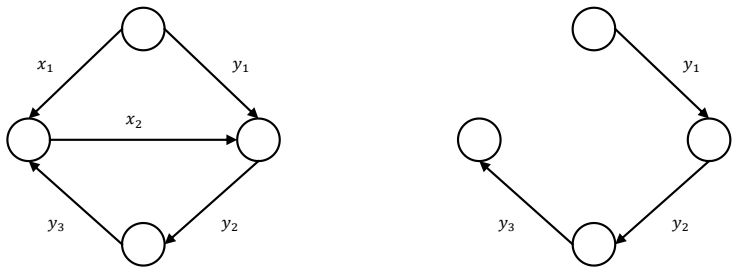
The auxiliary graph D(T) — a bipartite digraph whose nodes are the edges of G — is the central object. I1-arcs (y, x) say that replacing tree edge y by non-tree edge x keeps the underlying undirected graph acyclic; I2-arcs (x, y) say the same replacement keeps the indegree constraint of the partition matroid. The cost function l turns the optimality question into a negative-dicycle detection problem on this graph. The algorithm's engine is the simple negative dicycle: a negative dicycle containing no negative sub-dicycle, which Theorem 1 guarantees can be exchanged via symmetric difference to produce a cheaper arborescence. The paper's update loop maintains D(T) by recomputing I1-arcs with l
What would settle it
Run Algorithm 5 on a small digraph whose simple negative dicycle C0 contains at least two non-tree edges (n ≥ 2) and verify whether the weight of T strictly decreases after the foreach loop completes; if any such instance yields no decrease or a higher weight, the 'each iteration is guaranteed to yield an improved solution' claim is false. A direct trace with C0 = {y1,x1,y2,x2,y1} shows that the second branch may delete x1 and reinsert y2, producing T′ = T rather than T △ C0.
Extended reading notes
Core claim
Corollary 2 is the load-bearing statement: a subgraph T of a weighted digraph is a directed minimum spanning tree rooted at r if and only if T belongs to both the graphic matroid and the partition matroid, has |V|−1 edges, and the auxiliary graph D(T) — whose arcs encode which single-edge exchanges preserve matroid independence — contains no negative dicycle under the cost l(e) = −w(e) for e∈T and l(e)=w(e) for e∉T. Starting from any arborescence, the paper's algorithm detects a simple negative dicycle (one with no negative sub-dicycle), forms T′ = T △ C0, and, by Theorem 1(iii), T′ is again a directed spanning tree with strictly smaller weight. Repeating this exchange yields a strictly decr
Load-bearing premise
Algorithm 5's pseudocode updates the tree edge-by-edge inside the loop over the dicycle, and the paper assumes this sequential update is equivalent to the simultaneous exchange T′ = T △ C0; if a dicycle contains two or more exchanges, the loop can undo an earlier swap, so the claimed guarantee that every iteration improves the solution may fail without an ordering proof.
Editorial extensions
If this is right
- If a given tree T has no negative dicycle in D(T), then T is already a DMST; otherwise any simple negative dicycle gives a concrete set of edge exchanges that strictly decreases the total weight.
- Repeatedly applying the exchange converges to a DMST, generating a sequence of arborescences of strictly decreasing cost, which can be stopped early as an anytime algorithm.
- Edge deletion of a tree edge can be handled by setting its weight to infinity and running the same update; deletion of a non-tree edge leaves the DMST unchanged.
- Edge insertion reduces to adding the new node to D(T), computing its I1-arcs via LCA, its I2-arcs from the head's tree edge, and testing for a negative dicycle through it.
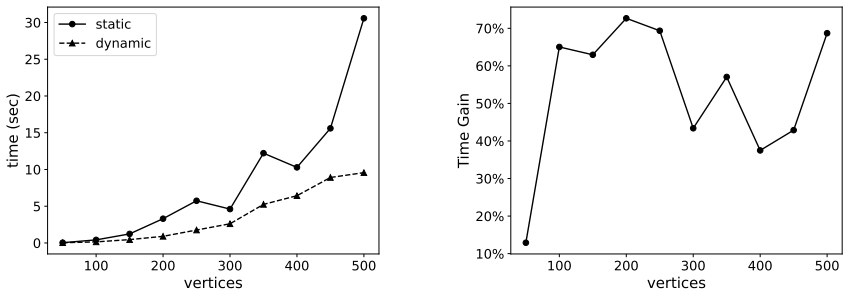
- The dynamic experiments report average time gains around 50% for deletions and over 75% for insertions on random dense and sparse graphs compared to recomputing the DMST statically.
Reading between the lines
- If the simultaneous-exchange correctness is fixed or proven, the approach could serve as a local-search oracle for any arborescence problem, including variants with degree or color constraints, since matroid intersection handles these constraints naturally.
- The auxiliary graph structure suggests a sensitivity analysis tool: the cost of the dicycle through a non-tree edge measures how much its weight must change before it enters the optimal tree — a quantity that contract-and-expand algorithms do not expose directly.
- Because the auxiliary graph is bipartite, negative-dicycle detection might be accelerated with specialized bipartite shortest-path algorithms, potentially improving the worst-case bound in practice.
- The experimental methodology could be extended to include adversarial or structured graphs, not just random graphs, to stress-test the sequential-update loop, especially cases with long dicycles containing several exchanges.
Editorial analysis
A structured set of objections, weighed in public.
Referee Report
Summary. This paper proposes a matroid-intersection-based algorithm for updating a directed minimum spanning tree (DMST) under weight changes, edge deletions, and edge insertions. Given an initial arborescence T, the algorithm constructs the exchange graph D(T), detects simple negative dicycles, and exchanges tree and non-tree edges to decrease the total weight. The paper claims each iteration yields a strictly cheaper arborescence and that the process terminates in at most w(T)-w(T_o) iterations. It also provides pseudocode, complexity bounds, and Python experiments comparing against NetworkX's Edmonds implementation and measuring dynamic-operation speedups.
Significance. If correct, the paper would offer an independent matroid-intersection route to dynamic DMST maintenance with a clean optimality certificate and substantial practical speedups. The theoretical reduction is standard: Theorem 1 and Corollary 2 correctly invoke the negative-dicycle optimality criterion for weighted matroid intersection, and no parameter fitting or circularity is present. The paper also ships code and reproducible experiments, which is a strength. However, the central algorithmic step as written is flawed: Algorithm 5 applies the exchange T△C0 sequentially inside a loop, and for dicycles with n≥2 this can undo the exchange and leave T unchanged. The claimed per-iteration improvement guarantee therefore does not follow from the presented algorithm, and the experimental validation does not repair this gap.
major comments (3)
- [Sec. 4, Algorithm 5, lines 4–13; Eq. (2)] The loop at lines 4–13 of Algorithm 5 updates T inside the `foreach v in C0` loop. For C0={y1,x1,...,yn,xn,y1}, line 7 replaces the current incoming edge of h_v. After x_i is processed, y_{i+1} becomes a non-tree edge; if the loop later reaches y_{i+1}, line 6 is true and line 7 re-inserts y_{i+1}, replacing x_i again. In the natural listing order, every exchange is undone and T returns to its starting value for n≥2; the simultaneous exchange T' = T△C0 is not implemented. The paper gives no ordering argument, and the bijection f in Section 4 is asserted without proof and does not control the order of T updates. This invalidates the per-iteration improvement claim and the iteration bound w(T)-w(T_o), and it can cause non-termination.
- [Sec. 4.2, complexity of Algorithm 4] The complexity analysis states that finding a simple negative dicycle runs in O(n^3m) because the loops at line 3 of Algorithm 4 need at most |C|/2 times. This ignores the inner loop of NegativeSubDicycle, which iterates over all nodes v∈C and performs a negative-cycle detection on D_C\{v} each time; the cost of that detection is not specified. A complete derivation is required before the overall bound O((w(T)-w(T_o)) n^3m) can be claimed.
- [Sec. 4.1, edge-deletion paragraph] The assertion that 'If the negative cycle detection fails at finding a dicycle involving e_out, that means there is no directed spanning tree after deleting e_out' is not proved. After deleting e_out, T is not a common independent set of the modified graph, so applying the negative-dicycle criterion of Corollary 2 to D(T) requires justification. The authors should prove that a replacement arborescence exists iff a dicycle involving e_out appears in the updated exchange graph, and that the first exchange yields a valid tree.
minor comments (5)
- [Sec. 3.2, after Eq. (2)] The displayed composition of T' by sub-trees 'x_n ∪ H1, x_1 ∪ H2, ..., x_{n-1}∪H_n' appears index-shifted relative to the relation h_{x_i}=h_{y_{i+1}}; please verify the indices.
- [Sec. 2, partition matroid definition] The sentence 'The root vertex r does not have to be the same for all independent sets of I2' is confusing, since the root is fixed for the DMST problem; rephrase.
- [Sec. 4.2, Tarjan reference [37]] The cyclic-detection complexity relies on Tarjan's subtree disassembly; cite a published version or give enough detail to verify the stated bound.
- [Sec. 5] The experimental section reports averages without standard deviations or instance counts; error bars would help assess the claimed speedups.
- [Throughout] Typos: 'constrast' (Introduction), 'dicyle' (Sec. 3.2), 'overal' (Sec. 5.1); a final proofread is needed.
Circularity Check
No significant circularity: the optimization criterion and exchange guarantee are imported from external matroid-intersection theorems, and the experimental check uses an independent implementation.
full rationale
The paper's central claim, Corollary 2, is a direct instantiation of Theorem 1, which is attributed to external matroid-intersection results in [4] and [18] (Brezovec et al.; Fujishige), with no author overlap. The cost function l(e) is the standard weighted matroid intersection cost, and the 'no negative dicycle' optimality condition is the external theorem, not a re-definition of the paper's target. The iterative improvement relies on Theorem 1(iii) ('Let C be a negative dicycle in D(I) ... Then I' = I - Y + X is a k-intersection with w(I') > w(I)'), again an external result. The paper's contribution is an implementation/update scheme around this theorem, and the algorithm is validated against NetworkX's independent implementation of Edmonds' algorithm, which is an external benchmark rather than the algorithm's own output. There are no fitted parameters being renamed as predictions, no uniqueness theorem imported from the authors' prior work, and no load-bearing self-citations. The potential concerns raised by a skeptical reader—that Algorithm 5's in-loop sequential mutation may not faithfully implement the simultaneous exchange T' = T△C0 for dicycles with n>=2, and that the bijection f in Section 4 is asserted without proof—are correctness or proof-completeness issues, not circular dependencies: they do not make the claimed result equal to its input by construction. Therefore the appropriate circularity score is 0.
Assumptions & free parameters
assumptions (5)
- standard math Matroid intersection framework: (A,I1) is a graphic matroid and (A,I2) is a partition matroid; a common independent set of size |V|-1 is exactly an r-arborescence.
- domain assumption Theorem 1 (negative-dicycle characterization and exchange validity) from Brezovec et al. and Fujishige.
- domain assumption A negative dicycle with no negative sub-dicycle yields a valid improved common independent set via symmetric difference.
- domain assumption Tarjan's subtree disassembly detects negative cycles in O(nM) on the auxiliary graph.
- domain assumption Edge weights are integers.
Cite this review
Pith. "Pith review of Optimization of the directed spanning trees using the weighted matroid intersection algorithm." pith.science (2026). https://pith.science/paper/N53T2B7I
@misc{pith2026260725238,
  author       = {Pith},
  title        = {Pith review of: Optimization of the directed spanning trees using the weighted matroid intersection algorithm},
  year         = {2026},
  howpublished = {\url{https://pith.science/paper/N53T2B7I}},
  note         = {Machine review of arXiv:2607.25238}
}
read the original abstract
In this paper, we consider the problem of updating the directed minimum spanning tree (DMST), when the given sample tree is subject to the weight changes, edge deletions and edge insertions. We present an implementation for updating the tree to a DMST using the weighted matroid intersection algorithm. Our algorithm focuses on maintaining a dynamic auxiliary graph, which plays a central role in the matroid intersection algorithm, and governs the iterations from the given tree to a DMST. Each iteration is guaranteed to yield an improved solution. We also provide an implementation of this algorithm and some experimental analysis.
Figures


Figures from the paper (6 more)




Reference graph
Works this paper leans on
-
[1]
Barab´ asi,Network Science; Cambridge University Press: Cambridge, UK, 2016
A.L. Barab´ asi,Network Science; Cambridge University Press: Cambridge, UK, 2016
2016
-
[2]
Bellman,On a routing problem
R.E. Bellman,On a routing problem. Quart. Appl. Math. 16, 87-90, (1958)
1958
-
[3]
Bock,An algorithm to construct a minimum directed spanning tree in a directed network, Developments in Operations Research, pp
F.C. Bock,An algorithm to construct a minimum directed spanning tree in a directed network, Developments in Operations Research, pp. 29-44, Gordon and Breach, (1971)
1971
-
[4]
Brezovec, G
C. Brezovec, G. Cornu´ ejols and F. Glover,Two algorithms for weighted matroid intersection. Mathematical Programming 36, 39–53 (1986). 19
1986
-
[5]
B¨ other, O
M. B¨ other, O. Kißig, and C. Weyand,Efficiently computing directed minimum spanning trees, 2023 Proceedings of the Symposium on Algorithm Engineering and Experiments (ALENEX), pages 86-95, SIAM, 2023
2023
-
[6]
B´ erczi, T
K. B´ erczi, T. Kir´ aly, Y. Yamaguchi and Y. Yokoi,Matroid Intersection under Re- stricted Oracles, SIAM Journal on Discrete Mathematics, Volume 37, Issue 2, Pages 1311-1330, 2023
2023
-
[7]
Y. J. Chu and T. H. Liu,On the shortest arborescence of a directed graph, Scientia Sinica, 1965, 14: 1396-1400
1965
-
[8]
W. J. Cook, W. H. Cunningham, W. R. Pulleyblank, and A. Schrijver.Combinato- rial optimization, Wiley-Interscience Series in Discrete Mathematics and Optimiza- tion, USA, 1:998, 1998
1998
Show all 39 references
-
[9]
Cherkassky, and A
B. Cherkassky, and A. Goldberg,Negative-cycle detection algorithms. Math. Pro- gram. 85, 277-311 (1999)
1999
-
[10]
E. W. Dijkstra. A note on two problems in connexion with graphs. Numerische Mathematik, pages 269-271, 1959
1959
-
[11]
Edmonds,Optimum branchings, Journal of Research of the National Bureau of Standards, 71B (1967), p
J. Edmonds,Optimum branchings, Journal of Research of the National Bureau of Standards, 71B (1967), p. 233
1967
-
[12]
Edmonds,Submodular Functions, Matroids, and Certain Polyhedra
J. Edmonds,Submodular Functions, Matroids, and Certain Polyhedra. In: J¨ unger, M., Reinelt, G., Rinaldi, G. (eds) Combinatorial Optimization - Eureka, You Shrink!. Lecture Notes in Computer Science, vol 2570. Springer, Berlin, Heidel- berg, (2003)
2003
-
[13]
Espada, A
J. Espada, A. P. Francisco, T. Rocher, L. M. S. Russo, C. Vaz, On Finding Optimal (Dynamic) Arborescences. Algorithms 2023, 16, 559. https://doi.org/10.3390/a16120559
2023 doi
-
[14]
Eppstein, Z
D. Eppstein, Z. Galil, G.F. Italiano,8: Dynamic graph algorithms. In: Algorithms and Theory of Computation Handbook. CRC Presss (1999)
1999
-
[15]
Erd˝ os and A
P. Erd˝ os and A. R´ enyi,On random graphs, i, Publicationes Mathematicae (Debre- cen), 6 (1959)
1959
-
[16]
L.R. Ford Jr. and D.R. Fulkerson,Flows in Networks. Princeton Univ. Press, Princeton, NJ, (1962)
1962
-
[17]
Frank, ,A weighted matroid intersection algorithm, Journal of Algorithms, 2(4): 328–336 (1981)
A. Frank, ,A weighted matroid intersection algorithm, Journal of Algorithms, 2(4): 328–336 (1981). 20
1981
-
[18]
Fujishige,A primal approach to the independent assignment problem, Journal of the Operations Research Society of Japan 20 (1977) 1-15
S. Fujishige,A primal approach to the independent assignment problem, Journal of the Operations Research Society of Japan 20 (1977) 1-15
1977
-
[19]
Fischer and R
O. Fischer and R. Oshman.A distributed algorithm for directed minimum weight spanning tree, Distributed Computing, 36(1):57-87, 2023
2023
-
[20]
H. N. Gabow, Z. Galil, T. H. Spencer, and R. E. Tarjan,Efficient algorithms for finding minimum spanning trees in undirected and directed graphs, Combinatorica, 6 (1986)
1986
-
[21]
Hanauer, M
K. Hanauer, M. Henzinger, and C. Schulz.Recent Advances in Fully Dynamic Graph Algorithms – A Quick Reference Guide. ACM J. Exp. Algorithmics 27, Article 1.11 (December 2022), 45 pages, 2022
2022
-
[22]
Hagberg P
A. Hagberg P. J. Swart and D. A. Schult, Exploring network structure, dynamics, and function using NetworkX, Report, Los Alamos National Laboratory (LANL), Los Alamos, NM (United States), 2008
2008
-
[23]
Harel, R
D. Harel, R. E. Tarjan,Fast algorithms for finding nearest common ancestors. SIAM J. Comput. 13(2), 338–355 (1984)
1984
-
[24]
Karp,A simple derivation of Edmonds’ algorithm for optimum branchings, Net- works 1 (1971): 265-272
R. Karp,A simple derivation of Edmonds’ algorithm for optimum branchings, Net- works 1 (1971): 265-272
1971
-
[25]
Kamiyama,Arborescence problems in directed graphs: Theorems and algorithms, Interdiscip
N. Kamiyama,Arborescence problems in directed graphs: Theorems and algorithms, Interdiscip. Inform. Sci. 20 (2014) 51-70
2014
-
[26]
Korte, and J
B. Korte, and J. Vygen.Combinatorial optimization: theory and algorithms, 6th edition, Springer, New York
-
[27]
E. L. Lawler,Matroid intersection algorithms, Mathematical Programming, 9: 31- 56 (1975)
1975
-
[28]
Lov´ asz,Computing ears and branchings in parallel, in 26th Annual Symposium on Foundations of Computer Science (sfcs 1985), 1985, pp
L. Lov´ asz,Computing ears and branchings in parallel, in 26th Annual Symposium on Foundations of Computer Science (sfcs 1985), 1985, pp. 464-467
1985
-
[29]
Madkour, W
A. Madkour, W. G. Aref, F. U. Rehman, M. A. Rahman, and S. Basalamah, (2017). A survey of shortest-path algorithms. arXiv:1705.02044
2017 arXiv
-
[30]
Moore,The Shortest Path Through a Maze
E.F. Moore,The Shortest Path Through a Maze. In: Proc. of the Int. Symp. on the Theory of Switching, pp. 285-292, (1959), Harvard University Press
1959
-
[31]
J. G. Oxley ,Matroid Theory, Oxford University Press, 2nd edition (2011). 21
2011
-
[32]
J.H. Pan, T. Mitra and W-F. Wong,Configuration bitstream compression for dy- namically reconfigurable FPGAs, IEEE/ACM International Conference on Com- puter Aided Design, 2004. ICCAD-2004., San Jose, CA, USA, 2004, pp. 766-773, doi: 10.1109/ICCAD.2004.1382679
2004 arXiv
-
[33]
G. G. Pollatos, O. A. Telelis, V. Zissimopoulos,Updating Directed Minimum Cost Spanning Trees. In: C. `Alvarez, M. Serna, (eds) Experimental Algorithms. WEA
-
[34]
Schrijver,Combinatorial Optimization: Polyhedra and Efficiency, Springer Berlin, Heidelberg, 2003
A. Schrijver,Combinatorial Optimization: Polyhedra and Efficiency, Springer Berlin, Heidelberg, 2003
2003
-
[35]
S¨ orensen, and G
K. S¨ orensen, and G. Janssens.An algorithm to generate all spanning trees of a graph in order of increasing cost, Pesquisa Operacional, 25 (2005): 219-229
2005
-
[36]
R. E. Tarjan,Finding optimum branchings, Networks, 7(1):25-35, 1977
1977
-
[37]
R. E. Tarjan,Shortest Paths. Technical report, AT&T Bell Laboratories, Murray Hill, NJ, (1981)
1981
-
[38]
L. Xu, D. Wen, L. Qin, R. Li, Y. Zhang, Y. Lu, and X. Lin.Minimum Spanning Tree Maintenance in Dynamic Graphs. Proc. ACM Manag. Data 3, 1, Article 54 (February 2025), 24 pages. https://doi.org/10.1145/3709704 binhong jiang Department of Mathematics, College of Information Scie...
2025 doi
-
[2006]
Springer, Berlin, Heidelberg
Lecture Notes in Computer Science, vol 4007. Springer, Berlin, Heidelberg
Reviewed August 1, 2026 · model on record in the stance chip above.
Discussion (0). Continue with ORCID to comment.