REVIEW 2 major objections 6 minor 79 references
SKAO-ALMA Synergies in Star Formation Science
T0 review · 2 major / 6 minor · reviewed 2026-08-01 · deepseek-v4-flash
Pith's one-line read The SKA and ALMA, both in the Southern hemisphere, can work together to map star-forming gas across five orders of magnitude in density and to time stellar flares from centimetre to millimetre wavelengths.
desk verdict A useful, honest SKA-ALMA synergy roadmap; the central simultaneous-time-domain claim is quantitatively unsubstantiated but explicitly caveated. read the letter →
The pith
A machine-rendered reading of the paper's core claim, the machinery that carries it, and where it could break.
The reading
What carries the argument
The central mechanism is frequency-space complementarity between the two arrays: SKA covers the low-frequency regime where free-free, gyrosynchrotron, maser, and low-frequency RRL emission dominate, while ALMA covers the high-frequency regime of dust emission and high-J molecular lines. Three diagnostic tools carry the argument: (1) spectral-index time series built from simultaneous cm-mm light curves, treating the two telescopes as one wideband instrument; (2) the H2CO (and cyanopolyyne) ladder spanning five orders of magnitude in gas density; and (3) radio recombination line series with up to 82 Hn-alpha lines simultaneously in a single SKA-Mid band, complemented by ALMA's high-frequency R
What would settle it
A concrete falsifier would be to compute the annual simultaneous-visibility windows and elevation tracks for a specific target (e.g., Orion) at both sites and show that the total usable time is too short to sample a flare's rise and decay, or to run a sensitivity calculation for a faint iCOM line (e.g., benzyne at ~9 GHz at an abundance of ~10^-10) against SKA-Mid's projected noise and find it undetectable in any reasonable integration time.
Extended reading notes
Core claim
The chapter's central claim is that the combination of SKA-Low, SKA-Mid, and ALMA, with their complementary frequency coverage (50 MHz–15 GHz and 35–950 GHz) and both in the Southern sky, enables simultaneous measurements that have previously been impossible outside the Northern-limited VLA-ALMA pair. By observing the same target at centimetre and millimetre wavelengths at comparable angular resolution and in the same epoch, one can measure spectral-index time series that disentangle gyrosynchrotron flaring, free-free jets, and dust emission; use the H2CO ladder and species like HC3N/HC5N to map density and temperature from diffuse to dense gas; and use radio recombination lines to trace ion
Load-bearing premise
The load-bearing premise is that the few hours of joint sky visibility between ALMA and the SKA sites can be scheduled at the required cadence with matched beam sizes, and that SKA-Mid can actually detect the faint molecular lines the chapter invokes—neither of which is demonstrated with a sensitivity calculation or a visibility schedule.
Editorial extensions
If this is right
- Simultaneous SKA-ALMA monitoring will produce the first spectral-index time series of extreme stellar flares across more than two decades of frequency, constraining electron populations in YSO coronae and their connection to accretion.
- H2CO observed by SKA in absorption and by ALMA in emission will map molecular gas density and temperature continuously from low-density cloud envelopes to compact cores, linking cloud-scale conditions to individual star formation.
- Multi-frequency radio recombination lines will trace ionised gas from dense HII regions to diffuse halo gas, with SKA-Mid also measuring free-free continuum to correct line-to-continuum ratios and electron temperatures.
- SKA-Mid's access to optically thin cm wavelengths will reveal complex organic molecules in protostellar disks that are obscured at ALMA wavelengths, and will quantify dust optical depth, correcting gas temperature and column density measurements.
- A Southern-sky survey of 6.7 GHz methanol and 1.6 GHz OH masers combined with ALMA maser transitions will test evolutionary sequences and episodic accretion in high-mass star formation.
Reading between the lines
- The chapter's case for simultaneous observations implicitly depends on scheduling the few joint-visibility hours per day; an alternative the authors leave unstated is quasi-simultaneous sequential monitoring with both arrays, which would still give spectral-index time series on longer timescales, at lower peak sensitivity.
- The paper's own list of key diagnostics highlights a 15–35 GHz frequency gap between SKA-Mid Band 5 and ALMA Band 1, which would block access to NH3 inversion transitions and methanol K-ladders; this is an unspoken argument for extending SKA-Mid to a Band 6.
- If the proposed joint observations work for Galactic star formation, the same cm-plus-mm pairing could be applied to extragalactic star formation and to other variable astrophysical sources, since the method is frequency-driven rather than source-specific.
- A near-term test of the feasibility is to use existing ALMA and MeerKAT data on a known flaring young star in overlapping visibility windows, to check whether the proposed cm-mm spectral-index time series can actually be obtained with current sensitivity.
Editorial analysis
A structured set of objections, weighed in public.
Referee Report
Summary. The manuscript is a chapter for the SKA-II volume reviewing potential synergies between SKAO (SKA-Low/SKA-Mid) and ALMA for star formation science. It covers continuum science, spectral-line studies of molecular clouds and young stellar objects, simultaneous time-domain observations, maser variability, and early-science opportunities with the ALMA2030 Wideband Sensitivity Upgrade. The headline claims are that joint SKAO–ALMA observations will enable spectral-index time series of stellar flares, complementary molecular tracers (e.g., H2CO) spanning large density ranges, and radio recombination line studies of ionised gas at multiple densities.
Significance. If the claimed synergies materialize, the chapter provides a useful programmatic overview of a fast-evolving observational landscape. Its strengths include concrete counts of simultaneously observable hydrogen RRLs (82 in SKA-Mid Band 1, 36 in Band 2, 21 in Band 5a), a well-chosen example of the flaring YSO ORBS, and a transparent acknowledgement of feasibility constraints in Section 5.1. The manuscript is not a measurement paper; its value rests on the plausibility of future facility capabilities. The main unmet need is quantitative support for the two most distinctive claims: simultaneous spectral-index flare science and SKA-Mid detection of complex organic molecules at low abundances.
major comments (2)
- [§5.1, Fig. 5] The flagship claim that SKAO–ALMA will enable simultaneous spectral-index flare science is not quantitatively supported. The text concedes 'limited hours of simultaneous visibility' and 'rare occurrences' of suitable beam matches, but provides no joint-visibility calculation for representative southern targets (e.g., Orion, Ophiuchus, Corona Australis), no analysis of how ALMA's configuration cycle affects usable overlap, and no estimate of how many simultaneous epochs with matched beams would be needed to produce a spectral-index time series. Without this, the claim remains a plausible aspiration rather than an established prospect. Please add order-of-magnitude calculations for at least one representative region, or explicitly soften the claim to a conditional synergy.
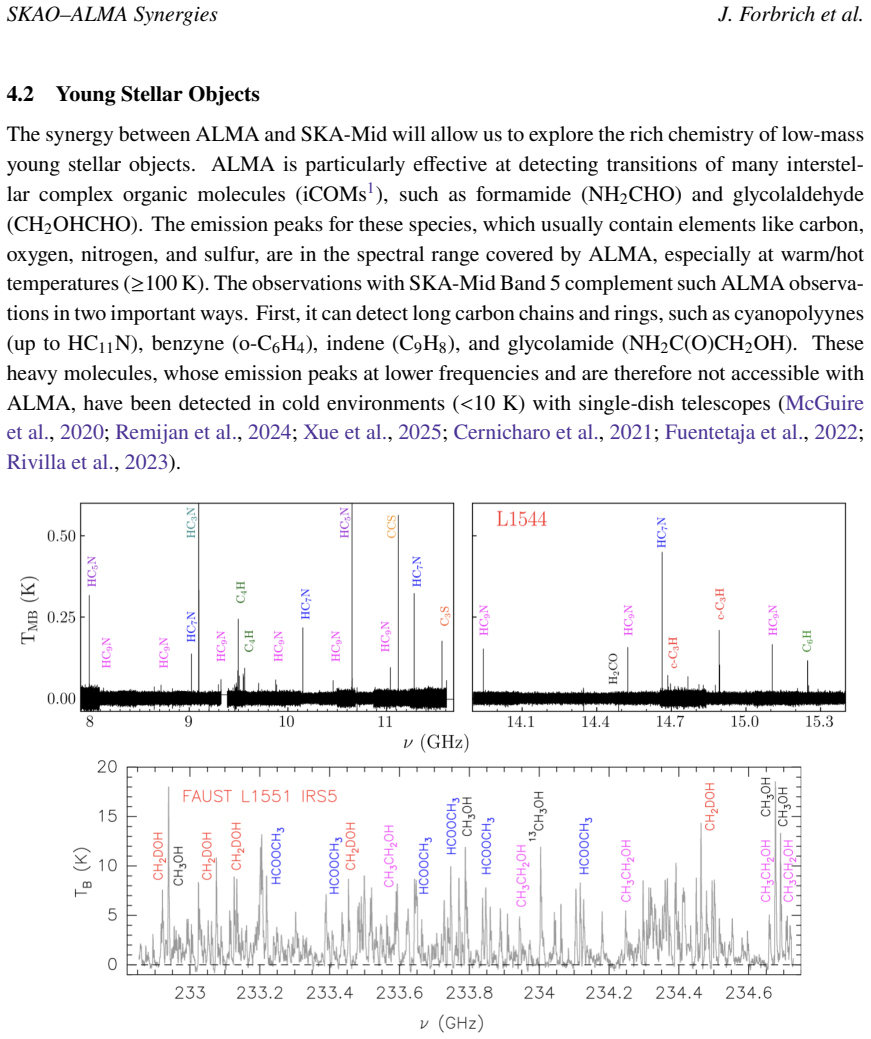
- [§4.2] The claim that SKA-Mid will detect iCOMs and long carbon chains (including benzyne, indene, glycolamide) in cold prestellar cores is made without a sensitivity estimate. The quoted abundances (10^-12 to 10^-6 relative to H2) and single-dish GBT detections do not establish that SKA-Mid Band 5 can detect these weak lines in reasonable integration times at the stated angular resolution. A simple line-strength or column-density sensitivity check for one or two representative species toward a source like L1544 would transform this section from speculation to a falsifiable expectation. Without it, the chemical-inventory synergy is a key unverified part of the chapter's central thesis.
minor comments (6)
- [§5.1] The sentence 'The sites of SKA-Mid and SKA-Low have only very limited simultaneous visibility' is garbled; it should refer to limited simultaneous visibility between ALMA and SKA-Mid/SKA-Low. Please rephrase.
- [Fig. 5 caption] The caption mentions ALMA and VLA, but the text discusses ALMA–MeerKAT simultaneous visibility. Clarify what is plotted (MeerKAT vs SKA-Mid?) and ensure the caption matches the text.
- [§2] The phrase 'SKA-Mid Band 5b cannot be simultaneously observed in its entirety' is awkward; suggest 'the full Band 5b cannot be covered in a single frequency tuning.'
- [§6] The reference 'SKAMemo20-01' is not in the reference list; please add a full bibliographic entry.
- [§4.1] Write 'H I' rather than 'Hi' for atomic hydrogen in the phrase 'the atomic hydrogen (Hi)' and in 'CO and Hi.'
- [§3] The sentence 'There are at least four mechanisms that produce continuum emission' is followed by a list of four, but 'the first of these' is ambiguous because the first listed item is described only as 'the interaction of energetic ionised particles...'; name it explicitly (gyrosynchrotron/synchrotron).
Circularity Check
No circularity: this is a review/prospectus chapter with no fitted-parameter predictions; self-citations are pointers, not load-bearing reductions.
full rationale
The chapter is a forward-looking review of SKAO-ALMA synergies rather than a derivation chain. It contains no equations, no fitted parameters, and no prediction that is constructed from its own inputs. Claims such as the number of H_n-alpha recombination lines observable in SKA-Mid bands are direct consequences of the stated frequency coverage and line rest frequencies, not outputs of a model. The scientific arguments rest on independent published observations (e.g., Forbrich et al. 2008; Vargas-González et al. 2023; De Simone et al. 2020) and published facility specifications. Citations to companion chapters in the same SKA volume (Bianchi, Karska, Rygl, Sabatini 2026) are cross-references to more detailed discussions, not load-bearing justifications of the central claim, and no uniqueness or exclusivity argument is imported from them. The main feasibility caveat in Section 5.1 — limited simultaneous visibility and rare beam-size matches — is explicitly acknowledged by the authors, and while it exposes a quantitative gap in the case for simultaneous time-domain science, a missing feasibility calculation is a correctness/evidential concern, not a circularity. No step in the text reduces to its own input, so no circular step can be exhibited.
Assumptions & free parameters
assumptions (5)
- domain assumption Quoted SKA/ALMA technical specifications (beam sizes, bandwidths, AA* and AA4 configurations) are accurate and will be realised as stated.
- domain assumption ALMA and SKA observations can be coordinated in time despite limited simultaneous visibility.
- domain assumption The proposed SKA-Mid Band 6 (15–50 GHz) will be part of the final SKA design.
- domain assumption ALMA2030 Wideband Sensitivity Upgrade will deliver the stated 4x instantaneous bandwidth.
- domain assumption SKA-Mid will be sensitive enough to detect weak iCOM lines with abundances down to 10^-12 relative to H2.
Cite this review
Pith. "Pith review of SKAO-ALMA Synergies in Star Formation Science." pith.science (2026). https://pith.science/paper/RETYX4DH
@misc{pith2026260725721,
  author       = {Pith},
  title        = {Pith review of: SKAO-ALMA Synergies in Star Formation Science},
  year         = {2026},
  howpublished = {\url{https://pith.science/paper/RETYX4DH}},
  note         = {Machine review of arXiv:2607.25721}
}
read the original abstract
We highlight the potential for synergies between the SKA telescopes and ALMA, which will begin to be significant already with SKA Early Science. Broadly within star formation science, we focus on 1) (simultaneous) time domain and variability studies (e.g., of (proto-)stars), which is systematically opening a new observing window that will enable us to better constrain the physics of extreme stellar flares and their interplay with mass accretion in young stars, 2) possibilities for complementary coverage of different transitions of molecules as tracers of the ISM (e.g., H2CO to trace density and temperature), and 3) radio recombination lines to trace ionised gas at different densities. Furthermore, we address synergies in terms of the spatial resolution of both observatories and new capabilities not only on the SKAO side but extending to the ALMA2030 wideband sensitivity upgrade.
Figures


Figures from the paper (2 more)


Reference graph
Works this paper leans on
-
[4]
doi: 10.3847/2041-8213/ac5a56. E. Bianchi et al.ApJ, 944(2):208, Feb
-
[5]
doi: 10.3847/1538-4357/acb5e8. E. Bianchi et al. InAdvancing Astrophysics with the SKA – II (AASKAII)
-
[9]
doi: 10.3847/2041-8213/ab2f8a. R. A. Burns. In T. Hirota, H. Imai, K. Menten, and Y. Pihlström, editors,Cosmic Masers: Proper Motion Toward the Next-Generation Large Projects, volume 380 ofIAU Symposium, pages 443–451, Jan
-
[10]
doi: 10.1017/S1743921323003381. R. A. Burns et al.Nature Astronomy, 7:557–568, May
-
[11]
doi: 10.1038/s41550-023-01899-w. L. Cacciapuoti et al.ApJ, 961(1):90, Jan
-
[12]
doi: 10.3847/1538-4357/ad0f17. L. Cacciapuoti et al.A&A, 700:A188, Aug
-
[16]
doi: 10.1051/0004-6361/202141573. L. Cros et al.A&A, 701:A148, Sept
-
[17]
doi: 10.1051/0004-6361/202555085. M. De Simone et al.ApJ, 896(1):L3, June
Show all 79 references
-
[18]
doi: 10.3847/2041-8213/ab8d41. M. De Simone et al.ApJ, 935(1):L14, Aug
-
[19]
doi: 10.3847/2041-8213/ac85af. A. K. Diaz-Rodriguez et al.ApJ, 930(1):91, May
-
[20]
doi: 10.3847/1538-4357/ac3b50. B. T. Draine.ARA&A, 41:241–289, Jan
-
[21]
doi: 10.1146/annurev.astro.41.011802.094840. B. T. Draine and A. Lazarian.ApJ, 494(1):L19–L22, Feb
-
[27]
doi: 10.3847/1538-4357/aa7aa4. A. Frank et al. In H. Beuther, R. S. Klessen, C. P. Dullemond, and T. Henning, editors,Protostars and Planets VI, pages 451–474, Jan
-
[29]
doi: 10.1051/0004-6361/202452191. R. Fuentetaja et al.A&A, 663:L3, July
-
[30]
doi: 10.1051/0004-6361/202243857. Y. Gao and P. M. Solomon.ApJ, 606(1):271–290, May
-
[32]
doi: 10.3847/1538-4357/ab311a. L. Giani et al.MNRAS, staf1941, Nov. 2025b. ISSN 0035-8711. doi: 10.1093/mnras/staf1941. A. Ginsburg et al.ApJ, 736(2):149, Aug
-
[34]
doi: 10.3847/1538-4357/aafb71. A. Ginsburg et al.ApJ, 942(2):66, Jan
-
[35]
doi: 10.3847/1538-4357/ac9f4a. M. Güdel.ARA&A, 40:217–261, Jan
-
[37]
doi: 10.1051/0004-6361/202039798. T. Hirota et al.PASJ, 74(5):1234–1262, Oct
-
[38]
doi: 10.1093/pasj/psac067. A. Hoque et al.ApJ, 987(2):197, July
-
[39]
doi: 10.3847/1538-4357/add928. C. L. H. Hull et al.ApJ, 823(2):L27, June
-
[40]
doi: 10.3847/2041-8205/823/2/L27. T. R. Hunter et al.ApJ, 837(2):L29, Mar
-
[41]
doi: 10.3847/2041-8213/aa5d0e. K. Immer et al.A&A, 595:A94, Nov
-
[42]
15 SKAO–ALMA Synergies J
doi: 10.1051/0004-6361/201628777. 15 SKAO–ALMA Synergies J. Forbrich et al. I. Jiménez-Serra et al.ApJ, 764(1):L4, Feb
-
[44]
doi: 10.3847/1538-4357/ab8adc. A. Karska et al. InAdvancing Astrophysics with the SKA – II (AASKAII)
-
[45]
doi: 10.1086/383186. P. Kaufmann et al.ApJ, 697(1):420–427, May
-
[48]
doi: 10.1007/s00159-020-0123-7. C.-F. Lee et al.Science Advances, 3(4):e1602935, Apr
-
[49]
doi: 10.1126/sciadv.1602935. M.-Y. Lee et al.ApJ, 809(1):56, Aug
-
[51]
doi: 10.1093/mnras/staa1577. A. López-Sepulcre et al.A&A, 692:A120, Dec
-
[52]
doi: 10.1051/0004-6361/202450169. J. G. Mangum and A. Wootten.ApJS, 89:123, Nov
-
[54]
doi: 10.3847/1538-4357/ab960b. M. J. Maureira et al.A&A, 689:L5, Sept
-
[55]
doi: 10.1051/0004-6361/202451166. B. A. McGuire et al.ApJ, 900(1):L10, Sept
-
[56]
doi: 10.3847/2041-8213/aba632. D. M. A. Meyer, E. I. Vorobyov, R. Kuiper, and W. Kley.MNRAS, 464(1):L90–L94, Jan
-
[57]
doi: 10.1093/mnrasl/slw187. A. Morbidelli et al.A&A, 691:A147, Nov
-
[58]
doi: 10.1051/0004-6361/202451388. L. Moscadelli, R. Cesaroni, M. T. Beltrán, and V. M. Rivilla.A&A, 650:A142, June
-
[59]
doi: 10.1051/0004-6361/202140829. M. Padovani, D. Galli, and A. E. Glassgold.A&A, 501(2):619–631, July
-
[60]
doi: 10.3847/1538-4357/ace164. T. Peters, S. N. Longmore, and C. P. Dullemond.MNRAS, 425(3):2352–2368, Sept
-
[62]
doi: 10.1051/0004-6361/201526803. A. J. Remijan et al.ApJ, 976(1):105, Nov
-
[63]
doi: 10.3847/1538-4357/ad856e. V. M. Rivilla et al.ApJ, 953(2):L20, Aug
-
[64]
doi: 10.3847/2041-8213/ace977. K. L. J. Rygl et al. InAdvancing Astrophysics with the SKA – II (AASKAII)
-
[65]
doi: 10.1051/0004-6361/202140469. G. Sabatini, S. Bovino, and E. Redaelli.ApJ, 947(1):L18, Apr
-
[66]
Sabatini et al.A&A, 692:A265, Dec
G. Sabatini et al.A&A, 692:A265, Dec. 2024a. doi: 10.1051/0004-6361/202451659. G. Sabatini et al.A&A, 684:L12, Apr. 2024b. doi: 10.1051/0004-6361/202449616. G. Sabatini et al.A&A, 698:L16, June
-
[67]
doi: 10.1051/0004-6361/202554750. G. Sabatini et al. InAdvancing Astrophysics with the SKA – II (AASKAII)
-
[68]
doi: 10.1093/mnras/staf1451. K. Taniguchi, M. Saito, T. K. Sridharan, and T. Minamidani.ApJ, 872(2):154, Feb
-
[69]
doi: 10.3847/1538-4357/ab001e. K. Taniguchi et al.ApJ, 965(2):162, Apr
-
[70]
doi: 10.3847/1538-4357/ad2fa1. S. Thorwirth et al.ApJ, 586(1):338–343, Mar
-
[71]
doi: 10.1086/367629. Y. Tsukamoto, M. N. Machida, and S.-i. Inutsuka.ApJ, 920(2):L35, Oct
-
[72]
H.Uchimura,T.Kudoh,andY.Tsukamoto.ApJ,984(2):143,May2025
doi: 10.3847/ 2041-8213/ac2b2f. H.Uchimura,T.Kudoh,andY.Tsukamoto.ApJ,984(2):143,May2025. doi: 10.3847/1538-4357/ adc806. J. S. Urquhart. In T. Hirota, H. Imai, K. Menten, and Y. Pihlström, editors,Cosmic Masers: Proper Motion Toward the Next-Generation Large Projects, volume ...
-
[73]
doi: 10.1017/S1743921323002326. J. Vargas-González et al.MNRAS, 522(1):56–69, June
-
[74]
doi: 10.1093/mnras/stad926. Y. X. Wang et al.A&A, 663:A177, July
-
[75]
doi: 10.1051/0004-6361/202142450. M. Wright et al.ApJ, 945(1):14, Mar
-
[76]
doi: 10.3847/1538-4357/acac2c. C. Xue et al.ApJS, 281(1):9, Nov
-
[77]
doi: 10.3847/1538-4365/ae04e5. Y. Zhang et al.ApJ, 886(1):L4, Nov
-
[78]
doi: 10.3847/2041-8213/ab5309. I. I. Zinchenko et al.MNRAS, 543(1):L9–L13, Oct
-
[79]
doi: 10.1093/mnrasl/slaf086. 17
-
[1985]
doi: 10.1146/annurev.aa.23.090185.001125. S. A. Dzib, J. Forbrich, M. J. Reid, and K. M. Menten.ApJ, 906(1):24, Jan
-
[1993]
doi: 10.1086/191841. M. J. Maureira et al.ApJ, 897(1):59, July
-
[1998]
doi: 10.1086/311167. G. A. Dulk.ARA&A, 23:169–224, Jan
- [1999]
-
[2002]
doi: 10.1146/annurev.astro.40.060401.093806. E. Herbst and E. F. van Dishoeck.ARA&A, 47:427–480, Sept
-
[2003]
doi: 10.1086/379101. S. L. Breen et al.ApJ, 876(2):L25, May
-
[2004]
doi: 10.1086/382999. S. Giacalone et al.ApJ, 882(1):33, Sept
-
[2008]
doi: 10.1086/522570. M. Kuffmeier, B. Zhao, and P. Caselli.A&A, 639:A86, July
-
[2009]
doi: 10.1088/0004-637X/697/1/420. E. Keto, Q. Zhang, and S. Kurtz.ApJ, 672(1):423–432, Jan
-
[2011]
doi: 10.1088/0004-637X/736/2/149. A. Ginsburg et al.ApJ, 872(1):54, Feb
-
[2012]
doi: 10.1111/j.1365-2966.2012.21676.x. J. E. Pineda et al.A&A, 686:A162, June
2012
-
[2013]
doi: 10.1088/2041-8205/764/1/L4. K. G. Johnston et al.ApJ, 896(1):35, June
-
[2014]
doi: 10.2458/azu_uapress_9780816531240-ch020. J. Frediani et al.A&A, 695:A78, Mar
-
[2015]
doi: 10.1088/0004-637X/809/1/56. T. Liu et al.MNRAS, 496(3):2790–2820, Aug
-
[2016]
doi: 10.3847/0004-637X/822/2/93. J. Forbrich et al.ApJ, 844(2):109, Aug
-
[2017]
doi: 10.1051/0004-6361/201730527. J. Forbrich, K. M. Menten, and M. J. Reid.A&A, 477(1):267–272, Jan
-
[2018]
C.Codellaetal.FrontiersinAstronomyandSpaceSciences,8:227,Dec.2021
doi: 10.1051/0004-6361/201732238. C.Codellaetal.FrontiersinAstronomyandSpaceSciences,8:227,Dec.2021. doi: 10.3389/fspas. 2021.782006. L. Colzi et al.A&A, 653:A129, Sept
2021
-
[2019]
doi: 10.3847/2041-8213/ab191c. C. L. Brogan et al.ApJ, 881(2):L39, Aug
-
[2020]
doi: 10.1093/mnrasl/slaa130. E. Bianchi et al.ApJ, 928(1):L3, Mar
-
[2021]
doi: 10.1051/0004-6361/202141660. R. Cesaroni et al.A&A, 612:A103, May
-
[2022]
doi: 10.1093/mnras/stac1391. E. Bianchi et al.MNRAS, 498(1):L87–L92, Nov
-
[2023]
doi: 10.3847/2041-8213/acef1d. M. R. Bate.MNRAS, 514(2):2145–2161, Aug
-
[2024]
doi: 10.1051/0004-6361/202347856. G. C. Bower et al.ApJ, 598(2):1140–1150, Dec
-
[2025]
C.Ceccarellietal
doi: 10.1051/0004-6361/202554645. C.Ceccarellietal. InProtostarsandPlanetsVII,volume534ofASPConferenceSeries,page379, July 2023a. 14 SKAO–ALMA Synergies J. Forbrich et al. C. Ceccarelli et al. In S. Inutsuka et al., editors,Protostars and Planets VII, volume 534 of Astronomica...
Reviewed August 1, 2026 · model on record in the stance chip above.
Discussion (0). Sign in to comment.