REVIEW 4 major objections 6 minor 29 references
A new look at old devils. II: New insights on classical radio galaxies from MeerKAT and uGMRT
T0 review · 4 major / 6 minor · reviewed 2026-08-01 · deepseek-v4-flash
Pith's one-line read This paper argues that the classic FRI/FRII classification of radio galaxies remains a useful first-order scheme, but the detailed structures revealed by deep, high-resolution imaging—filaments, multiple hotspot peaks, hybrid jets, dying lo
desk verdict Competent, honest imaging paper with genuinely new MeerKAT/uGMRT maps and age estimates; the FR-confirmation claim is partly baked into the sample selection, but the morphology work stands on its own. read the letter →
The pith
A machine-rendered reading of the paper's core claim, the machinery that carries it, and where it could break.
The reading
What carries the argument
The central tools are high-sensitivity, ~4–10-arcsecond total-intensity and in-band spectral-index images from MeerKAT L-band and uGMRT Band-4, combined with continuous-injection (CI) spectral ageing fits to integrated spectra. The CI model, which assumes a constant rate of electron injection followed by radiative losses, provides break frequencies that, together with equipartition magnetic field estimates and source volumes measured out to the 9-sigma contour, yield radiative ages. This machinery is what uncovers the substructures (filaments, multiple hotspot peaks, jet bends, backflow bifurcations) and connects morphology to evolutionary phase.
What would settle it
Run a morphological census on a sample of radio galaxies chosen without the low-resolution double-morphology requirement—for instance, all 4C sources in a declination strip—and measure the fraction of hybrid, amorphous, and restarted morphologies; if that fraction grows substantially, the claim that the FRI/II scheme is a useful first-order description would be falsified. A second, more targeted check: measure the spectral age of the inner hotspot pair in 3C445; if they are not younger than the outer lobes, the double-double restarted interpretation fails.
Extended reading notes
Core claim
At roughly 4–10 arcsecond resolution and microjansky sensitivities, ten radio galaxies—three FRI, three FRII, two tailed, and two FR0—display a wealth of substructure while remaining broadly assignable to the classical FRI/FRII families. The authors conclude that the FR scheme is still a useful first-order classification, but that filaments, multiple hotspot peaks, hybrid jet behaviour, large-scale asymmetries, and signs of restarted or dying activity require models that couple jet power with environmental complexity and episodic activity. Radiative ages derived from continuous-injection spectral fits range from ~40 Myr (3C105) to ~242 Myr (3C198), with 3C198 interpreted as an old, dying rad
Load-bearing premise
The sample was deliberately selected to contain only sources that already show a clear double radio morphology at the coarse 45-arcsecond resolution of NVSS, so the conclusion that most sources still fit the classical two-type scheme is partly enforced by the selection rather than independently tested.
Editorial extensions
If this is right
- Many 'classical' radio galaxies hide substantial substructure—filamentary lobes, multiple hotspot peaks, jet wiggles, and backflow bifurcations—that is only visible at high sensitivity and ~4–10 arcsecond resolution.
- Radiative ages from continuous-injection fits span roughly 40–240 Myr, showing that a small sample can contain active, restarted, and dying/remnant radio galaxies simultaneously.
- 3C445 shows aligned inner and outer hotspots along the jet axis, suggesting a double-double restarted structure; 3C198, with a very low break frequency and no detectable core or hotspots, is likely an old dying radio galaxy.
- The FRI/II radio-power divide is not clean; hybrid sources such as 3C403.1 blur the boundary, and morphology depends on jet power, environment, and history rather than radio power alone.
- FR0 radio galaxies remain compact and unresolved at current sensitivity, with no significant extended emission detected, leaving their nature (separate population vs. short-lived FRI phase) open.
Reading between the lines
- If such substructure is widespread, automated classifiers trained on coarse survey images will systematically mislabel a small but physically informative minority of radio galaxies; a shift toward continuous descriptors or stacked phenotype tags may be needed rather than discrete classes.
- The detection of several restarted and dying sources in a sample of ~14 objects hints that duty cycles are short relative to cosmological timescales; a larger, volume-limited census could quantify what fraction of a radio galaxy's life is spent in fading or re-triggered phases.
- The sharp spectral and surface-brightness break in the northern lobe of CGCG047−067 is a testable probe of ICM density gradients; X-ray surface-brightness mapping of its group environment could directly confirm or refute the environmental-transition interpretation.
- Since in-band spectral-index mapping was possible for only three sources, several morphological claims rest on total-intensity structure alone; matched-resolution multi-band observations would test whether hybrid morphologies correspond to distinct spectral-age distributions.
Editorial analysis
A structured set of objections, weighed in public.
Referee Report
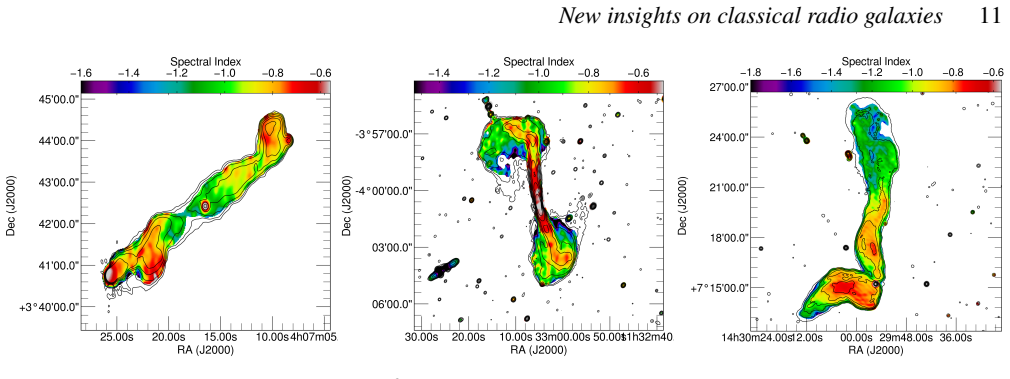
Summary. This paper presents MeerKAT L-band (856-1712 MHz) and uGMRT Band-4 (550-850 MHz) observations of ten radio galaxies from a larger 17-source programme, complementing four sources already published in Paper I. For each target the authors provide total-intensity images at 4-10 arcsec resolution, morphological descriptions, sizes, and flux densities; for three sources (3C105, 4C-03.43, CGCG047-067) they also present in-band spectral index maps with associated error maps. Integrated spectra combining the new measurements with archival flux densities are fitted with the Synage package, and the authors report CI-model break frequencies and equipartition-based radiative ages of about 40-242 Myr. The main scientific claim is that the detailed morphologies largely conform to the classical Fanaroff-Riley classification as a first-order scheme, while numerous substructures - filaments, multiple hotspots, S-shaped jets, possible restarted activity in 3C445 - demonstrate that environmental complexity and episodic activity must be part of a complete description. A secondary claim is that two FR0s remain compact in the new deep images.
Significance. The paper's descriptive content is strong and timely. The images reveal genuine new substructure in poorly studied sources (e.g., the L-shaped morphology of CGCG047-067, the filamentary structure of 3C198, the possible inner double in 3C445), and the authors are careful to quote noise levels and calibration errors and to provide spectral-index error maps. The data are public and the reduction procedures are standard and largely reproducible. If the selection caveat discussed below is addressed, the sample will be a useful reference for automated morphology classifiers. The spectral-age results are plausible but rest on heterogeneous data and model assumptions; they should be treated as indicative rather than precise. The FR-classification claim is the weakest part: because the sample was preselected at NVSS resolution to show a clear double morphology, the confirmation that most sources fit FR classes is in part an artefact of sample construction.
major comments (4)
- [Sect. 2, criterion (iii); Sect. 7, first bullet] The sample was required to exhibit 'a clear double radio morphology' at NVSS 45 arcsec. The paper's headline conclusion that the classical FR classification remains a valuable reference is therefore partly inherited from the selection step. To make the claim about the broader radio-galaxy population, please quantify how many 4C sources in the same redshift/declination window are excluded by criterion (iii), and either restrict the concluding statement to double-selected objects or explain how the excluded population would modify it. The substructure findings themselves are not affected by this issue.
- [Sect. 5.1, Table 4] The radiative ages combine our flux densities with archival measurements obtained at different resolutions, epochs, and calibration scales (Appendix B), and the choice of the CI model is reported as 'best fit' without fit statistics or a quantitative model comparison. Break-frequency uncertainties in Table 4 are formal fit errors. Given that these ages drive the interpretation of 3C198 as a dying source and support the 'multiple evolutionary stages' conclusion, the authors should add a systematic-error discussion, e.g., the dependence of the ages on the assumed magnetic-field/volume assumptions and on excluding individual low-frequency or single-dish archival points.
- [Table 3] Several table entries are internally inconsistent and affect reported physical quantities. For the FR0 sources, SDSS J0917+1331 is listed with S1.28=0.02±0.72 Jy and SDSS J1120+0407 with 0.01±0.21 Jy; if the errors are in mJy or the values are in different columns, the units or separators must be corrected, because as printed both detections are formally consistent with zero flux. In addition, NGC7503 is listed with LLS=0.01 Mpc, which is inconsistent with the ~55-78 kpc jet extents quoted in Sect. 4.8 and with its classification as a narrow-angle-tail source. These values feed into Figures 6 and 7, so they should be corrected and propagated.
- [Sect. 6.4 and Appendix A, 4C-03.43] The paper states that 4C-03.43 may be a wide-angle-tail source viewed almost face-on, but also that the integrated spectral fit for this source is unreliable because of very different archival resolutions. Since this source is one of only three with in-band spectral index maps, the reader should be told explicitly whether the spectral-index steepening interpretation is robust to the same resolution/missing-short-spacing issues that make the integrated spectrum unreliable.
minor comments (6)
- [Fig. 1 and Fig. 2 captions] The source name is given as CGCG046−067 in the figure captions but CGCG047−067 in the text and tables; please unify.
- [Sect. 3.1] 'automaking' should presumably read 'auto-masking'.
- [Sect. 5.2] The sentence beginning 'We follow the standard method of determining the spectral index...' is grammatically incomplete; Eq. (2) itself is correct, but the surrounding text should be reworded.
- [Table 3] The header for the largest linear size does not specify the unit; the values are given in Mpc, but NGC7503's value in particular needs checking as noted in the major comments. Please make the units explicit in the table.
- [Sect. 6.1 and Fig. 7] The text says the cumulative distribution in Fig. 7 indicates that the two cluster-dominant radio galaxies fall below the giant threshold, but the figure caption does not explain the colour coding or which points are cluster-dominant; please make the figure self-contained.
- [Sect. 2] The paper says the sample from Paper I was broadened to provide 'a similar fraction of FRI and FRII radio galaxies', but the eventual sample of 14 sources includes three FRI and three FRII in this paper plus four in Paper I; a short sentence summarizing the final FRI/FRII balance would help.
Circularity Check
No significant circularity; spectral ages are best-fit outputs, Paper I self-citations are not load-bearing, and the sample-selection pre-filter is a generalizability caveat rather than a tautological derivation.
full rationale
The paper's new observations — MeerKAT and uGMRT images, flux densities, spectral index maps, and morphological descriptions — are independent measurements. The integrated spectra are fitted with Synage KP/JP/CI models; the break frequencies and radiative ages are presented as fit outputs (e.g., Sect. 5.1, Table 4), not as independent predictions, so there is no fitted-input-called-prediction circularity. Self-citations to Paper I (Fanaroff et al. 2021) establish sample continuity and previously published imaging of four sources; no central conclusion rests solely on that citation. The only notable caveat is sample construction: criterion (iii) in Sect. 2 requires a 'clear double radio morphology' at NVSS 45″ resolution, which pre-selects sources that already resemble classical doubles and therefore weakens the generality of the statement that 'the classical FR classification remains a useful first-order scheme.' However, this is a sampling/generalizability limitation, not a derivation that reduces to its own inputs. The substructure findings — filaments, multiple hotspots, hybrid morphologies, restarted activity — are independent of the selection and would not be invalidated by relaxing the criterion.
Assumptions & free parameters
free parameters (4)
- Break frequency νbr (per source) =
0.22–7.54 GHz
- Injection spectral index α_inj =
0.5 (fixed after initial free fit); 0.89 for 3C403.1
- Equipartition parameters Φ=1, κ=1 =
—
- Source volumes (cylindrical, 9σ contours) =
per source, not tabulated
assumptions (4)
- domain assumption The integrated radio spectra are dominated by synchrotron radiative ageing and are adequately described by the Continuous Injection (CI) model.
- domain assumption Archival flux densities from heterogeneous telescopes, resolutions, and epochs can be combined into one integrated spectrum without inter-calibration or resolution corrections.
- domain assumption Equipartition with Φ=1 and κ=1 yields a good estimate of the magnetic field, and the emitting volume is well approximated by cylinders within the 9σ contour.
- standard math The standard radiative-age formula (Murgia et al. 1999, Eq. 2) correctly converts break frequency to age for these sources.
Cite this review
Pith. "Pith review of A new look at old devils. II: New insights on classical radio galaxies from MeerKAT and uGMRT." pith.science (2026). https://pith.science/paper/COK5CLOU
@misc{pith2026260725867,
  author       = {Pith},
  title        = {Pith review of: A new look at old devils. II: New insights on classical radio galaxies from MeerKAT and uGMRT},
  year         = {2026},
  howpublished = {\url{https://pith.science/paper/COK5CLOU}},
  note         = {Machine review of arXiv:2607.25867}
}
abstract
This paper presents a detailed morphological and spectral analysis of a sample of ten radio galaxies observed with the MeerKAT in L-band ($856\, \text{-}\,1712\ \mathrm{MHz}$) and the upgraded Giant Metrewave Radio Telescope in Band-4 ($550\,\text{-}\,850\ \mathrm{MHz}$). Our main goals are to revisit the current classification scheme for classical radio galaxies and study the properties of new radio features in jets, lobes and hot spots, which are becoming increasingly numerous due to the sensitivity and imaging capabilities of current radio interferometers, and suggest previous unexplored interaction mechanisms between the radio plasma and the external medium. The sample from the 4C catalogue includes FR I, FR II, wide-angle and narrow-angle tailed sources as well as FR 0 radio galaxies from FR0CAT, with redshifts ranging from $0.04\,\text{-}\,0.20$. The high angular resolution, $\sim4^{\prime\prime}\text{-}10^{\prime\prime}$ total intensity images are presented, revealing complex structures in the jets, lobes and hotspots of these sources. The integrated spectra of the sources, constructed using flux density measurements from our observations and archival data, reveal spectral breaks and slopes indicative of radiative ageing, with ages spanning $\sim40\,\text{-}\,242\ \mathrm{Myr}$. While the sample broadly confirms the classical FR classification as a useful first-order scheme, the substructures within the radio emission of sources highlight the need for models that incorporate environmental complexity and episodic jet activity to fully describe radio-galaxy evolution.
Figures


Figures from the paper (4 more)



Reference graph
Works this paper leans on
-
[1]
D., Capetti A., 2008, A&A, 489, 989 Baldi R
Adelman-McCarthyJ.K.,etal.,2007,TheAstrophysicalJournalSupplement Series, 172, 634 Adelman-McCarthyJ.K.,etal.,2008,TheAstrophysicalJournalSupplement Series, 175, 297 Baldi R. D., Capetti A., 2008, A&A, 489, 989 Baldi R. D., Capetti A., Massaro F., 2018, A&A, 609, A1 Baldi R. D., Capetti A., Giovannini G., 2019, MNRAS, 482, 2294 Balmaverde B., et al., 2019...
arXiv 2007
-
[2]
Genzel et al. (1976),
1976
-
[3]
Dicken et al. (2008),
2008
-
[4]
Kellermann and Pauliny-Toth (1973),
1973
-
[5]
Pauliny-Toth et al. (1978),
1978
-
[6]
Geldzahler and Witzel (1981),
1981
-
[7]
Kuehr et al. (1981),
1981
-
[8]
Kellermann et al. (1969),
1969
Show all 29 references
-
[9]
Pauliny-Toth et al. (1972),
1972
-
[10]
Gregory and Condon (1991), 11.Beckeretal.(1991),12.Griffithetal.(1995),13.Walletal.(1971),14.Wills(1975),15.WhiteandBecker(1992),16.Pauliny-Toth et al. (1966),
1991
-
[11]
Wright and Otrupcek (1990),
1990
-
[17]
Condon et al. (1998),
1998
-
[19]
Large et al. (1981),
1981
-
[20]
Gower et al. (1967),
1967
-
[22]
Jacobs et al. (2011),
2011
-
[23]
Bennett et al. (1986),
1986
-
[25]
Carter et al. (2009),
2009
-
[26]
Ching et al. (2017),
2017
-
[28]
Murphy et al. (2010),
2010
-
[29]
Healey et al. (2007),
2007
-
[30]
Douglas et al. (1996),
1996
-
[31]
Tingay et al. (2016),
2016
-
[34]
Kuźmicz et al. (2018),
2018
-
[35]
Ricci et al. (2006),
2006
-
[36]
Witzel et al. (1971). APPENDIX C: SPECTRAL INDEX ERROR Figure C1: MeerKAT in-band spectral index error maps for the sources 3C105, 4C−03.43, and CGCG047−067. MNRAS000, 1–19 (2026)
1971
-
[2002]
Missaglia et al
at redshift z=0.055. Missaglia et al. (2022) recently conducted a radio/optical study and concluded that the radio galaxy is part of a low-mass poor group. The radio galaxy belongs to the MURALES sample (Speranza et al. 2021; Balmaverde et al. 2019, 2021), investigated in sear...
2022
-
[2009]
(1997), where the two inner compact components located north and south of the core and aligned along the jet direction (labelled N1 and S1 in their paper) were identified
and have been investigated in detail with the JVLA at 22 GHz to studythedistributionofthestrongshocksinthehotspotregion.The radio galaxy was imaged at high angular resolution in Leahy et al. (1997), where the two inner compact components located north and south of the core and...
1997
-
[2011]
2006), is a typical BLRGemittingverystrongbroademissionlines(Rudy&Tokunaga 1982).Withalinearsizeof∼630kpc,itbelongstotheclassofgiant radio galaxies
elliptical galaxy possessing an exceptionally bright and compact central region (Madrid et al. 2006), is a typical BLRGemittingverystrongbroademissionlines(Rudy&Tokunaga 1982).Withalinearsizeof∼630kpc,itbelongstotheclassofgiant radio galaxies. It is aligned along north-south d...
2006
-
[7499]
SDSSJ1120+0407is associated with the galaxy CGCG039−127, with m 𝑔=15.4 and z=0.049655 (Yoshino & Yamauchi 2015), andSDSSJ0917+1331is associated with WISEA J091754.26+133145.5,withmagnitude17.79andlocatedatsimilar redshift (z=0.049932, Adelman-McCarthy et al. 2008). In both cas...
2015
Reviewed August 1, 2026 · model on record in the stance chip above.
Discussion (0). Sign in to comment.