REVIEW 1 major objections 4 minor 103 references
Parametrized $\underline{\mathbb{F}}_2$-Cohomology of $B_{C_2}O(1)$
T0 review · 1 major / 4 minor · reviewed 2026-08-01 · deepseek-v4-flash
Pith's one-line read This paper computes the full parametrized F2-cohomology ring of the classifying space for real C2-line bundles, showing it has six generators and four relations and encodes all RO(C2)-graded cohomology of Thom spaces of real C2-bundles.
desk verdict Real and useful computation of parametrized F2-cohomology of B_C2 O(1), but Theorem 9.3.2 has a load-bearing gap: a-multiple differentials are invisible to the forgetful map and are never ruled out. read the letter →
The pith
A machine-rendered reading of the paper's core claim, the machinery that carries it, and where it could break.
The reading
What carries the argument
The argument is carried by the parametrized Thom isomorphism, which identifies H^{γ+⋆}_B(B,R) with the RO(G)-graded cohomology of the Thom space Th(−γ); this reduces the computation to RO(C2)-graded cellular calculations on stunted projective spaces P^{p,q} ≅ Th(γ_{p,q}). Two new devices make the answer compact: 'homogeneity units' e_ξ, which convert between the parametrized and the RO(G)-graded Thom isomorphisms of homogeneous bundles, and 'triviality classes' ν for homogeneously trivial representations, which generate extra units when the dimension map KO_G(B)→RO(ΠB) is not surjective. The proof uses the Schubert representation-cell decomposition of P and the freeness of RO(C2)-graded coho
What would settle it
Pick a small stunted projective space, say P^{3,1} or P^{5,2}, and compute the RO(C2)-graded cellular boundary maps in its Schubert Rep(C2)-structure explicitly (e.g., by determining the degrees of the attaching maps). If any of the proposed M2-generators x_r is the target of a nonzero differential, or if two generators are connected by a differential, the module structure in Theorem 9.3.2 is wrong and the main presentation must be adjusted.
Extended reading notes
Core claim
Central discovery: an explicit presentation of the parametrized F2-cohomology of P = B_{C2}O(1) as an M2-algebra: M2[u10,u11,a10,a11,e,ν] modulo u10u11=ue, a10u11+a11u10=ae, e^2=1, ν^2=1. Here M2 is the RO(C2)-graded cohomology of a point; u10,u11 are orientation classes of the two tautological real C2-line bundles; a10,a11 their Euler classes; e is a unit balancing the parametrized and RO(C2)-graded Thom classes of the homogeneous bundle γ_{2,1}; ν is a unit measuring the difference between the full grading group RO(ΠP) ≅ Z^3×(Z/2)^2 and the subgroup KO(ΠP) ≅ Z^3×Z/2 of actual virtual bundles. The ring is free as an M2-module, and the parametrized Thom isomorphism turns this one presentatio
Load-bearing premise
The whole computation leans on the claim that, in the Schubert representation-cell decomposition of each stunted projective space P^{p,q}, every attaching map induces the zero differential in the RO(C2)-graded cellular complex; if any one of those differentials were nontrivial but still invisible to underlying singular cohomology, the list of free module generators—and with it the final six-generator presentation—would fail.
Editorial extensions
If this is right
- Every RO(C2)-graded F2-cohomology group of every Thom space Th(γ_{p,q}) over P is read off from the same six-generator ring; in particular the module generators x_r and their degrees listed in Theorem 9.3.2 follow from the same free module.
- The KO(ΠP)-graded (bundle-degree) subring is the same presentation with ν removed; degrees with μ=0 give the cohomology of all Euler and orientation classes of C2-line bundles.
- The same machinery recovers the previously known parametrized F2-cohomology of B_{C2}U(1) in the form M2[uγ,uχγ,aγ,aχγ]/(uγuχγ=u^2, aγuχγ+uγaχγ=a^2).
- The base-change and unit-adjoining theorems show that parametrized cohomology over a fixed-point component P_i is obtained from the presentation by inverting u_{1i}, giving explicit restriction formulas for the classes.
- Because the ring is free over M2, the parametrized Steenrod operations imported in Section 7.2 are determined by their values on the six generators, with the Cartan formula supplying operations on all classes.
Reading between the lines
- If the zero-differential claim in the Schubert cell structure holds for other equivariant Grassmannians or flag varieties built from representation cells, the same 'compute RO(G)-graded cohomology of stunted spaces, then package via the Thom isomorphism' strategy would yield explicit presentations for parametrized cohomology of B_{C2}O(n) or B_{C2}U(n).
- The appearance of the unit ν whenever KO(ΠB) ⊊ RO(ΠB) suggests a general phenomenon: parametrized cohomology will be a group-algebra extension by units coming from the kernel of dim; one could test this on any base where the dimension map is not surjective.
- The relation u10u11 = ue can be read as a 'reality' relation: after inverting u in M2, the homogeneity unit e becomes literally u10u11/u, so e acts like a virtual orientation class invisible to underlying singular cohomology, possibly interpretable as a local-system twist.
- The fixed-point restriction formulas effectively localize the presentation at u10 or u11; this hints that parametrized cohomology of spaces stratified by fixed-point components may always be a patchwork of such localizations, which could simplify future computations.
Signed reviews
Editorial analysis
A structured set of objections, weighed in public.
Referee Report
Summary. The paper computes the parametrized (RO(ΠP)-graded) ordinary cohomology of P = B_{C_2}O(1) with coefficients in the constant Mackey functor F_2. The main result, Theorem 10.3.4, identifies H_P^{*,*,*,*,*}(P,F_2) as the M_2-algebra M_2[u_{10},u_{11},a_{10},a_{11},e,ν] modulo (u_{10}u_{11}-ue, a_{10}u_{11}+a_{11}u_{10}-ae, e^2-1, ν^2-1), with explicit degrees. The grading RO(ΠP) is computed in Theorem 8.2.1 as Z^3×(Z/2)^2, and KO(ΠP) is identified in Theorem 8.3.4 as the subgroup with μ=0. The proof strategy goes through the RO(C_2)-graded cohomology of Thom spaces Th(γ_{p,q}), identified with stunted projective spaces; this yields the KO(ΠP)-graded part, and the remaining degree direction is adjoined as the unit ν. Part 1 develops general tools: Euler and orientation classes, homogeneity units, base-change isomorphisms, Steenrod operations, and a forgetful long exact sequence. Section 11 applies the same methods to recover Costenoble's computation for B_{C_2}U(1).
Significance. If correct, this is a substantial and useful computation. It provides the first detailed computation of parametrized cohomology with F_2-coefficients for a classifying space of real C_2-line bundles, and it simultaneously encodes the RO(C_2)-graded F_2-cohomology of all Thom spaces of real C_2-vector bundles over P. The paper is strong where it matters: the grading computation is explicit, the ring presentation is parameter-free and falsifiable, and the general toolkit (orientation classes, homogeneity units, parametrized Steenrod operations, base-change results) is independently valuable. The authors also reproduce Costenoble's BC_2U(1) computation in a unified framework. The main weakness is a gap in the proof of Theorem 9.3.2, which is load-bearing for the generator degrees used in the final presentation, but it appears repairable within the manuscript's scope.
major comments (1)
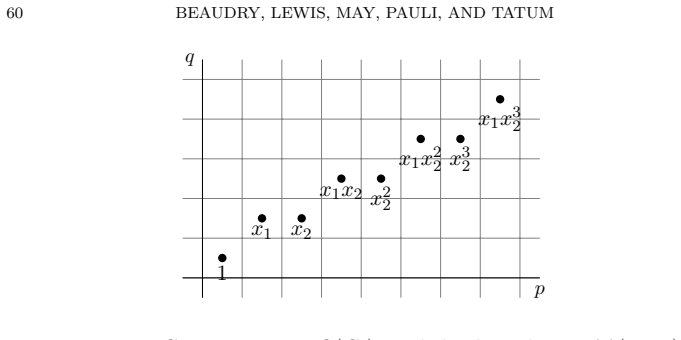
- [§9.3, proof of Theorem 9.3.2] The proof asserts that every attaching map in the Schubert Rep(C_2)-cell structure on P^{p,q} induces the zero differential, because any nonzero differential would kill two M_2-copies and change the underlying singular cohomology H^*(Th(γ_p),F_2). This justification is incomplete. In the cell structure of Fig. 7, adjacent cells such as D(R^{2m,m}) and D(R^{2m+1,m+1}) have degree difference (1,1)=|a|. A nonzero cellular coboundary from the first to the second would have M_2-coefficient a, and since i_e^*(a)=0 it is invisible to the forgetful map i_e^* and would not affect the underlying singular cohomology. Such a differential could still make the M_2-module structure non-free and would invalidate the generator degrees reported in Corollary 10.2.3 and hence the final presentation Theorem 10.3.4. The gap is repairable: Theorem 9.2.3 ensures freeness, and together with the forgetful long ex
minor comments (4)
- [§10.3, before Lemma 10.3.1] The sentence 'Recall that the full grading is RO(ΠP) ∼= Z3 ×(Z/2) 3' contains a typo: from Theorem 8.2.1 and the subsequent discussion, the grading is Z^3 × (Z/2)^2. The displayed degrees of ν in Theorem 10.3.4 are consistent with this correction.
- [§10.4, paragraph computing κ_{b_1}] The list of generators for κ_{b_1} is printed as '(0,0,0,1,0), (0,0,0,1,0)', with the second entry duplicated. It should presumably be '(0,0,0,0,1)' (the ν direction). Please correct.
- [Fig. 2] The figure label 'RP2_twist_2_paths' appears to be a leftover artifact from a drawing program. Consider replacing it with a descriptive caption or removing the stray label.
- [Remark 8.3.5] The remark states that the splitting of vector bundles over P, and a shorter proof of Theorem 8.3.4, are 'in preparation in [BZ]'. The main proof of Theorem 8.3.4 appears to be self-contained, but the remark should clarify whether the unpublished result is actually used in the proof or is only a side comment; relying on 'to appear' work for a claim near the main computation is undesirable.
Circularity Check
No significant circularity: the final presentation is derived from explicit cell, Thom-isomorphism, and Steenrod-operation computations; the flagged zero-differential gap is a correctness concern, not a circular reduction.
full rationale
The central computation is not fitted or self-referential. The grading RO(ΠP) is computed from the equivariant fundamental groupoid and an Atiyah–Segal completion argument (Thms. 8.2.1, 8.3.4). The module structure comes from explicit Schubert Rep(C2)-cell structures and known singular cohomology of stunted projective spaces (Thm. 9.3.2). The ring relations are derived from geometrically defined Euler classes, orientation classes, and homogeneity units, together with parametrized Steenrod operations (Thms. 10.2.12, 10.2.14, 10.3.4). No parameter is fitted to the target answer. Self-citations are not load-bearing: [BLM+25] is background; [HM20] is an externally published freeness theorem and the paper also gives an in-paper collapse argument; [BZ] is explicitly marked as an alternative ('The proof ... is in preparation in [BZ]') and the kept proof of KO(ΠP) does not depend on it. The one genuine concern is in the proof of Thm. 9.3.2: the assertion 'Any nontrivial differential would kill off two copies of M2, giving the wrong underlying cohomology' is under-justified, because a differential with coefficient a is invisible to the forgetful map i_e^* and need not change the underlying singular cohomology. This is a possible gap in the derivation of the M2-generator degrees, but it is not circularity: the conclusion does not reduce by construction to its inputs, and the gap is in principle repairable by direct computation of the Schubert attaching maps. Thus the paper's derivation chain is essentially independent and non-circular, with minor self-citation and a correctness caveat rather than a circular step.
Assumptions & free parameters
assumptions (6)
- domain assumption Costenoble–Waner parametrized cohomology theory: existence of RO(ΠB)-graded cohomology, representing spectra HR^γ, and Thom isomorphisms for all virtual bundles (Theorem 4.3.1, from [CW16, Thm. 3.11.3]).
- standard math Atiyah–Segal completion theorem: c: KO_G(B) → KO_G(B×EG) is completion at I(G) for compact B, plus the finite-type extension in Lemma 2.3.11.
- standard math Freeness theorem for Rep(C2)-complexes: H^{*,*}(X;F2) is free as an M2-module for finite-type Rep(C2)-complexes [Kro10], [HM20].
- standard math F2-orientability of homogeneous bundles and the RO(G)-graded Thom isomorphism (Theorem 4.3.8, cited to [BZ24]; for C2 also [Haz21]).
- domain assumption The four C2-line bundles on P are classified by homomorphisms Γ=C2×O(1)→O(1) via [May90], and their dimensions generate the μ=0 subgroup of RO(ΠP) (Lemma 8.3.2, Theorem 8.3.3).
- domain assumption The equivariant fundamental groupoid ΠP has the skeletal generating relations (8.1.2)–(8.1.3), computed by inspection of Fig. 2 and prior examples in [BLM+25].
Cite this review
Pith. "Pith review of Parametrized $\underline{\mathbb{F}}_2$-Cohomology of $B_{C_2}O(1)$." pith.science (2026). https://pith.science/paper/UVVJUZJX
@misc{pith2026260727398,
  author       = {Pith},
  title        = {Pith review of: Parametrized $\underline\mathbbF_2$-Cohomology of $B_C_2O(1)$},
  year         = {2026},
  howpublished = {\url{https://pith.science/paper/UVVJUZJX}},
  note         = {Machine review of arXiv:2607.27398}
}
abstract
We compute the parametrized (or twisted) ordinary cohomology of the classifying space for real $C_2$-line bundles, $B_{C_2}O(1)$ with coefficients in the constant Mackey functor $\underline{\mathbb{F}}_2$. Parametrized cohomology refines $RO(G)$-graded Bredon cohomology by assembling equivariant cohomology for all local coefficients into a single graded ring. For this reason, our work also encodes a computation of the $RO(C_2)$-graded cohomology of all Thom spaces of real $C_2$-vector bundles over $B_{C_2}O(1)$. Along the way, we prove many general results that can be applied to computations of parametrized cohomology over general bases $B$. In particular, we introduce a collection of characteristic classes, give a definition of orientation for non-homogeneous bundles, import equivariant Steenrod operations to this context, and give general results relating to base change.
Figures


Figures from the paper (4 more)


Reference graph
Works this paper leans on
-
[1]
Blumberg, David Gepner, Michael J
Matthew Ando, Andrew J. Blumberg, David Gepner, Michael J. Hopkins, and Charles Rezk, An -categorical approach to R -line bundles, R -module T hom spectra, and twisted R -homology , J. Topol. 7 (2014), no. 3, 869--893. 3252967
2014
-
[2]
, Units of ring spectra, orientations and T hom spectra via rigid infinite loop space theory , J. Topol. 7 (2014), no. 4, 1077--1117. 3286898
2014
-
[3]
M. F. Atiyah and G. B. Segal, Equivariant K -theory and completion , J. Differential Geometry 3 (1969), 1--18. 259946
1969
-
[4]
M. F. Atiyah, Thom complexes, Proc. London Math. Soc. (3) 11 (1961), 291--310. 131880
1961
-
[5]
Clark Barwick , Emanuele Dotto , Saul Glasman , Denis Nardin , and Jay Shah , Parametrized higher category theory and higher algebra: A general introduction , arXiv e-prints (2016), arXiv:1608.03654
arXiv 2016
-
[6]
376 (2025), Paper No
Agn\`es Beaudry, Chloe Lewis, Clover May, Sabrina Pauli, and Elizabeth Tatum, A guide to equivariant parametrized cohomology, Topology Appl. 376 (2025), Paper No. 109449. 4965750
2025
-
[7]
Prasit Bhattacharya , Alex Waugh , Mingcong Zeng , and Foling Zou , Equivariant Steenrod Operations , arXiv e-prints (2025), arXiv:2511.09816
arXiv 2025
-
[8]
Agnès Beaudry and Foling Zou, Maps between c_p -classifying spaces, To appear
Show all 103 references
-
[9]
Prasit Bhattacharya and Foling Zou, Equivariant orientation of vector bundles over disconnected base spaces, Proc. Lond. Math. Soc. (3) 129 (2024), no. 5, Paper No. e70005, 31. 4818770
2024
-
[10]
Caruso, Operations in equivariant Z /p -cohomology , Math
Jeffrey L. Caruso, Operations in equivariant Z /p -cohomology , Math. Proc. Cambridge Philos. Soc. 126 (1999), no. 3, 521--541. 1684248
1999
-
[11]
Costenoble and Thomas Hudson , The C_2 -equivariant ordinary cohomology of BT^2 , arXiv e-prints (2024), arXiv:2411.06470
Steven R. Costenoble and Thomas Hudson , The C_2 -equivariant ordinary cohomology of BT^2 , arXiv e-prints (2024), arXiv:2411.06470
2024 arXiv
-
[12]
, The C_2 -equivariant ordinary cohomology of BU(2) , arXiv e-prints (2024), arXiv:2411.06411
2024 arXiv
-
[13]
, The C_2 -equivariant ordinary cohomology of complex quadrics I: The antisymmetric case , arXiv e-prints (2025), arXiv:2510.26361
2025
-
[14]
, The C_2 -equivariant ordinary cohomology of complex quadrics II: The symmetric case , arXiv e-prints (2025), arXiv:2511.14251
2025
-
[15]
, The C_2 -equivariant ordinary cohomology of complex quadrics III: Exceptional cases , arXiv e-prints (2025), arXiv:2511.14264
2025
-
[16]
Costenoble, Thomas Hudson, and Sean Tilson, The C_2 -equivariant cohomology of complex projective spaces , Adv
Steven R. Costenoble, Thomas Hudson, and Sean Tilson, The C_2 -equivariant cohomology of complex projective spaces , Adv. Math. 398 (2022), Paper No. 108245, 69. 4388953
2022
-
[17]
S. R. Costenoble, J. P. May, and S. Waner, Equivariant orientation theory, Homology Homotopy Appl. 3 (2001), no. 2, 265--339, Equivariant stable homotopy theory and related areas (Stanford, CA, 2000). 1856029
2001
-
[18]
Costenoble, The RO( B) -graded C_ 2 -equivariant ordinary cohomology of B_ C_2 U(1) , Topology Appl
Steven R. Costenoble, The RO( B) -graded C_ 2 -equivariant ordinary cohomology of B_ C_2 U(1) , Topology Appl. 338 (2023), Paper No. 108660, 53. 4629789
2023
-
[19]
S. R. Costenoble and S. Waner, The equivariant T hom isomorphism theorem , Pacific J. Math. 152 (1992), no. 1, 21--39. 1139971
1992
-
[20]
Costenoble and Stefan Waner, Equivariant ordinary homology and cohomology, Lecture Notes in Mathematics, vol
Steven R. Costenoble and Stefan Waner, Equivariant ordinary homology and cohomology, Lecture Notes in Mathematics, vol. 2178, Springer, Cham, 2016. 3585352
2016
-
[21]
Isaksen, The motivic A dams spectral sequence , Geom
Daniel Dugger and Daniel C. Isaksen, The motivic A dams spectral sequence , Geom. Topol. 14 (2010), no. 2, 967--1014. 2629898
2010
-
[22]
Daniel Dugger, Bigraded cohomology of Z /2 -equivariant G rassmannians , Geom. Topol. 19 (2015), no. 1, 113--170. 3318749
2015
-
[23]
Guillou, Michael A
Bertrand J. Guillou, Michael A. Hill, Daniel C. Isaksen, and Douglas Conner Ravenel, The cohomology of C_2 -equivariant A(1) and the homotopy of ko _ C_2 , Tunis. J. Math. 2 (2020), no. 3, 567--632. 4041284
2020
-
[24]
Christy Hazel, Equivariant fundamental classes in RO (C_2) -graded cohomology with Z/2 -coefficients , Algebr. Geom. Topol. 21 (2021), no. 6, 2799--2856. 4344871
2021
-
[25]
M. A. Hill, M. J. Hopkins, and D. C. Ravenel, On the nonexistence of elements of K ervaire invariant one , Ann. of Math. (2) 184 (2016), no. 1, 1--262. 3505179
2016
-
[26]
2, 317--399
Po Hu and Igor Kriz, Real-oriented homotopy theory and an analogue of the A dams- N ovikov spectral sequence , Topology 40 (2001), no. 2, 317--399. 1808224
2001
-
[27]
285 (2020), 107413, 30
Eric Hogle and Clover May, The freeness theorem for equivariant cohomology of Rep (C_2) -complexes , Topology Appl. 285 (2020), 107413, 30. 4174010
2020
-
[28]
Kronholm, A freeness theorem for RO( Z/2) -graded cohomology , Topology Appl
William C. Kronholm, A freeness theorem for RO( Z/2) -graded cohomology , Topology Appl. 157 (2010), no. 5, 902--915. 2593703
2010
-
[29]
R. K. Lashof, Equivariant bundles, Illinois J. Math. 26 (1982), no. 2, 257--271. 650393
1982
-
[30]
J. P. May, Some remarks on equivariant bundles and classifying spaces, Ast\' e risque (1990), no. 191, 7, 239--253, International Conference on Homotopy Theory (Marseille-Luminy, 1988). 1098973
1990
-
[31]
J. P. May and J. Sigurdsson, Parametrized homotopy theory, Mathematical Surveys and Monographs, vol. 132, American Mathematical Society, Providence, RI, 2006. 2271789
2006
-
[32]
Hautes \' E tudes Sci
Graeme Segal, Equivariant K -theory , Inst. Hautes \' E tudes Sci. Publ. Math. (1968), no. 34, 129--151. 234452
1968
-
[33]
Martin C adek, The cohomology of BO (n) with twisted integer coefficients , J. Math. Kyoto Univ. 39 (1999), no. 2, 277--286. 1709293
1999
-
[34]
Vladimir Voevodsky, Motivic cohomology with Z /2 -coefficients , Publ. Math. Inst. Hautes \' E tudes Sci. (2003), no. 98, 59--104. 2031199
2003
-
[35]
Dylan Wilson , C_2 -equivariant Homology Operations: Results and Formulas , arXiv e-prints (2019), arXiv:1905.00058
2019 arXiv
-
[36]
U gur Y igit, RO(C_2) -graded Cohomology of C_2 -equivariant Eilenberg-Mac Lane spaces , arXiv e-prints (2023), arXiv:2301.04714
2023 arXiv
-
[37]
Segal, Graeme , TITLE =. Inst. Hautes \'. 1968 , PAGES =
1968
-
[38]
Araki, Sh\^or\^o. Japan. J. Math. (N.S.) , FJOURNAL =. 1978 , NUMBER =. doi:10.4099/math1924.4.363 , URL =
1978 doi
- [39]
- [40]
- [41]
-
[42]
Topology Appl
Beaudry, Agn\`es and Lewis, Chloe and May, Clover and Pauli, Sabrina and Tatum, Elizabeth , TITLE =. Topology Appl. , FJOURNAL =. 2025 , PAGES =. doi:10.1016/j.topol.2025.109449 , URL =
2025
-
[43]
Hazel, Christy , TITLE =. Math. Z. , FJOURNAL =. 2021 , NUMBER =. doi:10.1007/s00209-020-02542-4 , URL =
2021 doi
-
[44]
Hazel, Christy , TITLE =. Algebr. Geom. Topol. , FJOURNAL =. 2021 , NUMBER =. doi:10.2140/agt.2021.21.2799 , URL =
2021 doi
-
[45]
Hazel, Christy , TITLE =. J. Homotopy Relat. Struct. , FJOURNAL =. 2023 , NUMBER =. doi:10.1007/s40062-022-00321-y , URL =
2023 doi
-
[46]
Topology Appl
Hogle, Eric and May, Clover , TITLE =. Topology Appl. , FJOURNAL =. 2020 , PAGES =. doi:10.1016/j.topol.2020.107413 , URL =
2020
-
[47]
and Stasheff, James D
Milnor, John W. and Stasheff, James D. , TITLE =. 1974 , PAGES =
1974
-
[48]
Dugger, Daniel , TITLE =. J. Homotopy Relat. Struct. , FJOURNAL =. 2019 , NUMBER =. doi:10.1007/s40062-019-00236-1 , URL =
2019 doi
-
[49]
Dugger, Daniel , TITLE =. Geom. Topol. , FJOURNAL =. 2015 , NUMBER =. doi:10.2140/gt.2015.19.113 , URL =
2015 doi
-
[50]
Bhattacharya, Prasit and Zou, Foling , TITLE =. Proc. Lond. Math. Soc. (3) , FJOURNAL =. 2024 , NUMBER =. doi:10.1112/plms.70005 , URL =
2024 doi
-
[51]
Beaudry, Agn\`es and Bobkova, Irina and Hill, Michael and Stojanoska, Vesna , TITLE =. Algebr. Geom. Topol. , FJOURNAL =. 2020 , NUMBER =. doi:10.2140/agt.2020.20.3423 , URL =
2020 doi
-
[52]
Costenoble, S. R. and Waner, S. , TITLE =. Michigan Math. J. , FJOURNAL =. 1992 , NUMBER =. doi:10.1307/mmj/1029004526 , URL =
1992
-
[53]
and Hudson, Thomas and Tilson, Sean , TITLE =
Costenoble, Steven R. and Hudson, Thomas and Tilson, Sean , TITLE =. Adv. Math. , FJOURNAL =. 2022 , PAGES =. doi:10.1016/j.aim.2022.108245 , URL =
2022
-
[54]
Costenoble, S. R. and Waner, S. , TITLE =. Pacific J. Math. , FJOURNAL =. 1992 , NUMBER =
1992
-
[55]
Costenoble, S. R. and May, J. P. and Waner, S. , TITLE =. Homology Homotopy Appl. , FJOURNAL =. 2001 , NUMBER =. doi:10.4310/hha.2001.v3.n2.a2 , URL =
2001 doi
-
[56]
Waner, Stefan , TITLE =. Trans. Amer. Math. Soc. , FJOURNAL =. 1980 , NUMBER =. doi:10.2307/1998061 , URL =
1980 doi
-
[57]
Waner, Stefan , TITLE =. Trans. Amer. Math. Soc. , FJOURNAL =. 1982 , NUMBER =. doi:10.2307/1998768 , URL =
1982 doi
-
[58]
, TITLE =
Costenoble, Steven R. , TITLE =. Topology Appl. , FJOURNAL =. 2023 , PAGES =. doi:10.1016/j.topol.2023.108660 , URL =
2023
-
[59]
and Waner, Stefan , TITLE =
Costenoble, Steven R. and Waner, Stefan , TITLE =. 2016 , PAGES =. doi:10.1007/978-3-319-50448-3 , URL =
2016 doi
-
[60]
May, J. P. and Sigurdsson, J. , TITLE =. 2006 , PAGES =. doi:10.1090/surv/132 , URL =
2006 doi
-
[61]
and Zabrodsky, A
Dwyer, W. and Zabrodsky, A. , TITLE =. Algebraic topology,. 1987 , MRCLASS =. doi:10.1007/BFb0083003 , URL =
1987 doi
-
[62]
May, J. P. , TITLE =. Ast\'. 1990 , PAGES =
1990
-
[63]
1994 , PAGES =
Husemoller, Dale , TITLE =. 1994 , PAGES =. doi:10.1007/978-1-4757-2261-1 , URL =
1994 doi
-
[64]
Lewis, Jr., L. G. and May, J. P. and Steinberger, M. and McClure, J. E. , TITLE =. 1986 , PAGES =. doi:10.1007/BFb0075778 , URL =
1986 doi
-
[65]
Lashof, R. K. , TITLE =. Illinois J. Math. , FJOURNAL =. 1982 , NUMBER =
1982
-
[66]
The cohomology of. J. Math. Kyoto Univ. , FJOURNAL =. 1999 , NUMBER =. doi:10.1215/kjm/1250517912 , URL =
1999
-
[67]
Hill, M. A. and Hopkins, M. J. and Ravenel, D. C. , TITLE =. Ann. of Math. (2) , FJOURNAL =. 2016 , NUMBER =. doi:10.4007/annals.2016.184.1.1 , URL =
2016 doi
-
[68]
and Hopkins, Michael J
Hill, Michael A. and Hopkins, Michael J. and Ravenel, Douglas C. , TITLE =. Forum Math. , FJOURNAL =. 2017 , NUMBER =. doi:10.1515/forum-2016-0017 , URL =
2017 doi
-
[69]
Beaudry, Agnès and Zou, Foling , TITLE =
-
[70]
Homology Homotopy Appl
Pronk, Dorette and Scull, Laura , TITLE =. Homology Homotopy Appl. , FJOURNAL =. 2021 , NUMBER =. doi:10.4310/hha.2021.v23.n1.a3 , URL =
2021 doi
- [71]
-
[72]
Mukherjee, Amiya and Mukherjee, Goutam , TITLE =. Quart. J. Math. Oxford Ser. (2) , FJOURNAL =. 1996 , NUMBER =. doi:10.1093/qmath/47.2.199 , URL =
1996 doi
-
[73]
Topology Appl
Mukherjee, Goutam and Sen, Debasis , TITLE =. Topology Appl. , FJOURNAL =. 2010 , NUMBER =. doi:10.1016/j.topol.2010.01.004 , URL =
2010 doi
-
[74]
and Svensson, J.-A
Moerdijk, I. and Svensson, J.-A. , TITLE =. Proc. Amer. Math. Soc. , FJOURNAL =. 1993 , NUMBER =. doi:10.2307/2160037 , URL =
1993 doi
-
[75]
Basu, Samik and Sen, Debasis , TITLE =. J. Pure Appl. Algebra , FJOURNAL =. 2015 , NUMBER =. doi:10.1016/j.jpaa.2015.02.001 , URL =
2015 doi
-
[76]
Lastovecki, Richard , TITLE =. Comment. Math. Univ. Carolin. , FJOURNAL =. 2005 , NUMBER =
2005
-
[77]
Hornbostel, Jens and Wendt, Matthias , TITLE =. J. Topol. , FJOURNAL =. 2019 , NUMBER =. doi:10.1112/topo.12103 , URL =
2019 doi
-
[78]
, TITLE =
Spanier, Edwin H. , TITLE =. 1966 , PAGES =
1966
-
[79]
May, J. P. , TITLE =. 1996 , PAGES =. doi:10.1090/cbms/091 , URL =
1996 doi
-
[80]
1987 , PAGES =
tom Dieck, Tammo , TITLE =. 1987 , PAGES =. doi:10.1515/9783110858372.312 , URL =
1987 doi
-
[81]
, TITLE =
Hill, Michael A. , TITLE =. Handbook of homotopy theory , SERIES =. [2020] 2020 , MRCLASS =
2020
- [82]
- [83]
- [84]
- [85]
-
[86]
Topology , FJOURNAL =
Hu, Po and Kriz, Igor , TITLE =. Topology , FJOURNAL =. 2001 , NUMBER =. doi:10.1016/S0040-9383(99)00065-8 , URL =
2001 doi
-
[87]
, TITLE =
Kronholm, William C. , TITLE =. Topology Appl. , FJOURNAL =. 2010 , NUMBER =. doi:10.1016/j.topol.2009.12.006 , URL =
2010 doi
-
[88]
Bousfield, A. K. and Kan, D. M. , TITLE =. 1972 , PAGES =
1972
-
[89]
and Gepner, David and Hopkins, Michael J
Ando, Matthew and Blumberg, Andrew J. and Gepner, David and Hopkins, Michael J. and Rezk, Charles , TITLE =. J. Topol. , FJOURNAL =. 2014 , NUMBER =. doi:10.1112/jtopol/jtu009 , URL =
2014 doi
-
[90]
and Gepner, David and Hopkins, Michael J
Ando, Matthew and Blumberg, Andrew J. and Gepner, David and Hopkins, Michael J. and Rezk, Charles , TITLE =. J. Topol. , FJOURNAL =. 2014 , NUMBER =. doi:10.1112/jtopol/jtt035 , URL =
2014 doi
-
[91]
Atiyah, M. F. and Segal, G. B. , TITLE =. J. Differential Geometry , FJOURNAL =. 1969 , PAGES =
1969
-
[92]
Atiyah, M. F. , TITLE =. Proc. London Math. Soc. (3) , FJOURNAL =. 1961 , PAGES =. doi:10.1112/plms/s3-11.1.291 , URL =
1961 doi
-
[93]
arXiv e-prints , keywords =
Equivariant Steenrod Operations. arXiv e-prints , keywords =. doi:10.48550/arXiv.2511.09816 , archivePrefix =. 2511.09816 , primaryClass =
-
[94]
Voevodsky, Vladimir , TITLE =. Publ. Math. Inst. Hautes \'. 2003 , PAGES =. doi:10.1007/s10240-003-0010-6 , URL =
2003 doi
-
[95]
Voevodsky, Vladimir , TITLE =. Publ. Math. Inst. Hautes \'. 2003 , PAGES =. doi:10.1007/s10240-003-0009-z , URL =
2003 doi
-
[96]
, TITLE =
Dugger, Daniel and Isaksen, Daniel C. , TITLE =. Geom. Topol. , FJOURNAL =. 2010 , NUMBER =. doi:10.2140/gt.2010.14.967 , URL =
2010 doi
-
[97]
and Hill, Michael A
Guillou, Bertrand J. and Hill, Michael A. and Isaksen, Daniel C. and Ravenel, Douglas Conner , TITLE =. Tunis. J. Math. , FJOURNAL =. 2020 , NUMBER =. doi:10.2140/tunis.2020.2.567 , URL =
2020 doi
- [98]
-
[99]
and Gepner, David , TITLE =
Ando, Matthew and Blumberg, Andrew J. and Gepner, David , TITLE =. Geom. Topol. , FJOURNAL =. 2018 , NUMBER =. doi:10.2140/gt.2018.22.3761 , URL =
2018 doi
-
[100]
, TITLE =
Caruso, Jeffrey L. , TITLE =. Math. Proc. Cambridge Philos. Soc. , FJOURNAL =. 1999 , NUMBER =. doi:10.1017/S0305004198003375 , URL =
1999 doi
-
[101]
arXiv e-prints , keywords =
The C_2 -equivariant ordinary cohomology of complex quadrics I: The antisymmetric case. arXiv e-prints , keywords =. doi:10.48550/arXiv.2510.26361 , archivePrefix =. 2510.26361 , primaryClass =
-
[102]
arXiv e-prints , keywords =
The C_2 -equivariant ordinary cohomology of complex quadrics II: The symmetric case. arXiv e-prints , keywords =. doi:10.48550/arXiv.2511.14251 , archivePrefix =. 2511.14251 , primaryClass =
-
[103]
arXiv e-prints , keywords =
The C_2 -equivariant ordinary cohomology of complex quadrics III: Exceptional cases. arXiv e-prints , keywords =. doi:10.48550/arXiv.2511.14264 , archivePrefix =. 2511.14264 , primaryClass =
Reviewed August 1, 2026 · model on record in the stance chip above.
Discussion (0). Continue with ORCID to comment.