REVIEW 4 major objections 5 minor 43 references
V-RIS: Virtual-Aperture DoA Estimation with Sparse RIS
T0 review · 4 major / 5 minor · reviewed 2026-08-01 · deepseek-v4-flash
Pith's one-line read Sparse RIS with 25% of elements matches full-aperture DoA
desk verdict A plausible and well-executed combination of NEAR-style recurrence with RIS-coded observations, but the experiments don't yet pin down whether virtual-aperture reconstruction is what buys the accuracy. read the letter →
The pith
A machine-rendered reading of the paper's core claim, the machinery that carries it, and where it could break.
The reading
What carries the argument
The finite-order spatial recurrence of the far-field surface field (Proposition 2): for K plane-wave targets, each field entry equals a fixed linear combination of the K previous entries along the same row or column. This recurrence links deployed and virtual elements, turning an ill-posed inverse problem into a constrained reconstruction. The four-corner deployment supplies the K+1 consecutive samples needed to estimate the recurrence coefficients while preserving large aperture baselines. A closed-form affine alignment eliminates global complex gain and configuration-invariant additive bias from the receiver loss.
What would settle it
Deploy the same four-corner setup with a target in the near field (e.g., at 1 m for the 16x16 prototype) and run V-RIS with K equal to the declared target count; if the reconstructed field's Bartlett spectrum peaks are displaced by more than a few degrees, or the recurrence residual stays large, the far-field recurrence premise is falsified. A cleaner test: feed receiver observations synthesized from K=3 plane waves but run the algorithm with K=2; the recurrence residual should fail to vanish and DoA estimates should degrade.
Extended reading notes
Core claim
Under far-field illumination, the discretized RIS surface field obeys a K-th order linear recurrence along both aperture axes, because each target contributes a rank-one planar phase progression. V-RIS uses this recurrence as a propagation-consistency constraint to extend the field from four corner subarrays (which provide contiguous local samples and long baselines) to the whole virtual aperture. The reconstructed field is then processed by Bartlett beamforming. The paper reports that with only 25% of elements programmable, DoA errors stay within about a degree of a full-aperture baseline, in simulation and in an outdoor 5.8 GHz prototype.
Load-bearing premise
The target-to-RIS channel must be a superposition of exactly K far-field line-of-sight plane waves with the direct link blocked; if the target count K is wrong, the scene is near-field, or multipath varies with RIS configuration, the recurrence constraint does not describe the true field and reconstruction collapses.
Editorial extensions
If this is right
- If correct, high-resolution DoA sensing becomes cheaper: the number of programmable elements no longer determines aperture size.
- The reconstructed virtual-aperture field is reusable for other array-processing tasks, not just the specific estimator used here.
- The finite-order recurrence provides a physical prior that could transfer to other coded-aperture or sparse-array sensing problems.
- Measurement budget scales with the number of corner elements and target count, not with aperture size, making very large surfaces feasible.
- Sub-degree accuracy with 1-bit phase control suggests that cheap, coarse RIS hardware is sufficient for angular sensing.
Reading between the lines
- A testable extension is near-field generalization: replacing the plane-wave recurrence with a spherical-wave one would extend V-RIS to short-range settings, where the current model would fail.
- The recurrence prior is essentially a structured low-rank/latent-subspace assumption; one could compare it against matrix-completion baselines on the same coded observations to see how much the physics prior adds over generic low-rankness.
- Because the receiver only sees scalar projections, the number of independently recoverable targets may be bounded by the corner-block size; the paper's K-known assumption hides this limit — a model-order mismatch experiment would reveal it.
- If the configuration-invariant additive term is actually configuration-dependent (e.g., moving scatterers), the affine alignment in the loss would break; a dynamic-multipath test would expose that boundary.
Signed reviews
Editorial analysis
A structured set of objections, weighed in public.
Referee Report
Summary. The paper proposes V-RIS, a framework for 2D DoA estimation with a sparsely programmed RIS and a single-antenna receiver. The RIS physically deploys only four corner subarrays, and the missing aperture is treated as a virtual aperture. The full virtual-aperture surface field is reconstructed from RIS-coded scalar observations using an implicit neural representation (INR) enforced by two constraints: a bias-invariant receiver-domain data loss and a propagation-consistency loss based on a finite-order spatial recurrence of far-field surface fields. DoA estimation is then performed with a 2D Bartlett spectrum on the reconstructed field. The paper includes a four-corner deployment geometry justified by CRB reasoning, extensive simulations comparing against sparse-completion and direct-localization baselines, ablation studies, scalability experiments, robustness tests, and an outdoor prototype with 25% programmable elements.
Significance. If the central claim holds, V-RIS would provide a practical way to decouple effective sensing aperture from the number of programmable RIS elements, which is a timely and relevant result for low-cost RIS-aided localization. The paper has several strengths: Proposition 1 gives a clean closed-form affine nuisance alignment; Proposition 2 is a standard linear-prediction property and is properly attributed to the NEAR method; the outdoor prototype is a valuable proof of concept, showing sub-degree errors with only 25% programmable elements. However, the experiments do not currently isolate the contribution of the recurrence-based virtual-aperture reconstruction, because the Direct-LS baseline—which performs no such reconstruction—achieves nearly the same DoA accuracy. In addition, an ablation (V-RIS w/o Bias) behaves in a way that is inconsistent with the stated simulation protocol. These issues bear directly on the paper's main claim and need to be resolved before the contribution can be assessed.
major comments (4)
- [§V-B, Table I and Fig. 5] Direct-LS achieves DoA errors of (0.02°,0.02°), (0.04°,0.02°), and (0.05°,0.10°) for the three targets, while V-RIS yields (0.01°,0.00°), (0.01°,0.00°), and (0.01°,0.01°). The paper's central claim is that recurrence-based virtual-aperture reconstruction enables sparse-aperture performance, but Direct-LS obtains comparable accuracy without reconstructing any virtual aperture. This does not refute V-RIS, but it means the experiments do not demonstrate the causal role of the reconstruction. The authors should add head-to-head comparisons in regimes where reconstruction is argued to be essential: lower N, lower deployment ratios η, larger K, or scenarios with model mismatch (e.g., near-field or multipath). Without such results, the 'enabling' claim is not supported.
- [§V-D, Table II] The ablation 'V-RIS w/o Bias' collapses completely, but the simulation protocol in §V-A synthesizes observations according to (1) with no global gain or configuration-invariant additive term. Under that protocol, the bias-invariant loss should reduce to the ordinary data loss, and the two variants should behave almost identically. The observed collapse indicates either an unstated bias in the simulation or an implementation artifact. This must be explained. Similarly, 'V-RIS w/ Full Dep.' fails despite having more deployed elements and the same N=200; the paper attributes this to underdetermination, but the sparse four-corner case also has far fewer observations than unknowns. The explanation in terms of phase-configuration diversity is not convincing without a controlled experiment or convergence diagnostics.
- [§IV-C, Prop. 3] The four-corner deployment is a load-bearing design choice, but the CRB argument in Eq. (16) is taken from direct-array direction-cosine CRBs and is applied heuristically to a single-antenna RIS-coded observation model with INR reconstruction. The layout-dependent CRB term does not account for the coding mechanism, the number of snapshots, or the reconstruction error of the field. The conclusion that support must be confined to the corners is therefore not justified by the stated equations. Either derive a CRB for the actual coded-inverse problem or provide a more direct experiment that rules out other layouts while controlling for the number of deployed elements and measurement budget.
- [§IV-B and §V] Proposition 2 holds only when the target–RIS channel is a superposition of exactly K far-field plane waves and K is known. All simulations set K equal to the true target count (Sec. V-A), and the prototype has a single target. The text suggests AIC/MDL or validation residuals for selecting K, but no experiment tests model-order mismatch (K too small, K too large, or an unknown K). Since the recurrence loss is a hard structural constraint, misspecification of K can violate the propagation-consistency term and distort the reconstructed field. A sensitivity experiment with K mismatch is needed, or the paper should explicitly scope the claims to known K.
minor comments (5)
- [§V-A / Fig. 7] The axis labels in Fig. 7 appear garbled (e.g., '5 01 502 503 50/s8722/s51/s48...'). The horizontal and vertical axes should be clearly labeled as 'Number of snapshots N' and 'NMSE (dB)'.
- [§V-A] The simulation setting states that target gains are constant over N configurations and noise is AWGN, but it does not specify how many Monte Carlo trials are averaged for the main comparisons in Table I and Fig. 5. This should be stated for reproducibility and to indicate statistical significance.
- [§V-D, Table II] The label 'V-RIS w/ Full Dep.' is confusingly similar to the 'full-aperture benchmark' mentioned elsewhere (e.g., the oracle field in Fig. 5 and the full-aperture baseline in the prototype). Clarify the distinction between the oracle full-aperture field, the full-deployment reconstruction variant, and the prototype full-aperture programming.
- [§VI, Table III] The prototype reports a single measured realization for each configuration. Since the hardware setup includes quasi-static coupling and switching effects, reporting repeated measurements or a small number of trials would strengthen the claim that the error increments (0.41°, 0.21°) are not due to a single unlucky realization.
- [Intro and §II] There are minor typographical issues, e.g., 'involved' in the introduction and the phrase 'jointly seeks a full-aperture estimate bH and a deployed set' is slightly ungrammatical. These do not affect the technical content.
Circularity Check
No significant circularity: DoA estimates are validated against externally fixed ground truth; the spatial recurrence is standard annihilating-filter mathematics; self-citations are present but not load-bearing.
full rationale
Walking the derivation chain: (i) the observation model (Eq. 1, cited to [4],[15],[37]) maps the deployed-element field to scalar coded receiver observations via known RIS-Rx gains and programmed phases; (ii) the INR (Eqs. 5-7) parameterizes the full field; (iii) the bias-invariant loss (Prop. 1, proven in Appendix A) removes, by closed-form projection, a global complex gain and a configuration-invariant additive term, and the paper explicitly notes this leaves DoA unchanged; (iv) Prop. 2 (finite-order recurrence, imported from [36]) is the classical annihilating-filter property of a K-term exponential sequence and is externally verifiable standard math, so the missing in-paper proof is a support gap, not circularity; (v) the four-corner layout follows from the CRB spread argument (Prop. 3, [2]) plus the K+1 consecutive-sample requirement, not from the targets being estimated; (vi) DoA is read from the Bartlett spectrum (Eq. 2) of the reconstructed field, and ground-truth angles in simulation (set (19)) and prototype (target [3.76,0.22,14.70] m) are independently fixed, never used as fitting inputs. No predicted quantity equals a fitted quantity by construction: c_x, c_y are learned from the same coded observations that carry the DoA information, making the recurrence a data-driven regularizer in the standard ESPRIT/MUSIC sense. The known-order concession ('We set K to the number of synthesized targets in simulations') gives away model order but not the angles, so it is a limitation, not a circular step. The self-citations [37] (observation model, Wang/Qiu) and [31] (INR related work, Jin/Qiu/Ling) are not load-bearing: [37] is one of three citations for a standard model. Direct-LS nearly matching V-RIS in Table I challenges the causal role claimed for reconstruction, but that is an experimental-containment and contribution concern, not a circular reduction. Verdict: no significant circularity; score 2 for minor non-load-bearing self-citations.
Assumptions & free parameters
free parameters (6)
- Recurrence order K =
3 in simulations; 1 in the single-target prototype; selectable in deployment
- Recurrence coefficients c_x, c_y =
Learned during Stage 2
- INR parameters Theta =
Learned
- lambda_rec =
0.5 in Stage 2
- Positional encoding levels B =
Not specified
- Corner block size L (deployment ratio) =
eta=25%, L=16 in default simulation; L=4 in prototype
assumptions (6)
- domain assumption Target–RIS channel is a superposition of K far-field LoS plane waves, with the direct target–receiver link blocked.
- domain assumption RIS–Rx coefficients G_{mx,my} are known a priori from fixed geometry.
- standard math The discretized surface field satisfies the finite-order spatial recurrence of Prop. 2.
- domain assumption Receiver observations obey the affine model y = rho * y_hat + nu + n with configuration-invariant nu and global rho.
- ad hoc to paper K is known or selectable; simulations set K equal to the true target count.
- ad hoc to paper The CRB expressions (16) are the relevant geometry criterion and justify the four-corner layout.
Cite this review
Pith. "Pith review of V-RIS: Virtual-Aperture DoA Estimation with Sparse RIS." pith.science (2026). https://pith.science/paper/S6F7GRKB
@misc{pith2026260727716,
  author       = {Pith},
  title        = {Pith review of: V-RIS: Virtual-Aperture DoA Estimation with Sparse RIS},
  year         = {2026},
  howpublished = {\url{https://pith.science/paper/S6F7GRKB}},
  note         = {Machine review of arXiv:2607.27716}
}
abstract
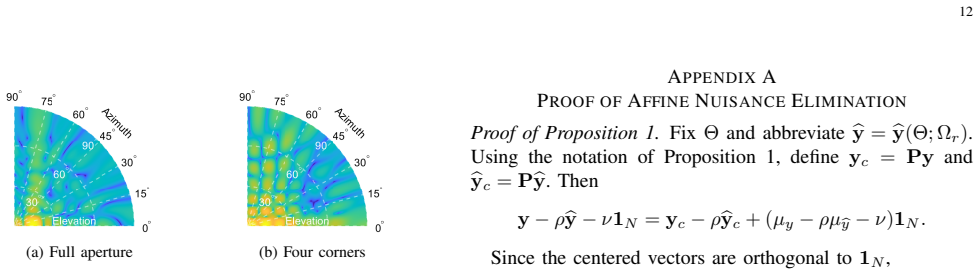
Large-aperture reconfigurable intelligent surfaces (RISs) enable high-resolution 2D direction-of-arrival (DoA) estimation, but existing approaches still tie hardware cost and control overhead to aperture size. To decouple the effective sensing aperture from the number of physically deployed RIS elements, we present V-RIS, a framework for virtual-aperture surface-field reconstruction and DoA estimation. V-RIS uses only four corner subarrays and a single-antenna receiver to reconstruct the virtual-aperture surface field from receiver observations collected under multiple RIS phase configurations, and then performs DoA estimation on the reconstructed virtual-aperture surface field. Our key observation is that, under far-field illumination, the discretized RIS surface field satisfies finite-order spatial recurrences along both aperture axes. We enforce data-level consistency through the RIS-coded receiver observations and propagation consistency through the far-field spatial recurrence, while using a four-corner deployment geometry that retains both contiguous local elements and long aperture baselines. To improve robustness in practical receiver observations, we adopt a bias-invariant receiver-domain loss that suppresses quasi-static hardware distortions and configuration-invariant multipath contributions. Extensive simulations show that V-RIS approaches the DoA accuracy of a full-aperture benchmark while producing cleaner spectra than matrix-completion and least-squares baselines. An outdoor prototype further validates the design: with only 25\% programmable elements, V-RIS keeps both elevation and azimuth errors within $1^\circ$ of the ground truth.
Figures


Figures from the paper (9 more)


Reference graph
Works this paper leans on
-
[1]
Reconfig- urable intelligent surfaces in 6G radio localization: A survey of recent developments, opportunities, and challenges,
A. Umer, I. M ¨u¨ursepp, M. M. Alam, and H. Wymeersch, “Reconfig- urable intelligent surfaces in 6G radio localization: A survey of recent developments, opportunities, and challenges,”IEEE Commun. Surveys Tuts., vol. 27, no. 6, pp. 3526–3560, Dec. 2025
2025
-
[2]
Movable antenna enhanced wireless sensing via antenna position optimization,
W. Ma, L. Zhu, and R. Zhang, “Movable antenna enhanced wireless sensing via antenna position optimization,”IEEE Trans. Wireless Com- mun., vol. 23, no. 11, pp. 16 575–16 589, Nov. 2024
2024
-
[3]
Target detection and positioning aided by reconfigurable surfaces: Reflective or holographic?
X. Zhang, H. Zhang, L. Liu, Z. Han, H. V . Poor, and B. Di, “Target detection and positioning aided by reconfigurable surfaces: Reflective or holographic?”IEEE Trans. Wireless Commun., vol. 23, no. 12, pp. 19 215–19 230, Dec. 2024
2024
-
[4]
Integrated sensing and communications with reconfig- urable intelligent surfaces: From signal modeling to processing,
S. P. Chepuri, N. Shlezinger, F. Liu, G. C. Alexandropoulos, S. Buzzi, and Y . C. Eldar, “Integrated sensing and communications with reconfig- urable intelligent surfaces: From signal modeling to processing,”IEEE Signal Process. Mag., vol. 40, no. 6, pp. 41–62, Sep. 2023
2023
-
[5]
A survey on integrated sensing and communication with intelligent metasurfaces: Trends, challenges, and opportunities,
A. Magbool, V . Kumar, Q. Wu, M. Di Renzo, and M. F. Flanagan, “A survey on integrated sensing and communication with intelligent metasurfaces: Trends, challenges, and opportunities,”IEEE Open J. Commun. Soc., vol. 6, pp. 7270–7318, 2025
2025
-
[6]
A cram ´er rao bounds based analysis of 3D antenna array geometries made from ULA branches,
D. T. Vu, A. Renaux, R. Boyer, and S. Marcos, “A cram ´er rao bounds based analysis of 3D antenna array geometries made from ULA branches,”Multidimens. Syst. Signal Process., vol. 24, no. 1, pp. 121– 155, Mar. 2013
2013
-
[7]
Exploit high-dimensional RIS information to local- ization: What is the impact of faulty element?
T. Wu, C. Pan, K. Zhi, H. Ren, M. Elkashlan, C.-X. Wang, R. Schober, and X.-H. You, “Exploit high-dimensional RIS information to local- ization: What is the impact of faulty element?”IEEE J. Sel. Areas Commun., vol. 42, no. 10, pp. 2803–2819, Oct. 2024
2024
-
[8]
Sensing RISs: Enabling dimension-independent CSI acquisition for beamforming,
J. Zhu, K. Liu, Z. Wan, L. Dai, T. J. Cui, and H. V . Poor, “Sensing RISs: Enabling dimension-independent CSI acquisition for beamforming,” IEEE Trans. Inf. Theory, vol. 69, no. 6, pp. 3795–3813, Jun. 2023
2023
Show all 43 references
-
[9]
Semi-passive intelligent reflecting surface-enabled sensing systems,
Q. Peng, Q. Wu, W. Chen, S. Ma, M.-M. Zhao, and O. A. Dobre, “Semi-passive intelligent reflecting surface-enabled sensing systems,” IEEE Trans. Commun., vol. 72, no. 12, pp. 7674–7688, Dec. 2024
2024
-
[10]
Holographic MIMO communications: Theoretical foundations, enabling technologies, and future directions,
T. Gong, P. Gavriilidis, R. Ji, C. Huang, G. C. Alexandropoulos, L. Wei, Z. Zhang, M. Debbah, H. V . Poor, and C. Yuen, “Holographic MIMO communications: Theoretical foundations, enabling technologies, and future directions,”IEEE Commun. Surveys Tuts., vol. 26, no. 1, pp. 196–...
2024
-
[11]
Design and validation of scalable reconfigurable intelligent surfaces,
M. Rossanese, P. Mursia, A. Garcia-Saavedra, V . Sciancalepore, A. Asadi, and X. Costa-Perez, “Design and validation of scalable reconfigurable intelligent surfaces,”Comput. Netw., vol. 241, Mar. 2024, Art. no. 110208
2024
-
[12]
Codebook-based solutions for reconfigurable intelligent surfaces and their open challenges,
J. An, C. Xu, Q. Wu, D. W. K. Ng, M. Di Renzo, C. Yuen, and L. Hanzo, “Codebook-based solutions for reconfigurable intelligent surfaces and their open challenges,”IEEE Wireless Commun., vol. 31, no. 2, pp. 134–141, Apr. 2024. 13
2024
-
[13]
On the impact of control signaling in RIS- empowered wireless communications,
F. Saggese, V . Croisfelt, R. Kotaba, K. Stylianopoulos, G. C. Alexan- dropoulos, and P. Popovski, “On the impact of control signaling in RIS- empowered wireless communications,”IEEE Open J. Commun. Soc., vol. 5, pp. 4383–4399, 2024
2024
-
[14]
Reconfigurable intelligent surface aided sparse DOA estimation method with non-ULA,
P. Chen, Z. Yang, Z. Chen, and Z. Guo, “Reconfigurable intelligent surface aided sparse DOA estimation method with non-ULA,”IEEE Signal Process. Lett., vol. 28, pp. 2023–2027, Sep. 2021
2023
-
[15]
Polarized intelligent reflecting surface aided 2D-DOA estimation for NLoS sources,
F. Wen, H. Wang, G. Gui, H. Sari, and F. Adachi, “Polarized intelligent reflecting surface aided 2D-DOA estimation for NLoS sources,”IEEE Trans. Wireless Commun., vol. 23, no. 7, pp. 8085–8098, Jul. 2024
2024
-
[16]
Dual lawson norm-based robust DOA estimation for RIS-aided wireless communication systems,
C. Yu, Y . Li, L. Li, Z. Huang, Q. Wu, and R. de Lamare, “Dual lawson norm-based robust DOA estimation for RIS-aided wireless communication systems,”IEEE Trans. Aerosp. Electron. Syst., vol. 61, no. 1, pp. 582–592, Feb. 2025
2025
-
[17]
Off-grid sparse Bayesian learning for channel estimation and localization in RIS-assisted MIMO-OFDM under NLoS,
U. Mutlu and Y . Kabalci, “Off-grid sparse Bayesian learning for channel estimation and localization in RIS-assisted MIMO-OFDM under NLoS,” Sensors, vol. 25, no. 13, Jul. 2025, Art. no. 4140
2025
-
[18]
RIS aided gridless 2D-DOA estimation via decoupled atomic norm minimization,
Y . Zheng, Q. Wang, L. Ren, Z. Ma, and P. Fan, “RIS aided gridless 2D-DOA estimation via decoupled atomic norm minimization,”IEEE Trans. Veh. Technol., vol. 73, no. 10, pp. 15 733–15 738, Oct. 2024
2024
-
[19]
Calibration in RIS-aided integrated sensing, localization and communication systems,
R. Ghazalian, P. Zheng, H. Chen, C. Ozturk, M. F. Keskin, V . Sciancale- pore, S. Gezici, T. Y . Al-Naffouri, and H. Wymeersch, “Calibration in RIS-aided integrated sensing, localization and communication systems,” IEEE Wireless Commun., vol. 33, no. 2, pp. 200–207, Apr. 2026
2026
-
[20]
RIS beam calibration for ISAC systems: Modeling and performance analysis,
M. Li, H. Chen, S. S. Petersen, H. Huang, A. Pourafzal, Y . Ge, M. Shen, and H. Wymeersch, “RIS beam calibration for ISAC systems: Modeling and performance analysis,”arXiv preprint arXiv:2505.15403, May 2025
2025 arXiv
-
[21]
Non-redundant sparse array with flexible aperture,
A. Ahmed and Y . D. Zhang, “Non-redundant sparse array with flexible aperture,” inProc. 54th Asilomar Conf. Signals, Syst., Comput., Nov. 2020, pp. 225–229
2020
-
[22]
Real-time CRLB based antenna selection in planar antenna arrays,
M. Arash, I. Stupia, and L. Vandendorpe, “Real-time CRLB based antenna selection in planar antenna arrays,”IEEE Trans. Wireless Commun., vol. 22, no. 6, pp. 4043–4056, Jun. 2023
2023
-
[23]
DoA estimation with sparse arrays: Effects of antenna element patterns and nonidealities,
N. Lindvall, M. Heino, R. Rajam ¨aki, M. Valkama, and V . Koivunen, “DoA estimation with sparse arrays: Effects of antenna element patterns and nonidealities,” inProc. 2025 IEEE Radar Conf. (RadarConf25), Oct. 2025, pp. 280–285
2025
-
[24]
ISAC system assisted by RIS with sparse active elements,
M. A. Haider, Y . D. Zhang, and E. Aboutanios, “ISAC system assisted by RIS with sparse active elements,”EURASIP J. Adv. Signal Process., vol. 2023, no. 1, Feb. 2023, Art. no. 20
2023
-
[25]
2D-DOA estimation in switching UCA using deep learning-based covariance matrix comple- tion,
R. Mei, Y . Tian, Y . Huang, and Z. Wang, “2D-DOA estimation in switching UCA using deep learning-based covariance matrix comple- tion,”Sensors, vol. 22, no. 10, May 2022, Art. no. 3754
2022
-
[26]
Coarray tensor completion for DOA estimation,
H. Zheng, Z. Shi, C. Zhou, and A. L. F. de Almeida, “Coarray tensor completion for DOA estimation,”IEEE Trans. Aerosp. Electron. Syst., vol. 59, no. 5, pp. 5472–5486, Oct. 2023
2023
-
[27]
Projected gradient descent for spectral compressed sensing via symmetric hankel factorization,
J. Li, W. Cui, and X. Zhang, “Projected gradient descent for spectral compressed sensing via symmetric hankel factorization,”IEEE Trans. Signal Process., vol. 72, pp. 1590–1606, 2024
2024
-
[28]
Provable randomized coordinate descent for matrix completion,
M. Callahan, T. Vu, and R. Raich, “Provable randomized coordinate descent for matrix completion,” inProc. IEEE Int. Conf. Acoust., Speech Signal Process. (ICASSP), Apr. 2024, pp. 9421–9425
2024
-
[29]
Low-rank tensor completion via novel sparsity-inducing regularizers,
Z. Y . Wang, H. C. So, and A. M. Zoubir, “Low-rank tensor completion via novel sparsity-inducing regularizers,”IEEE Trans. Signal Process., vol. 72, pp. 3519–3534, 2024
2024
-
[30]
Signal processing for implicit neural representations,
D. Xu, P. Wang, Y . Jiang, Z. Fan, and Z. Wang, “Signal processing for implicit neural representations,” inAdv. Neural Inf. Process. Syst., vol. 35. Curran Associates, Inc., 2022, pp. 13 404–13 418
2022
-
[31]
Implicit neural representations for codebook configuration in RIS-aided communication systems,
H. Yang, J. Wang, Z. Jin, J. Dong, R. Xiong, R. C. Qiu, and Z. Ling, “Implicit neural representations for codebook configuration in RIS-aided communication systems,”IEEE Trans. Cogn. Commun. Netw., vol. 12, pp. 2829–2843, 2026
2026
-
[32]
Feasibility study on solving the Helmholtz equation in 3D with PINNs,
S. Schoder and F. Kraxberger, “Feasibility study on solving the Helmholtz equation in 3D with PINNs,”arXiv preprint arXiv:2403.06623, Mar. 2024
2024 arXiv
-
[33]
Physics informed digital twin for RIS-assisted wireless communication system,
Q. Han, H. Zhang, Y . Li, D. Yuan, and X. Ma, “Physics informed digital twin for RIS-assisted wireless communication system,”IEEE Wireless Commun., vol. 32, no. 3, pp. 106–112, Jun. 2025
2025
-
[34]
Physics-informed machine learning optimization design of reconfigurable intelligent surfaces for IoT applications,
Z. Zhang, J. H. Qiu, J. W. Zhang, H.-D. Li, D. Tang, Q. Cheng, and W. Lin, “Physics-informed machine learning optimization design of reconfigurable intelligent surfaces for IoT applications,”IEEE Internet Things J., vol. 12, no. 23, pp. 51 041–51 055, Dec. 2025
2025
-
[35]
Physics-informed neural network with pretraining optimization for ocean acoustic field prediction,
J. Tang and H. Niu, “Physics-informed neural network with pretraining optimization for ocean acoustic field prediction,”J. Acoust. Soc. Amer., vol. 158, no. 5, pp. 3846–3860, Nov. 2025
2025
-
[36]
NEAR: Neural electromagnetic array response,
Y . Bu, J. Yu, K. Zheng, X. Zhang, and P. Pal, “NEAR: Neural electromagnetic array response,” inProc. 42nd Int. Conf. Mach. Learn. (ICML), ser. Proc. Mach. Learn. Res., vol. 267. PMLR, Jul. 2025, pp. 5749–5774
2025
-
[37]
Source localization and power estimation through RISs: Performance analysis and prototype validations,
F. Wang, T. Mi, C. Wang, R. Xiong, Z. Wang, and R. C. Qiu, “Source localization and power estimation through RISs: Performance analysis and prototype validations,”IEEE Trans. Wireless Commun., vol. 25, pp. 9406–9420, 2026
2026
-
[38]
H. L. Van Trees,Optimum Array Processing: Part IV of Detection, Estimation, and Modulation Theory. New York, NY: John Wiley & Sons, 2002
2002
-
[39]
NeRF: Representing scenes as neural radiance fields for view synthesis,
B. Mildenhall, P. P. Srinivasan, M. Tancik, J. T. Barron, R. Ramamoorthi, and R. Ng, “NeRF: Representing scenes as neural radiance fields for view synthesis,” inProc. Eur. Conf. Comput. Vis. (ECCV), Aug. 2020, pp. 405–421
2020
-
[40]
Detection of signals by information theoretic criteria,
M. Wax and T. Kailath, “Detection of signals by information theoretic criteria,”IEEE Transactions on Acoustics, Speech, and Signal Process- ing, vol. 33, no. 2, pp. 387–392, Apr. 1985
1985
-
[41]
Intelligent reflecting surface-assisted MU-MISO systems with imperfect hardware: Channel estimation and beamforming design,
A. Papazafeiropoulos, C. Pan, P. Kourtessis, S. Chatzinotas, and J. M. Senior, “Intelligent reflecting surface-assisted MU-MISO systems with imperfect hardware: Channel estimation and beamforming design,”IEEE Trans. Wireless Commun., vol. 21, no. 3, pp. 2077–2092, Mar. 2022
-
[42]
Intelligent reflecting surface: Practical phase shift model and beamforming optimization,
S. Abeywickrama, R. Zhang, Q. Wu, and C. Yuen, “Intelligent reflecting surface: Practical phase shift model and beamforming optimization,” IEEE Trans. Commun., vol. 68, no. 9, pp. 5849–5863, Sep. 2020
2020
-
[43]
RIS with insufficient phase shifting capability: Modeling, beamforming, and experimental validations,
L. Cao, H. Yin, L. Tan, and X. Pei, “RIS with insufficient phase shifting capability: Modeling, beamforming, and experimental validations,”IEEE Trans. Commun., vol. 72, no. 9, pp. 5911–5923, Sep. 2024
2024
Reviewed August 1, 2026 · model on record in the stance chip above.
Discussion (0). Continue with ORCID to comment.