REVIEW 4 major objections 5 minor 48 references
Learning Social Robot Navigation By Sensing Human Legs
T0 review · 4 major / 5 minor · reviewed 2026-07-31 · deepseek-v4-flash
Pith's one-line read Ankle-height LiDAR sees legs, not whole people; this paper builds a simulator that renders pedestrians as alternating leg-and-shoe pairs, trains a neural policy on those scans, and reports 95.1% success in unseen crowds with zero-shot trans
desk verdict A solid, useful RL-navigation paper with an unvalidated gait model at the center of its sim-to-real claim; worth a proper review. read the letter →
The pith
A machine-rendered reading of the paper's core claim, the machinery that carries it, and where it could break.
The reading
What carries the argument
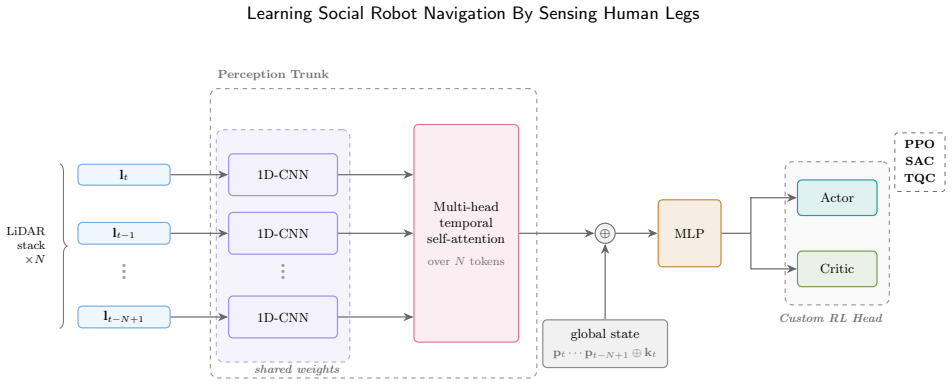
The load-bearing pieces are (1) the Non-Slip Gait (NSG) model — a two-foot kinematic gait where the stance foot is anchored to its touchdown position and the swing foot linearly interpolates to a dynamically updated target, reproducing the alternating two-cluster leg returns and the shoe below the scan plane — and (2) CALF, a hybrid network that processes stacked LiDAR scans with shared-weight 1D convolutions, temporal multi-head self-attention, and an MLP, fusing this perception stream with goal and kinematic state to output velocity commands. Around them sits the LegNav simulator, whose ray tracer individually returns on each foot and whose GPU-parallel implementation runs thousands of par
What would settle it
Record ankle-height 2D LiDAR scans of a person walking with the same sensor class (e.g., an RPLidar A1 at roughly 0.15 m) and compare the distribution of two-cluster range returns — inter-leg separation, cluster width, cadence, and occlusion intervals — with NSG's simulated scans; if the real distribution diverges substantially (e.g., legs occlude each other more often or the shoe is intermittently visible), the central claim that leg-level simulation closes the sim-to-real gap would be contradicted. A cheaper test is to retrain CALF on the same simulator but with the NSG gait replaced by sinu
Extended reading notes
Core claim
The central claim is that simulating articulated leg dynamics at the sensor level — not at the semantic level of full-body tracking — is what allows a learned navigation policy to behave safely and socially. Concretely, the paper introduces the Non-Slip Gait model, which anchors each foot at its last touchdown while the other foot swings, producing the characteristic two-cluster ankle-height LiDAR signature of alternating shins and the protruding shoe that the scan plane misses. The CALF network, a weight-shared 1D-CNN plus multi-head temporal self-attention plus MLP, then maps a stack of raw LiDAR frames directly to velocity commands. Trained with PPO in the LegNav simulator, the policy ach
Load-bearing premise
The load-bearing assumption is that the synthetic Non-Slip Gait model faithfully reproduces the ankle-height LiDAR signature of real pedestrians — foot positions, cadence, and the shoe below the scan plane — despite the paper offering no validation of NSG against real gait or leg-LiDAR data.
Editorial extensions
If this is right
- Policies trained on leg-level scans will transfer more readily to real robots with ankle-height LiDAR, because the observation distribution matches the physical sensor.
- The disc-to-leg ablation isolates the representation: the same architecture trained on disc pedestrians not only collides more often (24.5% vs 3.3% active collision rate) but almost never yields (2.9% vs 32.4%), showing that leg dynamics, not just reward shaping, drive the safety gains.
- A deployment-ready social navigation policy can be trained in under an hour on a single consumer GPU, making iterative policy development practical without expensive infrastructure.
- High yielding scores should be interpreted alongside timeout and progress metrics: classical planners that freeze near pedestrians can accumulate yield credit without actually completing the task.
- The temporal self-attention module over three stacked LiDAR frames is sufficient to infer pedestrian motion implicitly, removing the need for an explicit tracking pipeline at deployment.
Reading between the lines
- If the leg-level result holds, the main bottleneck for social navigation simulators shifts from crowd-dynamics fidelity to sensor-level fidelity: effort is better spent on realistic leg and foot returns than on more sophisticated social force models.
- A natural extension is to test whether leg-level sensing alone (without the explicit yield reward) can make yielding behavior emerge, or whether the reward is a necessary ingredient; the paper's ablation does not separate these two factors.
- Because ankle-height leg clusters are exactly what person-detection and tracking pipelines exploit, a leg-faithful simulator like LegNav could serve as a data generator for training and evaluating those perception stacks, not just end-to-end policies.
- The paper does not isolate the effect of the shoe protruding below the scan plane; a targeted ablation with shoe-less feet would quantify how much of the safety margin comes from the hidden-foot geometry versus the alternating two-cluster motion itself.
Editorial analysis
A structured set of objections, weighed in public.
Referee Report
Summary. The paper presents CALF, a convolutional-attention-MLP policy for social robot navigation from raw 2D LiDAR scans, trained by deep RL in a custom JAX simulator (LegNav). The key novelty is the Non-Slip Gait (NSG) model, which simulates pedestrians as two articulated feet/legs with a stance-swing cycle, producing the two-cluster leg returns an ankle-height LiDAR would observe, instead of the disc approximation common in prior work. The authors compare CALF trained with PPO, SAC, and TQC against classical planners (DWA, MPPI) and end-to-end RL baselines, report that CALF_PPO achieves 95.1% success and 3.3% active collision rate on unseen scenarios, and present a zero-shot deployment on a TurtleBot 4. The central claim, stated in the conclusion, is that simulating articulated leg dynamics at the sensor level is a key factor in reducing the sim-to-real gap.
Significance. If the results are reliable, the paper makes a useful contribution to sensor-level simulation for social robot navigation. The NSG model with stance-phase foot anchoring is a principled alternative to rigid-disc person representations, the LegNav simulator is fast enough for practical RL training (sub-hour on one consumer GPU), and the authors provide open-source code. The disc-to-leg ablation is a clear and informative comparison. The main value lies in demonstrating that leg-level LiDAR signatures can be learned from in an end-to-end policy and that such a policy transfers to a real robot. However, the strength of this claim is currently limited by the lack of validation of NSG against real gait or leg-level LiDAR data, the qualitative nature of the real-world experiments, and the absence of statistical significance measures.
major comments (4)
- [Sec. 4.3, Sec. 8] The central claim in the Conclusion—that simulating articulated leg dynamics at the sensor level is a key factor for reducing the sim-to-real gap—rests on the assumption that the NSG model faithfully reproduces the ankle-height LiDAR signature of real pedestrians. The manuscript provides no comparison of NSG-generated range returns to real leg-level LiDAR data, no gait-capture validation, and no sensitivity study of the NSG parameters (f_max, v_ref, r_leg, L_shoe, w_hip). The disc-to-leg ablation in Table 4 shows that leg-like inputs improve performance inside the simulator, but it does not validate that the specific dynamics produced by NSG (cadence, inter-leg distance, occlusion patterns) match reality. Without this validation, the sim-to-real claim is only a hypothesis supported by a qualitative real-world video.
- [Sec. 7.3] The real-world deployment section reports no quantitative results: no success rates, no collision counts, no tracking or leg-scan ground truth, and no comparison to alternative policies in the same physical setting. The claim of zero-shot transfer is therefore based on an informal demonstration. To substantiate the sim-to-real gap reduction, the authors should provide at least basic quantitative indicators (e.g., success over a defined number of runs, minimum distances, yielding events) and, ideally, record the actual LiDAR streams to compare with NSG predictions.
- [Sec. 7, Table 4] All simulation results are reported as point estimates without seed-level variance, confidence intervals, or statistical tests. Given that the policies are stochastic and the evaluation scenarios are randomized, differences such as the 3.3% vs. 7.3% active collision rate between CALF_PPO and TAGD, or the 82.8% vs. 95.1% success rate between CALF_TQC and CALF_PPO, may fall well within run-to-run noise. The authors should report mean and standard deviation over multiple training seeds or evaluation runs, and ideally perform a significance test. This is especially important because the paper's headline comparisons are between methods with fairly close aggregate metrics.
- [Sec. 5.3, Sec. 7] There is a circularity in the evaluation of social compliance. The yielding score YS is defined using the same frontal yield zone (Eq. 21: d_yield, ψ_FOV) and the same speed threshold v_stop as the reward term r_yield in Eq. 23. The space compliance SC uses the same d_comfort = 0.5 m that appears in the comfort penalty r_comfort in Eq. 20. Consequently, high values of SC and YS partly reflect the reward designer's choices rather than independent social norms. The paper should either evaluate with external metrics (e.g., human-annotated social compliance, or different thresholds) or explicitly discuss this limitation; the current presentation overstates the behavioral significance of these scores.
minor comments (5)
- [General notation] The mathematical notation is sometimes inconsistent between the main text and equations: for example, the goal vector p_t is defined as [g_x, g_y, ρ] in Eq. (5), but in Eq. (19) ρ_t is used as the angular error, while in Eq. (5) ρ_t is called the 'goal alignment angle'. It would help to define ρ_t once and consistently.
- [Sec. 4.3, Eq. (12)] The stride length s_l in Eq. (12) is derived as |v_body|/c. At the lower cadence clip (0.3 f_max) this implies a very large stride; it may be worth noting whether this creates unrealistic foot placements for slow-moving pedestrians. An explicit comment or a parameter check would clarify.
- [Fig. 9] The evaluation dashboard in Fig. 9 is dense and difficult to read in print. The authors should consider splitting it into multiple panels or enlarging the key subplots (especially the success/collision rate vs. speed curves).
- [Sec. 2.2] The related work section lists many recent methods, but the comparison in Table 4 includes only one recent end-to-end RL baseline (TAGD). Including at least one more recent baseline (e.g., NaviSTAR or RUMOR) would make the comparison more current and compelling, although this is not a blocker.
- [Sec. 6, Table 3] The maximum robot speed v_max is sampled from U[0.2, 2.0] during training, and the test evaluation in Sec. 7 sweeps discrete values of v_max. It would be useful to clarify whether the discrete test values are the same as the training distribution support and how the policy generalizes between these values (Fig. 10 partially addresses this).
Circularity Check
Evaluation metrics YS, SC, and ACR reuse the reward's own thresholds and event classes; the central leg-dynamics claim itself is not circular.
-
self definitional
[Sec. 7 (YS, SC definitions); Sec. 5.3 Eqs. (20) and (23); Sec. 1 (reward embedding of yielding)]
"YS (Yielding Score): The percentage of time steps during which the robot correctly yields (v_t ≤ v_stop) when the frontal yield zone is occupied by at least one pedestrian (see (21))."
YS is defined by the exact condition that Eq. (23) rewards positively (I_t nonempty and v_t ≤ v_stop) and for which the speed reward is suppressed. The paper itself says it introduced YS 'as a metric for evaluating the adherence of the trained policy to the desired behavior,' where that behavior was 'directly embedded ... into the RL agent reward.' SC uses the same 0.5 m threshold as d_comfort in the comfort penalty Eq. (20). Thus the social-compliance columns in Table 4 partly re-measure the reward designer's own objective rather than an independently defined social norm.
-
self definitional
[Sec. 5.3 active/passive collision classification; Sec. 7 ACR/PCR definitions]
"A contact with pedestrian i at time t is labelled active if the robot is moving above the stopping threshold (v_t > v_stop) and that same pedestrian occupies the frontal yield zone, i.e., i ∈ I_t."
The condition defining an 'active' collision is exactly the condition penalized with B_act = -50 in the terminal reward, while passive collisions match the smaller B_pas = -3.5 penalty. ACR and PCR therefore report the frequencies of the reward's own terminal event classes. Since the policy is trained to optimize this classified reward, the safety metrics are partly a restatement of the reward signal rather than an external verification of safety.
full rationale
The central derivation chain is not circular: the NSG model is an explicit kinematic construction (Eqs. 6-13) whose parameters come from cited gait literature, not from fitting the reported success or collision numbers; the disc-to-leg ablation compares two policies in the same simulator and is an internal empirical result rather than a tautology; and the zero-shot TurtleBot 4 deployment is external evidence, albeit qualitative. The HSFM citation [11] overlaps with two co-authors, but it is used as a published pedestrian-motion backbone, plays no uniqueness/forbidding role, and does not carry the leg-dynamics claim, so it does not raise the circularity score. The identified circularity is confined to the evaluation instrumentation: YS, SC, and ACR/PCR are defined with the same frontal-zone, stopping, comfort, and collision-classification thresholds as the reward, so those columns partly re-state the optimization objective. The main claim about leg-level sensor modeling remains independent of the fitted reward, leading to a moderate overall score.
Assumptions & free parameters
free parameters (4)
- Reward coefficients (6 dense + 5 terminal) =
α_prog=1.0, α_step=0.02, α_smooth=0.5, α_heading=0.005, α_comfort=0.15, α_yield=0.1; B_goal=20, B_obs=-30, B_act=-50, B_
- Social thresholds: d_comfort, d_yield, ψ_FOV, v_stop =
0.5 m, 1.5 m, 90°, 0.1 m/s
- NSG gait parameters: f_max, v_ref, r_leg, L_shoe, w_hip =
3.5 s^-1, 2.5 m/s, 0.08 m, 0.3 m, 0.3 m
- LiDAR noise parameters =
Gaussian σ unspecified; 6% salt-and-pepper
assumptions (5)
- domain assumption HSFM reproduces human crowd motion
- domain assumption NSG foot kinematics produce realistic two-cluster LiDAR returns
- ad hoc to paper Reward and evaluation metrics share definitions
- domain assumption Gaussian plus 6% salt-and-pepper noise approximates real LiDAR
- domain assumption Ghost-mode training with non-reacting pedestrians transfers to reacting pedestrians
invented entities (1)
-
Non-Slip Gait (NSG) model
Cite this review
Pith. "Pith review of Learning Social Robot Navigation By Sensing Human Legs." pith.science (2026). https://pith.science/paper/4FTBAYXL
@misc{pith2026260727922,
  author       = {Pith},
  title        = {Pith review of: Learning Social Robot Navigation By Sensing Human Legs},
  year         = {2026},
  howpublished = {\url{https://pith.science/paper/4FTBAYXL}},
  note         = {Machine review of arXiv:2607.27922}
}
read the original abstract
Robots navigating among pedestrians typically sense their surroundings with a 2D LiDAR mounted close to the ground. At that height, the sensor mostly sees moving legs rather than whole people, yet most learning-based navigation methods still treat pedestrians as simple shapes like circles. This paper addresses that gap with CALF (Convolutional Attention for Leg Features), an end-to-end neural architecture that combines convolutional layers, attention, and MLP to interpret leg motion directly from LiDAR scans and produce safe navigation commands. The CALF policy is trained using deep reinforcement learning algorithms within LegNav, a custom lightweight 2D simulator that combines 2D LiDAR ray tracing with a novel pedestrian gait model. The resulting policy is compared against classical and learning-based baselines in terms of navigation performance and social compliance. The approach is validated through real-world experiments via zero-shot deployment on a TurtleBot 4, yielding smooth and socially compliant trajectories. Written in JAX, the LegNav simulator enables the training of a deployment-ready CALF policy in under an hour on a single consumer GPU.
Figures


Figures from the paper (7 more)



Reference graph
Works this paper leans on
-
[1]
K. O. Arras, O. M. Mozos, W. Burgard, Using boosted features for the detection of people in 2d range data, in: Proceedings 2007 IEEE International Conference on Robotics and Automation, 2007, pp. 3402–3407. doi:10.1109/ROBOT.2007.363998
arXiv 2007
- [2]
-
[3]
URL https://arxiv.org/abs/1707.06347
J.Schulman,F.Wolski,P.Dhariwal,A.Radford,O.Klimov,Proximal policy optimization algorithms (2017).arXiv:1707.06347. URL https://arxiv.org/abs/1707.06347
arXiv 2017
-
[4]
Haarnoja, A
T. Haarnoja, A. Zhou, P. Abbeel, S. Levine, Soft actor-critic: Off- policymaximumentropydeepreinforcementlearningwithastochas- tic actor, in: Proceedings of the 35th International Conference on Machine Learning (ICML), 2018, pp. 1861–1870
2018
-
[5]
A.Kuznetsov,P.Shvechikov,A.Grishin,D.Vetrov,Controllingover- estimation bias with truncated mixture of continuous distributional quantile critics, in: H. D. III, A. Singh (Eds.), Proceedings of the 37th International Conference on Machine Learning, Vol. 119 of ProceedingsofMachineLearningResearch,PMLR,2020,pp.5556– 5566
2020
-
[6]
Y. F. Chen, M. Liu, M. Everett, J. P. How, Decentralized non- communicating multiagent collision avoidance with deep reinforce- ment learning, in: 2017 IEEE International Conference on Robotics andAutomation(ICRA),2017,pp.285–292. doi:10.1109/ICRA.2017. 7989037
-
[7]
6015–6022.doi:10.1109/ICRA.2019.8794134
C.Chen,Y.Liu,S.Kreiss,A.Alahi,Crowd-robotinteraction:Crowd- awarerobotnavigationwithattention-baseddeepreinforcementlearn- ing, in: 2019 International Conference on Robotics and Automation (ICRA), 2019, pp. 6015–6022.doi:10.1109/ICRA.2019.8794134
arXiv 2019
-
[8]
M. Everett, Y. F. Chen, J. P. How, Motion planning among dynamic, decision-making agents with deep reinforcement learning, in: 2018 IEEE/RSJ International Conference on Intelligent Robots and Sys- tems (IROS), 2018, pp. 3052–3059.doi:10.1109/IROS.2018.8593871
arXiv 2018
Show all 48 references
-
[9]
Bradbury, R
J. Bradbury, R. Frostig, P. Hawkins, M. J. Johnson, C. Leary, D. Maclaurin, G. Necula, A. Paszke, J. VanderPlas, S. Wanderman- Milne, Q. Zhang, JAX: composable transformations of Python+NumPy programs, version 0.3.13. Available at http://github.com/jax-ml/jax (2018)
2018
-
[10]
Helbing, P
D. Helbing, P. Molnár, Social force model for pedestrian dynamics, Physical Review E 51 (5) (1995) 4282–4286
1995
-
[11]
F.Farina,D.Fontanelli,A.Garulli,A.Giannitrapani,D.Prattichizzo, Walking ahead: The headed social force model, PLOS ONE 12 (1) (2017) e0169734
2017
-
[12]
van den Berg, S
J. van den Berg, S. J. Guy, M. Lin, D. Manocha, Reciprocal n-body collisionavoidance,in:C.Pradalier,R.Siegwart,G.Hirzinger(Eds.), Robotics Research, Springer Berlin Heidelberg, Berlin, Heidelberg, 2011, pp. 3–19
2011
-
[13]
D. Fox, W. Burgard, S. Thrun, The dynamic window approach to collision avoidance, IEEE Robotics & Automation Magazine 4 (1) (1997) 23–33. doi:10.1109/100.580977
1997 doi
-
[14]
Williams, A
G. Williams, A. Aldrich, E. A. Theodorou, Model predictive path integral control: From theory to parallel computation, Journal of Guidance, Control, and Dynamics 40 (2) (2017) 344–357
2017
-
[15]
Y. F. Chen, M. Everett, M. Liu, J. P. How, Socially aware motion planning with deep reinforcement learning, in: 2017 IEEE/RSJ Inter- nationalConferenceonIntelligentRobotsandSystems(IROS),2017, pp. 1343–1350. doi:10.1109/IROS.2017.8202312
2017
-
[16]
Everett, Y
M. Everett, Y. F. Chen, J. P. How, Collision avoidance in pedestrian- rich environments with deep reinforcement learning, IEEE Access 9 (2021) 10357–10377. doi:10.1109/ACCESS.2021.3050338
2021
-
[17]
10007–10013
C.Chen,S.Hu,P.Nikdel,G.Mori,M.Savva,Relationalgraphlearn- ingforcrowdnavigation,in:2020IEEE/RSJInternationalConference on Intelligent Robots and Systems (IROS), 2020, pp. 10007–10013. doi:10.1109/IROS45743.2020.9340705
2020
-
[18]
Y. Yang, J. Jiang, J. Zhang, J. Huang, M. Gao, St2: Spatial-temporal state transformer for crowd-aware autonomous navigation, IEEE RoboticsandAutomationLetters8(2)(2023)912–919. doi:10.1109/ LRA.2023.3234815
2023
-
[19]
W. Wang, R. Wang, L. Mao, B.-C. Min, Navistar: Socially aware robot navigation with hybrid spatio-temporal graph transformer and preference learning, in: 2023 IEEE/RSJ International Conference on IntelligentRobotsandSystems(IROS),2023,pp.11348–11355. doi: 10.1109/IROS55552.202...
2023
-
[20]
Martinez-Baselga, L
D. Martinez-Baselga, L. Riazuelo, L. Montano, Rumor: Reinforcement learning for understanding a model of the real world for navigation in dynamic environments, Robotics and Autonomous Systems 191 (2025) 105020. doi:https: //doi.org/10.1016/j.robot.2025.105020. URL https://www....
2025
-
[22]
6252–6259.doi:10.1109/ICRA.2018
P.Long,T.Fan,X.Liao,W.Liu,H.Zhang,J.Pan,Towardsoptimally decentralized multi-robot collision avoidance via deep reinforcement learning, in: 2018 IEEE International Conference on Robotics and Automation (ICRA), 2018, pp. 6252–6259.doi:10.1109/ICRA.2018. 8461113
2018 doi
-
[23]
J. Jin, N. M. Nguyen, N. Sakib, D. Graves, H. Yao, M. Jagersand, Mapless navigation among dynamics with social-safety-awareness: a reinforcement learning approach from 2d laser scans, in: 2020 IEEE InternationalConferenceonRoboticsandAutomation(ICRA),2020, pp. 6979–6985. doi:1...
2020
-
[24]
Dugas, J
D. Dugas, J. Nieto, R. Siegwart, J. J. Chung, Navrep: Unsupervised representations for reinforcement learning of robot navigation in dy- namic human environments, in: 2021 IEEE International Conference on Robotics and Automation (ICRA), 2021, pp. 7829–7835.doi: 10.1109/ICRA485...
2021
-
[25]
W. Zhu, M. Hayashibe, Learn to navigate in dynamic environments with normalized lidar scans, in: 2024 IEEE International Conference on Robotics and Automation (ICRA), 2024, pp. 7568–7575.doi: 10.1109/ICRA57147.2024.10611247
2024
-
[26]
de Heuvel, X
J. de Heuvel, X. Zeng, W. Shi, T. Sethuraman, M. Bennewitz, Spatiotemporal attention enhances lidar-based robot navigation in dynamic environments, IEEE Robotics and Automation Letters 9 (5) (2024) 4202–4209. doi:10.1109/LRA.2024.3373988
2024
-
[27]
Z. Xie, P. Dames, Drl-vo: Learning to navigate through crowded dy- namicscenesusingvelocityobstacles,IEEETransactionsonRobotics 39 (4) (2023) 2700–2719.doi:10.1109/TRO.2023.3257549
2023
-
[28]
Thrun, W
S. Thrun, W. Burgard, D. Fox, Probabilistic Robotics, MIT Press, 2005
2005
-
[29]
Boulic, N
R. Boulic, N. M. Thalmann, D. Thalmann, A global human walking model with real-time kinematic personification, The visual computer 6 (6) (1990) 344–358
1990
-
[30]
Y. Zou, J. Yang, D. Ceylan, J. Zhang, F. Perazzi, J.-B. Huang, Re- ducingfootskateinhumanmotionreconstructionwithgroundcontact constraints, in: Proceedings of the IEEE/CVF Winter Conference on Applications of Computer Vision, 2020, pp. 459–468
2020
-
[31]
A.Beacco,N.Pelechano,M.Kapadia,N.I.Badler,Footstepparame- terized motion blending using barycentric coordinates, Computers & Graphics 47 (2015) 105–112
2015
-
[32]
C. A. Fukuchi, R. K. Fukuchi, M. Duarte, Effects of walking speed ongaitbiomechanicsinhealthyparticipants:asystematicreviewand meta-analysis, Systematic reviews 8 (1) (2019) 153
2019
-
[33]
V. R. Konda, J. N. Tsitsiklis, Actor-critic algorithms, in: Advances in Neural Information Processing Systems 12, 1999, pp. 1008–1014
1999
-
[34]
Henderson, R
P. Henderson, R. Islam, P. Bachman, J. Pineau, D. Precup, D. Meger, Deep reinforcement learning that matters, in: Proceedings of the A. Vaglio et al.:Preprint submitted to Elsevier Page 15 of 16 Learning Social Robot Navigation By Sensing Human Legs Thirty-SecondAAAIConference...
2018 doi
-
[35]
Rajeswaran, K
A. Rajeswaran, K. Lowrey, E. Todorov, S. Kakade, Towards gen- eralization and simplicity in continuous control, in: Proceedings of the 31st International Conference on Neural Information Processing Systems (NeurIPS), 2017, pp. 6553–6564
2017
-
[36]
Isele, A
D. Isele, A. Cosgun, K. Subramanian, K. Booth, H. I. Christensen, Navigating occluded intersections with autonomous vehicles using deep reinforcement learning, in: Proceedings of the IEEE Interna- tional Conference on Robotics and Automation (ICRA), 2018, pp. 2034–2039. doi:10...
2018
-
[37]
Haarnoja, A
T. Haarnoja, A. Zhou, K. Hartikainen, G. Tucker, S. Ha, J. Tan, V. Kumar, H. Zhu, A. Gupta, P. Abbeel, S. Levine, Soft actor-critic algorithms and applications, in: Proceedings of the 2nd Conference on Robot Learning (CoRL), 2018, pp. 1–20. URL https://proceedings.mlr.press/v8...
2018
-
[38]
Haarnoja, A
T. Haarnoja, A. Zhou, P. Abbeel, S. Levine, Learning to walk via deep reinforcement learning, Proceedings of Robotics: Science and Systems (RSS) (2019).doi:10.15607/RSS.2019.XV.011
2019 doi
-
[39]
Y. Ma, Y. Liu, J. Wang, W. Yu, Socially compliant navigation with soft actor-critic reinforcement learning, in: Proceedings of the IEEE International Conference on Mechatronics and Automation (ICMA), 2022, pp. 1734–1739.doi:10.1109/ICMA54519.2022.9914739
2022
-
[40]
Dabney, M
W. Dabney, M. Rowland, M. Bellemare, R. Munos, Distributional reinforcement learning with quantile regression, Proceedings of the AAAI Conference on Artificial Intelligence 32 (1) (Apr. 2018).doi: 10.1609/aaai.v32i1.11791
2018 doi
-
[41]
M.G.Bellemare,W.Dabney,R.Munos,Adistributionalperspective on reinforcement learning, in: Proceedings of the 34th International Conference on Machine Learning (ICML), 2017, pp. 449–458
2017
-
[42]
X. Chen, M. Everett, M. Liu, J. P. How, Robot navigation in crowds by implicit cooperative modeling, in: Proceedings of the AAAI Con- ference on Artificial Intelligence, Vol. 35, 2021, pp. 11303–11311. doi:10.1609/aaai.v35i13.17258
2021 doi
-
[43]
1369–1401.doi:10.1109/ICAIIC68212.2026
S.U.Bae,D.S.Han,Deepreinforcementlearning-basedmobilerobot navigation using truncated quantile critics, in: 2026 International ConferenceonArtificialIntelligenceinInformationandCommunica- tion (ICAIIC), 2026, pp. 1369–1401.doi:10.1109/ICAIIC68212.2026. 11454248
2026
-
[44]
J. C. Choton, J. Woods, W. Hsu, Efficient environment design for multi-robot navigation via continuous control, arXiv preprint arXiv:2508.14105 (2025)
2025 arXiv
-
[45]
A.Stratton,K.Hauser,C.Mavrogiannis,Characterizingthecomplex- ity of social robot navigation scenarios, IEEE Robotics and Automa- tion Letters 10 (1) (2025) 184–191.doi:10.1109/LRA.2024.3502060
2025
-
[46]
N. A. Sen, D. Kulić, P. Carreno-Medrano, Domain randomization for learning to navigate in human environments, IEEE Robotics and AutomationLetters10(2)(2025)1625–1632. doi:10.1109/LRA.2024. 3521178
2025 doi
-
[47]
Mavrogiannis, F
C. Mavrogiannis, F. Baldini, A. Wang, D. Zhao, P. Trautman, A. Ste- infeld, J. Oh, Core challenges of social robot navigation: A survey, J. Hum.-Robot Interact. 12 (3) (Apr. 2023).doi:10.1145/3583741. URL https://doi.org/10.1145/3583741
2023 doi
-
[48]
Gao, C.-M
Y. Gao, C.-M. Huang, Evaluation of socially-aware robot navigation, Frontiers in Robotics and AI Volume 8 - 2021 (2022).doi:10.3389/ frobt.2021.721317
2021
-
[49]
Anderson, A
P. Anderson, A. Chang, D. S. Chaplot, A. Dosovitskiy, S. Gupta, V. Koltun, J. Kosecka, J. Malik, R. Mottaghi, M. Savva, et al., On evaluation of embodied navigation agents, arXiv preprint arXiv:1807.06757 (2018). A. Vaglio et al.:Preprint submitted to Elsevier Page 16 of 16
2018 arXiv
Reviewed July 31, 2026 · model on record in the stance chip above.
Discussion (0). Sign in to comment.