REVIEW 2 major objections 6 minor 139 references
FFLO transition and quantum criticality in polarized Fermi gases
T0 review · 2 major / 6 minor · reviewed 2026-07-31 · grok-4.5
Pith's one-line read A minimal self-consistency fix makes the 2D FFLO quantum critical point physically consistent and reveals non-Fermi-liquid exponents set by Fermi-surface nesting.
desk verdict Solid ladder-diagram paper that fixes the 2D NSCT phase-diagram pathology, delivers usable analytic NFL self-energies, and cleanly classifies 3D FFLO as mean-field via nesting geometry and vertex power-counting. read the letter →
The pith
A machine-rendered reading of the paper's core claim, the machinery that carries it, and where it could break.
The reading
What carries the argument
Minimal self-consistent t-matrix (MSCT): a constant self-energy shift evaluated at each species’ Fermi momentum that realigns the bare-like propagators with the interacting Fermi surfaces, largely restoring Luttinger compliance while keeping the ladder diagrams analytically tractable.
What would settle it
A fully self-consistent t-matrix (or controlled quantum Monte Carlo) calculation of the 2D critical polarization versus coupling, or of the low-frequency self-energy exponent on the Fermi surface at the FFLO point; a clear deviation from the mean-field-like pc(g) or from |ω|^{2/3} would falsify the claim.
Extended reading notes
Core claim
Within a minimal self-consistent t-matrix scheme, the zero-temperature normal-to-FFLO transition in two dimensions has a physically consistent critical line over the full interaction range; at criticality the fermionic self-energy on the Fermi surface scales as |ω|^{2/3} (non-Fermi liquid), the bosonic and fermionic dynamical exponents are both 3 in 2D and both 2 in 3D, and in 3D all higher vertex corrections to the Hertz–Millis action are irrelevant, so the transition belongs to the mean-field universality class.
Load-bearing premise
That a single constant (momentum- and frequency-independent) self-energy shift is enough self-consistency to trust both the phase diagram and the low-energy critical exponents.
Editorial extensions
If this is right
- The 2D FFLO quantum critical point is a non-Fermi liquid with z = 3 and fermionic damping ∼ ω^{2/3}, analogous at RPA level to 2D Ising-nematic and charge-density-wave criticality.
- Three-dimensional FFLO criticality is mean-field (ν = 1/2, z = 2), in the same class as three-dimensional itinerant antiferromagnets.
- Differences between 2D and 3D critical damping trace to whether the majority and minority Fermi surfaces are tangent (parabolic nesting) or crossing (flat nesting) at the pairing momentum.
- Quasiparticle weight vanishes as (p − pc)^{1/2} on approach to the critical polarization, and momentum distributions lose their Fermi steps at criticality.
Reading between the lines
- Because MSCT critical polarization essentially collapses onto mean-field, any experiment or simulation that finds a substantially lower pc in 2D would signal that frequency-dependent self-energy or three-body physics (especially near the polaron–molecule limit) matters beyond the minimal shift.
- The geometric nesting picture suggests lattice realizations with discrete hot spots could interpolate between the continuum 2D (tangent) and 3D (crossing) exponents, offering a tunable test of the damping form.
- If vertex irrelevance holds in 3D FFLO, thermodynamic and spectroscopic signatures near the transition should follow ordinary mean-field scaling with only weak logarithmic corrections, simplifying comparison with cold-atom and heavy-fermion data.
Editorial analysis
A structured set of objections, weighed in public.
Referee Report
Summary. The manuscript studies the T=0 normal-to-FFLO transition in a 2D polarized Fermi gas within a diagrammatic t-matrix framework. It shows that the non-self-consistent t-matrix (NSCT) produces an unphysical phase diagram due to severe Luttinger-theorem violation, then introduces a minimal self-consistent t-matrix (MSCT) scheme—a constant self-energy shift that aligns interacting and bare-like Fermi momenta—restoring approximate Luttinger compliance and a continuous, physically sensible critical polarization versus coupling. Within MSCT the authors characterize quantum criticality: Im Σ^R ∼ |ω|^{2/3} (NFL) on the Fermi surface and ∼ |ω| (marginal) off it in a specified momentum window; Z_σ ∼ (p−p_c)^{1/2}; bosonic and fermionic dynamical exponents z_b = z_f = 3 in 2D. They unify 2D/3D criticality via the nesting geometry of majority and minority Fermi surfaces (tangent/parabolic in 2D vs crossing/flat in 3D), recover the 3D Im Σ ∼ |ω|^{1/2} analytically, and show by Hertz–Millis power counting that all 2n-point vertex corrections are irrelevant in 3D, placing the 3D FFLO QPT in the mean-field class analogous to the itinerant antiferromagnet. Extensive analytic appendices support the low-energy expansions.
Significance. If the results hold within the stated approximation, the paper supplies a coherent, analytically controlled account of FFLO quantum criticality across dimensions, with explicit formulas for the critical pair propagator, fermionic self-energies on and off the FS, and vertex scaling. The geometric nesting picture cleanly explains why damping is ∼Ω/q and z=3 in 2D versus ∼Ω and z=2 in 3D, and the 3D mean-field classification is a concrete, falsifiable placement relative to other itinerant QPTs (Table I). Strengths include machine-readable analytic structure in Apps. A–G, numerical checks of Z_σ scaling, comparison to prior full SC t-matrix (3D) and one-loop RG (2D) that leave exponents unchanged, and public data for the figures. The work is a solid contribution to ultracold polarized gases and metallic quantum criticality.
major comments (2)
- [Sec. IV B, Fig. 2, Abstract] Sec. IV B and Fig. 2: The MSCT critical line is essentially identical to mean-field because near-exact Luttinger compliance forces μ̃_σ ≃ E_{Fσ}^0 in the Thouless condition (Eq. 29). This is disclosed, but the abstract and introduction still advertise a “physically consistent phase diagram over the whole interaction range” as a main result of the improved theory. Please state more prominently (abstract/conclusions) that absolute p_c(g) remains mean-field-level within MSCT, while the load-bearing advances are Luttinger restoration, the NFL/marginal spectra, the dynamical exponents, and the 3D vertex irrelevance—properties that are cross-checked against full SC t-matrix [60] and one-loop RG [65] and do not rely on shifting p_c away from MF.
- [Appendix F] App. F, Eqs. (F6)–(F8) and the inductive step to u_n: The 4-point vertex is computed carefully and shown singular at Q_i = Q_FF, Ω_i → 0, with [g_4] = 3−2z_b < 0 for z_b = 2. The leap to arbitrary n via “by induction” and the compact form u_n ∝ |Ω|/(iΩ−v_{F↑}q)^{n−1}(iΩ−v_{F↓}q)^{n−1} is plausible given the separable linearized kinematics, but a short explicit sketch for n=3 (or a clearer statement of what is being inducted) would make the claim that all 2n-point vertices are irrelevant fully self-contained. This underpins the mean-field universality conclusion for 3D.
minor comments (6)
- [Sec. V A, Fig. 7] Fig. 7 caption and App. B: The pair spectral weight intensity plot is central; labeling sectors I/II and the collective-mode symbols more explicitly in the main text (not only the appendix) would help non-specialist readers.
- [Sec. V] Notation: Tildes denoting MSCT quantities (μ̃, Σ̃, Γ̃) are sometimes dropped “to avoid overburdening” (Sec. V). A single clarifying sentence at the start of Sec. V that all subsequent Σ, Γ_0 are MSCT would reduce ambiguity when comparing to NSCT formulas in the appendices.
- [Sec. VI C, Fig. 13] Fig. 13: The nesting cartoons are very useful; adding the 3D “hot circle” (rotationally complete matching manifold) explicitly in the caption would match the continuum vs lattice discussion in Sec. VI C.
- [Fig. 3, Sec. III] Typos/consistency: “Lifhsitz” → “Lifshitz” (Fig. 3 caption); “Implement ation” spacing in Sec. III heading; occasional “ow-ing” line breaks. Check arXiv PDF for hyphenation artifacts.
- [Sec. VI E, Table I] Table I is an excellent summary; a footnote clarifying that “Hertz–Millis holds” means Gaussian fixed-point stability under the vertex power counting of App. F (not that the original Hertz locality assumption is literally true) would prevent misreading.
- [Sec. VII] Ref. [60] and [65] are used appropriately as external checks; citing them once more when stating z_b = z_f in the conclusions would reinforce that the exponents are not MSCT artifacts.
Circularity Check
No load-bearing circularity: critical exponents and vertex irrelevance are derived from ladder/Hertz–Millis expansions; MSCT≈mean-field pc is a disclosed construction consequence, not a hidden prediction.
-
self definitional
[Sec. IV B (phase diagram / Luttinger–MF equivalence)]
"This finding can be understood by noticing that if the MSCT approach exactly satisfied the Luttinger theorem, then its critical line would be bound to coincide with the MF critical line. ... fulfillment of the Luttinger theorem requires μσ=E0Fσ+Σ̃(k0Fσ,0) and kFσ=k0Fσ, thus implying μ̃σ=E0Fσ and the full equivalence between the two equations. ... As a consequence, the critical line is essentially unchanged with respect to the MF one."
The MSCT constant shift is defined so that interacting and bare-like Fermi momenta coincide (Luttinger alignment). Under exact Luttinger compliance the Thouless condition then uses the same chemical potentials as mean-field, so pc(g)≡pc^MF by construction. The paper discloses this; it is not used to claim an independent non-MF phase boundary, and the NFL/exponent results do not rely on this identity.
full rationale
The paper’s central results (2D |ω|^{2/3} NFL self-energy, zb=zf=3 in 2D and zb=zf=2 in 3D, nesting geometry, and 3D 2n-vertex irrelevance) follow from explicit low-energy expansions of the MSCT/RPA ladder and Hertz–Millis power counting (Apps. C–F), not from fits to external data or uniqueness theorems imported from the authors. Self-citations ([60], [57,58], [65]) supply prior methods and cross-checks; they do not force the 2D phase diagram or the vertex scaling. The only mild self-definitional element is that the constant self-energy shift is built to align Fermi surfaces with Luttinger, which by the paper’s own algebra makes pc(g) coincide with mean-field when the theorem holds exactly—an equivalence the authors state openly (Sec. IV B) rather than market as an independent prediction. That is a limitation of the approximation, not circular derivation of the criticality claims. Score 2 reflects that single disclosed construction consequence; steps are otherwise empty of forced reductions.
Assumptions & free parameters
assumptions (7)
- domain assumption Attractive contact interaction regularized by the 2D two-body binding energy / scattering length a_2D (Eqs. 1–2).
- domain assumption Particle–particle ladder (t-matrix) resummation for the pair propagator and self-energy (Fig. 1, Eqs. 3–5).
- ad hoc to paper Minimal self-consistency: replace G_0 by a mean-field-shifted propagator with constant Σ̃_σ(k_{Fσ},0) so interacting and bare-like Fermi momenta coincide (Sec. II B, Eqs. 9–14).
- domain assumption Generalized Thouless criterion: instability when Γ_0(Q_FF, Ω=0)^{-1}=0 locates the normal-to-FFLO boundary (Eq. 15).
- domain assumption Zero temperature taken before all Matsubara sums; continuous frequency integrals replace discrete sums (Sec. II).
- domain assumption Hertz–Millis effective bosonic action in the pairing channel; scaling dimensions of u_n and g_{2n} diagnose relevance of mode–mode couplings (Sec. VI B, App. F).
- domain assumption Luttinger theorem (FS volume fixed by density) is required for a physically acceptable approximate theory of polarized gases.
invented entities (1)
-
Minimal self-consistent t-matrix (MSCT) scheme
Cite this review
Pith. "Pith review of FFLO transition and quantum criticality in polarized Fermi gases." pith.science (2026). https://pith.science/paper/FNHKXMWF
@misc{pith2026260728335,
  author       = {Pith},
  title        = {Pith review of: FFLO transition and quantum criticality in polarized Fermi gases},
  year         = {2026},
  howpublished = {\url{https://pith.science/paper/FNHKXMWF}},
  note         = {Machine review of arXiv:2607.28335}
}
read the original abstract
We investigate the zero-temperature transition from the polarized normal phase to the FFLO state in a two-dimensional Fermi gas by means of a diagrammatic t-matrix approach. We first show that the standard non-self-consistent theory produces an unphysical phase diagram because of a severe violation of the Luttinger theorem. Motivated by this observation, we introduce a minimal self- consistent extension that largely restores compliance with the Luttinger theorem while preserving the analytical simplicity of the original formalism. This leads to a physically consistent phase diagram over the whole interaction range. Building on this improved description, we characterize the quantum critical behavior of the FFLO transition through the quasiparticle decay rates, quasiparticle weights, momentum distributions, and the critical dynamics of both fermionic and bosonic degrees of freedom. We further compare the two- and three-dimensional systems, showing that their critical properties can be understood within a unified geometrical picture based on the nesting of the majority and minority Fermi surfaces. Finally, for the three-dimensional case, we demonstrate within the Hertz-Millis framework that vertex corrections are irrelevant, thereby placing the FFLO quantum phase transition in the mean-field universality class, in close analogy with itinerant antiferromagnets.
Figures


Figures from the paper (11 more)




Reference graph
Works this paper leans on
-
[60]
Urban and P
M. Urban and P. Schuck, Occupation numbers in strongly polarized Fermi gases and the Luttinger the- orem, Phys. Rev. A90, 023632 (2014)
2014
-
[65]
M. Pini, P. Pieri, and G. C. Strinati, Fermi gas throughout the BCS-BEC crossover: Comparative study oft-matrix approaches with various degrees of self-consistency, Phys. Rev. B99, 094502 (2019)
2019
-
[1]
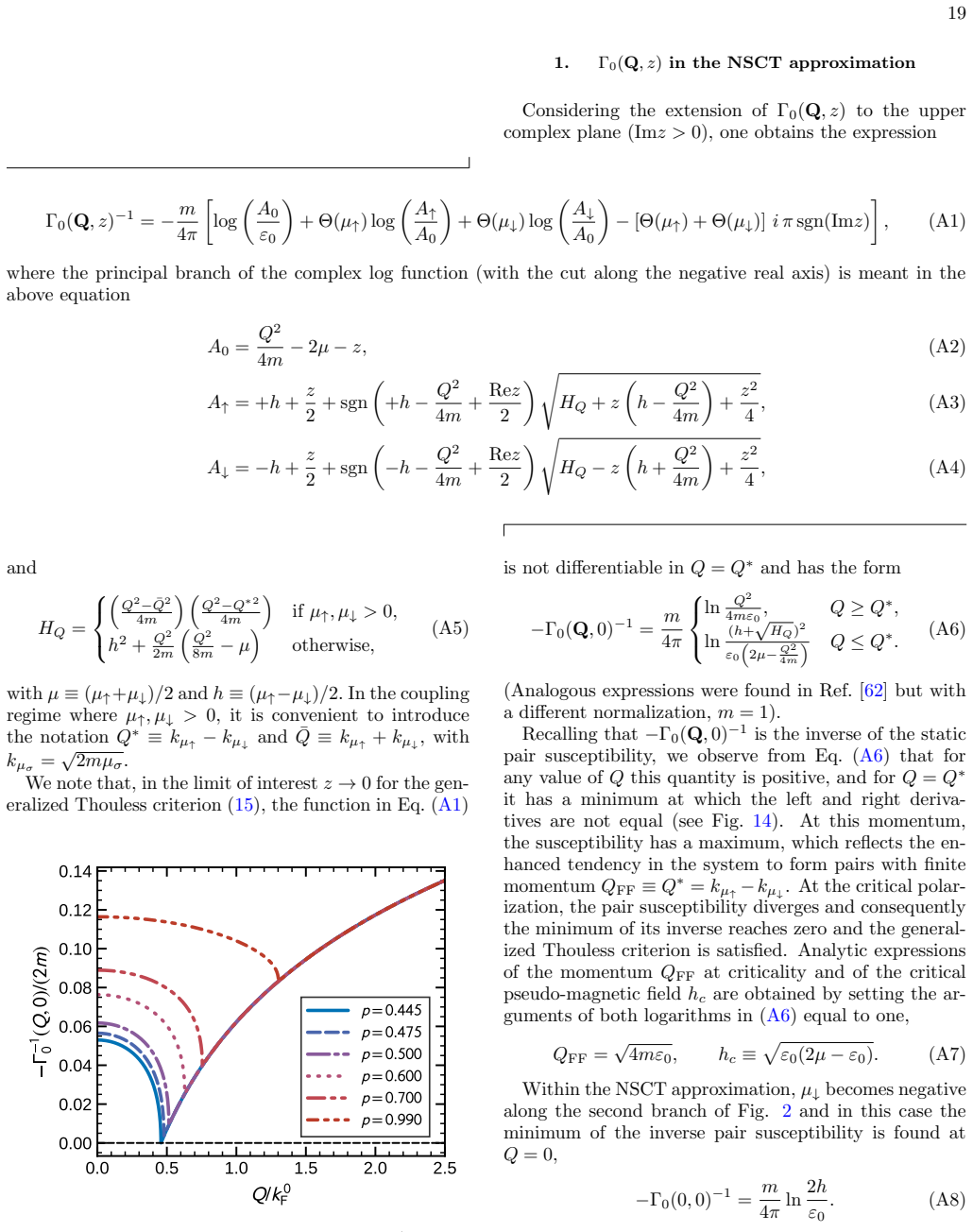
2D By analytically continuing the retarded self-energy at criticality [Eqs. (37) and (40)] to the positive imaginary frequency axis, we obtain the following expression for the dressed fermionic propagator ˜Gσ(kFσ +k, iω)−1 =−i γ|ω|2/3 − ky 2 2m −v Fσkx.(51) Here, we adopt the conventional low-energy formulation of Fermi liquid theory [9], where momenta ar...
-
[2]
3D A similar reasoning can be applied to the 3D FFLO transition by taking into account that the bosonic damp- ing term is now∼Ω, as discussed in sec. VI A. Moreover, the locus of points in momentum space (red circle) host- ing the soft modes of the pairing propagator is now secant rather than tangent to the FS of either species, generat- ing a configurati...
-
[3]
When the threshold frequencies are inside the continuum of Im[Γ R 0 (Q, ¯Ω), they identify the position of cusps in Im[Γ R 0 (Q, ¯Ω)
In these regions, as in the region below ¯Ωth(Q), the continuum of the pair spectral weight function identically vanishes. When the threshold frequencies are inside the continuum of Im[Γ R 0 (Q, ¯Ω), they identify the position of cusps in Im[Γ R 0 (Q, ¯Ω). This information is used when performing numerical integrals such as in Eq. (19). Appendix C: Low-en...
-
[4]
parabolic approximation
F ermionic momentum on the FS We first consider the case withkon the FS:k=k F↓ such that|k F↑| − |k|=QFF ≡ √4mε0. We start by examining the expression (C5) analytically continued to the real frequency axis (z→ ¯Ω +i0 +) ΓR 0 (k′ −k,¯ω+ ˜ξ↑ k′)−1 =− m 4π " a↑ q −e↓ |k′−k| −¯ω− ˜ξ↑ k′ +i0 + +a ↓ q −e↑ |k′−k| + ¯ω+˜ξ↑ k′ +i0 + +b v(|k′ −k| −QFF) # . (D2) 23 ...
-
[5]
F ermionic momentum outside the FS Focusing again on the minority species, we now consider the casek F↓ < k <2kF↑ −k ↓. In this case, a solution of the equation|k ′ −k|=Q FF for the integration variablek ′ exists when the (arbitrary) direction ofQ FF is chosen such that the angleγ k betweenQ FF andksatisfies Eq. (36). As a result,γ k ̸= 0, π. The geometry...
-
[6]
The previous change to curvilinear coordinates is now a simple rotation of the (k ′ x, k′ y) plane according to the transformation ( ˜ω¯ω=v(x) F↑ k′ x +v (y) F↑ k′ y ˜p¯ω v = cosγ k k′ x + sinγ k k′ y (D14) 25 10 4 10 3 10 2 10 1 100 / 10 8 10 7 10 6 10 5 10 4 10 3 10 2 10 1 100 ( , )/ (a) < = < < > 10 4 10 3 10 2 10 1 100 / 10 9 10 8 10 7 10 6 10 5 10 4 ...
Show all 139 references
-
[7]
Varma, Z
C. Varma, Z. Nussinov, and W. van Saarloos, Singular or non-Fermi liquids, Phys. Rep.361, 267 (2002)
2002
-
[8]
H. v. L¨ ohneysen, A. Rosch, M. Vojta, and P. W¨ olfle, Fermi-liquid instabilities at magnetic quantum phase transitions, Rev. Mod. Phys.79, 1015 (2007)
2007
-
[9]
Senthil, Critical Fermi surfaces and non-Fermi liquid metals, Phys
T. Senthil, Critical Fermi surfaces and non-Fermi liquid metals, Phys. Rev. B78, 035103 (2008)
2008
-
[10]
M. A. Metlitski, D. F. Mross, S. Sachdev, and T. Senthil, Cooper pairing in non-Fermi liquids, Phys. Rev. B91, 115111 (2015)
2015
-
[11]
Brando, D
M. Brando, D. Belitz, F. M. Grosche, and T. R. Kirk- patrick, Metallic quantum ferromagnets, Rev. Mod. Phys.88, 025006 (2016)
2016
-
[12]
J. A. Hertz, Quantum critical phenomena, Phys. Rev. B14, 1165 (1976)
1976
-
[13]
A. V. Chubukov and D. L. Maslov, Nonanalytic cor- rections to the Fermi-liquid behavior, Phys. Rev. B68, 155113 (2003)
2003
-
[14]
Belitz, T
D. Belitz, T. R. Kirkpatrick, and T. Vojta, How generic scale invariance influences quantum and classical phase transitions, Rev. Mod. Phys.77, 579 (2005)
2005
-
[15]
Sachdev,Quantum Phase Transitions, 2nd ed
S. Sachdev,Quantum Phase Transitions, 2nd ed. (Cam- bridge University Press, Cambridge, 2011)
2011
-
[16]
Belitz, T
D. Belitz, T. R. Kirkpatrick, and T. Vojta, Nonanalytic behavior of the spin susceptibility in clean Fermi sys- tems, Phys. Rev. B55, 9452 (1997)
1997
-
[17]
A. V. Chubukov, C. P´ epin, and J. Rech, Instability of the Quantum-Critical Point of Itinerant Ferromagnets, Phys. Rev. Lett.92, 147003 (2004)
2004
-
[18]
Abanov and A
A. Abanov and A. Chubukov, Anomalous Scaling at the Quantum Critical Point in Itinerant Antiferromagnets, Phys. Rev. Lett.93, 255702 (2004)
2004
-
[19]
Bergeron, D
D. Bergeron, D. Chowdhury, M. Punk, S. Sachdev, and A.-M. S. Tremblay, Breakdown of Fermi liquid behavior at the (π, π) = 2kF spin-density wave quantum-critical point: The case of electron-doped cuprates, Phys. Rev. B86, 155123 (2012)
2012
-
[20]
E. Berg, M. A. Metlitski, and S. Sachdev, Sign- Problem–Free Quantum Monte Carlo of the Onset of Antiferromagnetism in Metals, Science338, 1606 (2012)
2012
-
[21]
Holder and W
T. Holder and W. Metzner, Non-Fermi-liquid behavior at the onset of incommensurate 2k F charge- or spin- density wave order in two dimensions, Physical Review B90, 161106 (2014)
2014
-
[22]
Holder and W
T. Holder and W. Metzner, Anomalous dynamical scal- ing from nematic and U(1) gauge field fluctuations in two-dimensional metals, Phys. Rev. B92, 041112 (2015)
2015
-
[23]
B. S. Chandrasekhar, A Note on the Maximum Critical Field of High-Field Superconductors, Appl. Phys. Lett. 1, 7 (1962)
1962
-
[24]
A. M. Clogston, Upper Limit for the Critical Field in Hard Superconductors, Phys. Rev. Lett.9, 266 (1962)
1962
-
[25]
M. W. Zwierlein, A. Schirotzek, C. H. Schunck, and W. Ketterle, Fermionic Superfluidity with Imbalanced Spin Populations and the Quantum Phase Transition to the Normal State, Science311, 492 (2006)
2006
-
[26]
G. B. Partridge, W. Li, R. I. Kamar, Y.-a. Liao, and R. G. Hulet, Pairing and Phase Separation in a Polar- ized Fermi Gas, Science311, 503 (2006)
2006
-
[27]
Y. Shin, M. W. Zwierlein, C. H. Schunck, A. Schirotzek, and W. Ketterle, Observation of Phase Separation in a Strongly Interacting Imbalanced Fermi Gas, Phys. Rev. Lett.97, 030401 (2006)
2006
-
[28]
Fulde and R
P. Fulde and R. A. Ferrell, Superconductivity in a Strong Spin-Exchange Field, Phys. Rev.135, A550 (1964)
1964
-
[29]
A. I. Larkin and Y. N. Ovchinnikov, Nonuniform state of superconductors, Zh. Eksp. Teor. Fiz.47, 1136 (1964), [Sov. Phys. JETP 20, 762–770 (1965)]
1964
-
[30]
Casalbuoni and G
R. Casalbuoni and G. Nardulli, Inhomogeneous super- conductivity in condensed matter and QCD, Rev. Mod. Phys.76, 263 (2004)
2004
-
[31]
Matsuda and K
Y. Matsuda and K. Shimahara, Fulde-Ferrell-Larkin- Ovchinnikov state in heavy fermion superconductors, J. Phys. Soc. Jpn.76, 051005 (2007)
2007
-
[32]
Combescot, Introduction to FFLO Phases and Col- lective Modes in the BEC-BCS Crossover, inUltra-Cold Fermi Gases, edited by M
R. Combescot, Introduction to FFLO Phases and Col- lective Modes in the BEC-BCS Crossover, inUltra-Cold Fermi Gases, edited by M. Inguscio, W. Ketterle, and C. Salomon (IOS Press, Amsterdam, 2007) pp. 697–714
2007
-
[33]
J. J. Kinnunen, J. E. Baarsma, J.-P. Martikainen, and P. T¨ orm¨ a, The Fulde–Ferrell–Larkin–Ovchinnikov state for ultracold fermions in lattice and harmonic poten- tials: a review, Rep. Prog. Phys.81, 046401 (2018)
2018
-
[34]
Calvanese Strinati, P
G. Calvanese Strinati, P. Pieri, G. Roepke, P. Schuck, and M. Urban, The BCS–BEC crossover: From ultra- cold Fermi gases to nuclear systems, Phys. Rep.738, 1 (2018)
2018
-
[35]
Bianchi, R
A. Bianchi, R. Movshovich, C. Capan, P. G. Pagliuso, and J. L. Sarrao, Possible Fulde-Ferrell- Larkin-Ovchinnikov Superconducting State in CeCoIn5, Phys. Rev. Lett.91, 187004 (2003)
2003
-
[36]
Kenzelmann, T
M. Kenzelmann, T. Str¨ assle, C. Niedermayer, M. Sigrist, B. Padmanabhan, M. Zolliker, A. D. Bianchi, R. Movshovich, E. D. Bauer, J. L. Sarrao, and J. D. Thompson, Coupled Superconducting and Magnetic Order in CeCoIn 5, Science321, 1652 (2008)
2008
-
[37]
Lortz, Y
R. Lortz, Y. Wang, A. Demuer, P. H. M. B”ottger, B. Bergk, G. Zwicknagl, Y. Nakazawa, and J. Wos- nitza, Calorimetric Evidence for a Fulde-Ferrell-Larkin- Ovchinnikov Superconducting State in the Layered Organic Superconductorκ-(BEDT-TTF) 2Cu(NCS)2, Phys. Rev. Lett.99, 187002 (2007)
2007
-
[38]
J. A. Wright, E. Green, P. Kuhns, A. Reyes, J. Brooks, J. Schlueter, R. Kato, H. Yamamoto, M. Kobayashi, and S. E. Brown, Zeeman-Driven Phase Transi- tion within the Superconducting State ofκ-(BEDT- TTF)2Cu(NCS)2, Phys. Rev. Lett.107, 087002 (2011)
2011
-
[39]
Mayaffre, S
H. Mayaffre, S. Kr”amer, M. Horvati’c, C. Berthier, K. Miyagawa, K. Kanoda, and V. F. Mitrovi’c, Evi- dence of Andreev bound states as a hallmark of the FFLO phase inκ-(BEDT-TTF) 2Cu(NCS)2, Nat. Phys. 10, 928 (2014)
2014
-
[40]
Koutroulakis, H
G. Koutroulakis, H. K”uhne, J. A. Schlueter, J. Wos- nitza, and S. E. Brown, Microscopic Study of the Fulde- Ferrell-Larkin-Ovchinnikov State in an All-Organic Su- perconductor, Phys. Rev. Lett.116, 067003 (2016)
2016
-
[41]
C. W. Cho, J. H. Yang, N. F. Q. Yuan, J. Shen, T. Wolf, and R. Lortz, Thermodynamic Evidence for the Fulde- Ferrell-Larkin-Ovchinnikov State in the KFe2As2 Super- conductor, Phys. Rev. Lett.119, 217002 (2017). 30
2017
-
[42]
Kasahara, Y
S. Kasahara, Y. Sato, S. Licciardello, M. ˇCulo, S. Ar- senijevi’c, T. Ottenbros, T. Tominaga, J. B”oker, I. Eremin, T. Shibauchi, J. Wosnitza, N. E. Hussey, and Y. Matsuda, Evidence for an Fulde-Ferrell-Larkin- Ovchinnikov State with Segmented Vortices in the BCS- BEC-Crossov...
2020
-
[43]
Y.-A. Liao, A. S. C. Rittner, T. Paprotta, W. Li, G. B. Partridge, R. G. Hulet, S. K. Baur, and E. J. Mueller, Spin-imbalance in a one-dimensional Fermi gas, Nature 467, 567 (2010)
2010
-
[44]
B. A. Olsen, M. C. Revelle, J. A. Fry, D. E. Sheehy, and R. G. Hulet, Phase Diagram of a Strongly Interacting Spin-Imbalanced Fermi Gas, Phys. Rev. A92, 063616 (2015)
2015
-
[45]
M. C. Revelle, J. A. Fry, B. A. Olsen, and R. G. Hulet, 1D to 3D Crossover of a Spin-Imbalanced Fermi Gas, Phys. Rev. Lett.117, 235301 (2016)
2016
-
[46]
Sundar, J
B. Sundar, J. A. Fry, M. C. Revelle, R. G. Hulet, and K. R. A. Hazzard, Spin-imbalanced ultracold Fermi gases in a two-dimensional array of tubes, Phys. Rev. A 102, 033311 (2020)
2020
-
[47]
R. Yao, S. Chi, M. Wang, R. J. Fletcher, and M. Zwier- lein, Measuring Pair Correlations in Bose and Fermi Gases via Atom-Resolved Microscopy, Phys. Rev. Lett. 134, 183402 (2025)
2025
-
[48]
M. Pini, P. Pieri, and G. Calvanese Strinati, Strong Fulde-Ferrell Larkin-Ovchinnikov pairing fluctuations in polarized Fermi systems, Phys. Rev. Res.3, 043068 (2021)
2021
-
[49]
Sarma, On the influence of a uniform exchange field acting on the spins of the conduction electrons in a su- perconductor, J
G. Sarma, On the influence of a uniform exchange field acting on the spins of the conduction electrons in a su- perconductor, J. Phys. Chem. Solids24, 1029 (1963)
1963
-
[50]
Magnetized
D. E. Sheehy and L. Radzihovsky, BEC-BCS Crossover in “Magnetized” Feshbach-Resonantly Paired Superflu- ids, Phys. Rev. Lett.96, 060401 (2006)
2006
-
[51]
D. E. Sheehy and L. Radzihovsky, BEC–BCS Crossover, Phase Transitions and Phase Separation in Polarized Resonantly-Paired Superfluids, Ann. Phys.322, 1790 (2007)
2007
-
[52]
M. M. Parish, F. M. Marchetti, A. Lamacraft, and B. D. Simons, Finite-temperature phase diagram of a polar- ized Fermi condensate, Nat. Phys.3, 124 (2007)
2007
-
[53]
Chevy and C
F. Chevy and C. Mora, Ultra-cold polarized Fermi gases, Rep. Prog. Phys.73, 112401 (2010)
2010
-
[54]
Radzihovsky and D
L. Radzihovsky and D. E. Sheehy, Imbalanced Feshbach-resonant Fermi gases, Rep. Prog. Phys.73, 076501 (2010)
2010
-
[55]
C. Lobo, A. Recati, S. Giorgini, and S. Stringari, Nor- mal state of a polarized Fermi gas at unitarity, Phys. Rev. Lett.97, 200403 (2006)
2006
-
[56]
Pilati and S
S. Pilati and S. Giorgini, Phase separation in a polarized fermi gas at zero temperature, Phys. Rev. Lett.100, 030401 (2008)
2008
-
[57]
Gukelberger, S
J. Gukelberger, S. Lienert, E. Kozik, L. Pollet, and M. Troyer, Fulde-Ferrell-Larkin-Ovchinnikov pairing as leading instability on the square lattice, Phys. Rev. B 94, 075157 (2016)
2016
-
[58]
Vitali, P
E. Vitali, P. Rosenberg, and S. Zhang, Exotic Super- fluid Phases in Spin-Polarized Fermi Gases in Optical Lattices, Phys. Rev. Lett.128, 203201 (2022)
2022
-
[59]
Kashimura, R
T. Kashimura, R. Watanabe, and Y. Ohashi, Spin sus- ceptibility and fluctuation corrections in the BCS-BEC crossover regime of an ultracold Fermi gas, Phys. Rev. A86, 043622 (2012)
2012
-
[61]
Tajima, T
H. Tajima, T. Kashimura, R. Hanai, R. Watanabe, and Y. Ohashi, Uniform spin susceptibility and spin-gap phenomenon in the BCS-BEC crossover regime of an ultracold Fermi gas, Phys. Rev. A89, 033617 (2014)
2014
-
[62]
Frank, J
B. Frank, J. Lang, and W. Zwerger, Universal phase di- agram and scaling functions of imbalanced Fermi gases, J. Exp. Theor. Phys.127, 812 (2018)
2018
-
[63]
Perali, P
A. Perali, P. Pieri, G. C. Strinati, and C. Castellani, Pseudogap and spectral function from superconduct- ing fluctuations to the bosonic limit, Phys. Rev. B66, 024510 (2002)
2002
-
[64]
Pieri, L
P. Pieri, L. Pisani, and G. C. Strinati, BCS-BEC crossover at finite temperature in the broken-symmetry phase, Phys. Rev. B70, 094508 (2004)
2004
-
[66]
M. Pini, P. Pieri, and G. Calvanese Strinati, Evo- lution of an attractive polarized Fermi gas: From a Fermi liquid of polarons to a non-Fermi liquid at the Fulde-Ferrell-Larkin-Ovchinnikov quantum critical point, Phys. Rev. B107, 054505 (2023)
2023
-
[67]
Pantel, D
P.-A. Pantel, D. Davesne, and M. Urban, Polarized Fermi gases at finite temperature in the BCS-BEC crossover, Phys. Rev. A90, 053629 (2014)
2014
-
[68]
D. E. Sheehy, Fulde-Ferrell-Larkin-Ovchinnikov state of two-dimensional imbalanced Fermi gases, Phys. Rev. A 92, 053631 (2015)
2015
-
[69]
K. V. Samokhin and M. S. Mar’enko, Quantum fluctua- tions in Larkin-Ovchinnikov-Fulde-Ferrell superconduc- tors, Phys. Rev. B73, 144502 (2006)
2006
-
[70]
Piazza, W
F. Piazza, W. Zwerger, and P. Strack, FFLO strange metal and quantum criticality in two dimensions: The- ory and application to organic superconductors, Phys. Rev. B93, 085112 (2016)
2016
-
[71]
Pimenov, I
D. Pimenov, I. Mandal, F. Piazza, and M. Punk, Non- Fermi liquid at the FFLO quantum critical point, Phys. Rev. B98, 024510 (2018)
2018
-
[72]
Bauer, M
M. Bauer, M. M. Parish, and T. Enss, Universal Equa- tion of State and Pseudogap in the Two-Dimensional Fermi Gas, Phys. Rev. Lett.112, 135302 (2014)
2014
-
[73]
Bloom, Two-dimensional Fermi gas, Phys
P. Bloom, Two-dimensional Fermi gas, Phys. Rev. B12, 125 (1975)
1975
-
[74]
Bertaina and S
G. Bertaina and S. Giorgini, BCS-BEC Crossover in a Two-Dimensional Fermi Gas, Phys. Rev. Lett.106, 110403 (2011)
2011
-
[75]
Q. Chen, J. Stajic, S. Tan, and K. Levin, BCS–BEC crossover: From high temperature superconductors to ultracold superfluids, Phys. Rep.412, 1 (2005)
2005
-
[76]
J. M. Luttinger, Fermi Surface and Some Simple Equi- librium Properties of a System of Interacting Fermions, Phys. Rev.119, 1153 (1960)
1960
-
[77]
Pieri and G
P. Pieri and G. C. Strinati, Luttinger theorem and im- balanced Fermi systems, Eur. Phys. J. B90, 68 (2017)
2017
-
[78]
Randeria, J.-M
M. Randeria, J.-M. Duan, and L.-Y. Shieh, Bound states, Cooper pairing, and Bose condensation in two dimensions, Phys. Rev. Lett.62, 981 (1989)
1989
-
[79]
Levinsen and M
J. Levinsen and M. M. Parish, Strongly interacting two- dimensional Fermi gases, inAnnu. Rev. Cold At. Mol., 31 Vol. 3 (2015) Chap. 1, pp. 1–75
2015
-
[80]
Salasnich and F
L. Salasnich and F. Toigo, Composite bosons in the two- dimensional BCS-BEC crossover from Gaussian fluctu- ations, Phys. Rev. A91, 011604 (2015)
2015
-
[81]
L. He, H. L¨ u, G. Cao, H. Hu, and X.-J. Liu, Quan- tum fluctuations in the BCS-BEC crossover of two- dimensional Fermi gases, Phys. Rev. A92, 023620 (2015)
2015
-
[82]
Boettcher, L
I. Boettcher, L. Bayha, D. Kedar, P. A. Murthy, M. Nei- dig, M. G. Ries, A. N. Wenz, G. Z¨ urn, S. Jochim, and T. Enss, Equation of State of Ultracold Fermions in the 2D BEC-BCS Crossover Region, Phys. Rev. Lett.116, 045303 (2016)
2016
-
[83]
Vitali, H
E. Vitali, H. Shi, M. Qin, and S. Zhang, Visualizing the BEC-BCS crossover in a two-dimensional Fermi gas: Pairing gaps and dynamical response functions from ab initio computations, Phys. Rev. A96, 061601 (2017)
2017
-
[84]
Zielinski, B
T. Zielinski, B. Ross, and A. Gezerlis, Pairing in two- dimensional Fermi gases with a coordinate-space poten- tial, Phys. Rev. A101, 033601 (2020)
2020
-
[85]
Sobirey, N
L. Sobirey, N. Luick, M. Bohlen, H. Biss, H. Moritz, and T. Lompe, Observation of superfluidity in a strongly correlated two-dimensional Fermi gas, Science372, 844 (2021)
2021
-
[86]
Van Loon and C
S. Van Loon and C. A. R. S´ a de Melo, Effects of Quan- tum Fluctuations on the Low-Energy Collective Modes of Two-Dimensional Superfluid Fermi Gases from the BCS to the Bose Limit, Phys. Rev. Lett.131, 113001 (2023)
2023
-
[87]
Pisani, P
L. Pisani, P. Bovini, F. Pavan, and P. Pieri, Boson- fermion pairing and condensation in two-dimensional Bose-Fermi mixtures, SciPost Phys.18, 076 (2025)
2025
-
[88]
Tartari,Phase diagram of a two-component Fermi gas with density imbalance throughout the BCS-BEC crossover, Ph.D
A. Tartari,Phase diagram of a two-component Fermi gas with density imbalance throughout the BCS-BEC crossover, Ph.D. thesis, University of Camerino (2011)
2011
-
[89]
Schneider, V
W. Schneider, V. B. Shenoy, and M. Randeria, The- ory of Radio Frequency Spectroscopy of Polarized Fermi Gases, (2009), arXiv:0903.3006 [cond-mat.other]
2009 arXiv
-
[90]
Dzyaloshinskii, Some consequences of the Luttinger theorem: The Luttinger surfaces in non-Fermi liquids and Mott insulators, Phys
I. Dzyaloshinskii, Some consequences of the Luttinger theorem: The Luttinger surfaces in non-Fermi liquids and Mott insulators, Phys. Rev. B68, 085113 (2003)
2003
-
[91]
Combescot, S
R. Combescot, S. Giraud, and X. Leyronas, Analytical theory of the dressed bound state in highly polarized Fermi gases, Europhys. Lett.88, 60007 (2010)
2010
-
[92]
M. Punk, P. T. Dumitrescu, and W. Zwerger, Polaron- to-molecule transition in a strongly imbalanced Fermi gas, Phys. Rev. A80, 053605 (2009)
2009
-
[93]
Fratini and P
E. Fratini and P. Pieri, Mass imbalance effect in res- onant Bose-Fermi mixtures, Phys. Rev. A85, 063618 (2012)
2012
-
[94]
M. M. Parish, Polaron-molecule transitions in a two- dimensional Fermi gas, Phys. Rev. A83, 051603(R) (2011)
2011
-
[95]
Durel and M
D. Durel and M. Urban, Application of the renormalized random-phase approximation to polarized Fermi gases, Phys. Rev. A101, 013608 (2020)
2020
-
[96]
A. L. Fetter and J. D. Walecka,Quantum Theory of Many-Particle Systems(Dover Publications, Mineola, NY, 2003)
2003
-
[97]
J. M. Luttinger and J. C. Ward, Ground-State Energy of a Many-Fermion System. II, Phys. Rev.118, 1417 (1960)
1960
-
[98]
Takada and T
S. Takada and T. Izuyama, Superconductivity in a Molecular Field. I, Prog. Theor. Phys.41, 635 (1969)
1969
-
[99]
A. A. Abrikosov, L. P. Gorkov, and I. E. Dzyaloshinskii, Methods of Quantum Field Theory in Statistical Physics (Dover Publications, New York, 1975)
1975
-
[100]
Nozi` eres,Theory of Interacting Fermi Systems(W
P. Nozi` eres,Theory of Interacting Fermi Systems(W. A. Benjamin, New York, 1964)
1964
-
[101]
Gan and E
J. Gan and E. Wong, Non-Fermi-liquid behavior in quantum critical systems, Phys. Rev. Lett.71, 4226 (1993)
1993
-
[102]
Schmitt-Rink, C
S. Schmitt-Rink, C. M. Varma, and A. E. Ruckenstein, Pairing in two dimensions, Phys. Rev. Lett.63, 445 (1989)
1989
-
[103]
Dupuis,Field Theory of Condensed Matter and Ul- tracold Gases, Vol
N. Dupuis,Field Theory of Condensed Matter and Ul- tracold Gases, Vol. 1 (World Scientific, Singapore, 2023)
2023
-
[104]
P. C. Hohenberg and B. I. Halperin, Theory of dynamic critical phenomena, Rev. Mod. Phys.49, 435 (1977)
1977
-
[105]
Holder and W
T. Holder and W. Metzner, Fermion loops and improved power-counting in two-dimensional critical metals with singular forward scattering, Phys. Rev. B92, 245128 (2015)
2015
-
[106]
A. J. Millis, Effect of a nonzero temperature on quantum critical points in itinerant fermion systems, Phys. Rev. B48, 7183 (1993)
1993
-
[107]
Oganesyan, S
V. Oganesyan, S. A. Kivelson, and E. Fradkin, Quantum theory of a nematic Fermi fluid, Phys. Rev. B64, 195109 (2001)
2001
-
[108]
Metzner, D
W. Metzner, D. Rohe, and S. Andergassen, Soft Fermi Surfaces and Breakdown of Fermi-Liquid Behavior, Phys. Rev. Lett.91, 066402 (2003)
2003
-
[109]
Dell’Anna and W
L. Dell’Anna and W. Metzner, Fermi surface fluctua- tions and single electron excitations near Pomeranchuk instability in two dimensions, Phys. Rev. B73, 045127 (2006)
2006
-
[110]
W¨ olfle and A
P. W¨ olfle and A. Rosch, Fermi Liquid Near a Quantum Critical Point, J. Low Temp. Phys.147, 165
-
[111]
P. A. Lee, Gauge field, Aharonov-Bohm flux, and high- Tc superconductivity, Phys. Rev. Lett.63, 680 (1989)
1989
-
[112]
M. A. Metlitski and S. Sachdev, Quantum phase tran- sitions of metals in two spatial dimensions. I. Ising- nematic order, Phys. Rev. B82, 075127 (2010)
2010
-
[113]
Belitz, T
D. Belitz, T. R. Kirkpatrick, A. J. Millis, and T. Vojta, Nonanalytic magnetization dependence of the magnon effective mass in itinerant quantum ferromagnets, Phys. Rev. B58, 14155 (1998)
1998
-
[114]
J. Rech, C. P´ epin, and A. V. Chubukov, Quantum crit- ical behavior in itinerant electron systems: Eliashberg theory and instability of a ferromagnetic quantum crit- ical point, Phys. Rev. B74, 195126 (2006)
2006
-
[115]
Dalidovich and S.-S
D. Dalidovich and S.-S. Lee, Perturbative non-Fermi liq- uids from dimensional regularization, Phys. Rev. B88, 245106 (2013)
2013
-
[116]
Mandal and S.-S
I. Mandal and S.-S. Lee, Ultraviolet/infrared mixing in non-Fermi liquids, Phys. Rev. B92, 035141 (2015)
2015
-
[117]
Sur and S.-S
S. Sur and S.-S. Lee, Quasilocal strange metal, Phys. Rev. B91, 125136 (2015)
2015
-
[118]
K¨ uchler, P
R. K¨ uchler, P. Gegenwart, J. Custers, O. Stock- ert, N. Caroca-Canales, C. Geibel, J. G. Sereni, and F. Steglich, Quantum Criticality in the Cubic Heavy- Fermion System CeIn 3−xSnx, Phys. Rev. Lett.96, 256403 (2006)
2006
-
[119]
Fawcett, Spin-density-wave antiferromagnetism in chromium, Rev
E. Fawcett, Spin-density-wave antiferromagnetism in chromium, Rev. Mod. Phys.60, 209 (1988)
1988
-
[120]
J. A. Hertz and M. A. Klenin, Fluctuations in itinerant- electron paramagnets, Phys. Rev. B10, 1084 (1974). 32
1974
-
[121]
Abanov, A
A. Abanov, A. V. Chubukov, and J. Schmalian, Quantum-critical theory of the spin-fermion model and its application to cuprates: Normal state analysis, Adv. Phys.52, 119 (2003)
2003
-
[122]
Pieri and G
P. Pieri and G. C. Strinati, Strong-coupling limit in the evolution from BCS superconductivity to Bose-Einstein condensation, Phys. Rev. B61, 15370 (2000)
2000
-
[123]
Pistolesi and G
F. Pistolesi and G. C. Strinati, Evolution from BCS superconductivity to Bose condensation: Calculation of the zero-temperature phase coherence length, Phys. Rev. B53, 15168 (1996)
1996
-
[124]
Lee, Stability of the U(1) spin liquid with a spinon Fermi surface in 2 + 1 dimensions, Phys
S.-S. Lee, Stability of the U(1) spin liquid with a spinon Fermi surface in 2 + 1 dimensions, Phys. Rev. B78, 085129 (2008)
2008
-
[125]
Polchinski, Low-energy dynamics of the spinon-gauge system, Nucl
J. Polchinski, Low-energy dynamics of the spinon-gauge system, Nucl. Phys. B422, 617 (1994)
1994
-
[126]
M. A. Metlitski and S. Sachdev, Quantum phase transi- tions of metals in two spatial dimensions. II. Spin den- sity wave order, Phys. Rev. B82, 075128 (2010)
2010
-
[127]
S. A. Maier and P. Strack, Universality in antiferromag- netic strange metals, Phys. Rev. B93, 165114 (2016)
2016
-
[128]
Lunts, A
P. Lunts, A. Schlief, and S.-S. Lee, Emergence of a con- trol parameter for the antiferromagnetic quantum crit- ical metal, Phys. Rev. B95, 245109 (2017)
2017
-
[129]
Schlief, P
A. Schlief, P. Lunts, and S.-S. Lee, Exact Critical Expo- nents for the Antiferromagnetic Quantum Critical Metal in Two Dimensions, Phys. Rev. X7, 021010 (2017)
2017
-
[130]
Lunts, M
P. Lunts, M. S. Albergo, and M. Lindsey, Non-Hertz- Millis scaling of the antiferromagnetic quantum critical metal via scalable Hybrid Monte Carlo, Nat. Commun. 14, 2547 (2023)
2023
-
[131]
Y. B. Bazaliy, R. Ramazashvili, Q. Si, and M. R. Nor- man, Magnetotransport near a quantum critical point in a simple metal, Phys. Rev. B69, 144423 (2004)
2004
-
[132]
Mandal, Stable non-Fermi liquid fixed point at the onset of incommensurate 2kF charge density wave order, Nucl
I. Mandal, Stable non-Fermi liquid fixed point at the onset of incommensurate 2kF charge density wave order, Nucl. Phys. B1005, 116586 (2024)
2024
-
[133]
Pirolo, L
F. Pirolo, L. Pisani, and P. Pieri, Data for ”FFLO tran- sition and quantum criticality in polarized Fermi gases” (2026), Zenodo Repository
2026
-
[134]
S. L. Sondhi, S. M. Girvin, J. P. Carini, and D. Sha- har, Continuous quantum phase transitions, Rev. Mod. Phys.69, 315 (1997)
1997
-
[135]
M. E. Fisher and R. J. Burford, Theory of Critical-Point Scattering and Correlations. I. The Ising Model, Phys. Rev.156, 583 (1967)
1967
-
[136]
B. L. Altshuler, L. B. Ioffe, and A. J. Millis, Critical behavior of theT= 0 2k F density-wave phase transition in a two-dimensional Fermi liquid, Phys. Rev. B52, 5563 (1995)
1995
-
[137]
Lee, Low-energy effective theory of Fermi surface coupled with U(1) gauge field in 2 + 1 dimensions, Phys
S.-S. Lee, Low-energy effective theory of Fermi surface coupled with U(1) gauge field in 2 + 1 dimensions, Phys. Rev. B80, 165102 (2009)
2009
-
[138]
Drechsler and W
M. Drechsler and W. Zwerger, Crossover from BCS- superconductivity to Bose-condensation, Annalen der Physik504, 15 (1992)
1992
-
[139]
D’Alberto, L
J. D’Alberto, L. Cardarelli, D. E. Galli, G. Bertaina, and P. Pieri, Quantum Monte Carlo and perturbative study of two-dimensional Bose-Fermi mixtures, Phys. Rev. A109, 053302 (2024)
2024
Reviewed July 31, 2026 · model on record in the stance chip above.
Discussion (0). Continue with ORCID to comment.