REVIEW 1 major objections 3 minor 114 references
Information Aggregation and Social Networks: Responsiveness and Overturning
T0 review · 1 major / 3 minor · reviewed 2026-08-03 · deepseek-v4-flash
Pith's one-line read No single network structure is uniformly optimal for social learning.
desk verdict Solid paper with a fixable but real gap: Corollary 1 is false for N=2 because star and complete networks coincide; the intended N≥3 result is probably right. read the letter →
The pith
A machine-rendered reading of the paper's core claim, the machinery that carries it, and where it could break.
The reading
What carries the argument
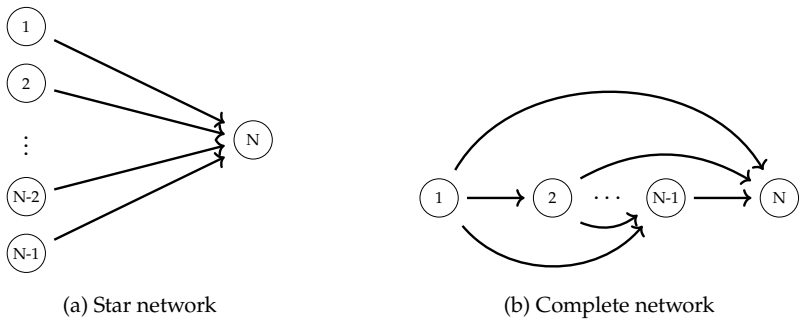
The two extreme networks: the star network, where all but the last agent act on private signals alone and the last agent observes everyone; and the complete network, where every agent observes all earlier actions. The proof machinery is a pair of constructed information structures and the two forces they isolate. The responsiveness effect: less connected networks keep actions sensitive to private signals, avoiding cascades. The overturning effect: fully connected networks let an action that reverses the prevailing history reveal that its agent received an unusually informative signal, and later agents can read that reversal. The four-signal structure in Theorem 2 has likelihood ratios ordere
What would settle it
Compute, for the constructed four-signal structure Π*, the equilibrium payoffs of the complete network versus every other network for N=4; if any non-complete network matched or exceeded the complete network's terminal payoff, Theorem 2 would fail. More directly, to falsify Corollary 1 one would need a network that is weakly best under both Π_B and Π*, which the uniqueness proofs forbid.
Extended reading notes
Core claim
The central discovery is a negative result about network rankings: for the criterion of the terminal agent's expected payoff at a fixed finite period, there is no network that weakly outperforms every other network for every information structure. The proof is by constructing two opposite information structures. Theorem 1 builds a binary information structure in which, because actions perfectly reveal binary signals, the star network makes every predecessor's signal directly readable, whereas any connected network induces cascades that destroy responsiveness; hence star uniquely maximizes the last agent's payoff. Theorem 2 builds a four-signal structure with lexicographically ordered informa
Load-bearing premise
The 'no uniform optimum' conclusion is established only when we evaluate networks by the expected payoff of the last decision-maker at a single fixed finite period; if the objective were long-run learning speed or average welfare of all agents, a uniformly best network could still exist.
Editorial extensions
If this is right
- For any fixed information structure, the best network must be evaluated jointly with the signal distribution; no off-the-shelf ranking of networks exists.
- In environments where moderately informative signals dominate, sacrificing a few early agents to act independently (star-like 'guinea pig' design) improves terminal decisions.
- In environments where extremely informative signals occur with nontrivial probability, full transparency of histories (complete-network-like design) lets one surprising action correct a long wrong chain.
- The trade-off persists in large societies: as the number of agents grows, both networks achieve asymptotic learning, but the rate comparison still depends on the same cutoff.
Reading between the lines
- The non-uniformity result is proven for the terminal agent's expected payoff at a finite horizon; a different welfare criterion such as utilitarian average payoff or long-run learning speed might in principle admit a uniformly best network, and this paper does not rule that out.
- One could test the trade-off empirically in laboratory settings: vary the tail-thickness of signal distributions and compare whether allowing subjects to observe all previous actions versus isolating them changes accuracy in the direction predicted.
- The overturning effect suggests a design principle for platforms: when signals can be extreme but rare, making reversals salient (e.g., highlighting action switches) may substitute for full network connectivity.
Editorial analysis
A structured set of objections, weighed in public.
Referee Report
Summary. The paper studies sequential social learning in a finite-horizon model with binary actions and a uniform prior. Two extreme networks are analyzed: a star network, in which only the terminal agent observes all predecessors, and a complete network, in which every agent observes all predecessors. Theorem 1 constructs a binary signal structure under which the star network uniquely maximizes the terminal agent's expected payoff, and Theorem 2 constructs a four-signal information structure under which the complete network uniquely maximizes it. The paper concludes (Corollary 1) that no network is uniformly optimal across all information structures. Section 5 provides a cutoff characterization in a mixture-of-binary-and-conclusive-signals class and numerical support. The proofs are collected in appendices.
Significance. The main conceptual message — that the ranking of networks depends on the information structure, so denser observation is not uniformly better — is interesting and, once the N≥3 scope is made explicit, is supported by a careful analysis. The construction underlying Theorem 2, with lexicographically ordered signal likelihoods that make overturning histories interpretable, is a novel technique and is verified through the inequalities in Lemma 3. Proposition 2 gives a sharp, falsifiable comparative static with an explicit limit as N→∞. The paper does not estimate parameters from data and does not rely on its own prior results. The welfare criterion is transparent: the main theorems concern the terminal agent's expected payoff at a fixed finite horizon, with Proposition 1 extending the complete-network advantage to all agents under the constructed information structure.
major comments (1)
- [Section 3; Definitions 1–2; Corollary 1; Appendix C.3] The model allows N=2 (Section 3), but for N=2 Definitions 1 and 2 coincide: both give N_2={1}, and the only other network has N_2=∅. By Lemma 1 (Appendix A.2), V_2(full,Π) ≥ V_2(empty,Π) for every information structure Π. Hence the full network satisfies the uniform-optimality condition in Corollary 1, directly contradicting the corollary as stated. The proof after Theorem 2 requires star≠complete to obtain a contradiction, which fails when N=2. The proof of Theorem 2 in Appendix C.3 also does not handle this case: after the Lemma 1 reduction, the constructed network for an N=2 non-complete network is the complete network itself, so neither Condition (I) nor (II) is violated and Lemma 8(iii) does not apply because N=N_C. The fix is local but load-bearing: state Theorems 1, 2, and Corollary 1 for N≥3 (or add an explicit N=2 exception to Corollary 1). Proposition 2 already restricts to N≥3
minor comments (3)
- [Appendix C.1] The text states LR(l*)=δ^{N^3}, but from the definitions π*(l*|L)=δ^{α+1} and π*(l*|H)=δ^{(α+1)N^3}, the correct value is LR(l*)=δ^{(α+1)(N^3-1)}. The proofs in Lemma 3 use the correct value, so this is a typo, but it should be corrected.
- [Section 4] The paragraph beginning 'However, analyzing the general properties of how connectivity affects agents' payoffs is highly complicated... Given this difficulty, we focus on two important networks...' is repeated almost verbatim two paragraphs in a row. One copy should be removed.
- [Appendix B, proof of Lemma 3] In the proof of inequality (1), the sentence 'the second inequality follows from δ<1/(3N)<1/3' appears to refer to the third inequality in the displayed chain. Please clarify the reference.
Circularity Check
No significant circularity: the existence results are self-contained constructions with no fitted parameters and no load-bearing self-citations.
full rationale
The paper's central claims, Theorems 1 and 2, are existence results established by explicitly constructed information structures. Theorem 1 fixes a binary information structure satisfying LR(l)LR(h)^{N-2}<1<LR(l)LR(h)^{N-1} and proves, via Lemma 2, that the star network uniquely maximizes agent N's expected payoff. Theorem 2 constructs a four-signal information structure Pi* using an auxiliary parameter delta in (0,1/(3N)), proves the required likelihood-ratio inequalities in Lemma 3, characterizes equilibrium actions in Lemmas 4-6, and then proves strict optimality of the complete network. Corollary 1 is a direct logical consequence of Theorems 1 and 2: a uniformly optimal network would have to coincide with the star network under Pi_B and with the complete network under Pi*, and since these networks differ for N>=3, no such network exists. No parameter is estimated from data, no prediction is a renamed fitted value, and no step relies on the authors' own prior work. The self-citation pattern is absent: citations to Ali, Smith-Sorensen, and the classical cascades literature are contextual and non-load-bearing. One non-circular correctness concern is that the model allows N=2, where the star and complete networks coincide, making Corollary 1 false as stated; however, this is a boundary-case correctness issue, not circularity, since the proof itself does not presuppose its conclusion. The numerical exercises in Section 5.2 also compare closed-form expected payoffs under fixed families of distributions rather than fitting parameters and relabeling them as predictions. Overall, the derivation chain is self-contained and no circular step is present.
Assumptions & free parameters
free parameters (1)
- δ (auxiliary construction parameter for Π*) =
any δ ∈ (0, 1/(3N))
assumptions (5)
- domain assumption Common prior with P(H)=P(L)=1/2
- domain assumption Private signals are conditionally independent and identically distributed across agents
- domain assumption Agents observe only neighbors' actions, not private signals
- ad hoc to paper Tie-breaking rule: indifferent agents choose action 0
- domain assumption Payoff is 1 if action matches the state, 0 otherwise
Cite this review
Pith. "Pith review of Information Aggregation and Social Networks: Responsiveness and Overturning." pith.science (2026). https://pith.science/paper/NLKOL45S
@misc{pith2026260728921,
  author       = {Pith},
  title        = {Pith review of: Information Aggregation and Social Networks: Responsiveness and Overturning},
  year         = {2026},
  howpublished = {\url{https://pith.science/paper/NLKOL45S}},
  note         = {Machine review of arXiv:2607.28921}
}
read the original abstract
This paper studies how network structures affect the efficiency of information aggregation in social learning environments. We consider a model in which rational agents sequentially choose actions based on private signals and observations of their neighbors' actions in a network. Focusing on comparisons of expected payoffs at a given finite period, we show that there exists an information structure under which the star network achieves a strictly higher expected payoff than any other network, and another information structure under which the complete network achieves a strictly higher expected payoff than any other network. Taken together, these results imply that no network is uniformly optimal across all information structures. Our analysis highlights a trade-off between the responsiveness effect and the overturning effect: disconnected networks preserve responsiveness of actions to private signals, whereas highly connected networks facilitate the aggregation of extreme information that overturns public beliefs.
Figures


Figures from the paper (6 more)




Reference graph
Works this paper leans on
-
[1]
The Annals of Mathematical Statistics , pages=
Equivalent comparisons of experiments , author=. The Annals of Mathematical Statistics , pages=. 1953 , publisher=
1953
-
[2]
American Economic Review , volume=
Bayesian persuasion , author=. American Economic Review , volume=
-
[3]
Annual Review of Economics , volume=
Bayesian persuasion and information design , author=. Annual Review of Economics , volume=. 2019 , publisher=
2019
-
[4]
Journal of Economic Literature , volume=
Information design: A unified perspective , author=. Journal of Economic Literature , volume=. 2019 , publisher=
2019
-
[5]
Theoretical Economics , volume=
Bayes correlated equilibrium and the comparison of information structures in games , author=. Theoretical Economics , volume=. 2016 , publisher=
2016
-
[6]
American Economic Journal: Microeconomics , volume=
Information design , author=. American Economic Journal: Microeconomics , volume=. 2019 , publisher=
2019
-
[7]
American Economic Review , volume=
Advertising content , author=. American Economic Review , volume=. 2006 , publisher=
2006
-
[8]
Journal of Economic Theory , pages=
Information design for selling search goods and the effect of competition , author=. Journal of Economic Theory , pages=. 2023 , publisher=
2023
Show all 114 references
-
[9]
arXiv preprint arXiv:2303.13409 , year=
Persuaded search , author=. arXiv preprint arXiv:2303.13409 , year=
-
[10]
1995 , publisher=
Repeated games with incomplete information , author=. 1995 , publisher=
1995
-
[11]
Working paper , year=
Guided search , author=. Working paper , year=
-
[12]
American Economic Review: Insights , volume=
Herd Design , author=. American Economic Review: Insights , volume=. 2023 , publisher=
2023
-
[13]
Available at SSRN 4342503 , year=
Information Design of Sponsored Advertising , author=. Available at SSRN 4342503 , year=
-
[14]
Economics Letters , volume=
A model of Bayesian persuasion with transfers , author=. Economics Letters , volume=. 2017 , publisher=
2017
-
[15]
Web and Internet Economics: 15th International Conference, WINE 2019, New York, NY, USA, December 10--12, 2019, Proceedings 15 , pages=
Persuasion and incentives through the lens of duality , author=. Web and Internet Economics: 15th International Conference, WINE 2019, New York, NY, USA, December 10--12, 2019, Proceedings 15 , pages=. 2019 , organization=
2019
-
[16]
Theoretical Economics , volume=
Paying with information , author=. Theoretical Economics , volume=. 2023 , publisher=
2023
-
[17]
Available at SSRN 4762231 , year=
Designing Contracts and Information Jointly , author=. Available at SSRN 4762231 , year=
-
[18]
2022 , institution=
Comparisons of signals , author=. 2022 , institution=
2022
-
[19]
Journal of Economic Theory , volume=
When are signals complements or substitutes? , author=. Journal of Economic Theory , volume=. 2013 , publisher=
2013
-
[20]
Proceedings of the second Berkeley symposium on mathematical statistics and probability , volume=
Comparison of experiments , author=. Proceedings of the second Berkeley symposium on mathematical statistics and probability , volume=. 1951 , organization=
1951
-
[21]
Research in Economics , volume=
The value of information in monotone decision problems , author=. Research in Economics , volume=. 2018 , publisher=
2018
-
[22]
2011 , publisher=
Comparing location experiments , booktitle=. 2011 , publisher=
2011
-
[23]
Econometrica , volume=
Information acquisition in auctions , author=. Econometrica , volume=. 2000 , publisher=
2000
-
[24]
2018 , publisher=
de Oliveira, Henrique , journal=. 2018 , publisher=
2018
-
[25]
Annals of Statistics , volume=
Comparing location experiments , author=. Annals of Statistics , volume=
-
[26]
Journal of Economic Theory , volume=
On comparisons of information structures with infinite states , author=. Journal of Economic Theory , volume=. 2024 , publisher=
2024
-
[27]
Whitmeyer, Mark , journal=. Bayes=
-
[28]
A geometric
Wu, Wenhao , journal=. A geometric. 2023 , publisher=
2023
-
[29]
2021 , institution=
Coarse bayesian updating , author=. 2021 , institution=
2021
-
[30]
Journal of Political Economy , volume=
Non-bayesian persuasion , author=. Journal of Political Economy , volume=. 2022 , publisher=
2022
-
[31]
Available at SSRN 4467608 , year=
Privacy Preserving Signals , author=. Available at SSRN 4467608 , year=
-
[32]
Econometrica , volume=
Extreme points and majorization: Economic applications , author=. Econometrica , volume=. 2021 , publisher=
2021
-
[33]
AEA Papers and Proceedings , volume=
Simplicity and probability weighting in choice under risk , author=. AEA Papers and Proceedings , volume=. 2022 , organization=
2022
-
[34]
Available at SSRN 3253494 , year=
Preference for simplicity , author=. Available at SSRN 3253494 , year=
-
[35]
Available at SSRN , volume=
Simplicity and risk , author=. Available at SSRN , volume=
-
[36]
American Economic Review , volume=
Quantifying information and uncertainty , author=. American Economic Review , volume=. 2019 , publisher=
2019
-
[37]
Econometrica , volume=
Pathological outcomes of observational learning , author=. Econometrica , volume=. 2000 , publisher=
2000
-
[38]
The Quarterly Journal of Economics , volume=
A simple model of herd behavior , author=. The Quarterly Journal of Economics , volume=. 1992 , publisher=
1992
-
[39]
Journal of Political Economy , volume=
A theory of fads, fashion, custom, and cultural change as informational cascades , author=. Journal of Political Economy , volume=. 1992 , publisher=
1992
-
[40]
Econometrica , volume=
Learning from reviews: The selection effect and the speed of learning , author=. Econometrica , volume=. 2022 , publisher=
2022
-
[41]
IEEE Transactions on Signal and Information Processing over Networks , volume=
Information cascades with noise , author=. IEEE Transactions on Signal and Information Processing over Networks , volume=. 2017 , publisher=
2017
-
[42]
UB Economics--Working Papers, 2022, E22/434 , year=
Persuading crowds , author=. UB Economics--Working Papers, 2022, E22/434 , year=
2022
-
[43]
2021 , institution=
Information cascades and social learning , author=. 2021 , institution=
2021
-
[44]
Journal of Economic Theory , volume=
Social learning with endogenous observation , author=. Journal of Economic Theory , volume=. 2016 , publisher=
2016
-
[45]
Games and Economic Behavior , volume=
Observational learning under imperfect information , author=. Games and Economic Behavior , volume=. 2004 , publisher=
2004
-
[46]
American Economic Journal: Microeconomics , volume=
Social learning with costly search , author=. American Economic Journal: Microeconomics , volume=. 2016 , publisher=
2016
-
[47]
Available at SSRN 4498779 , year=
Social Learning through Action-Signals , author=. Available at SSRN 4498779 , year=
-
[48]
Journal of Economic Theory , volume=
Information design through scarcity and social learning , author=. Journal of Economic Theory , volume=. 2023 , publisher=
2023
-
[49]
The Journal of finance , volume=
Sequential sales, learning, and cascades , author=. The Journal of finance , volume=. 1992 , publisher=
1992
-
[50]
The RAND Journal of Economics , volume=
Dynamic monopoly pricing and herding , author=. The RAND Journal of Economics , volume=. 2006 , publisher=
2006
-
[51]
Economic Theory , volume=
Monopoly pricing in the binary herding model , author=. Economic Theory , volume=. 2008 , publisher=
2008
-
[52]
Journal of Political Economy , volume=
Search, information, and prices , author=. Journal of Political Economy , volume=. 2021 , publisher=
2021
-
[53]
Games and Economic Behavior , volume=
Optimizing information in the herd: Guinea pigs, profits, and welfare , author=. Games and Economic Behavior , volume=. 2002 , publisher=
2002
-
[54]
The Review of Economic Studies , volume=
Informational herding, optimal experimentation, and contrarianism , author=. The Review of Economic Studies , volume=. 2021 , publisher=
2021
-
[55]
The Review of Economic Studies , volume=
Bayesian learning in social networks , author=. The Review of Economic Studies , volume=. 2011 , publisher=
2011
-
[56]
The Quarterly Journal of Economics , volume=
Recommender systems as mechanisms for social learning , author=. The Quarterly Journal of Economics , volume=. 2018 , publisher=
2018
-
[57]
Econometrica , volume=
On the efficiency of social learning , author=. Econometrica , volume=. 2019 , publisher=
2019
-
[58]
The Quarterly Journal of Economics , volume=
Complementary information and learning traps , author=. The Quarterly Journal of Economics , volume=. 2020 , publisher=
2020
-
[59]
Operations Research , volume=
Bayesian social learning from consumer reviews , author=. Operations Research , volume=. 2019 , publisher=
2019
-
[60]
Journal of Economic Theory , volume=
Herding with costly information , author=. Journal of Economic Theory , volume=. 2018 , publisher=
2018
-
[61]
American Economic Journal: Microeconomics , volume=
Observational learning and demand for search goods , author=. American Economic Journal: Microeconomics , volume=. 2012 , publisher=
2012
-
[62]
Econometrica , volume=
Beyond unbounded beliefs: How preferences and information interplay in social learning , author=. Econometrica , volume=. 2024 , publisher=
2024
-
[63]
Games and Economic Behavior , volume=
Word-of-mouth learning , author=. Games and Economic Behavior , volume=. 2004 , publisher=
2004
-
[64]
Journal of Economic Theory , volume=
The wisdom of the minority , author=. Journal of Economic Theory , volume=. 2009 , publisher=
2009
-
[65]
Games and Economic Behavior , volume=
Bayesian learning in social networks , author=. Games and Economic Behavior , volume=. 2003 , publisher=
2003
-
[66]
Available at SSRN 1138095 , year=
Rational social learning by random sampling , author=. Available at SSRN 1138095 , year=
-
[67]
International Game Theory Review , volume=
Herding with costly information , author=. International Game Theory Review , volume=. 2006 , publisher=
2006
-
[68]
The BE Journal of Theoretical Economics , volume=
Herding with costly observation , author=. The BE Journal of Theoretical Economics , volume=. 2007 , publisher=
2007
-
[69]
The Review of Economic Studies , volume=
Reputation building under observational learning , author=. The Review of Economic Studies , volume=. 2023 , publisher=
2023
-
[70]
The Review of Economic Studies , volume=
Multidimensional social learning , author=. The Review of Economic Studies , volume=. 2019 , publisher=
2019
-
[71]
Mathematics of Operations Research , volume=
A general analysis of sequential social learning , author=. Mathematics of Operations Research , volume=. 2021 , publisher=
2021
-
[72]
Theoretical Economics , volume=
Information diffusion in networks through social learning , author=. Theoretical Economics , volume=. 2015 , publisher=
2015
-
[73]
Journal of Economic Theory , volume=
A monopolistic market for information , author=. Journal of Economic Theory , volume=. 1986 , publisher=
1986
-
[74]
The American Economic Review , volume=
Selling and trading on information in financial markets , author=. The American Economic Review , volume=. 1988 , publisher=
1988
-
[75]
Econometrica: Journal of the Econometric Society , pages=
Direct and indirect sale of information , author=. Econometrica: Journal of the Econometric Society , pages=. 1990 , publisher=
1990
-
[76]
The Rand Journal of Economics , volume=
The price of advice , author=. The Rand Journal of Economics , volume=. 2007 , publisher=
2007
-
[77]
American Economic Journal: Microeconomics , volume=
Selling cookies , author=. American Economic Journal: Microeconomics , volume=. 2015 , publisher=
2015
-
[78]
American economic review , volume=
The design and price of information , author=. American economic review , volume=. 2018 , publisher=
2018
-
[79]
Annual Review of Economics , volume=
Markets for information: An introduction , author=. Annual Review of Economics , volume=. 2019 , publisher=
2019
-
[80]
arXiv preprint arXiv:2408.17398 , year=
Robust Technology Regulation , author=. arXiv preprint arXiv:2408.17398 , year=
-
[81]
Journal of Economic theory , volume=
On the convergence of informational cascades , author=. Journal of Economic theory , volume=. 1993 , publisher=
1993
-
[82]
Journal of Economic Literature , volume=
Information cascades and social learning , author=. Journal of Economic Literature , volume=. 2024 , publisher=
2024
-
[83]
Econometrica: Journal of the Econometric Society , pages=
Monotone comparative statics , author=. Econometrica: Journal of the Econometric Society , pages=. 1994 , publisher=
1994
-
[84]
The Pisitive Effect of Garbling on Social Learning , author=
-
[85]
Mu, Xiaosheng and Pomatto, Luciano and Strack, Philipp and Tamuz, Omer , journal=. From. 2021 , publisher=
2021
-
[86]
American Economic Review , volume=
Comparisons of signals , author=. American Economic Review , volume=. 2024 , publisher=
2024
-
[87]
Econometrica , volume=
The law of large demand for information , author=. Econometrica , volume=. 2002 , publisher=
2002
-
[88]
Available at SSRN 2722234 , year=
Strategically valuable information , author=. Available at SSRN 2722234 , year=
-
[89]
Games and Economic Behavior , volume=
Comparison of information structures , author=. Games and Economic Behavior , volume=. 2000 , publisher=
2000
-
[90]
Games and Economic Behavior , volume=
Signaling and mediation in games with common interests , author=. Games and Economic Behavior , volume=. 2010 , publisher=
2010
-
[91]
Games and Economic Behavior , volume=
Garbling of signals and outcome equivalence , author=. Games and Economic Behavior , volume=. 2013 , publisher=
2013
-
[92]
Games and Economic Behavior , volume=
Comparison of information structures in zero-sum games , author=. Games and Economic Behavior , volume=. 2008 , publisher=
2008
-
[93]
the law of large demand for information
Comment on “the law of large demand for information” , author=. Econometrica , volume=. 2014 , publisher=
2014
-
[94]
New characterization of
Ben-Shahar, Danny and Sulganik, Eyal , journal=. New characterization of. 2024 , publisher=
2024
-
[95]
University of Chicago , year=
Notes on the comparison of experiments , author=. University of Chicago , year=
-
[96]
arXiv preprint arXiv:2405.16458 , year=
Comparing experiments in discounted problems , author=. arXiv preprint arXiv:2405.16458 , year=
-
[97]
arXiv preprint arXiv:2407.16648 , year=
Dynamic Signals , author=. arXiv preprint arXiv:2407.16648 , year=
-
[98]
1991 , publisher=
Comparison of statistical experiments , author=. 1991 , publisher=
1991
-
[99]
Zeitschrift f
Comparison of experiments when the parameter space is finite , author=. Zeitschrift f. 1970 , publisher=
1970
-
[100]
arXiv preprint arXiv:2406.05299 , year=
Learning about informativeness , author=. arXiv preprint arXiv:2406.05299 , year=
-
[101]
Journal of Economic Theory , volume=
The speed of sequential asymptotic learning , author=. Journal of Economic Theory , volume=. 2018 , publisher=
2018
-
[102]
Available at SSRN 5147454 , year=
Social Learning with Markovian Information , author=. Available at SSRN 5147454 , year=
-
[103]
The Annals of Statistics , volume=
Comparison of sequential experiments , author=. The Annals of Statistics , volume=. 1996 , publisher=
1996
-
[104]
arXiv preprint arXiv:2405.13709 , year=
Comparisons of sequential experiments for additively separable problems , author=. arXiv preprint arXiv:2405.13709 , year=
-
[105]
Journal of Economic Theory , pages=
Social learning through coarse signals of others' actions , author=. Journal of Economic Theory , pages=. 2025 , publisher=
2025
-
[106]
Actualites Scientifiques et Industrielles , volume=
Sur un nouveau theoreme-limite de la theorie des probabilites , author=. Actualites Scientifiques et Industrielles , volume=
-
[107]
Journal of Political Economy , volume=
Learning efficiency of multiagent information structures , author=. Journal of Political Economy , volume=. 2023 , publisher=
2023
-
[108]
Learning in social networks
Golub, Benjamin and Sadler, Evan , isbn =. Learning in social networks. The Oxford Handbook of the Economics of Networks. 2016 , month =
2016
-
[109]
Econometrica , volume=
Strategic learning and the topology of social networks , author=. Econometrica , volume=. 2015 , publisher=
2015
-
[110]
arXiv preprint arXiv:1911.10116 , year=
Aggregative efficiency of bayesian learning in networks , author=. arXiv preprint arXiv:1911.10116 , year=
1911
-
[111]
Economics Letters , volume=
On the role of responsiveness in rational herds , author=. Economics Letters , volume=. 2018 , publisher=
2018
-
[112]
American Economic Journal: Microeconomics , volume=
Naive learning in social networks and the wisdom of crowds , author=. American Economic Journal: Microeconomics , volume=. 2010 , publisher=
2010
-
[113]
Review of Economic Studies , volume=
Learning from neighbours about a changing state , author=. Review of Economic Studies , volume=. 2023 , publisher=
2023
-
[114]
The Quarterly Journal of Economics , volume=
Extensive imitation is irrational and harmful , author=. The Quarterly Journal of Economics , volume=. 2014 , publisher=
2014
Reviewed August 3, 2026 · model on record in the stance chip above.
Discussion (0). Sign in to comment.