REVIEW 4 major objections 5 minor 39 references
Geometry-Aware Resource Allocation for Network-Level ISAC Systems
T0 review · 4 major / 5 minor · reviewed 2026-08-03 · deepseek-v4-flash
Pith's one-line read For cooperative OFDMA sensing, the optimal time-frequency resource allocation distributes each transceiver's aperture along the gradient direction of the Cramér–Rao lower bound.
desk verdict The two-UE closed form is solid and VGPA is a sensible heuristic, but the multi-UE 'proportional-to-gradient' optimality claim is not proven and as stated contradicts the paper's own KKT solution. read the letter →
The pith
A machine-rendered reading of the paper's core claim, the machinery that carries it, and where it could break.
The reading
What carries the argument
The central object is the aperture, the variance of the subcarrier indices (frequency aperture) or symbol indices (time aperture) assigned to a UE; it enters the Fisher information matrix and therefore sets the CRLB. The proof rests on three pieces: the two-transmitter closed form, which exposes the geometric water-filling intuition that resources are cross-leveraged between partners; the asymptotic multi-transmitter gradient, computed by modeling UE angles and distances as i.i.d. draws from a fixed joint PDF and applying the law of large numbers, which yields a gradient direction independent of the operating point (eq. (38)); and the variance-stride relationship (Prop. 4), which lets an alg
What would settle it
For a fixed small network (e.g., K=4 transceivers with a chosen, non-uniform coupled angle–distance distribution), numerically grid-search the continuous aperture split under a total-aperture constraint to locate the exact CRLB minimizer, and compare it with the allocation proportional to the gradient in eq. (38) computed from the assumed PDF. If the exact minimizer does not lie on that gradient direction, or if the expected-CRLB landscape has a minimum inconsistent with that direction, Proposition 3 fails. A lighter check: evaluate ∂CRLB/∂σ_k^2 at several feasible aperture points and test whe
Extended reading notes
Core claim
In cooperative OFDMA sensing, the frequency-domain aperture of each transmitter — the variance of its assigned subcarrier indices — is the resource that controls localization accuracy, and the whole allocation problem reduces to distributing this variance under a total-aperture budget. For K=2 the optimal apertures have a closed form that reveals cross-linked geometric gains: each node's allocation is scaled by the partner's angular quality. For K>2, using a law-of-large-numbers approximation with i.i.d. UE angles and distances, the paper derives the expected gradient of the CRLB with respect to the apertures, proves the CRLB decreases with every aperture unless the UE sits at angle pi (coll
Load-bearing premise
The proof for multi-transmitter networks assumes UE angles and distances are independent draws from a fixed probability distribution and that the network is large enough for the law of large numbers to replace random sums by expectations; if that does not hold at the actual network size, allocating apertures proportionally to the fixed gradient is not proven to minimize the CRLB.
Editorial extensions
If this is right
- In OFDMA network-level ISAC, sensing resources should be allocated to transceivers in proportion to their geometric sensitivity, not merely their channel SNR.
- Transceivers whose angle to the target is collinear with the target-receiver axis should receive minimal aperture, since their contribution to the CRLB vanishes.
- The same gradient-based allocation rule applies to velocity estimation as to ranging, because delay and Doppler estimation are mathematically isomorphic.
- The Variance-Guided Partitioning Algorithm offers a scalable, roughly linear-complexity way to turn continuous optimal apertures into discrete subcarrier sets while satisfying per-UE communication-rate constraints.
- According to the paper's numerical results, uniform aperture allocation can underperform even random allocation when transceiver geometry is asymmetric, because it wastes budget on geometrically blind nodes.
Reading between the lines
- A natural adaptive extension would estimate the joint angle–distance distribution online from tracking data and recompute the aperture gradient, turning water-filling into a control policy for mobile targets or users.
- The same variance–geometry coupling should generalize beyond apertures to other sensing resource dimensions such as power or antenna selection, since the FIM depends only on weighted sums of steering-vector outer products.
- For finite small networks, an iterative scheme that re-evaluates the exact CRLB gradient at the current allocation point would likely beat the fixed asymptotic direction; comparing the two would measure how much the law-of-large-numbers assumption actually costs.
- When the i.i.d. assumption fails — as in clustered or street-canyon deployments — the fixed-gradient theorem is not strictly applicable, and the paper's own street-canyon results suggest that a geometry-only (angle-based) allocation already captures most of the gain, pointing to a robustness hierarchy worth formalizing.
Signed reviews
Editorial analysis
A structured set of objections, weighed in public.
Referee Report
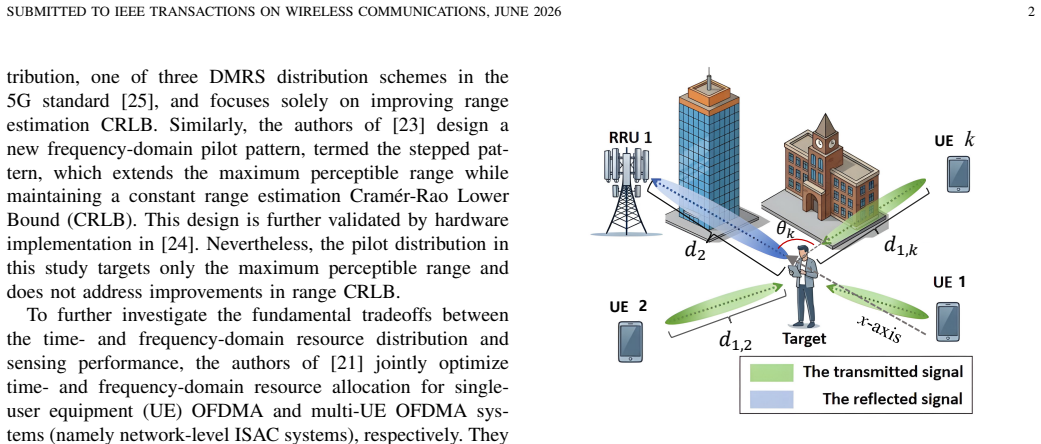
Summary. The paper proposes a two-stage framework for allocating time-frequency resources among distributed OFDMA transceivers in a network-level ISAC system, with the goal of minimizing the CRLB of target position estimation. For the two-transmitter case, Proposition 1 gives a closed-form optimal allocation of frequency apertures (variance of subcarrier indices) under a total variance budget; this part is a standard convex optimization result. For the multi-transmitter case, the paper uses an asymptotic law-of-large-numbers argument to claim that the gradient of the expected CRLB has a fixed direction, and then states Proposition 3, asserting that allocating aperture proportions along this gradient minimizes the expected CRLB. The authors call this 'geometric water-filling.' They then formulate the discrete subcarrier assignment as an NP-hard integer partitioning problem and propose the Variance-Guided Partitioning Algorithm (VGPA), a two-stage heuristic combining variance-guided initialization with Metropolis-based local search. Numerical simulations compare VGPA against random and uniform allocation in two-UE, multi-UE, Gaussian-mixture, and street-canyon scenarios.
Significance. If the multi-transmitter optimality claim were correct, the geometric water-filling principle would be a genuinely useful design insight for network-level ISAC, and the paper would make a strong theoretical contribution. The two-UE closed-form result is clean and appears correct given the stated CRLB model; it is a worthwhile contribution. The proposed VGPA is low-complexity and the numerical comparisons suggest that it can outperform geometry-agnostic baselines. However, the central multi-transmitter theorem is not established: the asymptotic derivation uses mathematically invalid expectation approximations, and the inference from a fixed gradient direction to proportional allocation is a non sequitur. As a result, the paper's headline claim of optimal resource allocation is not supported. The numerical evaluation of VGPA is also circular in that the algorithm is constructed to enforce the very ratios that Proposition 3 claims to be optimal. The practical heuristic may still be useful, but the paper as submitted does not provide a sound theoretical foundation for it.
major comments (4)
- [§III-C.2, Eq. (38), Proposition 3] The inference from a fixed gradient direction to proportional allocation is invalid. If ∇E[CRLB] = c·h with h constant, then the objective is, to first order, linear in the aperture vector. Under a linear budget constraint Σ N_k σ²_k ≤ E_total, the constrained minimizer of a linear function is an extreme point (put the entire budget into the most sensitive coordinate, subject to bounds), not the proportional interior point σ² ∝ h. The two-UE solution in Appendix A, Eq. (46), satisfies σ²_1/σ²_2 = sqrt(Γ₁N₂/(Γ₂N₁)), which is not proportional to the gradient of CRLB. Thus Proposition 3 is not merely unproved; it is false as stated. No proof or appendix is provided for it.
- [§III-C.1, Eq. (26)] Equation (26) replaces E[(A−B)/(ρ C)] with (E[A]−E[B])/(ρ E[C]), where A = ∂g₁/∂v_k · g₂, B = g₁·∂g₂/∂v_k, and C = g₂². This is mathematically invalid unless strong higher-order moment and correlation conditions are established, which the paper does not do. Chebyshev's LLN does not justify replacing the expectation of a ratio by the ratio of expectations. Every subsequent expression, including the non-positive derivative in Proposition 2 and the fixed gradient in Eq. (38), inherits this error. Eq. (37) is therefore not the derivative of the true expected CRLB.
- [§III-C.1, Eqs. (27)-(31)] The factorization leading to Eqs. (27) and (28) is not justified. For example, E[f(k,k′)(f(k,k′)−f(k′,k)) v_k v_k′] is rewritten as E[f(k,k′)(f(k,k′)−f(k′,k))] E[v_k v_k′], which requires independence between the angular terms and the distance-dependent terms v_k, v_k′; the paper only assumes a joint PDF p(θ,d), not independence. Moreover, θ_{k1} is sometimes treated as a deterministic index (e.g., Eqs. (29)-(33)) and sometimes as random (as in the stated expectation over geometry). The quantity E[∂CRLB/∂σ²_{k1}] is not well-defined under the current notation.
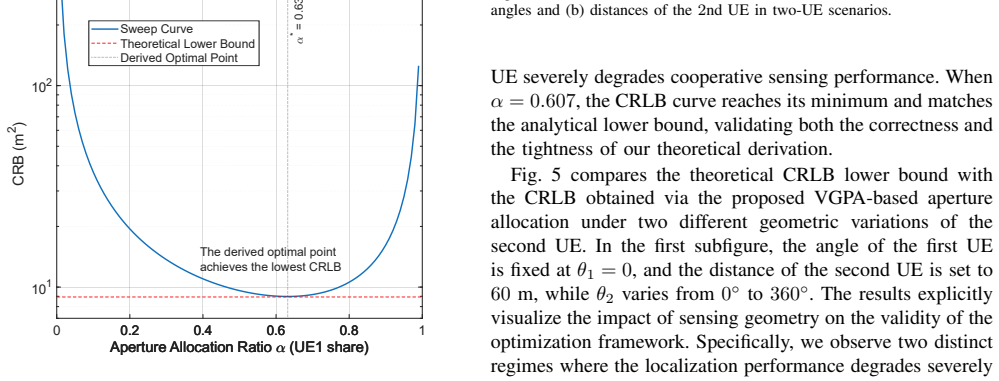
- [§V, Figs. 6-9] The numerical evaluation does not test the optimality claim. VGPA is explicitly constructed to match the GWF ratios: Algorithm 1 uses the variance ratios α from the geometric water-filling strategy and Eq. (40) projects the partition onto those ratios. Comparing VGPA against random and uniform allocation therefore only shows that this particular heuristic beats those baselines; it does not validate Proposition 3. The abstract's claim that the scheme 'approaches the theoretical performance lower bound' is supported only in the two-UE simulations (Fig. 5); no comparable multi-UE lower-bound comparison is presented.
minor comments (5)
- [Eq. (12)] The definition of E_total is badly typeset: the expression 'NX n=1 ... NX m=1' is garbled, making the summation range and the variance definition unclear. Please correct the notation.
- [§III-B, after Eq. (13)] The text says 'we first optimize the objective with respect to σ²_1 and σ²_1'; the second variable should be σ²_2.
- [§IV-A] Typo: 'the minimized communication rate of each UE shuld be satisfied' should be 'should'.
- [§V, paragraph before Fig. 7] The text refers to 'Fig. 6(a)' and 'Fig. 6(b)' when discussing the results shown in Fig. 7. Please renumber the cross-references.
- [Fig. 4] The figure annotation appears to give α* = 0.632 while the text reports α = 0.607. Please reconcile the values.
Circularity Check
No significant circularity; the core two-UE derivation is self-contained, while the multi-UE optimality gap is a rigor issue, not a circular reduction.
full rationale
The two-transmitter result is derived rather than assumed: the FIM in (3) is co-cited to [11] and external [33], eq. (11) expands CRLB=Tr(F_N^{-1}), and Appendix A solves the Lagrange problem (42)-(48) to obtain the closed forms (15)-(16). No parameters are fitted and the constrained minimizer is obtained from stationarity, so this part is self-contained. The multi-transmitter chain is where the paper is weak, but the weakness is not circularity. Eq. (26) approximates E[A/B] by E[A]/E[B], and the move from a 'fixed' gradient direction (38) to Proposition 3 (proportional allocation minimizes the expected CRLB) is asserted rather than derived from KKT/boundary conditions; in fact a fixed gradient direction alone does not imply that the constrained minimizer is the proportional interior point. That is a mathematical non-sequitur / omitted proof, not an output equivalent to its input by construction. Same-group prior work [11],[21] supplies the FIM/aperture-variance model, but the FIM is independently cited to [33] and the variance-budget identity is elementary; there is no uniqueness theorem or unverified ansatz chain that forces the result by self-citation. The only mild tautology is in the evaluation: VGPA's objective (39)/(41) explicitly penalizes deviation from the target ratios alpha, so Fig. 7(a) showing that the achieved ratios track alpha mainly confirms that the optimizer enforces its own constraint, not that Proposition 3 is globally true. This weakens the validation but is not a circular step in the derivation. Overall: no significant circularity; score 2 reflects the same-group model citations and the validation tautology, not a reduction of the central claim to its inputs.
Assumptions & free parameters
assumptions (6)
- domain assumption The FIM in (3) is F_N = ρ Σ_k d_{1,k}^{-β} d_2^{-β} σ_k^2 [a_k², a_k b_k; a_k b_k, b_k²], i.e., sensing information scales linearly with the variance of allocated subcarrier indices.
- domain assumption Delay and Doppler estimation are mathematically isomorphic, so time-aperture optimization is structurally identical to frequency-aperture optimization.
- domain assumption For K>2, UE angles/distances are i.i.d. draws from a fixed joint PDF p(θ,d), and sums can be replaced by expectations via Chebyshev's law of large numbers.
- ad hoc to paper Angles are uniformly distributed over [0,2π) and independent of distances in the closed-form gradient example.
- standard math Metropolis refinement with a sufficiently slow cooling schedule converges to the global optimum with probability one.
- domain assumption The variance budget constraint N₁σ₁²+N₂σ₂²≤E_total and the total-variance decomposition (51)-(52) hold with subset means aligned to the global mean.
Cite this review
Pith. "Pith review of Geometry-Aware Resource Allocation for Network-Level ISAC Systems." pith.science (2026). https://pith.science/paper/FXMMG5Q7
@misc{pith2026260729060,
  author       = {Pith},
  title        = {Pith review of: Geometry-Aware Resource Allocation for Network-Level ISAC Systems},
  year         = {2026},
  howpublished = {\url{https://pith.science/paper/FXMMG5Q7}},
  note         = {Machine review of arXiv:2607.29060}
}
read the original abstract
Network-level integrated sensing and communication (ISAC) is recognized as a transformative technology for next-generation mobile radio systems. By enabling collaboration among multiple transceivers, network-level ISAC can significantly enhance both communication and sensing performance through spatial diversity. However, existing resource allocation strategies typically overlook the impact of spatial geometry, where identical time-frequency resources contribute differently to sensing accuracy depending on the transceiver's location. This leaves the fundamental coupling between spatial topology and resource efficacy unclear, rendering optimal resource allocation a critical challenge for unlocking the full potential of network-level ISAC.To address this challenge, this paper investigates the optimal distribution of time-frequency resources across spatially distributed transceivers through a theoretically grounded two-stage framework. First, we analytically derive the optimal time and frequency aperture distributions for sensing, defined as the variances of the allocated symbol and subcarrier indices, respectively, under both two-transmitter and multi-transmitter scenarios. By exploiting the mathematical isomorphism between delay and Doppler estimation, we prove that the optimal resource allocation strategy follows the gradient direction of the Cramer-Rao Lower Bound (CRLB) with respect to the apertures. Second, to bridge the gap between theoretical aperture values and practical OFDMA constraints, such as the minimized communication rate of each user equipment (UE), we formulate the resource allocation as a combinatorial integer partitioning problem. To tackle the NP-hard nature of the formulated problem, a low-complexity Variance-Guided Partitioning Algorithm (VGPA) is proposed to jointly optimize the subcarrier and symbol patterns for communication and sensing.
Figures


Figures from the paper (4 more)


Reference graph
Works this paper leans on
-
[21]
On the fundamental trade-offs of time-frequency resource distribution in OFDMA ISAC,
X.-Y . Wang, S. Yang, K. Meng, H.-Y . Zhai, and C. Masouros, “On the fundamental trade-offs of time-frequency resource distribution in OFDMA ISAC,” 2024. [Online]. Available: https://arxiv.org/abs/2407. 12628
2024
-
[1]
An overview of signal processing techniques for joint communication and radar sensing,
J. A. Zhang, F. Liu, C. Masouros, R. W. Heath, Z. Feng, L. Zheng, and A. Petropulu, “An overview of signal processing techniques for joint communication and radar sensing,”IEEE Journal of Selected Topics in Signal Processing, vol. 15, no. 6, pp. 1295–1315, Nov. 2021
2021
-
[2]
Toward multi- functional 6G wireless networks: Integrating sensing, communication, and security,
Z. Wei, F. Liu, C. Masouros, N. Su, and A. P. Petropulu, “Toward multi- functional 6G wireless networks: Integrating sensing, communication, and security,”IEEE Communications Magazine, vol. 60, no. 4, pp. 65– 71, Apr. 2022
2022
-
[3]
Integrated sensing and communication channel: Measurements, char- acteristics, and modeling,
J. Zhang, J. Wang, Y . Zhang, Y . Liu, Z. Chai, G. Liu, and T. Jiang, “Integrated sensing and communication channel: Measurements, char- acteristics, and modeling,”IEEE Communications Magazine, vol. 62, no. 6, pp. 98–104, Jun. 2024
2024
-
[4]
Joint radar and communication design: Applications, state-of-the-art, and the road ahead,
F. Liu, C. Masouros, A. P. Petropulu, H. Griffiths, and L. Hanzo, “Joint radar and communication design: Applications, state-of-the-art, and the road ahead,”IEEE Transactions on Communications, vol. 68, no. 6, pp. 3834–3862, Jun. 2020
2020
-
[5]
WiIID: Wi-Fi based intelligent indoor intrusion detection with tensor decomposition,
Y .-R. Duan, S. Yang, H.-Y . Zhai, X.-Y . Wang, J.-S. Tan, Y .-S. Luo, and S. Chen, “WiIID: Wi-Fi based intelligent indoor intrusion detection with tensor decomposition,”IEEE Wireless Communications Letters, pp. 1–1, Oct. 2025, early access
2025
-
[6]
Joint multi- user communication and sensing exploiting both signal and environment sparsity,
X. Tong, Z. Zhang, J. Wang, C. Huang, and M. Debbah, “Joint multi- user communication and sensing exploiting both signal and environment sparsity,”IEEE Journal of Selected Topics in Signal Processing, vol. 15, no. 6, pp. 1409–1422, Nov. 2021
2021
-
[7]
Joint localization and environment sensing by harnessing NLOS components in RIS-aided mmwave communication systems,
Y . Huang, J. Yang, W. Tang, C.-K. Wen, S. Xia, and S. Jin, “Joint localization and environment sensing by harnessing NLOS components in RIS-aided mmwave communication systems,”IEEE Transactions on Wireless Communications, vol. 22, no. 12, pp. 8797–8813, Dec. 2023
2023
Show all 39 references
-
[8]
An overview of cellular ISAC for low-altitude UA V: New opportunities and challenges,
Y . Song, Y . Zeng, Y . Yang, Z. Ren, G. Cheng, X. Xu, J. Xu, S. Jin, and R. Zhang, “An overview of cellular ISAC for low-altitude UA V: New opportunities and challenges,”IEEE Communications Magazine, pp. 1–8, Jul. 2025, early access
2025
-
[9]
Cooperative ISAC networks: Opportunities and challenges,
K. Meng, C. Masouros, A. P. Petropulu, and L. Hanzo, “Cooperative ISAC networks: Opportunities and challenges,”IEEE Wireless Commu- nications, vol. 32, no. 3, pp. 212–219, Jun. 2025
2025
-
[10]
Network-level ISAC design: State-of-the-art, challenges, and opportunities,
K. Han, K. Meng, X.-Y . Wang, and C. Masouros, “Network-level ISAC design: State-of-the-art, challenges, and opportunities,”IEEE Journal of Selected Topics in Electromagnetics, Antennas and Propagation, vol. 1, no. 1, pp. 65–83, Sep. 2025
2025
-
[11]
Cooperative ISAC networks: Performance analysis, scaling laws, and optimization,
K. Meng, C. Masouros, A. P. Petropulu, and L. Hanzo, “Cooperative ISAC networks: Performance analysis, scaling laws, and optimization,” IEEE Transactions on Wireless Communications, vol. 24, no. 2, pp. 877– 892, Feb. 2025
2025
-
[12]
Integrated sensing and commu- nication: A network level perspective,
Y . Cui, H. Ding, L. Zhao, and J. An, “Integrated sensing and commu- nication: A network level perspective,”IEEE Wireless Communications, vol. 31, no. 1, pp. 103–109, Feb. 2024
2024
-
[13]
High-performance low-complexity hierarchical frequency synchroniza- tion for distributed massive MIMO-OFDMA systems,
X.-Y . Wang, S. Yang, T.-H. Yuan, H.-Y . Zhai, J. Zhang, and L. Hanzo, “High-performance low-complexity hierarchical frequency synchroniza- tion for distributed massive MIMO-OFDMA systems,”IEEE Transac- tions on Vehicular Technology, vol. 72, no. 9, pp. 12 343–12 348, Sep. 2023
2023
-
[14]
Clutter sup- pression, parameter association, and time-frequency synchronization for ranging and velocity estimation in perceptive vehicular networks,
X.-Y . Wang, S. Yang, J. Zhang, C. Masouros, and P. Zhang, “Clutter sup- pression, parameter association, and time-frequency synchronization for ranging and velocity estimation in perceptive vehicular networks,”IEEE Journal on Selected Areas in Communications, Apr. 2024, accepted
2024
-
[15]
Network-level inte- grated sensing and communication: Interference management and BS coordination using stochastic geometry,
K. Meng, C. Masouros, G. Chen, and F. Liu, “Network-level inte- grated sensing and communication: Interference management and BS coordination using stochastic geometry,”IEEE Transactions on Wireless Communications, vol. 23, no. 12, pp. 19 365–19 381, Dec. 2024
2024
-
[16]
Hybrid CSI-based hierarchical beamforming for flexible duplex MIMO systems,
H.-Y . Zhai, S. Yang, T.-H. Yuan, X.-Y . Wang, J.-S. Tan, and S. Chen, “Hybrid CSI-based hierarchical beamforming for flexible duplex MIMO systems,”IEEE Transactions on Vehicular Technology, pp. 1–6, Jul. 2025, early access
2025
-
[17]
Cooperative coherent multistatic imaging and phase synchronization in networked sensing,
D. Tagliaferri, M. Manzoni, M. Mizmizi, S. Tebaldini, A. Virgilio Monti- Guarnieri, C. Maria Prati, and U. Spagnolini, “Cooperative coherent multistatic imaging and phase synchronization in networked sensing,” IEEE Journal on Selected Areas in Communications, vol. 42, no. 10, ...
2024
-
[18]
Deep cooperation in ISAC system: Resource, node and infrastructure perspectives,
Z. Wei, H. Liu, Z. Feng, H. Wu, F. Liu, Q. Zhang, and Y . Du, “Deep cooperation in ISAC system: Resource, node and infrastructure perspectives,”IEEE Internet of Things Magazine, vol. 7, no. 6, pp. 118– 125, Nov. 2024
2024
-
[19]
Network-level ISAC: An analytical study of antenna topologies ranging from massive to cell- free MIMO,
K. Meng, K. Han, C. Masouros, and L. Hanzo, “Network-level ISAC: An analytical study of antenna topologies ranging from massive to cell- free MIMO,”IEEE Transactions on Wireless Communications, 2025, early access
2025
-
[20]
Interference mitigation for network-level ISAC: An optimization perspective,
D. Xu, Y . Xu, X. Zhang, X. Yu, S. Song, and R. Schober, “Interference mitigation for network-level ISAC: An optimization perspective,”IEEE Communications Magazine, vol. 62, no. 9, pp. 28–34, Sep. 2024
2024
-
[22]
Resource optimization for delay estimation in perceptive mobile networks,
Y . Hu, W. Deng, J. A. Zhang, and Y . J. Guo, “Resource optimization for delay estimation in perceptive mobile networks,”IEEE Wireless Communications Letters, vol. 13, no. 1, pp. 223–227, Jan. 2024
2024
-
[23]
OFDM pilot- based radar for joint vehicular communication and radar systems,
C. D. Ozkaptan, E. Ekici, O. Altintas, and C.-H. Wang, “OFDM pilot- based radar for joint vehicular communication and radar systems,” in 2018 IEEE Vehicular Networking Conference (VNC), Taipei, Taiwan, Dec. 2018, pp. 1–8
2018
-
[24]
Demo: A software-defined OFDM radar for joint automotive radar and communication systems,
C. D. Ozkaptan, E. Ekici, and O. Altintas, “Demo: A software-defined OFDM radar for joint automotive radar and communication systems,” in2019 IEEE Vehicular Networking Conference (VNC), Los Angeles, USA, Dec. 2019, pp. 1–2
2019
-
[25]
Physical layer procedures for data,
3GPP, “Physical layer procedures for data,” 3rd Generation Partnership Project, TS 38.214 V18.1.0, Dec. 2023
2023
-
[26]
Target localization accuracy gain in MIMO radar-based systems,
H. Godrich, A. M. Haimovich, and R. S. Blum, “Target localization accuracy gain in MIMO radar-based systems,”IEEE Transactions on Information Theory, vol. 56, no. 6, pp. 2783–2803, Jun. 2010
2010
-
[27]
Maximum likelihood angle estimation for signals with known waveforms,
J. Li and R. Compton, “Maximum likelihood angle estimation for signals with known waveforms,”IEEE Transactions on Signal Processing, vol. 41, no. 9, pp. 2850–2862, Sep. 1993
1993
-
[28]
Framework for a perceptive mobile network using joint communication and radar sensing,
M. L. Rahman, J. A. Zhang, X. Huang, Y . J. Guo, and R. W. Heath, “Framework for a perceptive mobile network using joint communication and radar sensing,”IEEE Transactions on Aerospace and Electronic Systems, vol. 56, no. 3, pp. 1926–1941, Sep. 2019
1926
-
[29]
Enabling joint communication and radar sensing in mobile networks-a survey,
J. A. Zhang, M. L. Rahman, K. Wu, X. Huang, Y . J. Guo, S. Chen, and J. Yuan, “Enabling joint communication and radar sensing in mobile networks-a survey,”IEEE Communications Surveys & Tutorials, vol. 24, no. 1, pp. 306–345, First quarter. 2021
2021
-
[30]
ISAC super-resolution receiver via lifted atomic norm minimization,
I. Valiulahi, C. Masouros, and A. P. Petropulu, “ISAC super-resolution receiver via lifted atomic norm minimization,” 2024. [Online]. Available: https://arxiv.org/abs/2411.09495
2024 arXiv
-
[31]
ISAC receiver design: Joint doa and data estimation in the presence of incomplete signal observations,
I. Valiulahi, C. Masouros, M. Alaaeldin, and E. Alsusa, “ISAC receiver design: Joint doa and data estimation in the presence of incomplete signal observations,”IEEE Open Journal of Vehicular Technology, vol. 6, pp. 846–852, 2025
2025
-
[32]
Windowing optimization for fingerprint-spectrum-based passive sensing in perceptive mobile networks,
X.-Y . Wang, S. Yang, H.-Y . Zhai, C. Masouros, and J. Andrew Zhang, “Windowing optimization for fingerprint-spectrum-based passive sensing in perceptive mobile networks,”IEEE Transactions on Communications, vol. 73, no. 2, pp. 1367–1382, Feb. 2025
2025
-
[33]
Target localization geometry gain in distributed MIMO radar,
M. Sadeghi, F. Behnia, R. Amiri, and A. Farina, “Target localization geometry gain in distributed MIMO radar,”IEEE Transactions on Signal Processing, vol. 69, pp. 1642–1652, Feb. 2021
2021
-
[34]
Super-resolution range and velocity estimations with OFDM integrated radar and communications waveform,
Y . Liu, G. Liao, Y . Chen, J. Xu, and Y . Yin, “Super-resolution range and velocity estimations with OFDM integrated radar and communications waveform,”IEEE Transactions on Vehicular Technology, vol. 69, no. 10, pp. 11 659–11 672, Oct. 2020
2020
-
[35]
Boyd and L
S. Boyd and L. Vandenberghe,Convex optimization. Cambridge university press, 2004
2004
-
[36]
D. P. Bertsekas,Constrained optimization and Lagrange multiplier methods. Academic press, 2014
2014
-
[37]
R ´ev´esz,The laws of large numbers
P. R ´ev´esz,The laws of large numbers. Academic Press, 2014, vol. 4
2014
-
[38]
Stochastic relaxation, gibbs distributions, and the bayesian restoration of images,
S. Geman and D. Geman, “Stochastic relaxation, gibbs distributions, and the bayesian restoration of images,”IEEE Transactions on Pattern Analysis and Machine Intelligence, vol. PAMI-6, no. 6, pp. 721–741, Nov 1984
1984
-
[39]
Henry,The analysis of variance
S. Henry,The analysis of variance. John Wiley & Sons, 1999, vol. 72
1999
Reviewed August 3, 2026 · model on record in the stance chip above.
Discussion (0). Continue with ORCID to comment.