REVIEW 3 major objections 4 minor 62 references
Potential-defect-driven collective modes of one-dimensional two-component quantum droplets
T0 review · 3 major / 4 minor · reviewed 2026-08-03 · deepseek-v4-flash
Pith's one-line read A central repulsive barrier drives a one-dimensional binary quantum droplet through a polarization transition at a critical atom number, and the excitation spectrum exposes the switch as a discontinuity and six near-zero modes.
desk verdict A conventional but useful droplet-defect study whose headlined result is stated backwards in the abstract and conclusion, and whose ground-state transition lacks an energy comparison. read the letter →
The pith
A machine-rendered reading of the paper's core claim, the machinery that carries it, and where it could break.
The reading
What carries the argument
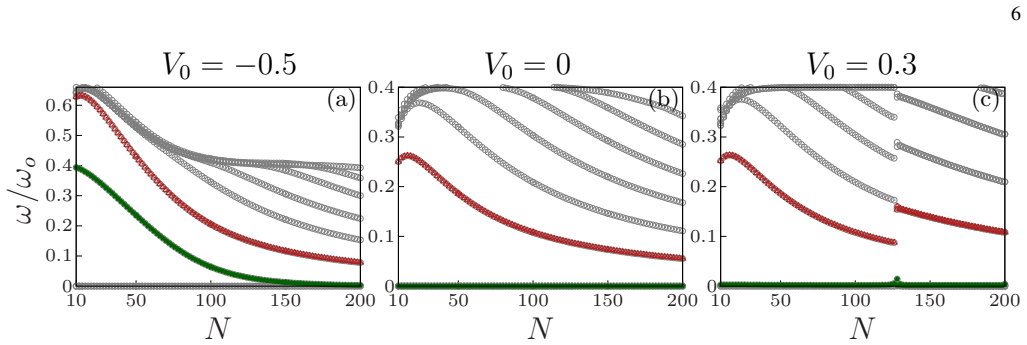
The key machinery is the extended Gross-Pitaevskii equation (eGPE) with the exact one-dimensional Lee-Huang-Yang correction, solved by imaginary-time propagation, and linearized through Bogoliubov-de Gennes (BdG) equations on a basis of 200 harmonic-oscillator states. The central diagnostic is the population imbalance I = (NL - NR)/(NL + NR), which acts as the order parameter: it jumps from 1 (polarized) to 0 (unpolarized) at Ncr. The spectral signatures — softening of the dipole mode, a discontinuity in mode frequencies, and the clustering of six modes near zero — connect the ground-state transition to observable collective dynamics.
What would settle it
Directly compare the energies of the polarized and symmetric stationary states for N around 126 at g12 = -0.9, V0 = 0.3, sigma = 1, lambda = 0; if the symmetric state has lower energy below 126, the claimed transition is a solver artifact. A second check is to scan N upward and downward for hysteresis: a genuine ground-state transition should reproduce Ncr from both directions, while a metastable branch would jump at different N depending on the direction.
Extended reading notes
Core claim
On the paper's own terms, the discovery is that the competition between barrier-induced localization and interaction-driven delocalization produces a sharp ground-state transition in a one-dimensional two-component quantum droplet. Below a critical atom number Ncr (126 for g12 = -0.9, V0 = 0.3, sigma = 1, lambda = 0), the LHY-stabilized droplet is fully polarized in one well of the double-well potential, with population imbalance |I| = 1. At Ncr it discontinuously rearranges into an unpolarized state with equal occupation of both wells (I = 0). The transition is not only static: the Bogoliubov-de Gennes quasiparticle spectrum shows a discontinuity at Ncr, and the unpolarized phase supports u
Load-bearing premise
The load-bearing premise is that imaginary-time propagation from random and mixed-symmetry initial states converges to the global energy minimum at every atom number, so the polarized branch below Ncr is the true ground state rather than a metastable artifact of the solver.
Editorial extensions
If this is right
- If the transition is real, a 1D two-component droplet in a double-well trap is a clean model system for an atom-number-driven symmetry-breaking transition, with Ncr as a tunable control parameter.
- The six near-zero modes predicted in the unpolarized phase imply slow inter-well dynamics, including Josephson-type oscillations and coupled dipole excitations, that could be seen in real-time imaging of droplet mixtures.
- The softening of the dipole mode with increasing N, and as the defect is tuned from attractive to zero, provides a measurable precursor of the transition and of the restoration of translational invariance.
- The quench protocols — breathing for weak quenches, filaments and fragmentation for strong quenches — offer experimental routes to controllably create localized fragments or multi-droplet arrays.
- The discontinuity in the quasiparticle spectrum at Ncr gives an observable, frequency-domain marker of the ground-state switch, complementary to density-imaging measurements of population imbalance.
Reading between the lines
- Editorial: The stated direction of the Ncr(g12) trend is internally inconsistent: the abstract and conclusion say stronger attraction lowers Ncr, while Sec. III and the Fig. 2 caption say weaker attraction lowers Ncr. The figure as drawn appears to follow the body's version; the discrepancy is unresolved in the text.
- Editorial: Because no energy comparison between the polarized and symmetric stationary states is shown, and no hysteresis scan is reported, the transition boundary Ncr(g12) should be read as a property of the solver's converged state rather than a proven ground-state phase boundary.
- Editorial: The six near-zero modes depend on a BdG basis of 200 oscillator states with no reported convergence test; checking against larger bases or against real-time evolution spectra would confirm they are physical rather than numerical.
- Editorial: A natural extension is to map Ncr as a function of barrier height V0 and width sigma, and to compare the predicted spectral discontinuity with sum-rule or many-body estimates for the 1D Bose mixture.
Editorial analysis
A structured set of objections, weighed in public.
Referee Report
Summary. The paper studies a one-dimensional two-component Bose-Bose quantum droplet in a harmonic trap with a localized Gaussian defect, using the extended Gross-Pitaevskii equation with the exact LHY correction and Bogoliubov–de Gennes theory. It reports a polarization transition as a function of atom number in the presence of a repulsive central barrier: for N < N_cr the ground state is fully polarized (the droplet lies in one well), while for N >= N_cr it becomes symmetric. The transition is claimed to appear as a discontinuity and softening of the low-lying collective spectrum, with up to six near-zero modes in the unpolarized regime. The paper also studies the dependence of N_cr on the intercomponent attraction, the role of harmonic confinement, and the real-time dynamics after quenches of the interaction and of the defect strength.
Significance. If the reported transition is a genuine ground-state property, the paper would add a useful example of how a localized defect controls droplet self-binding, polarization, and collective excitations. The theoretical framework is standard and imported from established references (Petrov 2015; Ilg et al. 2018; Mistakidis et al. 2023), and the paper computes outputs rather than fitting parameters. The main claims are falsifiable by direct numerical energy comparison and by experiments with tunable barriers. However, the manuscript currently contains a direct internal contradiction about the direction of the N_cr(g12) trend, and the central ground-state transition is not verified against metastability or basis-convergence artifacts. These issues are load-bearing for the main phase-diagram claim.
major comments (3)
- [Abstract; Sec. III.A; Sec. IV (Conclusions)] The abstract states that "the critical number of atoms for the transition decreases as the attractive intercomponent interaction increases" (i.e., stronger attraction -> smaller N_cr), and the Conclusions state that "the unpolarized state becomes energetically favourable at a smaller number of atoms for larger intercomponent interactions." In direct opposition, Sec. III.A (text near Fig. 2) states "with less attractive g12, N_cr decreases," and the discussion says "with less attractive g12, N_cr decreases... attributed to the attraction that inhibits the transition." The body and Fig. 2 therefore claim weaker attraction -> smaller N_cr. Both cannot be correct. This is a central claim of the paper, not a minor typo, because the abstract and conclusions advertise the opposite trend from the main figure.
- [Sec. III, opening; Sec. III.A; Fig. 2] The ground state is found by imaginary-time propagation starting from "a random initial state and a superposition of symmetric and asymmetric functions." For a first-order-like transition, both the polarized (N < N_cr) and symmetric (N >= N_cr) solutions can be local minima of the eGPE energy functional. The paper does not compare the energies of these two candidate states, nor does it perform a hysteresis scan (e.g., sweeping N upward and downward while seeding with the previous solution). Thus N_cr = 126 at g12 = -0.9 is not established as a genuine ground-state transition; it may reflect the point where the solver's basin of attraction changes. This concern is load-bearing for the phase diagram and the interpretation of the BdG discontinuity in Fig. 5(c). A direct E_polarized(N) vs. E_symmetric(N) comparison and a hysteresis test should be reported.
- [Sec. III, opening; Sec. III.B; Figs. 5-6] The Bogoliubov–de Gennes matrix is diagonalized in a basis of only 200 harmonic-oscillator states, with no convergence test as a function of basis size. The central spectral claims include up to six modes clustered near zero energy and a spectral discontinuity at the transition. If the basis is insufficient for the broad, flat-top droplets at large N or for the strongly localized fragments in a double well, the near-zero modes could be numerical artifacts. The authors should report a convergence check for at least a few representative points, e.g., N = 150 and N = 200 at V0 = 0.3 and V0 = -0.5, with larger bases (300-500 states) and possibly a spatial-grid check.
minor comments (4)
- [Fig. 1(a) caption and text] The caption labels the V0 = -0.5 case as an "attractive barrier." A negative V0 is a potential well/dimple, not a barrier. Please use consistent terminology.
- [Fig. 2 inset] The inset axis labels are unclear: the horizontal axis is presumably N and the vertical axis is |I|, but no axis titles are shown. Also the jump from |I| = 1 to 0 at N around 126 would be easier to assess with a marker or a vertical dashed line.
- [Sec. III.B, Fig. 5(c) discussion] The text says that for small N the dipole mode "possesses a small finite energy, which overlaps with zero-energy modes." It would help to state explicitly in the figure or text that the green star at small N is not exactly zero, since the legend otherwise appears to show a zero-energy branch.
- [Sec. III.B, mode counting] The text says the unpolarized state has six modes clustered around zero, but the list in Sec. III.B mentions two U(1) modes and four low-lying modes (i-iv). That totals six, yet the subsequent sentence says "consists of six modes clustered around zero" and then "in addition, two nearly degenerate breathing modes emerge." Please clarify whether the six include the breathing pair or are only the symmetry-related modes.
Circularity Check
No significant circularity; computation is self-contained from established eGPE and BdG formalism.
full rationale
The paper's central derivation is self-contained: the extended Gross-Pitaevskii equation with the exact 1D LHY correction (Eq. 5) is adopted from independent references (Petrov 2015; Ilg et al. 2018; Mistakidis et al. 2023), and the full LHY functional form is quoted. The reported results—N_cr=126, the polarization transition, excitation frequencies, and dynamics—are computed outputs of imaginary-time propagation and Bogoliubov–de Gennes diagonalization, not fitted parameters. No quantity in the final predictions is defined in terms of another reported prediction; the population imbalance (Eq. 9) is a diagnostic of the computed density. The Bogoliubov spectrum is derived by linearizing the same equations with no adjustable constants. The only self-citation, Ref. [39] (a prior paper by the authors on Gaussian-barrier droplets), is cited alongside Refs. [29,30] simply as a geometry using a localized Gaussian barrier; it does not supply the model, a uniqueness theorem, an ansatz, or any fitted value, so it is not load-bearing. There is a non-circular inconsistency worth noting: the abstract and Sec. IV say N_cr decreases with stronger attraction, while Sec. III.A says 'with less attractive g12, N_cr decreases.' Also, the ground-state search may converge to a metastable polarized branch rather than the global minimum, but that is a numerical correctness concern, not a circular derivation.
Assumptions & free parameters
free parameters (5)
- g (dimensionless intracomponent interaction) =
1
- g12 (dimensionless intercomponent attraction) =
-0.9 (varied from about -0.9 to -0.55 in Fig. 2)
- V0 (defect strength) =
0.3 (barrier); -0.5 (well); 1.0 in Fig. 7 inset
- sigma (Gaussian defect width) =
1.0 a_osc; 0.1-1.3 in Fig. 4 inset
- lambda (axial harmonic trap strength) =
0 for most results; 0-0.2 in Fig. 7
assumptions (5)
- domain assumption The extended Gross-Pitaevskii energy functional (multicomponent GP + exact 1D LHY correction) describes the droplet ground state and low-energy dynamics.
- domain assumption Bogoliubov linearization: fluctuations around the stationary ground state are small, and the BdG spectrum (Eqs. 7-8) captures the low-lying collective modes.
- ad hoc to paper The ground state found by imaginary-time propagation from random and symmetric/asymmetric initial states is the global energy minimum for every N.
- ad hoc to paper The 200 harmonic-oscillator-state basis is sufficient for the BdG diagonalization, and the spatial grid for the eGPE is converged.
- standard math U(1) gauge symmetry and translational invariance imply the zero-energy Goldstone modes identified in Figs. 4-5.
Cite this review
Pith. "Pith review of Potential-defect-driven collective modes of one-dimensional two-component quantum droplets." pith.science (2026). https://pith.science/paper/C2SEQXCR
@misc{pith2026260729292,
  author       = {Pith},
  title        = {Pith review of: Potential-defect-driven collective modes of one-dimensional two-component quantum droplets},
  year         = {2026},
  howpublished = {\url{https://pith.science/paper/C2SEQXCR}},
  note         = {Machine review of arXiv:2607.29292}
}
read the original abstract
We examine a one-dimensional binary mixture of ultradilute quantum droplets in the presence of a central potential defect. The properties of the potential strength and the number of atoms exhibit distinct polarization transitions and low-lying ollective excitation spectra. The balance of (attractive) Lee-Huang-Yang quantum fluctuations and repulsive mean-field interactions results in a self-bound quantum droplet in a potential well. However, the potential barrier causes the polarization transition with the number of atoms, which is reflected in the excitation spectrum as a discontinuity and softening of the quasiparticle modes. We reveal that the critical number of atoms for the transition decreases as the attractive intercomponent interaction increases. Finally, the quench time dynamics of the interaction in potential barrier and well show the localization and diffusive fragmented droplets of two-component systems.
Figures


Figures from the paper (4 more)


Reference graph
Works this paper leans on
-
[1]
D. S. Petrov, Phys. Rev. Lett.115, 155302 (2015)
2015
-
[2]
It has recently been considered in recent studies of quantum droplets [26, 46] and mobile impurities [47]
The exact correction allows us to examine the collective modes away from the mean-field sta- bility regime. It has recently been considered in recent studies of quantum droplets [26, 46] and mobile impurities [47]. The Euler-Lagrange or Gross-Pitaevskii (GP) equations de- scribing the dynamics of the system are iℏ ∂ψi ∂t = " − ℏ2 2m ∂2 ∂x2 +V(x) +g ii|ψi|...
-
[3]
C. R. Cabrera, L. Tanzi, J. Sanz, B. Naylor, P. Thomas, P. Cheiney, and L. Tarruell, Science359, 301 (2018)
2018
-
[4]
Cheiney, C
P. Cheiney, C. R. Cabrera, J. Sanz, B. Naylor, L. Tanzi, and L. Tarruell, Phys. Rev. Lett.120, 135301 (2018)
2018
-
[5]
Ferioli, G
G. Ferioli, G. Semeghini, L. Masi, G. Giusti, G. Modugno, M. Inguscio, A. Gallemí, A. Recati, and M. Fattori, Phys. Rev. Lett.122, 090401 (2019)
2019
-
[6]
D’Errico, A
C. D’Errico, A. Burchianti, M. Prevedelli, L. Salasnich, F. An- cilotto, M. Modugno, F. Minardi, and C. Fort, Phys. Rev. Res. 1, 033155 (2019)
2019
-
[7]
Burchianti, C
A. Burchianti, C. D’Errico, M. Prevedelli, L. Salasnich, F. An- cilotto, M. Modugno, F. Minardi, and C. Fort, Condens. Matter 5, 21 (2020)
2020
-
[8]
Böttcher, J.-N
F. Böttcher, J.-N. Schmidt, J. Hertkorn, K. S. Ng, S. D. Graham, M. Guo, T. Langen, and T. Pfau, Rep. Prog. Phys.84, 012403 (2021)
2021
Show all 62 references
-
[9]
Chomaz, I
L. Chomaz, I. Ferrier-Barbut, F. Ferlaino, B. Laburthe-Tolra, B. L. Lev, and T. Pfau, Rep. Prog. Phys.86, 026401 (2023)
2023
-
[10]
Ferrier-Barbut, H
I. Ferrier-Barbut, H. Kadau, M. Schmitt, M. Wenzel, and T. Pfau, Phys. Rev. Lett.116, 215301 (2016)
2016
-
[11]
Schmitt, M
M. Schmitt, M. Wenzel, F. Böttcher, I. Ferrier-Barbut, and T. Pfau, Nature539, 259 (2016). 10
2016
-
[12]
Z.-H. Luo, W. Pang, B. Liu, Y .-Y . Li, and B. A. Malomed, Front. Phys.16, 32201 (2021)
2021
-
[13]
B. A. Malomed, Front. Phys.16, 22504 (2020)
2020
-
[14]
Wächtler and L
F. Wächtler and L. Santos, Phys. Rev. A94, 043618 (2016)
2016
-
[15]
T. D. Lee, K. Huang, and C. N. Yang, Phys. Rev.106, 1135 (1957)
1957
-
[16]
D. S. Petrov and G. E. Astrakharchik, Phys. Rev. Lett.117, 100401 (2016)
2016
-
[17]
T. Ilg, J. Kumlin, L. Santos, D. S. Petrov, and H. P. Büchler, Phys. Rev. A98, 051604 (2018)
2018
-
[18]
Chen and C.-L
C.-A. Chen and C.-L. Hung, Phys. Rev. Lett.127, 023604 (2021)
2021
-
[19]
Cappellaro, T
A. Cappellaro, T. Macrì, and L. Salasnich, Phys. Rev. A97, 053623 (2018)
2018
-
[20]
Semeghini, G
G. Semeghini, G. Ferioli, L. Masi, C. Mazzinghi, L. Wolswijk, F. Minardi, M. Modugno, G. Modugno, M. Inguscio, and M. Fattori, Phys. Rev. Lett.120, 235301 (2018)
2018
-
[21]
Tylutki, G
M. Tylutki, G. E. Astrakharchik, B. A. Malomed, and D. S. Petrov, Phys. Rev. A101, 051601(R) (2020)
2020
-
[22]
Stürmer, M
P. Stürmer, M. N. Tengstrand, R. Sachdeva, and S. M. Reimann, Phys. Rev. A103, 053302 (2021)
2021
-
[23]
Y . Fei, X. Du, X.-L. Chen, and Y . Zhang, Phys. Rev. A109, 053309 (2024)
2024
-
[24]
P. Zin, M. Pylak, and M. Gajda, New J. Phys.23, 033022 (2021)
2021
-
[25]
Baillie, R
D. Baillie, R. M. Wilson, R. N. Bisset, and P. B. Blakie, Phys. Rev. A94, 021602 (2016)
2016
-
[26]
Albiez, R
M. Albiez, R. Gati, J. Fölling, S. Hunsmann, M. Cristiani, and M. K. Oberthaler, Phys. Rev. Lett.95, 010402 (2005)
2005
-
[27]
I. A. Englezos, P. Schmelcher, and S. I. Mistakidis, SciPost Phys.19, 133 (2025)
2025
-
[28]
J. C. Pelayo, G. Bougas, T. Fogarty, T. Busch, and S. I. Mis- takidis, SciPost Phys.18, 129 (2025)
2025
-
[29]
Smerzi, S
A. Smerzi, S. Fantoni, S. Giovanazzi, and S. R. Shenoy, Phys. Rev. Lett.79, 4950 (1997)
1997
-
[30]
S. Levy, E. Lahoud, I. Shomroni, and J. Steinhauer, Nature449, 579 (2007)
2007
-
[31]
Y . Shin, M. Saba, T. A. Pasquini, W. Ketterle, D. E. Pritchard, and A. E. Leanhardt, Phys. Rev. Lett.92, 050405 (2004)
2004
-
[32]
Schumm, S
T. Schumm, S. Hofferberth, L. M. Andersson, S. Wildermuth, S. Groth, I. Bar-Joseph, J. Schmiedmayer, and P. Krüger, Nat. Phys.1, 57 (2005)
2005
-
[33]
Jo, J.-H
G.-B. Jo, J.-H. Choi, C. A. Christensen, T. A. Pasquini, Y .-R. Lee, W. Ketterle, and D. E. Pritchard, Phys. Rev. Lett.98, 180401 (2007)
2007
-
[34]
H. Uncu, D. Tarhan, E. Demiralp, and O. E. Müstecaplıo ˘glu, Phys. Rev. A76, 013618 (2007)
2007
-
[35]
M. C. Garrett, A. Ratnapala, E. D. van Ooijen, C. J. Vale, K. Weegink, S. K. Schnelle, O. Vainio, N. R. Heckenberg, H. Rubinsztein-Dunlop, and M. J. Davis, Phys. Rev. A83, 013630 (2011)
2011
-
[36]
Morsch and M
O. Morsch and M. Oberthaler, Rev. Mod. Phys.78, 179 (2006)
2006
-
[37]
Bloch, Nat
I. Bloch, Nat. Phys.1, 23 (2005)
2005
-
[38]
A. L. Gaunt, T. F. Schmidutz, I. Gotlibovych, R. P. Smith, and Z. Hadzibabic, Phys. Rev. Lett.110, 200406 (2013)
2013
-
[39]
Navon, A
N. Navon, A. L. Gaunt, R. P. Smith, and Z. Hadzibabic, Nature 539, 72 (2016)
2016
-
[40]
Kaur and K
H. Kaur and K. Suthar, J. Phys. B: At. Mol. Opt. Phys.58, 195301 (2025)
2025
-
[41]
Ramanathan, K
A. Ramanathan, K. C. Wright, S. R. Muniz, M. Zelan, W. T. Hill, C. J. Lobb, K. Helmerson, W. D. Phillips, and G. K. Campbell, Phys. Rev. Lett.106, 130401 (2011)
2011
-
[42]
Raghavan, A
S. Raghavan, A. Smerzi, S. Fantoni, and S. R. Shenoy, Phys. Rev. A59, 620 (1999)
1999
-
[43]
Cavicchioli, C
L. Cavicchioli, C. Fort, F. Ancilotto, M. Modugno, F. Minardi, and A. Burchianti, Phys. Rev. Lett.134, 093401 (2025)
2025
-
[44]
L. P. Pitaevskii and S. Stringari,Bose-Einstein Condensation and Superfluidity(Oxford University Press, 2016)
2016
-
[45]
H. Xiao, X. Zhang, J. Liu, X. Du, X.-L. Chen, and Y . Zhang, Phys. Rev. A113, 063301 (2026)
2026
-
[46]
Mistakidis, A
S. Mistakidis, A. V olosniev, R. Barfknecht, T. Fogarty, T. Busch, A. Foerster, P. Schmelcher, and N. Zinner, Phys. Rep. 1042, 1 (2023)
2023
-
[47]
Bristy, G
F. Bristy, G. A. Bougas, G. C. Katsimiga, and S. I. Mistakidis, Chaos Solit. Fractals201, 117383 (2025)
2025
-
[48]
Sinha, S
S. Sinha, S. Biswas, L. Santos, and S. Sinha, Phys. Rev. A108, 023311 (2023)
2023
-
[49]
N. N. Bogoliubov, J. Phys. (USSR)11, 23 (1947)
1947
-
[50]
A. L. Fetter, Ann. Phys.70, 67 (1972)
1972
-
[51]
D. S. Petrov, (2023), arXiv:2312.05336 [cond-mat.quant-gas]
2023 arXiv
-
[52]
Görlitz, J
A. Görlitz, J. M. V ogels, A. E. Leanhardt, C. Raman, T. L. Gus- tavson, J. R. Abo-Shaeer, A. P. Chikkatur, S. Gupta, S. Inouye, T. Rosenband, and W. Ketterle, Phys. Rev. Lett.87, 130402 (2001)
2001
-
[53]
Moritz, T
H. Moritz, T. Stöferle, M. Köhl, and T. Esslinger, Phys. Rev. Lett.91, 250402 (2003)
2003
-
[54]
Romero-Ros, G
A. Romero-Ros, G. C. Katsimiga, S. I. Mistakidis, S. Mossman, G. Biondini, P. Schmelcher, P. Engels, and P. G. Kevrekidis, Phys. Rev. Lett.132, 033402 (2024)
2024
-
[55]
Navon, R
N. Navon, R. P. Smith, and Z. Hadzibabic, Nat. Phys.17, 1334 (2021)
2021
-
[56]
Tajik, B
M. Tajik, B. Rauer, T. Schweigler, F. Cataldini, J. Sabino, F. S. Møller, S.-C. Ji, I. E. Mazets, and J. Schmiedmayer, Opt. Ex- press27, 33474 (2019)
2019
-
[57]
G. E. Astrakharchik and B. A. Malomed, Phys. Rev. A98, 013631 (2018)
2018
-
[58]
X. Du, Y . Fei, X.-L. Chen, and Y . Zhang, Phys. Rev. A108, 033312 (2023)
2023
-
[59]
Trenkwalder, G
A. Trenkwalder, G. Spagnolli, G. Semeghini, S. Coop, M. Lan- dini, P. Castilho, L. Pezzè, G. Modugno, M. Inguscio, and A. Smerzi, Nat. Phys.12, 826 (2016)
2016
-
[60]
Wysocki, K
P. Wysocki, K. Jachymski, G. E. Astrakharchik, and M. Ty- lutki, Phys. Rev. A110, 033303 (2024)
2024
-
[61]
Juliá-Díaz, M
B. Juliá-Díaz, M. Melé-Messeguer, M. Guilleumas, and A. Polls, Phys. Rev. A80, 043622 (2009)
2009
-
[62]
E. G. Charalampidis and S. I. Mistakidis, Phys. Rev. A111, 013318 (2025)
2025
Reviewed August 3, 2026 · model on record in the stance chip above.
Discussion (0). Continue with ORCID to comment.