REVIEW 2 major objections 4 minor 67 references
A recursive butterfly factorization with optimality guarantees
T0 review · 2 major / 4 minor · reviewed 2026-08-03 · deepseek-v4-flash
Pith's one-line read A recursive format for butterfly matrices yields quasi-optimal approximation algorithms for both entry and matvec access, providing the first error guarantee for the standard hybrid butterfly factorization.
desk verdict Solid, genuinely useful paper that gives the first quasi-optimality guarantee for the Liu et al. matvec butterfly factorization; the key caveat is that the central BF-out bound is imported from a companion paper and the memory-efficient appendix is under-proved. read the letter →
The pith
A machine-rendered reading of the paper's core claim, the machinery that carries it, and where it could break.
The reading
What carries the argument
The central object is the recursive factorization of butterfly matrices (Theorem 4): a level-L butterfly matrix B equals U X V^T with U,V block-diagonal with orthonormal columns, and X a 2×2 block matrix whose four blocks are level-(L−2) butterfly matrices. This identity turns butterfly approximation into a recursion on smaller matrices: at each level one must find block-diagonal column/row bases that capture the extreme complementary low-rank blocks (the BF-out class), then recurse on the core X. Two tools carry the analysis: (i) a quasi-optimality bound for BF-out approximation imported from the BLR2 class (Theorem 9), which guarantees the one-level compression is within 2Γ of the best BF-
What would settle it
Take an exactly butterfly matrix A of rank k, apply Algorithm 2 with truncated SVD; since the optimal butterfly error is zero, the claimed guarantee demands the output B satisfies A=B exactly—any nonzero error at any size N falsifies the chain. Similarly, for Algorithm 3 on an exactly butterfly A with the specified oversampling, the recovered B must satisfy A=B up to floating-point rounding; a residual growing with N would refute the O(N^{1/4}) bound.
Extended reading notes
Core claim
The paper's central discovery is a recursive characterization of butterfly matrices (Theorem 4): B is a level-L butterfly matrix if and only if B = U X V^T, where U and V are block-diagonal with orthonormal k-column blocks, and X, partitioned into four equal blocks, has each block a level-(L−2) butterfly matrix. From this characterization the authors derive a greedy recursive meta-algorithm. At each level it computes near-optimal 'BF-out' approximations—matrices whose extreme complementary blocks are low-rank—and then recurses on the 2×2 blocks of the compressed core. The analysis shows the accumulated error is at most a factor Γ(L+2) times the optimal butterfly approximation error, with Γ=1
Load-bearing premise
The guarantees hinge on the imported BLR2 bound (Theorem 9) that near-optimal fits to each extreme block yield a near-optimal one-level approximation, together with the structural assumption that sketching errors stay additive and independent as they propagate through the recursion.
Editorial extensions
If this is right
- With entry access, any N×N matrix can be compressed to butterfly form in O(N^2) operations within an O(sqrt(log N)) factor of the optimal butterfly approximation—a guarantee matching the only previous algorithm of this kind but via a simpler, recursive route.
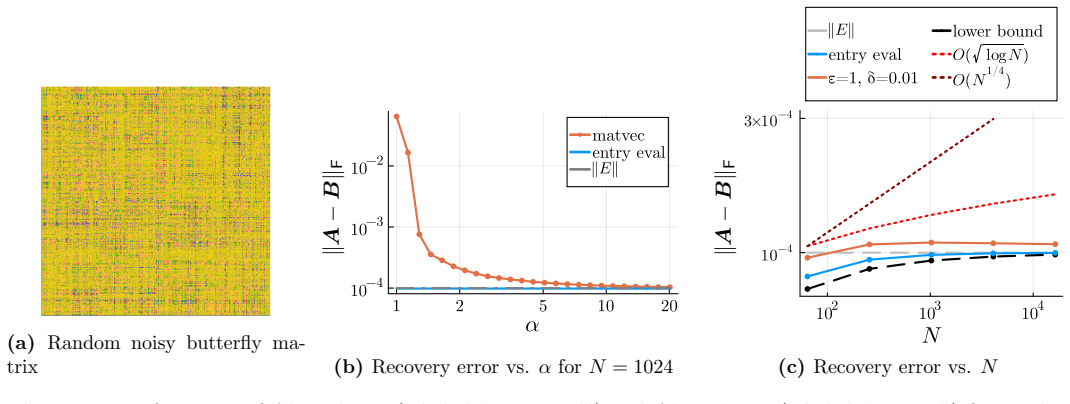
- With matvec-only access, a butterfly approximation within O(N^{1/4}) of optimal is achievable using ~O(sqrt(N)) matrix-vector products and ~O(N) working memory; this is the first quasi-optimality guarantee for the widely used hybrid butterfly factorization method.
- Because the recursive format is a data structure rather than a product of sparse factors, it simplifies both implementation (an open-source Julia package is provided) and the analysis of butterfly algorithms.
- Rank-adaptive and rectangular-matrix extensions follow from the same framework by using per-block rank selection and independent row/column trees, which the numerical experiments show works well on NUDFT and Hankel transform matrices.
- The absolute-error bound (Theorem 15) gives implementable stopping criteria: if every complementary block is approximated to error ε (absolute or relative), the final butterfly has error bounded by a simple closed form—useful for practical accuracy control.
Reading between the lines
- If the O(N^{1/4}) factor can be improved to O(sqrt(log N)) while retaining O(N) memory, the matvec algorithm would match the entry-access guarantee; the authors' Theorem 17 (via BF-mid) already shows O(sqrt(L)) is possible at the cost of O(N^{3/2}) memory, suggesting a trade-off frontier worth exploring.
- The recursive characterization may help in other butterfly-related problems, such as learning butterfly-structured neural-network layers or deriving lower bounds on matvec queries, since it exposes the hierarchical core in a form amenable to recursion arguments.
- A testable extension: replace Gaussian sketches in Algorithm 3 with structured (e.g., subsampled random Fourier or sparse sign) sketches; Lemma 20's independence assumption might be relaxed, potentially reducing the oversampling polylog factors in practice.
- The BLR2 connection (BF-out as a special case) suggests that quasi-optimal techniques for HSS and other hierarchical low-rank formats could be adapted to butterfly approximation, possibly leading to a family of provably near-optimal hierarchical compression algorithms.
Editorial analysis
A structured set of objections, weighed in public.
Referee Report
Summary. The paper formalizes a recursive definition of butterfly matrices (Theorem 4) and uses it to design two approximation algorithms: an entry-access algorithm (Algorithm 2 / Corollary 13) that runs in O(N^2 k) time and achieves Frobenius error within O(√log N) of the best butterfly approximation, and a matvec algorithm (Algorithm 3) that uses O~(√N) matvec queries and achieves error within O(N^{1/4}) of optimal; a memory-efficient implementation (Algorithm 4, Appendix C) is claimed to reduce working memory to O~(N). The authors also identify their matvec algorithm as a reformulation of the hybrid butterfly factorization of Liu et al. and claim the first theoretical quasi-optimality guarantee for that method. Numerical experiments on noisy butterfly matrices, NUDFT, and Hankel transforms are reported, along with an open-source Julia implementation.
Significance. If the technical claims hold, this is a substantial contribution: it provides a clean recursive characterization of butterfly matrices, gives the first quasi-optimality guarantee for the widely used matvec-based hybrid butterfly factorization, and matches the best known entry-access guarantee with a simpler algorithm. The proof of Theorem 4 is detailed and self-contained, and the inductions in Theorems 10 and 12 and Lemma 20 are internally consistent. The randomized analysis is sophisticated and mostly rigorous, and the paper ships reproducible code and experiments that honestly separate worst-case bounds from observed behavior. The main caveats are the heavy reliance on an imported result from a companion paper for the central BF-out approximation bound, and the fact that the advertised O~(N)-memory variant is asserted without a formal proof.
major comments (2)
- [Section 3.1, Theorem 9] Theorem 9 is load-bearing: the upper bound ∥A−B∥² ≤ 2Γ min_{BF-out} is used in Theorem 12 and Lemma 19, and the lower-bound inequality is used in Lemma 19 and Theorem 15. The paper says the result follows 'immediately' from [3, Theorem C.3] via the identification BF-out(L,k)=BLR2(2L,2k,k,∅) in Remark 8, but neither the exact statement of [3, Theorem C.3] nor the verification of the parameter mapping is provided. The lower-bound part can be derived directly from Definition 7, but the upper-bound part is a genuine import. Please include a self-contained proof of the upper bound, or quote [3, Theorem C.3] in full and prove the mapping and the constant 2Γ.
- [Appendix C, Algorithms 4–5] The abstract's central claim of O~(N) working memory for the matrix-free variant rests on Appendix C, which states that the memory-efficient implementation has 'memory complexity improved to O(N k log(N/k))' and that 'the output and approximation guarantees remain unchanged.' No theorem or proof is given. The analysis in Section 4.2 and Theorem 22 applies to Algorithm 3, which stores all sketches upfront with O(αN√(N k)) memory. Please add a formal statement that Algorithm 4 produces the same output distribution (or the same error guarantee with the same probability) as Algorithm 3, together with a proof of the memory bound, or revise the advertised claims.
minor comments (4)
- [Definitions 1–2 and throughout] The text repeatedly says 'as in Theorem 1' and 'by Theorem 2' when referring to Definition 1 and Definition 2 (e.g., Definition 2, Definition 7, Lemma 23). Please fix the cross-references.
- [Lemma 20 and Theorem 22] The probability expression '1− L+2/2 δ' is ambiguous; it should be written as 1−((L+2)/2)δ. Similarly, in the proof of Theorem 22, 'eδ= 2/L+2 δ' should be 'eδ = 2δ/(L+2)'.
- [Section 4, notation] The text says O~(·) suppresses polynomial factors in L=O(log N); these are polylogarithmic factors in N. The terminology is understandable but could be clarified.
- [Corollary 13] The complexity statement O(N²k) is correct for fixed k, but the abstract says O(N²); please state the k-dependence explicitly in the abstract or introduction.
Circularity Check
No significant circularity: the quasi-optimality results are derived from a recursive characterization plus an imported BLR2 bound that constitutes independent support, not a fit or a self-justifying definition.
full rationale
The paper's central claims do not reduce to their inputs by construction. Theorem 4 gives a recursive characterization of butterfly matrices and is proved in Appendix A via the leftfold/side/halving bookkeeping; it is not assumed as the definition. The entry-access guarantee (Theorem 12) follows by induction from Theorem 9, Theorem 10, and an exact Pythagorean decomposition; no parameter is fitted to make the conclusion hold. The matvec guarantee (Theorem 22) is derived from randomized sketching lemmas (Lemma 18, Lemma 19, Lemma 20, Lemma 21) with explicit oversampling and failure-probability dependencies; the error propagation is analyzed, not assumed by renaming. The one load-bearing external input is Theorem 9, imported from [3, Theorem C.3 and Remark 3.6] via the identification BF-out(L,k)=BLR2(2L,2k,k,∅). This is a citation to prior work with overlapping authors, but it is an independently stated theorem about a different matrix class (BLR2/HSS), with assumptions that do not include the target butterfly-optimality result. Under the provided review rules, such a citation counts as real evidence and does not by itself raise the circularity score. The lower-bound half of Theorem 9 is also a direct consequence of the extreme-block rank constraints, not a fitted input. If [3]'s constants or the BF-out/BLR2 identification were wrong, that would be a correctness risk, not circularity. The numerical experiments against known transforms provide additional external sanity checks. Overall, I find no step where a 'prediction' is equivalent by construction to a fitted quantity or to a self-citation chain.
Assumptions & free parameters
assumptions (4)
- domain assumption Complementary low-rank property is assumed to hold exactly, not approximately, for the recursive characterization to be an equivalence.
- domain assumption Matrix dimension is restricted to N=2^{L+1}k with even L and a perfect dyadic partition tree.
- standard math Random Gaussian sketch matrices provide the subspace-embedding and low-rank recovery guarantees used in Lemma 18 and Lemma 21.
- domain assumption Theorem 9, imported from [3, Theorem C.3], correctly bounds the error of greedy BF-out approximation.
Cite this review
Pith. "Pith review of A recursive butterfly factorization with optimality guarantees." pith.science (2026). https://pith.science/paper/ZBVTWA64
@misc{pith2026260729361,
  author       = {Pith},
  title        = {Pith review of: A recursive butterfly factorization with optimality guarantees},
  year         = {2026},
  howpublished = {\url{https://pith.science/paper/ZBVTWA64}},
  note         = {Machine review of arXiv:2607.29361}
}
abstract
We formalize a recursive format for representing a butterfly matrix. This new format naturally leads to a simple recursive algorithm for computing a quasi-optimal butterfly approximation to an arbitrary $N \times N$ matrix $A$. When the entries of $A$ are explicitly available, we show that the algorithm computes a butterfly matrix $B$ in $O(N^2)$ operations with approximation error $\|A - B\|_F$ at most a $O(\sqrt{\log(N)})$ factor away from that of the best possible approximation by a butterfly matrix. We also develop a matrix-free variant of the method, which uses $\widetilde{O}(\sqrt{N})$ matrix-vector products and $\widetilde{O}(N)$ working memory and, with high probability, returns a butterfly approximation with Frobenius norm error within a $O(N^{1/4})$-factor of the optimal error. We show that the algorithm is a reformulation of the hybrid butterfly factorization approach presented in [Liu et. al.; SISC, 43 (2021)]. Our paper therefore provides the first theoretical quasi-optimality guarantee for that algorithm.
Figures


Figures from the paper (5 more)



Reference graph
Works this paper leans on
-
[3]
and Ho, Kenneth L
Li, Yingzhou and Yang, Haizhao and Martin, Eileen R. and Ho, Kenneth L. and Ying, Lexing , title =. Multiscale Modeling & Simulation , volume =. 2015 , doi =
2015
-
[1]
arXiv preprint arXiv:2505.16937 , year=
Quasi-optimal hierarchically semi-separable matrix approximation , author=. arXiv preprint arXiv:2505.16937 , year=
-
[2]
Amsel, Noah and Chen, Tyler and Keles, Feyza Duman and Halikias, Diana and Musco, Cameron and Musco, Christopher and Persson, David , TITLE =. SIAM J. Matrix Anal. Appl. , FJOURNAL =. 2026 , NUMBER =. doi:10.1137/25M176622X , URL =
-
[4]
Li, Yingzhou and Yang, Haizhao and Martin, Eileen R. and Ho, Kenneth L. and Ying, Lexing , TITLE =. Multiscale Model. Simul. , FJOURNAL =. 2015 , NUMBER =. doi:10.1137/15M1007173 , URL =
-
[5]
Chen, Tyler and Keles, Feyza Duman and Halikias, Diana and Musco, Cameron and Musco, Christopher and Persson, David , TITLE =. Proceedings of the 2025. 2025 , ISBN =. doi:10.1137/1.9781611978322.87 , URL =
-
[6]
On randomized trace estimates for indefinite matrices with an application to determinants , author=. Found. Comput. Math. , fjournal=. 2021 , url =
2021
-
[7]
Cortinovis, Alice and Kressner, Daniel , TITLE =. Found. Comput. Math. , FJOURNAL =. 2022 , NUMBER =. doi:10.1007/s10208-021-09525-9 , URL =
-
[8]
Halko, N. and Martinsson, P. G. and Tropp, J. A. , TITLE =. SIAM Rev. , FJOURNAL =. 2011 , NUMBER =. doi:10.1137/090771806 , URL =
Show all 67 references
-
[10]
and Yang, Haizhao , TITLE =
Pang, Qiyuan and Ho, Kenneth L. and Yang, Haizhao , TITLE =. SIAM J. Sci. Comput. , FJOURNAL =. 2020 , NUMBER =. doi:10.1137/19M1294873 , URL =
2020 doi
-
[11]
and Dewilde, P
Chandrasekaran, S. and Dewilde, P. and Gu, M. and Pals, T. and van der Veen, A. J. , year =. Fast Stable Solver for Sequentially Semi-separable Linear Systems of Equations , ISBN =. doi:10.1007/3-540-36265-7_51 , booktitle =
-
[12]
Ashcraft, Cleve and Buttari, Alfredo and Mary, Theo , TITLE =. SIAM J. Matrix Anal. Appl. , FJOURNAL =. 2021 , NUMBER =. doi:10.1137/20M1386451 , URL =
2021 doi
-
[13]
and Martinsson, Per-Gunnar , TITLE =
Gillman, Adrianna and Young, Patrick M. and Martinsson, Per-Gunnar , TITLE =. Front. Math. China , FJOURNAL =. 2012 , NUMBER =. doi:10.1007/s11464-012-0188-3 , URL =
2012 doi
-
[14]
Martinsson, P. G. and Rokhlin, V. , TITLE =. J. Comput. Phys. , FJOURNAL =. 2005 , NUMBER =. doi:10.1016/j.jcp.2004.10.033 , URL =
2005 doi
-
[15]
arXiv preprint arXiv:2507.19290 , year=
Query Efficient Structured Matrix Learning , author=. arXiv preprint arXiv:2507.19290 , year=
-
[17]
Le, Quoc-Tung and Zheng, L\'eon and Riccietti, Elisa and Gribonval, R\'emi , TITLE =. SIAM J. Matrix Anal. Appl. , FJOURNAL =. 2025 , NUMBER =. doi:10.1137/24M1708796 , URL =
2025 doi
-
[18]
arXiv preprint arXiv:2009.11392 , year=
Fast and stable randomized low-rank matrix approximation , author=. arXiv preprint arXiv:2009.11392 , year=
2009 arXiv
-
[19]
arXiv preprint arXiv:2004.08434 , year=
Projection-cost-preserving sketches: Proof strategies and constructions , author=. arXiv preprint arXiv:2004.08434 , year=
2004 arXiv
-
[20]
and Woodruff, David P
Bakshi, Ainesh and Clarkson, Kenneth L. and Woodruff, David P. , booktitle =. Low-rank approximation with
-
[21]
Krylov Methods are (nearly) Optimal for Low-Rank Approximation , url =
Bakshi, Ainesh and Narayanan, Shyam , year =. Krylov Methods are (nearly) Optimal for Low-Rank Approximation , url =. doi:10.1109/focs57990.2023.00128 , booktitle =
2023
-
[22]
2018 , ISBN =
Simchowitz, Max and El Alaoui, Ahmed and Recht, Benjamin , TITLE =. 2018 , ISBN =. doi:10.1145/3188745.3188796 , URL =
2018
-
[23]
2026 , eprint=
Nearly Instance Optimal Sparse Matrix Approximation from Matrix-Vector Products , author=. 2026 , eprint=
2026
-
[24]
arXiv preprint arXiv:2606.12179 , year=
Nearly Instance Optimal Sparse Matrix Approximation from Matrix-Vector Products , author=. arXiv preprint arXiv:2606.12179 , year=
-
[25]
SIAM Journal on Matrix Analysis and Applications , volume =
Amsel, Noah and Chen, Tyler and Keles, Feyza Duman and Halikias, Diana and Musco, Cameron and Musco, Christopher , title =. SIAM Journal on Matrix Analysis and Applications , volume =. 2026 , doi =
2026
-
[26]
Amsel, Noah and Chen, Tyler and Keles, Feyza Duman and Halikias, Diana and Musco, Cameron and Musco, Christopher , TITLE =. SIAM J. Matrix Anal. Appl. , FJOURNAL =. 2026 , NUMBER =. doi:10.1137/25M1742710 , URL =
2026 doi
-
[28]
Park, Taejun and Nakatsukasa, Yuji , TITLE =. Appl. Comput. Harmon. Anal. , FJOURNAL =. 2026 , PAGES =. doi:10.1016/j.acha.2026.101869 , URL =
2026
-
[29]
, TITLE =
Dasarathy, Gautam and Shah, Parikshit and Bhaskar, Badri Narayan and Nowak, Robert D. , TITLE =. IEEE Trans. Inform. Theory , FJOURNAL =. 2015 , NUMBER =. doi:10.1109/TIT.2015.2391251 , URL =
2015
-
[30]
arXiv preprint arXiv:1311.2448 , year=
Recovery of sparse matrices via matrix sketching , author=. arXiv preprint arXiv:1311.2448 , year=
-
[31]
Curtis, A. R. and Powell, M. J. D. and Reid, J. K. , year =. On the Estimation of Sparse. J. Inst. Math. Appl. , fjournal =. doi:10.1093/imamat/13.1.117 , number =
-
[33]
and Mor\'e, Jorge J
Coleman, Thomas F. and Mor\'e, Jorge J. , TITLE =. SIAM J. Numer. Anal. , FJOURNAL =. 1983 , NUMBER =. doi:10.1137/0720013 , URL =
1983 doi
-
[34]
and Cai, Jin-Yi , TITLE =
Coleman, Thomas F. and Cai, Jin-Yi , TITLE =. SIAM J. Algebraic Discrete Methods , FJOURNAL =. 1986 , NUMBER =. doi:10.1137/0607026 , URL =
1986 doi
-
[35]
Dharangutte, Prathamesh and Musco, Christopher , TITLE =. 2023. 2023 , ISBN =. doi:10.1137/1.9781611977585.ch32 , URL =
2023 doi
-
[36]
arXiv preprint arXiv:2201.10684 , year=
Stochastic diagonal estimation: probabilistic bounds and an improved algorithm , author=. arXiv preprint arXiv:2201.10684 , year=
-
[37]
and Saad, Yousef , TITLE =
Tang, Jok M. and Saad, Yousef , TITLE =. Numer. Linear Algebra Appl. , FJOURNAL =. 2012 , NUMBER =. doi:10.1002/nla.779 , URL =
2012 doi
-
[38]
and Kokiopoulou, E
Bekas, C. and Kokiopoulou, E. and Saad, Y. , TITLE =. Appl. Numer. Math. , FJOURNAL =. 2007 , NUMBER =. doi:10.1016/j.apnum.2007.01.003 , URL =
2007 doi
-
[39]
Proceedings of the 2023 Annual ACM-SIAM Symposium on Discrete Algorithms (SODA) , pages=
Toeplitz low-rank approximation with sublinear query complexity , author=. Proceedings of the 2023 Annual ACM-SIAM Symposium on Discrete Algorithms (SODA) , pages=. 2023 , organization=
2023
-
[40]
Proceedings of the 2023
Kapralov, Michael and Lawrence, Hannah and Makarov, Mikhail and Musco, Cameron and Sheth, Kshiteej , TITLE =. Proceedings of the 2023. 2023 , ISBN =. doi:10.1137/1.9781611977554.ch159 , URL =
2023 doi
-
[41]
A Butterfly-Based Direct Integral-Equation Solver Using Hierarchical
Guo, Han and Liu, Yang and Hu, Jun and Michielssen, Eric , year =. A Butterfly-Based Direct Integral-Equation Solver Using Hierarchical. IEEE Transactions on Antennas and Propagation , publisher =. doi:10.1109/tap.2017.2727511 , number =
2017
-
[42]
Liu, Yang and Xing, Xin and Guo, Han and Michielssen, Eric and Ghysels, Pieter and Li, Xiaoye Sherry , TITLE =. SIAM J. Sci. Comput. , FJOURNAL =. 2021 , NUMBER =. doi:10.1137/20M1315853 , URL =
2021 doi
-
[43]
Sch\"afer, Florian and Katzfuss, Matthias and Owhadi, Houman , TITLE =. SIAM J. Sci. Comput. , FJOURNAL =. 2021 , NUMBER =. doi:10.1137/20M1336254 , URL =
2021 doi
-
[44]
Waters, Andrew and Sankaranarayanan, Aswin and Baraniuk, Richard , booktitle =. Spa
-
[45]
arXiv preprint arXiv:2605.21828 , year=
A Butterfly-Accelerated Manifold Harmonic Transform , author=. arXiv preprint arXiv:2605.21828 , year=
-
[46]
An algorithm for the rapid evaluation of special function transforms , author=. Appl. Comput. Harm. Anal. , volume=. 2010 , publisher=
2010
-
[47]
O'Neil, Michael and Woolfe, Franco and Rokhlin, Vladimir , TITLE =. Appl. Comput. Harmon. Anal. , FJOURNAL =. 2010 , NUMBER =. doi:10.1016/j.acha.2009.08.005 , URL =
2010 doi
-
[48]
Interpolative butterfly factorization , author=. SIAM J. Sci. Comput. , volume=. 2017 , publisher=
2017
-
[49]
Li, Yingzhou and Yang, Haizhao , TITLE =. SIAM J. Sci. Comput. , FJOURNAL =. 2017 , NUMBER =. doi:10.1137/16M1074941 , URL =
2017 doi
-
[50]
2009 , publisher=
Candes, Emmanuel and Demanet, Laurent and Ying, Lexing , journal=. 2009 , publisher=
2009
-
[51]
Multiscale Model
Cand\`es, Emmanuel and Demanet, Laurent and Ying, Lexing , TITLE =. Multiscale Model. Simul. , FJOURNAL =. 2009 , NUMBER =. doi:10.1137/080734339 , URL =
2009 doi
-
[52]
2010 , publisher=
Tygert, Mark , journal=. 2010 , publisher=
2010
-
[53]
Tygert, Mark , TITLE =. J. Comput. Phys. , FJOURNAL =. 2010 , NUMBER =. doi:10.1016/j.jcp.2010.05.004 , URL =
2010 doi
-
[54]
2012 , publisher=
Seljebotn, DS , journal=. 2012 , publisher=
2012
-
[55]
Seljebotn, D. S. , title =. 2012 , month =. doi:10.1088/0067-0049/199/1/5 , url =
2012 doi
-
[56]
A butterfly algorithm for synthetic aperture radar imaging , author=. SIAM J. Imag. Sci. , volume=. 2012 , publisher=
2012
-
[57]
IEEE Transactions on Antennas and Propagation , volume=
A multilevel matrix decomposition algorithm for analyzing scattering from large structures , author=. IEEE Transactions on Antennas and Propagation , volume=. 1996 , publisher=
1996
-
[58]
and Boag, A
Michielssen, E. and Boag, A. , journal=. A multilevel matrix decomposition algorithm for analyzing scattering from large structures , year=
-
[59]
International conference on machine learning , pages=
Learning fast algorithms for linear transforms using butterfly factorizations , author=. International conference on machine learning , pages=. 2019 , organization=
2019
-
[60]
Proceedings of the 36th International Conference on Machine Learning , pages =
Learning Fast Algorithms for Linear Transforms Using Butterfly Factorizations , author =. Proceedings of the 36th International Conference on Machine Learning , pages =. 2019 , volume =
2019
-
[61]
International Conference on Learning Representations , volume=
Parameter-efficient orthogonal finetuning via butterfly factorization , author=. International Conference on Learning Representations , volume=
-
[62]
Parameter-Efficient Orthogonal Finetuning via Butterfly Factorization , url =
Liu, Weiyang and Qiu, Zeju and Feng, Yao and Xiu, Yuliang and Xue, Yuxuan and Yu, Longhui and Feng, Haiwen and Liu, Zhen and Heo, Juyeon and Peng, Songyou and Wen, Yandong and Black, Michael J and Weller, Adrian and Ha, David , booktitle =. Parameter-Efficient Orthogonal Finet...
-
[63]
SIAM Journal on Mathematics of Data Science , volume=
Efficient identification of butterfly sparse matrix factorizations , author=. SIAM Journal on Mathematics of Data Science , volume=. 2023 , publisher=
2023
-
[64]
Zheng, L\'eon and Riccietti, Elisa and Gribonval, R\'emi , TITLE =. SIAM J. Math. Data Sci. , FJOURNAL =. 2023 , NUMBER =. doi:10.1137/22M1488727 , URL =
2023 doi
-
[65]
SIAM Journal on Scientific Computing , volume=
Sparse approximate multifrontal factorization with butterfly compression for high-frequency wave equations , author=. SIAM Journal on Scientific Computing , volume=. 2021 , publisher=
2021
-
[66]
Liu, Yang and Ghysels, Pieter and Claus, Lisa and Li, Xiaoye Sherry , TITLE =. SIAM J. Sci. Comput. , FJOURNAL =. 2021 , NUMBER =. doi:10.1137/20M1349667 , URL =
2021 doi
-
[67]
A parallel nonuniform fast
Barnett, Alexander H and Magland, Jeremy and af Klinteberg, Ludvig , journal=. A parallel nonuniform fast. 2019 , publisher=
2019
-
[68]
and Magland, Jeremy and af Klinteberg, Ludvig , TITLE =
Barnett, Alexander H. and Magland, Jeremy and af Klinteberg, Ludvig , TITLE =. SIAM J. Sci. Comput. , FJOURNAL =. 2019 , NUMBER =. doi:10.1137/18M120885X , URL =
2019 doi
-
[69]
A Nonuniform Fast
Beckman, Paul G and O’Neil, Michael , journal=. A Nonuniform Fast. 2026 , publisher=
2026
-
[70]
and O'Neil, Michael , TITLE =
Beckman, Paul G. and O'Neil, Michael , TITLE =. SIAM J. Sci. Comput. , FJOURNAL =. 2026 , NUMBER =. doi:10.1137/25M1796758 , URL =
2026 doi
-
[71]
Proceedings of Thirty Ninth Conference on Learning Theory , pages =
Query Efficient Structured Matrix Learning , author =. Proceedings of Thirty Ninth Conference on Learning Theory , pages =. 2026 , editor =
2026
Reviewed August 3, 2026 · model on record in the stance chip above.
Discussion (0). Sign in to comment.