REVIEW 3 major objections 3 minor 53 references
On the use of field RR Lyrae as Galactic probes:. IX. Radial velocities
T0 review · 3 major / 3 minor · reviewed 2026-08-03 · deepseek-v4-flash
Pith's one-line read By fitting universal radial-velocity-curve templates to sparse spectra, the paper builds a homogeneous catalog of barycentric velocities and pulsation amplitudes for 15,955 field RR Lyrae stars — and uses it to show that metallic-line RV am
desk verdict Large, useful RV catalog for RR Lyrae, but the paper's own Fig. 5 shows cross-diagnostic V_gamma offsets (Hα–Hβ ~7 km/s, Hα–Hγ ~14 km/s) that contradict the homogeneity claim. read the letter →
The pith
A machine-rendered reading of the paper's core claim, the machinery that carries it, and where it could break.
The reading
What carries the argument
The central object is the radial-velocity-curve (RVC) template: a universal, phase-dependent shape for the pulsation velocity of RR Lyrae stars, separately constructed for metallic lines (Fe, Mg, Na) and Balmer lines (Hα, Hβ, Hγ, Hδ). Two fitting modes are used: a free-amplitude mode, which derives the RV amplitude directly from four or more measurements, and a fixed-amplitude mode, which scales the template using the photometric V-band amplitude for three-phase-point data. The templates convert sparse, randomly phased RV measurements into a barycentric velocity (relative to the Sun) and a pulsation amplitude, and are validated against two calibration samples with full phase coverage.
What would settle it
Take the paper's calibration samples of fully phase-covered RR Lyrae curves and randomly thin each curve to 1, 3, and 7 phase points hundreds of times; if the template-recovered V_gamma shows a statistically significant offset that grows with iron abundance or with Blazhko phase, or if the free-amplitude RV amplitude systematically drifts lower for stars with periods above 0.6 days, the shape-universality premise fails and the catalog's metallicity and Bailey-diagram trends would require revision.
Extended reading notes
Core claim
The central discovery is that template fitting of radial-velocity curves, based on universal shapes for metallic and Balmer lines, yields V_gamma and RV amplitudes that agree with full-phase measurements to within a few km/s even when the target has only three to seven phase points. Applied to 17,563 field RR Lyrae (12,353 RRab, 5,011 RRc, 199 RRd), the method produces a catalog of 15,955 stars after quality filtering with typical V_gamma accuracies of 3.8, 6.5, and 11.3 km/s depending on phase coverage. From this homogeneous sample, the paper reports three physical results: (i) metallic-line RV amplitudes are essentially independent of metallicity (slope below the 2σ level), whereas higher-
Load-bearing premise
The load-bearing premise is that the radial-velocity-curve templates have a universal shape across the full range of period, amplitude, metallicity, and Blazhko phase, so that even a single phase point yields an unbiased barycentric velocity; if template shapes vary with metallicity or are distorted for Blazhko or metal-rich stars, the V_gamma and amplitude values inherit systematic offsets that propagate into every scaling relation and Bailey-diagram trend in the paper.
Editorial extensions
If this is right
- The catalog becomes the reference sample of barycentric radial velocities and RV amplitudes for field RR Lyrae, allowing future spectroscopic surveys to calibrate and validate their own RV measurements without re-observing stars across a full pulsation cycle.
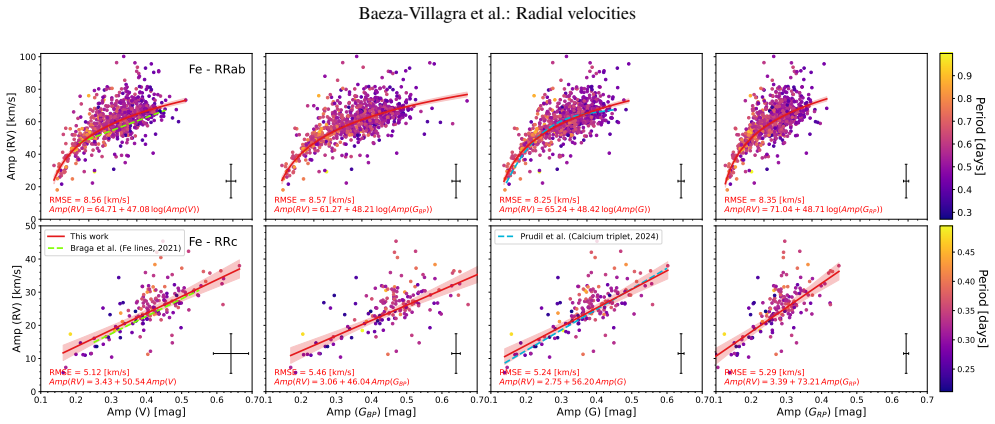
- The nonlinear (logarithmic) scaling relations for RRab stars mean RV amplitudes can be predicted from photometric amplitudes alone, extending kinematic and pulsation studies to the much larger photometric samples of RR Lyrae.
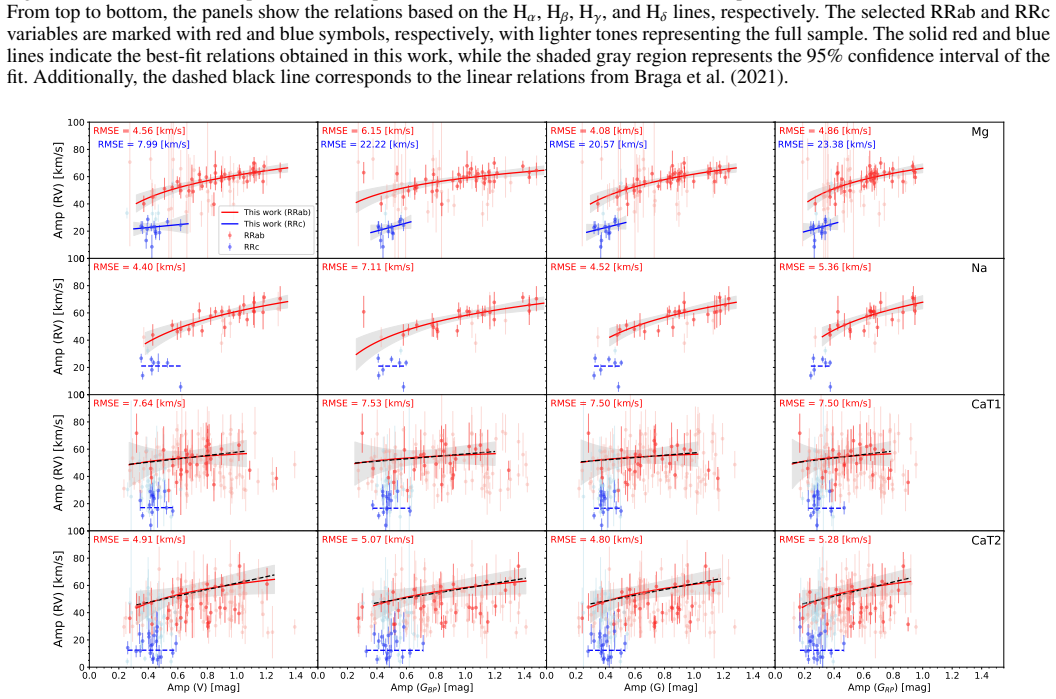
- The near-zero metallicity dependence of metallic-line RV amplitudes implies that the spectroscopic Bailey diagram is largely free of metallicity bias, simplifying the interpretation of the short- and long-period sequences and of the spread at fixed period.
- The increasing metallicity sensitivity of the higher Balmer lines provides a new spectroscopic diagnostic of atmospheric structure, since those lines form in higher atmospheric layers than the metallic lines.
- The finding that candidate Blazhko variables are skewed toward metal-intermediate and metal-rich, short-period populations, if confirmed, indicates that metal-rich environments favor Blazhko modulation and connects the phenomenon to the high-amplitude short-period (HASP) regime.
- The reduced scatter in the spectroscopic Bailey diagram suggests that period–RV-amplitude combinations can be used as a distance- and reddening-independent probe of chemical composition, complementing direct iron-abundance measurements.
Reading between the lines
- If the template shapes are truly universal across period, amplitude, and metallicity, the same pipeline could be applied to sparsely sampled RR Lyrae in external galaxies or to massive upcoming surveys with limited epochs, potentially multiplying the kinematic sample size by an order of magnitude without new dense-phase observations.
- The contrast between the metallicity-independent metallic-line amplitudes and the metallicity-dependent Balmer-line amplitudes suggests that the atmospheric layers probed by Hγ and Hδ shift in optical depth as a function of iron abundance in a way that directly affects the measured pulsation velocity; a testable prediction is that this slope should correlate with effective temperature across the i
- The break in the RRab amplitude-scaling relation implies a physical turnover in the luminosity-to-radius amplitude ratio; an independent check would be to measure RV amplitudes for a sample of long-period, low-amplitude RRab stars and verify they follow the logarithmic extrapolation rather than the linear relation used in earlier work.
- The smooth, low-scatter spectroscopic Bailey diagram could be exploited as a purely kinematic classifier of RR Lyrae subtypes, potentially improving mode identification for stars where photometric classification is ambiguous.
Editorial analysis
A structured set of objections, weighed in public.
Referee Report
Summary. The paper compiles radial-velocity (RV) measurements for 17,563 field RR Lyrae stars from DESI, LAMOST, SDSS, Gaia, STELLA, du Pont, and the literature. Using the Braga et al. (2021) RVC templates, it derives barycentric velocities V_gamma and RV amplitudes with fixed- and free-amplitude fitting, and combines them with literature values to produce a final catalog of 15,955 stars. The method is validated against Gaia DR3 and du Pont calibration samples, and resampling tests in Appendix A show that template fitting outperforms simple averaging. The paper then uses the derived amplitudes to construct photometric–RV amplitude scaling relations, spectroscopic Bailey diagrams, metallicity trends, and a Blazhko candidate analysis.
Significance. If the homogeneity and accuracy claims hold, this would indeed be a valuable reference catalog: the largest homogeneous set of RRL V_gamma values and RV amplitudes, with immediate applications to Galactic kinematics and as a training set for future multi-object spectroscopic surveys. The paper's strengths include the use of a free-amplitude template method that does not assume a photometric amplitude, external validation on two calibration samples, and quantitative resampling experiments demonstrating the advantage of template fitting over simple means. However, the central homogeneity claim is weakened by large cross-diagnostic V_gamma offsets that are visible in the paper's own Fig. 5 and are not addressed by the calibration samples. The accuracy figures quoted in the abstract are therefore not fully supported for Balmer-only or sparsely sampled stars.
major comments (3)
- [§4.1, Fig. 5] The claim that different diagnostics give 'very similar V_gamma' is not supported by the paper's own numbers. For the same stars, the mean V_gamma from Hα is -48.1 km/s vs -55.2 from Hβ (Δ=7.1 km/s), -47.3 vs -61.6 from Hγ (Δ=14.3 km/s), and -46.6 vs -57.9 from Hδ (Δ=11.3 km/s). Since the final V_gamma is the global mean over available diagnostics, stars observed only in Hα will be systematically offset from stars observed only in Hβ by ~7 km/s. The Appendix A validation is based on Fe-line templates against Gaia/du Pont and does not test Balmer V_gamma zero-points. The quoted 3.8/6.5/11.3 km/s accuracies are therefore not established for Balmer-only RVCs. Please calibrate per-diagnostic offsets using common stars, or restrict the homogeneity/accuracy claims to the validated Fe-line subset.
- [§3 and Appendix A] The abstract's accuracy for 'fewer than three phase points' (11.3 km/s) is not supported by the validation presented. Section 3 states that templates can be applied even with a single RV measurement, but Appendix A's resampling test draws subsets of 3, 4, 5, 6, 9, and 12 points; no test covers 1 or 2 points. The 11.3 km/s figure therefore appears to be an extrapolation. Please either provide a validation for 1–2 point cases (e.g., Monte Carlo with known V_gamma) or revise the claimed accuracy and the associated catalog uncertainties for such stars.
- [§4.2, Figs. 6–8] The scaling relations rest on subjective sample cuts. In particular, the Balmer-line relations are derived after 'neglect[ing] 1195 stars from the SDSS catalog ... since they show a larger scatter' with no quantitative criterion; the Fe-line relations additionally exclude all stars with Amp(RV) > 120 km/s (RRab) or > 50 km/s (RRc). These cuts can bias the fitted slopes and the inferred break locations. Please quantify the impact: show fits with and without the SDSS exclusion, report the number of stars removed by each cut, and justify the amplitude caps by an objective outlier criterion rather than by the range that makes the relation appear linear/logarithmic.
minor comments (3)
- [§4.3] The Blazhko analysis uses non-modulated templates and labels the resulting amplitudes as a 'first-order approximation.' This caveat should be repeated when drawing the metallicity-skew conclusion, since the amplitude bias may correlate with period and metallicity.
- [Eq. (5)] The SP relation for RRab stars includes a log(P)^4 term but no log(P)^3 term. Please confirm that this is intentional and not a typographical omission.
- [Table C.1] The DESI resolution entry is listed as '2000–5500' but the notes state that R varies from 2000 at 3600 Å to 5500 at 9800 Å. Please make the wavelength dependence explicit in the table column heading.
Circularity Check
No significant circularity: empirical RV catalog is externally validated and the derived scalings are fits to measured quantities, not constructions from their inputs.
full rationale
The paper's central measurements are not equivalent to their inputs. V_gamma and RV amplitudes are obtained by template fitting, with the free-amplitude method fitting the RV amplitude directly from the spectroscopic data rather than assuming a photometric amplitude; Appendix A validates V_gamma against independent Gaia DR3 and du Pont samples. The fixed-amplitude method is used only for sparse-phase V_gamma estimation, and the paper explicitly notes that its amplitude is inferred from photometry rather than measured, while the scaling relations and metallicity trends are based on free-amplitude fits. The transformed Fabrizio et al. (2021) sequence relations are explicitly labeled as 'not new fits' and are used only to visualize the spectroscopic Bailey diagram, not as independent predictions. The heavy use of the authors' own RVC templates (Braga et al. 2021) is load-bearing, but the templates are validated against external benchmarks and the derived quantities are checked against literature values, so the self-citation does not reduce the derivation to its inputs. The Blazhko amplitude limitation ('no specific templates for Blazhko RRLs are currently available') is openly disclosed for that subset. The cross-diagnostic V_gamma offsets shown in Fig. 5, while a possible concern for the homogeneity/accuracy claim, are an internal consistency and calibration question rather than a circularity in the derivation chain.
Assumptions & free parameters
free parameters (5)
- Scaling-relation coefficients a,b (Table 2) =
RRab Fe(V): a=64.71±0.45, b=47.08±1.72; RRc Fe(V): a=3.43±1.91, b=50.54±4.75; additional lines in Table 2
- Amp(RV) upper cuts for scaling relations =
120 km/s (RRab), 50 km/s (RRc)
- Minimum RV count for Balmer scaling subsample =
>9 (RRab), >4 (RRc)
- SDSS exclusion count for Balmer scaling =
1195 stars
- Sigma-clipping thresholds =
2 sigma_err; 3 sigma_res; 2 sigma for V_gamma mean
assumptions (5)
- domain assumption RVC templates from Braga et al. (2021) apply to all RRLs regardless of period, amplitude, metallicity, or Blazhko status, and can be used with as few as one phase point.
- domain assumption Pulsation is purely radial and spectral-line shifts map directly to photospheric radial motion, so the fitted RVC yields the barycentric velocity after phase averaging.
- domain assumption Balmer and metallic lines form at different depths, so amplitude differences between diagnostics trace atmospheric structure.
- domain assumption Gaia photometric amplitudes, PR3C periods, and SR3C metallicities are accurate and on consistent systems.
- ad hoc to paper Candidate Blazhko variables can be treated with non-modulated templates; the resulting amplitudes are a first-order approximation.
Cite this review
Pith. "Pith review of On the use of field RR Lyrae as Galactic probes:. IX. Radial velocities." pith.science (2026). https://pith.science/paper/R7WXEAUP
@misc{pith2026260729597,
  author       = {Pith},
  title        = {Pith review of: On the use of field RR Lyrae as Galactic probes:. IX. Radial velocities},
  year         = {2026},
  howpublished = {\url{https://pith.science/paper/R7WXEAUP}},
  note         = {Machine review of arXiv:2607.29597}
}
abstract
We present the largest and most homogeneous catalog of radial velocity (RV) measurements for field RR Lyrae (RRL) variables, based on both proprietary and publicly available spectroscopic data. The sample includes 17,563 RRLs pulsating in the fundamental mode (12,353 RRab), in the first overtone (5,011 RRc), and in double-mode (199 RRd). The RV curve (RVC) templates for metallic and Balmer lines were used to derive RV amplitudes and $V_{\gamma}$ velocities, defined as the RV of the stellar barycenter with respect to the Sun. The typical accuracy across the catalog is on average 3.8 km s$^{-1}$ for well-sampled RVCs, 6.5 km s$^{-1}$ for RVCs with 3-7 phase points and 11.3 km s$^{-1}$ for RVCs with fewer than three phase points. The use of different spectroscopic diagnostics and RVC templates provides, within the errors, very similar $V_{\gamma}$ velocities. We found that the metallicity dependence of RV amplitudes is vanishing for metallic lines, but becomes increasingly significant for H$\gamma$ and H$\delta$. Moreover, the scaling relations between photometric (V, $G_{BP}$, G, $G_{RP}$) and RV amplitudes are linear for RRc and nonlinear for RRab variables, independently of the adopted diagnostic. This circumstantial evidence indicates that convection affects more luminosity than RV amplitudes when moving from the blue (hot) to the red (cool) edge of the instability strip. The spectroscopic Bailey diagram (RV amplitude versus period) shows a smooth transition and a reduced spread at a fixed period, when moving from metal-poor to metal-rich RRLs. Finally, we also found evidence that the metallicity distribution function of Blazhko RRLs is skewed toward the metal-intermediate and metal-rich regimes.
Figures


Figures from the paper (11 more)






Reference graph
Works this paper leans on
-
[1]
2024, MNRAS, 527, 12196
Bobrick, A., Iorio, G., Belokurov, V ., et al. 2024, MNRAS, 527, 12196
2024
-
[2]
F., Crestani, J., et al
Bono, G., Braga, V . F., Crestani, J., et al. 2020, ApJ, 896, L15
2020
-
[3]
F., Fabrizio, M., et al
Bono, G., Braga, V . F., Fabrizio, M., et al. 2026, ApJ, 998, 86
2026
-
[4]
K., Minniti, D., et al
Botan, E., Saito, R. K., Minniti, D., et al. 2021, MNRAS, 504, 654
2021
-
[5]
F., Bono, G., Fiorentino, G., et al
Braga, V . F., Bono, G., Fiorentino, G., et al. 2020, A&A, 644, A95
2020
-
[6]
F., Crestani, J., Fabrizio, M., et al
Braga, V . F., Crestani, J., Fabrizio, M., et al. 2021, ApJ, 919, 85
2021
-
[7]
F., Monelli, M., Dall’Ora, M., et al
Braga, V . F., Monelli, M., Dall’Ora, M., et al. 2024, A&A, 689, A349
2024
-
[8]
F., Stetson, P
Braga, V . F., Stetson, P. B., Bono, G., et al. 2016, AJ, 152, 170
2016
Show all 53 references
-
[9]
G., Carretta, E., et al
Bragaglia, A., Gratton, R. G., Carretta, E., et al. 2001, AJ, 122, 207
2001
-
[10]
2009, Ap&SS, 320, 261
Catelan, M. 2009, Ap&SS, 320, 261
2009
-
[11]
& Smith, H
Catelan, M. & Smith, H. A. 2015, Pulsating Stars (Wiley-VCH, Weinheim)
2015
-
[12]
Chadid, M., Sneden, C., & Preston, G. W. 2017, ApJ, 835, 187
2017
-
[13]
2023, A&A, 674, A18
Clementini, G., Ripepi, V ., Garofalo, A., et al. 2023, A&A, 674, A18
2023
-
[14]
2018, A&A, 616, A5 Cruz Reyes, M., Anderson, R
Cropper, M., Katz, D., Sartoretti, P., et al. 2018, A&A, 616, A5 Cruz Reyes, M., Anderson, R. I., Johansson, L., Netzel, H., & Medaric, Z. 2024, A&A, 684, A173
2018
-
[15]
2025, MNRAS, 541, 1434
Cuevas-Otahola, B., Mateu, C., Cabrera-Ziri, I., et al. 2025, MNRAS, 541, 1434
2025
-
[16]
C., Abrams, D
Dalton, G., Trager, S. C., Abrams, D. C., et al. 2012, in Society of Photo-Optical Instrumentation Engineers (SPIE) Conference Series, V ol. 8446, Ground- based and Airborne Instrumentation for Astronomy IV , ed. I. S. McLean, S. K. Ramsay, & H. Takami, 84460P
2012
-
[17]
K., Berdnikov, L
Dambis, A. K., Berdnikov, L. N., Kniazev, A. Y ., et al. 2013, MNRAS, 435, 3206 de Jong, R. S., Bellido-Tirado, O., Chiappini, C., et al. 2012, in Society of Photo- Optical Instrumentation Engineers (SPIE) Conference Series, V ol. 8446, Ground-based and Airborne Instrumentatio...
2013
-
[18]
& Ivezi´c, Ž
Donev, E. & Ivezi´c, Ž. 2025, AJ, 169, 310 D’Orazi, V ., Storm, N., Casey, A. R., et al. 2024, MNRAS, 531, 137
2025
-
[19]
F., et al
Fabrizio, M., Bono, G., Braga, V . F., et al. 2019, ApJ, 882, 169
2019
-
[20]
F., Crestani, J., et al
Fabrizio, M., Braga, V . F., Crestani, J., et al. 2021, ApJ, 919, 118
2021
-
[21]
2011, PASP, 123, 384
Fabrizio, M., Nonino, M., Bono, G., et al. 2011, PASP, 123, 384
2011
-
[22]
W., et al
Feng, Y ., Guhathakurta, P., Peng, E. W., et al. 2026, ApJ, 998, 157 Fernández-Alvar, E., Ruiz-Lara, T., Gallart, C., et al. 2025, A&A, 704, A258 Article number, page 14 of 21 Baeza-Villagra et al.: Radial velocities
2026
-
[23]
F., et al
Fiorentino, G., Bono, G., Braga, V . F., et al. 2022, in Memorie della Societa Astronomica Italiana, V ol. 93, 47
2022
-
[24]
2015, ApJ, 798, L12
Fiorentino, G., Bono, G., Monelli, M., et al. 2015, ApJ, 798, L12
2015
-
[25]
L., Marsakov, V
Gozha, M. L., Marsakov, V . A., & Koval’, V . V . 2018, Astrophysics, 61, 41
2018
-
[26]
2018, MNRAS, 474, 2142
Iorio, G., Belokurov, V ., Erkal, D., et al. 2018, MNRAS, 474, 2142
2018
-
[27]
2017, MNRAS, 468, 1317
Jurcsik, J., Smitola, P., Hajdu, G., et al. 2017, MNRAS, 468, 1317
2017
-
[28]
2023, A&A, 674, A5
Katz, D., Sartoretti, P., Guerrier, A., et al. 2023, A&A, 674, A5
2023
-
[29]
2017, AJ, 153, 75
Kunder, A., Kordopatis, G., Steinmetz, M., et al. 2017, AJ, 153, 75
2017
-
[30]
M., et al
Kunder, A., Pérez-Villegas, A., Rich, R. M., et al. 2020, AJ, 159, 270
2020
-
[31]
M., Hawkins, K., et al
Kunder, A., Rich, R. M., Hawkins, K., et al. 2015, ApJ, 808, L12
2015
-
[32]
Kunder, A. M. 2022, Universe, 8, 206
2022
-
[33]
& de Boer, K
Maintz, G. & de Boer, K. S. 2005, A&A, 442, 229
2005
-
[34]
2015, ApJ, 808, 50
Marconi, M., Coppola, G., Bono, G., et al. 2015, ApJ, 808, 50
2015
-
[35]
E., Li, T
Medina, G. E., Li, T. S., Allende Prieto, C., et al. 2025, ApJ, arXiv:2505.10614, in press
2025 arXiv
-
[36]
P., Marengo, M., Martínez-Vázquez, C
Mullen, J. P., Marengo, M., Martínez-Vázquez, C. E., et al. 2022, ApJ, 931, 131
2022
-
[37]
2018, MNRAS, 480, 1229
Netzel, H., Smolec, R., Soszy´nski, I., & Udalski, A. 2018, MNRAS, 480, 1229
2018
-
[38]
Oke, J. B. 1966, ApJ, 145, 468
1966
-
[39]
Preston, G. W. 1959, ApJ, 130, 507
1959
-
[40]
K., & Kunder, A
Prudil, Z., Dékány, I., Grebel, E. K., & Kunder, A. 2020, MNRAS, 492, 3408
2020
-
[41]
J., Lemasle, B., et al
Prudil, Z., Koch-Hansen, A. J., Lemasle, B., et al. 2022, A&A, 664, A148
2022
-
[42]
J., & Dékány, I
Prudil, Z., Smolec, R., Kunder, A., Koch-Hansen, A. J., & Dékány, I. 2024, A&A, 685, A153
2024
-
[43]
2020, A&A, 641, A96
Savino, A., Koch, A., Prudil, Z., Kunder, A., & Smolec, R. 2020, A&A, 641, A96
2020
-
[44]
1940, Harvard College Observatory Circular, 437, 1
Schwarzschild, M. 1940, Harvard College Observatory Circular, 437, 1
1940
-
[45]
2013, A&A, 549, A101
Skarka, M. 2013, A&A, 549, A101
2013
-
[46]
2020, MNRAS, 494, 1237
Skarka, M., Prudil, Z., & Jurcsik, J. 2020, MNRAS, 494, 1237
2020
-
[47]
Smith, H. A. 1981, PASP, 93, 721
1981
-
[48]
Smith, H. A. 1995, RR Lyrae Stars (Cambridge University Press, Cambridge)
1995
-
[49]
& Preston, G
Sneden, C. & Preston, G. W. 2024, AJ, 167, 268
2024
-
[50]
W., Chadid, M., & Adamów, M
Sneden, C., Preston, G. W., Chadid, M., & Adamów, M. 2017, ApJ, 848, 68
2017
-
[51]
2018, in Society of Photo-Optical Instrumentation Engineers (SPIE) Conference Series, V ol
Tamura, N., Takato, N., Shimono, A., et al. 2018, in Society of Photo-Optical Instrumentation Engineers (SPIE) Conference Series, V ol. 10702, Ground- based and Airborne Instrumentation for Astronomy VII, ed. C. J. Evans, L. Simard, & H. Takami, 107021C
2018
-
[52]
2018, in Society of Photo-Optical Instrumentation Engineers (SPIE) Conference Series, V ol
Taylor, W., Cirasuolo, M., Afonso, J., et al. 2018, in Society of Photo-Optical Instrumentation Engineers (SPIE) Conference Series, V ol. 10702, Ground- based and Airborne Instrumentation for Astronomy VII, ed. C. J. Evans, L. Simard, & H. Takami, 107021G
2018
-
[53]
Walker, A. R. 1989, PASP, 101, 570 Article number, page 15 of 21 A&A proofs:manuscript no. RV_paper Appendix A: Validation with calibration sample To verify the accuracy of our results, we selected two calibra- tion samples (CS). The first consists of 19 stars (16 RRab and 3 R...
1989
Reviewed August 3, 2026 · model on record in the stance chip above.
Discussion (0). Sign in to comment.