REVIEW 4 major objections 5 minor 71 references
Data-Driven Model Order Reduction with pyMOR
T0 review · 4 major / 5 minor · reviewed 2026-08-04 · deepseek-v4-flash
Pith's one-line read The paper claims that one open-source Python library, pyMOR, is the only MOR framework that unifies an extensive set of model-based and data-driven reduction algorithms for both parametric PDEs and control systems, and supports hybrid pipel
desk verdict A solid, thorough software-integration report for pyMOR's data-driven MOR suite; the architecture and code are the contribution, but the numerical comparisons have reporting gaps that need fixing before you rely on the performance claims. read the letter →
The pith
A machine-rendered reading of the paper's core claim, the machinery that carries it, and where it could break.
The reading
What carries the argument
The organizing mechanism is pyMOR's interface layer: all equations appear as Model objects built from Operator and VectorArray objects, so projection-based reductors and data-driven reductors consume the same data structures and a model-based ROM can be reused as the data source for a data-driven ROM. Supporting machinery includes HAPOD for memory-limited snapshot compression (a three-level POD tree in the Navier-Stokes example), DEIM with least-squares residual minimization for hyperreduction, kernel interpolation (VKOGA) for low-data parameter-to-coefficient maps, and transfer-function interpolation via Loewner matrices, barycentric AAA, and ERA from impulse-response data.
What would settle it
Run the POD-ML and DMD pipelines on a convection-dominated parametric flow with viscosity below 1e-2, or on a non-periodic unsteady flow, and compare against the reported relative errors; if kernel surrogates degrade below roughly 1e-3 or DMD requires far more than five modes, the practical breadth claim is weakened. A survey-level check also settles the uniqueness claim: any actively maintained open-source package that offers transfer-function interpolation, state-space identification, and parametric projection methods through one model interface would directly refute the 'only library' asser
Extended reading notes
Core claim
The paper's central claim is that a single software framework can meaningfully span both classical model-based model order reduction and recent data-driven approaches by expressing every full-order model through the same abstract Operator, VectorArray, and Model interfaces. It establishes this by adding data-driven reductors for POD-ML, DMD, Loewner, AAA, and ERA to the existing projection-based toolbox, and by showing a hybrid pipeline in which a projection-based POD-DEIM ROM generates training data for a kernel- or neural-network surrogate. The numerical evidence is presented as supporting evidence: model-based ROMs reach 47-74x speedups with relative state errors around 1e-4, kernel-based
Load-bearing premise
The demonstration depends on the favorable structure of the benchmarks: the Navier-Stokes parameter range is restricted to high viscosities (1e-2 to 1) to avoid slow Kolmogorov N-width decay, and DMD is tested only in a periodic vortex-shedding window; if the advertised real-world problems are not similarly compressible or periodic, the shown accuracy and speedups are not guaranteed to carry over.
Editorial extensions
If this is right
- With a full-order model exposed through pyMOR's interfaces, comparing projection, data-only, and hybrid reduction methods becomes a matter of selecting a reductor rather than re-implementing a workflow.
- A model-based ROM can act as a cheap surrogate for generating training data for a data-driven ROM: the paper shows 200 training parameters generated from the POD-DEIM ROM cost about 1.2 hours versus about 9.4 hours from the full-order model, and the neural-network surrogate improves by almost an order of magnitude.
- Interpolation-based kernels (VKOGA, GPR) are the better default in low-data regimes; deep neural networks catch up only when hundreds of training parameters are available.
- For periodic unsteady flows, five DMD modes reproduce vortex-shedding velocity fields to visual accuracy, with error decaying as the number of modes increases.
- For LTI control systems, data-driven interpolation methods (Loewner, AAA, ERA) produce ROMs within roughly one order of magnitude of model-based balanced truncation and IRKA at reduced order 20, and p-AAA matches parametric BT/IRKA to about 1e-2 error on the tested damping range.
Reading between the lines
- Editorial inference: the same interface abstraction that enables model/data hybrid pipelines also enables per-parameter method selection—for example, using DMD in periodic parameter regimes and POD-ML in transient regimes—which the paper mentions as future work through an adaptive hierarchy.
- Editorial inference: the VKOGA advantage over neural networks at 30 training parameters suggests that greedy kernel centers may remain the data-efficient choice as parameter dimension grows, but the paper's parametric control example is only two-dimensional and does not test this directly.
- Editorial inference: because a single 71,352-DoF Navier-Stokes trajectory already exceeds 8 GB of memory, HAPOD-style hierarchical compression is likely required for any high-dimensional unsteady output; whether the same speedups hold after accounting for external-solver I/O and wrapper overhead is not measured in the paper.
Signed reviews
Editorial analysis
A structured set of objections, weighed in public.
Referee Report
Summary. The paper presents the data-driven model order reduction (MOR) capabilities added to pyMOR, including POD-based methods (POD-ML with VKOGA, DNNs, and GPR), DMD, the Loewner framework, AAA/p-AAA, and ERA. It describes how these methods fit into pyMOR's Operator/Model abstraction and demonstrates them on two test cases: a parametrized incompressible Navier-Stokes problem, where POD-DEIM, POD-ML, a hierarchical POD-DEIM-to-POD-ML pipeline, and DMD are compared; and a mass-spring-damper chain, where model-based (BT, IRKA, SOBTp, PH-IRKA) and data-driven (Loewner, AAA, ERA, p-AAA) system-theoretic methods are compared. The paper claims that pyMOR is the only software library providing such an extensive selection of model-based and data-driven MOR algorithms in a unified framework for both control systems and parameterized PDEs in weak formulation.
Significance. If the framework claim holds, the paper is a valuable contribution to the MOR software ecosystem. It provides an open-source implementation, companion code with a DOI, and extensive numerical experiments spanning both PDE-based and control-system problems. The unified interface-based design, which allows model-based and data-driven methods to be combined in hierarchical pipelines, is a genuine strength. The main caveat is that the numerical evidence for the data-driven methods is obtained in deliberately favorable regimes, and several reporting gaps affect the strength of the stated comparisons. These issues are fixable and do not invalidate the architecture claim, but they are central to the paper's demonstration that the unified framework is practically useful across the advertised scope.
major comments (4)
- [Section 6.1.4, Fig. 10] The DMD errors reported in Fig. 10 are reconstruction errors computed on the same time interval [6,8] that is used to build the DMD model. The text states that the solution is 'restricted to the time interval [6,8]', and the DMD code in Section 5.3 fits W and omegas from the same snapshot sequence X that is later compared against. Thus the reported 'relative errors' measure fit quality, not predictive accuracy. This is especially consequential because the eigenvalues are shown to lie on the unit circle, confirming that the test case is periodic. Please relabel these as training/reconstruction errors, or preferably evaluate on a holdout interval (e.g., t in [8,10]) or an unseen initial condition and report generalization error.
- [Section 6.1.3, Table 2] The machine learning results in Table 2 are single runs. The NeuralNetworkRegressor uses random initialization, mini-batching, and early stopping, so the reported errors and the relative ranking of VKOGA, DNN, and GPR may depend on the random seed. The statement 'restarting the training with different random initial conditions is not necessary' is not a substitute for reporting variance. Please provide means and standard deviations over at least 5--10 independent runs, or fixed seeds for all methods, and state the number of runs. This is needed to support conclusions such as the DNN benefiting from 200 training points in the POD-DEIM-ML setting.
- [Section 6.1] The numerical evidence for data-driven MOR is confined to two favorable regimes. The parametric Navier-Stokes study restricts the viscosity to [10^-2, 10^0] explicitly to avoid slow Kolmogorov N-width decay [58], and the only DMD experiment uses a periodic vortex-shedding regime at nu=10^-3 on t in [6,8]. These restrictions are acknowledged in the text, but the abstract and central claim (Sec. 1) advertise data-driven methods for a broad class of parameterized PDE problems. As presented, the demonstrated accuracy and speedups for POD-ML and DMD may not transfer to advection-dominated, non-periodic, or transport-dominated problems. Please either add at least one experiment outside these favorable regimes, or explicitly scope the claims in the abstract and conclusion to the tested parameter and time ranges.
- [Section 6.1.3, Table 2] The hierarchical POD-DEIM-ML pipeline is presented as enabling efficient training-data generation, but the numerical results show a mixed picture. For VKOGA and GPR, the POD-DEIM-ML state errors (2.41e-04) are an order of magnitude larger than the corresponding POD-ML errors (3.21e-05), and the speedups are comparable. The paper notes the state-error increase but does not discuss its structural reason: the hierarchical ROM inherits the error of its teacher ROM, so the extra training data did not compensate for the reduced fidelity of the teacher in the kernel-based methods. Please add a discussion of this accuracy/cost trade-off, since it directly bears on the claim that pyMOR enables 'flexible and efficient hierarchical model reduction pipelines.'
minor comments (5)
- [Section 5.2.1] The heading contains a typo: 'algortihms' should be 'algorithms'.
- [Section 5.6] There is a typo in the first sentence: 'recoverd form' should be 'recovered from'.
- [Section 3.3] The custom IMEXModel assumes that E, F_i, and g are time-independent, as noted in the code comment, but this assumption is not stated in the main text. Please make it explicit as a limitation of the current implementation.
- [Section 1] The claim that pyMOR is 'the only software library' with this combination is supported only by a narrative survey and 'to the best of our knowledge.' A feature-comparison table against the cited libraries (e.g., libROM, PyDMD, MORLAB, Pressio) would make the claim easier to verify.
- [Section 6.1.4, Fig. 12] The visual comparison between the FOM and DMD solutions at the final time is qualitative. Since the DMD errors in Fig. 10 are reconstruction errors on the training interval, the figure caption should specify that this is a reconstruction, not a forecast.
Circularity Check
DMD error curve is an in-sample fit; the central unified-framework claim remains independently grounded.
-
fitted input called prediction
[Section 6.1.4 (DMD, Fig. 10); DMD usage in Section 5.3]
"To observe a time-periodic pattern, we set the inlet velocity to ... and restrict the solution to the time interval [6,8]. We use values up to N=15 for the number of retained DMD modes in the reduced model and investigate the approximation error for different truncation ranks. // W, omegas = dmd(X, modes=num_dmd_modes, order='phase', cont_time_dt=fom.dt) ... b = lstsq_solver.solve(VectorArrayOperator(W), X[0]) ... t = np.arange(len(X)) * fom.dt ... X_dmd = W.lincomb(coeffs)"
The DMD model is built from the same snapshot sequence X that is later used as the reconstruction target: the Sec. 5.3 code computes the modes from X, fits the coefficient vector b to X[0], and evaluates the DMD reconstruction at t = np.arange(len(X)) * fom.dt, i.e., exactly the training times. The errors plotted in Fig. 10 are therefore in-sample reconstruction errors over the interval [6,8] that generated the snapshots, not holdout or predictive MOR errors. Reporting these errors as evidence of DMD performance reduces to measuring how well the rank-N DMD fit reproduces its own inputs; no unseen time interval, parameter, or input is used to test generalization.
full rationale
The central claim of the paper is a software-architecture claim: pyMOR uniquely integrates model-based and data-driven MOR in one framework. That claim is supported by the public code, the interface design, the code excerpts, and the numerical comparisons, not by a chain of equations that reduces to its own inputs. The POD-ML and POD-DEIM experiments use test parameters held out from training (the 20 log-uniform test set and error measure (24)), so those accuracy numbers are genuine holdout evaluations. The system-theoretic comparisons (BT, IRKA, Loewner, AAA, ERA) also report convergence curves over model orders and data amounts rather than renaming fitted parameters as predictions. There is no load-bearing self-citation chain: citations to the authors' prior pyMOR/HAPOD work are normal references to independently published algorithms and code; the central claim does not rest on an unverified uniqueness theorem or ansatz smuggled in by citation. The main circularity-relevant flaw is the DMD experiment in Sec. 6.1.4, where the approximation error is computed on the same trajectory used to build the DMD modes and coefficients, making Fig. 10 a fit-quality measure. This inflates the apparent DMD performance but does not undermine the framework claim itself. The post-hoc choice of 80/70 truncation ranks in Sec. 6.2.2 is a model-selection concern rather than circularity. Overall, the derivation chain is largely self-contained, with one in-sample evaluation that warrants a moderate score.
Assumptions & free parameters
free parameters (7)
- HAPOD POD truncation tolerance =
10^-4 (mean ℓ2 error)
- VKOGA kernel length scale =
0.3 (scaled parameter domain)
- VKOGA greedy tolerance and regularization =
tol=1e-6, reg=1e-12
- DNN architecture and training hyperparameters =
3 layers × 128 neurons; Adam lr=1e-3; 1000 epochs; batch 2048; patience 250
- GPR hyperparameters =
Gaussian kernel shape 0.3, reg=1e-12, no tuning
- Parametric BT/IRKA truncation ranks =
80 for BT, 70 for IRKA
- Data grids for Loewner/AAA/p-AAA and ERA =
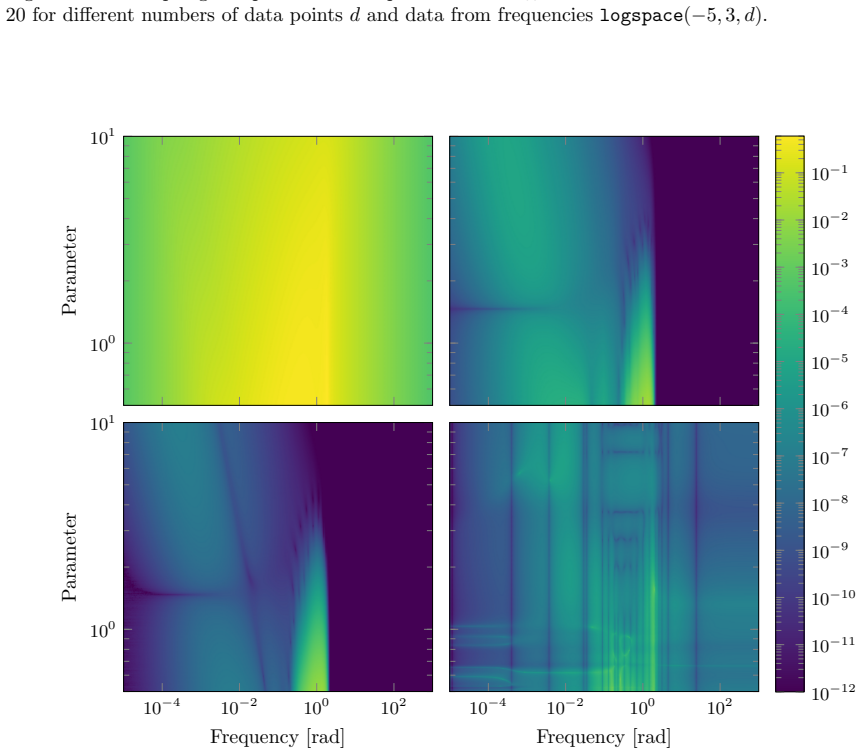
50 frequencies logspace(-5,3); p-AAA 100×100 grid; ERA horizon [0,100], sample Δt=0.05
assumptions (6)
- standard math Standard results in linear systems theory and approximation: SVD/POD optimality, Loewner interpolation, AAA barycentric rational approximation, ERA realization, balanced truncation H∞ bound, IRKA H2-optimality conditions.
- domain assumption The LTI systems under reduction are asymptotically stable (E^{-1}A Hurwitz) and the port-Hamiltonian structure (6) holds for the spring-damper example.
- domain assumption The parametric Navier-Stokes tests are restricted to a relatively high-viscosity regime ν ∈ [10^-2, 10^0] to avoid slow Kolmogorov N-width decay.
- ad hoc to paper In the custom IMEXModel, E, F_i and g are assumed time-independent so they can be pre-assembled before time stepping.
- ad hoc to paper The DMD example selects a periodic vortex-shedding regime (ν=10^-3, t ∈ [6,8]) so that DMD eigenvalues lie on the unit circle.
- ad hoc to paper Neural-network training uses subsampled time trajectories (every 10th step) and the random-access-in-time formulation due to limited training parameters.
Cite this review
Pith. "Pith review of Data-Driven Model Order Reduction with pyMOR." pith.science (2026). https://pith.science/paper/XDVTJSHW
@misc{pith2026260800082,
  author       = {Pith},
  title        = {Pith review of: Data-Driven Model Order Reduction with pyMOR},
  year         = {2026},
  howpublished = {\url{https://pith.science/paper/XDVTJSHW}},
  note         = {Machine review of arXiv:2608.00082}
}
read the original abstract
pyMOR is a free and open-source software library of model order reduction algorithms for the Python programming language. Designed with classical model-based reduction methods for large-scale parametric partial differential equation problems in mind, algorithms in pyMOR are implemented in terms of operations on abstract VectorArray, Operator and Model interfaces, allowing for a seamless integration with external solver codes implementing the full-order model. For cases where a tight integration with the full-order model code is not feasible, data-driven model order reduction algorithms, which only require simulation or measurement data of the full-order model, are an attractive alternative. In this work we discuss the data-driven methods that have been recently added to pyMOR, show practical examples of their application using pyMOR and compare their performance with classical model-based methods. We show that pyMOR serves as a unified framework for combining model-based and data-driven methods, enabling the construction of flexible and efficient hierarchical model reduction pipelines.
Figures


Figures from the paper (14 more)


Reference graph
Works this paper leans on
-
[58]
Reduced Basis Methods: Success, Limitations and Future Challenges
M. Ohlberger and S. Rave. “Reduced Basis Methods: Success, Limitations and Future Challenges”. In:Proceedings of the Conference ALGORITMY 2016, 20th Conference on Scientific Computing, Vysoke Tatry, Podbanske, Slovakia, March 13-18, 2016. Ed. by A. Handloviˇ cov´ a and D.ˇSevˇ coviˇ c. Bratislava: Publishing House of Slovak University of Technology in Bra...
2016
-
[1]
A. C. Antoulas.Approximation of Large-Scale Dynamical Systems. Vol. 6. Adv. Des. Control. Philadelphia, PA: SIAM Publications, 2005.isbn: 9780898715293.doi:10.1137/1.9780898718713
-
[2]
Interpolatory Model Reduction of Large-Scale Dynamical Systems
A. C. Antoulas, C. A. Beattie, and S. Gugercin. “Interpolatory Model Reduction of Large-Scale Dynamical Systems”. In:Efficient Modeling and Control of Large-Scale Systems. Ed. by Javad Mohammadpour and Karolos M. Grigoriadis. Boston, MA: Springer US, 2010, pp. 3–58.isbn: 978-1-4419-5756-6.doi:10.1007/978-1-4419-5757-3\_1
-
[3]
Model Reduction of Bilinear Systems in the Loewner Framework
A. C. Antoulas, I. V. Gosea, and A. C. Ionita. “Model Reduction of Bilinear Systems in the Loewner Framework”. In:SIAM J. Sci. Comput.38.5 (2016), B889–B916.doi:10.1137/15M1041432
-
[4]
Athanasios C. Antoulas, Christopher A. Beattie, and Serkan Gugercin.Interpolatory Methods for Model Reduction. Computational Science & Engineering. Philadelphia, PA: SIAM, 2020.isbn: 978- 1-61197-607-6.doi:10.1137/1.9781611976083
-
[5]
System-theoretic model order reduction with pyMOR
Linus Balicki et al. “System-theoretic model order reduction with pyMOR”. In:Proc. Appl. Math. Mech.19.1 (2019).issn: 1617-7061.doi:10.1002/pamm.201900459
-
[6]
Maxime Barrault et al. “An ‘empirical Interpolation’ Method: Application to Efficient Reduced- Basis Discretization of Partial Differential Equations”. In:C. R. Math. Acad. Sci. Paris339.9 (2004), pp. 667–672.issn: 1631-073X.doi:10.1016/j.crma.2004.08.006
-
[7]
Realization-independentH 2-approximation
Christopher Beattie and Serkan Gugercin. “Realization-independentH 2-approximation”. In:IEEE Conference on Decision and Control (CDC). Maui, HI, USA: IEEE, 2012, pp. 4953–4958.doi: 10.1109/cdc.2012.6426344
arXiv 2012
Show all 71 references
-
[8]
Benner, J
P. Benner, J. Saak, and S. W. R. Werner.MORLAB – Model Order Reduction LABoratory (version 6.0). See also:https://www.mpi- magdeburg.mpg.de/projects/morlab. 2023.doi:10.5281/ zenodo.7072831
2023
-
[9]
Benner et al., eds.Model Reduction and Approximation: Theory and Algorithms
P. Benner et al., eds.Model Reduction and Approximation: Theory and Algorithms. Computational Science & Engineering. Philadelphia, PA: SIAM, 2017.isbn: 978-1-611974-81-2.doi:10.1137/1. 9781611974829
2017 doi
-
[10]
Interpolation-BasedH 2-Model Reduction of Bilinear Control Systems
Peter Benner and Tobias Breiten. “Interpolation-BasedH 2-Model Reduction of Bilinear Control Systems”. In:SIAM J. Matrix Anal. Appl.33.3 (2012), pp. 859–885.issn: 1095-7162.doi:10 . 1137/110836742
2012
-
[11]
Model order reduction based on moment-matching
Peter Benner and Lihong Feng. “Model order reduction based on moment-matching”. In:Model Order Reduction. System- and Data-Driven Methods and Algorithms. Ed. by Peter Benner et al. Vol. 1. Berlin, Boston: De Gruyter, 2021.doi:10.1515/9783110498967-003
2021 doi
-
[12]
Truncated Gramians for Bilinear Systems and Their Advantages in Model Order Reduction
Peter Benner, Pawan Goyal, and Martin Redmann. “Truncated Gramians for Bilinear Systems and Their Advantages in Model Order Reduction”. In:Model Reduction of Parametrized Systems. Ed. by Peter Benner et al. Cham: Springer International Publishing, 2017, pp. 285–300.isbn: 978-3...
2017 doi
-
[13]
Berlin, Boston: De Gruyter, 2020.doi:10.1515/9783110498967
Peter Benner et al., eds.Model Order Reduction: Volume 1 System- and Data-Driven Methods and Algorithms. Berlin, Boston: De Gruyter, 2020.doi:10.1515/9783110498967
2020 doi
-
[14]
Berlin, Boston: De Gruyter, 2020.doi:10.1515/9783110499001
Peter Benner et al., eds.Model Order Reduction: Volume 3 Applications. Berlin, Boston: De Gruyter, 2020.doi:10.1515/9783110499001
2020 doi
-
[15]
Balancing-related model reduction methods
Tobias Breiten and Tatjana Stykel. “Balancing-related model reduction methods”. In:Model Order Reduction. System- and Data-Driven Methods and Algorithms. Ed. by Peter Benner et al. Vol. 1. Berlin, Boston: De Gruyter, 2021.doi:10.1515/9783110498967-002
2021 doi
-
[16]
Passivity preserving model reduction via spectral factoriza- tion
Tobias Breiten and Benjamin Unger. “Passivity preserving model reduction via spectral factoriza- tion”. In:Automatica142 (2022), p. 110368.doi:10.1016/j.automatica.2022.110368. 33
2022
-
[17]
Galerkin v. Least-Squares Petrov–Galerkin Projection in Nonlinear Model Reduction
Kevin Carlberg, Matthew Barone, and Harbir Antil. “Galerkin v. Least-Squares Petrov–Galerkin Projection in Nonlinear Model Reduction”. In:Journal of Computational Physics330 (2017), pp. 693–734.issn: 00219991.doi:10.1016/j.jcp.2016.10.033
2017 doi
-
[18]
Second-order balanced truncation
Y. Chahlaoui et al. “Second-order balanced truncation”. In:Linear Algebra Appl.415.2–3 (2006), pp. 373–384.doi:10.1016/j.laa.2004.03.032
2006 doi
-
[19]
Structure-Preserving Model Reduction for Nonlin- ear Port-Hamiltonian Systems
S. Chaturantabut, C. Beattie, and S. Gugercin. “Structure-Preserving Model Reduction for Nonlin- ear Port-Hamiltonian Systems”. In:SIAM J. Sci. Comput.38.5 (2016), B837–B865.issn: 1095-7197. doi:10.1137/15m1055085
2016 doi
-
[20]
Nonlinear Model Reduction via Discrete Empirical Interpolation
Saifon Chaturantabut and Danny C. Sorensen. “Nonlinear Model Reduction via Discrete Empirical Interpolation”. In:SIAM J. Sci. Comput.32.5 (2010), pp. 2737–2764.issn: 1064-8275.doi:10. 1137/090766498
2010
-
[21]
2019.doi:10.11578/dc.20190408.3
Youngsoo Choi et al.libROM. 2019.doi:10.11578/dc.20190408.3
2019 doi
-
[22]
Double Greedy Algorithms: Reduced Basis Methods for Transport Dominated Problems
Wolfgang Dahmen, Christian Plesken, and Gerrit Welper. “Double Greedy Algorithms: Reduced Basis Methods for Transport Dominated Problems”. In:ESAIM: Mathematical Modelling and Nu- merical Analysis48.03 (May 2014), pp. 623–663.issn: 1290-3841.doi:10.1051/m2an/2013103
2014
-
[23]
EZyRB: Easy Reduced Basis Method
Nicola Demo, Marco Tezzele, and Gianluigi Rozza. “EZyRB: Easy Reduced Basis Method”. In: Journal of Open Source Software3.24 (Apr. 2018), p. 661.issn: 2475-9066.doi:10.21105/joss. 00661
2018 doi
-
[24]
Greedy Algorithms for Reduced Bases in Banach Spaces
Ronald DeVore, Guergana Petrova, and Przemyslaw Wojtaszczyk. “Greedy Algorithms for Reduced Bases in Banach Spaces”. In:Constructive Approximation37.3 (2013), pp. 455–466.issn: 0176-4276. doi:10.1007/s00365-013-9186-2
2013 doi
-
[25]
A New Selection Operator for the Discrete Empirical Interpo- lation Method—Improved A Priori Error Bound and Extensions
Zlatko Drmaˇ c and Serkan Gugercin. “A New Selection Operator for the Discrete Empirical Interpo- lation Method—Improved A Priori Error Bound and Extensions”. In:SIAM J. Sci. Comput.38.2 (2016), A631–A648.issn: 1064-8275.doi:10.1137/15M1019271
2016 doi
-
[26]
pyNIROM–A suite of python modules for non-intrusive reduced order modeling of time-dependent problems
Sourav Dutta et al. “pyNIROM–A suite of python modules for non-intrusive reduced order modeling of time-dependent problems”. In:Software Impacts10 (2021), p. 100129.issn: 2665-9638.doi: 10.1016/j.simpa.2021.100129
2021
-
[27]
Julian Feinauer et al. “MULTIBAT: Unified workflow for fast electrochemical 3D simulations of lithium-ion cells combining virtual stochastic microstructures, electrochemical degradation models and model order reduction”. In:Journal of Computational Science31 (2019), pp. 172–18...
2019 doi
-
[28]
Data-driven model order reduction of quadratic- bilinear systems
Ion Victor Gosea and Athanasios C. Antoulas. “Data-driven model order reduction of quadratic- bilinear systems”. In:Numer. Linear Algebra Appl.25.6 (2018), e2200.doi:10.1002/nla.2200
2018 doi
-
[29]
Data-Driven Balancing of Linear Dynamical Systems
Ion Victor Gosea, Serkan Gugercin, and Christopher Beattie. “Data-Driven Balancing of Linear Dynamical Systems”. In:SIAM J. Sci. Comput.44.1 (2022), A554–A582.issn: 1095-7197.doi: 10.1137/21m1411081
2022 doi
-
[30]
H 2 Model Reduction for Large-Scale Linear Dynam- ical Systems
S. Gugercin, A. C. Antoulas, and C. Beattie. “H 2 Model Reduction for Large-Scale Linear Dynam- ical Systems”. In:SIAM J. Matrix Anal. Appl.30.2 (2008), pp. 609–638.doi:10.1137/060666123
2008 doi
-
[31]
Structure-preserving tangential interpolation for model reduction of port- Hamiltonian systems
Serkan Gugercin et al. “Structure-preserving tangential interpolation for model reduction of port- Hamiltonian systems”. In:Automatica48.9 (2012), pp. 1963–1974.issn: 0005-1098.doi:10.1016/ j.automatica.2012.05.052
2012
-
[32]
A Reduced Basis Method for Evolution Schemes with Parameter-Dependent Explicit Operators
B. Haasdonk, M. Ohlberger, and G. Rozza. “A Reduced Basis Method for Evolution Schemes with Parameter-Dependent Explicit Operators”. In:Electron. Trans. Numer. Anal.32 (2008), pp. 145– 161.issn: 1068-9613
2008
-
[33]
Chapter 2: Reduced Basis Methods for Parametrized PDEs–A Tutorial In- troduction for Stationary and Instationary Problems
Bernard Haasdonk. “Chapter 2: Reduced Basis Methods for Parametrized PDEs–A Tutorial In- troduction for Stationary and Instationary Problems”. In:Model Reduction and Approximation. Philadelphia, US: SIAM, 2017, pp. 65–136.isbn: 9781611974829.doi:10.1137/1.9781611974829. ch2
2017 doi
-
[34]
A New Certified Hierarchical and Adaptive RB-ML-ROM Surrogate Model for Parametrized PDEs
Bernard Haasdonk et al. “A New Certified Hierarchical and Adaptive RB-ML-ROM Surrogate Model for Parametrized PDEs”. In:SIAM J. Sci. Comput.45.3 (2023), A1039–A1065.doi:10. 1137/22M1493318. 34
2023
-
[35]
Fast Evaluation of Time-Harmonic Maxwell’s Equations Using the Reduced Basis Method
M. W. Hess and P. Benner. “Fast Evaluation of Time-Harmonic Maxwell’s Equations Using the Reduced Basis Method”. In:IEEE Trans. Microw. Theory Techn.61.6 (2013), pp. 2265–2274.doi: 10.1109/TMTT.2013.2258167
2013
-
[36]
Non-intrusive reduced order modeling of nonlinear problems using neural networks
J. S. Hesthaven and S. Ubbiali. “Non-intrusive reduced order modeling of nonlinear problems using neural networks”. In:J. Comput. Phys.363 (2018), pp. 55–78.doi:10.1016/j.jcp.2018.02.037
2018 doi
-
[37]
Hesthaven, Gianluigi Rozza, and Benjamin Stamm.Certified Reduced Basis Methods for Parametrized Partial Differential Equations
Jan S. Hesthaven, Gianluigi Rozza, and Benjamin Stamm.Certified Reduced Basis Methods for Parametrized Partial Differential Equations. Switzerland: Springer International Publishing, 2016. isbn: 9783319224701.doi:10.1007/978-3-319-22470-1
2016 doi
-
[38]
Hierarchical Approximate Proper Orthogonal Decomposition
C. Himpe, T. Leibner, and S. Rave. “Hierarchical Approximate Proper Orthogonal Decomposition”. In:SIAM J. Sci. Comput.40.5 (2018), A3267–A3292.doi:10.1137/16M1085413
2018 doi
-
[39]
PyDMD: A Python Package for Robust Dynamic Mode Decomposition
Sara M. Ichinaga et al. “PyDMD: A Python Package for Robust Dynamic Mode Decomposition”. In: J. Mach. Learn. Res.25.417 (2024), pp. 1–9.url:https://jmlr.org/papers/v25/24-0739.html
2024
-
[40]
Data-Driven Parametrized Model Reduction in the Loewner Framework
A. C. Ionita and A. C. Antoulas. “Data-Driven Parametrized Model Reduction in the Loewner Framework”. In:SIAM J. Sci. Comput.36.3 (2014), A984–A1007.doi:10.1137/130914619. [41]ITHACA-FV.https://ithaca-fv.github.io/ITHACA-FV/. June 2026. (Visited on 06/26/2026)
2014 doi
-
[42]
An eigensystem realization algorithm for modal parameter identification and model reduction
Jer-Nan Juang and Richard S. Pappa. “An eigensystem realization algorithm for modal parameter identification and model reduction”. In:Journal of Guidance, Control, and Dynamics8.5 (1985), pp. 620–627.issn: 1533-3884.doi:10.2514/3.20031
1985 doi
-
[43]
PySINDy: A Comprehensive Python Package for Robust Sparse System Identification
Alan A. Kaptanoglu et al. “PySINDy: A Comprehensive Python Package for Robust Sparse System Identification”. In:Journal of Open Source Software7.69 (Jan. 2022), p. 3994.issn: 2475-9066.doi: 10.21105/joss.03994
2022 doi
-
[44]
Adam: A Method for Stochastic Optimization
Diederik P. Kingma and Jimmy Ba. “Adam: A Method for Stochastic Optimization”. In:Inter- national Conference on Learning Representations (ICLR). 2015.url:https://arxiv.org/abs/ 1412.6980
2015 arXiv
-
[45]
Ver- sion ed93797
Hendrik Kleikamp et al.Data-Driven Model Order Reduction with pyMOR (companion code). Ver- sion ed93797. July 2026.doi:10.5281/zenodo.21444105.url:https://doi.org/10.5281/ zenodo.21444105
2026 doi
-
[46]
Tangential interpolation-based eigensystem realization algorithm for MIMO systems
B. Kramer and S. Gugercin. “Tangential interpolation-based eigensystem realization algorithm for MIMO systems”. In:Mathematical and Computer Modelling of Dynamical Systems22.4 (2016), pp. 282–306.doi:10.1080/13873954.2016.1198389
2016
-
[47]
A framework for the solution of the generalized realization problem
A. J. Mayo and A. C. Antoulas. “A framework for the solution of the generalized realization problem”. In:Linear Algebra Appl.425.2–3 (2007). Special Issue in honor of P. A. Fuhrmann, Edited by A. C. Antoulas, U. Helmke, J. Rosenthal, V. Vinnikov, and E. Zerz, pp. 634–662.doi: ...
2007 doi
-
[48]
PySPOD: A Python Package for Spectral Proper Or- thogonal Decomposition (SPOD)
Gianmarco Mengaldo and Romit Maulik. “PySPOD: A Python Package for Spectral Proper Or- thogonal Decomposition (SPOD)”. In:Journal of Open Source Software6.60 (Apr. 2021), p. 2862. issn: 2475-9066.doi:10.21105/joss.02862
2021 doi
-
[49]
Balancing and model reduction for second-order form linear sys- tems
D. G. Meyer and S. Srinivasan. “Balancing and model reduction for second-order form linear sys- tems”. In:IEEE Trans. Autom. Control41.11 (1996), pp. 1632–1644.doi:10.1109/9.544000
1996 doi
-
[50]
pyMOR – Generic Algorithms and Interfaces for Model Order Reduction
Ren´ e Milk, Stephan Rave, and Felix Schindler. “pyMOR – Generic Algorithms and Interfaces for Model Order Reduction”. In:SIAM J. Sci. Comput.38.5 (2016), S194–S216.issn: 1095-7197.doi: 10.1137/15m1026614
2016 doi
-
[51]
Efficient Algorithms for Eigensystem Realization Using Randomized SVD
Rachel Minster et al. “Efficient Algorithms for Eigensystem Realization Using Randomized SVD”. In:SIAM J. Matrix Anal. Appl.42.2 (2021), pp. 1045–1072.issn: 1095-7162.doi:10 . 1137 / 20m1327616
2021
-
[52]
L2-optimal Reduced-order Modeling Using Parameter-separable Forms
Petar Mlinari´ c and Serkan Gugercin. “L2-optimal Reduced-order Modeling Using Parameter-separable Forms”. In:SIAM J. Sci. Comput.45.2 (2023), A554–A578.doi:10.1137/22M1500678
2023 doi
-
[53]
Parametric Model Order Reduction Using pyMOR
Petar Mlinari´ c, Stephan Rave, and Jens Saak. “Parametric Model Order Reduction Using pyMOR”. In:Model Reduction of Complex Dynamical Systems. Cham: Springer International Publishing, 2021, pp. 357–367.isbn: 9783030729837.doi:10.1007/978-3-030-72983-7_17. 35 [54]ModelOrderRed...
2021 doi
-
[55]
Principal component analysis in linear systems: controllability, observability, and model reduction
B. C. Moore. “Principal component analysis in linear systems: controllability, observability, and model reduction”. In:IEEE Trans. Autom. Control26.1 (1981), pp. 17–32.doi:10.1109/TAC. 1981.1102568
1981
-
[56]
Port-Hamiltonian Dynamic Mode Decomposition
Riccardo Morandin, Jonas Nicodemus, and Benjamin Unger. “Port-Hamiltonian Dynamic Mode Decomposition”. In:SIAM J. Sci. Comput.45.4 (2023), A1690–A1710.issn: 1095-7197.doi:10. 1137/22m149329x
2023
-
[57]
The AAA Algorithm for Rational Ap- proximation
Yuji Nakatsukasa, Olivier S` ete, and Lloyd N. Trefethen. “The AAA Algorithm for Rational Ap- proximation”. In:SIAM J. Comput.40.3 (2018), A1494–A1522.doi:10.1137/16M1106122
2018 doi
-
[59]
A Model Reduction Framework for Efficient Simulation of Li-Ion Batter- ies
Mario Ohlberger et al. “A Model Reduction Framework for Efficient Simulation of Li-Ion Batter- ies”. In:Finite Volumes for Complex Applications VII-Elliptic, Parabolic and Hyperbolic Problems. Cham: Springer International Publishing, 2014, pp. 695–702.isbn: 9783319055916.doi:1...
2014
-
[61]
PyTorch: an imperative style, high-performance deep learning library
Adam Paszke et al. “PyTorch: an imperative style, high-performance deep learning library”. In: Proceedings of the 33rd International Conference on Neural Information Processing Systems. Red Hook, NY, USA: Curran Associates Inc., 2019
2019
-
[62]
Scikit-learn: Machine Learning in Python
F. Pedregosa et al. “Scikit-learn: Machine Learning in Python”. In:Journal of Machine Learning Research12 (2011), pp. 2825–2830
2011
-
[63]
Alfio Quarteroni, Andrea Manzoni, and Federico Negri.Reduced Basis Methods for Partial Differ- ential Equations. Vol. 92. UNITEXT. Cham: Springer International Publishing, 2016.isbn: 978-3- 319-15430-5 978-3-319-15431-2.doi:10.1007/978-3-319-15431-2
2016 doi
-
[64]
Carl Edward Rasmussen and Christopher K. I. Williams.Gaussian Processes for Machine Learning. Massachusetts Institute of Technolog: The MIT Press, 2005.isbn: 9780262256834.doi:10.7551/ mitpress/3206.001.0001. [65]RBniCSx.https://github.com/RBniCS/RBniCSx. June 2026. (Visited o...
2005
-
[66]
Balanced truncation model reduction of second-order systems
T. Reis and T. Stykel. “Balanced truncation model reduction of second-order systems”. In:Math. Comput. Model. Dyn. Syst.14.5 (2008), pp. 391–406.doi:10.1080/13873950701844170
2008 doi
- [67]
-
[69]
The p-AAA Algorithm for Data- Driven Modeling of Parametric Dynamical Systems
Andrea Carracedo Rodriguez, Linus Balicki, and Serkan Gugercin. “The p-AAA Algorithm for Data- Driven Modeling of Parametric Dynamical Systems”. In:SIAM J. Comput.45.3 (2023), A1332– A1358.doi:10.1137/20M1322698
2023 doi
-
[70]
Parametric PDEs Worked Out Problems
Gianluigi Rozza et al.Real Time Reduced Order Computational Mechanics. Parametric PDEs Worked Out Problems. SISSA Springer Series. Cham: Springer, 2024.isbn: 978-3-031-49891-6.doi: 10.1007/978-3-031-49892-3
2024 doi
-
[71]
Kernel Methods for Surrogate Modeling
Gabriele Santin and Bernard Haasdonk. “Kernel Methods for Surrogate Modeling”. In:Model Order Reduction. System- and Data-Driven Methods and Algorithms. Ed. by Peter Benner et al. Vol. 1. Berlin, Boston: De Gruyter, 2021.doi:10.1515/9783110498967-009. 36
2021 doi
-
[72]
Benchmark Computations of Laminar Flow Around a Cylinder
M. Sch¨ afer et al. “Benchmark Computations of Laminar Flow Around a Cylinder”. In:Flow Simula- tion with High-Performance Computers II: DFG Priority Research Programme Results 1993–1995. Ed. by Ernst Heinrich Hirschel. Wiesbaden: Vieweg+Teubner Verlag, 1996, pp. 547–566.isbn:...
1993 doi
-
[73]
Dynamic mode decomposition of numerical and experimental data
Peter J. Schmid. “Dynamic mode decomposition of numerical and experimental data”. In:Journal of Fluid Mechanics656 (2010), pp. 5–28.issn: 1469-7645.doi:10.1017/s0022112010001217
2010 doi
-
[74]
Turbulence and the Dynamics of Coherent Structures Part I: Coherent Structures
L. Sirovich. “Turbulence and the Dynamics of Coherent Structures Part I: Coherent Structures”. In:Quarterly of Applied Mathematics45.3 (1987), pp. 561–571. [75]Tutorial: Binding an External PDE Solver to pyMOR — pyMOR V2025.2.2 Manual.https:// docs.pymor.org/2025-2-2/tutorial_...
1987
-
[76]
Non-intrusive reduced order modeling of unsteady flows using artificial neural networks with application to a combustion problem
Qian Wang, Jan S. Hesthaven, and Deep Ray. “Non-intrusive reduced order modeling of unsteady flows using artificial neural networks with application to a combustion problem”. In:J. Comput. Phys.384 (2019), pp. 289–307.doi:10.1016/j.jcp.2019.01.031
2019 doi
-
[77]
Analysis of Target Data-Dependent Greedy Kernel Algorithms: Convergence Rates forf-,f·P- andf /P-Greedy
Tizian Wenzel, Gabriele Santin, and Bernard Haasdonk. “Analysis of Target Data-Dependent Greedy Kernel Algorithms: Convergence Rates forf-,f·P- andf /P-Greedy”. In:Constr. Ap- prox.57.1 (2022), pp. 45–74.issn: 1432-0940.doi:10.1007/s00365-022-09592-3. 37
2022 doi
Reviewed August 4, 2026 · model on record in the stance chip above.
Discussion (0). Continue with ORCID to comment.