REVIEW 3 major objections 4 minor 36 references
Spectroscopy of the Hyperfine Structure of HD$^+$ in Rotationally Excited States with 10-ppb Uncertainty
T0 review · 3 major / 4 minor · reviewed 2026-08-05 · deepseek-v4-flash
Pith's one-line read The first direct microwave measurement of the total hyperfine interval in the (v=0,L=3) state of HD+ yields 1,050,804.511 ± 0.011 kHz, 81 times more precise than theory and 1.9σ higher.
desk verdict A solid, novel precision measurement of a new HD+ hyperfine interval, with the main caveat being missing supplementary material rather than any apparent flaw in the logic. read the letter →
The pith
A machine-rendered reading of the paper's core claim, the machinery that carries it, and where it could break.
The reading
What carries the argument
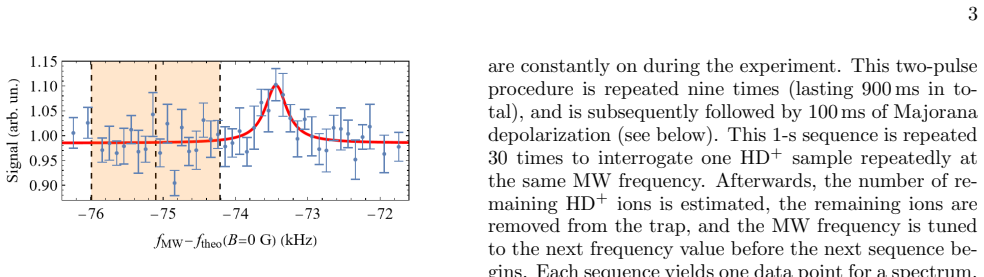
The key mechanism is a population-amplification scheme: intermittent Majorana depolarization randomly re-orients the spin state of the HD+ ensemble, while blackbody radiation repopulates rotational levels, together raising the occupancy of the target magnetic sublevel from 0.24% to about 6%. The measured transition, J=5, M_J=0 → J=4, M_J=-1, has a small quadratic Zeeman shift, and its residual field dependence is removed by fitting line centers at several bias fields to the theoretical Zeeman curve. This yields a zero-field interval with an 8.8-Hz statistical uncertainty, later corrected for systematic shifts.
What would settle it
Measure the same J=5→J=4 hyperfine transition at several bias fields between 1 and 2 G using an independently calibrated magnetic field (for example, fully characterized Be+ co-magnetometry), and check whether the zero-field extrapolation still gives 1,050,804.511 kHz; if the theoretical Zeeman curve is off by more than about 10 Hz at these fields, the extrapolated frequency will move away from the reported value. Alternatively, a future direct microwave measurement of the v=9,L=3 total hyperfine interval that disagrees with the predicted −6.8(1.2) kHz deviation would undercut the rotational-s
Extended reading notes
Core claim
The central claim is that the total hyperfine interval in the (v=0,L=3) state of HD+ is 1,050,804.511 ± 0.011 kHz, determined by detecting a single field-insensitive magnetic subcomponent of the J=5→J=4 transition at 1.0508 GHz in a linear Paul trap. The paper argues that this measurement, at 10 ppb fractional uncertainty, is the most precise hyperfine benchmark for HD+ to date and provides a critical test of molecular quantum-electrodynamics theory. The measured value sits 1.9σ above the ab initio prediction of 1,050,802.78 ± 0.89 kHz, while a hybrid prediction built from the measured L=0 coefficients scaled by theoretical rotational ratios agrees with the new result to within 0.06σ. The au
Load-bearing premise
The paper assumes the theoretical Zeeman shift of HD+ is accurate to a few parts in 10^8; this theory is used both to set the bias field scale and to extrapolate line positions measured at 1–2 G down to zero field, so any error of order 10–20 Hz in the Zeeman model would shift the reported 1,050,804.511 kHz value.
Editorial extensions
If this is right
- The measured hyperfine interval provides a benchmark for mQED hyperfine calculations, 81 times more accurate than the current theory, which should stimulate improved calculations of the missing contributions.
- Combined with the L=0 Penning-trap results, the measurement supports the hypothesis that the rotational scaling of the Fermi-contact coefficients E4 and E5 is correctly predicted by theory, so the theoretical error is roughly L-independent rather than rotationally growing.
- The measurement, together with previous two-photon spectroscopy of the v=0→v=9 transition, implies a −6.8(1.2) kHz deviation from theory for the total hyperfine interval in v=9, L=3, a prediction the authors plan to test directly.
- The demonstrated population-amplification technique can be applied to any microwave or optical transition in sympathetically cooled molecular ions with appreciable 300-K rotational population, enabling spectroscopy of rare quantum states.
Reading between the lines
- If the rotational-scaling hypothesis is correct, then comparing the L=3 and L=0 measurements isolates the L-dependent part of the hyperfine discrepancy and may locate the missing physics in terms that do not scale with rotation, such as nuclear-structure or higher-order QED effects tied to the deuteron.
- The same population-amplification approach could be adapted to other hydride molecular ions with REMPD-accessible vibrational levels, potentially extending high-precision hyperfine benchmarks to species such as H2+ or other deuterated ions.
- A direct measurement of the v=9,L=3 hyperfine interval, as the authors propose, would test the predicted −6.8 kHz deviation and could determine whether the discrepancy scales with vibrational quantum number, offering a further discriminator between theories.
- The reliance on the theoretical Zeeman curve for the zero-field extrapolation could be checked by independently calibrating the magnetic field with fully characterized Be+ spectroscopy, which would turn the current a posteriori calibration into a model-independent measurement.
Editorial analysis
A structured set of objections, weighed in public.
Referee Report
Summary. This Letter reports the first measurement of the total hyperfine interval in the (v=0, L=3) manifold of HD+ using microwave spectroscopy of sympathetically cooled HD+ ions in a Paul trap. The authors overcome the low occupancy of the relevant hyperfine state by combining intermittent Majorana depolarization with blackbody-driven rotational redistribution, achieving an effective population amplification of 25. They observe the first-order-field-insensitive component J=5, M_J=0 → J=4, M_J=−1 and, after fitting the line centers versus bias field to the theoretical HD+ Zeeman curve, obtain a zero-field transition frequency of 1,050,804.511(11) kHz (10 ppb). This differs from the ab initio prediction, 1,050,802.78(89) kHz, by 1.9σ. A hybrid prediction constructed from the L=0 experimental spin coefficients of König et al. and theoretical L-scaling of the Fermi-contact coefficients agrees with the measured value, which the authors interpret as support for the correctness of the rotational scaling of the hyperfine theory. The main text gives an uncertainty budget and a plausible high-level description, but the central Zeeman model, the systematic-correction derivations, and the analysis/data are relegated to a Supplemental Material and a data repository that are not included in the preprint.
Significance. If the result is correct, it is a significant experimental advance: it is the most precise HD+ hyperfine measurement to date, 81 times more accurate than the theoretical prediction, and it sharpens the existing tension between mQED hyperfine theory and experiment. The population-amplification technique is novel and potentially transferable to other hydride ions. The hybrid analysis is a clever consistency test, and the authors are transparent about the correlation assumption behind it. The main weakness is that the load-bearing details — the Zeeman model, the 24.09 kHz/G^2 coefficient, the B-field offset fit, and the systematic corrections — are not present in the manuscript itself, so the central 10-ppb claim cannot currently be independently verified.
major comments (3)
- [Control over Zeeman shifts / Fig. 3] The zero-field frequency is the central result. It is obtained by fitting measured line centers as a function of bias field to the theoretical HD+ Zeeman curve, with an overall field offset as a free parameter. The quadratic Zeeman coefficient 24.09 kHz/G^2, the derivation and uncertainty of the Zeeman curve, the propagation of the 10-mG field noise and the fitted −10(6) mG offset into the 8.8-Hz statistical uncertainty, and the 1.2-Hz quadratic-Zeeman systematic are all relegated to Supplemental Material [19], which is not included with the preprint. The data in Fig. 3 span only 1–2 G; the extrapolation to zero field therefore depends sensitively on the assumed curvature. A deviation of a few percent in the 24.09 kHz/G^2 coefficient would shift the intercept by kilohertz, i.e., far above the claimed 11-Hz total uncertainty. The paper's statement that the Zeeman effect is known to severa
- [Data availability] The data availability statement is a placeholder ('{public DataverseNL handle to be inserted by authors}'), and the promised measurement data, fit model, and analysis are not present. For a 10-ppb claim that disagrees with theory by 1.9σ and relies on a multi-step analysis (Welch's t-test, slow-signal correction, Lorentzian fits, Zeeman fit, multiple systematic corrections), the underlying data and code are necessary for a referee to confirm the central result. Please provide the actual data repository and, at minimum, the fitted line centers with their uncertainties and residuals as a table in the supplement.
- [Control over Zeeman shifts / Fig. 3] The a-posteriori calibration uses the theoretical HD+ Zeeman curve, which is derived within the same hyperfine theory that the measurement is designed to test. The manuscript should quantify the sensitivity of the quadratic Zeeman coefficient and the inferred field offset to the hyperfine parameters, and should demonstrate that a 1.9σ error in the hyperfine intervals does not alter the zero-field intercept by more than a fraction of 1 Hz. This analysis is absent from the main text and presumably resides in the missing supplement.
minor comments (4)
- [Summary / last paragraph] The final paragraph states the transition as '(F, S, J) = (1,2,4)→(1,2,5)', but the rest of the paper uses '(1,2,5)→(0,1,4)'. Please correct this inconsistency.
- [Fig. 3 caption] The caption gives the zero-field theoretical value as 1,050,802.79(89) kHz, while the text and abstract quote 1,050,802.78(89) kHz. Please harmonize the rounding.
- [Zeeman section] The line is called 'field-insensitive', but it has a quadratic Zeeman shift of 24.09 kHz/G^2, which is about 95 kHz at 1.99 G. Consider calling it 'first-order field-insensitive' or 'linearly field-insensitive' to avoid confusion.
- [Hybrid prediction] The statement that the ratios E_i(0,3)/E_i(0,0) have 'zero uncertainty' is categorical; the text immediately acknowledges the correlation assumption, but it would be clearer to state that this holds exactly only under the hypothesis of perfectly correlated theoretical uncertainties. The 0.98-robustness test is helpful, but the wording should reflect the conditional nature.
Circularity Check
No significant circularity: the central hyperfine interval is an independent external measurement; self-citations are not load-bearing. Missing supplemental data is a reproducibility limitation, not a circular reduction.
full rationale
The measured total hyperfine interval in (v=0,L=3) HD+ is determined by fitting observed microwave line centers as a function of bias field to a theoretical Zeeman curve, with free offset frequency and magnetic-field offset. The zero-field frequency is the fitted offset; it is not set equal to the ab initio prediction f_theo. The theoretical field dependence is auxiliary and, at the stated 10^-8 accuracy, contributes negligibly to the 11-Hz uncertainty. No parameter of the target hyperfine Hamiltonian is fitted to the spectrum, so the 1.9-sigma comparison with f_theo (Refs. [21,35]) is an external test. The hybrid prediction f_hyb is explicitly constructed from E_exp(0,0) (König et al.) and theoretical scaling ratios; the paper labels it 'hybrid' and uses it only as a consistency check of rotational scaling. The agreement f_exp vs f_hyb is not a tautology because f_exp is independently measured. Self-citations to [13,21,35,36] are prior ab initio calculations and analysis methods that are not adjusted to the present data. The main weaknesses are verifiability gaps: the Supplemental Material [19] containing the Zeeman model and systematic corrections is absent, and the data-availability statement is a placeholder. These do not constitute equation-level circularity but should be weighed as reproducibility risks.
Assumptions & free parameters
free parameters (2)
- Magnetic field offset (fit nuisance) =
-10(6) mG relative to Be+ derived estimates
- Zero-field transition frequency (line-center fit output) =
1,050,804.511(11) kHz after systematic corrections
assumptions (6)
- domain assumption The HD+ hyperfine Hamiltonian and the F,S,J coupling scheme of Karr and Koelemeij and Haidar et al. correctly label the measured transition as (F,S,J)=(1,2,5) -> (0,1,4) and identify it as the total hyperfine interval.
- domain assumption The theoretical Zeeman effect of HD+ is accurate to several parts in 10^8, so using it to extrapolate field-dependent line centers to zero field is exact at the reported uncertainty.
- domain assumption REMPD with the 1442 nm and 1445 nm lasers is state-selective for the (F,S,J)=(0,1,4) hyperfine component of v=0,L=3, so HD+ loss faithfully reports population in the J=4 target state.
- domain assumption Blackbody radiation and spontaneous emission redistribute rotational population on the experimental timescale, and Majorana depolarization repopulates magnetic substates, producing the factor-25 occupancy enhancement.
- domain assumption For the hybrid prediction, theoretical errors of E_i(0,0) and E_i(0,3) for i=4,5 are treated as perfectly correlated, so the scaling ratios have zero uncertainty.
- domain assumption Before spectroscopy, all HD+ ions have decayed to the vibrational ground state v=0, and the initial rotational distribution is approximately thermal at 300 K.
Cite this review
Pith. "Pith review of Spectroscopy of the Hyperfine Structure of HD$^+$ in Rotationally Excited States with 10-ppb Uncertainty." pith.science (2026). https://pith.science/paper/6V6QPHI6
@misc{pith2026260800607,
  author       = {Pith},
  title        = {Pith review of: Spectroscopy of the Hyperfine Structure of HD$^+$ in Rotationally Excited States with 10-ppb Uncertainty},
  year         = {2026},
  howpublished = {\url{https://pith.science/paper/6V6QPHI6}},
  note         = {Machine review of arXiv:2608.00607}
}
abstract
We report the first measurement of the total hyperfine interval in the manifold of the ($v=0,L=3$) rovibrational state of HD$^+$ using microwave spectroscopy of HD$^+$ ions in a linear Paul trap. To overcome the low (0.2%) occupancy of the quantum states involved, we employ a novel technique that combines intermittent Majorana depolarization of the HD$^+$ ensemble with redistribution of rotational-state population by blackbody radiation to effectively amplify the occupancy by a factor of 25. This enables the observation of a single field-insensitive magnetic subcomponent of the hyperfine transition, leading to a measured total hyperfine interval of ${1\,050\,804.511}\pm 0.011\,$kHz with an unprecedented relative uncertainty of 10 parts per billion. This differs from the theoretically predicted value ${1\,050\,802.78}\pm 0.89\,$kHz by 1.9$\sigma$. We show that our experimental value is consistent with the recently measured hyperfine structure of the ($v=0,L=0$) rovibrational state of HD$^+$ [C.M. K\"onig et al., High-precision Penning trap spectroscopy of the ground state spin structure of HD$^+$, Phys. Rev. Lett. $\mathbf{136}$,143002 (2026)], for which a similar deviation from theory was found. Our work may help resolve puzzling discrepancies between the theoretical and experimental hyperfine structure observed previously in optical rovibrational spectra of HD$^+$.
Figures


Reference graph
Works this paper leans on
-
[19]
See Supplemental Material at [URL will be inserted by publisher] for details regarding the theoretical hyperfine structure, the DC and AC Zeeman shifts, the experi- mental procedure, and experimental and theoretical un- certainties
-
[1]
S. Schiller, Precision spectroscopy of molecular hydro- gen ions: an introduction, Contemporary Physics63, 247 (2022). 6
work page 2022
-
[2]
J.-Ph. Karr, L. Hilico, J. C. J. Koelemeij, and V. I. Ko- robov, Hydrogen molecular ions for improved determina- tion of fundamental constants, Phys. Rev. A94, 050501 (2016)
work page 2016
-
[3]
J.-Ph. Karr, S. Schiller, V. I. Korobov, and S. Alighan- bari, Determination of a set of fundamental constants from molecular hydrogen ion spectroscopy: A modeling study, Phys. Rev. A112, 022809 (2025)
work page 2025
-
[4]
S. Schiller and J.-Ph. Karr, Prospects for the determi- nation of fundamental constants with beyond-state-of- the-art uncertainty using molecular hydrogen ion spec- troscopy, Phys. Rev. A109, 042825 (2024), see also Er- ratum: Phys. Rev. A111, 059902 (2025)
work page 2024
- [5]
-
[6]
S. Alighanbari, G. S. Giri, F. L. Constantin, V. I. Ko- robov, and S. Schiller, Precise test of quantum electro- dynamics and determination of fundamental constants with HD+ ions, Nature581, 152 (2020)
work page 2020
-
[7]
I. V. Kortunov, S. Alighanbari, M. G. Hansen, G. S. Giri, V. I. Korobov, and S. Schiller, Proton–electron mass ratio by high-resolution optical spectroscopy of ion ensembles in the resolved-carrier regime, Nature Physics17, 569 (2021)
work page 2021
Show all 36 references
-
[8]
Alighanbari, I
S. Alighanbari, I. V. Kortunov, G. S. Giri, and S. Schiller, Test of charged baryon interaction with high-resolution vibrational spectroscopy of molecular hydrogen ions, Na- ture Physics19, 1263 (2023)
2023
-
[9]
D. J. Fink and E. G. Myers, Deuteron-to-Proton Mass Ratio from Simultaneous Measurement of the Cyclotron Frequencies of H+ 2 and D+, Phys. Rev. Lett.127, 243001 (2021)
2021
-
[10]
S. Rau, F. Heiße, F. K¨ ohler-Langes, S. Sasidharan, R. Haas, D. Renisch, C. E. D¨ ullmann, W. Quint, S. Sturm, and K. Blaum, Penning trap mass measure- ments of the deuteron and the HD + molecular ion, Na- ture585, 43 (2020)
2020
-
[11]
Heiße, S
F. Heiße, S. Rau, F. K¨ ohler-Langes, W. Quint, G. Werth, S. Sturm, and K. Blaum, High-precision mass spectrom- eter for light ions, Phys. Rev. A100, 022518 (2019)
2019
-
[12]
Sturm, F
S. Sturm, F. K¨ ohler, J. Zatorski, A. Wagner, Z. Harman, G. Werth, W. Quint, C. H. Keitel, and K. Blaum, High- precision measurement of the atomic mass of the electron, Nature506, 467 (2014)
2014
-
[13]
Karr and J
J.-Ph. Karr and J. C. J. Koelemeij, Extraction of spin- averaged rovibrational transition frequencies in HD + for the determination of fundamental constants, Molecular Physics121, e2216081 (2023)
2023
-
[14]
P. J. Mohr, D. B. Newell, B. N. Taylor, and E. Tiesinga, CODATA recommended values of the fundamental phys- ical constants: 2022, Rev. Mod. Phys.97, 025002 (2025)
2022
-
[15]
E. J. Salumbides, J. C. J. Koelemeij, J. Komasa, K. Pachucki, K. S. E. Eikema, and W. Ubachs, Bounds on fifth forces from precision measurements on molecules, Phys. Rev. D87, 112008 (2013)
2013
-
[16]
Biesheuvel, J.-Ph
J. Biesheuvel, J.-Ph. Karr, L. Hilico, K. S. E. Eikema, W. Ubachs, and J. C. J. Koelemeij, Probing QED and fundamental constants through laser spectroscopy of vi- brational transitions in HD+, Nature Communications7, 10385 (2016)
2016
-
[17]
Germann, S
M. Germann, S. Patra, J.-Ph. Karr, L. Hilico, V. I. Ko- robov, E. J. Salumbides, K. S. E. Eikema, W. Ubachs, and J. C. J. Koelemeij, Three-body QED test and fifth- force constraint from vibrations and rotations of HD +, Phys. Rev. Res.3, L022028 (2021)
2021
-
[18]
Delaunay, J.-Ph
C. Delaunay, J.-Ph. Karr, T. Kitahara, J. C. J. Koele- meij, Y. Soreq, and J. Zupan, Self-consistent extraction of spectroscopic bounds on light new physics, Phys. Rev. Lett.130, 121801 (2023)
2023
-
[20]
K. B. Jefferts, Hyperfine Structure in the Molecular Ion H+ 2 , Phys. Rev. Lett.23, 1476 (1969)
1969
-
[21]
Haidar, V
M. Haidar, V. I. Korobov, L. Hilico, and J.-Ph. Karr, Higher-order corrections to the spin-orbit and spin-spin tensor interactions in HD +, Phys. Rev. A106, 042815 (2022)
2022
-
[22]
Bonilla, T
J. Bonilla, T. R. Richardson, S. Bacca, C. Ji, and L. Plat- ter, Improved nuclear-structure corrections to the hyper- fine splitting of electronic and muonic deuterium, Physics Letters B874, 140257 (2026)
2026
-
[23]
Kalinowski, K
M. Kalinowski, K. Pachucki, and V. A. Yerokhin, Nuclear-structure corrections to the hyperfine splitting in muonic deuterium, Phys. Rev. A98, 062513 (2018)
2018
-
[24]
C. M. K¨ onig, M. Bohman, F. Heiße, J. Morgner, T. Sailer, B. Tu, K. Blaum, S. Sturm, D. Bakalov, H. D. Nogueira, J.-Ph. Karr, O. Kullie, and S. Schiller, High-Precision Penning Trap Spectroscopy of the Ground State Spin Structure of HD +, Phys. Rev. Lett.136, 143002 (2026)
2026
-
[25]
V. Q. Tran, J.-Ph. Karr, A. Douillet, J. C. J. Koelemeij, and L. Hilico, Two-photon spectroscopy of trapped HD + ions in the Lamb-Dicke regime, Phys. Rev. A88, 033421 (2013)
2013
-
[26]
Patra,Towards Doppler-free two-photon spectroscopy of trapped and cooled HD + ions, PhD thesis, Vrije Uni- versiteit Amsterdam (2019)
S. Patra,Towards Doppler-free two-photon spectroscopy of trapped and cooled HD + ions, PhD thesis, Vrije Uni- versiteit Amsterdam (2019)
2019
-
[27]
A. C. Wilson, C. Ospelkaus, A. P. VanDevender, J. A. Mlynek, K. R. Brown, D. Leibfried, and D. J. Wineland, A 750-mW, Continuous-Wave, Solid-State Laser Source at 313 nm for Cooling and Manipulating Trapped 9Be+ Ions, Applied Physics B105, 741 (2011)
2011
-
[28]
J. C. J. Koelemeij, B. Roth, and S. Schiller, Blackbody thermometry with cold molecular ions and application to ion-based frequency standards, Phys. Rev. A76, 023413 (2007)
2007
-
[29]
B. Roth, J. C. J. Koelemeij, H. Daerr, and S. Schiller, Rovibrational spectroscopy of trapped molecular hydro- gen ions at millikelvin temperatures, Phys. Rev. A74, 040501 (2006)
2006
-
[30]
Biesheuvel, J.-Ph
J. Biesheuvel, J.-Ph. Karr, L. Hilico, K. S. E. Eikema, W. Ubachs, and J. C. J. Koelemeij, High-precision spec- troscopy of the HD + molecule at the 1-p.p.b. level, Ap- plied Physics B123, 23 (2017), published 24 December 2016 (online)
2017
-
[31]
Bakalov, V
D. Bakalov, V. I. Korobov, and S. Schiller, Magnetic field effects in the transitions of the HD + molecular ion and precision spectroscopy, Journal of Physics B: Atomic, Molecular and Optical Physics44, 025003 (2011)
2011
-
[32]
Schneider, B
T. Schneider, B. Roth, H. Duncker, I. Ernsting, and S. Schiller, All-optical preparation of molecular ions in the rovibrational ground state, Nature Physics6, 275 7 (2010)
2010
-
[33]
Okada, M
K. Okada, M. Wada, T. Nakamura, R. Iida, S. Ohtani, J.-i. Tanaka, H. Kawakami, and I. Katayama, Laser-Microwave Double-Resonance Spectroscopy of Laser-Cooled 9 Be+ Ions in a Weak Magnetic Field for Studying Unstable Be Isotopes, Journal of the Physical Society of Japan67, 3073...
1998 doi
-
[34]
D. J. Wineland, J. J. Bollinger, and W. M. Itano, Laser- fluorescence mass spectroscopy, Phys. Rev. Lett.50, 628 (1983)
1983
-
[35]
V. I. Korobov, J.-Ph. Karr, M. Haidar, and Z.-X. Zhong, Hyperfine structure in the H + 2 and HD + molecular ions at ordermα 6, Phys. Rev. A102, 022804 (2020)
2020
-
[36]
J. C. J. Koelemeij, Effect of correlated hyper- fine theory errors in the determination of rota- tional and vibrational transition frequencies in HD+, Molecular Physics120, e2058637 (2022), https://doi.org/10.1080/00268976.2022.2058637
2022
Reviewed August 5, 2026 · model on record in the stance chip above.
Discussion (0). Continue with ORCID to comment.