REVIEW 3 major objections 5 minor 22 references
Machine learning the arithmetic of Boyd's Mahler measure conjectures
T0 review · 3 major / 5 minor · reviewed 2026-08-05 · deepseek-v4-flash
Pith's one-line read The rational factor in Boyd's Mahler-measure identities is arithmetically structured: for p≥5 its p-adic valuation obeys a geometric law, and at 2 and 3 it is tied to the elliptic curve's bad primes.
desk verdict Valuable dataset and some real conjectures, but the headline p≥5 law is contradicted by the paper's own p=5 chi-square, and the 19-digit rational recognition deserves a hard look before the statistics are trusted. read the letter →
The pith
A machine-rendered reading of the paper's core claim, the machinery that carries it, and where it could break.
The reading
What carries the argument
The central object is the reciprocal $n_k = 1/r_k$ of Boyd's rational factor. The main working identity is the empirical decomposition at the prime 2: $v_2(n_k) = \omega_{odd}(k) + 2\omega_{odd}(k^2-16) - c(k) + s(k) + X_k$, where $\omega_{odd}$ counts distinct odd prime divisors, $c(k)$ is 4 or 2 depending on whether $E_k$ is semistable or additive at 2, $s(k)$ is a deterministic correction that spikes when $k$ is 2-adically close to $\pm 8$, and $X_k$ follows $NB(3,3/5)$. At the prime 3 the analogous mechanism is the parity law $v_3(n_k)=0 \Rightarrow \alpha(k)$ odd and $v_3(n_k)=1 \Rightarrow \alpha(k)$ even, with $\alpha(k) = \#S_k + v_3(k) + 1_{8|k}$. At primes $p\ge 5$ the mechanism is the geometric law $P(v_p(n_k)=r)=p^{-r}$. The load-bearing bridge to arithmetic is the Bloch–Kato
What would settle it
Recompute $\mu_k$ and $L'(E_k,0)$ for 500 randomly chosen $k$ near 250,000 with 100-digit precision and rerun rational reconstruction; if any recovered $r_k$ differs from the 19-digit value, or if the reconstruction failure rate grows with the conductor, the empirical p-adic laws collapse. A complementary check: tally $v_5(n_k)$ on a fresh 250,000-value window, since the reported $\chi^2/\nu\approx 12.8$ for $p=5$ already flags this prime as the outlier.
Extended reading notes
Core claim
Boyd's conjecture asserts $\mu_k = r_k L'(E_k,0)$ for an elliptic curve $E_k$. The paper's central discovery: for all but seven exceptional $k$ up to 250,000, $r_k$ is the reciprocal of an integer $n_k$ whose p-adic valuations are locally determined by $E_k$. For $p\ge 5$, $P(v_p(n_k)=r)=p^{-r}$. For $p=3$, valuations obey congruence and parity laws tied to bad primes $\equiv 1 \pmod{3}$. For $p=2$, $v_2(n_k) \approx \omega_{odd}(k)+2\omega_{odd}(k^2-16)-c(k)+s(k)+X_k$ with $X_k\approx NB(3,3/5)$. The paper conjectures $\hat{v}(k)\le v_2(n_k)$ for $k\ne 4,8$ and proves it conditionally, under Bloch–Kato hypotheses, on an infinite subfamily $k=4u$.
Load-bearing premise
The whole dataset depends on recognizing $r_k$ as a rational number from 19 decimal digits of $\mu_k$ and $L'(E_k,0)$; if that precision is insufficient for large $k$, some of the 250,000 quotients are misidentified, and every valuation law inherits the error.
Editorial extensions
If this is right
- If the p≥5 law holds, an integer k has n_k divisible by p with probability 1/(p−1), not 1/p, and higher powers of p then follow the classical geometric distribution.
- If Conjecture 3.2 is true, v_2(n_k) is always at least the weighted count of odd bad primes minus a bounded 2-adic correction; in particular its average order is at least 5 log log k.
- Under Bloch–Kato, valuations of n_k carry information about Tate-twisted Selmer groups and regulator indices; conditional verification on the k=4u family shows Mahler-measure data can certify lower bounds on Selmer 2-ranks.
- The near-integrality statement (n_k integer except k∈{3,4,5,8,12,16,32}) is recovered and sharpened, and the size law |n_k| ≍ N_k/log k gives a first-order prediction of the magnitude of n_k.
Reading between the lines
- The p=5 χ² deviation, while small, is a signature that the p≥5 law may fail at small primes; a natural test is to recompute the p=5 tallies on a disjoint 250,000-value window or under the nonsquare k=√m regime.
- If the residual X_k is genuinely NB(3,3/5) and independent of k, then the sharpness cases v_2(n_k)=\hat v(k) should have density dictated by that distribution; the network's improved detection of those cases suggests a deterministic hidden feature—possibly a Selmer 2-rank or regulator index equal to 1—that a dedicated classifier could try to isolate.
- The same valuation statistics could be tested on other one-parameter Mahler-measure families to see whether the 2-adic weighted count and negative-binomial residual are universal or special to this family.
Editorial analysis
A structured set of objections, weighed in public.
Referee Report
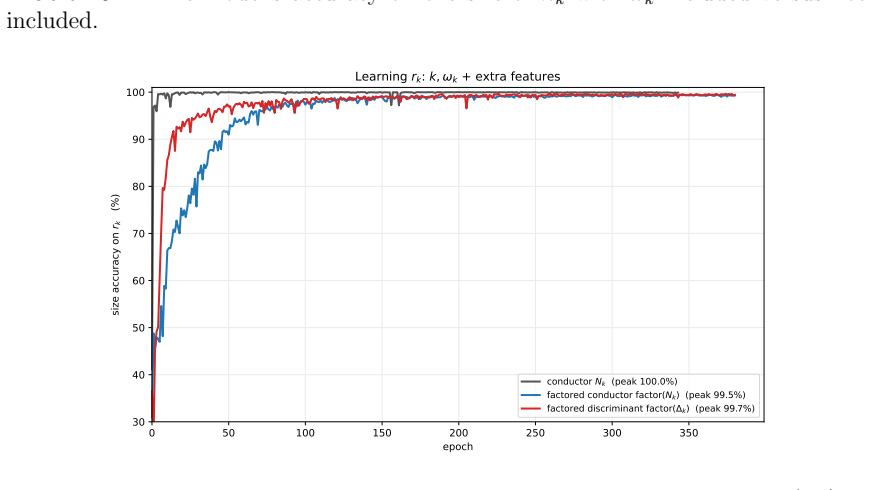
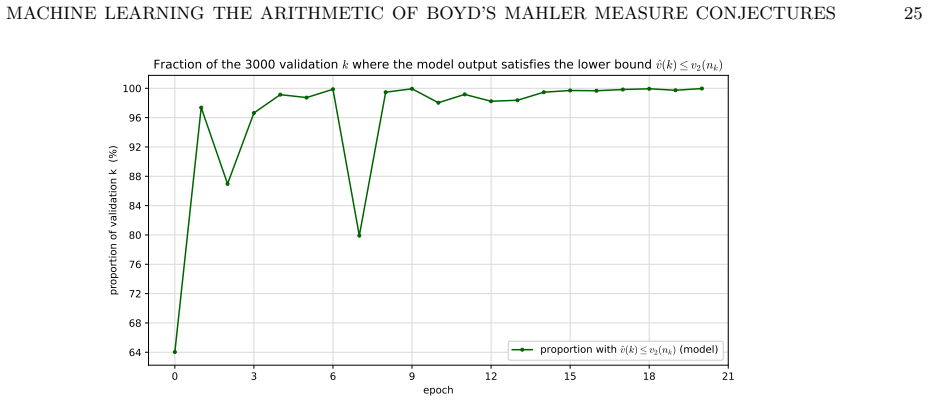
Summary. The paper computes Boyd Mahler measure quotients r_k (equivalently n_k = 1/r_k) for the first 250,000 integer k, combining PARI/GP numerical computation with LLL rational recognition, statistical analysis, and transformer experiments on the Axolver/Int2Int platform. The main statistical claims are: the sign of r_k is governed by the root number; |n_k| has order N_k/log(k) via Lemma 3.1; for p≥5 the positive p-adic valuations of n_k follow P(v_p(n_k)=r)=p^{-r}; the 3-adic valuations obey congruence and parity laws on large subfamilies; and the 2-adic valuations are modeled by a weighted count of odd primes dividing k and k^2-16, plus corrections c(k), s(k), and a negative-binomial residual. A conditional proof of the 2-adic lower-bound conjecture (Conjecture 3.2) is given for a special family under Bloch-Kato-type assumptions from [DGdJK26]. The machine-learning experiments show that the model can learn the size of n_k from the conductor, partially learn v_3 and v_2, but collapses to the trivial prediction for p=5,7.
Significance. If the empirical regularities survive scrutiny, this is a substantial contribution to the arithmetic of Boyd's Mahler measure conjectures: it proposes concrete, locally structured laws for the rational factors r_k and connects them to conductors, bad reduction, and Bloch-Kato Selmer groups. The paper's strengths are its scale, the explicit chi-square diagnostics, the public data/code, and the honest reporting of the neural-network limitations (e.g., §5.2). Lemma 3.1 is clean and the conditional Proposition 3.4 is a serious attempt to connect the data to the Bloch-Kato framework. However, the headline p≥5 law is already contradicted by the paper's own Table 3.1 at p=5, and the rational-recognition step at only 19 decimal digits is not validated for the largest conductors. Both points are load-bearing for the empirical claims and require correction before the paper's central assertions can be accepted.
major comments (3)
- [§3.2, Table 3.1; Abstract] The unqualified law P(v_p(n_k)=r)=p^{-r} for all p≥5 is contradicted by the paper's own data at p=5. Table 3.1a reports χ²=76.84 with ν=6, i.e. χ²/ν=12.81, and Table 3.1b shows systematic excesses at r=2,3,4,6 (ratios 1.065, 1.071, 1.178, 1.188). Since p=5 has by far the largest sample in the table, this is not a tail artifact. The abstract, §3.2, and §6 all retain the unqualified p≥5 statement. The paper must either state the law only for p≥7, or formulate and test a p=5 refinement, e.g. conditioning on p|k, p|(k²−16), or the reduction type of E_k. As written, the headline empirical claim is false at p=5.
- [§2, numerical recognition] All valuation statistics in §3 inherit the correctness of the LLL rational recognition of r_k from 19 decimal digits. No higher-precision check is reported. For large k, n_k is of size ≍ N_k/log(k), and the corresponding rational r_k can have large numerator and denominator; 19 digits may not be sufficient to determine such a rational uniquely. A misidentified r_k would silently bias every empirical law in Section 3. Please recompute a random sample of values (especially large k and large conductors) with, say, 50–100 digits and report the fraction of r_k that change, or provide a denominator bound justifying 19 digits.
- [§3.3–3.4, Table 3.5, Figure 3.4] The statistical models in §3.3–3.4 are fitted and evaluated on the same 250,000 values: the weights W_q(k), corrections c(k) and s(k), the negative-binomial parameters, the mode shift in (3.12), and the exceptional sets in Table 3.5 are all estimated from the full dataset. No out-of-sample split or holdout validation is reported. Moreover, Figure 3.4 shows χ²/ν=7.9 for the final 2-adic model, which for N≈250,000 is a poor absolute fit despite the similar visual shape. Please add a validation protocol (e.g., fit on one half, test on the other), report out-of-sample χ² for the valuation distributions, and quantify the NB goodness-of-fit rather than relying on visual agreement.
minor comments (5)
- [Figure 3.4 caption] The caption reads 'χ 2/ν=7.9' with broken typography; define χ² and ν explicitly at that point, since the main definition appears only in §3.2.
- [§3.3.1, Table 3.3] Law (3.6) is stated to hold on A 'with the exception of k=1', but k=1 belongs to A; please clarify whether the exception is the single k=1 or a different value, and make the statement in (3.6) consistent with the table.
- [§5.1, Figure 5.2] The text says the model learned fastest with N_k, 'closely followed by factor(Δk) and closely followed by factor(Nk)'; the figure legend lists the factored conductor peak at 99.5% and factored discriminant at 99.7%. Please align the text with the plotted peaks.
- [§4] The validation set is described as not used for hyperparameter tuning, but model selection across epochs is performed on validation accuracy. Please note this explicitly, as it is a form of model selection.
- [Throughout] Several displayed equations have broken math spacing (e.g., 'N_k/4π^2 L(E_k,2)' in (3.3), and 'NB(3,3/5)' vs 'NB(r=3, p=3/5)'). A careful proofread of the LaTeX rendering would improve clarity.
Circularity Check
Minor in-sample 'predictor' labeling in the 2-adic model; no load-bearing self-citation or definitional circularity.
-
fitted input called prediction
[Section 3.4, equations (3.8)-(3.12)]
"Since the mode of this distribution is 1, the best deterministic predictor we found for v_2(n_k) is (3.12) P̂(k) := round(ˆv(k) + s(k) + 1). This predictor has Pearson correlation coefficient 0.78 with v_2(n_k), only slightly higher than the correlation obtained using ˆv(k) alone. Moreover, the prediction P̂(k) is correct 24.3% of the time."
The terms entering P̂ are fitted to the same 249,999 values of v_2(n_k): the weights 1 and 2 in W_q(k) are described as 'empirically' appropriate, c(k) is chosen to raise the correlation from 0.69 to 0.77, s(k) is fit to the excess table, and the NB(3,3/5) residual is fit to the same histogram. Reporting the correlation and 24.3% accuracy of P̂ on this identical dataset is therefore a goodness-of-fit statistic, not an out-of-sample prediction. The 'prediction' is statistically forced by the fitted inputs; no held-out evaluation of P̂ is given.
full rationale
The paper is primarily an empirical study. Its central claims (the p≥5 valuation law, the 2-adic model, and the parity laws at 3) are presented as observations or heuristics, not as derivations, so fitting them to the dataset is not hidden circularity. The numerical derivation of n_k = 1/r_k uses independently computed Mahler measures and L'(E_k,0) with LLL rational recognition (Section 2), not a self-consistent ansatz. The conductor-size estimate (3.4) follows from the hypergeometric formula (2.1), the functional equation (3.3), and Lemma 3.1, all standard or proven in the paper; it is not obtained by fitting. The machine-learning experiments use a train/test split and are therefore out-of-sample, although using the 'test' set for monitoring is a methodological concern rather than circularity. Proposition 3.4 is explicitly conditional on the external preprint [DGdJK26] and on Bloch–Kato assumptions; that citation is not by the present authors, and the proof reduces Conjecture 3.2 for a special family to those assumptions rather than smuggling the conjecture in. Self-citations such as [Lal10] and [LR07] are to standard theorems and proven formulas, not load-bearing uniqueness claims. The paper itself flags the p=5 deviation and the heuristic nature of the 2-adic model, which we weigh as transparent limitation statements rather than circularity. The only genuine circularity-adjacent step is the in-sample accuracy claim for P̂(k) in Section 3.4, which is minor relative to the paper's central empirical content.
Assumptions & free parameters
free parameters (6)
- W_q(k) weights =
1 for q|k, 2 for q|k^2-16
- c(k) correction =
4 if E_k semistable at 2 (v_2(N_k) in {0,1}), else 2
- s(k) correction for 2-adic proximity to ±8 =
(3/2) * max(1 - 2^{5 - max(v2(k-8), v2(k+8))}, 0)
- Negative binomial parameters (r, p) for X_k =
r=3, p=3/5, mean 2, mode 1
- Mode shift in P̂(k) =
+1 (round of mode of fitted NB)
- ε(m) sign-dependent shift for the nonsquare case =
0 for |m| a perfect square, 1 for m < 0 nonsquare, 2 for m > 0 nonsquare
assumptions (6)
- domain assumption Boyd's conjectural identity (0.1): µ_k = r_k L'(E_k, 0) for k ∈ Z \ {-4, 0, 4}
- standard math Modularity and functional equation for L(E_k, s), giving L'(E_k, 0) = ω_k N_k/(4π²) L(E_k, 2)
- standard math Hasse-Weil bound |a_p| ≤ 2√p
- domain assumption Hypergeometric formulas for µ_k from [RZ14, p. 2324]
- domain assumption Theorems and assumptions of [DGdJK26], including Assumption 12.1, finite-dimensionality of K_2(Ẽ_u)^int ⊗ Q, finiteness of H^1_f(Q, Ẽ_u[2^∞](-1)), and the Bloch-Kato conjecture
- domain assumption Numerical correctness of PARI/GP's lindep (LLL) and hypergeometric evaluations at 19 decimal digits for all k
Cite this review
Pith. "Pith review of Machine learning the arithmetic of Boyd's Mahler measure conjectures." pith.science (2026). https://pith.science/paper/GZ2W7U7Y
@misc{pith2026260800615,
  author       = {Pith},
  title        = {Pith review of: Machine learning the arithmetic of Boyd's Mahler measure conjectures},
  year         = {2026},
  howpublished = {\url{https://pith.science/paper/GZ2W7U7Y}},
  note         = {Machine review of arXiv:2608.00615}
}
abstract
Boyd conjectured that the Mahler measure of $P_k(x,y)=x+y+\frac{1}{x}+\frac{1}{y}+k$ for $k$ an integer, is given by $r_kL'(E_k,0)$, where $E_k$ is the elliptic curve associated to the zero locus of $P_k$ and $r_k$ is a rational number. We study various arithmetic properties of $r_k$ using a dataset containing the first $250{,}000$ values of $k$, combining large-scale statistical analysis assisted by Claude with transformer-based experiments carried out using Axolver. We recover Boyd's observation that, apart from a few exceptions, $r_k$ is the reciprocal of an integer. The size of this integer is governed by the conductor of the elliptic curve. Moreover, its $p$-adic valuations display markedly different behavior according to the prime. For $p\geq 5$, the probability of $v_p(r_k)=-m$ for $m\geq 1$ appears to be $p^{-m}$. For the primes $2$ and $3$, however, we find additional arithmetic structure involving congruence conditions on $k$ and the primes of bad reduction of $E_k$. Although the neural networks do not predict $r_k$ exactly, they recover significant information about its magnitude and valuations. In particular, the experiments at the prime $2$ suggest arithmetic structure beyond the explicit predictor obtained from our statistical analysis.
Figures


Figures from the paper (18 more)






Reference graph
Works this paper leans on
-
[1]
A numerical approach toward the p -adic B eilinson conjecture for elliptic curves over Q
Masanori Asakura, Masataka Chida, and Fran c ois Brunault. A numerical approach toward the p -adic B eilinson conjecture for elliptic curves over Q . Res. Math. Sci. , 10(1):Paper No. 11, 58, 2023
work page 2023
-
[2]
Syntomic regulators and p -adic integration
Amnon Besser. Syntomic regulators and p -adic integration. II . K_2 of curves. In Proceedings of the C onference on p -adic A spects of the T heory of A utomorphic R epresentations ( J erusalem, 1998) , volume 120, pages 335--359, 2000
work page 1998
-
[3]
David W. Boyd. Mahler's measure and special values of L -functions. Experiment. Math. , 7(1):37--82, 1998
work page 1998
-
[4]
Version explicite du th\'eor\`eme de B eilinson pour la courbe modulaire X_1(N)
Fran c ois Brunault. Version explicite du th\'eor\`eme de B eilinson pour la courbe modulaire X_1(N) . C. R. Math. Acad. Sci. Paris , 343(8):505--510, 2006
work page 2006
-
[5]
Regulators of S iegel units and applications
Fran c ois Brunault. Regulators of S iegel units and applications. J. Number Theory , 163:542--569, 2016
work page 2016
-
[6]
p -adic regulators on curves and special values of p -adic L -functions
Robert Coleman and Ehud de Shalit. p -adic regulators on curves and special values of p -adic L -functions. Invent. Math. , 93(2):239--266, 1988
work page 1988
-
[7]
Int2Int: a framework for mathematics with transformers
Fran c ois Charton . Int2int: a framework for mathematics with transformers. arXiv:2502.17513 [cs.LG] , 2025
work page Pith review arXiv 2025
-
[8]
Deligne periods of mixed motives, K -theory and the entropy of certain Z ^n -actions
Christopher Deninger. Deligne periods of mixed motives, K -theory and the entropy of certain Z ^n -actions. J. Amer. Math. Soc. , 10(2):259--281, 1997
work page 1997
Show all 22 references
-
[9]
The 2-part of the bloch-kato conjecture, and indivisibility results, for K_2 of some elliptic curves
Neil Dummigan, Vasily Golyshev, Rob de Jeu, and Matt Kerr. The 2-part of the bloch-kato conjecture, and indivisibility results, for K_2 of some elliptic curves. arXiv preprint arXiv:2605.11100 , 2026
2026 arXiv
-
[10]
Adam: A method for stochastic optimization
Diederik P Kingma and Jimmy Ba. Adam: A method for stochastic optimization. arXiv preprint arXiv:1412.6980 , 2014
2014 arXiv
-
[11]
Matilde N. Lal\'in. On a conjecture by B oyd. Int. J. Number Theory , 6(3):705--711, 2010
2010
-
[12]
Lal\'in and Mathew D
Matilde N. Lal\'in and Mathew D. Rogers. Functional equations for M ahler measures of genus-one curves. Algebra Number Theory , 1(1):87--117, 2007
2007
-
[13]
Lal\'in, Detchat Samart, and Wadim Zudilin
Matilde N. Lal\'in, Detchat Samart, and Wadim Zudilin. Further explorations of B oyd's conjectures and a conductor 21 elliptic curve. J. Lond. Math. Soc. (2) , 93(2):341--360, 2016
2016
-
[14]
Mahler measures and q -series
Anton Mellit. Mahler measures and q -series. Oberwolfach Reports , 8(3):1990--1991, 2011. Abstract from the workshop ``Explicit Methods in Number Theory,'' Oberwolfach, Germany, 17--23 July 2011
1990
-
[15]
Elliptic dilogarithms and parallel lines
Anton Mellit. Elliptic dilogarithms and parallel lines. J. Number Theory , 204:1--24, 2019
2019
-
[16]
Bordeaux
PARI Group , Univ. Bordeaux. PARI/GP version 2.17.2 , 2025. Available from http://pari.math.u-bordeaux.fr/
2025
-
[17]
Heuristics for the arithmetic of elliptic curves
Bjorn Poonen. Heuristics for the arithmetic of elliptic curves. In Proceedings of the I nternational C ongress of M athematicians--- R io de J aneiro 2018. V ol. II . I nvited lectures , pages 399--414. World Sci. Publ., Hackensack, NJ, 2018
2018
-
[18]
Modular M ahler measures
Fernando Rodriguez-Villegas. Modular M ahler measures. I . In Topics in number theory ( U niversity P ark, PA , 1997) , volume 467 of Math. Appl. , pages 17--48. Kluwer Acad. Publ., Dordrecht, 1999
1997
-
[19]
Rogers and Wadim Zudilin
Mathew D. Rogers and Wadim Zudilin. From L -series of elliptic curves to M ahler measures. Compos. Math. , 148(2):385--414, 2012
2012
-
[20]
Rogers and Wadim Zudilin
Mathew D. Rogers and Wadim Zudilin. On the M ahler measure of 1+X+1/X+Y+1/Y . Int. Math. Res. Not. IMRN , (9):2305--2326, 2014
2014
-
[21]
Attention is all you need
Ashish Vaswani, Noam Shazeer, Niki Parmar, Jakob Uszkoreit, Llion Jones, Aidan N Gomez, ukasz Kaiser, and Illia Polosukhin. Attention is all you need. Advances in neural information processing systems , 30, 2017
2017
-
[22]
Regulator of modular units and M ahler measures
Wadim Zudilin. Regulator of modular units and M ahler measures. Math. Proc. Cambridge Philos. Soc. , 156(2):313--326, 2014
2014
Reviewed August 5, 2026 · model on record in the stance chip above.
Discussion (0). Continue with ORCID to comment.