REVIEW 7 minor 48 references
MDGAM-Based Cooperative Task Scheduling for Communication-Constrained Distributed Multi-Agent Systems
T0 review · 0 major / 7 minor · reviewed 2026-08-04 · deepseek-v4-flash
Pith's one-line read A distributed neural scheduler with graph attention and learned communication messages can outperform auction-based and prior learning-based multi-robot task allocation under communication constraints, the paper claims.
desk verdict A solid incremental extension of attention-based NCO to communication-constrained MRTA; the GRMAPG unbiasedness worry the reader raised does not survive close reading, but the missing error bars and GPU-vs-CPU runtime comparison keep this from being fully convincing. read the letter →
The pith
A machine-rendered reading of the paper's core claim, the machinery that carries it, and where it could break.
The reading
What carries the argument
MDGAM is an encoder-decoder graph attention architecture: the encoder runs an extended graph attention mechanism that updates node representations and edge representations through three attention operations (node-node, edge-node, node-edge), so pairwise relations like travel time and communication links shape the embeddings. A task decoder produces the selection distribution over candidate nodes (masked by feasibility), and a communication decoder outputs a continuous message vector shared with communication-connected agents. GRMAPG builds a group of equivalent instances from each training instance via symmetry transformations (rotations, task-type/capability exchanges, temporal scaling) and
What would settle it
Compute the empirical mean of the GRMAPG gradient estimator on a batch of instances while replacing all rewards with a fixed constant, so the true policy gradient is zero. If the estimator is unbiased, the mean should be statistically zero; any significant nonzero mean shows the leave-one-out baseline is not independent of the current trajectory. A second check: train with group size K=2 versus K=8 and compare, since a biased estimator's properties should change with group size.
Extended reading notes
Core claim
The central claim is that MDGAM—a multi-decoder graph attention policy that jointly outputs task selections and learned communication messages—trained by the critic-free GRMAPG algorithm, achieves higher task-completion than auction-based heuristics (CBBA, PI-maxAss, EEPI) and prior learning-based methods (DL-DRL, CAM) under partial observability, time-window constraints, heterogeneous agent capabilities, and range-limited communication. The paper's key supporting result is in Table I: the proposed method attains the best average number of completed tasks in all nine scale/range settings, with gains over PI-maxAss growing from 2.24% (small scale, r=0.4) to 5.94% (large scale, r=0.4), plus lo
Load-bearing premise
The training algorithm's unbiasedness claim requires that a trajectory's probability is independent of the rewards from the other group members used in its baseline; since all agents share the same policy parameters and their communication messages depend on messages received from agents in the same communication component, trajectories within a group are correlated, so the baseline may not be conditionally independent and the gradient estimate could be biased.
Editorial extensions
If this is right
- A single learned distributed policy can replace handcrafted bidding and consensus rules for MRTA with time windows and range-limited communication, while completing more tasks.
- The critic-free training scheme reduces trainable parameters relative to actor-critic MARL baselines and avoids handcrafted stepwise reward shaping, improving convergence in the reported training curves.
- The learned communication decoder provides a coordination mechanism under partial observability; removing it decreases task-completion performance in ablations.
- Inference runtime scales better than PI-based heuristics: roughly 95x faster than PI-maxAss and 5.7x faster than EEPI on the large-scale setting, with fewer message transmissions.
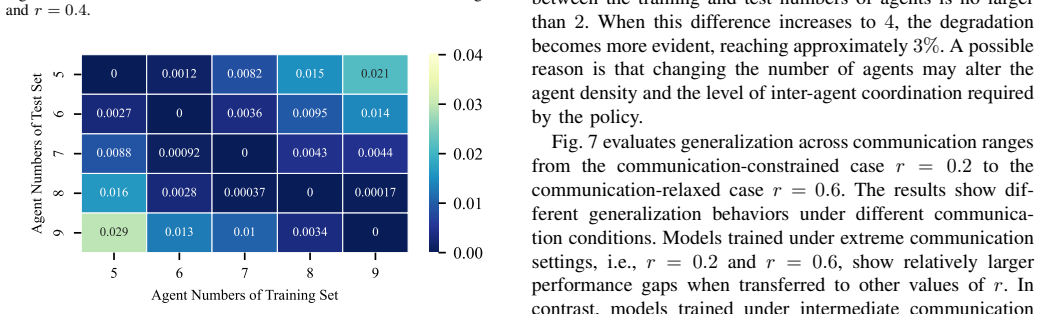
- The policy transfers across task-number variations and moderate agent-number/communication-range shifts with limited degradation, per the generalization heatmaps.
Reading between the lines
- The unbiasedness claim for GRMAPG's baseline (Eq. 45) depends on group-member trajectories being conditionally independent; since all agents share policy parameters and messages depend on other agents' messages inside the same communication component, that independence is questionable. A direct check would be to measure gradient bias using constant rewards.
- The reported gains could stem more from the edge-aware graph encoder and learned messages than from the critic-free baseline; a scale-by-scale comparison of MDGAM with a well-tuned critic would isolate the contribution.
- The communication abstraction ignores bandwidth, delay, and packet loss; if those were modeled, the benefit of learned message passing might shrink. A testable extension is evaluating under message dropout or smaller message dimension.
- The same graph-attention and group-relative training design could be extended to online task arrivals or uncertain execution times, as the paper itself lists as future work, by sampling durations inside the equivalent-instance group.
Editorial analysis
A structured set of objections, weighed in public.
Referee Report
Summary. The paper addresses communication-constrained distributed multi-agent task scheduling, formulating the problem as a Dec-POMDP with heterogeneous agents, time windows, and limited communication ranges. It proposes MDGAM, an encoder-multi-decoder graph attention policy that outputs both task-selection actions and continuous communication messages, and GRMAPG, a critic-free policy gradient algorithm that constructs leave-one-out baselines from equivalent transformed instances. Experiments under three problem scales and three communication ranges compare the method with CBBA, PI-maxAss, EEPI, DL-DRL, and CAM, reporting higher average task completion in all nine settings, along with ablation, complexity, and generalization tests.
Significance. If the reported results hold, this is a useful contribution to learning-based distributed MRTA: it combines an edge-aware graph attention architecture with an explicit communication decoder and replaces a learned critic with a group-relative baseline, a sensible adaptation of POMO/GRPO-style training to the multi-agent terminal-reward setting. I specifically examined the GRMAPG unbiasedness claim in Eq. (45). The external stress-test concern does not land: conditional on the transformed instances, the rollouts for different group members are generated independently; the shared policy parameters are fixed during sampling and do not create stochastic dependence across members, so b_k is conditionally independent of σ_k and the score-function identity applies. The paper also ships an anonymous code repository and includes ablations and generalization experiments, which are additional strengths.
minor comments (7)
- [V-A, Table I] The headline claim that the method achieves the highest average number of completed tasks in all nine settings is based on point estimates. Please report standard deviations, confidence intervals, or the number of evaluation seeds/runs, and ideally a paired statistical test, so that the reader can assess whether the gains (e.g., +4.13% over PI-maxAss at (100,7), r=0.4) are meaningful relative to run-to-run variability.
- [V-C, Table III] The runtime comparison is confounded by hardware: PI-maxAss and EEPI are run on a CPU while the proposed neural policy is evaluated on a GPU. The claim of being 'about 95 times faster' is therefore not an algorithmic comparison. Please provide CPU-only inference timing for the neural policy (or another same-hardware comparison) and clearly frame the table as an end-to-end system-level comparison.
- [V (experimental setup)] The instance generation is described only as 'within prescribed ranges.' For reproducibility, the actual numerical ranges for the square region, time windows, service durations, agent velocities, latest return time, and communication radius should be stated explicitly, or a pointer to where these are defined in the code should be given.
- [IV-B, Eq. (45)] The unbiasedness argument is sound, but it is stated compactly. Please make explicit that the required condition is: conditional on the transformed instances, the trajectories of different group members are sampled independently, and b_k is a function only of σ_{−k}. This would preempt future concerns about the score-function identity.
- [II-B, Eq. (8)] The factorization of Pθ(σ|g) should clarify that the product is over the chronological sequence of decision events, not an arbitrary per-agent ordering, because local observations at later events depend on previous actions of other agents.
- [Figures 3, 5-7] In the provided text the x-axis labels of Figure 3 and the cell labels of the generalization heatmaps render as garbled glyph sequences. Please ensure fonts are embedded and the figures are readable in the final PDF.
- [Throughout] Minor typos: 'UA Vs' in the Note to Practitioners and Introduction should be 'UAVs' or 'UAV's'; also check the spacing in the anonymous code link and ensure it is replaced with a permanent repository before publication.
Circularity Check
No significant circularity: the GRMAPG baseline is a valid leave-one-out baseline over independent rollouts, and the empirical claims are held-out evaluations.
full rationale
The paper's derivation chain is self-contained. GRMAPG's unbiasedness claim (Eq. 45) is a standard score-function identity: because group-member trajectories are sampled independently conditioned on the transformed instances (as stated in Section IV-B), the leave-one-out baseline b_k is conditionally independent of sigma_k; shared policy parameters theta are fixed during sampling and do not create stochastic dependence across group members. The communication-message coupling occurs within a single trajectory, not across group members, so it does not break the identity. The main results (Table I) are measured on held-out instances against external heuristics and learning baselines, so no fitted parameter is renamed as a prediction. The only self-citations ([14], [37]) are contextual or architectural: Eq. (12)-(15) fully specify the extended graph attention mechanism in the paper, so [37] is not load-bearing. No circular step was identified.
Assumptions & free parameters
free parameters (5)
- Problem instance sampling ranges =
unspecified
- Communication decoder message dimension d_com =
128
- Group size K =
4
- Embedding dim / heads / layers / learning rate / epochs =
128 / 8 / 4 / 1e-4 → 1e-5 / 20
- C=2 task types and 1/3 capability split =
2 types, one-third each capability
assumptions (5)
- domain assumption The local information-exchange phase completes instantaneously before each decision event (Section II-B).
- ad hoc to paper The transformations in (41) preserve the theoretical optimal objective (rotations, type/capability swaps, adaptive temporal scaling).
- ad hoc to paper Trajectories of different group members are sampled independently given the transformed instances (used in Eq. 45).
- domain assumption Task conflict handling: if two agents pick the same task, the later arrival loses it (Section II-A).
- domain assumption No low-level networking effects; bandwidth/delay/packet loss are ignored (Section II-A).
invented entities (2)
-
Learned real-valued communication message c_i_m (Eq. 30)
-
Group-relative advantage baseline b_k
Cite this review
Pith. "Pith review of MDGAM-Based Cooperative Task Scheduling for Communication-Constrained Distributed Multi-Agent Systems." pith.science (2026). https://pith.science/paper/YILM3PYA
@misc{pith2026260800648,
  author       = {Pith},
  title        = {Pith review of: MDGAM-Based Cooperative Task Scheduling for Communication-Constrained Distributed Multi-Agent Systems},
  year         = {2026},
  howpublished = {\url{https://pith.science/paper/YILM3PYA}},
  note         = {Machine review of arXiv:2608.00648}
}
read the original abstract
Cooperative task scheduling in communication-constrained distributed multi-agent systems is challenging because each agent must make decisions from partial and dynamic observations while satisfying complex practical constraints. Existing heuristics rely on handcrafted bidding rules and repeated consensus, whereas many learning-based methods assume global observations and lack explicit communication-based coordination. To address these limitations, this paper proposes a neural scheduling framework for distributed multi-robot task allocation (MRTA), consisting of a multi-decoder graph attention model (MDGAM) policy model and a critic-free group relative multi-agent policy gradient (GRMAPG) training algorithm. MDGAM uses an extended graph attention mechanism to jointly update node and edge features, and employs multiple decoders to generate task-selection decisions and communication messages. GRMAPG constructs group-relative advantages from equivalent task-planning instances to replace the critic network used in conventional MARL algorithms, thereby reducing training difficulty and improving convergence performance. Experiments under different problem scales and communication ranges show that the proposed method improves task-completion performance over existing heuristic and learning-based methods, while ablation, complexity, and generalization tests further validate the proposed innovations.
Figures


Figures from the paper (3 more)


Reference graph
Works this paper leans on
-
[1]
An iterative two-phase optimization method based on divide and conquer framework for integrated scheduling of multiple uavs,
H. Liu, X. Li, G. Wu, M. Fan, R. Wang, L. Gao, and W. Pedrycz, “An iterative two-phase optimization method based on divide and conquer framework for integrated scheduling of multiple uavs,”IEEE Trans. Intell. Transp. Syst., vol. 22, no. 9, pp. 5926–5938, 2020
2020
-
[2]
Dis- tributed multirobot task assignment via consensus admm,
O. Shorinwa, R. N. Haksar, P. Washington, and M. Schwager, “Dis- tributed multirobot task assignment via consensus admm,”IEEE Trans. Robot., vol. 39, no. 3, pp. 1781–1800, 2023
2023
-
[3]
Distributed consensus control of multi-agent systems with higher order agent dynamics and dynamically changing directed interaction topologies,
S. Su and Z. Lin, “Distributed consensus control of multi-agent systems with higher order agent dynamics and dynamically changing directed interaction topologies,”IEEE Trans. Autom. Control, vol. 61, no. 2, pp. 515–519, 2015
2015
-
[4]
Group-based distributed auction algorithms for multi-robot task assignment,
X. Bai, A. Fielbaum, M. Kronm ¨uller, L. Knoedler, and J. Alonso- Mora, “Group-based distributed auction algorithms for multi-robot task assignment,”IEEE Trans. Autom. Sci. Eng., vol. 20, no. 2, pp. 1292– 1303, 2022
2022
-
[5]
Multi-robot task allocation: A review of the state-of-the-art,
A. Khamis, A. Hussein, and A. Elmogy, “Multi-robot task allocation: A review of the state-of-the-art,” inCooperative Robots and Sensor Networks 2015, ser. Studies in Computational Intelligence, A. Koub ˆaa and J. R. Mart ´ınez-de Dios, Eds. Cham, Switzerland: Springer, 2015, vol. 604, pp. 31–51
2015
-
[6]
Energy efficient multi-robot task allocation constrained by time window and precedence,
L. Zhang, J. Zhao, E. Lamon, Y . Wang, and X. Hong, “Energy efficient multi-robot task allocation constrained by time window and precedence,” IEEE Trans. Autom. Sci. Eng., vol. 22, pp. 18 162–18 173, 2023
2023
-
[7]
Coalition-based approach to task allocation of multiple robots with resource constraints,
J. Chen and D. Sun, “Coalition-based approach to task allocation of multiple robots with resource constraints,”IEEE Trans. Autom. Sci. Eng., vol. 9, no. 3, pp. 516–528, 2012
2012
-
[8]
Particle swarm optimization algorithm for the optimization of rescue task allocation with uncertain time constraints,
N. Geng, Z. Chen, Q. A. Nguyen, and D. Gong, “Particle swarm optimization algorithm for the optimization of rescue task allocation with uncertain time constraints,”Complex Intell. Syst., vol. 7, no. 2, pp. 873–890, 2021
2021
Show all 48 references
-
[9]
Integrated task assignment and path planning for capacitated multi- agent pickup and delivery,
Z. Chen, J. Alonso-Mora, X. Bai, D. D. Harabor, and P. J. Stuckey, “Integrated task assignment and path planning for capacitated multi- agent pickup and delivery,”IEEE Robot. Autom. Lett., vol. 6, no. 3, pp. 5816–5823, 2021
2021
-
[10]
A formal analysis and taxonomy of task allocation in multi-robot systems,
B. P. Gerkey and M. J. Matari ´c, “A formal analysis and taxonomy of task allocation in multi-robot systems,”Int. J. Robot. Res., vol. 23, no. 9, pp. 939–954, 2004
2004
-
[11]
Integrated task allocation and path coordination for large-scale robot networks with uncertainties,
Z. Liu, H. Wei, H. Wang, H. Li, and H. Wang, “Integrated task allocation and path coordination for large-scale robot networks with uncertainties,” IEEE Trans. Autom. Sci. Eng., vol. 19, no. 4, pp. 2750–2761, 2021
2021
-
[12]
Cooperative multiple task assignment problem with stochastic velocities and time windows for heterogeneous unmanned aerial vehicles using a genetic algorithm,
Z. Jia, J. Yu, X. Ai, X. Xu, and D. Yang, “Cooperative multiple task assignment problem with stochastic velocities and time windows for heterogeneous unmanned aerial vehicles using a genetic algorithm,” Aerosp. Sci. Technol., vol. 76, pp. 112–125, 2018
2018
-
[13]
Multi-agent distributed optimiza- tion via inexact consensus admm,
T.-H. Chang, M. Hong, and X. Wang, “Multi-agent distributed optimiza- tion via inexact consensus admm,”IEEE Trans. Signal Process., vol. 63, no. 2, pp. 482–497, 2014
2014
-
[14]
Distributed policy gradient for linear quadratic networked control with limited communication range,
Y . Yan and Y . Shen, “Distributed policy gradient for linear quadratic networked control with limited communication range,”IEEE Trans. Signal Process., vol. 72, pp. 2087–2100, 2024
-
[15]
Consensus-based decentralized auctions for robust task allocation,
H.-L. Choi, L. Brunet, and J. P. How, “Consensus-based decentralized auctions for robust task allocation,”IEEE Trans. Robot., vol. 25, no. 4, pp. 912–926, 2009
2009
-
[16]
Reinforcement learning with multiple relational attention for solving vehicle routing problems,
Y . Xu, M. Fang, L. Chen, G. Xu, Y . Du, and C. Zhang, “Reinforcement learning with multiple relational attention for solving vehicle routing problems,”IEEE Trans. Cybern., vol. 52, no. 10, pp. 11 107–11 120, 2021
2021
-
[17]
Consensus-based auction ap- proaches for decentralized task assignment,
L. Brunet, H.-L. Choi, and J. How, “Consensus-based auction ap- proaches for decentralized task assignment,” inAIAA Guid., Navig., Control Conf. Exhib., 2008, p. 6839
2008
-
[18]
A heuristic distributed task allocation method for multivehicle multitask problems and its application to search and rescue scenario,
W. Zhao, Q. Meng, and P. W. Chung, “A heuristic distributed task allocation method for multivehicle multitask problems and its application to search and rescue scenario,”IEEE Trans. Cybern., vol. 46, no. 4, pp. 902–915, 2015
2015
-
[19]
An asynchronous consensus method with low communication traffic and high efficiency for distributed multi-agent scheduling,
R. Chen, J. Li, Y . Chen, Y . Huang, X. Wang, and L. Shen, “An asynchronous consensus method with low communication traffic and high efficiency for distributed multi-agent scheduling,”IEEE Trans. Mobile Comput., 2025
2025
-
[20]
Distributed task assignment for multiple robots under limited communication range,
X. Bai, W. Yan, and S. S. Ge, “Distributed task assignment for multiple robots under limited communication range,”IEEE Trans. Syst., Man, Cybern., Syst., vol. 52, no. 7, pp. 4259–4271, 2021
2021
-
[21]
Distributed task rescheduling with time constraints for the optimization of total task allocations in a multirobot system,
J. Turner, Q. Meng, G. Schaefer, A. Whitbrook, and A. Soltoggio, “Distributed task rescheduling with time constraints for the optimization of total task allocations in a multirobot system,”IEEE Trans. Cybern., vol. 48, no. 9, pp. 2583–2597, 2017
2017
-
[22]
An efficient distributed task allocation method for maximizing task allocations of multirobot systems,
S. Wang, Y . Liu, Y . Qiu, S. Li, and J. Zhou, “An efficient distributed task allocation method for maximizing task allocations of multirobot systems,”IEEE Trans. Autom. Sci. Eng., vol. 21, no. 3, pp. 3588–3602, 2023
2023
-
[23]
Communication- efficient decentralized task allocation for large-scale multi-agent sys- tems,
S. Wang, S. Li, Y . Huangfu, Y . Qiu, and Y . Liu, “Communication- efficient decentralized task allocation for large-scale multi-agent sys- tems,”IEEE Robot. Autom. Lett., 2025
2025
-
[24]
Pointer networks,
O. Vinyals, M. Fortunato, and N. Jaitly, “Pointer networks,”Adv. Neural Inf. Process. Syst., vol. 28, 2015
2015
-
[25]
Neural com- binatorial optimization with reinforcement learning,
I. Bello, H. Pham, Q. V . Le, M. Norouzi, and S. Bengio, “Neural com- binatorial optimization with reinforcement learning,”arXiv:1611.09940, 2016
2016 arXiv
-
[26]
Learning combinatorial optimization algorithms over graphs,
E. Khalil, H. Dai, Y . Zhang, B. Dilkina, and L. Song, “Learning combinatorial optimization algorithms over graphs,”Adv. Neural Inf. Process. Syst., vol. 30, 2017
2017
-
[27]
An efficient graph con- volutional network technique for the travelling salesman problem,
C. K. Joshi, T. Laurent, and X. Bresson, “An efficient graph con- volutional network technique for the travelling salesman problem,” arXiv:1906.01227, 2019
1906 arXiv
-
[28]
Attention, learn to solve routing problems!
W. Kool, H. van Hoof, and M. Welling, “Attention, learn to solve routing problems!” inInt. Conf. Learn. Represent., 2019
2019
-
[29]
Pointerformer: Deep reinforced multi-pointer transformer for the traveling salesman problem,
Y . Jin, Y . Ding, X. Pan, K. He, L. Zhao, T. Qin, L. Song, and J. Bian, “Pointerformer: Deep reinforced multi-pointer transformer for the traveling salesman problem,” inProc. AAAI Conf. Artif. Intell., vol. 37, no. 7, 2023, pp. 8132–8140
2023
-
[30]
Pomo: Policy optimization with multiple optima for reinforcement learning,
Y .-D. Kwon, J. Choo, B. Kim, I. Yoon, Y . Gwon, and S. Min, “Pomo: Policy optimization with multiple optima for reinforcement learning,” Adv. Neural Inf. Process. Syst., vol. 33, pp. 21 188–21 198, 2020
2020
-
[31]
Learning to handle complex constraints for vehicle routing problems,
J. Bi, Y . Ma, J. Zhou, W. Song, Z. Cao, Y . Wu, and J. Zhang, “Learning to handle complex constraints for vehicle routing problems,”Adv. Neural Inf. Process. Syst., vol. 37, pp. 93 479–93 509, 2024
2024
-
[32]
Mapdp: Cooperative multi-agent reinforcement learning to solve pickup and delivery problems,
Z. Zong, M. Zheng, Y . Li, and D. Jin, “Mapdp: Cooperative multi-agent reinforcement learning to solve pickup and delivery problems,” inProc. AAAI Conf. Artif. Intell., vol. 36, no. 9, 2022, pp. 9980–9988
2022
-
[33]
Dl-drl: A double-level deep reinforcement learning approach for large-scale task scheduling of multi-uav,
X. Mao, G. Wu, M. Fan, Z. Cao, and W. Pedrycz, “Dl-drl: A double-level deep reinforcement learning approach for large-scale task scheduling of multi-uav,”IEEE Trans. Autom. Sci. Eng., vol. 22, pp. 1028–1044, 2024
2024
-
[34]
A hierarchical multi-task and multi- agent assignment approach: Learning dqn strategy from execution,
Y . Wang, H. Li, and Q. Shen, “A hierarchical multi-task and multi- agent assignment approach: Learning dqn strategy from execution,” IEEE Trans. Autom. Sci. Eng., 2025
2025
-
[35]
Learning to allocate time-bound and dynamic tasks to multiple robots using covariant attention neural net- works,
S. Paul and S. Chowdhury, “Learning to allocate time-bound and dynamic tasks to multiple robots using covariant attention neural net- works,”J. Comput. Inf. Sci. Eng., vol. 24, no. 9, p. 091005, 2024
2024
-
[36]
The complexity of decentralized control of markov decision processes,
D. S. Bernstein, R. Givan, N. Immerman, and S. Zilberstein, “The complexity of decentralized control of markov decision processes,” Math. Oper . Res., vol. 27, no. 4, pp. 819–840, 2002
2002
-
[37]
Egam: Extended graph attention model for solving routing problems,
L. Wang, Y . Yan, M. Huang, and Y . Shen, “Egam: Extended graph attention model for solving routing problems,”arXiv:2601.21281, 2026
2026
-
[38]
Attention is all you need,
A. Vaswani, N. Shazeer, N. Parmar, J. Uszkoreit, L. Jones, A. N. Gomez, Ł. Kaiser, and I. Polosukhin, “Attention is all you need,”Adv. Neural Inf. Process. Syst., vol. 30, 2017
2017
-
[39]
Bert: Pre-training of deep bidirectional transformers for language understanding,
J. Devlin, M.-W. Chang, K. Lee, and K. Toutanova, “Bert: Pre-training of deep bidirectional transformers for language understanding,” inProc. 2019 Conf. North Amer . Chapter Assoc. Comput. Linguistics: Human Lang. Technol., 2019, pp. 4171–4186
2019
-
[40]
Deep residual learning for image recognition,
K. He, X. Zhang, S. Ren, and J. Sun, “Deep residual learning for image recognition,” inProc. IEEE Conf. Comput. Vis. Pattern Recognit., 2016, pp. 770–778
2016
-
[41]
Layer normalization,
J. L. Ba, J. R. Kiros, and G. E. Hinton, “Layer normalization,” arXiv:1607.06450, 2016
2016 arXiv
-
[42]
Multi-agent actor-critic for mixed cooperative-competitive environ- ments,
R. Lowe, Y . I. Wu, A. Tamar, J. Harb, O. Pieter Abbeel, and I. Mordatch, “Multi-agent actor-critic for mixed cooperative-competitive environ- ments,”Adv. Neural Inf. Process. Syst., vol. 30, 2017. JOURNAL OF LATEX CLASS FILES, VOL. 14, NO. 8, AUGUST 2021 14
2017
-
[43]
The surprising effectiveness of ppo in cooperative multi-agent games,
C. Yu, A. Velu, E. Vinitsky, J. Gao, Y . Wang, A. Bayen, and Y . Wu, “The surprising effectiveness of ppo in cooperative multi-agent games,” Adv. Neural Inf. Process. Syst., vol. 35, pp. 24 611–24 624, 2022
2022
-
[44]
Simple statistical gradient-following algorithms for connectionist reinforcement learning,
R. J. Williams, “Simple statistical gradient-following algorithms for connectionist reinforcement learning,”Mach. Learn., vol. 8, no. 3, pp. 229–256, 1992
1992
-
[45]
Sym-nco: Leveraging symmetricity for neural combinatorial optimization,
M. Kim, J. Park, and J. Park, “Sym-nco: Leveraging symmetricity for neural combinatorial optimization,”Adv. Neural Inf. Process. Syst., vol. 35, pp. 1936–1949, 2022
1936
-
[46]
Deepseekmath: Pushing the limits of mathematical reason- ing in open language models,
Z. Shao, P. Wang, Q. Zhu, R. Xu, J. Song, X. Bi, H. Zhang, M. Zhang, Y . Liet al., “Deepseekmath: Pushing the limits of mathematical reason- ing in open language models,”arXiv:2402.03300, 2024
2024 arXiv
-
[47]
Adam: A method for stochastic optimiza- tion,
D. P. Kingma and J. L. Ba, “Adam: A method for stochastic optimiza- tion,” inInt. Conf. Learn. Represent., 2015
2015
-
[48]
Learning the travelling salesperson problem requires rethinking generalization,
C. K. Joshi, Q. Cappart, L.-M. Rousseau, and T. Laurent, “Learning the travelling salesperson problem requires rethinking generalization,” Constraints, vol. 27, pp. 70–98, 2022
2022
Reviewed August 4, 2026 · model on record in the stance chip above.
Discussion (0). Continue with ORCID to comment.