REVIEW 3 major objections 6 minor 53 references
Ion stopping from bound and free electrons in plasmas: A channel-mixed RPA approach with average-atom orbitals
T0 review · 3 major / 6 minor · reviewed 2026-08-05 · deepseek-v4-flash
Pith's one-line read A channel-mixed RPA dielectric reproduces proton stopping near and above the Bragg peak in partially ionized plasmas.
desk verdict A solid, usable all-electron linear-response stopping model with a real but contained free-free weak spot; worth refereeing, conditional on reproducibility and f-f consistency checks. read the letter →
The pith
A machine-rendered reading of the paper's core claim, the machinery that carries it, and where it could break.
The reading
What carries the argument
Equation (4), the channel-mixed energy loss function Im[ε⁻¹]_{cmRPA} = V_k Im[χ_bb + χ_bf + χ_ff] / |1 − V_k(χ_bb + χ_bf + χ_ff)|², is the central object. It is what distinguishes cmRPA from the Chihara-style unmixed form, Eq. (5), because taking the imaginary part of the inverse dielectric puts every channel's real and imaginary response into one denominator; that mixing is the mechanism by which bound-free transitions and the free-electron plasmon interfere. The bound channel polarizabilities come from radial matrix elements of average-atom orbitals, with a small width that smooths the continuum, and the free-free piece is the finite-temperature Lindhard function with exactly ⟨Z⟩ electrons
What would settle it
Measure proton stopping in warm dense carbon near 0.5 g/cm3 and 10 eV across the Bragg peak with enough precision to distinguish cmRPA's hybridized curve from the unmixed additive model; if the data trace the additive curve, the paper's channel-mixing claim is falsified.
Extended reading notes
Core claim
The paper claims that the electronic stopping of an ion in a partially ionized plasma can be captured by a dielectric function in which bound-bound, bound-free, and free-free transitions all enter a single random-phase-approximation denominator, with the bound transitions built from average-atom orbitals and the free-free piece taken as finite-temperature Lindhard response. The resulting energy-loss function, Eq. (4), is the channel-mixed RPA (cmRPA) form. It is distinguished from a Chihara-style unmixed decomposition, Eq. (5), because the real and imaginary parts of all channels screen each other in one denominator, so bound and free responses interfere. Against ambient-condition stopping d
Load-bearing premise
Everything rests on the assumption that the small inconsistency between how free electrons (plane waves) and bound electrons (average-atom orbitals) are treated does not materially change the stopping power the model predicts.
Editorial extensions
If this is right
- Stopping curves for protons and alphas in warm dense and inertial-confinement fusion conditions can be generated orders of magnitude faster than TD-DFT, enabling parameter sweeps and diagnostic design.
- At temperatures where bound states are partially occupied, bound-bound transitions give a low-velocity stopping contribution that a free-electron-only model misses.
- A proper RPA treatment of bound-free transitions can either enhance or suppress stopping relative to additive channel models, depending on where the bound edge sits relative to the plasmon, so the bound correction is condition-dependent.
- In double-shell inertial-confusion tungsten at 10–100 times compression, omitting bound electrons under-predicts stopping, and cold versus hot tungsten give noticeably different alpha ranges.
- For the recent warm dense carbon measurement, the model implies that bound-state treatment cannot fix the measured deficit under linear response, directing attention to other physics or experimental effects.
Reading between the lines
- Editorial inference: because the paper's local-field-correction test raises low-velocity stopping toward experiment, adding a consistent local-field correction to the mixed denominator is a natural next step that could push cmRPA's validity down across the Bragg peak.
- Editorial inference: the same dielectric function governs inelastic x-ray scattering, so the predicted bound-free/plasmon hybridization should be visible as a redistribution of spectral weight in warm dense matter x-ray Thomson scattering or electron-energy-loss measurements; a direct spectral measurement would independently test the channel-mixing claim.
- Editorial inference: the f-sum violation and the Appendix A low-velocity artifact both trace to using plane-wave Lindhard for continuum states that the average-atom model sees as quasibound; replacing the Lindhard free-free response with an average-atom-consistent continuum appears to be the highest-leverage fix and would likely recalibrate the tungsten predictions at extreme compression.
- Editorial inference: at projectile charges beyond protons, nonlinear effects enter precisely in the low-velocity region where bound-bound features appear, so comparing cmRPA against all-electron TD-DFT for alpha or heavier ions in partially ionized targets would map where linear response breaks and where bound contributions must be folded into binary-collision models.
Editorial analysis
A structured set of objections, weighed in public.
Referee Report
Summary. The manuscript develops a channel-mixed RPA (cmRPA) dielectric function for electronic stopping in partially ionized plasmas, combining a finite-temperature Lindhard free-free response with average-atom (AA) bound-bound and bound-free polarizabilities in a single RPA denominator (Eq. 4). The model is validated against ambient IAEA data and TD-DFT for Al, Fe, Ne, and W, and applied to temperature-dependent Al stopping, HED tungsten, and the Malko et al. warm dense carbon experiment. The authors report good agreement above the Bragg peak, identify non-trivial channel-mixing and bound-bound contributions, and conclude that improved bound-state modeling is unlikely to explain the Malko discrepancy.
Significance. If the central claim holds, cmRPA is an efficient, physically transparent all-electron linear-response stopping model for partially ionized plasmas, with explicit bound-channel transitions and a natural mechanism for bound-free/free-free interference. The paper's strengths are the explicit orbital matrix elements, the broad ambient validation set, the direct comparison with TD-DFT, and the application to ICF-relevant conditions. The main limitation is the inconsistent treatment of the free-free response: the Lindhard assumption is not validated in regimes where AA continuum states deviate strongly from plane waves, and Appendix A shows that a sum-rule-preserving modification of the f-f kernel produces large, unphysical stopping changes. This makes the predictive claim for such regimes currently unsupported.
major comments (3)
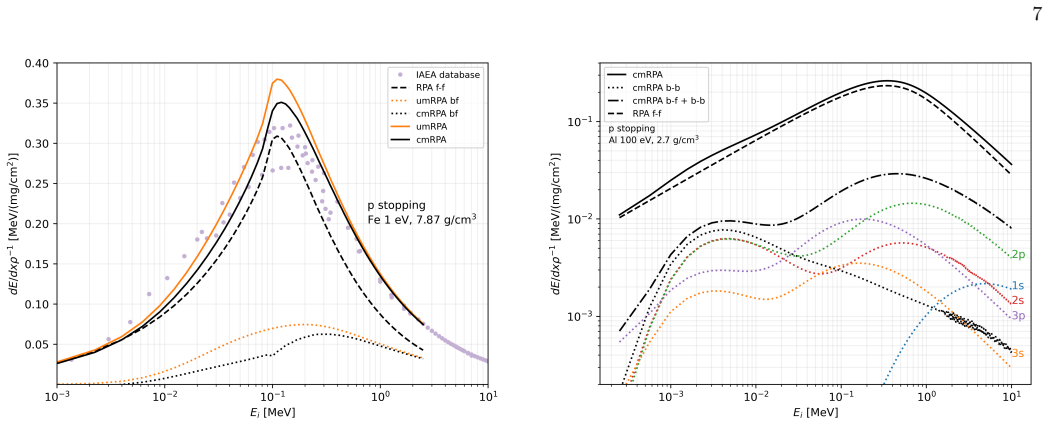
- [Sec. II.A, Eqs. (4),(6); Appendix A, Fig. 12] The free-free Lindhard assumption is load-bearing. Because Eq. (4) mixes chi_ff nonlinearly with chi_bb and chi_bf in the denominator, an error in the f-f spectral distribution is not a small additive correction; it modifies the channel interference that is a central result (Sec. III.C). Appendix A shows that replacing the Lindhard DOS with the AA DOS in a sum-rule-preserving manner creates an unphysical low-velocity peak in stopping (Fig. 12b). This demonstrates that f-sum-rule conservation is insufficient to control the stopping-relevant spectrum. The full AA f-f polarizability, with both initial and final continuum states in Eq. (6), is not computed in this work. The ambient validations in Fig. 2 involve small Z_bar and nearly free-electron-like free states, so they do not constrain the problematic regime, e.g., Al at T=100 eV (Fig. 1c-d) or HED tungsten (Sec. III.D). Please provide a
- [Sec. II.A, Eq. (12)] The width parameter c_Gamma is set to 1 with the statement that varying it changes only computational expense and 'does not change the result,' but no convergence study is shown. Given the continuum sensitivity demonstrated in Appendix A, this insensitivity must be supported numerically. Please provide the stopping power as a function of c_Gamma (or, equivalently, continuum mesh spacing) for at least one representative case, and state the criterion used to choose c_Gamma in the production runs.
- [Appendix B, Fig. 13] The paper uses the ion-sphere-restricted radial integrals for all production results, explicitly sacrificing orthogonality between bound and free states. The authors show that the effect on stopping is small for carbon at T=10 eV, but this is a single, relatively low-Z case. For the high-Z, tightly compressed tungsten conditions of Sec. III.D, bound-state radii may be comparable to the ion-sphere radius, and the j0 -> j0-1 correction described in Appendix B is an ad hoc fix. Please provide a targeted check of the ion-sphere truncation error for at least one of the tungsten conditions, or state a criterion for when the truncation is valid.
minor comments (6)
- [Notation throughout] The angular frequency appears as w in Eqs. (6), (10)-(12), and (A1), but as omega elsewhere. Use \omega consistently.
- [Fig. 1 caption, panel b] The phrase 'the f-f part only (orange) versus ⟨Z⟩' is unclear; please say 'the free-free contribution normalized to ⟨Z⟩'.
- [Fig. 8] The initial proton beam energy distribution is shown 'in green,' but the RPA+CBC curve is also green; use different colors/linestyles to avoid ambiguity.
- [Appendix A] Define g_AA_DOS(E) and g_ideal_DOS(E) explicitly; currently only their ratio is used, which makes the construction hard to reproduce.
- [Reference [36]] The journal name 'Npj Comput. Mater.' should be 'npj Computational Materials'.
- [Sec. III.A] Typographical issue: 'we have a)aluminum...' lacks spaces after the panel labels in several places.
Circularity Check
No significant circularity: cmRPA is self-contained; acknowledged f-f inconsistency is a limitation, not a circular step.
full rationale
The derivation is self-contained. Equation (1) is the standard linear-response stopping integral; Eq. (2) defines the RPA dielectric as a sum of independent-particle channel polarizabilities; Eqs. (6)-(11) give those polarizabilities from average-atom orbitals and matrix elements. No parameter is fitted to the stopping data used for validation. The only tunable coefficient, c_Gamma in Eq. (12), is set to unity with a stated insensitivity check, and the ion-sphere truncation is explicitly checked against the extended-sphere result (Appendix B). The f-f channel is approximated by finite-T Lindhard rather than by the fully consistent AA continuum response; this is an acknowledged approximation that produces a ~1% f-sum violation and a sensitivity demonstration in Appendix A. These are consistency/accuracy caveats, not circular reductions: Lindhard's Z_bar sum and AA orbitals are inputs, while the predicted ELF and stopping powers are compared to independent IAEA experiments and TD-DFT simulations. The tartarus code citation [28] is a tool citation, not a load-bearing argument that assumes the target result. No equation or prediction reduces by construction to its inputs.
Assumptions & free parameters
free parameters (1)
- c_Gamma =
1
assumptions (6)
- domain assumption Linear response approximation: projectile potential perturbs the plasma weakly, so stopping is given by Eq. (1) in terms of the dielectric function.
- domain assumption The irreducible polarizability is the independent-particle (RPA) susceptibility computed from average-atom Kohn-Sham orbitals with Fermi-Dirac occupations.
- ad hoc to paper Free-free response is approximated by the finite-temperature Lindhard function with Z_bar electrons, not by AA continuum states.
- domain assumption The average-atom model (tartarus) with spherical symmetry gives reliable orbitals and charge states for the conditions studied.
- ad hoc to paper A finite width Gamma(omega) with c_Gamma=1 smooths the continuum without changing integrated stopping.
- ad hoc to paper Truncating bound-free radial integrals at the ion-sphere radius, and applying the j0-1 correction, preserves stopping accuracy.
Cite this review
Pith. "Pith review of Ion stopping from bound and free electrons in plasmas: A channel-mixed RPA approach with average-atom orbitals." pith.science (2026). https://pith.science/paper/SCFMQCIK
@misc{pith2026260800797,
  author       = {Pith},
  title        = {Pith review of: Ion stopping from bound and free electrons in plasmas: A channel-mixed RPA approach with average-atom orbitals},
  year         = {2026},
  howpublished = {\url{https://pith.science/paper/SCFMQCIK}},
  note         = {Machine review of arXiv:2608.00797}
}
read the original abstract
Ion stopping in partially ionized plasmas often receives roughly equal contributions from bound and free electrons, yet bound electron contributions are usually treated at a very coarse level, with the exception of costly time-dependent density functional theory (TD-DFT) simulations. At energies above the Bragg peak, where linear response methods are a good approximation, more accurate treatment is both feasible and critical for predictive modeling. We develop a channel-mixed random phase approximation (cmRPA) dielectric response function that combines Lindhard free response with explicit average-atom bound state transitions. Validating against ambient condition experiments and TD-DFT simulations, we demonstrate excellent agreement for proton stopping near and above the Bragg peak. The computational efficiency of our approach enables systematic exploration of extreme conditions across a wide range of densities and temperatures. We find non-trivial stopping effects from channel mixing between bound and free transitions via RPA, bound-bound stopping contributions at low velocity, and predict significant bound electron contributions to stopping in tungsten at peak compression conditions relevant to inertial confinement fusion experiments. Applying our model to the warm dense matter stopping experiment of Malko et al. (2022), we evaluate whether improved bound-state modeling could resolve the reported theory-experiment discrepancy, finding that within the constraints of linear response theory, bound stopping mismodeling is unlikely to be the source of the observed deficit.
Figures


Figures from the paper (10 more)


Reference graph
Works this paper leans on
-
[1]
Bethe, Theory of the Passage of Fast Corpuscular Rays Through Matter, Annalen Phys.5, 325 (1930)
H. Bethe, Theory of the Passage of Fast Corpuscular Rays Through Matter, Annalen Phys.5, 325 (1930)
work page 1930
- [2]
-
[3]
T. W. Hentschel, A. Kononov, A. Olmstead, A. Cangi, A. D. Baczewski, and S. B. Hansen, Improving dynamic collision frequencies: Impacts on dynamic structure fac- tors and stopping powers in warm dense matter, Physics of Plasmas30(2023)
work page 2023
-
[4]
A. J. White, L. A. Collins, K. Nichols, and S. X. Hu, Mixed stochastic-deterministic time-dependent density functional theory: application to stopping power of warm dense car- bon, Journal of Physics: Condensed Matter34, 174001 (2022)
work page 2022
-
[5]
A. Schleife, Y. Kanai, and A. A. Correa, Accurate atomistic first-principles calculations of electronic stopping, Phys. Rev. B91, 014306 (2015)
work page 2015
-
[6]
A. Kononov, T. W. Hentschel, S. B. Hansen, and A. D. Baczewski, Nonlinear effects in light-ion stopping powers within real-time time-dependent density functional theory, 12 Physics of Plasmas33, 032704 (2026)
work page 2026
-
[7]
N. D. Mermin, Lindhard dielectric function in the relaxation-time approximation, Phys. Rev. B1, 2362 (1970)
1970
-
[8]
G. Faussurier, Finite-temperature static local-field- correction factor in warm-dense-matter stopping-power calculation, Physics of Plasmas32, 032704 (2025)
work page 2025
Show all 53 references
-
[9]
Z. H. Levine and S. G. Louie, New model dielectric function and exchange-correlation potential for semiconductors and insulators, Phys. Rev. B25, 6310 (1982)
1982
-
[10]
A. H. Søndersted, M. Kuisma, J. K. Svaneborg, M. K. Svendsen, and K. S. Thygesen, Improved dielectric response of solids: Combining the bethe-salpeter equation with the random phase approximation, Phys. Rev. Lett.133, 026403 (2024)
2024
-
[11]
Onida, L
G. Onida, L. Reining, and A. Rubio, Electronic excitations: density-functional versus many-body green’s-function ap- proaches, Rev. Mod. Phys.74, 601 (2002)
2002
-
[12]
Salvat, Bethe stopping-power formula and its correc- tions, Phys
F. Salvat, Bethe stopping-power formula and its correc- tions, Phys. Rev. A106, 032809 (2022)
2022
-
[13]
J. F. Ziegler, M. Ziegler, and J. Biersack, Srim – the stop- ping and range of ions in matter (2010), Nuclear Instru- ments and Methods in Physics Research Section B: Beam Interactions with Materials and Atoms268, 1818 (2010), 19th International Conference on Ion Beam Analysis
2010
-
[14]
This database is available from the iaea web site,https: //nds.iaea.org/stopping, accessed: March, 2026
2026
-
[15]
K. Wittmaack, Misconceptions impairing the validity of the stopping power tables in the srim library and suggestions for doing better in the future, Nuclear Instruments and Methods in Physics Research Section B: Beam Interactions with Materials and Atoms380, 57 (2016)
2016
-
[16]
Montanari, P
C. Montanari, P. Dimitriou, L. Marian, A. Mendez, J. Per- alta, and F. Bivort-Haiek, The iaea electronic stopping power database: Modernization, review, and analysis of the existing experimental data, Nuclear Instruments and Methods in Physics Research Section B: Beam Interact...
2024
-
[17]
Malko, W
S. Malko, W. Fox, L. Volpe, R. Fedosejevs, W. Cayzac, X. Vaisseau, V. Ospina-Bohorques, P. Grabowski, A. Cor- rea, C. Walsh, A. White, L. Collins, S. Hu, K. Nichols, S. Hansen, A. Baczewski, T. Hentschel, A. Kononov, M. Bailly-Grandvaux, K. Bhutwala, F. Beg, C. McGuffey, D. Ba...
2022
-
[18]
J. A. Frenje, R. Florido, R. Mancini, T. Nagayama, P. Grabowski, H. Rinderknecht, H. Sio, A. Zylstra, M. Gatu Johnson, C. Li,et al., Experimental valida- tion of low-z ion-stopping formalisms around the bragg peak in high-energy-density plasmas, Physical review let- ters (2019)
2019
-
[19]
Malko, W
S. Malko, W. Cayzac, V. Ospina-Boh´ orquez, K. Bhutwala, M. Bailly-Grandvaux, C. McGuffey, R. Fedosejevs, X. Vais- seau, A. Tauschwitz, J. I. Api˜ naniz, D. De Luis Blanco, G. Gatti, M. Huault, J. A. P. Hernandez, S. X. Hu, A. J. White, L. A. Collins, K. Nichols, P. Neumayer, ...
2022
-
[20]
Zylstra, J
A. Zylstra, J. Frenje, P. Grabowski, C. Li, G. Collins, P. Fitzsimmons, S. Glenzer, F. Graziani, S. Hansen, S. Hu, et al., Measurement of charged-particle stopping in warm dense plasma, Physical review letters114, 215002 (2015)
2015
-
[21]
L. J. Stanek, A. Kononov, S. B. Hansen, B. M. Haines, S. X. Hu, P. F. Knapp, M. S. Murillo, L. G. Stanton, H. D. Whitley, S. D. Baalrud, L. J. Babati, A. D. Baczewski, M. Bethkenhagen, A. Blanchet, I. Clay, Raymond C., K. R. Cochrane, L. A. Collins, A. Dumi, G. Faussurier, M. ...
2024
-
[22]
The CBC model has also been extended to use AA input, however it was found to typically overestimate stopping [4]
which uses a simple Bethe-like stopping term derived from Hartree-Fock bound states. The CBC model has also been extended to use AA input, however it was found to typically overestimate stopping [4]. Other models for bound stopping based on the AA use the known free electron l...
-
[23]
Faussurier, C
G. Faussurier, C. Blancard, P. Coss´ e, and P. Renaudin, Equation of state, transport coefficients, and stopping power of dense plasmas from the average-atom model self- consistent approach for astrophysical and laboratory plas- mas, Physics of Plasmas17(2010)
2010
-
[24]
M. D. Barriga-Carrasco and D. Casas, Electronic stopping of protons in xenon plasmas due to free and bound elec- trons, Laser and Particle Beams31, 105–111 (2013)
2013
-
[25]
T. A. Mehlhorn, M. F. Gu, and I. Golovkin, An enhanced rpa-lda model for ion stopping power from cold matter to high-energy density plasmas: A unified, open-source frame- work (2026), arXiv:2606.30978 [physics.plasm-ph]
2026 arXiv
-
[26]
P. Wang, T. Mehlhorn, and J. MacFarlane, A unified self- consistent model for calculating ion stopping power in icf plasma, Physics of Plasmas5, 2977 (1998)
1998
-
[27]
Kremp, M
D. Kremp, M. Schlanges, and K. Wolf-Dietrich,Quantum Statistics of Nonideal Plasmas, 2005th ed., Springer Series on Atomic, Optical, and Plasma Physics (Springer, Berlin, Germany, 2004)
2004
-
[28]
M. D. Barriga-Carrasco, F. Chac´ on-Rubio, and C. C. Mon- tanari, Stopping power of plasma free and bound electrons using dielectric formalism, The European Physical Journal Plus137, 375 (2022)
2022
-
[29]
Johnson, J
W. Johnson, J. Nilsen, and K. Cheng, Thomson scatter- ing in the average-atom approximation, Physical Review E—Statistical, Nonlinear, and Soft Matter Physics86, 036410 (2012)
2012
-
[30]
N. M. Gill and C. E. Starrett, Tartarus: A relativistic green’s function quantum average atom code, High Energy Density Physics24, 33 (2017)
2017
-
[31]
Blenski and K
T. Blenski and K. Ishikawa, Pressure ionization in the spherical ion-cell model of dense plasmas and a pressure formula in the relativistic pauli approximation, Phys. Rev. E51, 4869 (1995)
1995
-
[32]
B le´ nski and B
T. B le´ nski and B. Cichocki, Linear response of partially ionized, dense plasmas, Laser and Particle Beams10, 299 (1992)
1992
-
[33]
Caizergues, T
C. Caizergues, T. Blenski, and R. Piron, Dynamic linear response of atoms in plasmas and photo-absorption cross- section in the dipole approximation, High Energy Density Physics18, 7 (2016)
2016
-
[34]
G. B. Arfken, H. J. Weber, and F. E. Harris, Mathemat- ical preliminaries, inMathematical Methods for Physicists (Elsevier, 2013) pp. 1–82
2013
-
[35]
G. D. Mahan,Many-particle physics, Physics of Solids and Liquids (Springer, New York, NY, 2010)
2010
-
[36]
sum rule violations since the states are mutually orthogo- nal only when integrated over all space
for a 3e pseudopotential (pink circles) and an 11e pseudopotential (turquoise triangles),b)iron at ambient density,ρ= 7.87 g/cm3 andT= 0.026 eV,c)neon gas atρ= 0.125 g/cm 3 andT= 0.026 eV,d)tungsten at ambient conditions,T= 0.026 eV and ρ= 19.3 g/cm 3. sum rule violations sinc...
2022
-
[37]
Johnson, Low-frequency conductivity in the average- atom approximation, High Energy Density Physics5, 61 (2009)
W. Johnson, Low-frequency conductivity in the average- atom approximation, High Energy Density Physics5, 61 (2009)
2009
-
[38]
Kononov, T
A. Kononov, T. W. Hentschel, S. B. Hansen, and A. D. Baczewski, Trajectory sampling and finite-size effects in first-principles stopping power calculations, Npj Comput. 13 Mater.9(2023)
2023
-
[39]
Gericke, M
D. Gericke, M. Schlanges, and W. Kraeft, Stopping power of a quantum plasma—t-matrix approximation and dynam- ical screening, Physics Letters A222, 241 (1996)
1996
-
[40]
L. J. Babati, S. Rightley, N. R. Shaffer, and S. D. Baalrud, Collisional stopping power of ions in warm dense matter, Phys. Rev. E113, 015201 (2026)
2026
-
[41]
Kononov, T
A. Kononov, T. W. Hentschel, S. B. Hansen, and A. D. Baczewski, Nonlinear effects in light-ion stopping powers within real-time time-dependent density functional theory (2025), arXiv:2511.00759 [physics.plasm-ph]
2025
-
[42]
Kononov, T
A. Kononov, T. W. Hentschel, S. B. Hansen, and A. D. Baczewski, Core contributions to stopping powers in warm dense matter (2023)
2023
-
[43]
D. S. Montgomery, W. S. Daughton, B. J. Albright, A. N. Simakov, D. C. Wilson, E. S. Dodd, R. C. Kirkpatrick, R. G. Watt, M. A. Gunderson, E. N. Loomis, E. C. Mer- ritt, T. Cardenas, P. Amendt, J. L. Milovich, H. F. Robey, R. E. Tipton, and M. D. Rosen, Design considerations f...
2018
-
[44]
Kramida, Yu
A. Kramida, Yu. Ralchenko, J. Reader, and and NIST ASD Team, NIST Atomic Spectra Database (ver. 5.12), [On- line]. Available:https://physics.nist.gov/asd[2026, April 17]. National Institute of Standards and Technology, Gaithersburg, MD. (2024)
2026
-
[45]
Hayes, J
A. Hayes, J. D. Martin, G. Jungman, D. Montgomery, J. Colgan, C. J. Fontes, G. Rusev, H. Geppert-Kleinrath, J. B. Wilhelmy, E. Loomis,et al., Reaction-in-flight neu- trons as a diagnostic for hydrodynamical mixing in double shell inertial confinement fusion capsules, Physics o...
2025
-
[46]
G. B. Zimmerman, Recent developments in monte carlo techniques (Lawrence Livermore National Laboratory (LLNL), Livermore, CA (United States), 1990)
1990
-
[47]
C. C. Montanari, J. E. Miraglia, and N. R. Arista, Dynam- ics of solid inner-shell electrons in collisions with bare and dressed swift ions, Phys. Rev. A66, 042902 (2002)
2002
-
[48]
L. S. Brown, D. L. Preston, and R. L. Singleton Jr., Charged particle motion in a highly ionized plasma, Physics Reports410, 237 (2005)
2005
-
[49]
Maynard and C
G. Maynard and C. Deutsch, Born random phase approx- imation for ion stopping in an arbitrarily degenerate elec- tron fluid, Journal de Physique46, 1113 (1985)
1985
-
[50]
C. C. Montanari and J. E. Miraglia, Low- and intermediate- energy stopping power of protons and antiprotons in solid targets, Phys. Rev. A96, 012707 (2017)
2017
-
[51]
J. P. Peralta, M. Fiori, A. M. P. Mendez, and C. C. Monta- nari, Stopping-power calculations and the levine-mermin dielectric function for inner shells, Phys. Rev. A105, 062814 (2022)
2022
-
[52]
N. M. Gill, C. J. Fontes, and C. E. Starrett, Time- dependent density functional theory applied to average atom opacity, Physical Review E103, 043206 (2021)
2021
-
[53]
Dornheim, Z
T. Dornheim, Z. A. Moldabekov, and P. Tolias, Analytical representation of the local field correction of the uniform electron gas within the effective static approximationana- lytical representation of the local field correction of the uni- form electron gas within the effecti...
2021
Reviewed August 5, 2026 · model on record in the stance chip above.
Discussion (0). Continue with ORCID to comment.