REVIEW 6 major objections 8 minor 91 references
Refined Thompson Learning for Adaptive Bandits: Sustainable Power-Efficient Flexibility Scheduling Across Data Centers
T0 review · 6 major / 8 minor · reviewed 2026-08-15 · deepseek-v4-flash
Pith's one-line read This paper shows that prior-augmented Thompson–Whittle scheduling lets data centers answer grid flexibility requests without revealing job details, and that refined variants beat plain Thompson–Whittle in every reported stress test.
desk verdict Useful applied extension of Thompson-Whittle RMAB to data center demand response, but the headline robustness claim outruns the reported evidence because the best variant is selected per stress cell and the supplement that would settle it is absent. read the letter →
The pith
A machine-rendered reading of the paper's core claim, the machinery that carries it, and where it could break.
The reading
What carries the argument
The load-bearing machinery is the Whittle index computed from posterior samples of each arm's transition and reward functions, together with refinements that discipline those samples. The Whittle index is the smallest subsidy that makes leaving an arm passive optimal, which decouples the multi-armed problem into per-arm single-agent MDPs and yields a rankable score. The refinements are: an adaptive trust weight $\tau_i(s,t)$, which blends the sampled Whittle score with a UCB score in states that have few observed transitions; a $\beta$-gated prior that replaces a sampled transition row by a convex combination of the posterior row and a structural queue-based prior, with the gate drawn from a Beta distribution to avoid over-conservatism; low-rank SVD smoothing of transition matrices to pool information across rows; and offline/support priors that encode feasible transitions via zero masks and historical queue models. These mechanisms act on the estimates that feed the Whittle calculation rather than on the final action directly, so they preserve the index-policy interpretation.
What would settle it
Run the learned policy on a job trace in which the same queue position regularly yields very different rescheduling power savings, such as mixing huge AI training jobs with tiny interactive jobs, and compare the estimated transition and reward functions against the empirical frequencies; if the queue-position model cannot predict realized savings, the Whittle indices are computed from mis-specified models and the 15–34 point margins should shrink or reverse.
Extended reading notes
Core claim
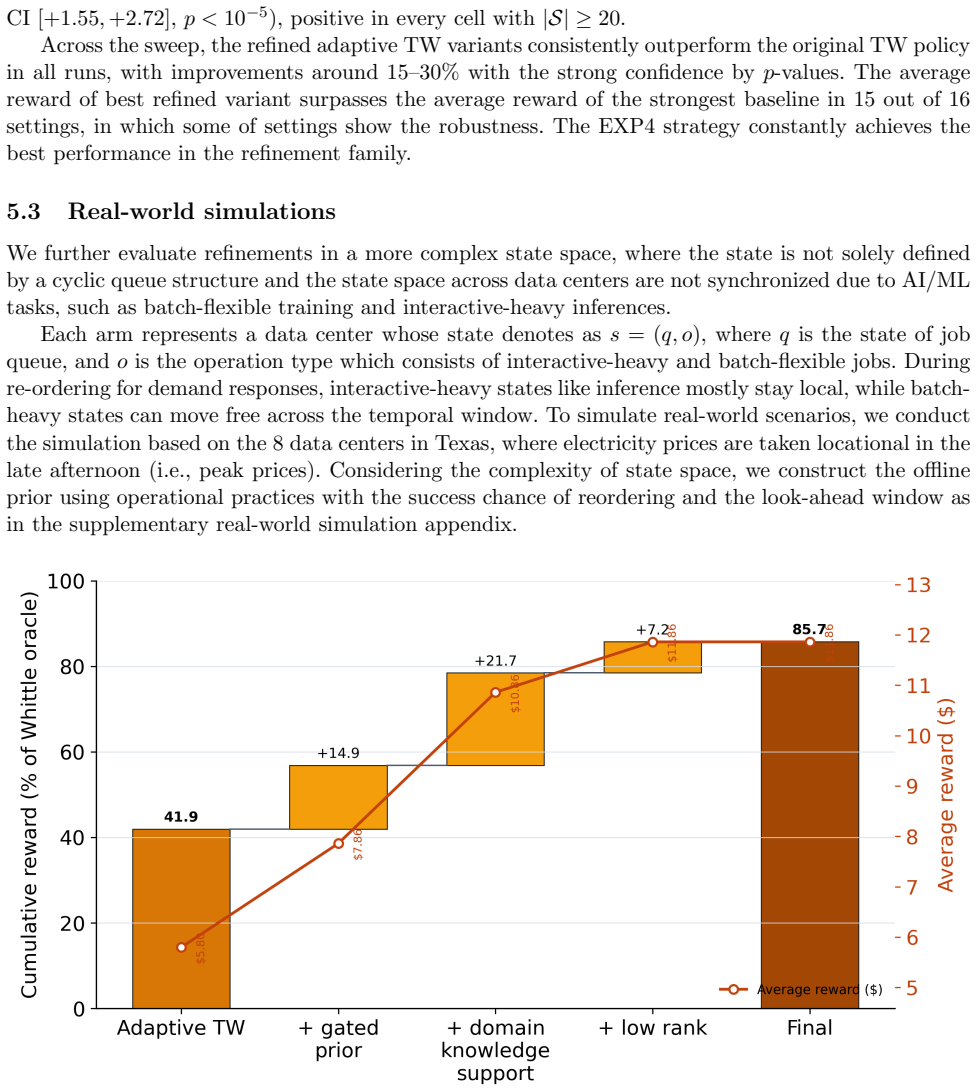
The central discovery is that prior-augmented Thompson sampling makes Whittle-index scheduling usable in sparse, noisy data-center environments, where the plain Thompson–Whittle policy degrades sharply. On the paper's own account, the adaptive mixed strategy that weights the sampled Whittle index against a UCB score by visit frequency, combined with domain priors (gated structural priors and offline/support masks) and low-rank smoothing of transition rows, lifts cumulative reward from roughly 41.8–61.1% of the oracle for plain TW to 65.6–96.0% for the best refined variant across the reported stress sweep. The real-world simulation on eight data centers moves from 41.9% of oracle for adaptive TW to 78.5% with the full refinement. The paper also establishes that the improved reward is accompanied by lower $\ell^1$ transition-estimation error and less probability mass on infeasible transitions, though at 1,000 rounds the best transition estimator is not the highest reward earner. The authors conclude that domain knowledge, not just more data, is what lets a learned Whittle policy survive sparse state visits.
Load-bearing premise
The load-bearing premise is that the current position in the job queue is a sufficient state, so the power savings and the next position can be predicted from it alone; in practice the specific jobs waiting in the lookahead window also determine those outcomes.
Editorial extensions
If this is right
- Grid operators can request load reductions through a learned policy that never needs to see job internals; the data center only reports coarse context and a flexibility action.
- In sparse regimes—short learning horizons, large state spaces, noisy state observations—the refined variants recover a large share of the oracle reward where plain TW collapses.
- Because the refined family is cheaper than EXP4's expert mixing, the improvement is not bought with extra computation.
- The demonstrations on real VM traces suggest the approach transfers from lightweight internal workloads to ML training and inference jobs.
- If the Markov model holds, the same index-policy machinery could be reused across data centers without retraining the full joint problem.
Reading between the lines
- The paper's state omits which jobs are in the lookahead window, so the reported margins may shrink in settings where identical queue positions hide very different rescheduling savings; testing on job-level traces with explicit power models would settle this.
- The spectral rank rule found in the appendix—choosing the smallest rank that retains 95% of singular-value mass—looks like a general fix for low-rank transition smoothing, not one tied to this application.
- The adaptive trust weight could be transferred to other restless-bandit learning problems as a generic exploration–exploitation device, since it only needs visit counts and a sampled index.
- The economic gains quoted in dollars per kWh suggest a concrete market test: a grid operator could compare realized load reductions under this policy against a rule-based baseline during peak price windows.
Signed reviews
Editorial analysis
A structured set of objections, weighed in public.
Referee Report
Summary. The paper proposes RACER+, a contextual restless multi-armed bandit (RMAB) framework for data-center demand-response flexibility scheduling. Each data center is modeled as an MDP whose state is the current position in a cyclic job queue; transition and reward functions are learned online via Thompson sampling, and arm selection is made by a Whittle index policy computed from posterior samples. The paper contributes several refinements to the basic Thompson–Whittle (TW) learner: an adaptive UCB/TW mixer, offline and support priors, beta-gated priors, low-rank transition smoothing, and a spectral rank rule. Experiments cover a baseline regime, a transition-stress regime with |S| in {8, 20, 50, 100} and noise probability rho in {0, 0.1, 0.2, 0.3} over 100 rounds, and a real-world Texas data-center simulation. The headline claim is that, in every stress cell, the cellwise best refined variant beats TW by 15–34 points of oracle reward and also beats the strongest baseline in most cells, at lower computational cost than EXP4.
Significance. The application is timely and the empirical setup is more realistic than a purely synthetic bandit benchmark: the authors use Azure VM and MIT SuperCloud traces, provide an anonymized code supplement, and report seed-level error bars that permit paired comparisons. The refined variants address a genuine sparse-data difficulty, and the L1/off-support diagnostics are a sensible way to attribute gains. If a single pre-specified refined variant could be shown to dominate TW and strong baselines across the stress sweep, this would be a useful advance for demand-response scheduling without operator visibility. At present, however, the central robustness claim is established only for a per-cell post-hoc selected variant, so the practical significance is not yet demonstrated; the revision should either provide a fixed selection rule or reframe the claims.
major comments (6)
- [Section 5.2, Table 3] The sentence 'Every refined variant beats TW in all sixteen cells by 15–34 points of oracle' is not supported by Table 3, which reports only the single best refined variant per (|S|,rho) cell, with the winning variant changing across cells (e.g., 'Adp. TW + beta gated prior' at (8,0.0) and 'Adp. TW' at (100,0.1)). Because the per-cell winner is selected after observing the outcomes, the reported margins are maxima over a family of refinements and do not demonstrate that any single refined policy robustly beats TW. The abstract's 'cellwise best' wording is appropriately limited, but the prose and the practical framing of a deployable robust policy are not. Please report all variants or a pre-specified selection rule, and adjust the claims.
- [Section 5.2] The text is internally inconsistent: it first says the best refined variant 'leads the strongest baseline in fourteen, tying in two whose intervals span zero' and then says it 'surpasses the average reward of the strongest baseline in 15 out of 16 settings.' Table 3 shows negative margins versus the baseline at (|S|=8,rho=0.2) (-0.71 +/- 6.27) and (|S|=100,rho=0.3) (-2.90 +/- 13.87), i.e., two losses, not two ties, so neither count matches the table. Please correct the counts and the interpretation.
- [Section 5.3] The spectral rank rule is described as 'pre-registered,' but it is introduced after the results and evaluated on the same 16-cell stress sweep used to develop it; the reported gain (+2.13 points, 95% CI [+1.55,+2.72], p<10^-5, n=120) is a post-hoc comparison on the same data, not a confirmatory test. Please provide evidence that the rule was fixed before observing these cells (e.g., a dated protocol) or re-frame the spectral analysis as exploratory with a separate hold-out evaluation.
- [Section 5.2, Table 3] The per-cell paired t-tests reported in Table 3 are unadjusted for multiple comparisons across 16 cells and numerous refined variants; with this many tests, p<0.05 is expected under the global null. Reporting family-wise adjusted p-values (e.g., Holm-Bonferroni) or pre-specifying a single primary cell/variant comparison would substantially strengthen the robustness claim.
- [Table 1 and Equations (2), (5)] The MDP state is defined only as 'positions i in the circular job queue' in Table 1, but the reward from rescheduling (power savings minus delay penalty) and the queue evolution depend on which specific jobs are in the look-ahead window, which is not part of the state. If the queue-position state is not sufficient for the transition and reward functions, the learned P and R are misspecified and the Whittle indices computed from them do not correspond to the true control problem. The text mentions an 'additional assumption' in the supplementary shared-queue formulation but does not validate it in the main text. Please add a validation (e.g., predictive checks of the learned transition/reward model, or a comparison with a state-enriched variant).
- [Section 4.1] The text says 'We also perform the hyperparameter sweeps to identify optimal values, such as the trust floor tau_min in (0,0.1] and beta gate G_i^a.' If these parameters are tuned on the same stress cells for which Table 3 reports improvements, the reported margins are optimistically biased. Please specify which hyperparameters were fixed before the experiments and evaluate sensitivity on held-out settings (e.g., nested resampling), or temper the claims accordingly.
minor comments (8)
- [Sections 1 and 3.1] 'placed the increasing pressures' should be 'placing increasing pressure', and 'Lamma 1' should be 'Lemma 1'.
- [Section 5.2] 'The gives a combination of across 16 runs' is ungrammatical; please revise.
- [Figure 2 caption] The caption uses 'refined TM-TW variants' although the text defines the variants as TW; please harmonize the acronyms.
- [Section 5.2] 'The EXP4 strategy constantly achieves the best performance in the refinement family' is confusing because EXP4 is a baseline, not a refinement; please rephrase (e.g., 'EXP4 is the strongest baseline').
- [Section 2] The citation 'Dai et al., Liu et al., 2026' is incomplete; supply full author lists or citation keys.
- [References and Table 3] There are minor typographical issues: 'Whittle Whittle [1988]' duplicates the author name, 'Micheal Terrall' should be 'Michael Terrall', and 'p-test' in Table 3 should be 'p-value' or 'paired t-test p-value'.
- [Abstract and Section 5.2] The abstract claims 'lower computational cost than EXP4,' but no runtime measurements or complexity analysis appear in the main text; please add evidence or qualify the claim.
- [Supplementary material] Several theoretical claims (indexability in Definition 1, the L1/off-support leakage analyses in Section 5.1, and the low-rank composed-kernel certificate in Section 3.3) are deferred to supplementary material that was not supplied with the manuscript; please ensure the supplement is available at review time so these claims can be checked.
Circularity Check
No derivation-level circularity; the refined-variant gains are partially fitted because hyperparameters and the spectral rank rule are tuned and evaluated on the same stress cells.
-
fitted input called prediction
[Section 4.1 (Experiment settings) and Section 5.2, Table 3]
"We also perform the hyperparameter sweeps to identify optimal values, such as the trust floor τmin∈(0,0.1] and beta gate G_i^a. ... For each (|S|,ρ) pair, the table reports the best baseline (with its name), original TW, and the best refined variant."
The hyperparameters that define the refined variants are tuned by sweeps on the same 16-cell stress sweep in which the variants are then evaluated, and Table 3 reports the best refined variant per cell after outcomes are known. The reported 15-34 point margins versus TW are therefore maxima over a family of configurations fitted to those cells, not out-of-sample predictions. This does not make TW-vs-oracle invalid, but it makes the 'refined variants are robustly superior' phrase an in-sample selection result rather than a predictive finding.
-
fitted input called prediction
[Section 5.3 (Real-world simulations), spectral-rule passage]
"Under the spectral rule, the smallest rank holding 95% of the singular-value mass, a pre-registered sweep over sixteen (|S|,ρ) cells with ten paired replications each gains +2.13 points of oracle for |S|≥20 (95% CI [+1.55,+2.72], paired t p<10−5, n=120), positive in all twelve such cells (sign test p=.0005); means are +1.46, +2.56, +2.38 at |S|=20,50,100. The fixed cap was the limitation: it degenerates to rank one at |S|=8."
The spectral rank rule is introduced after the fixed-cap result, with its 95% singular-value threshold chosen to address the observed limitation ('The fixed cap was the limitation'), and then evaluated on the same sixteen (|S|,ρ) cells that motivated it. The +2.13-point gain and its p-value are thus a description of the fitted rule applied back to the fitting data, not a preregistered prediction. Calling this sweep 'pre-registered' cannot be verified, and the surrounding text gives direct evidence that the rule was derived from the same cells.
full rationale
The core derivation is self-contained: Whittle index computation follows the standard single-arm subsidy MDP, Thompson sampling is applied to learned transition/reward posteriors, and the comparison baselines (EXP4, UCB, ST) are external methods implemented against fixed simulations. No load-bearing uniqueness theorem or prior result is imported from the authors' own work, and the MDP/Whittle equations are not equivalent to the reported rewards by construction. The main circularity-like defects are statistical: hyperparameters and the cellwise 'best refined variant' are selected on the same 16 stress cells in which they are reported, and the spectral rank rule is justified by and tested on the same cells despite being labeled pre-registered. These are fitted-input-called-prediction issues that inflate the refinement gains, but they do not make the central TW-versus-oracle benchmark circular. The sentence 'Every refined variant beats TW in all sixteen cells' is also unsupported because Table 3 reports only the best refined variant per cell, though this is an overstatement rather than a derivational circularity. Overall score 4 reflects partial circularity in the reported gains without full reduction of the central claim to its inputs.
Assumptions & free parameters
free parameters (5)
- Trust floor tau_min =
swept in (0, 0.1]
- Beta-gate scale kappa and epsilon =
kappa=20, epsilon=1e-3
- Low-rank cap r =
min{10, max(1, floor(|S|/8))}
- Spectral threshold for rank selection =
95% singular-value mass
- Gate normalization constant =
2 + sqrt(|S|)
assumptions (4)
- domain assumption Queue position is a sufficient statistic for transition and reward
- ad hoc to paper Each arm MDP is indexable
- domain assumption Contextual noise is iid state-observation corruption
- standard math Dirichlet-Categorical and Gaussian conjugate Bayesian updates are valid for the learned model
Cite this review
Pith. "Pith review of Refined Thompson Learning for Adaptive Bandits: Sustainable Power-Efficient Flexibility Scheduling Across Data Centers." pith.science (2026). https://pith.science/paper/J4HQKOMH
@misc{pith2026260800921,
  author       = {Pith},
  title        = {Pith review of: Refined Thompson Learning for Adaptive Bandits: Sustainable Power-Efficient Flexibility Scheduling Across Data Centers},
  year         = {2026},
  howpublished = {\url{https://pith.science/paper/J4HQKOMH}},
  note         = {Machine review of arXiv:2608.00921}
}
read the original abstract
The rapid rise in energy consumption from large-scale AI workloads in data centers placed the increasing pressures on power grids in recent years. Since grids must maintain real-time bal- ance between supply and demand, there has been heightened interest in job flexibility services from data centers. We propose an adaptive, learning-based contextual restless multi-armed bandit (RMAB) framework in which the grid requests load reductions without requiring visibility into job (re)scheduling decisions. With multiple virtual machine (VM) datasets, the core strategy models a cyclic job queue and batch-level (re)scheduling within each data center as a Markov decision process (MDP), and derives Whittle-index-based policies computed from the learned transition and reward functions via Thompson sampling. To address the challenges of enlarging state space and sparse state visits, we introduce domain-knowledge-enriched refined strategies, including adaptive mixed strategies, gated priors, low-rank smoothing, and offline posterior support. Extensive simulations under both baseline and stress scenarios demonstrate that the cellwise best refined variant exceeds TW in every reported cell of the stress sweep at lower computational cost than EXP4. These results demonstrate the economic value of data center flexibility services and underscore the importance of high-quality, open-source AI workload datasets for developing and evaluating adaptive scheduling algorithms.
Figures


Reference graph
Works this paper leans on
-
[1]
Operations Research , author =
Generalized. Operations Research , author =. 2014 , pages =. doi:10.1287/opre.2014.1272 , abstract =
- [2]
-
[3]
Chen, Xin and Hou, I-Hong , month = dec, year =. Contextual. 2024. doi:10.1109/CDC56724.2024.10886713 , urldate =
arXiv 2024
-
[4]
Deadline scheduling as restless bandits , isbn =
Yu, Zhe and Xu, Yunjian and Tong, Lang , month = sep, year =. Deadline scheduling as restless bandits , isbn =. 2016 54th. doi:10.1109/ALLERTON.2016.7852304 , urldate =
arXiv 2016
-
[5]
Zhang, Yupeng and Wan, Xu and Kong, Xiangyun and Yang, Chao and Ma, Binda and Yin, Wotao and Zhou, Jian , month = aug, year =. Proceedings of the 31st. doi:10.1145/3711896.3737381 , language =
-
[6]
Nature Energy , author =. 2025 , pages =. doi:10.1038/s41560-025-01927-1 , language =
-
[7]
Journal of Applied Probability , author =
Restless bandits: activity allocation in a changing world , volume =. Journal of Applied Probability , author =. 1988 , pages =. doi:10.2307/3214163 , abstract =
doi:10.2307/3214163 1988
-
[8]
Contextual
Beygelzimer, Alina and Langford, John and Li, Lihong and Reyzin, Lev and Schapire, Robert E , year =. Contextual
Show all 91 references
-
[9]
IEEE Transactions on Smart Grid , author =
Joint. IEEE Transactions on Smart Grid , author =. 2019 , pages =. doi:10.1109/TSG.2019.2903767 , number =
2019
-
[10]
European Journal of Operational Research , author =
Wasserstein distributionally robust chance-constrained optimization for energy and reserve dispatch:. European Journal of Operational Research , author =. 2022 , pages =. doi:10.1016/j.ejor.2021.04.015 , language =
2022 doi
-
[11]
Maximizing acquisition functions for
Wilson, James and Hutter, Frank and Deisenroth, Marc , editor =. Maximizing acquisition functions for. Advances in
-
[12]
, editor =
Frazier, Peter I. , editor =. Bayesian. Recent. 2018 , doi =
2018
-
[13]
Operations Research , author =
From. Operations Research , author =. 2010 , pages =. doi:10.1287/opre.1090.0712 , abstract =
2010
-
[14]
Operations Research Letters , author =
Energy and reserve dispatch with distributionally robust joint chance constraints , volume =. Operations Research Letters , author =. 2021 , pages =. doi:10.1016/j.orl.2021.01.012 , language =
2021 doi
-
[15]
IEEE Transactions on Smart Grid , author =
Distributionally. IEEE Transactions on Smart Grid , author =. 2022 , pages =. doi:10.1109/TSG.2022.3150397 , number =
2022
-
[16]
IEEE Transactions on Power Systems , author =
Strategic gaming analysis for electric power systems: an. IEEE Transactions on Power Systems , author =. 2000 , pages =. doi:10.1109/59.867153 , number =
2000 doi
-
[17]
and Conejo, Antonio J
Gabriel, Steven A. and Conejo, Antonio J. and Fuller, J. David and Hobbs, Benjamin F. and Ruiz, Carlos , collaborator =. Equilibria and. Complementarity. 2013 , doi =
2013
-
[18]
IEEE Transactions on Smart Grid , author =
Flexibility. IEEE Transactions on Smart Grid , author =. 2022 , pages =. doi:10.1109/TSG.2022.3153634 , urldate =
2022
-
[19]
Operations Research , author =
Distributionally. Operations Research , author =. 2010 , pages =. doi:10.1287/opre.1090.0741 , abstract =
2010
-
[20]
Mathematical Programming , author =
Optimized. Mathematical Programming , author =. 2022 , pages =. doi:10.1007/s10107-019-01442-8 , language =
2022 doi
-
[21]
Wasserstein
Kuhn, Daniel and Esfahani, Peyman Mohajerin and Nguyen, Viet Anh and Shafieezadeh-Abadeh, Soroosh , editor =. Wasserstein. Operations. 2019 , doi =
2019
-
[22]
IEEE Transactions on Power Systems , author =
On the. IEEE Transactions on Power Systems , author =. 2020 , pages =. doi:10.1109/TPWRS.2019.2943670 , number =
2020
-
[23]
IEEE Transactions on Smart Grid , author =
Risk. IEEE Transactions on Smart Grid , author =. 2021 , pages =. doi:10.1109/TSG.2020.3030319 , number =
2021
-
[24]
SIAM Journal on Optimization , author =
Convex. SIAM Journal on Optimization , author =. 2007 , pages =. doi:10.1137/050622328 , language =
2007 doi
-
[25]
Joule , author =
Mitigating. Joule , author =. 2020 , pages =. doi:10.1016/j.joule.2020.08.001 , language =
2020 doi
-
[26]
Joule , author =
Sources of data center energy estimates:. Joule , author =. 2022 , pages =. doi:10.1016/j.joule.2022.07.011 , language =
2022 doi
-
[27]
Coordinating renewable microgrids for reliable reserve services: a distributionally robust chance-constrained game , isbn =
Ding, Yifu and Wang, Siyuan and Hobbs, Benjamin , month = jun, year =. Coordinating renewable microgrids for reliable reserve services: a distributionally robust chance-constrained game , isbn =. Proceedings of the 14th. doi:10.1145/3575813.3597342 , language =
-
[28]
Federal Energy Regulatory Commission , month = feb, year =
-
[29]
IEEE Transactions on Power Systems , author =
Deep. IEEE Transactions on Power Systems , author =. 2022 , pages =. doi:10.1109/TPWRS.2021.3096144 , number =
2022
-
[30]
Bayesian optimization for distributionally robust chance-constrained problem , url =
-
[31]
2024 , file =
Ancillary. 2024 , file =
2024
-
[32]
Proceedings of the IEEE , author =
Distributed. Proceedings of the IEEE , author =. 2012 , note =. doi:10.1109/JPROC.2011.2161236 , abstract =
2012
-
[33]
doi:https://doi.org/10.1145/1508284.150826 , abstract =
Meisner, David and Gold, Brian T and Wenisch, Thomas F , year =. doi:https://doi.org/10.1145/1508284.150826 , abstract =
-
[34]
Sustainable Computing: Informatics and Systems , author =
Data center and load aggregator coordination towards electricity demand response , volume =. Sustainable Computing: Informatics and Systems , author =. 2024 , pages =. doi:10.1016/j.suscom.2024.100957 , language =
2024
-
[35]
Tang, Zhenheng and Wang, Yuxin and Wang, Qiang and Chu, Xiaowen , month = may, year =. The
-
[36]
Adapting
Lin, Liuzixuan and Chien, Andrew A , month = jun, year =. Adapting. Proceedings of the 14th. doi:10.1145/3575813.3595197 , language =
-
[37]
Manufacturing & Service Operations Management , author =
Aggregating. Manufacturing & Service Operations Management , author =. 2024 , pages =. doi:10.1287/msom.2021.0539 , abstract =
2024
-
[38]
2004 , doi =
Finite-. 2004 , doi =
2004
-
[39]
2024 , file =
Powering. 2024 , file =
2024
-
[40]
Mathematical Programming , author =
Distributionally robust joint chance constraints with second-order moment information , volume =. Mathematical Programming , author =. 2013 , pages =. doi:10.1007/s10107-011-0494-7 , language =
2013 doi
- [41]
-
[42]
Mathematical Programming , author =
Data-driven distributionally robust optimization using the. Mathematical Programming , author =. 2018 , keywords =. doi:10.1007/s10107-017-1172-1 , abstract =
2018 doi
-
[43]
Google Data Centers , author =
Efficiency –. Google Data Centers , author =
-
[44]
, year =
Sun, Xu Andy and Conejo, Antonio J. , year =. Robust
-
[45]
and Coskun, Ayse K
Zhang, Yijia and Paschalidis, Ioannis Ch. and Coskun, Ayse K. , month = jun, year =. Data. Proceedings of the. doi:10.1145/3307772.3328309 , language =
-
[46]
IEEE Transactions on Parallel and Distributed Systems , author =
Temporal. IEEE Transactions on Parallel and Distributed Systems , author =. 2014 , pages =. doi:10.1109/TPDS.2013.69 , number =
2014 doi
-
[47]
Barroso, Luiz André and Hölzle, Urs and Ranganathan, Parthasarathy , year =. The
-
[48]
Repurposing
Ding, Yifu and Mallapragada, Dharik and Patel, Serena and Stoner, Robert James , month = jul, year =. Repurposing. 2024. doi:10.1109/PESGM51994.2024.10688708 , urldate =
2024
-
[49]
Minimizing
Rao, Lei and Liu, Xue and Xie, Le and Liu, Wenyu , month = mar, year =. Minimizing. 2010. doi:10.1109/INFCOM.2010.5461933 , urldate =
2010
-
[50]
Management Science , author =
Adaptive. Management Science , author =. 2019 , pages =. doi:10.1287/mnsc.2017.2952 , abstract =
2019
-
[51]
Characterization and prediction of deep learning workloads in large-scale
Hu, Qinghao and Sun, Peng and Yan, Shengen and Wen, Yonggang and Zhang, Tianwei , month = nov, year =. Characterization and prediction of deep learning workloads in large-scale. Proceedings of the. doi:10.1145/3458817.3476223 , language =
-
[52]
Energy Conversion and Management , author =
Driving towards net-zero from the energy sector:. Energy Conversion and Management , author =. 2024 , pages =. doi:10.1016/j.enconman.2024.118645 , language =
2024
-
[53]
John Wilkes , title =
-
[54]
Bayesian
Großhans, Michael and Sawade, Christoph and Brückner, Michael and Scheffer, Tobias , editor =. Bayesian. Proceedings of the 30th. 2013 , note =
2013
-
[55]
Guo, Wenshuo and Jordan, Michael. I. and Lin, Tianyi , month = dec, year =. A. 2021 60th. doi:10.1109/CDC45484.2021.9683562 , urldate =
2021
-
[56]
IEEE Transactions on Cloud Computing , author =
Characterizing. IEEE Transactions on Cloud Computing , author =. 2022 , pages =. doi:10.1109/TCC.2020.3034500 , number =
2022
-
[57]
Oude Essink and Damien Fay and Soumyendu Sarkar , booktitle=
Antonio Guillen-Perez and Avisek Naug and Vineet Gundecha and Sahand Ghorbanpour and Ricardo Luna Gutierrez and Ashwin Ramesh Babu and Munther Salim and Shubhanker Banerjee and Eoin H. Oude Essink and Damien Fay and Soumyendu Sarkar , booktitle=. 2026 , url=
2026
-
[58]
The Thirty-ninth Annual Conference on Neural Information Processing Systems Datasets and Benchmarks Track , year=
Feel-Good Thompson Sampling for Contextual Bandits: a Markov Chain Monte Carlo Showdown , author=. The Thirty-ninth Annual Conference on Neural Information Processing Systems Datasets and Benchmarks Track , year=
-
[59]
Foundations and Trends® in Machine Learning , author =
A. Foundations and Trends® in Machine Learning , author =. 2018 , pages =. doi:10.1561/2200000070 , abstract =
2018 doi
-
[60]
Proceedings of the AAAI Conference on Artificial Intelligence , author =
Context in. Proceedings of the AAAI Conference on Artificial Intelligence , author =. 2025 , pages =. doi:10.1609/aaai.v39i27.35039 , abstract =
2025 doi
-
[61]
Thompson
Hsieh, Yu-Guan and Kasiviswanathan, Shiva Prasad and Kveton, Branislav and Blöbaum, Patrick , year =. Thompson
-
[62]
1933 , pages =
Biometrika , author =. 1933 , pages =. doi:10.1093/biomet/25.3-4.285 , language =
1933 doi
-
[63]
Zero Sum
Abbasi, Ali and Thrash, Chayne and Qin, Haoran and Sharma, Shansita and Seifi, Sepehr and Kolouri, Soheil , booktitle =. Zero Sum. 2026 , eprint =
2026
- [64]
-
[65]
2010 , keywords =
Bayesian nonparametrics , isbn =. 2010 , keywords =
2010
-
[66]
and Suresh, Arjun and Taubitz, Rowan and Zhan, Sean and Wasson, Scott and Kanter, David and Reddi, Vijay Janapa , month = mar, year =
Tschand, Arya and Rajan, Arun Tejusve Raghunath and Idgunji, Sachin and Ghosh, Anirban and Holleman, Jeremy and Kiraly, Csaba and Ambalkar, Pawan and Borkar, Ritika and Chukka, Ramesh and Cockrell, Trevor and Curtis, Oliver and Fursin, Grigori and Hodak, Miro and Kassa, Hiwot ...
2025
-
[67]
Watts vs
Liu, Shaohui and Shin, Sungho and Deka, Deepjyoti , month = may, year =. Watts vs
-
[68]
Electricity
ElectricityMaps , url =. Electricity
-
[69]
GridStatus , url =. Grid
-
[70]
Contextual
Beygelzimer, Alina and Langford, John and Li, Lihong and Reyzin, Lev and Schapire, Robert E , year =. Contextual. Proceedings of the Fourteenth International Conference on Artificial Intelligence and Statistics , volume =
-
[71]
NeurIPS Workshop on New Frontiers in Learning, Control, and Dynamical Systems , author =
Thompson. NeurIPS Workshop on New Frontiers in Learning, Control, and Dynamical Systems , author =. 2023 , pages =
2023
-
[72]
Weng, Qizhen and Xiao, Wencong and Yu, Yinghao and Wang, Wei and Wang, Cheng and He, Jian and Li, Yong and Zhang, Liping and Lin, Wei and Ding, Yu , month = apr, year =. 19th
-
[73]
Nature , author =
Data centres will use twice as much energy by 2030 — driven by. Nature , author =. 2025 , pages =. doi:10.1038/d41586-025-01113-z , language =
2025 doi
-
[74]
Electricity
Electricity Maps , url =. Electricity
-
[75]
Grid Status , url =. Grid
-
[76]
IEEE Transactions on Power Systems , author =
Index. IEEE Transactions on Power Systems , author =. 2014 , pages =. doi:10.1109/TPWRS.2013.2289972 , number =
2014
-
[77]
https://www.nvidia.com/content/dam/en-zz/Solutions/Data-Center/a100/pdf/nvidia-a100-datasheet.pdf , author =
-
[78]
iScience , author =
Flexible data centers reduce power system costs but can increase emissions , volume =. iScience , author =. 2026 , pages =. doi:10.1016/j.isci.2026.116497 , language =
2026
-
[79]
Shehabi, Arman and Smith, Sarah and Sartor, Dale and Brown, Richard and Herrlin, Magnus and Koomey, Jonathan and Masanet, Eric and Horner, Nathaniel and Azevedo, Inês and Lintner, William , month = jun, year =. United. doi:10.2172/1372902 , language =
-
[80]
Science , author =
Recalibrating global data center energy-use estimates , volume =. Science , author =. 2020 , pages =. doi:10.1126/science.aba3758 , abstract =
2020 doi
-
[81]
How we’re making data centers more flexible to benefit power grids , url =
Terrall, Micheal , month = aug, year =. How we’re making data centers more flexible to benefit power grids , url =
-
[82]
2025 , pages =
IEEE Transactions on Parallel and Distributed Systems , author =. 2025 , pages =. doi:10.1109/TPDS.2024.3470074 , number =
2025
-
[83]
Chandrakasan, Anantha , month = may, year =
Song, Ziye and Lee, Kyungmi and Lee, Eun Kyung and Zhang, Xin and Eilam, Tamar and P. Chandrakasan, Anantha , month = may, year =
-
[84]
Guillen-Perez, Antonio and Naug, Avisek and Gundecha, Vineet and Ghorbanpour, Sahand and Gutierrez, Ricardo Luna and Babu, Ashwin Ramesh and Salim, Munther and Banerjee, Shubhanker and Essink, Eoin H Oude and Fay, Damien and Sarkar, Soumyendu , file =
-
[85]
arXiv preprint , year =
Liang, Biyonka and Bojinov, Iavor , title =. arXiv preprint , year =
-
[86]
Proceedings of the AAAI Conference on Artificial Intelligence , year =
Wang, Kai and Xu, Lily and Taneja, Aparna and Tambe, Milind , title =. Proceedings of the AAAI Conference on Artificial Intelligence , year =
-
[87]
Sliding-Window Thompson Sampling for Non-Stationary Settings , journal =
Fiandri, Marco and Metelli, Alberto Maria and Trov. Sliding-Window Thompson Sampling for Non-Stationary Settings , journal =
-
[88]
, title =
Bickel, David R. , title =. The American Statistician , year =
-
[89]
Chung, Jae-Won and Liang, Zirui and Mao, Yanyong and Chen, Jiasi and Chowdhury, Mosharaf and Dvorkin, Vladimir , year =
-
[90]
Throughput-
Dai, Jim and Deng, Tianze and Li, Yueying and Peng, Tianyi , year=. Throughput-
-
[91]
Samsi, Siddharth and Weiss, Matthew L. and Bestor, David and Li, Baolin and Jones, Michael and Reuther, Albert and Edelman, Daniel and Arcand, William and Byun, Chansup and Holodnack, John and Hubbell, Matthew and Kepner, Jeremy and Klein, Anna and McDonald, Joseph and Michale...
2021
Reviewed August 15, 2026 · model on record in the stance chip above.
Discussion (0). Continue with ORCID to comment.