REVIEW 4 major objections 6 minor 44 references
DreamTrajectory: Trajectory-Guided Action Generation with World Model Alignment for Mobile Manipulation
T0 review · 4 major / 6 minor · reviewed 2026-08-06 · deepseek-v4-flash
Pith's one-line read DreamTrajectory claims that mobile manipulation improves when an explicit end-effector trajectory guides action generation and a lightweight world model checks each candidate action against that plan before execution.
desk verdict A clean two-component method with solid trajectory-guidance gains, but the claimed test-time refinement benefit is under-identified because the ablation never isolates the world model's role. read the letter →
The pith
A machine-rendered reading of the paper's core claim, the machinery that carries it, and where it could break.
The reading
What carries the argument
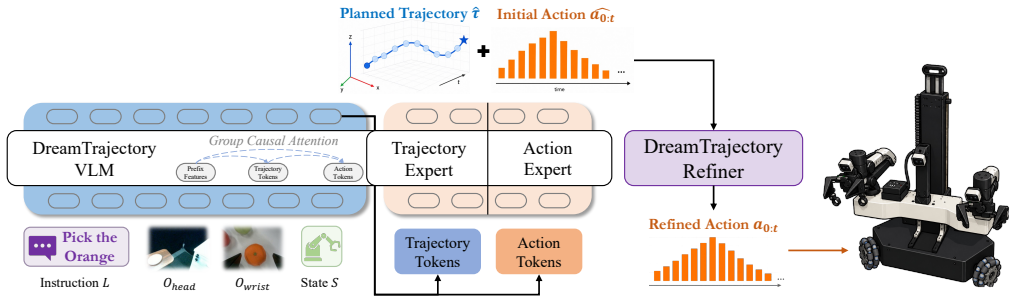
The central object is the chunk-local end-effector trajectory $\tau_{t:t+H-1}$: a sequence of $H$ 7D poses (position plus orientation quaternion) expressed in the base frame fixed at the replanning step, capturing the combined effect of future base and arm motion. It carries the argument because it is both the task-space plan that guides action denoising and the reference against which candidate actions are scored. The mechanisms that make it load-bearing are the group-causal attention mask in the dual-stream flow-matching action expert, which lets trajectory tokens condition action tokens but not vice versa, and the GRU trajectory world model that predicts the induced trajectory for a candi
What would settle it
Measure the trajectory world model's xyz average displacement error on the actual test-time candidate distribution: AR(1)-perturbed actions with $\sigma=0.05$, $\rho=0.9$ around the initial proposal. The paper reports 0.028 m on nominal trajectories; if the perturbed-candidate ADE is several times larger while refinement still adds 7.3 points, the gain cannot plausibly come from planned–induced trajectory agreement. A confirmatory check is to rerun refinement on MS-HAB scoring candidates by true simulator rollouts instead of the learned model and see whether the learned-world-model gain reprod
Extended reading notes
Core claim
DreamTrajectory's central claim is that an explicit end-effector trajectory is the missing intermediate representation for whole-body mobile manipulation. Instead of mapping observations directly to base–arm action chunks, the policy jointly denoises a future 7D end-effector pose trajectory and the action chunk in one flow-matching expert, with a group-causal attention mask letting the trajectory guide actions without reverse leakage. A GRU trajectory world model, trained on logged successful and failed interactions, predicts the trajectory each candidate action would actually induce. At test time, the framework samples perturbed candidates, predicts induced trajectories, and executes the ca
Load-bearing premise
The load-bearing premise is that the trajectory world model, trained on a fixed set of logged interactions, predicts the induced trajectories of the small time-correlated action perturbations used at test time accurately enough that the planned–induced agreement score is a genuine signal; if those predictions are biased on just those perturbed candidates, the selection step can rank worse actions higher and the reported 7.3-point refinement gain would not replicate.
Editorial extensions
If this is right
- Trajectory guidance alone adds 15.2 points on average over the action-only π0.5 baseline on MS-HAB, and world-model refinement adds another 7.3 points, so the two mechanisms are complementary.
- The full method raises average success on the six MS-HAB set_table subtasks from 32.3% to 54.8%, with the largest per-task gains on contact-rich articulated objects: open-fridge rises from 5% to 51% and close-counter from 38% to 80%.
- On a physical mobile manipulator, trajectory guidance raises average success from 63.3% to 81.7%, and refinement brings it to 90.0%.
- The trajectory world model adds 49.02M parameters (1.40% of the VLA) and 8.10 ms latency; the full framework adds 11.75 ms per replanning step, so the consistency check is cheap enough to run at deployment.
- Refinement in the ablation improves all six subtasks, including tasks where trajectory guidance is already strong, indicating it corrects residual plan-to-execution error rather than only rescuing failed guidance.
Reading between the lines
- The refiner is policy-agnostic in design—it reads an action chunk and compares a predicted induced trajectory with a plan—so it could be attached to other action-chunk VLAs, not only the flow-matching policy used here. The paper only demonstrates it with its own trajectory-guided expert, so portability is an inference.
- Because scoring happens in 7D task space rather than pixel space, refinement cost scales with trajectory length and candidate count, not image resolution. The 8.10 ms world-model latency was measured on one desktop GPU; the same trade-off on lower-power or embedded hardware is untested.
- The ablation shows trajectory guidance slightly lowers success on pick-apple and open-counter while sharply raising contact-rich tasks. An adaptive weighting between direct action prediction and trajectory guidance, or a confidence gate that skips refinement, might recover those points; the paper reports the drops but does not test such a mechanism.
- The chunk-local base-frame trajectory representation could naturally extend to two grippers or to a base-trajectory stream for other whole-body platforms, but the paper does not test any embodiment beyond a wheeled mobile manipulator.
Editorial analysis
A structured set of objections, weighed in public.
Referee Report
Summary. DreamTrajectory (DT) proposes a two-component method for language-conditioned mobile manipulation: (1) a VLA that jointly predicts an end-effector trajectory and a whole-body action chunk, using group-causal attention so the trajectory guides action generation; and (2) a lightweight action-conditioned trajectory world model that, at test time, predicts the trajectory induced by each of N candidate action perturbations and selects the candidate best aligned with the planned trajectory plus a smoothness term. On the MS-HAB set_table benchmark, the authors report improvements from 32.3% (action-only π0.5) to 47.5% with trajectory guidance and to 54.8% with additional world-model refinement. On three real-world tasks with an ARX LIFT robot, the corresponding rates are 63.3%, 81.7%, and 90.0%. The paper also ablates trajectory guidance, compares world-model architectures, and reports low added parameter/latency overhead.
Significance. If the reported results hold, DT is a pragmatic contribution: it demonstrates that a compact task-space trajectory can act as an effective intermediate representation for whole-body mobile manipulation, and that aligning candidate actions to a planned trajectory via a learned world model can be done with only 49M additional parameters and ~12 ms added latency. The ablation in Table 3 cleanly separates trajectory guidance from test-time refinement, and the architecture comparison in Table 5 is informative. The paper is also explicit about the assumption that the world model is learned from logged interactions because analytic forward kinematics cannot capture contacts and control errors. However, the central quantitative claims currently rest on experiments without error bars, real-world results with only 20 episodes per task, and a refinement ablation that does not isolate the mechanism responsible for the gain. These gaps must be addressed before the conclusions are fully supported.
major comments (4)
- [§3.3, Eqs. (7)–(8); Table 3] Alternatively, if the authors believe such controls are standard, they should at least report the distribution of selected candidates (e.g., how often a perturbed candidate is chosen over the original) and show that the world model's predicted trajectory correlates with true success on a validation set.
- [§3.3, §3.4 Stage II; Table 5] Also specify how the logged interaction dataset was collected (which policy, how many trials, success/failure ratio), since this affects the world model's coverage of the perturbation distribution.
- [Tables 2–4] At minimum, provide binomial CIs for each row in Tables 2–4 and a paired or per-task significance test for the main comparisons.
- [§3.3, Eqs. (7)–(8); Table 3] If the gain persists across a range, this substantially strengthens the paper; if it does not, the current presentation overstates robustness.
minor comments (6)
- [Throughout] The manuscript repeatedly refers to 'supplementary materials' for key details: the exact attention mask, inference equations, definitions of S_traj and S_smooth, and the world-model training objective. Since no supplementary is included, these details are unavailable. Please either include the supplementary material or state clearly where it can be obtained.
- [Table 2] Formatting errors: numbers in the ACT and Diffusion Policy rows are concatenated (e.g., '22.093.0' should be '22.0 93.0', and '19.061.0' should be '19.0 61.0'). Please fix the spacing.
- [Table 5] The distinction between 'Angular ADE' and 'Geodesic ADE' is unclear. Define both metrics, particularly how quaternion geodesic distance is computed and whether the same sign-alignment is applied in both cases.
- [§4.1 Real-world setup] The fruit pick-and-place task includes four objects but the paper reports only an aggregate success rate. Please report per-object success or state that the aggregate is over episodes with randomized object identity, so the reader can assess variability.
- [§4.5] The added latency of 11.75 ms is reported on one GPU, but the VLA's own inference latency is not given. Reporting the relative overhead (e.g., VLA latency without DT) would make the 'lightweight' claim more interpretable.
- [References] Several references are to arXiv preprints dated 2026 with author lists that include unusual institutional names (e.g., 'Intelligence, P.'). Please verify that all citations are accurate and complete, as the editor may need to check them.
Circularity Check
No circularity: the claimed gains are measured rollouts, and the world model and planned trajectory are independently learned quantities.
full rationale
The paper's central claims—trajectory guidance raising success from 32.3% to 47.5% and test-time refinement to 54.8%—are measured rollout outcomes, not derived or fitted quantities. The trajectory world model (Eq. 6) is trained on recorded interaction outcomes with ground-truth executed trajectories τ_exec, explicitly 'rather than an open-loop planned trajectory' (Sec. 3.4). At test time, the planned trajectory τ̂ is produced by the VLA, and the score (Eq. 8) compares each candidate's predicted induced trajectory against τ̂; candidate selection is then evaluated by actual task success. There is no by-construction equality between the inputs (images, state, action candidates) and the reported success rates. The trajectory-guided stage is an architectural modification (group-causal attention, Eqs. 3–5) against an action-only baseline; the improvement is an empirical ablation, not a logical consequence of a definition. Self-citations to the authors' related VLA papers appear only in the Related Work section and do not support any load-bearing premise of the method. The known weakness—absence of a control isolating the world model's predictions from random perturbation and smoothness—is an experimental confound, not circularity. Hence no circular step can be quoted.
Assumptions & free parameters
free parameters (6)
- lambda (trajectory agreement weight) =
0.5
- eta (smoothness scale) =
1e-3
- sigma (perturbation marginal std) =
0.05
- rho (AR(1) lag-one correlation) =
0.9
- N (number of candidates) =
30
- lambda_tau and lambda_a (flow-matching loss weights) =
unspecified
assumptions (6)
- standard math Conditional flow matching from pi0 is a valid generative formulation for joint trajectory and action samples.
- domain assumption An end-effector trajectory in chunk-local frame is a sufficient and meaningful task-space guide for whole-body mobile manipulation.
- domain assumption The trajectory world model, trained on a fixed offline interaction dataset, generalizes to the candidate perturbations used at test time.
- domain assumption The interaction dataset for the world model is representative of deployment conditions and includes both successful and failed trials from the same task distribution.
- domain assumption Pretrained pi0.5 weights provide a valid initialization for the trajectory-guided VLA.
- domain assumption The 100-episode simulated and 20-episode real-world evaluations produce reliable estimates of success without error bars.
Cite this review
Pith. "Pith review of DreamTrajectory: Trajectory-Guided Action Generation with World Model Alignment for Mobile Manipulation." pith.science (2026). https://pith.science/paper/2T77A5H6
@misc{pith2026260801381,
  author       = {Pith},
  title        = {Pith review of: DreamTrajectory: Trajectory-Guided Action Generation with World Model Alignment for Mobile Manipulation},
  year         = {2026},
  howpublished = {\url{https://pith.science/paper/2T77A5H6}},
  note         = {Machine review of arXiv:2608.01381}
}
read the original abstract
Mobile manipulation requires a robot to coordinate base and arm motion under continuously changing viewpoints and contact conditions, within an action space far larger than that of fixed-base manipulation. Existing Vision-Language-Action (VLA) policies are limited in two respects. (i)They map observations directly to whole-body action chunks, searching this large action space without an explicit task-space motion plan, which makes coordinated base--arm prediction imprecise. (ii)They execute the predicted chunk open-loop, without checking whether the actions can realize the motion the policy intended, so control errors and unmodeled contacts accumulate into a gap between planned and realized motion. We present DreamTrajectory, a trajectory-guided framework for language-conditioned mobile manipulation that introduces one component for each limitation. Addressing(i), DreamTrajectory jointly predicts an intention-level end-effector trajectory and a whole-body action chunk in a single action expert, so that the trajectory explicitly guides base--arm action generation instead of remaining implicit. Addressing(ii), a lightweight trajectory world model predicts the trajectory that a candidate action chunk would induce, and a test-time search--predict--score procedure selects the candidate best aligned with the planned trajectory. On MS-HAB, trajectory guidance raises average success from 32.3% to 47.5% and test-time refinement further to 54.8%, with the largest gains on contact-rich articulated-object tasks. On three real-world mobile manipulation tasks, the corresponding average success rates are 63.3%, 81.7%, and 90.0%.
Figures


Reference graph
Works this paper leans on
-
[1]
arXiv preprint arXiv:2406.09246 , year=
Openvla: An open-source vision-language-action model , author=. arXiv preprint arXiv:2406.09246 , year=
-
[2]
International Conference on Learning Representations , volume=
Rdt-1b: a diffusion foundation model for bimanual manipulation , author=. International Conference on Learning Representations , volume=
-
[3]
Black, Kevin and Brown, Noah and Driess, Danny and Esmail, Adnan and Equi, Michael and Finn, Chelsea and Fusai, Niccolo and Groom, Lachy and Hausman, Karol and Ichter, Brian and others , journal=
-
[4]
Intelligence, Physical and Black, Kevin and Brown, Noah and Darpinian, James and Dhabalia, Karan and Driess, Danny and Esmail, Adnan and Equi, Michael and Finn, Chelsea and Fusai, Niccolo and others , journal=
-
[5]
arXiv preprint arXiv:2603.03596 , year=
Mem: Multi-scale embodied memory for vision language action models , author=. arXiv preprint arXiv:2603.03596 , year=
-
[6]
Intelligence, Physical and Ai, Bo and Amin, Ali and Aniceto, Raichelle and Balakrishna, Ashwin and Balke, Greg and Black, Kevin and Bokinsky, George and Cao, Shihao and Charbonnier, Thomas and others , journal=
-
[7]
arXiv preprint arXiv:2503.14734 , year=
Gr00t n1: An open foundation model for generalist humanoid robots , author=. arXiv preprint arXiv:2503.14734 , year=
-
[8]
arXiv preprint arXiv:2502.19645 , year=
Fine-tuning vision-language-action models: Optimizing speed and success , author=. arXiv preprint arXiv:2502.19645 , year=
Show all 44 references
-
[9]
arXiv preprint arXiv:2506.01844 , year=
Smolvla: A vision-language-action model for affordable and efficient robotics , author=. arXiv preprint arXiv:2506.01844 , year=
-
[10]
International Conference on Learning Representations , volume=
Tracevla: Visual trace prompting enhances spatial-temporal awareness for generalist robotic policies , author=. International Conference on Learning Representations , volume=
-
[11]
IEEE Robotics and Automation Letters , year=
Diffusion trajectory-guided policy for long-horizon robot manipulation , author=. IEEE Robotics and Automation Letters , year=
-
[12]
Proceedings of the Computer Vision and Pattern Recognition Conference , pages=
Cot-vla: Visual chain-of-thought reasoning for vision-language-action models , author=. Proceedings of the Computer Vision and Pattern Recognition Conference , pages=
-
[13]
arXiv preprint arXiv:2410.06158 , year=
Gr-2: A generative video-language-action model with web-scale knowledge for robot manipulation , author=. arXiv preprint arXiv:2410.06158 , year=
-
[14]
Advances in Neural Information Processing Systems , volume=
Dreamvla: a vision-language-action model dreamed with comprehensive world knowledge , author=. Advances in Neural Information Processing Systems , volume=
-
[15]
arXiv preprint arXiv:2506.21539 , year=
Worldvla: Towards autoregressive action world model , author=. arXiv preprint arXiv:2506.21539 , year=
-
[16]
Proceedings of the Computer Vision and Pattern Recognition Conference , pages=
Momanipvla: Transferring vision-language-action models for general mobile manipulation , author=. Proceedings of the Computer Vision and Pattern Recognition Conference , pages=
-
[17]
arXiv preprint arXiv:2602.15922 , year=
World action models are zero-shot policies , author=. arXiv preprint arXiv:2602.15922 , year=
-
[18]
arXiv preprint arXiv:2604.27792 , year=
Motubrain: An advanced world action model for robot control , author=. arXiv preprint arXiv:2604.27792 , year=
-
[19]
arXiv preprint arXiv:2603.17240 , year=
GigaWorld-Policy: An Efficient Action-Centered World--Action Model , author=. arXiv preprint arXiv:2603.17240 , year=
-
[20]
International Conference on Learning Representations , volume=
Maniskill-hab: A benchmark for low-level manipulation in home rearrangement tasks , author=. International Conference on Learning Representations , volume=
-
[21]
Proceedings of the IEEE conference on computer vision and pattern recognition , pages=
Deep residual learning for image recognition , author=. Proceedings of the IEEE conference on computer vision and pattern recognition , pages=
-
[22]
arXiv preprint arXiv:2212.06817 , year=
Rt-1: Robotics transformer for real-world control at scale , author=. arXiv preprint arXiv:2212.06817 , year=
-
[23]
Conference on Robot Learning , pages=
Rt-2: Vision-language-action models transfer web knowledge to robotic control , author=. Conference on Robot Learning , pages=. 2023 , organization=
2023
-
[24]
arXiv preprint arXiv:2303.03378 , year=
Palm-e: An embodied multimodal language model , author=. arXiv preprint arXiv:2303.03378 , year=
-
[25]
2024 IEEE International Conference on Robotics and Automation (ICRA) , pages=
Open x-embodiment: Robotic learning datasets and rt-x models: Open x-embodiment collaboration 0 , author=. 2024 IEEE International Conference on Robotics and Automation (ICRA) , pages=. 2024 , organization=
2024
-
[26]
arXiv preprint arXiv:2405.12213 , year=
Octo: An open-source generalist robot policy , author=. arXiv preprint arXiv:2405.12213 , year=
-
[27]
International Conference on Learning Representations , volume=
Vision-language foundation models as effective robot imitators , author=. International Conference on Learning Representations , volume=
-
[28]
IEEE Robotics and Automation Letters , year=
Tinyvla: Towards fast, data-efficient vision-language-action models for robotic manipulation , author=. IEEE Robotics and Automation Letters , year=
-
[29]
arXiv preprint arXiv:2501.15830 , year=
Spatialvla: Exploring spatial representations for visual-language-action model , author=. arXiv preprint arXiv:2501.15830 , year=
-
[30]
arXiv preprint arXiv:2411.19650 , year=
Cogact: A foundational vision-language-action model for synergizing cognition and action in robotic manipulation , author=. arXiv preprint arXiv:2411.19650 , year=
-
[31]
arXiv preprint arXiv:2402.10885 , year=
3d diffuser actor: Policy diffusion with 3d scene representations , author=. arXiv preprint arXiv:2402.10885 , year=
-
[32]
arXiv preprint arXiv:2311.01977 , year=
Rt-trajectory: Robotic task generalization via hindsight trajectory sketches , author=. arXiv preprint arXiv:2311.01977 , year=
-
[33]
arXiv preprint arXiv:2506.01185 , year=
Homer: Learning in-the-wild mobile manipulation via hybrid imitation and whole-body control , author=. arXiv preprint arXiv:2506.01185 , year=
-
[34]
arXiv preprint arXiv:2411.04983 , year=
Dino-wm: World models on pre-trained visual features enable zero-shot planning , author=. arXiv preprint arXiv:2411.04983 , year=
-
[35]
arXiv preprint arXiv:2506.09985 , year=
V-jepa 2: Self-supervised video models enable understanding, prediction and planning , author=. arXiv preprint arXiv:2506.09985 , year=
-
[36]
arXiv preprint arXiv:2603.14482 , year=
V-jepa 2.1: Unlocking dense features in video self-supervised learning , author=. arXiv preprint arXiv:2603.14482 , year=
-
[37]
arXiv preprint arXiv:2503.00200 , year=
Unified video action model , author=. arXiv preprint arXiv:2503.00200 , year=
-
[38]
arXiv preprint arXiv:2504.02792 , year=
Unified world models: Coupling video and action diffusion for pretraining on large robotic datasets , author=. arXiv preprint arXiv:2504.02792 , year=
-
[39]
arXiv preprint arXiv:2304.13705 , year=
Learning fine-grained bimanual manipulation with low-cost hardware , author=. arXiv preprint arXiv:2304.13705 , year=
-
[40]
Proceedings of Robotics: Science and Systems (RSS) , year=
Diffusion Policy: Visuomotor Policy Learning via Action Diffusion , author=. Proceedings of Robotics: Science and Systems (RSS) , year=
-
[41]
Proceedings of the AAAI Conference on Artificial Intelligence , volume=
Reconvla: Reconstructive vision-language-action model as effective robot perceiver , author=. Proceedings of the AAAI Conference on Artificial Intelligence , volume=
-
[42]
International Conference on Learning Representations , volume=
Spatial forcing: Implicit spatial representation alignment for vision-language-action model , author=. International Conference on Learning Representations , volume=
-
[43]
2025 IEEE/RSJ International Conference on Intelligent Robots and Systems (IROS) , pages=
Pd-vla: Accelerating vision-language-action model integrated with action chunking via parallel decoding , author=. 2025 IEEE/RSJ International Conference on Intelligent Robots and Systems (IROS) , pages=. 2025 , organization=
2025
-
[44]
International Conference on Learning Representations , volume=
Unified diffusion VLA: Vision-language-action model via joint discrete denosing diffusion process , author=. International Conference on Learning Representations , volume=
Reviewed August 6, 2026 · model on record in the stance chip above.
Discussion (0). Sign in to comment.