REVIEW 3 major objections 5 minor 45 references
SABRE: A Multi-Agent Approach for Selecting Out-of-Distribution Detectors Under a Budget
T0 review · 3 major / 5 minor · reviewed 2026-08-15 · deepseek-v4-flash
Pith's one-line read An out-of-distribution detector that leads on natural images can invert on a specialized domain, and SABRE replaces that fixed choice with per-regime selection.
desk verdict The empirical finding that fixed OOD detectors invert across domains is solid and worth knowing; the SABRE framework is plausible but the paper overstates 'tracks the strongest detector' because it omits the obvious baseline of using the same calibration labels to simply pick the best single detector, which likely beats SABRE at lower cost. read the letter →
The pith
A machine-rendered reading of the paper's core claim, the machinery that carries it, and where it could break.
The reading
What carries the argument
The load-bearing identity is the Analyst's reliability weight $w_m = \max(0, 2A_m(\mathcal{C})-1)$, computed from each detector's AUROC $A_m$ on a small labeled calibration set $\mathcal{C}$ drawn from the deployment domain and disjoint from the scored data. Detectors at or below chance ($A_m \le 0.5$) receive zero weight and are ruled out, preventing an inverted detector from cancelling sound ones in the aggregate. The final score is the weight-adjusted mean of calibrated positions, $s_{\text{SABRE}}(x) = \frac{\sum_{m \in R(x)} w_m \tilde{s}_m(x)}{\sum_{m \in R(x)} w_m}$; each raw score is mapped to the scale of positions among calibration in-distribution scores. This calibration loop, not the order in which the Selector consults detectors, carries the recovery, with the Selector and Reporter contributing budget efficiency and modest gains.
What would settle it
If a domain pair is found on a frozen encoder where no post-hoc detector inverts and the benchmark-preferred detector remains best, the central claim would collapse; concretely, compute AUROC of MSP, Energy, and MCM on natural images versus any specialized image domain, and if none of them falls below 50 while scoring above 50 on natural images, the inversion premise fails.
Extended reading notes
Core claim
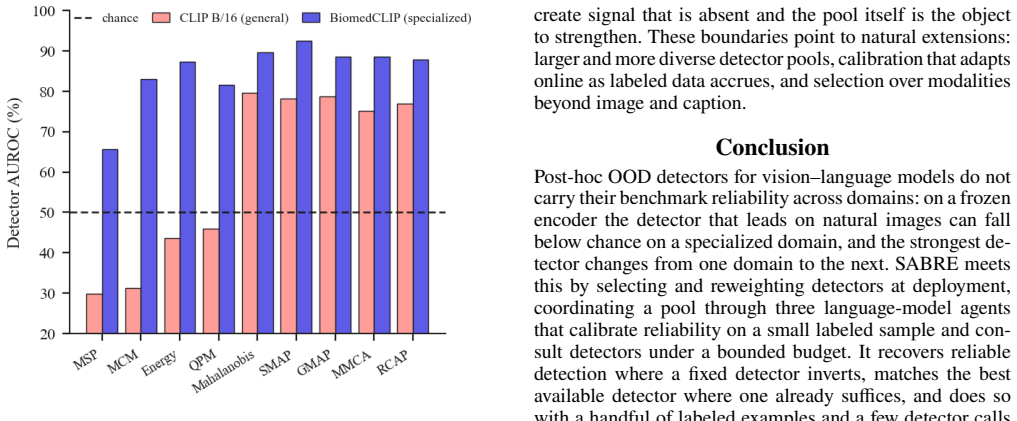
On CLIP ViT-B/16, MCM scores 97.7 AUROC on iNaturalist and 31.2 on NCT-CRC; Energy drops from 98.5 to 43.6; MSP drops from 87.9 to 29.9, so the detector that ranks highest on natural-image benchmarks ranks below chance on histopathology. The paper establishes that no fixed post-hoc detector is reliable throughout, and the same pattern recurs on all five encoders, including a domain-specialized biomedical encoder that lifts every detector but leaves the per-domain ordering intact. SABRE's central claim is that reliability can be measured at deployment rather than assumed: three language-model agents select and weight detectors per regime, and the decisive component is the Analyst's reliability calibration, which assigns zero weight to detectors that are at or below chance on a small held-out labeled sample. The result is that SABRE reaches or approaches the best fixed detector in each domain without knowing in advance which detector that is, and a component analysis isolates the calibration step as the source of the recovery.
Load-bearing premise
The method assumes a small labeled calibration set from the deployment domain is available at deployment; without those labels the reliability weights cannot be computed and SABRE degrades to an unweighted selector that is near chance where detectors invert.
Editorial extensions
If this is right
- A practitioner entering a new domain with a frozen encoder can measure which detectors to trust with roughly 50 to 150 labeled examples and can rule out detectors that invert there.
- Benchmark comparison should not be used to lock in a single detector for deployment; the paper's evidence implies reliability must be re-established per domain.
- Under a budget of three detector calls per image, SABRE reaches about 97% of full-pool quality while spending 2.6 calls per image on average.
- SABRE tracks the best fixed detector rather than surpassing it, so gains concentrate where a fixed detector would fail; on the hardest tissue source, where no detector separates the classes, selection cannot create signal.
- Using a domain-matched encoder and per-regime selection are complementary: a specialized encoder raises every detector's floor but does not remove the need to choose among them.
Reading between the lines
- Editorial inference: the inversion phenomenon is likely broader than the detectors tested here; any fixed scoring rule reads a particular structure of a frozen representation, and a domain shift can reorganize which structure separates novelty, so the same failure could appear for other score families.
- Editorial inference: the calibration weight $2A_m(\mathcal{C})-1$ is a monotone transform of per-domain AUROC, so the same logic could be used to choose among feature extractors or captioning models, not only among post-hoc detectors.
- Editorial inference: the paper's random-selection control shows the Selector's ordering contributes cost savings rather than accuracy, suggesting the agent layer could be replaced by a cheaper deterministic scheduling rule whenever latency matters, leaving the Analyst's weights as the core mechanism.
Signed reviews
Editorial analysis
A structured set of objections, weighed in public.
Referee Report
Summary. This paper studies whether a post-hoc OOD detector selected on a benchmark remains reliable under domain shift for a frozen vision-language encoder. Using CLIP-family encoders and two domains (natural images and histopathology), the authors show that detectors such as MCM and Energy, which lead on natural images, invert on histopathology by scoring in-distribution tissue as more anomalous than outliers, and that the best detector changes by domain. They introduce SABRE, a multi-agent system with three LLM agents: a Selector chooses detectors under a bounded per-image budget, a Reporter consolidates evidence, and an Analyst computes reliability weights from a labeled calibration set disjoint from the test data. The paper proposes four multimodal density detectors and reports a component analysis showing that the Analyst's reliability weighting, rather than the selection order, drives recovery; random selection with the same weights matches SABRE, and SABRE reaches 76.3 AUROC on NCT-CRC with 2.6 mean detector calls.
Significance. The empirical finding that fixed detector reliability does not transfer across domains is clearly supported by the data and strengthened by careful controls: disjoint calibration and test splits, validation-split tracking that matches the test split, a random-selection control, and paired-bootstrap significance tests. However, the paper's central method claim, that SABRE tracks the strongest detector per domain, is not established because the most natural baseline using the same calibration labels, selecting the single detector with maximum calibration AUROC and deploying it, is never evaluated. Such a baseline costs one detector call per image and would likely approach the oracle 'Best single detector' entries that SABRE fails to reach on the main tissue datasets. The contribution of the LLM agents is therefore unclear beyond budget accounting, and the paper's method-level conclusions need to be re-examined.
major comments (3)
- [Methodology, 'Analyst and the calibration mechanism' (Eq. 2); Table 3] The central claim that SABRE 'tracks the strongest detector in each domain' is not supported because the paper omits the calibration-argmax baseline. The labeled calibration set C used to compute w_m = max(0, 2A_m(C)-1) in Eq. (2) can equally be used to rank detectors by A_m(C), select m* = argmax_m A_m(C), and deploy that single detector. This baseline uses exactly the same supervision as SABRE, costs one detector call per image rather than SABRE's mean 2.6 calls (Table 3), and should approximately achieve the 'Best single detector' row: 79.9 on NCT-CRC where SABRE obtains 76.3, and 69.6 on CRC-VAL where SABRE obtains 64.4 (Table 2). The paper gives no evidence that SABRE reaches this baseline's level, so the method-level claim of tracking or converging to the strongest detector is unsubstantiated.
- [Experiments, 'What the Recovery Depends On' (Table 3)] Table 3 shows that random selection under the Analyst's weights (76.6) matches SABRE (76.3) on NCT-CRC, and that unweighted selection is near chance. Combined with the component analysis (Table 2), this means the entire accuracy recovery comes from the calibration weights, not from the agent-based selection order. The paper should either demonstrate a domain or dataset where the Selector and Reporter improve over random selection under the same budget and weights, or reframe SABRE as a calibration-weighted ensemble with a budget cap. As written, the multi-agent selection mechanism is not shown to contribute to accuracy.
- [Table 2 vs. Table 6; natural-image results] There is an inconsistency in the reported best single detector for NCT-CRC: Table 2 gives 79.6, while Table 3 and supplementary Table 6 give 79.9; this must be reconciled. In addition, the natural-image SABRE results are reported only in prose and Figure 4, with no table of AUROC values and no comparison to the calibration-argmax baseline; such a table is needed to support the claim that SABRE 'matches the strongest fixed detector' on that domain, especially because there the reliability weights are also derived from labeled calibration data.
minor comments (5)
- [Abstract and main text] There are formatting artifacts in the abstract and introduction, such as 'SABRE (Selective Agentic Budgeted Reliability Ensemble,)' and 'S elective Agentic BudgetedR eliabilityE nsemble', with stray spaces and punctuation; please correct these.
- [Supplementary D.6; main-text experiments] The selective gate with threshold theta = 0.15 is described in the supplementary material but never mentioned in the main-text experimental protocol; please clarify whether the reported mean calls and AUROC figures include this gate.
- [Table 13] Table 13 shows that MSP and MCM retain high selection shares even after their calibration weights become zero; since these calls do not affect the aggregate, please explain whether the Selector is aware of zero weights when spending budget, or report an effective weighted-call count.
- [Supplementary C.5] The four proposed detectors are strongly rank-correlated (Kendall tau between 0.72 and 0.99), which the main text should acknowledge when interpreting pool diversity and the Selector's choices.
- [GCHTID discussion] GCHTID is repeatedly called a 'difficulty ceiling', but the +Crit configuration reaches 58.0 against best single 60.7 on ViT-L/14 (Table 6); please define the term more carefully or weaken the ceiling language.
Circularity Check
No circularity: SABRE's calibration weights are held-out and the QPM self-citation is not load-bearing.
full rationale
The derivation chain is not circular. The central inversion claim is an empirical benchmark result measured on external datasets (ImageNet-100, iNaturalist, SUN, Places, Textures, NCT-CRC, CRC-VAL, GCHTID), not derived from the method's own weights. The Analyst's reliability weights w_m = max(0, 2A_m(C)-1) are computed on a labeled calibration set C that is explicitly disjoint from the scored test data, so reporting test AUROC is a held-out evaluation rather than a fitted prediction. Eq. (3) combines detector scores with these held-out weights; no test label enters the computation. The only self-referential element is the QPM baseline, a static variant of the authors' own T-QPM (Naiknaware and Sekeh 2026), but it is one of nine pool members and the inversion result is independently established by MSP, Energy, and MCM on external benchmarks, so the self-citation is not load-bearing. The skeptical concern that a calibration-argmax single-detector baseline is missing is an evaluation or comparison gap rather than circularity: omitting a baseline does not make SABRE's reported AUROC equivalent to its inputs by construction. The paper also runs controls (random selection under the same weights, budget sweeps, disjoint validation splits) that separate calibration from selection order and confirm the configuration ordering was not selected on test data, further supporting the non-circular interpretation.
Assumptions & free parameters
free parameters (8)
- gamma (caption weight in proposed detectors) =
2
- delta (MMCA cross-modal penalty weight) =
0.25
- G (number of semantic groups) =
4
- theta (selective gate threshold) =
0.15
- B (query budget) =
3
- MCM temperature T =
1
- QPM beta weights =
uniform 0.25
- calibration set fraction =
30% (150 images)
assumptions (6)
- domain assumption A labeled calibration set can be drawn from the deployment domain, disjoint from the scored set.
- domain assumption The captioner's output does not leak class identity.
- domain assumption The calibration set is representative of the test distribution (same deployment domain).
- standard math AUROC is the correct threshold-free metric for comparing OOD detectors.
- domain assumption LLM agents with greedy decoding and fixed seeds produce reproducible decisions.
- ad hoc to paper The detector pool is static and finite; selection cannot create signal absent from all detectors.
invented entities (4)
-
SMAP (Semantic Mahalanobis Anomaly Profile)
independent evidence
-
RCAP (Regional Concentration Anomaly Profile)
independent evidence
-
MMCA (Multi-Modal Confidence Asymmetry)
independent evidence
-
GMAP (Gated Mixture Anomaly Positioning)
independent evidence
Cite this review
Pith. "Pith review of SABRE: A Multi-Agent Approach for Selecting Out-of-Distribution Detectors Under a Budget." pith.science (2026). https://pith.science/paper/2OMGVHZB
@misc{pith2026260802959,
  author       = {Pith},
  title        = {Pith review of: SABRE: A Multi-Agent Approach for Selecting Out-of-Distribution Detectors Under a Budget},
  year         = {2026},
  howpublished = {\url{https://pith.science/paper/2OMGVHZB}},
  note         = {Machine review of arXiv:2608.02959}
}
read the original abstract
Post-hoc out-of-distribution (OOD) detection for vision-language models assumes that a detector chosen on a benchmark stays reliable once deployed. We show this fails across domains: on a single frozen encoder, a detector that leads in one domain can invert in another, scoring in-distribution inputs as more anomalous than genuine outliers, and the best detector changes from domain to domain, so no fixed choice is reliable throughout. We introduce SABRE (Selective Agentic Budgeted Reliability Ensemble,) which replaces this fixed choice with per-regime selection at inference. Three language-model agents reason over a library of post-hoc detectors under a bounded query budget: a Selector chooses which detector to consult next, a Reporter consolidates the evidence for each input, and an Analyst calibrates detector reliability on a small labeled sample held out from the deployment domain and disjoint from the test data, weighting selection and aggregation without ever observing a scored input's label. The library includes four multimodal density detectors we propose. Inferring the operating regime from data, SABRE tracks the strongest detector in each domain without prior knowledge of it, recovering reliable detection where a conventional detector inverts and converging to that detector where it is sound. A component analysis shows the agents are complementary: the Reporter's feedback yields consistent gains, and the Analyst's calibration is decisive against inversion, ruling out unreliable detectors so that aggregation no longer cancels the sound ones. Since no fixed rule can be trusted across domains, reliability must be established at deployment rather than assumed from a benchmark, and SABRE shows this can be done automatically.
Figures


Figures from the paper (3 more)


Reference graph
Works this paper leans on
-
[1]
D. Hendrycks and K. Gimpel. A Baseline for Detecting Misclassified and Out-of-Distribution Examples in Neural Networks. ICLR. 2017
work page 2017
-
[2]
S. Liang and Y. Li and R. Srikant. Enhancing the Reliability of Out-of-Distribution Image Detection in Neural Networks. ICLR. 2018
work page 2018
- [3]
- [4]
- [5]
- [6]
- [7]
-
[8]
H. Wang and Z. Li and L. Feng and W. Zhang. ViM : Out-of-Distribution with Virtual-Logit Matching. CVPR. 2022
work page 2022
Show all 45 references
-
[9]
Wei and R
H. Wei and R. Xie and H. Cheng and L. Feng and B. An and Y. Li. Mitigating Neural Network Overconfidence with Logit Normalization. ICML. 2022
2022
-
[10]
Ren and S
J. Ren and S. Fort and J. Liu and A. G. Roy and S. Padhy and B. Lakshminarayanan. A Simple Fix to Mahalanobis Distance for Improving Near- OOD Detection. arXiv preprint arXiv:2106.09022. 2021
2021 arXiv
-
[11]
Lakshminarayanan and A
B. Lakshminarayanan and A. Pritzel and C. Blundell. Simple and Scalable Predictive Uncertainty Estimation using Deep Ensembles. NeurIPS. 2017
2017
-
[12]
Yang and P
J. Yang and P. Wang and D. Zou and others. OpenOOD : Benchmarking Generalized Out-of-Distribution Detection. NeurIPS. 2022
2022
-
[13]
Yang and K
J. Yang and K. Zhou and Y. Li and Z. Liu. Generalized Out-of-Distribution Detection: A Survey. International Journal of Computer Vision. 2024
2024
-
[14]
Radford and J
A. Radford and J. W. Kim and C. Hallacy and others. Learning Transferable Visual Models from Natural Language Supervision. ICML. 2021
2021
-
[15]
Zhai and B
X. Zhai and B. Mustafa and A. Kolesnikov and L. Beyer. Sigmoid Loss for Language Image Pre-Training. ICCV. 2023
2023
-
[16]
Zhang and Y
S. Zhang and Y. Xu and N. Usuyama and others. Large-Scale Domain-Specific Pretraining for Biomedical Vision-Language Processing. arXiv preprint arXiv:2303.00915. 2023
2023 arXiv
-
[17]
Ming and Z
Y. Ming and Z. Cai and J. Gu and Y. Sun and W. Li and Y. Li. Delving into Out-of-Distribution Detection with Vision-Language Representations. NeurIPS. 2022
2022
-
[18]
Esmaeilpour and B
S. Esmaeilpour and B. Liu and E. Robertson and L. Shu. Zero-Shot Out-of-Distribution Detection Based on the Pre-trained Model CLIP. AAAI. 2022
2022
-
[19]
Wang and Y
H. Wang and Y. Li and H. Yao and X. Li. CLIPN for Zero-Shot OOD Detection: Teaching CLIP to Say No. ICCV. 2023
2023
-
[20]
Miyai and Q
A. Miyai and Q. Yu and G. Irie and K. Aizawa. LoCoOp : Few-Shot Out-of-Distribution Detection via Prompt Learning. NeurIPS. 2023
2023
-
[21]
Jiang and F
X. Jiang and F. Liu and Z. Fang and H. Chen and T. Liu and F. Zheng and B. Han. Negative Label Guided OOD Detection with Pretrained Vision-Language Models. ICLR. 2024
2024
-
[22]
Miyai and Q
A. Miyai and Q. Yu and G. Irie and K. Aizawa. GL-MCM : Global and Local Maximum Concept Matching for Zero-Shot Out-of-Distribution Detection. International Journal of Computer Vision. 2025
2025
-
[23]
Cao and Z
C. Cao and Z. Zhong and Z. Zhou and Y. Liu and T. Liu and B. Han. Envisioning Outlier Exposure by Large Language Models for Out-of-Distribution Detection. ICML. 2024
2024
-
[24]
Ming and Y
Y. Ming and Y. Li. How Does Fine-Tuning Impact Out-of-Distribution Detection for Vision-Language Models?. International Journal of Computer Vision. 2023
2023
-
[25]
Xu and K
R. Xu and K. Ding. Large Language Models for Anomaly and Out-of-Distribution Detection: A Survey. arXiv preprint arXiv:2409.01980. 2024
2024 arXiv
-
[26]
Yao and J
S. Yao and J. Zhao and D. Yu and N. Du and I. Shafran and K. Narasimhan and Y. Cao. ReAct : Synergizing Reasoning and Acting in Language Models. ICLR. 2023
2023
-
[27]
Shinn and F
N. Shinn and F. Cassano and E. Berman and A. Gopinath and K. Narasimhan and S. Yao. Reflexion: Language Agents with Verbal Reinforcement Learning. NeurIPS. 2023
2023
-
[28]
Yao and D
S. Yao and D. Yu and J. Zhao and I. Shafran and T. L. Griffiths and Y. Cao and K. Narasimhan. Tree of Thoughts: Deliberate Problem Solving with Large Language Models. NeurIPS. 2023
2023
-
[29]
Wu and G
Q. Wu and G. Bansal and J. Zhang and others. AutoGen : Enabling Next-Gen LLM Applications via Multi-Agent Conversation. COLM. 2024
2024
-
[30]
Hong and M
S. Hong and M. Zhuge and J. Chen and others. MetaGPT : Meta Programming for a Multi-Agent Collaborative Framework. ICLR. 2024
2024
-
[31]
J. N. Kather and N. Halama and A. Marx. 100,000 Histological Images of Human Colorectal Cancer and Healthy Tissue. 2018. doi:10.5281/zenodo.1214456
2018 doi
-
[32]
J. N. Kather and J. Krisam and P. Charoentong and others. Predicting Survival from Colorectal Cancer Histology Slides Using Deep Learning: A Retrospective Multicenter Study. PLoS Medicine. 2019
2019
-
[33]
Van Horn and O
G. Van Horn and O. Mac Aodha and Y. Song and Y. Cui and C. Sun and A. Shepard and H. Adam and P. Perona and S. Belongie. The iNaturalist Species Classification and Detection Dataset. CVPR. 2018
2018
-
[34]
Xiao and J
J. Xiao and J. Hays and K. A. Ehinger and A. Oliva and A. Torralba. SUN Database: Large-Scale Scene Recognition from Abbey to Zoo. CVPR. 2010
2010
-
[35]
Zhou and A
B. Zhou and A. Lapedriza and A. Khosla and A. Oliva and A. Torralba. Places: A 10 Million Image Database for Scene Recognition. IEEE Transactions on Pattern Analysis and Machine Intelligence. 2018
2018
-
[36]
Cimpoi and S
M. Cimpoi and S. Maji and I. Kokkinos and S. Mohamed and A. Vedaldi. Describing Textures in the Wild. CVPR. 2014
2014
-
[37]
Huang and Y
R. Huang and Y. Li. MOS : Towards Scaling Out-of-Distribution Detection for Large Semantic Space. CVPR. 2021
2021
-
[38]
Naiknaware and S
A. Naiknaware and S. Sekeh. T-QPM: Enabling Temporal Out-Of-Distribution Detection and Domain Generalization for Vision-Language Models in Open-World. arXiv preprint arXiv:2603.18481. 2026
2026 arXiv
-
[39]
Deng and W
J. Deng and W. Dong and R. Socher and L.-J. Li and K. Li and L. Fei-Fei. ImageNet: A Large-Scale Hierarchical Image Database. CVPR. 2009
2009
-
[40]
Lou and J
S. Lou and J. Ji and H. Li and X. Zhang and Y. Jiang and M. Hua and K. Chen and K. Ge and Q. Zhang and L. Wang and P. Han and L. Cao. A Large Histological Images Dataset of Gastric Cancer with Tumour Microenvironment Annotation for AI. Scientific Data. 2025
2025
-
[41]
J. N. Kather and J. Krisam and P. Charoentong and others. Predicting Survival from Colorectal Cancer Histology Slides Using Deep Learning: A Retrospective Multicenter Study. PLOS Medicine. 2019
2019
-
[42]
ImageNet100
ambityga. ImageNet100. 2026
2026
-
[43]
NCT-CRC-HE-100K
imrankhan77. NCT-CRC-HE-100K. 2026
2026
-
[44]
CRC-VAL-HE-7K
merveatasoy1. CRC-VAL-HE-7K. 2026
2026
-
[45]
Gastric Cancer Histopathology Tissue Image Dataset
orvile. Gastric Cancer Histopathology Tissue Image Dataset. 2026
2026
Reviewed August 15, 2026 · model on record in the stance chip above.
Discussion (0). Continue with ORCID to comment.