REVIEW 3 major objections 5 minor 27 references
Process-Knowledge-Embedded Safe DRL for Real-Time Dispatch of Process Loads in Industrial Microgrids
T0 review · 3 major / 5 minor · reviewed 2026-08-15 · deepseek-v4-flash
Pith's one-line read Embedding steelmaking process knowledge in a safe deep reinforcement learning agent yields strictly feasible, cost-reducing 5-minute dispatch for industrial microgrid loads.
desk verdict Novel safe-RL mechanism for steelmaking dispatch, but the central recursive-feasibility guarantee does not connect the sampled continuous powers to the durations used in the proof, and the reported 60 MW EAF operation contradicts the stated 40–50 min duration bound. read the letter →
The pith
A machine-rendered reading of the paper's core claim, the machinery that carries it, and where it could break.
The reading
What carries the argument
The central object is the process-distance-guided action-processing mechanism (PDG-AP). For discrete connection actions $a$ and $b$, the process distance $d_t(a,b)$ is the fraction of active-frontier operating decisions that differ between them. Excluded-action probability mass is reallocated to safe actions through a KL-regularized minimum-distance distribution $\omega^\star$, yielding the safety-processed policy $\tilde\pi^x_\theta$; the expected process-correction distance $C_t(\theta)$ is then constrained in the PPO update through a primal-dual objective with budget $\kappa$. Proposition 1's recursive-feasibility guarantee rests on processing-time inequalities of the form $\tau^{\mathrm{LF}}_k \le \tau^{\mathrm{EAF}}_{k+1}$ and $\tau^{\mathrm{LF}}_k + \tau^{\mathrm{CC}}_k \le \tau^{\mathrm{EAF}}_{k+1} + \tau^{\mathrm{LF}}_{k+1}$, with backup continuation using maximum allowed durations.
What would settle it
Run a single 5-minute step where an EAF at its minimum power (45 MW) is declared active for the minimum allowed duration (40 minutes); the delivered energy is 30 MWh, below the 34.8 MWh required, so the heat is not complete at the scheduled time and the downstream LF start constructed in Proposition 1 is infeasible. Finding this configuration in the modelled plant would refute the recursive-feasibility claim.
Extended reading notes
Core claim
The paper's central claim is that process knowledge can be moved from an external safety filter into the policy itself while preserving hard feasibility. It defines an active frontier of currently and next eligible heats, making the action space lossless relative to full-batch decisions. A process-distance-guided action-processing mechanism (PDG-AP) separates safe from excluded discrete connection actions and reallocates excluded probability to safe actions weighted by both process distance and the actor's own preference. Proposition 1 asserts that, under the configured processing-time inequalities, every processed action leaves at least one admissible continuation, so the schedule cannot deadlock. The expected process-correction distance is then incorporated into PPO as a constraint with budget $\kappa$, giving a primal-dual update and the bound that the raw policy's expected probability on excluded actions is at most $n_x \kappa$; case studies claim this yields feasible, cost-effective schedules.
Load-bearing premise
The guarantee assumes that a safe discrete connection action fully determines whether the process can continue, even though actual processing durations are produced by continuous power samples that may complete heats faster or slower than the assumed bounds.
Editorial extensions
If this is right
- At the reported 0.18 ms per decision, PK-SDRL can dispatch steelmaking loads at 5-minute scale with ample time for online deployment.
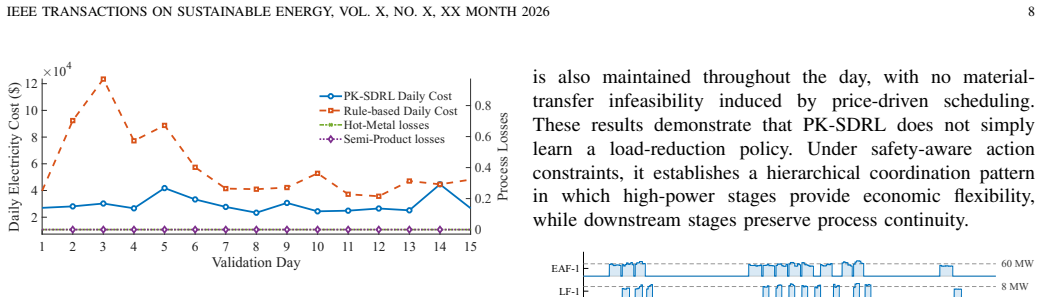
- If the case-study results hold, a plant can lower electricity procurement by shifting EAF-intensive operation to low grid-import periods while keeping interstage transfer and waiting-time constraints satisfied and the daily quota at 100%.
- The correction-budget constraint gives operators a tunable safety knob: a smaller $\kappa$ forces the raw actor to stay closer to feasible actions, at a possible economic cost.
- The ablation result implies that without such action processing, a cost-minimizing DRL agent evades process penalties by under-producing, so feasibility guarantees are behavior-changing rather than decorative.
Reading between the lines
- An extension not developed in the paper is transferring the same discrete-action safety plus continuous-power execution split to other multistage industrial loads such as oxygen supply or chemical batch lines; each transfer would need its own check that sampled power realizes the planned processing durations within the stated bounds.
- The reported cost savings are likely sensitive to price volatility and renewable availability: on flatter price profiles, the economic advantage over rule-based operation should shrink.
- A testable refinement would replace the deterministic tanh power mapping with a stochastic power model and re-derive the feasibility guarantee as probabilistic, because the current proof assumes sampled power produces the assumed completion times.
Signed reviews
Editorial analysis
A structured set of objections, weighed in public.
Referee Report
Summary. The paper proposes a process-knowledge-embedded safe deep reinforcement learning (PK-SDRL) framework for 5-minute real-time dispatch of electric arc furnace–ladle furnace–continuous casting (EAF–LF–CC) steelmaking process loads in an industrial microgrid. The method constructs a lossless active-frontier action space, a process-distance-guided action-processing (PDG-AP) mechanism that reallocates probability mass from infeasible to feasible discrete connection actions, and a parameterized-action PPO with a primal–dual correction-budget constraint. The paper claims a recursive process-feasibility guarantee (Proposition 1), a bound on the raw policy's dependence on safety processing (Proposition 2), and case-study results with zero process losses and electricity-cost reductions of 49.2% versus rule-based scheduling and 25.9% versus rolling MILP at 0.18 ms per decision step. The central theoretical claim is that PDG-AP guarantees admissible execution and feasible continuation for the executed hybrid policy.
Significance. If the recursive-feasibility guarantee and the reported cost savings are correct, this would be a useful contribution to safe DRL for industrial process load dispatch, particularly in showing how process knowledge can be embedded both in action masking and in the policy-update objective. The formulation of the lossless active-frontier action space, the explicit process-distance measure, and the derived raw-policy infeasibility bound are sensible and constructive elements. The empirical study is broad, including ablation, comparison with rolling MILP, and sensitivity to forecast errors. However, the load-bearing safety guarantee is not established by the supplied analysis, and a parameter inconsistency in the case study undermines the reported feat of zero process losses. The manuscript therefore requires substantial revision before its central claims can be accepted.
major comments (3)
- [Section III-C and Appendix A, Proposition 1] The proof of Proposition 1 assumes that processing durations d and interstage intervals q can be prescribed as part of the backup schedule, but in the model these quantities are not decision variables: they are realized outcomes of the continuous power trajectory through Eq. (2) and the mapping in Eq. (24). The safe set U_s_t is defined using only the discrete connection action δ and constraints (4)–(7), before the power sample P*_t is drawn. The proof constructs a backup continuation by selecting values such as d^{LF}_{k+1} = τ̅^{LF}_{k+1}, but it does not show that the power sample actually executed yields those durations. A different power sample can make a heat complete earlier or later than assumed, violating the separation inequalities (46)–(47) and destroying the claimed feasible continuation. Consequently, Proposition 1 does not establish recursive feasibility for the executed hybrid policy, and the abstract's claim of a hard guarantee of admissible execution is not supported.
- [Section IV-A Table I and Section IV-B Fig. 10] There is an internal inconsistency between the stated device parameters and the reported operating trajectories. For the EAF, the required energy is 34.8 MWh/heat, the power bounds are [45, 75] MW, and the admissible processing duration is 40–50 min. To satisfy both the energy requirement and the duration constraint (7), the average EAF power must lie in approximately [41.8, 52.2] MW. The case study reports EAF powers varying around 60 MW (Fig. 10), which would complete a heat in about 34.8 minutes, below the 40-minute lower bound. Unless the model allows the energy requirement to be oversatisfied or the duration constraint is interpreted differently, the illustrated trajectories violate constraint (7). This undermines the reported zero process losses and the claim of admissible execution in the case study, and the discrepancy must be resolved.
- [Section III-C, definition of safe set U_s_t] The computation of the safe set U_s_t is not specified. The text states that a discrete action belongs to U_s_t only if it satisfies constraints (4)–(7), but constraint (7) is a future-looking constraint involving the finish time t_fn, which is not known at the current decision time t and depends on subsequent actions and power samples. Without a constructive rule for evaluating (7) for in-progress heats, the membership test for U_s_t is ambiguous. This ambiguity affects both Proposition 1 and the practical implementation of the safety mask, so the paper should specify how U_s_t is computed at each step.
minor comments (5)
- [Section IV-C, Table III] The headline cost reductions are based on a validation set of only 15 days; reporting a confidence interval or the per-day cost distribution would strengthen the claim that the improvement is statistically significant.
- [Fig. 7] The y-axis label appears to contain a typo, reading "Ct(3) pet(3)" instead of using the θ notation introduced in the text for C_t(θ) and p^e_t(θ).
- [Section III-A and IV-A] The paper does not specify the neural-network architectures or the full set of PPO/GAE hyperparameters (beyond the values in Table II), which would make reproduction of the training procedure difficult.
- [Section IV-C, comparative evaluation] The rolling MILP baseline is limited to a 3-hour prediction horizon, whereas the DRL agent is trained on full-day episodes; the paper should discuss whether this difference gives PK-SDRL an unfair advantage in exploiting longer-horizon price patterns.
- [Abstract and Section I] The acronym EAF–LF–CC is used in the abstract without definition; it should be spelled out on first use.
Circularity Check
No circularity: cost claims are tested against external baselines and the feasibility bound follows from the paper's definitions.
full rationale
PK-SDRL's central claims are not derived by fitting the target quantities. The 49.2%/25.9% cost reductions are measured against rule-based and rolling-MILP baselines on unseen validation days (Sec. IV-C, Table III), so they are external comparisons rather than reconstructions of the inputs. Proposition 2 is a direct consequence of the definitions of U_s_t, C_t, d_min, and the probability-mass transfer in (17); no fitted parameter is renamed as a prediction. The recursive-feasibility guarantee (Proposition 1, Appendix A) is a combinatorial argument over the discrete connection variables, and while the proof chooses backup durations d and q rather than demonstrating that the sampled continuous power realizes those durations—a potential correctness gap—that is not a circularity in the sense of the target result being equivalent to an input by construction. No load-bearing self-citations were found; the cited prior work is contextual. The reported decreases in C_t(θ) and p_e(θ) during training (Fig. 7) are descriptive traces of the optimized objective, not independent validation, but they are not used to derive a predicted quantity. Accordingly, the paper is self-contained against external baselines and no circular step is exhibited.
Assumptions & free parameters
free parameters (10)
- Correction budget κ =
0.05
- Process-distance/KL tradeoff τ_m =
0.10
- State-transition shaping coefficient η =
3.0e3 $
- Stage weights ω_s =
1/3 each
- Terminal quota reward ρ_day =
2.5e4 $
- Process-loss penalties c_hm, c_sp =
1.4e4 $/heat, 9.0e3 $/heat
- Production-shortfall penalty c_q =
2.5e4 $/heat
- Demand-exceedance coefficient c_exc =
2 (units implied)
- Forecast error standard deviation σ_f =
10% of realized values
- PPO, GAE, and network hyperparameters
assumptions (5)
- domain assumption Processing-time bounds for consecutive heats satisfy τ_LF_k ≤ τ_EAF_{k+1} and τ_LF_k + τ_CC_k ≤ τ_EAF_{k+1} + τ_LF_{k+1}.
- ad hoc to paper Process feasibility at a decision can be checked from the discrete connection action alone via U_s_t in constraints (4)-(7), independent of the continuous power sample.
- domain assumption The MDP state includes short-term forecasts of price and renewable generation over a 3-hour horizon, with zero-mean Gaussian error σ_f=10% at test time.
- standard math Standard PPO clipped surrogate and GAE provide unbiased policy-gradient estimates.
- domain assumption An episode starts from a process-feasible initial state Ξ_0.
Cite this review
Pith. "Pith review of Process-Knowledge-Embedded Safe DRL for Real-Time Dispatch of Process Loads in Industrial Microgrids." pith.science (2026). https://pith.science/paper/EZ766IWY
@misc{pith2026260803149,
  author       = {Pith},
  title        = {Pith review of: Process-Knowledge-Embedded Safe DRL for Real-Time Dispatch of Process Loads in Industrial Microgrids},
  year         = {2026},
  howpublished = {\url{https://pith.science/paper/EZ766IWY}},
  note         = {Machine review of arXiv:2608.03149}
}
read the original abstract
Steelmaking process loads (SPLs) are flexible resources that enhance local renewable-energy utilization and reduce electricity procurement costs in industrial microgrids. However, strong multistage coupling makes current decisions affect subsequent feasibility, challenging conventional deep reinforcement learning to reduce costs while maintaining process feasibility throughout production. This paper proposes a process-knowledge-embedded safe deep reinforcement learning framework for the real-time dispatch of SPLs in industrial microgrids. Specifically, a lossless active-frontier action space is constructed, and a process-distance-guided action-processing mechanism reallocates excluded-action probabilities according to process distance and the actor's safe-action preference. Recursive process feasibility is established to guarantee admissible execution and feasible continuation. Furthermore, the expected process-correction distance is incorporated into PPO through a correction budget and a primal-dual update to internalize process knowledge into the raw policy, while a derived bound quantifies the raw policy's dependence on safety processing. Case studies using real-world data demonstrate zero process losses, electricity-cost reductions of 49.2% and 25.9% relative to rule-based scheduling and rolling MILP, respectively, within an acceptable computation time.
Figures


Figures from the paper (10 more)




Reference graph
Works this paper leans on
-
[1]
Energy management of networked microgrids with real-time pricing by reinforcement learning,
G. Cui, Q.-S. Jia, and X. Guan, “Energy management of networked microgrids with real-time pricing by reinforcement learning,”IEEE transactions on smart grid, vol. 15, no. 1, pp. 570–580, 2023
work page 2023
-
[2]
C. Huang, H. Zhang, Y . Song, L. Wang, T. Ahmad, and X. Luo, “Demand response for industrial micro-grid considering photovoltaic power uncertainty and battery operational cost,”IEEE Transactions on Smart Grid, vol. 12, no. 4, pp. 3043–3055, 2021
work page 2021
-
[3]
H. Hui, M. Bao, Y . Ding, and C. J. Meinrenken, “Incorporating multi-energy industrial parks into power system operations: A high- dimensional flexible region method,”IEEE Transactions on Smart Grid, vol. 16, no. 1, pp. 463–477, 2024
work page 2024
-
[4]
Optimal industrial load control in smart grid,
A. Gholian, H. Mohsenian-Rad, and Y . Hua, “Optimal industrial load control in smart grid,”IEEE Transactions on Smart Grid, vol. 7, no. 5, pp. 2305–2316, 2015
work page 2015
-
[5]
A rule-based approach founded on description logics for industry 4.0 smart factories,
G. Kourtis, E. Kavakli, and R. Sakellariou, “A rule-based approach founded on description logics for industry 4.0 smart factories,”IEEE Transactions on Industrial Informatics, vol. 15, no. 9, pp. 4888–4899, 2019
work page 2019
-
[6]
Cost-effective scheduling of steel plants with flexible EAFs,
X. Zhang, G. Hug, and I. Harjunkoski, “Cost-effective scheduling of steel plants with flexible EAFs,”IEEE Transactions on Smart Grid, vol. 8, no. 1, pp. 239–249, 2017
work page 2017
-
[7]
Efficient schedul- ing of discrete industrial processes through continuous modeling,
R. Lyu, X. Su, E. Du, H. Guo, Q. Chen, and C. Kang, “Efficient schedul- ing of discrete industrial processes through continuous modeling,”IEEE Transactions on Smart Grid, vol. 16, no. 6, pp. 4726–4740, 2025
work page 2025
-
[8]
A demand response energy management scheme for industrial facilities in smart grid,
Y . M. Ding, S. H. Hong, and X. H. Li, “A demand response energy management scheme for industrial facilities in smart grid,”IEEE trans- actions on industrial informatics, vol. 10, no. 4, pp. 2257–2269, 2014
work page 2014
Show all 27 references
-
[9]
Design and value evaluation of demand response based on model predictive control,
K. Miyazaki, K. Kobayashi, S.-i. Azuma, N. Yamaguchi, and Y . Yamashita, “Design and value evaluation of demand response based on model predictive control,”IEEE Transactions on Industrial Informatics, vol. 15, no. 8, pp. 4809–4818, 2019
2019
-
[10]
Real-time scheduling for dynamic partial-no-wait multiobjective flexible job shop by deep reinforcement learning,
S. Luo, L. Zhang, and Y . Fan, “Real-time scheduling for dynamic partial-no-wait multiobjective flexible job shop by deep reinforcement learning,”IEEE Transactions on Automation Science and Engineering, vol. 19, no. 4, pp. 3020–3038, 2021
2021
-
[11]
Flexible job-shop scheduling via graph neural network and deep reinforcement learning,
W. Song, X. Chen, Q. Li, and Z. Cao, “Flexible job-shop scheduling via graph neural network and deep reinforcement learning,”IEEE Transac- tions on Industrial Informatics, vol. 19, no. 2, pp. 1600–1610, 2022
2022
-
[12]
Model-free real-time ev charging scheduling based on deep reinforcement learning,
Z. Wan, H. Li, H. He, and D. Prokhorov, “Model-free real-time ev charging scheduling based on deep reinforcement learning,”IEEE Transactions on Smart Grid, vol. 10, no. 5, pp. 5246–5257, 2018
2018
-
[13]
Data-driven real-time price-based demand response for industrial facilities energy management,
R. Lu, R. Bai, Y . Huang, Y . Li, J. Jiang, and Y . Ding, “Data-driven real-time price-based demand response for industrial facilities energy management,”Applied Energy, vol. 283, p. 116291, 2021
2021
-
[14]
Multi-agent deep reinforce- ment learning based demand response for discrete manufacturing sys- tems energy management,
R. Lu, Y .-C. Li, Y . Li, J. Jiang, and Y . Ding, “Multi-agent deep reinforce- ment learning based demand response for discrete manufacturing sys- tems energy management,”Applied Energy, vol. 276, p. 115473, 2020
2020
-
[15]
Multi-agent deep reinforcement learning based demand response and energy management for heavy industries with discrete manufacturing systems,
A. Bashyal, T. Boroukhian, P. Veerachanchai, M. Naransukh, and H. Wicaksono, “Multi-agent deep reinforcement learning based demand response and energy management for heavy industries with discrete manufacturing systems,”Applied Energy, vol. 392, p. 125990, 2025
2025
-
[16]
A deep reinforcement learning based multi-objective optimization for the scheduling of oxygen production system in integrated iron and steel plants,
G. Che, Y . Zhang, L. Tang, and S. Zhao, “A deep reinforcement learning based multi-objective optimization for the scheduling of oxygen production system in integrated iron and steel plants,”Applied Energy, vol. 345, p. 121332, 2023
2023
-
[17]
Optimization of oxygen system scheduling in hybrid action space based on deep reinforcement learning,
L. Li, X. Yang, S. Yang, and X. Xu, “Optimization of oxygen system scheduling in hybrid action space based on deep reinforcement learning,” Computers & Chemical Engineering, vol. 171, p. 108168, 2023
2023
-
[18]
Deep reinforcement learning for scheduling of a steel plant in the electricity spot market,
M. Shah, Y . Zhou, J. Wu, and M. Mowbray, “Deep reinforcement learning for scheduling of a steel plant in the electricity spot market,” Engineering, 2026
2026
-
[19]
Learning to operate distribution networks with safe deep reinforcement learning,
H. Li and H. He, “Learning to operate distribution networks with safe deep reinforcement learning,”IEEE Transactions on Smart Grid, vol. 13, no. 3, pp. 1860–1872, 2022
2022
-
[20]
Real-time price- based demand response for industrial manufacturing process via safe reinforcement learning,
X. Ye, Z.-W. Liu, M. Chi, L. Ye, and C. Li, “Real-time price- based demand response for industrial manufacturing process via safe reinforcement learning,”IEEE Transactions on Industrial Informatics, vol. 21, no. 4, pp. 2937–2946, 2025
2025
-
[21]
Safe reinforcement learning method integrating process knowledge for real-time scheduling of gas supply network,
P. Zhou, Z. Xu, X. Zhu, J. Zhao, C. Song, and Z. Shao, “Safe reinforcement learning method integrating process knowledge for real-time scheduling of gas supply network,”Information Sciences, vol. 633, pp. 280–304, 2023
2023
-
[22]
Evolution-assisted safe reinforcement learning for real-time production optimization under uncertainty of industrial rotary kilns,
F. Tang, Y . Li, C. Yang, and B. Sun, “Evolution-assisted safe reinforcement learning for real-time production optimization under uncertainty of industrial rotary kilns,”Process Safety and Environmental Protection, p. 108014, 2025
2025
-
[23]
Safe reinforcement learning for industrial optimal control: A case study from metallurgical industry,
J. Zheng, R. Jia, S. Liu, D. He, K. Li, and F. Wang, “Safe reinforcement learning for industrial optimal control: A case study from metallurgical industry,”Information Sciences, vol. 649, p. 119684, 2023
2023
-
[24]
Hierarchical coordination of networked- microgrids toward decentralized operation: A safe deep reinforcement learning method,
Y . Xia, Y . Xu, and X. Feng, “Hierarchical coordination of networked- microgrids toward decentralized operation: A safe deep reinforcement learning method,”IEEE Transactions on Sustainable Energy, vol. 15, no. 3, pp. 1981–1993, 2024
1981
-
[25]
Safe deep reinforcement learning for microgrid energy management in distribution networks with leveraged spatial–temporal perception,
Y . Ye, H. Wang, P. Chen, Y . Tang, and G. Strbac, “Safe deep reinforcement learning for microgrid energy management in distribution networks with leveraged spatial–temporal perception,” IEEE Transactions on Smart Grid, vol. 14, no. 5, pp. 3759–3775, 2023
2023
-
[26]
Secure energy man- agement of multi-energy microgrid: A physical-informed safe reinforce- ment learning approach,
Y . Wang, D. Qiu, M. Sun, G. Strbac, and Z. Gao, “Secure energy man- agement of multi-energy microgrid: A physical-informed safe reinforce- ment learning approach,”Applied Energy, vol. 335, p. 120759, 2023
2023
-
[27]
Ultra-short-term spatiotemporal forecasting of renewable resources: An attention temporal convolutional network- based approach,
J. Liang and W. Tang, “Ultra-short-term spatiotemporal forecasting of renewable resources: An attention temporal convolutional network- based approach,”IEEE Transactions on Smart Grid, vol. 13, no. 5, pp. 3798–3812, 2022
2022
Reviewed August 15, 2026 · model on record in the stance chip above.
Discussion (0). Continue with ORCID to comment.