REVIEW 3 major objections 5 minor 17 references
Beyond Predicting Responses: Conformal Inference for Latent Distributional Parameters
T0 review · 3 major / 5 minor · reviewed 2026-08-05 · deepseek-v4-flash
Pith's one-line read LatentCP constructs finite-sample-valid uncertainty sets for unobserved instance-specific parameters by inverting a conformal response set through a known forward model, with no latent calibration labels, unique inverse, or mixing distribut
desk verdict A real new construction for conformal inference on latent parameters with a clean proof; the untested forward-model assumption is the main gap. read the letter →
The pith
A machine-rendered reading of the paper's core claim, the machinery that carries it, and where it could break.
The reading
What carries the argument
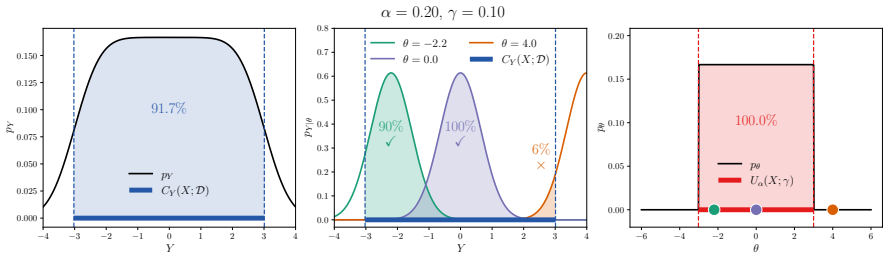
The load-bearing object is the forward-compatibility probability p_gamma(theta,x) = P_{Y~P_theta(.|x)}{Y in C_gamma(x;D_n)}, which measures how much probability a candidate latent parameter's induced response distribution assigns to the conformally calibrated response set; it is the bridge from response-space coverage to latent-space coverage. Its complement, normalized as e_gamma(theta,x) = (1-p_gamma(theta,x))/gamma, forms an e-value-type incompatibility score whose expectation is at most one at the true parameter, and averaging these scores over a fixed distribution of miscoverage levels yields the multilevel construction with the same finite-sample validity.
What would settle it
Simulate data from a hierarchical model in which the supplied forward family is deliberately wrong—for example, responses drawn from a Student-t law while LatentCP is given a Gaussian forward family—and measure empirical coverage of the true latent parameter over many repetitions at 1-alpha=0.9. A coverage shortfall below 90% would demonstrate that the latent guarantee depends on the forward model being correct, which is the boundary the authors flag.
Extended reading notes
Core claim
The paper's central claim is that finite-sample-valid prediction sets for an unobserved, instance-specific latent distributional parameter theta can be obtained by transferring a conformal prediction set for the observable response through a known forward family P_theta(.|x). Under Assumption 1—exchangeable context–latent pairs with responses drawn independently from the specified forward distributions—the split-conformal response set C_gamma satisfies P{Y_{n+1} in C_gamma} >= 1-gamma. Defining U_alpha(x;gamma) as the set of theta whose forward distribution assigns probability at least 1-gamma/alpha to C_gamma, Theorem 1 proves P{theta_{n+1} in U_alpha(X_{n+1};gamma)} >= 1-alpha. The multile
Load-bearing premise
The forward family {P_theta(.|x)} must be known and correctly describe every unit's response law; if any true mechanism lies outside the family, the compatibility scores used to transfer response coverage to latent coverage are computed under the wrong law.
Editorial extensions
If this is right
- If the theorems are right, uncertainty sets for latent mechanisms can be delivered from only observed context–response pairs and a known forward model, giving finite-sample coverage statements in domains such as wildfire risk, sensor calibration, and preference modeling without ground-truth latent labels.
- Any functional of the latent parameter inherits coverage: if theta_{n+1} lies in U_alpha with probability at least 1-alpha, then a scalar quantity such as wildfire intensity lambda_theta(x) lies in its image under the same probability, yielding a calibrated uncertainty interval for the quantity that drives decisions.
- Because the method treats the response-space conformal set as an interchangeable module, stronger or more adaptive response conformal procedures can be plugged in to sharpen the latent sets while preserving the transfer guarantee.
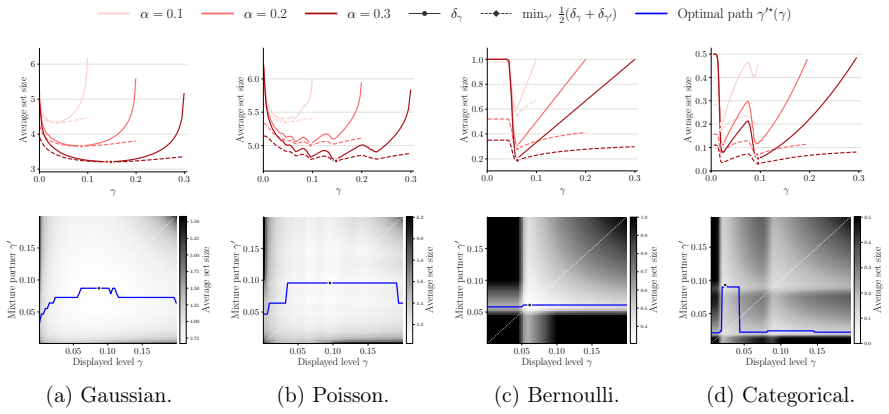
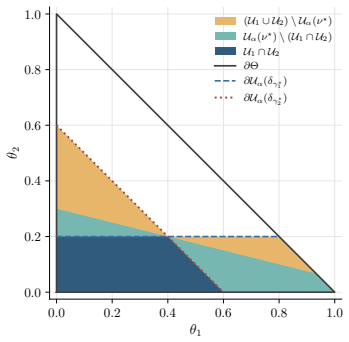
- The multilevel construction contains every fixed-level method as a special case and, at the population-oracle level, its optimized mixture never has larger expected set size than the best fixed level; it can strictly shrink the set when different response miscoverage levels carry complementary information.
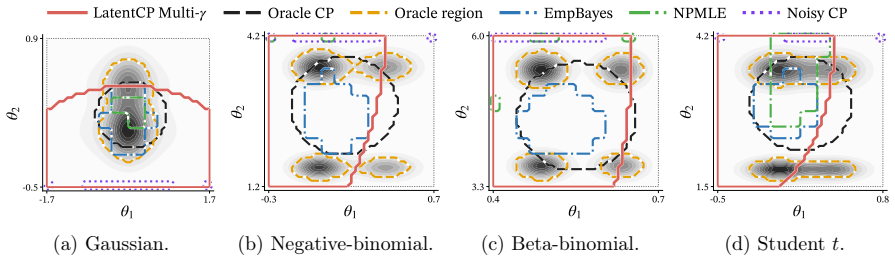
- Under weak identification, observational nonidentifiability, and latent heterogeneity, approaches that rely on estimated mixing distributions or point inversions can under-cover, whereas LatentCP retains all observationally compatible candidates and maintains nominal latent coverage.
Reading between the lines
- Because e_gamma is an e-value, the multilevel averaging can be viewed as e-merging; a natural sequential extension would accumulate these scores over time or data batches to obtain anytime-valid latent uncertainty sets, a reading the paper does not pursue.
- A plugin route to forward-model uncertainty suggests itself: fit the forward family from data and add a second conformal stage over the fitted family so that estimation error is absorbed; the paper leaves forward-model misspecification explicitly open.
- The response-space stage is modular, so pairing LatentCP with conditional or generative conformal response sets could sharpen latent sets while preserving the finite-sample transfer; this combination is not tested in the paper.
Editorial analysis
A structured set of objections, weighed in public.
Referee Report
Summary. The paper proposes LatentCP, a conformal framework for constructing finite-sample valid uncertainty sets for an instance-specific latent distributional parameter θ_{n+1}, using only observed context–response pairs and a specified forward family {P_θ(·|x)}. The method first builds a split-conformal prediction set C_γ in the observable response space, then inverts it through the forward model: U_α(x;γ) = {θ : P_{Y∼P_θ(·|x)}(Y∈C_γ) ≥ 1−γ/α}. Theorem 1 proves finite-sample marginal coverage ≥1−α under exchangeability of (X_i,θ_i) and correct specification of the forward model. A multilevel extension averages normalized incompatibility scores across several response-space miscoverage rates and thresholds the average at 1/α, with validity given in Theorem 2 and a sandwich property in Proposition 1. Experiments on synthetic data and a California wildfire application illustrate the method's behavior, including an explicit example in which a two-level mixture strictly improves efficiency over every fixed level.
Significance. The central idea is elegant and, conditional on its stated assumptions, the transfer from response-space conformal coverage to latent-space coverage is correct. The proofs of Theorems 1 and 2 are short, self-contained, and valid. The paper makes a genuine contribution by showing that finite-sample uncertainty sets for latent distributional parameters can be constructed without latent calibration labels, a unique inverse mapping, or knowledge of the mixing distribution. The e-value-based aggregation is a nice extension, and the explicit categorical example in Appendix D.1 convincingly demonstrates a strict efficiency gain from multilevel aggregation. The authors are also honest about the limitations, particularly the reliance on a correctly specified forward model and the lack of conditional coverage. If the theoretical guarantee is taken together with a clear statement of when the implementation preserves it, this would be a valuable addition to the conformal prediction and latent-variable inference literature.
major comments (3)
- [Section 2, Condition (ii), and Appendix C.2, Eq. (4)] The load-bearing transfer in Theorem 1 uses E[1−p_γ(θ_{n+1},X_{n+1})] = P(Y_{n+1}∉C_γ). This equality is valid only if the true conditional law of Y given X,θ is exactly the assumed P_θ. p_γ is computed under the assumed forward family; under misspecification, p_γ is not the true probability assigned to C_γ, and the Markov transfer can fail even though response-space conformal coverage holds. The paper acknowledges this in Section 6 but provides no sensitivity analysis, diagnostic, or contamination experiment. Since this is the main substantive limitation of the central claim, I ask the authors to add a systematic misspecification experiment (e.g., contaminating the forward family) and to discuss conditions under which the transfer degrades gracefully.
- [Section 4.3 and Appendix D.2] Theorems 1 and 2 concern the exact sets U_α(x;γ) and U_α(x;ν) defined over all θ∈Θ. The practical implementation, however, evaluates p_γ only on a finite grid Θ_N and constructs bU_{α,N}. The conservative expansion in Proposition 2 restores a guarantee for off-grid parameters, but the main text and the experimental section do not state whether the reported coverage is for bU_{α,N} or for the expanded set bU^{exp}_{α,N}. As written, the finite-sample guarantee in continuous-parameter experiments is not formally established for the implemented grid-based set. Please clarify which set is used in the experiments and, if the unexpanded grid set is used, either implement the expansion or state explicitly that the experiments are an approximation whose exact coverage is not covered by Theorem 1.
- [Section 5.2] The real-data wildfire application uses spatio-temporal data with spatial and temporal dependence, which violates Assumption 1. The paper honestly reports response coverage rather than latent coverage, because λ is unobserved. As a result, the real-data section does not validate the paper's advertised latent uncertainty sets; it only illustrates the method's output. This is not a fatal flaw, but the manuscript should more explicitly separate the theoretical finite-sample claim from the illustrative application and should either weaken the claim that the application 'produces spatially adaptive uncertainty sets for latent fire intensity' or add a simulation with dependent data that examines how coverage degrades under dependence.
minor comments (5)
- [Section 2, Condition (ii)] The sentence 'the forward family {P_θ(·|x) : θ∈Θ} is known and can be evaluated from' is incomplete; 'from' should be 'evaluated' or the sentence finished.
- [Section 4.1] The construction in (6) is called 'randomized' but, once ν is fixed, the resulting set is deterministic given D_n and x. The terminology could mislead readers; consider calling it a 'mixture' or 'weighted' construction instead.
- [Figure 6] The vertical axis labels in the two-dimensional panels contain '10□1' and '10□1', which appear to be garbled scientific notation (likely 10^1 and 10^2). Please fix the rendering.
- [Appendix E, first paragraph] There is a typo: 'Each synthtic experiments are averaged over 50 independent runs' should be 'Each synthetic experiment is averaged over 50 independent runs.'
- [Section 5.2] The comparison with the 'dashed Poisson MLE band' is not fully specified. State the exact construction of this band and how it relates to the forward model and to LatentCP's output.
Circularity Check
No significant circularity: latent coverage is derived from split-conformal response coverage via Markov's inequality, and tuning is ancillary.
full rationale
The load-bearing derivation is self-contained. Theorem 1 (Appendix C.2) uses only Eq. (3), the standard split-conformal coverage guarantee, and the definition p_gamma(theta,x) = P_{Y~P_theta(.|x)}{Y in C_gamma(x;D_n)}. The proof computes E[1-p_gamma(theta_{n+1},X_{n+1})] = P{Y_{n+1} notin C_gamma} <= gamma by iterated expectation; this is not an identity built into U_alpha. The inclusion threshold 1-gamma/alpha is chosen analytically from Markov's inequality, not fitted, and Theorem 2's e-value property is derived by Tonelli from the same moment bound. Tuning gamma or nu on an independent sample does not enter the validity argument: the paper states that conditional on the tuning sample bnu is fixed and independent of the calibration sample, and recalibrates conformal thresholds on separate data, so the selected level is not a fitted input renamed as a prediction. The stated assumptions (exchangeability, known forward family) are genuine conditions; the paper flags forward-model misspecification as future work (Section 6) and honestly reports only response coverage for the real wildfire data because latent intensity is unobserved. Self-citations (Zheng & Zhu 2024; Zhou & Zhu 2026; Chen et al. 2026) are related-work/motivation only and are never used to justify Theorem 1 or Theorem 2. No circular step is identifiable.
Assumptions & free parameters
free parameters (4)
- gamma (response-space miscoverage rate) =
e.g., 0.0278 selected on tuning data in the wildfire analysis; default gamma = alpha/2
- multilevel weights and support (w, gamma_1,...,gamma_K) =
selected on tuning sample via Algorithm 2; in the wildfire application the optimized two-level construction collapses to
- response predictor used in the nonconformity score =
gradient boosting on 1984-2003 in the wildfire study
- Lipschitz constants L_{gamma_k}(x) and covering radius r_N in the grid expansion
assumptions (6)
- domain assumption Assumption 1: exchangeable context-latent pairs (X_i,theta_i) and conditionally independent responses Y_i | (X_i,theta_i) ~ P_{theta_i}(.|X_i)
- domain assumption Forward family {P_theta(.|x)} is known and correctly specified (Condition (ii), Section 2)
- domain assumption Split-conformal machinery: fixed nonconformity score and predictor trained independently of calibration data
- standard math Markov inequality and Tonelli's theorem applied to R_gamma and e_gamma
- standard math e-value first-moment property E[e_gamma(theta_{n+1},X_{n+1})] <= 1 holds for the true latent draw
- domain assumption Lipschitz continuity of theta -> p_gamma(theta,x) with known constants, plus covering radius of Theta_N
Cite this review
Pith. "Pith review of Beyond Predicting Responses: Conformal Inference for Latent Distributional Parameters." pith.science (2026). https://pith.science/paper/3FHKN7S4
@misc{pith2026260803607,
  author       = {Pith},
  title        = {Pith review of: Beyond Predicting Responses: Conformal Inference for Latent Distributional Parameters},
  year         = {2026},
  howpublished = {\url{https://pith.science/paper/3FHKN7S4}},
  note         = {Machine review of arXiv:2608.03607}
}
read the original abstract
Many prediction problems seek to infer an unobserved, instance-specific parameter that governs the distribution of an observable response, even though the latent parameter is unavailable for both historical and future instances. We develop LatentCP, a prior-free conformal framework that constructs uncertainty sets for latent distributional parameters using only observed context--response pairs and a specified forward model. The method first constructs a conformal prediction set in the observable response space and then retains candidate latent parameters according to the probability their induced response distributions assign to that set. This inversion provides finite-sample marginal coverage without requiring latent calibration labels, a unique inverse mapping, or knowledge of the latent mixing distribution. Because latent-set efficiency depends nonmonotonically on the response-space miscoverage rate, we further introduce a multilevel procedure that aggregates normalized incompatibility scores across several response sets and selects the aggregation distribution using an independent tuning sample. Across synthetic experiments, LatentCP maintains nominal latent coverage under weak forward identification, observational nonidentifiability, and latent heterogeneity and multimodality, where empirical-Bayes, likelihood-based, and proxy-label conformal methods can substantially under-cover. On a California wildfire real dataset, it produces spatially adaptive uncertainty sets for latent fire intensity. Independent tuning improves efficiency, while multilevel aggregation provides additional gains when different response levels contain complementary information, without sacrificing validity.
Figures

Figures from the paper (5 more)


Reference graph
Works this paper leans on
-
[1]
Two-dimensionalθdata-generating mechanisms.For all four families,X∼ N(0, I2)
We then drawS uniformly from{−1,1},U B ∼Unif(I B), and setY=X+SU B. Two-dimensionalθdata-generating mechanisms.For all four families,X∼ N(0, I2). We setβ= (0.8,−0.4) ⊤ ande(X) = exp(0.35X 1). Conditional onX=x, the latent coordinates are independent. Coordinatejfollows a mixture of two components; its second component is selected with probability wj(x) = ...
work page 1984
-
[2]
ForC γ ⊆ {0,1,2}, compatibility is evaluated exactly: pγ(θ) = 2X j=0 θj1{j∈ C γ}
= 1 60 . ForC γ ⊆ {0,1,2}, compatibility is evaluated exactly: pγ(θ) = 2X j=0 θj1{j∈ C γ}. Set size is measured by two-dimensional Lebesgue area overΘ, whose total area is1/2. This final mechanism is constructed to illustrate a strict benefit from multilevel aggregation. Atα= 0.2, consider γ⋆ 1 = 1 60 , γ ⋆ 2 = 5 60 , ν ⋆ = 1 2 δγ⋆ 1 + 1 2 δγ⋆ 2 . The cor...
work page 1973
-
[5]
Shuyi Chen, Shixiang Zhu, and Ramteen Sioshansi. Large-scale resilience planning for wildfire-prone electricity-system via adaptive robust optimization.arXiv preprint arXiv:2604.01232,
-
[10]
Locally adaptive conformal inference for operator models
Trevor Harris and Yan Liu. Locally adaptive conformal inference for operator models. arXiv preprint arXiv:2507.20975,
-
[14]
Minxing Zheng and Shixiang Zhu
URLhttps://proceedings.neurips.cc/paper_files/paper/ 2025/file/806288e682d8a38c0bf21e37ab38af0a-Paper-Conference.pdf. Minxing Zheng and Shixiang Zhu. Generative conformal prediction with optimized coverage allocation.arXiv preprint arXiv:2410.13735,
arXiv 2025
-
[15]
URLhttps://openreview.net/forum?id=xRjOrcj08o. 23 A Why Set-Valued Latent Inference Is Necessary This appendix formalizes two distinct obstacles to point identification of the latent distributional parameter. The first islatent heterogeneity: the latent parameter of a new sample remains random after conditioning on its observed context. The second isobser...
work page 2019
-
[1995]
ISBN 9780940600324. doi: 10.1214/cbms/1462106013. Jan-Matthis Lueckmann, Jan Boelts, David Greenberg, Pedro Goncalves, and Jakob Macke. Benchmarking simulation-based inference. In Arindam Banerjee and Kenji Fukumizu, editors,Proceedings of the 24th International Conference on Artificial Intelligence and Statistics, volume 130 ofProceedings of Machine Lear...
-
[2006]
URLhttps://doi.org/10.1214/009053606000000029
doi: 10.1214/ 009053606000000029. URLhttps://doi.org/10.1214/009053606000000029. Yehuda Koren, Robert Bell, and Chris Volinsky. Matrix factorization techniques for recommender systems.Computer, 42(8):30–37,
Show all 17 references
-
[2011]
Approximate bayesian computation in population genetics.Genetics, 162(4):2025–2035,
Mark A Beaumont, Wenyang Zhang, and David J Balding. Approximate bayesian computation in population genetics.Genetics, 162(4):2025–2035,
2025
-
[2012]
Merging uncertainty sets via majority vote
Matteo Gasparin and Aaditya Ramdas. Merging uncertainty sets via majority vote. arXiv preprint arXiv:2401.09379,
-
[2013]
Conformal prediction with cor- rupted labels: Uncertain imputation and robust re-weighting.arXiv preprint arXiv:2505.04733,
Shai Feldman, Stephen Bates, and Yaniv Romano. Conformal prediction with cor- rupted labels: Uncertain imputation and robust re-weighting.arXiv preprint arXiv:2505.04733,
-
[2017]
URLhttps://doi.org/ 10.1214/16-AOS1435
doi: 10.1214/16-AOS1435. URLhttps://doi.org/ 10.1214/16-AOS1435. 19 David J Bartholomew, Martin Knott, and Irini Moustaki.Latent variable models and factor analysis: A unified approach. John Wiley & Sons,
-
[2018]
Lihua Lei and Emmanuel J Candès
doi: 10.1080/01621459.2017.1307116. Lihua Lei and Emmanuel J Candès. Conformal inference of counterfactuals and indi- vidual treatment effects.Journal of the Royal Statistical Society Series B: Statistical Methodology, 83(5):911–938,
2017
-
[2023]
Set-preserving calibration from conformal p-values to e-values.arXiv preprint arXiv:2606.03600,
Nabil Alami, Jad Zakharia, and Souhaib Ben Taieb. Set-preserving calibration from conformal p-values to e-values.arXiv preprint arXiv:2606.03600,
-
[2024]
E-values expand the scope of conformal prediction.arXiv preprint arXiv:2503.13050,
Etienne Gauthier, Francis Bach, and Michael I Jordan. E-values expand the scope of conformal prediction.arXiv preprint arXiv:2503.13050,
-
[2025]
Monitoring trends and burn severity (mtbs): Monitoring wildfire ac- tivity for the past quarter century using landsat data
20 Mark Finco, Brad Quayle, Yuan Zhang, Jennifer Lecker, Kevin A Megown, and C Ken- neth Brewer. Monitoring trends and burn severity (mtbs): Monitoring wildfire ac- tivity for the past quarter century using landsat data. InIn: Morin, Randall S.; Liknes, Greg C., comps. Moving ...
2012
-
[2026]
A gentle introduction to confor- mal prediction and distribution-free uncertainty quantification.arXiv preprint arXiv:2107.07511,
Anastasios N Angelopoulos and Stephen Bates. A gentle introduction to confor- mal prediction and distribution-free uncertainty quantification.arXiv preprint arXiv:2107.07511,
Reviewed August 5, 2026 · model on record in the stance chip above.
Discussion (0). Sign in to comment.