REVIEW 3 major objections 6 minor 115 references
Implications of Broad [O III] 4364 and UV Line Emission in Two Little Red Dots at z ~ 7 - 8
T0 review · 3 major / 6 minor · reviewed 2026-08-08 · deepseek-v4-flash
Pith's one-line read The paper reports the first detection of broad [O III] λ4364 emission in Little Red Dots, using its ratio to broad [O III] λ5008 to infer broad-line gas densities about 10 times higher than in low-redshift quasars.
desk verdict First broad [O III] 4364 detections in LRDs are a real step forward, but the density claim needs a temperature systematic and the second object is marginal. read the letter →
The pith
A machine-rendered reading of the paper's core claim, the machinery that carries it, and where it could break.
The reading
What carries the argument
The central diagnostic is the broad-component ratio [O III] $\lambda4364/\lambda5008$. The two lines come from the same O$^{2+}$ ion but have different critical densities, $n_{\rm crit}\approx3\times10^7$ cm$^{-3}$ for $\lambda4364$ versus $\approx7\times10^5$ cm$^{-3}$ for $\lambda5008$, so the ratio becomes density-sensitive between those values. Separating the broad and narrow components with simultaneous double-Gaussian fits to H$\beta$, H$\gamma$, and the [O III] lines lets the authors isolate the broad-line-region gas, and the inferred densities carry the assumed temperature $T_e = 15{,}000$--$25{,}000$ K. A secondary piece of machinery is the C III] $\lambda1907/\lambda1909$ doublet ratio for the narrow-line densities, and the virial-scaled size estimate $R \lesssim R_e\,(\mathrm{FWHM}_n/\mathrm{FWHM})^2$ that places the broad [O III] clouds at about 1--10 pc from the center.
What would settle it
A high-resolution NIRSpec observation (e.g., G395H) of the two LRDs that recovers broad [O III] $\lambda4364$ at S/N $>5$ would test the claim: if the broad component disappears, if a temperature-sensitive ratio places $T_e$ outside 15,000--25,000 K, or if the measured $\lambda4364/\lambda5008$ ratio falls to the low-density limit, the density excess over quasars would not hold.
Extended reading notes
Core claim
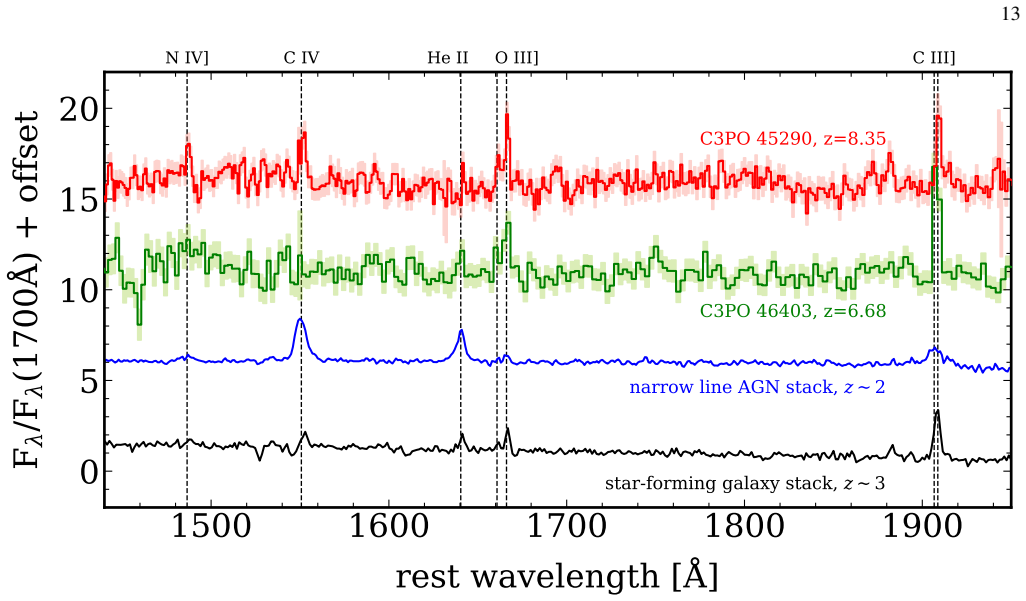
Both C3PO 45290 ($z=8.35$) and C3PO 46403 ($z=6.68$) show broad [O III] $\lambda4364$ with FWHM around 1000 km s$^{-1}$, roughly one-third the width of their broad H$\beta$ lines, while the [O III] $\lambda\lambda4960,5008$ lines remain narrow. Fitting two Gaussian components to H$\gamma$, H$\beta$, and [O III] $\lambda4364$ yields broad-component ratios $\lambda4364/\lambda5008$ that require $\log(n/\mathrm{cm}^{-3}) = 6.3$--$7.9$ at $T_e = 15{,}000$--$25{,}000$ K, exceeding the broad-line-region densities measured from the same ratio in PG quasars by a factor of 3--10. The paper further reports narrow UV lines ([C III] $\lambda1907 +$ C III] $\lambda1909$, O III] $\lambda\lambda1661,1666$) with C III]-derived densities $\log(n_e/\mathrm{cm}^{-3})=4.2$--$5.2$, and both objects require an additional ionizing source to explain the high equivalent widths and the [O III] $\lambda4364$/H$\gamma$ ratios. The interpretation is that dense clouds with non-unity covering factor surround the central accretion disk, letting part of its ionizing radiation escape, and the nitrogen and carbon abundance ratios point to recent, rapid star formation in the same gas.
Load-bearing premise
The broad-line density estimates assume the broad [O III]-emitting gas has $T_e = 15{,}000$--$25{,}000$ K, which the paper does not measure directly; the density shifts by several tenths of a dex outside that range, and for one object the broad line is detected at only $2.8\sigma$.
Editorial extensions
If this is right
- Broad [O III] λ4364 emission appears in both LRDs, making these the first reported cases of broad forbidden lines in the class, with FWHM about one-third of Hβ.
- The implied broad-line densities, log n = 6.3--7.9, sit 3--10 times above PG quasar broad-line regions, so LRDs are not straightforward scaled versions of standard quasar BLRs.
- If the widths are virial, dense metal-enhanced clouds sit within about 1--10 pc of the engine, while the narrower [Fe II] in C3PO 46403 suggests cooler dense gas at larger radius.
- The UV line equivalent widths and [O III] 4364/Hγ ratios require some accretion-disk photons to escape, disfavoring unity-covering-factor dense-gas models for these two objects.
- Sub-solar C/O and elevated N/O imply rapid recent enrichment, linking the LRD phase to young starbursts if such ratios are found to be common.
Reading between the lines
- If the broad [O III] density diagnostic is applied to larger LRD samples, a testable prediction is that broad 4364 strength tracks the presence of [Fe II] or coronal lines, since all trace dense metal-enriched clouds; existing medium-resolution spectra could be searched for this correlation.
- The assumed temperature window could be checked indirectly by comparing broad Hγ/Hβ and He II 4686/Hβ ratios with photoionization models; a hotter or cooler broad-line region would shift the density estimate by several tenths of a dex and weaken the quasar comparison.
- The stratified, non-unity covering-factor picture may explain the weak X-rays: if sightlines clear enough to leak ionizing photons are also Compton-thin, the escaping field could be soft-photon-dominated, boosting [O III] and C III] without producing a hard X-ray component.
- The nitrogen-enhancement signature could be tied to very young Wolf-Rayet populations by searching for broad He II 4686 or unusually high He II equivalent widths in a larger LRD sample, which would test the claim that short starbursts accompany the LRD phase.
Editorial analysis
A structured set of objections, weighed in public.
Referee Report
Summary. The paper reports deep NIRSpec G140M/G395M spectroscopy of two Little Red Dots at z=6.68 and z=8.35. It identifies narrow and broad components in the rest-optical Balmer and [O III] lines and reports broad [O III] λ4364 emission (FWHM ~1000 km/s) in both objects. Using the broad [O III] λ4364/λ5008 ratio and an assumed broad-line temperature T_e=15,000–25,000 K, the authors derive broad-line gas densities log n_e ~ 6.3–7.9 cm^-3, 3–10 times higher than in PG quasar broad-line regions, and combine this with narrow-line C III], O III], and [O III]/Hγ diagnostics to argue that the LRD envelopes are stratified, with dense clouds at ~1–10 pc from the central engine and a non-unity covering factor. The paper also reports narrow-line densities from C III] and Si III]/N IV] doublets, sub-solar C/O, and enhanced N/O, and concludes that ionizing radiation from the accretion disk plus stellar photoionization is needed.
Significance. If the broad [O III] detection and density interpretation hold, this is the first report of broad forbidden [O III] lines in LRDs and provides a novel density measurement of the broad-line region at z>6, with implications for LRD structure and the escape of AGN ionizing radiation. The analysis is generally careful: two-component fits are shown with residuals, and the interpretation uses PyNeb, public photoionization grids, and comparison samples. The narrow-line density measurements and EW-based ionization arguments are useful even if the broad-line density claim is later revised. However, the main density claim currently rests on an assumed T_e and on one marginal line detection, so the headline quantitative result is not yet established at the level of the abstract.
major comments (3)
- [§4.2, Table 3, Figure 8] The central density claim is not robust to the assumed broad-line electron temperature. The paper derives log n_e = 6.8±0.5 and 7.4±0.5 from the broad [O III] λ4364/λ5008 ratio using T_e = 15,000–25,000 K, but it states explicitly 'we have no direct measure of the gas temperature of the broad lines.' The ratio depends on T_e as well as n_e, and the low-density limiting ratio increases strongly with T_e; at T_e ≈ 40,000 K, a plausible temperature for a dense, hard-irradiated BLR, the same observed ratios would give densities about 0.5–1 dex lower. That shift would place C3PO 46403 inside the PG quasar distribution and C3PO 45290 near its upper tail, removing the quoted '3–10× higher than quasars' result. Table 3 propagates only the line-ratio uncertainties and not this T_e systematic. Please provide the inferred density as an explicit function of T_e (extending Figure 8 to at least 40,000 K), or obtain an independent T_e constraint, and revise the abstract, Section 4.2, and Section 6 so that the density excess is stated conditionally on T_e.
- [Table 1; Figures 5–6] The C3PO 46403 broad [O III] λ4364 detection is marginal: Table 1 gives F_b = (0.511±0.185)×10^-18 erg s^-1 cm^-2, i.e., S/N = 2.8, and the corresponding broad [O III] λ5008 detection has S/N ≈ 3.2. The line also sits in a region blended with broad Hγ and [Fe II] lines. This is below the usual 3σ detection threshold, yet the abstract and Section 6 state as a result that 'both LRDs show broad [O III] λ4364 emission.' If this line is not real or is substantially affected by the Hγ/[Fe II] decomposition, the two-object density claim reduces to a single object. Please report a detection significance based on a robust model comparison (for example, Δχ² or a Bayesian evidence ratio with and without the broad [O III] component), or present the conclusions with the marginal status of this source explicitly stated.
- [§5.3, Figure 14; §4.2] The comparison with PG quasars may not be apples-to-apples. The paper compares the C3PO broad-line densities with the Baskin & Laor (2005) PG quasar values but does not state whether those comparison values were derived with the same assumed T_e, the same atomic data (PyNeb versus other calculations), and the same treatment of narrow and broad components. If the PG densities were obtained at a different T_e or with different collisional data, part of the quoted 3–10× excess could be a systematic offset rather than a physical difference. Please state the assumed T_e and method for the comparison sample and, if necessary, recompute the comparison on a common T_e and atomic-data grid.
minor comments (6)
- [Section 2] There is a typo: the text refers to 'C3PO 45490' where it should be 'C3PO 45290.'
- [Section 4.1] There is a typo: 'C3PO 43640' should be 'C3PO 46403' in the discussion of the UV line-ratio measurements.
- [Figure 11] The y-axis label reads 'log [O III] 4634 / H' but should refer to [O III] λ4364; the axis label is missing the λ and uses the wrong wavelength.
- [Section 3 and Section 1] There are typographical errors: 'compnonets' should be 'components' in Section 3, and Section 1 contains 'broad emission-line components of of hydrogen' with a duplicated 'of.'
- [Section 4.2] The text first says the broad lines are expected to have T_e ≈ 10,000–20,000 K (citing Baskin & Laor 2005) and then assumes T_e = 15,000–25,000 K; the upward shift and the widening of the range should be justified or reconciled.
- [Table 3 and Section 5.1] For C3PO 45290, the quoted N/O uncertainty excludes the ICF uncertainty even though the text states the ICF contributes an additional +0.23/−0.18 dex; the table should give a combined uncertainty or clearly state the separate contribution.
Circularity Check
No load-bearing circularity: the broad-line density claim is derived from measured [O III] line ratios through external PyNeb atomic data, with the T_e assumption explicitly labeled as assumed.
full rationale
The paper's central claim—broad [O III] λ4364 emission in two LRDs implying log n_e ≈ 6.3–7.9 cm^-3—rests on measured broad-component fluxes (Table 1), converted to density via the PyNeb emissivity ratio [O III] λ4364/λ5008 as a function of n_e and T_e (Section 4.2, Figure 8). PyNeb (Luridiana et al. 2015) is external atomic physics, and the comparison benchmark (PG quasar BLR densities from Baskin & Laor 2005) is an independent literature sample; no parameter is fitted to these two objects and then renamed a prediction. The electron temperature is not measured, and the paper says so explicitly ('we have no direct measure of the gas temperature of the broad lines'), listing T_e = 15,000–25,000 K as an assumption in Table 3. A different T_e would shift the densities, but this is model/assumption sensitivity, not circularity, because the density is not defined in terms of the conclusion. The [O III] λ4364/Hγ AGN classification uses empirical boundary regions from Mazzolari et al. (2024) and Backhaus et al. (2025), not boundaries fit to the C3PO data. Abundance ratios use PyNeb and literature Cloudy/BPASS grids with stated parameters (Sections 5.1–5.2). Several in-prep works by the same team (Papovich et al., Hu et al., Yang et al.) are cited for data reduction and model grids, but these are not the load-bearing evidence for the high-density claim. The S/N = 2.8 broad 4364 detection in C3PO 46403 and the assumed T_e are genuine fragility/correctness concerns, but they do not make the derivation equivalent to its inputs. Overall: no significant circularity; score 2 reflects minor, non-load-bearing self-citations only.
Assumptions & free parameters
free parameters (2)
- Assumed broad-line electron temperature T_e =
15000-25000 K
- Assumed narrow-line electron temperature for abundance and density derivations =
15000 K (C3PO 45290), 20000 K (C3PO 46403)
assumptions (5)
- standard math Standard atomic data and PyNeb collisional and radiative rates for line-ratio to density and abundance conversions
- domain assumption Photoionization models (Cloudy, BPASS) are reliable for predicting EW limits and line-ratio grids used to classify ionizing sources
- domain assumption No significant dust attenuation in the line-emitting regions, based on Hgamma/Hbeta ratios consistent with the theoretical value
- domain assumption The narrow-line gas size is comparable to the F150W effective radius R_e used in the virial size estimate
- domain assumption Ionization correction factors from Berg et al. (2019) and Martinez et al. (2025) apply to the C2+/O2+, N2+/O2+, and N3+/O2+ ratios in these LRDs
Cite this review
Pith. "Pith review of Implications of Broad [O III] 4364 and UV Line Emission in Two Little Red Dots at z ~ 7 - 8." pith.science (2026). https://pith.science/paper/LTLGHXDJ
@misc{pith2026260804101,
  author       = {Pith},
  title        = {Pith review of: Implications of Broad [O III] 4364 and UV Line Emission in Two Little Red Dots at z ~ 7 - 8},
  year         = {2026},
  howpublished = {\url{https://pith.science/paper/LTLGHXDJ}},
  note         = {Machine review of arXiv:2608.04101}
}
abstract
We present deep, NIRSpec G140M and G395M spectroscopy of Little Red Dots (LRDs) at z = 6.68 and z = 8.35. Both LRDs show broad Balmer and [O III] $\lambda$4364 emission. The broad [O III] $\lambda$4364 lines have FWHM ~1000 km/s, about 1/3 that of the H$\beta$ lines. Assuming gas temperatures T ~ 15,000 - 25,000 K, the [O III] $\lambda$4364/[O III] $\lambda$5008 ratios of the broad lines yield high gas densities, log n/cm^-3 = 6.3 to 7.9, 3-10$\times$ higher than those in broad-line regions of low-redshift quasars. If the broad-lines trace virial motions, it is evidence for metal-enhanced gas clouds, ~1-10~pc from the LRD engine. Both LRDs show narrow [C III] $\lambda$1907 + C III] $\lambda$1909, and O III] $\lambda\lambda$1661,1666. The C III] ratios yield narrow-line gas densities, log n/cm^-3 = 4.2-5.2, similar to those in other star-forming galaxies. The line equivalent widths, EW(O III]), EW(C III]), are at, or exceed, limits expected for stellar populations, likely requiring an additional ionizing source. The LRDs also have [O III] $\lambda$4364/H$\gamma$ ratios that favor ionization from an accretion disk, possibly combined with stars. Both LRDs show nitrogen enhancement based on detections of N III] $\lambda$1746 or N IV] $\lambda$1486, which may imply rapid, recent star-formation. These results favor a scenario where the LRD gas envelopes are highly stratified, having high-density clouds with a non-unity covering factors and a complex geometry, such that ionizing radiation from the LRD accretion disk, combined with that from star-forming regions, produce the nebular emission features.
Figures


Figures from the paper (10 more)




Reference graph
Works this paper leans on
-
[1]
Aggarwal, K. M., & Keenan, F. P. 1999, ApJS, 123, 311, doi: 10.1086/313232
doi:10.1086/313232 1999
-
[2]
Akins, H. B., Casey, C. M., Lambrides, E., et al. 2025, ApJ, 991, 37, doi: 10.3847/1538-4357/ade984
-
[3]
Alexandroff, R. M., Zakamska, N. L., Barth, A. J., et al. 2018, MNRAS, 479, 4936, doi: 10.1093/mnras/sty1685
-
[4]
Ananna, T. T., Bogdán, Á., Kovács, O. E., Natarajan, P., & Hickox, R. C. 2024, ApJL, 969, L18, doi: 10.3847/2041-8213/ad5669
-
[5]
1989, GeoCoA, 53, 197, doi: 10.1016/0016-7037(89)90286-X Arellano-Córdova, K
Anders, E., & Grevesse, N. 1989, GeoCoA, 53, 197, doi: 10.1016/0016-7037(89)90286-X Arellano-Córdova, K. Z., Berg, D. A., Mingozzi, M., et al. 2025, MNRAS, 544, 1588, doi: 10.1093/mnras/staf1723
-
[6]
Arevalo-Gonzalez, F., Tripodi, R., Llerena, M., et al. 2026, A&A, 709, A46, doi: 10.1051/0004-6361/202558652 Arrabal Haro, P., Dickinson, M., Finkelstein, S. L., et al. 2023, ApJL, 951, L22, doi: 10.3847/2041-8213/acdd54
-
[7]
2026, arXiv e-prints, arXiv:2601.10573, doi: 10.48550/arXiv.2601.10573
Asada, Y ., Inayoshi, K., Fei, Q., Fujimoto, S., & Willott, C. 2026, arXiv e-prints, arXiv:2601.10573, doi: 10.48550/arXiv.2601.10573
-
[8]
Asplund, M., Amarsi, A. M., & Grevesse, N. 2021, A&A, 653, A141, doi: 10.1051/0004-6361/202140445 Astropy Collaboration, Robitaille, T. P., Tollerud, E. J., et al. 2013, A&A, 558, A33, doi: 10.1051/0004-6361/201322068
Show all 115 references
-
[9]
E., Cleri, N
Backhaus, B. E., Cleri, N. J., Trump, J. R., et al. 2025, ApJ, 994, 125, doi: 10.3847/1538-4357/ae1136
2025 doi
-
[10]
Baggen, J. F. W., van Dokkum, P., Brammer, G., et al. 2024, ApJL, 977, L13, doi: 10.3847/2041-8213/ad90b8
2024 doi
-
[11]
2005, MNRAS, 358, 1043, doi: 10.1111/j.1365-2966.2005.08841.x
Baskin, A., & Laor, A. 2005, MNRAS, 358, 1043, doi: 10.1111/j.1365-2966.2005.08841.x
2005
-
[12]
C., & Dexter, J
Begelman, M. C., & Dexter, J. 2026, ApJ, 996, 48, doi: 10.3847/1538-4357/ae274a
2026 doi
-
[13]
C., Rossi, E
Begelman, M. C., Rossi, E. M., & Armitage, P. J. 2008, MNRAS, 387, 1649, doi: 10.1111/j.1365-2966.2008.13344.x
2008
-
[14]
McQuinn, K. B. W. 2019, ApJ, 874, 93, doi: 10.3847/1538-4357/ab020a
2019 doi
- [15]
-
[16]
2025, MNRAS, 544, L167, doi: 10.1093/mnrasl/slaf116
Brazzini, M., D’Eugenio, F., Maiolino, R., et al. 2025, MNRAS, 544, L167, doi: 10.1093/mnrasl/slaf116
2025 doi
-
[17]
Brinchmann, J., Charlot, S., White, S. D. M., et al. 2004, MNRAS, 351, 1151, doi: 10.1111/j.1365-2966.2004.07881.x
2004
-
[18]
2025,, 1.20.2 Zenodo, doi: 10.5281/zenodo.17515973
Bushouse, H., Eisenhamer, J., Dencheva, N., et al. 2025,, 1.20.2 Zenodo, doi: 10.5281/zenodo.17515973
2025 doi
-
[19]
2001, PASP, 113, 1449, doi: 10.1086/324269
Calzetti, D. 2001, PASP, 113, 1449, doi: 10.1086/324269
2001 doi
-
[20]
J., Katz, H., Rey, M
Cameron, A. J., Katz, H., Rey, M. P., & Saxena, A. 2023, MNRAS, 523, 3516, doi: 10.1093/mnras/stad1579
2023 doi
-
[21]
J., Katz, H., Witten, C., et al
Cameron, A. J., Katz, H., Witten, C., et al. 2024, MNRAS, 534, 523, doi: 10.1093/mnras/stae1547
2024 doi
-
[22]
M., Akins, H
Casey, C. M., Akins, H. B., Kokorev, V ., et al. 2024, ApJL, 975, L4, doi: 10.3847/2041-8213/ad7ba7
2024 doi
- [23]
-
[24]
2026, MNRAS, 545, staf2131, doi: 10.1093/mnras/staf2131
Chang, S.-J., Gronke, M., Matthee, J., & Mason, C. 2026, MNRAS, 545, staf2131, doi: 10.1093/mnras/staf2131
2026 doi
-
[25]
2023, A&A, 673, L7, doi: 10.1051/0004-6361/202346410
Charbonnel, C., Schaerer, D., Prantzos, N., et al. 2023, A&A, 673, L7, doi: 10.1051/0004-6361/202346410
2023 doi
-
[26]
A., Boylan-Kolchin, M., et al
Chisholm, J., Berg, D. A., Boylan-Kolchin, M., et al. 2026, ApJL, 1004, L4, doi: 10.3847/2041-8213/ae6dae
2026 doi
-
[27]
J., Yang, G., Papovich, C., et al
Cleri, N. J., Yang, G., Papovich, C., et al. 2023a, ApJ, 948, 112, doi: 10.3847/1538-4357/acc1e6 22
-
[28]
J., Olivier, G
Cleri, N. J., Olivier, G. M., Hutchison, T. A., et al. 2023b, ApJ, 953, 10, doi: 10.3847/1538-4357/acde55
-
[29]
J., Olivier, G
Cleri, N. J., Olivier, G. M., Backhaus, B. E., et al. 2025, ApJ, 994, 146, doi: 10.3847/1538-4357/ae0f17
2025 doi
-
[30]
C., et al
Davis, K., Brooks, M., Simons, R. C., et al. 2026, arXiv e-prints, arXiv:2606.00258, doi: 10.48550/arXiv.2606.00258 de Graaff, A., Hviding, R. E., Naidu, R. P., et al. 2025a, arXiv e-prints, arXiv:2511.21820, doi: 10.48550/arXiv.2511.21820 de Graaff, A., Rix, H.-W., Naidu, R. ...
-
[31]
2016, MNRAS, 456, 3354, doi: 10.1093/mnras/stv2794
Feltre, A., Charlot, S., & Gutkin, J. 2016, MNRAS, 456, 3354, doi: 10.1093/mnras/stv2794
2016 doi
-
[32]
J., Labbé, I., Zitrin, A., et al
Furtak, L. J., Labbé, I., Zitrin, A., et al. 2024, Nature, 628, 57, doi: 10.1038/s41586-024-07184-8
2024 doi
-
[33]
J., Duncan, K
Gloudemans, A. J., Duncan, K. J., Eilers, A.-C., et al. 2025, ApJ, 986, 130, doi: 10.3847/1538-4357/adddb9
2025 doi
-
[34]
A., Pacucci, F., & Kocevski, D
Guia, C. A., Pacucci, F., & Kocevski, D. D. 2024, Research Notes of the AAS, 8, 207, doi: 10.3847/2515-5172/ad7262
2024 doi
- [35]
-
[36]
2016, MNRAS, 462, 1757, doi: 10.1093/mnras/stw1716
Gutkin, J., Charlot, S., & Bruzual, G. 2016, MNRAS, 462, 1757, doi: 10.1093/mnras/stw1716
2016 doi
-
[37]
N., Shapley, A
Hainline, K. N., Shapley, A. E., Greene, J. E., & Steidel, C. C. 2011, ApJ, 733, 31, doi: 10.1088/0004-637X/733/1/31
2011 doi
-
[38]
2023, ApJ, 959, 39, doi: 10.3847/1538-4357/ad029e
Harikane, Y ., Zhang, Y ., Nakajima, K., et al. 2023, ApJ, 959, 39, doi: 10.3847/1538-4357/ad029e
2023 doi
-
[39]
2019, MNRAS, 487, 333, doi: 10.1093/mnras/stz1256
Hirschmann, M., Charlot, S., Feltre, A., et al. 2019, MNRAS, 487, 333, doi: 10.1093/mnras/stz1256
2019 doi
-
[40]
2023, MNRAS, 526, 3610, doi: 10.1093/mnras/stad2955
Hirschmann, M., Charlot, S., Feltre, A., et al. 2023, MNRAS, 526, 3610, doi: 10.1093/mnras/stad2955
2023 doi
-
[41]
2024, ApJ, 971, 21, doi: 10.3847/1538-4357/ad5015
Hu, W., Papovich, C., Dickinson, M., et al. 2024, ApJ, 971, 21, doi: 10.3847/1538-4357/ad5015
2024 doi
-
[42]
A., Papovich, C., Finkelstein, S
Hutchison, T. A., Papovich, C., Finkelstein, S. L., et al. 2019, ApJ, 879, 70, doi: 10.3847/1538-4357/ab22a2
2019 doi
-
[43]
A., Larson, R
Hutchison, T. A., Larson, R. L., Arrabal Haro, P., et al. 2025, arXiv e-prints, arXiv:2512.12509, doi: 10.48550/arXiv.2512.12509
2025 doi
-
[44]
2025, The Astrophysical Journal Letters, 980, L27, doi: 10.3847/2041-8213/adaebd
Inayoshi, K., & Maiolino, R. 2025, The Astrophysical Journal Letters, 980, L27, doi: 10.3847/2041-8213/adaebd
2025 doi
-
[45]
2023, ApJ, 959, 100, doi: 10.3847/1538-4357/ad09be
Isobe, Y ., Ouchi, M., Tominaga, N., et al. 2023, ApJ, 959, 100, doi: 10.3847/1538-4357/ad09be
2023 doi
-
[46]
I., Schaerer, D., Worseck, G., et al
Izotov, Y . I., Schaerer, D., Worseck, G., et al. 2023, MNRAS, 522, 1228, doi: 10.1093/mnras/stad1036
2023 doi
-
[47]
E., & Ravindranath, S
Jaskot, A. E., & Ravindranath, S. 2016, ApJ, 833, 136, doi: 10.3847/1538-4357/833/2/136
2016 doi
-
[48]
2025, MNRAS, 544, 3900, doi: 10.1093/mnras/staf1867
Ji, X., Maiolino, R., Übler, H., et al. 2025, MNRAS, 544, 3900, doi: 10.1093/mnras/staf1867
2025 doi
-
[49]
2026, MNRAS, 545, staf2235, doi: 10.1093/mnras/staf2235
Ji, X., D’Eugenio, F., Juodžbalis, I., et al. 2026, MNRAS, 545, staf2235, doi: 10.1093/mnras/staf2235
2026 doi
-
[50]
2023, ApJL, 951, L17, doi: 10.3847/2041-8213/acd938
Jones, T., Sanders, R., Chen, Y ., et al. 2023, ApJL, 951, L17, doi: 10.3847/2041-8213/acd938
2023 doi
-
[51]
E., Ferguson, H
Jung, I., Ravindranath, S., Jaskot, A. E., Ferguson, H. C., & James, B. L. 2025, ApJ, 988, 4, doi: 10.3847/1538-4357/adde49 Juodžbalis, I., Maiolino, R., Baker, W. M., et al. 2025, arXiv e-prints, arXiv:2504.03551, doi: 10.48550/arXiv.2504.03551
2025 doi
-
[52]
J., Heisler, C
Kewley, L. J., Heisler, C. A., Dopita, M. A., & Lumsden, S. 2001, ApJS, 132, 37, doi: 10.1086/318944
2001 doi
-
[53]
I., & Lugaro, M
Kobayashi, C., Karakas, A. I., & Lugaro, M. 2020, ApJ, 900, 179, doi: 10.3847/1538-4357/abae65
2020 doi
-
[54]
D., Onoue, M., Inayoshi, K., et al
Kocevski, D. D., Onoue, M., Inayoshi, K., et al. 2023, ApJL, 954, L4, doi: 10.3847/2041-8213/ace5a0
2023 doi
-
[55]
D., Finkelstein, S
Kocevski, D. D., Finkelstein, S. L., Barro, G., et al. 2025, ApJ, 986, 126, doi: 10.3847/1538-4357/adbc7d
2025 doi
-
[56]
I., Greene, J
Kokorev, V ., Caputi, K. I., Greene, J. E., et al. 2024a, ApJ, 968, 38, doi: 10.3847/1538-4357/ad4265
-
[57]
2024b, ApJ, 975, 178, doi: 10.3847/1538-4357/ad7d03
Kokorev, V ., Chisholm, J., Endsley, R., et al. 2024b, ApJ, 975, 178, doi: 10.3847/1538-4357/ad7d03
-
[58]
P., et al
Kokorev, V ., Chisholm, J., Naidu, R. P., et al. 2026, ApJ, 1004, 153, doi: 10.3847/1538-4357/ae4ed7
2026 doi
-
[59]
Ralchenko, Reader, J., & and NIST ASD Team
Kramida, A., Yu. Ralchenko, Reader, J., & and NIST ASD Team. 2024, NIST Atomic Spectra Database (ver. 5.12), [Online]. Available:https://physics.nist.gov/asd[2026, July 21]. National Institute of Standards and Technology,
2024
- [60]
- [61]
-
[62]
L., Garofali, K., et al
Lambrides, E., Larson, R. L., Garofali, K., et al. 2026a, Nature Astronomy, 10, 868, doi: 10.1038/s41550-026-02813-w
- [63]
-
[64]
Laor, A., & Davis, S. W. 2014, MNRAS, 438, 3024, doi: 10.1093/mnras/stt2408
2014 doi
-
[65]
2026, ApJ, 997, 364, doi: 10.3847/1538-4357/ae2bdf
Lin, X., Fan, X., Cai, Z., et al. 2026, ApJ, 997, 364, doi: 10.3847/1538-4357/ae2bdf
2026 doi
-
[66]
2022, A&A, 659, A16, doi: 10.1051/0004-6361/202141651
Llerena, M., Amorín, R., Cullen, F., et al. 2022, A&A, 659, A16, doi: 10.1051/0004-6361/202141651
2022 doi
-
[67]
Luridiana, V ., Morisset, C., & Shaw, R. A. 2015, A&A, 573, A42, doi: 10.1051/0004-6361/201323152
2015 doi
- [68]
-
[69]
2024a, A&A, 691, A145, doi: 10.1051/0004-6361/202347640
Maiolino, R., Scholtz, J., Curtis-Lake, E., et al. 2024a, A&A, 691, A145, doi: 10.1051/0004-6361/202347640
-
[70]
2024b, Nature, 627, 59, doi: 10.1038/s41586-024-07052-5
Maiolino, R., Scholtz, J., Witstok, J., et al. 2024b, Nature, 627, 59, doi: 10.1038/s41586-024-07052-5
-
[71]
2025, MNRAS, 538, 1921, doi: 10.1093/mnras/staf359
Maiolino, R., Risaliti, G., Signorini, M., et al. 2025, MNRAS, 538, 1921, doi: 10.1093/mnras/staf359
2025 doi
-
[72]
2024, A&A, 681, A30, doi: 10.1051/0004-6361/202347411
Marques-Chaves, R., Schaerer, D., Kuruvanthodi, A., et al. 2024, A&A, 681, A30, doi: 10.1051/0004-6361/202347411
2024 doi
-
[73]
A., James, B
Martinez, Z., Berg, D. A., James, B. L., et al. 2025, ApJ, 995, 204, doi: 10.3847/1538-4357/ae17c6
2025 doi
-
[74]
V ., Brinchmann, J., Franx, M., et al
Maseda, M. V ., Brinchmann, J., Franx, M., et al. 2017, A&A, 608, A4, doi: 10.1051/0004-6361/201730985
2017 doi
-
[75]
P., Brammer, G., et al
Matthee, J., Naidu, R. P., Brammer, G., et al. 2024, ApJ, 963, 129, doi: 10.3847/1538-4357/ad2345
2024 doi
-
[76]
2026, arXiv e-prints, arXiv:2603.17667, doi: 10.48550/arXiv.2603.17667
Matthee, J., Torralba, A., Pezzulli, G., et al. 2026, arXiv e-prints, arXiv:2603.17667, doi: 10.48550/arXiv.2603.17667
2026 doi
-
[77]
2024, A&A, 691, A345, doi: 10.1051/0004-6361/202450407
Mazzolari, G., Übler, H., Maiolino, R., et al. 2024, A&A, 691, A345, doi: 10.1051/0004-6361/202450407
2024 doi
-
[78]
J., Finkelstein, S
McGrath, E. J., Finkelstein, S. L., Barro, G., et al. 2026, ApJL, 999, L6, doi: 10.3847/2041-8213/ae3da2
2026 doi
-
[79]
L., Arellano-Córdova, K
Mingozzi, M., James, B. L., Arellano-Córdova, K. Z., et al. 2022, ApJ, 939, 110, doi: 10.3847/1538-4357/ac952c
2022 doi
-
[80]
L., Berg, D
Mingozzi, M., James, B. L., Berg, D. A., et al. 2024, ApJ, 962, 95, doi: 10.3847/1538-4357/ad1033
2024 doi
-
[81]
2026, A&A, 710, A321, doi: 10.1051/0004-6361/202558256
Morel, I., Schaerer, D., Marques-Chaves, R., et al. 2026, A&A, 710, A321, doi: 10.1051/0004-6361/202558256
2026 doi
-
[82]
2001, ApJ, 549, 155, doi: 10.1086/319062
Nagao, T., Murayama, T., & Taniguchi, Y . 2001, ApJ, 549, 155, doi: 10.1086/319062
2001 doi
-
[83]
P., Matthee, J., Katz, H., et al
Naidu, R. P., Matthee, J., Katz, H., et al. 2025, https://arxiv.org/abs/2503.16596
2025 arXiv
- [84]
-
[85]
Pacucci, F., Ferrara, A., & Kocevski, D. D. 2026, arXiv e-prints, arXiv:2601.14368, doi: 10.48550/arXiv.2601.14368
2026 doi
-
[86]
W., Hu, W., et al
Papovich, C., Cole, J. W., Hu, W., et al. 2026, ApJ, 1000, 111, doi: 10.3847/1538-4357/ae3b25 Planck Collaboration, Aghanim, N., Akrami, Y ., et al. 2020, A&A, 641, A6, doi: 10.1051/0004-6361/201833910
2026 doi
-
[87]
2026, ApJ, 1003, 234, doi: 10.3847/1538-4357/ae5e6b
Ronayne, K., Papovich, C., Kirkpatrick, A., et al. 2026, ApJ, 1003, 234, doi: 10.3847/1538-4357/ae5e6b
2026 doi
-
[88]
2018, MNRAS, 474, 128, doi: 10.1093/mnras/stx2590
Rose, M., Tadhunter, C., Ramos Almeida, C., et al. 2018, MNRAS, 474, 128, doi: 10.1093/mnras/stx2590
2018 doi
-
[89]
P., et al
Rusakov, V ., Watson, D., Nikopoulos, G. P., et al. 2026, Nature, 649, 574, doi: 10.1038/s41586-025-09900-4
2026 doi
-
[90]
2025, A&A, 697, A175, doi: 10.1051/0004-6361/202348804
Scholtz, J., Maiolino, R., D’Eugenio, F., et al. 2025, A&A, 697, A175, doi: 10.1051/0004-6361/202348804
2025 doi
-
[91]
P., et al
Senchyna, P., Plat, A., Stark, D. P., et al. 2024, ApJ, 966, 92, doi: 10.3847/1538-4357/ad235e
2024 doi
-
[92]
J., Greene, J
Setton, D. J., Greene, J. E., Spilker, J. S., et al. 2025, ApJL, 991, L10, doi: 10.3847/2041-8213/ade78b
2025 doi
-
[93]
2026, ApJ, 997, 309, doi: 10.3847/1538-4357/ae3150
Shi, Y ., Dai, L., Murray, N., et al. 2026, ApJ, 997, 309, doi: 10.3847/1538-4357/ae3150
2026 doi
-
[94]
H., et al
Sneppen, A., Watson, D., Matthews, J. H., et al. 2026, arXiv e-prints, arXiv:2601.18864, doi: 10.48550/arXiv.2601.18864
2026 doi
-
[95]
2018, MNRAS, 477, 2817, doi: 10.1093/mnras/sty782
Sobral, D., Matthee, J., Darvish, B., et al. 2018, MNRAS, 477, 2817, doi: 10.1093/mnras/sty782
2018 doi
- [96]
-
[97]
Q., Naidu, R
Sun, W. Q., Naidu, R. P., Matthee, J., et al. 2026, The Open Journal of Astrophysics, 9, 62505, doi: 10.33232/001c.162505
2026 doi
-
[98]
P., Plat, A., et al
Tang, M., Stark, D. P., Plat, A., et al. 2025, ApJ, 991, 217, doi: 10.3847/1538-4357/adfd57
2025 doi
- [99]
-
[100]
2024, MNRAS, 534, 2086, doi: 10.1093/mnras/stae2191
Tapia, T., Bekki, K., & Groves, B. 2024, MNRAS, 534, 2086, doi: 10.1093/mnras/stae2191
2024 doi
-
[101]
J., Kokorev, V ., Kocevski, D
Taylor, A. J., Kokorev, V ., Kocevski, D. D., et al. 2025, ApJL, 989, L7, doi: 10.3847/2041-8213/ade789 The Astropy-Specutils Development Team. 2026,, v2.4.0 Zenodo, doi: 10.5281/zenodo.1421356
2025 doi
-
[102]
W., Stark, D
Topping, M. W., Stark, D. P., Endsley, R., et al. 2024, MNRAS, 529, 4087, doi: 10.1093/mnras/stae800
2024 doi
-
[103]
W., Sanders, R
Topping, M. W., Sanders, R. L., Shapley, A. E., et al. 2025, MNRAS, 541, 1707, doi: 10.1093/mnras/staf903
2025 doi
-
[104]
2026, A&A, 707, A75, doi: 10.1051/0004-6361/202557537
Torralba, A., Matthee, J., Pezzulli, G., et al. 2026, A&A, 707, A75, doi: 10.1051/0004-6361/202557537
2026 doi
-
[105]
2025, Nature Communications, 16, 9830, doi: 10.1038/s41467-025-65070-x Übler, H., Maiolino, R., Pérez-González, P
Tripodi, R., Martis, N., Markov, V ., et al. 2025, Nature Communications, 16, 9830, doi: 10.1038/s41467-025-65070-x Übler, H., Maiolino, R., Pérez-González, P. G., et al. 2024, MNRAS, 531, 355, doi: 10.1093/mnras/stae943
2025 doi
-
[106]
2026, ApJ, 999, 183, doi: 10.3847/1538-4357/ae4101
Umeda, H., Inayoshi, K., Harikane, Y ., & Murase, K. 2026, ApJ, 999, 183, doi: 10.3847/1538-4357/ae4101
2026 doi
-
[107]
2024, ApJL, 969, L13, doi: 10.3847/2041-8213/ad55f7
Wang, B., Leja, J., de Graaff, A., et al. 2024, ApJL, 969, L13, doi: 10.3847/2041-8213/ad55f7
2024 doi
-
[108]
L., et al
Wang, B., de Graaff, A., Davies, R. L., et al. 2025, ApJ, 984, 121, doi: 10.3847/1538-4357/adc1ca
2025 doi
-
[109]
2026, ApJ, 1003, 10, doi: 10.3847/1538-4357/ae5bab
Wang, B., Leja, J., Katz, H., et al. 2026, ApJ, 1003, 10, doi: 10.3847/1538-4357/ae5bab
2026 doi
-
[110]
2026, in American Astronomical Society Meeting Abstracts, V ol
Weldon, A., & Papovich, C. 2026, in American Astronomical Society Meeting Abstracts, V ol. 247, American Astronomical Society Meeting Abstracts, 239.02
2026
-
[111]
A., Coil, A
Weldon, A., Reddy, N. A., Coil, A. L., et al. 2024, MNRAS, 531, 4560, doi: 10.1093/mnras/stae1428
2024 doi
-
[112]
2025, MNRAS, 536, 27, doi: 10.1093/mnras/stae2535
Witstok, J., Maiolino, R., Smit, R., et al. 2025, MNRAS, 536, 27, doi: 10.1093/mnras/stae2535
2025 doi
-
[113]
Riffel, R. A. 2020, MNRAS, 492, 4680, doi: 10.1093/mnras/staa062
2020 doi
-
[114]
T., et al
Yue, M., Eilers, A.-C., Ananna, T. T., et al. 2024, ApJL, 974, L26, doi: 10.3847/2041-8213/ad7eba 24
2024 doi
-
[115]
Zhu, P., Trussler, J., & Kewley, L. J. 2026, ApJ, 998, 5, doi: 10.3847/1538-4357/ae28d4
2026 doi
Reviewed August 8, 2026 · model on record in the stance chip above.
Discussion (0). Continue with ORCID to comment.