REVIEW 3 major objections 6 minor 130 references
Resolving dense photo-dissociation regions: the structure of photochemical fronts in three-dimensional gas distributions
T0 review · 3 major / 6 minor · reviewed 2026-08-15 · deepseek-v4-flash
Pith's one-line read Heterogeneous three-dimensional gas naturally makes the H2 and C+ fronts in the Orion Bar overlap or reverse order, and produces the arc-like H2 emission morphology seen with JWST.
desk verdict A real step forward in 3D PDR modeling, but the headline claim of a generic 3D mechanism rests on one random realization per fractal dimension. read the letter →
The pith
A machine-rendered reading of the paper's core claim, the machinery that carries it, and where it could break.
The reading
What carries the argument
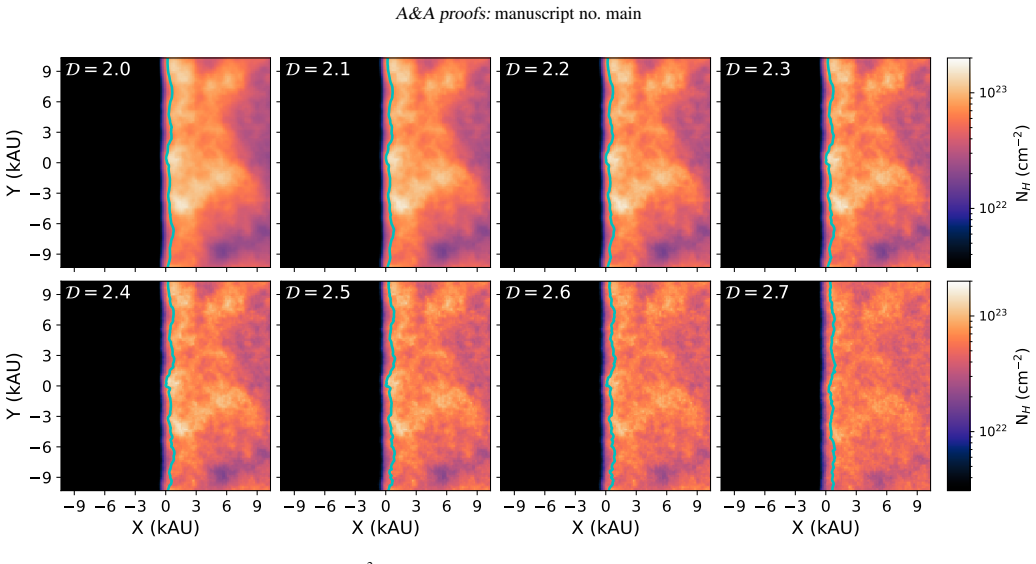
The load-bearing machinery is a three-dimensional steady-state PDR model built on a fractal density field: a Gaussian random field with power spectrum $P(k)=k^{-n}$, $n=2(4-D)$, exponentiated to a log-normal density distribution and truncated by a softened Heaviside function to create a uniform-density cavity irradiated from one side. The radiation transfer uses 48 rays per cell restricted to those pointing toward the illuminating boundary, so the FUV field, self-shielding column densities, and line cooling share the same rays; a new solver computes the non-LTE populations of 132 H2 rovibrational levels and their line cooling and emissivities. Front geometry is defined by the isosurfaces $x(\mathrm{H_2})=0.25$ (H-front) and $x(\mathrm{C}^+)/x_{\mathrm{C}}=1/e$ (C-front), and synthetic optically thin H2 line maps with foreground extinction are compared to observations. The fractal dimension $D$ controls clumpiness: low $D$ gives large correlated structures and visible arcs and filaments, while high $D$ gives many small clumps and a tight, linear front.
What would settle it
A decisive test would be to map the C+ and H2 front positions along many individual sightlines in the Orion Bar with ALMA and JWST and compare the measured separation distribution with the model's prediction: if observed separations are systematically larger than about 0.25 kAU, or if the C-front never precedes the H-front, the geometric explanation would be ruled out.
Extended reading notes
Core claim
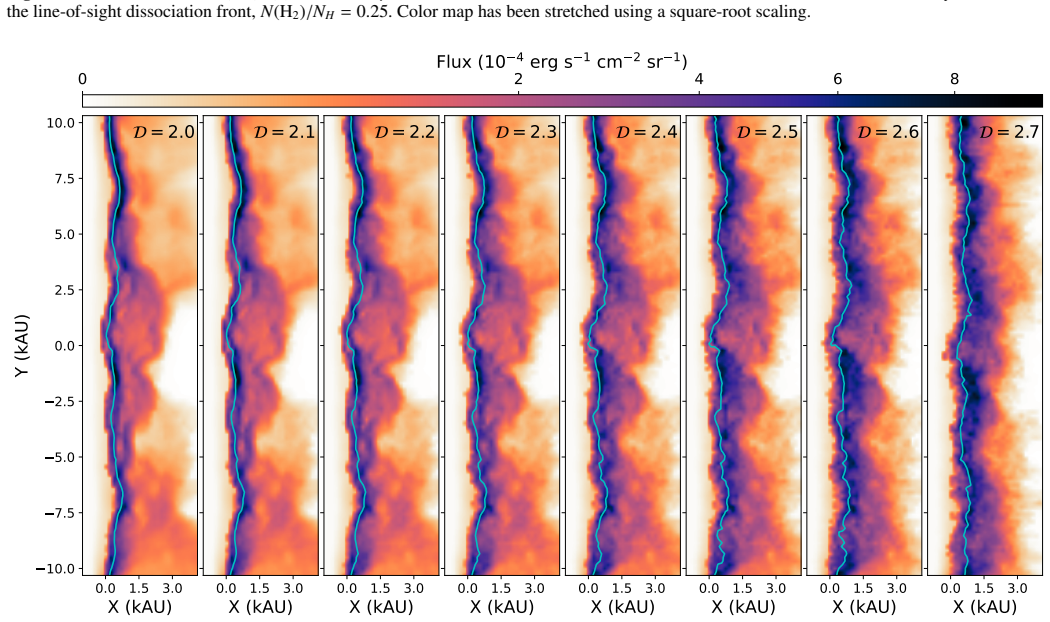
The central claim is that dense substructures in a three-dimensional gas distribution naturally produce C+ recombination fronts that are cospatial with or precede the H2 dissociation front, without invoking complex chemodynamical processes. In the model, the H2 dissociation front is a complex isosurface shaped by low-density voids and dense clumps; shadowing and shielding by these substructures let FUV radiation penetrate unevenly, so C+ can survive in regions where H2 still exists. Along $128^2$ lines of sight, the C–H front separation is centered on cospatiality, with a tail out to 6 kAU and, at higher fractal dimensions, sightlines where the C-front precedes the H-front. Synthetic maps of the (1-0)S(1) 2.12 µm and (0-0)S(9) 4.69 µm lines reproduce both the observed intensities and the arc/filament morphology of JWST images. The paper interprets this as evidence that the spatial dimensionality of the gas distribution, not additional chemistry, couples the two photochemical fronts.
Load-bearing premise
The load-bearing assumption is that a static, randomly-phased fractal density field with a chosen clumpiness and density spread represents the real gas structure of the Orion Bar; if actual turbulent dynamics arrange the gas differently, the front overlap and emission morphology could change.
Editorial extensions
If this is right
- Front separation should be reported as a distribution rather than a single number, because the model predicts a broad spread of separations around cospatiality, including negative values.
- Arc- and filament-like H2 emission features in JWST images can be read as projections of a structured three-dimensional dissociation front rather than separate dynamical layers.
- Vibrationally excited H2 at the front drives endothermic reactions such as C+ + H2* → CH+ + H, so hydrocarbon and sulfur-hydride emission should trace the same complex front surface.
- The preferred fractal dimensions around D≈2.2–2.4 imply a mix of compressive large-scale structure and turbulent clumping in the gas that produces the observed front morphology.
Reading between the lines
- Editorial extension: if front overlap is purely geometric, then fully dynamical simulations of turbulent clouds with the same radiation field should reproduce the same front-separation distribution from first principles.
- Editorial extension: the same fractal-density machinery could be applied to other edge-on PDRs, such as the Horsehead Nebula, to predict whether their front separations and H2 morphologies follow the same dependence on clumpiness.
- Editorial extension: the method could be inverted, using observed front-separation distributions and H2 arc statistics to constrain the effective fractal dimension of unresolved cloud structure in more distant PDRs.
Signed reviews
Editorial analysis
A structured set of objections, weighed in public.
Referee Report
Summary. This manuscript presents a new three-dimensional steady-state PDR model, based on an upgraded version of the 3d-pdr code with plane-parallel irradiation and non-LTE H2 rovibrational level populations. The authors construct a set of fractal density fields with fractal dimensions D = 2.0–2.7 as a proxy for the clumpy gas in the Orion Bar, and compute the 3D chemical, thermal, and H2 line emission structure. The central claim is that, in a 3D heterogeneous density distribution, dense substructures naturally shadow and shield the gas so that the H2 dissociation front and the C+ recombination front become cospatial (or the C-front even precedes the H-front), and that the resulting synthetic (1-0)S(1) and (0-0)S(9) maps show arc- and filament-like morphologies resembling JWST NIRCAM observations of the Orion Bar (Habart et al. 2024; Peeters et al. 2024).
Significance. If the central result holds, it is an important step for PDR astrochemistry: it offers a geometrically simple explanation for the observed overlapping H2 and C+ fronts without invoking chemodynamical effects, and it demonstrates a genuine 3D modeling capability with a public code. The paper's strengths include that the front co-spatiality is an emergent property rather than a fitted target, that the H2 level population solver and the plane-irradiation ray-tracing are new technical developments in 3d-pdr, and that the code is publicly available. The claims are also falsifiable: the mechanism predicts specific front-separation distributions and morphological features that can be tested against observations and against multi-realization ensembles. However, as detailed below, the current evidence does not yet establish the claimed generality because each fractal dimension is represented by a single random realization, and the observational comparison is largely qualitative.
major comments (3)
- [Section 2.1 and Sections 3.4–3.6, Fig. 8] The paper uses a single random realization of the fractal density field per fractal dimension D. All results in Sections 3.4–3.6, including the fitted trend δr = 0.22*(D−2)+0.27 in Fig. 8 and the morphological identification of JWST-like arcs in Figs. 9–10, are therefore specific to one random phase draw. The construction also centers the fractal on its highest-density region and applies a softened Heaviside truncation, so each field contains one dominant central structure; a different seed could lack this feature and produce different front-separation distributions and emission morphologies. Since the central claim is that heterogeneous 3D gas distributions generically produce cospatial or preceding C-fronts and arced H2 emission, the authors need to show robustness across multiple realizations per D. Without this, the paper cannot distinguish a general 3D shadowing mechanism from a seed-specific arrangement, and the later preference for D ≈ 2.2–2.4 in Section 4 is post hoc rather than predictive.
- [Section 3.6, Eq. (10)] Equation (10) contains a sign error in the foreground extinction term. As written, the attenuation factor is exp(−(σ_d N_H(<z) − τ_fg)), so a positive foreground optical depth τ_fg would increase, not decrease, the line intensity. The text states that the foreground extinction is meant to attenuate the flux and 'only changes the overall strength'; the formula should read exp(−(σ_d N_H(<z) + τ_fg)). Because the synthetic intensities in Section 3.6 and the comparison to JWST values (Habart et al. 2024; Peeters et al. 2024) are based on this equation, the sign error affects the quantitative comparison and must be corrected and the affected maps re-examined.
- [Section 3.6 and Section 4] The observational comparison is qualitative. The authors state that the predicted intensities are 'close to those seen' and that the maps show 'filamentary and arc structures' similar to JWST, but no quantitative metrics are provided: there is no convolution to the JWST NIRCAM beam, no comparison of intensity distributions or spatial power spectra, and no statistical measure of morphological similarity. The preference for fractal dimensions D ≈ 2.2–2.4 is then inferred from this visual comparison, using one realization per D. The reader cannot assess how strongly the observations constrain D, or whether the claimed morphological similarity is significant. The authors should either supply a quantitative comparison or explicitly soften the claim that the model 'reproduces' the observed morphology and that the D range is 'preferred.'
minor comments (6)
- [Abstract] The abstract contains the typo 'plane-irradiatation'; it should be 'plane-irradiation'.
- [Introduction] The phrase 'theraytheiaray-tracing algorithm' is missing a space; it should read 'the raytheia ray-tracing algorithm'.
- [Section 3.4, page 9] In the sentence about voids in the density distribution, 'V oids' contains a spurious space and should be 'Voids'.
- [Figure 8] The axis label 'C-H front seperation' misspells 'separation'; the same spelling error appears in the caption.
- [Acknowledgements] 'We are greatful for the helpful comments' should be 'grateful'.
- [Section 2.4] The discussion of assumptions is clear and honest, but it would help to explicitly state in Section 3.5 that the front-separation distributions are not corrected for the systematic uncertainties introduced by the single-FUV-band approximation and the fixed grain size; a one-sentence sensitivity statement would improve reproducibility.
Circularity Check
No significant circularity: front co-spatiality and morphology are emergent outputs of the 3D radiative-chemical model, not inputs or fitted targets.
full rationale
The paper's central claims--that H2 dissociation and C+ recombination fronts overlap or that C-fronts can precede H-fronts (Sec. 3.5) and that H2 emission maps show arc/filament structure (Sec. 3.6)--are emergent outputs of solving the chemical network, H2 rovibrational level populations (Eqs. 2-8), and ray-tracing radiation transfer on prescribed fractal density fields. The front definitions in Secs. 3.4-3.5 (x(H)=2x(H2)=0.5, x(H2)=0.25, and x(C+)/xC=1/e) are standard, independent abundance thresholds; nothing in the model construction requires them to coincide. The fractal density fields are stated as an assumed proxy (Sec. 2.1), not derived from the target result, and the D-preference (D~2.2-2.4) is explicitly a post hoc comparison to observations rather than a fitted input. Self-citations to 3d-pdr and raytheia (Bisbas et al. 2012; Zhu et al. 2026) are code/method credits with overlapping authorship, but the new plane-irradiation scheme and H2 solver are described in the paper, and the underlying collisional and radiative data (Zhang et al. 2021; Cloudy data; UMIST/KIDA) are external. No uniqueness theorem, fitted parameter disguised as prediction, or definitional equivalence can be quoted. The single-realization robustness concern raised by the reader is a sampling/validity limitation, not circularity.
Assumptions & free parameters
free parameters (5)
- fractal dimension D =
scanned 2.0 to 2.7; preferred 2.2 to 2.4
- log-normal spread sigma =
1
- central density n0 =
not explicitly stated; dense structures span 1e4 to 5e6 cm-3
- foreground extinction tau_fg =
2 mag (A_V)
- H2 level truncation =
v_max=10, J_max=11 (132 levels)
assumptions (5)
- ad hoc to paper The gas density can be represented by a static fractal field with a power-law power spectrum and log-normal PDF.
- domain assumption Chemistry and level populations are in steady state.
- domain assumption A single FUV band with one dust opacity and precomputed H2/CO shielding factors is sufficient.
- ad hoc to paper H2 formation on dust grains populates levels in LTE at the exothermic energy of 4.4781 eV.
- domain assumption H2 line emission is optically thin and only attenuated by dust along the line of sight.
Cite this review
Pith. "Pith review of Resolving dense photo-dissociation regions: the structure of photochemical fronts in three-dimensional gas distributions." pith.science (2026). https://pith.science/paper/PK53UHTZ
@misc{pith2026260804116,
  author       = {Pith},
  title        = {Pith review of: Resolving dense photo-dissociation regions: the structure of photochemical fronts in three-dimensional gas distributions},
  year         = {2026},
  howpublished = {\url{https://pith.science/paper/PK53UHTZ}},
  note         = {Machine review of arXiv:2608.04116}
}
read the original abstract
For decades, the Orion Bar has been the prototypical photo-dissociation region. Viewed nearly edge-on, it offers a unique window into the stratified chemical structure of the atomic-to-molecular transition of the interstellar medium. Understanding its photochemistry is essential to interpreting key observations originating from dense photo-dissociation regions. ALMA and JWST observations reveal that H2 photo-dissociation front overlaps with the C+ recombination front and exhibits a complex spatial morphology. Despite considerable theoretical effort, existing modeling approaches based on simplified geometrical assumptions have difficulties reproducing the spatial emission structure. Our aim is to investigate the response of photochemistry in realistic three-dimensional density distributions, using the Orion Bar as a representative application. We present the first fully three-dimensional high-resolution model of an Orion Bar analogue that resolves the relevant photochemical fronts using the upgraded steady-state 3D-PDR photo-dissociation region code, which allows for the treatment of plane-irradiatation and for the solution of the non-LTE H2 rovibrational levels. We find that the H2 dissociation front is characterized by a complex surface that overlaps with the C+ recombination front. Our 3D model can reproduce the complex morphology of H2 emission seen in observations, in particular the arc- and filament-like features, and provides a physical explanation of its chemistry. The overlapping H2 dissociation and C+ recombination fronts and the spatial emission morphology can be explained due to the three-dimensional gas distribution, resulting in shadowing and shielding by dense substructures. Our results mark a turning point for astrochemistry, where three-dimensional steady-state models can deliver fundamentally new insights into the chemistry of the interstellar medium.
Figures


Figures from the paper (6 more)


Reference graph
Works this paper leans on
-
[1]
The distance to the Orion Nebula. , keywords =. doi:10.1051/0004-6361:20078247 , archivePrefix =. 0709.0485 , primaryClass =
-
[2]
RAYTHEIA: a high-performance ray-tracing algorithm for three-dimensional direction-dependent equations in astronomical simulations. , keywords =. doi:10.1093/mnras/stag906 , archivePrefix =. 2605.09882 , primaryClass =
-
[3]
A photon dominated region code comparison study. , keywords =. doi:10.1051/0004-6361:20065918 , archivePrefix =. astro-ph/0702231 , primaryClass =
-
[4]
Isentropic instability and dynamic substructures in the Orion Bar photodissociation region: Analytical and numerical insights. , keywords =. doi:10.1051/0004-6361/202554479 , adsurl =
-
[5]
PDRs4All: XII. Far-ultraviolet-driven formation of simple hydrocarbon radicals and their relation with polycyclic aromatic hydrocarbons. , keywords =. doi:10.1051/0004-6361/202453350 , archivePrefix =. 2503.03353 , primaryClass =
-
[6]
Sulfur-bearing hydrides in UV-illuminated gas and grains
Bottlenecks to interstellar sulfur chemistry. Sulfur-bearing hydrides in UV-illuminated gas and grains. , keywords =. doi:10.1051/0004-6361/202039756 , archivePrefix =. 2101.01012 , primaryClass =
-
[7]
JWST's NIR spectroscopic view of the Orion Bar
PDRs4All: III. JWST's NIR spectroscopic view of the Orion Bar. , keywords =. doi:10.1051/0004-6361/202348244 , archivePrefix =. 2310.08720 , primaryClass =
-
[8]
PDRs4All. II. JWST's NIR and MIR imaging view of the Orion Nebula. , keywords =. doi:10.1051/0004-6361/202346747 , archivePrefix =. 2308.16732 , primaryClass =
Show all 130 references
-
[9]
Quantum study and 3 detection of NH emission in the Orion Bar PDR
The role of highly vibrationally excited H _ 2 initiating the nitrogen chemistry. Quantum study and 3 detection of NH emission in the Orion Bar PDR. , keywords =. doi:10.1051/0004-6361/202243884 , archivePrefix =. 2206.10441 , primaryClass =
-
[10]
, keywords =
Photodissociation and X-Ray-Dominated Regions. , keywords =. doi:10.1146/annurev-astro-052920-010254 , archivePrefix =. 2202.05867 , primaryClass =
-
[11]
, keywords =
PDRs4All: A JWST Early Release Science Program on Radiative Feedback from Massive Stars. , keywords =. doi:10.1088/1538-3873/ac604c , archivePrefix =. 2201.05112 , primaryClass =
-
[12]
, keywords =
Properties of Highly Rotationally Excited H _ 2 in Photodissociation Regions. , keywords =. doi:10.3847/1538-4357/abe9b0 , adsurl =
-
[13]
, keywords =
The relation between the turbulent Mach number and observed fractal dimensions of turbulent clouds. , keywords =. doi:10.1093/mnras/stz1853 , archivePrefix =. 1907.01689 , primaryClass =
1907 arXiv
-
[14]
, keywords =
Merged H/H _ 2 and C ^ + /C/CO transitions in the Orion Bar. , keywords =. doi:10.1093/mnras/stz983 , archivePrefix =. 1904.04423 , primaryClass =
1904 arXiv
-
[15]
, keywords =
Direct estimation of electron density in the Orion Bar PDR from mm-wave carbon recombination lines. , keywords =. doi:10.1051/0004-6361/201935556 , archivePrefix =. 1904.10356 , primaryClass =
1904 arXiv
-
[16]
Widespread CH ^ + (J = 1-0), CO (10-9), HCN (6-5), and HCO ^ + (6-5) emission
Molecular tracers of radiative feedback in Orion (OMC-1). Widespread CH ^ + (J = 1-0), CO (10-9), HCN (6-5), and HCO ^ + (6-5) emission. , keywords =. doi:10.1051/0004-6361/201834409 , archivePrefix =. 1812.00821 , primaryClass =
-
[17]
, keywords =
Structure of photodissociation fronts in star-forming regions revealed by Herschel observations of high-J CO emission lines. , keywords =. doi:10.1051/0004-6361/201832611 , archivePrefix =. 1801.03893 , primaryClass =
- [18]
-
[19]
, keywords =
State-to-state chemistry and rotational excitation of CH ^ + in photon-dominated regions. , keywords =. doi:10.1093/mnras/stx892 , archivePrefix =. 1704.02233 , primaryClass =
-
[20]
, keywords =
Complex organic molecules in strongly UV-irradiated gas. , keywords =. doi:10.1051/0004-6361/201730459 , archivePrefix =. 1705.06612 , primaryClass =
-
[21]
, keywords =
Spatially resolved images of reactive ions in the Orion Bar. , keywords =. doi:10.1051/0004-6361/201730716 , archivePrefix =. 1704.08621 , primaryClass =
-
[22]
, keywords =
Excitation of Molecular Hydrogen in the Orion Bar Photodissociation Region from a Deep Near-infrared IGRINS Spectrum. , keywords =. doi:10.3847/1538-4357/aa5b9f , archivePrefix =. 1701.05604 , primaryClass =
-
[23]
Temperature and density differentiation near the PDR surface
Herschel/HIFI spectral line survey of the Orion Bar. Temperature and density differentiation near the PDR surface. , keywords =. doi:10.1051/0004-6361/201628916 , archivePrefix =. 1611.07470 , primaryClass =
-
[24]
, keywords =
Spatial distribution of far-infrared rotationally excited CH ^ + and OH emission lines in the Orion Bar photodissociation region. , keywords =. doi:10.1051/0004-6361/201629445 , archivePrefix =. 1609.04359 , primaryClass =
-
[25]
Understanding the Orion Bar stratification
Modelling clumpy photon-dominated regions in 3D. Understanding the Orion Bar stratification. , keywords =. doi:10.1051/0004-6361/201424287 , archivePrefix =. 1405.5553 , primaryClass =
-
[26]
, keywords =
Compression and ablation of the photo-irradiated molecular cloud the Orion Bar. , keywords =. doi:10.1038/nature18957 , archivePrefix =. 1608.06173 , primaryClass =
-
[27]
, keywords =
The chemistry and spatial distribution of small hydrocarbons in UV-irradiated molecular clouds: the Orion Bar PDR. , keywords =. doi:10.1051/0004-6361/201424568 , archivePrefix =. 1412.0417 , primaryClass =
-
[28]
, keywords =
H I-to-H _ 2 Transitions and H I Column Densities in Galaxy Star-forming Regions. , keywords =. doi:10.1088/0004-637X/790/1/10 , archivePrefix =. 1404.5042 , primaryClass =
-
[29]
- CH ^ + , SH ^ + , and CF ^ +
The chemistry of ions in the Orion Bar I. - CH ^ + , SH ^ + , and CF ^ + . The effect of high electron density and vibrationally excited H _ 2 in a warm PDR surface. , keywords =. doi:10.1051/0004-6361/201220519 , archivePrefix =. 1212.4378 , primaryClass =
-
[30]
, keywords =
Herschel/HIFI observations of [C II] and [ ^ 13 C II] in photon-dominated regions. , keywords =. doi:10.1051/0004-6361/201219837 , archivePrefix =. 1211.3359 , primaryClass =
-
[32]
, keywords =
Dispersal of molecular clouds by ionizing radiation. , keywords =. doi:10.1111/j.1365-2966.2012.21767.x , archivePrefix =. 1206.6492 , primaryClass =
2012
-
[33]
UV-driven chemistry in simulations of the interstellar medium. I. Post-processed chemistry with the Meudon PDR code. , keywords =. doi:10.1051/0004-6361/201218865 , archivePrefix =. 1205.5689 , primaryClass =
-
[34]
, keywords =
Waves on the surface of the Orion molecular cloud. , keywords =. doi:10.1038/nature09289 , archivePrefix =. 1011.0295 , primaryClass =
-
[35]
, keywords =
The Chemistry of Vibrationally Excited H _ 2 in the Interstellar Medium. , keywords =. doi:10.1088/0004-637X/713/1/662 , archivePrefix =. 1003.1375 , primaryClass =
-
[36]
, keywords =
Rotationally Warm Molecular Hydrogen in the Orion Bar. , keywords =. doi:10.1088/0004-637X/701/1/677 , archivePrefix =. 0906.2310 , primaryClass =
-
[37]
, keywords =
Uncertainties in H _ 2 and HD chemistry and cooling and their role in early structure formation. , keywords =. doi:10.1111/j.1365-2966.2008.13224.x , archivePrefix =. 0803.1768 , primaryClass =
2008
-
[38]
, keywords =
[Si II], [Fe II], [C II], and H _ 2 Emission from Massive Star-forming Regions. , keywords =. doi:10.1086/503596 , adsurl =
-
[39]
, keywords =
A Model for Atomic and Molecular Interstellar Gas: The Meudon PDR Code. , keywords =. doi:10.1086/503252 , archivePrefix =. astro-ph/0602150 , primaryClass =
-
[40]
, keywords =
Interstellar Carbon in Translucent Sight Lines. , keywords =. doi:10.1086/382592 , archivePrefix =. astro-ph/0401510 , primaryClass =
-
[41]
, keywords =
The structure of the Orion bar. , keywords =
-
[42]
Reviews of Modern Physics , keywords =
Photodissociation regions in the interstellar medium of galaxies. Reviews of Modern Physics , keywords =. doi:10.1103/RevModPhys.71.173 , adsurl =
-
[43]
, keywords =
On the fractal structure of molecular clouds. , keywords =
-
[44]
, keywords =
The Abundance of Interstellar Nitrogen. , keywords =. doi:10.1086/311023 , archivePrefix =. astro-ph/9710162 , primaryClass =
-
[45]
, keywords =
Carbon Radio Recombination Lines in the Orion Bar. , keywords =. doi:10.1086/310893 , archivePrefix =. astro-ph/9707276 , primaryClass =
-
[46]
, year = 1997, month = jan, volume =
Dense Photodissociation Regions (PDRs). , year = 1997, month = jan, volume =. doi:10.1146/annurev.astro.35.1.179 , adsurl =
1997 doi
-
[47]
, keywords =
A Fractal Origin for the Mass Spectrum of Interstellar Clouds. , keywords =. doi:10.1086/178009 , adsurl =
-
[48]
, keywords =
Structure and chemistry of the Orion bar photon-dominated region. , keywords =
-
[49]
, keywords =
Nonequilibrium Photodissociation Regions: Ionization-Dissociation Fronts. , keywords =. doi:10.1086/176805 , archivePrefix =. astro-ph/9508067 , primaryClass =
-
[50]
, keywords =
Anatomy of a Photodissociation Region: High Angular Resolution Images of Molecular Emission in the Orion Bar. , keywords =. doi:10.1086/173711 , adsurl =
-
[51]
, keywords =
Radiative Cooling of Warm Molecular Gas. , keywords =. doi:10.1086/173388 , adsurl =
-
[52]
Science , year = 1993, month = oct, volume =
Anatomy of the Photodissociation Region in the Orion Bar. Science , year = 1993, month = oct, volume =. doi:10.1126/science.262.5130.86 , adsurl =
1993 doi
-
[53]
Physical Processes in Fragmentation and Star Formation , year = 1990, editor =
Perception of interstellar structure - Facing complexity. Physical Processes in Fragmentation and Star Formation , year = 1990, editor =. doi:10.1007/978-94-009-0605-1_12 , adsurl =
1990 doi
-
[54]
, keywords =
The Orion molecular cloud and star-forming region. , keywords =. doi:10.1146/annurev.aa.27.090189.000353 , adsurl =
-
[55]
Photodissociation regions. I. Basic model. , keywords =. doi:10.1086/163111 , adsurl =
-
[56]
, keywords =
Photoelectric heating of interstellar gas. , keywords =. doi:10.1086/190513 , adsurl =
-
[57]
, keywords =
Ortho to para conversion of H _ 2 on interstellar grains. , keywords =
-
[58]
, keywords =
H _ 2 Rovibrational Excitation in Protoplanetary Disks and Its Effects on the Chemistry. , keywords =. doi:10.3847/1538-4357/abe712 , archivePrefix =. 2102.08295 , primaryClass =
-
[59]
, keywords =
Efficient ortho-para conversion of H _ 2 on interstellar grain surfaces. , keywords =. doi:10.1051/0004-6361/201527879 , archivePrefix =. 1601.04356 , primaryClass =
-
[60]
, keywords =
Infrared Diagnostics of the Formation of H 2 on Interstellar Dust. , keywords =. doi:10.1086/176043 , adsurl =
-
[61]
Warm molecular hydrogen spectroscopy in the Horsehead nebula
JWST observations of photodissociation regions: II. Warm molecular hydrogen spectroscopy in the Horsehead nebula. , keywords =. doi:10.1051/0004-6361/202556314 , archivePrefix =. 2510.06812 , primaryClass =
-
[62]
Detection of infrared CH ^ + and CH _ 3 ^ + rovibrational emission in the Orion Bar and disk d203-506: Evidence of chemical pumping
PDRs4All: XI. Detection of infrared CH ^ + and CH _ 3 ^ + rovibrational emission in the Orion Bar and disk d203-506: Evidence of chemical pumping. , keywords =. doi:10.1051/0004-6361/202453441 , archivePrefix =. 2502.08354 , primaryClass =
- [63]
-
[64]
, keywords =
Rapid Ortho-to-para Nuclear Spin Conversion of H _ 2 on a Silicate Dust Surface. , keywords =. doi:10.3847/1538-4357/abd9c0 , archivePrefix =. 2101.02357 , primaryClass =
-
[65]
, keywords =
Orion's Bar: Physical Conditions Across the Definitive H ^ + /H ^ 0 /H _ 2 Interface. , keywords =. doi:10.1088/0004-637X/693/1/285 , archivePrefix =. 0811.1176 , primaryClass =
-
[66]
PDRs4All. V. Modelling the dust evolution across the illuminated edge of the Orion Bar. , keywords =. doi:10.1051/0004-6361/202348728 , archivePrefix =. 2401.01221 , primaryClass =
-
[67]
, keywords =
Chemistry in Dense Photon-dominated Regions. , keywords =. doi:10.1086/192198 , adsurl =
-
[68]
, keywords =
H _ 2 (v = 0,1) + C ^ + ( ^ 2 P) H+CH ^ + State-to-state Rate Constants for Chemical Pumping Models in Astrophysical Media. , keywords =. doi:10.1088/0004-637X/766/2/80 , adsurl =
-
[69]
, keywords =
Total transition probability and spontaneous radiative dissociation of B, C, B' and D states of molecular hydrogen. , keywords =. doi:10.1051/aas:2000121 , adsurl =
-
[70]
, keywords =
The Infrared Response of Molecular Hydrogen Gas to Ultraviolet Radiation: High-Density Regions. , keywords =. doi:10.1086/167193 , adsurl =
-
[71]
Physical Chemistry Chemical Physics (Incorporating Faraday Transactions) , year = 2014, month = jan, volume =
The effect of the reactant internal excitation on the dynamics of the C++ H2reaction. Physical Chemistry Chemical Physics (Incorporating Faraday Transactions) , year = 2014, month = jan, volume =. doi:10.1039/C4CP03289F , adsurl =
2014 doi
-
[72]
, keywords =
The Ratio of Ortho- to Para-H _ 2 in Photodissociation Regions. , keywords =. doi:10.1086/307115 , archivePrefix =. astro-ph/9812049 , primaryClass =
-
[73]
Formation and excitation of HD in photodissociation regions: Application to the Orion Bar
PDRs4All: XVII. Formation and excitation of HD in photodissociation regions: Application to the Orion Bar. , keywords =. doi:10.1051/0004-6361/202557445 , archivePrefix =. 2510.11248 , primaryClass =
-
[74]
, year = 2024, month = jun, volume =
The chemistry and excitation of H _ 2 and HD in the early Universe. , year = 2024, month = jun, volume =. doi:10.1093/mnras/stae994 , adsurl =
2024 doi
-
[75]
, keywords =
Collisional cooling of primordial and interstellar media by H _ 2. , keywords =. doi:10.1093/mnras/stab2272 , adsurl =
-
[76]
Research Notes of the American Astronomical Society , keywords =
Cosmic Ray Dissociation of Molecular Hydrogen and Dense Cloud Chemistry. Research Notes of the American Astronomical Society , keywords =. doi:10.3847/2515-5172/ab97ae , archivePrefix =. 2010.13703 , primaryClass =
2010 arXiv
-
[77]
, keywords =
The full infrared spectrum of molecular hydrogen. , keywords =. doi:10.1051/0004-6361/201936249 , archivePrefix =. 1909.11585 , primaryClass =
1909 arXiv
-
[78]
, keywords =
The 1600 A Emission Bump in Protoplanetary Disks: A Spectral Signature of H _ 2 O Dissociation. , keywords =. doi:10.3847/1538-4357/aa7cee , archivePrefix =. 1706.09940 , primaryClass =
-
[79]
, keywords =
Revisited study of the ro-vibrational excitation of H _ 2 by H: towards a revision of the cooling of astrophysical media. , keywords =. doi:10.1093/mnras/stv1683 , adsurl =
-
[80]
, keywords =
Photochemical Heating of Dense Molecular Gas. , keywords =. doi:10.1088/0004-637X/810/2/125 , archivePrefix =. 1506.04167 , primaryClass =
-
[81]
, keywords =
Interpreting observations of molecular outflow sources: the MHD shock code mhd\_vode. , keywords =. doi:10.1051/0004-6361/201525740 , adsurl =
-
[82]
Surface chemistry in the interstellar medium. I. H _ 2 formation by Langmuir-Hinshelwood and Eley-Rideal mechanisms. , keywords =. doi:10.1051/0004-6361/201118126 , archivePrefix =. 1202.0374 , primaryClass =
-
[83]
Journal of Chemical Theory and Computation , volume =
Komasa, Jacek and Piszczatowski, Konrad and Łach, Grzegorz and Przybytek, Michał and Jeziorski, Bogumił and Pachucki, Krzysztof , title =. Journal of Chemical Theory and Computation , volume =. 2011 , doi =
2011
-
[84]
, keywords =
Vibrational Level Population of H _ 2 and H ^ + _ 2 in the Early Universe. , keywords =. doi:10.1088/0067-0049/193/1/7 , archivePrefix =. 1103.3586 , primaryClass =
-
[85]
, keywords =
ISO observation of molecular hydrogen and fine-structure lines in the photodissociation region IC63. , keywords =. doi:10.1111/j.1365-2966.2009.15501.x , adsurl =
2009
-
[86]
, keywords =
The excitation of molecular hydrogen by atomic hydrogen in astrophysical media. , keywords =. doi:10.1111/j.1365-2966.2007.12420.x , adsurl =
2007
-
[87]
Journal of Physics B Atomic Molecular Physics , year = 2007, month = aug, volume =
The rovibrational excitation of H _ 2 induced by H. Journal of Physics B Atomic Molecular Physics , year = 2007, month = aug, volume =. doi:10.1088/0953-4075/40/16/003 , adsurl =
2007 doi
-
[88]
, keywords =
H _ 2 Pure Rotational Lines in the Orion Bar. , keywords =. doi:10.1086/431919 , archivePrefix =. astro-ph/0506003 , primaryClass =
-
[89]
, keywords =
Molecular Hydrogen in Star-forming Regions: Implementation of its Microphysics in CLOUDY. , keywords =. doi:10.1086/429215 , archivePrefix =. astro-ph/0501485 , primaryClass =
-
[90]
, keywords =
The cooling of astrophysical media by H\_2. , keywords =. doi:10.1046/j.1365-8711.1999.02497.x , adsurl =
1999
-
[91]
, keywords =
Structure of Stationary Photodissociation Fronts. , keywords =. doi:10.1086/177689 , archivePrefix =. astro-ph/9603032 , primaryClass =
-
[92]
, keywords =
Time-dependent Fluorescent H 2 Emission. , keywords =. doi:10.1086/175168 , adsurl =
-
[93]
, keywords =
Photodissociation of H2 and the H/H2 transition in interstellar clouds. , keywords =
-
[94]
, keywords =
Line Emission from Clumpy Photodissociation Regions. , keywords =. doi:10.1086/169516 , adsurl =
-
[95]
, keywords =
Ultraviolet Fluorescent Molecular Hydrogen Emission. , keywords =. doi:10.1086/168177 , adsurl =
-
[96]
, keywords =
The Infrared Response of Molecular Hydrogen Gas to Ultraviolet Radiation: A Scaling Law. , keywords =. doi:10.1086/166664 , adsurl =
-
[97]
, keywords =
Fluorescent Excitation of Interstellar H 2. , keywords =. doi:10.1086/165740 , adsurl =
-
[98]
, keywords =
Comprehensive Models of Diffuse Interstellar Clouds: Physical Conditions and Molecular Abundances. , keywords =. doi:10.1086/191135 , adsurl =
-
[99]
, keywords =
Vibrational excitation of H _ 2 in intense ultraviolet fluxes. , keywords =. doi:10.1086/155850 , adsurl =
-
[100]
, year = 1972, month = jan, volume =
Spontaneous radiative dissociation in molecular hydrogen. , year = 1972, month = jan, volume =. doi:10.1016/0022-4073(72)90168-9 , adsurl =
1972 doi
- [101]
-
[102]
, keywords =
Photochemistry and Heating/Cooling of the Multiphase Interstellar Medium with UV Radiative Transfer for Magnetohydrodynamic Simulations. , keywords =. doi:10.3847/1538-4365/ac9b1d , archivePrefix =. 2210.08024 , primaryClass =
-
[103]
, keywords =
SILCC-Zoom: the dynamic and chemical evolution of molecular clouds. , keywords =. doi:10.1093/mnras/stx2343 , archivePrefix =. 1704.06487 , primaryClass =
-
[104]
, keywords =
Metallicity Dependence of the H/H _ 2 and C ^ + /C/CO Distributions in a Resolved Self-regulating Interstellar Medium. , keywords =. doi:10.3847/1538-4357/ac0dbd , archivePrefix =. 2103.03889 , primaryClass =
-
[105]
, keywords =
Is molecular gas necessary for star formation?. , keywords =. doi:10.1111/j.1365-2966.2011.19648.x , archivePrefix =. 1105.3073 , primaryClass =
2011
-
[106]
The KOSMA- PDR model. I. Recent updates to the numerical model of photo-dissociated regions. , keywords =. doi:10.1051/0004-6361/202141854 , archivePrefix =. 2205.04233 , primaryClass =
-
[107]
, keywords =
Quadrupole Transition Probabilities for the Excited Rovibrational States of H _ 2. , keywords =. doi:10.1086/313091 , adsurl =
-
[108]
, keywords =
High-angular-resolution NIR view of the Orion Bar revealed by Keck/NIRC2. , keywords =. doi:10.1051/0004-6361/202244034 , archivePrefix =. 2206.08245 , primaryClass =
-
[109]
, keywords =
Fractal Dimension of Interstellar Clouds: Opacity and Noise Effects. , keywords =. doi:10.1086/510351 , archivePrefix =. astro-ph/0610613 , primaryClass =
-
[110]
The Interstellar Medium in I Zw 18 Seen with JWST/MIRI. II. Warm Molecular Hydrogen and Warm Dust. , keywords =. doi:10.3847/1538-4357/ae0191 , archivePrefix =. 2509.02690 , primaryClass =
-
[111]
Pitts and L
Willam M. Pitts and L. Pasternack and J.R. McDonald , abstract =. Temperature dependence of the C2(X1Σg+) reaction with H2 and CH4 and C2(X1Σg+ and a 3Πu equilibrated states) with O2 , journal =. 1982 , issn =. doi:https://doi.org/10.1016/0301-0104(82)87050-X , url =
1982 doi
-
[112]
, keywords =
The penetration of diffuse ultraviolet radiation into interstellar clouds. , keywords =. doi:10.1086/157778 , adsurl =
-
[113]
, keywords =
The penetration of Far-UV radiation into molecular clouds. , keywords =. doi:10.1051/0004-6361:20066119 , archivePrefix =. astro-ph/0702033 , primaryClass =
-
[114]
, keywords =
Formation of interstellar SH ^ + from vibrationally excited H _ 2 : Quantum study of S ^ + + H _ 2 ⇄ SH ^ + + H reaction and inelastic collision. , keywords =. doi:10.1051/0004-6361/201935471 , archivePrefix =. 1905.02779 , primaryClass =
1905 arXiv
-
[115]
, keywords =
The UMIST Database for Astrochemistry 2022. , keywords =. doi:10.1051/0004-6361/202346908 , archivePrefix =. 2311.03936 , primaryClass =
2022 arXiv
-
[116]
, keywords =
The 2024 KIDA network for interstellar chemistry. , keywords =. doi:10.1051/0004-6361/202450606 , archivePrefix =. 2407.15958 , primaryClass =
2024 arXiv
-
[117]
, keywords =
The Photodissociation and Chemistry of Interstellar CO. , keywords =. doi:10.1086/166877 , adsurl =
-
[118]
, keywords =
Atomic to molecular hydrogen transition in interstellar clouds. , keywords =. doi:10.1086/156753 , adsurl =
-
[119]
, keywords =
Molecular Hydrogen Formation in the Interstellar Medium. , keywords =. doi:10.1086/342607 , archivePrefix =. astro-ph/0207035 , primaryClass =
-
[120]
Millimeter and submillimeter observations of the Orion Bar. I. Physical structure. , keywords =
-
[121]
, keywords =
Electron-Ion Recombination on Grains and Polycyclic Aromatic Hydrocarbons. , keywords =. doi:10.1086/324035 , archivePrefix =. astro-ph/0105237 , primaryClass =
-
[122]
, keywords =
Interstellar Dust Grains. , keywords =. doi:10.1146/annurev.astro.41.011802.094840 , archivePrefix =. astro-ph/0304489 , primaryClass =
-
[123]
, keywords =
Dust Grain-Size Distributions and Extinction in the Milky Way, Large Magellanic Cloud, and Small Magellanic Cloud. , keywords =. doi:10.1086/318651 , archivePrefix =. astro-ph/0008146 , primaryClass =
-
[124]
PDRs4All. IX. Sulfur elemental abundance in the Orion Bar. , keywords =. doi:10.1051/0004-6361/202449229 , archivePrefix =. 2404.09235 , primaryClass =
-
[125]
, keywords =
Clumps and triggered star formation in ionized molecular clouds. , keywords =. doi:10.1093/mnras/stt1115 , archivePrefix =. 1306.4317 , primaryClass =
-
[126]
, keywords =
Fractal 3-D simulations of molecular clouds. , keywords =
-
[127]
doi:10.4159/harvard.9780674864658 , adsurl =
Moving Envelopes of Stars. doi:10.4159/harvard.9780674864658 , adsurl =
-
[128]
, keywords =
Carbon monoxide in collapsing interstellar clouds. , keywords =. doi:10.1086/153665 , adsurl =
-
[129]
, keywords =
Formation of the methyl cation by photochemistry in a protoplanetary disk. , keywords =. doi:10.1038/s41586-023-06307-x , archivePrefix =. 2401.03296 , primaryClass =
-
[130]
, keywords =
IRAM 30 m Large Scale Survey of ^ 12 CO(2-1) and ^ 13 CO(2-1) Emission in the Orion Molecular Cloud. , keywords =. doi:10.1088/0004-637X/795/1/13 , archivePrefix =. 1408.2999 , primaryClass =
-
[131]
, keywords =
C _ 2 H observations toward the Orion Bar. , keywords =. doi:10.1051/0004-6361/201424220 , archivePrefix =. 1405.3903 , primaryClass =
Reviewed August 15, 2026 · model on record in the stance chip above.
Discussion (0). Continue with ORCID to comment.