REVIEW 3 major objections 4 minor 106 references
FAST Ultra-Deep Survey: the baryonic Tully-Fisher relation in FUDS0 field
T0 review · 3 major / 4 minor · reviewed 2026-08-08 · deepseek-v4-flash
Pith's one-line read Using 74 HI-selected galaxies from the FUDS0 pilot field, this paper finds the baryonic Tully-Fisher relation has slope k=3.32, zero point b=10.07, and no significant evolution out to z=0.42, with outliers dominated by measurement effects.
desk verdict Solid local BTFR from a new FAST field, but the no-evolution claim at z>0.12 is inference dressed as a detection, and the paper itself admits the assumption. read the letter →
The pith
A machine-rendered reading of the paper's core claim, the machinery that carries it, and where it could break.
The reading
What carries the argument
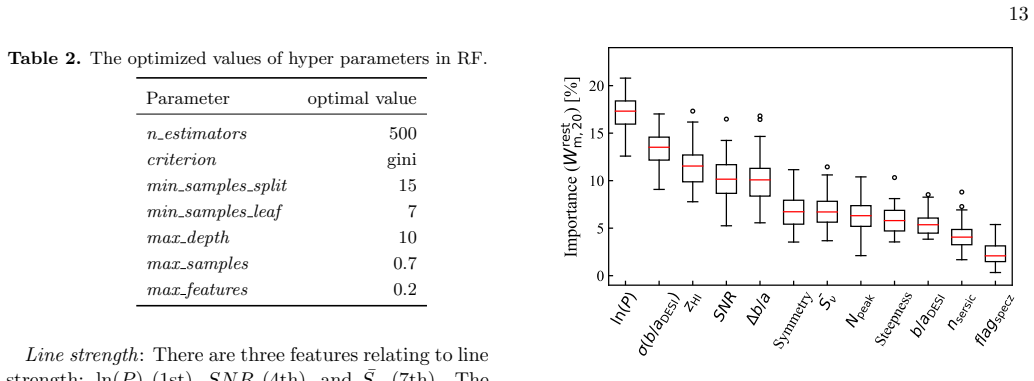
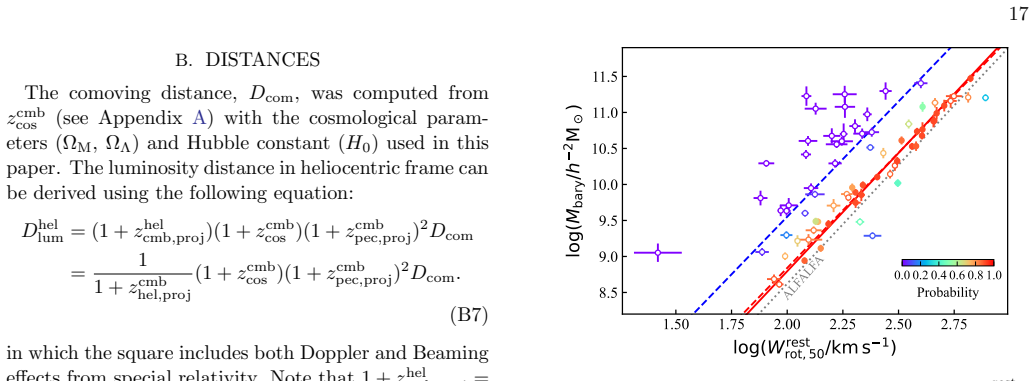
The load-bearing mechanism is a two-component Gaussian mixture model fitted to the BTFR plane, written as $y=k(x-2.4)+b$ for the tight component and a parallel component offset by $\delta_{\rm Outlier}$ with its own scatter; a shared slope $k$ lets the model recover the main relation even when a large outlier population is present. The companion machinery is a random forest classifier that ranks galaxy properties by their ability to predict whether a galaxy belongs to $C_{\rm BTFR}$ or $C_{\rm Outlier}$, which is what links the outlier population to observational errors. The velocity measure is the rest-frame $W^{\rm rest}_{\rm rot,20}$ width from reprocessed Busy-function profiles, corrected for turbulence and inclination, and baryonic mass includes stellar mass plus 1.4 times the atomic plus predicted molecular gas.
What would settle it
Measure the BTFR directly at $0.12<z<0.42$ with a sample of a few hundred high-significance HI galaxies with accurate inclinations, fit the two-component model with $k$ and $\delta_{\rm Outlier}$ free, and test whether the recovered $C_{\rm BTFR}$ zero point and slope agree with $k=3.32$, $b=10.07$; a departure beyond the quoted $1\sigma$ uncertainties would falsify the no-evolution claim.
Extended reading notes
Core claim
The paper argues that, in the $M_{\rm bary}$--$W^{\rm rest}_{\rm rot,20}$ plane, the FUDS0 IGS sample is described by two Gaussian components that share one slope. The tight component, $C_{\rm BTFR}$, has $k=3.32_{-0.11}^{+0.12}$, $b=10.07_{-0.03}^{+0.03}$, and $\sigma_{\rm BTFR}=0.036_{-0.009}^{+0.010}$, matching the high-quality HQS fit and the local ALFALFA relation in slope; the dispersed component, $C_{\rm Outlier}$, sits at a vertical offset $\delta_{\rm Outlier}=0.47_{-0.13}^{+0.14}$ with larger scatter. The paper claims the tight component's slope and zero point do not change between the $z\le0.08$ and $0.08<z\le0.12$ bins, and that at $z=0.12-0.42$, where only the outlier component is detectable, fixing the slope and using the full-sample offset recovers a zero point consistent with no evolution. The random forest analysis is the evidence for the observational origin of the outliers: line-significance and inclination uncertainty outrank morphology, confusion, or redshift as predictors of membership.
Load-bearing premise
The no-evolution conclusion at $z>0.12$ depends on assuming the outlier population at those redshifts sits at the same vertical offset from the main relation, and follows the same slope, as the outlier population in the full sample; if either of those changes with redshift, the inferred high-redshift zero point would be biased.
Editorial extensions
If this is right
- At $z<0.42$, baryonic masses of disk galaxies can be predicted from rotation widths with about $0.036$ dex intrinsic scatter once observational outliers are removed.
- BTFR-based distance estimates, previously trusted only locally, remain a valid tool out to $z\sim0.4$.
- Simulation predictions of a flatter slope and higher intercept by $z\sim0.5$ are not supported by this sample.
- Targeting high signal significance and reliable inclinations is sufficient to obtain a clean BTFR, without invoking galaxy evolution to explain the scatter.
- The planned full FUDS survey, with roughly six times the FUDS0 sample, should sharpen or challenge these constraints.
Reading between the lines
- An implication the paper leaves implicit is that a non-evolving BTFR could serve as a redshift-independent distance rung connecting local HI galaxies to $z\sim0.4$ systems that lack other distance anchors.
- If the outliers are truly measurement-driven, earlier claims of BTFR evolution based on optical rotation curves may need to revisit inclination and line-significance systematics before interpreting offset as cosmic evolution.
- A testable extension is to apply the same two-component plus random-forest pipeline to the full FUDS survey and check whether $\delta_{\rm Outlier}$ is truly constant with redshift rather than an artifact of the pilot sample.
- Since molecular masses are predicted from an optical scaling relation rather than measured, a redshift-dependent molecular fraction would shift the baryonic masses and could alter the inferred zero point; the no-evolution result inherits this uncertainty.
Editorial analysis
A structured set of objections, weighed in public.
Referee Report
Summary. The paper uses 74 HI-selected galaxies from the FUDS0 pilot field (with a 24-galaxy high-quality subsample) to measure the baryonic Tully-Fisher relation at redshifts up to z=0.42. A two-component Gaussian mixture model yields slope k=3.32(+0.12,-0.11), zero point b=10.07(+0.03,-0.03), and intrinsic scatter sigma_BTFR=0.036(+0.010,-0.009) for the tight component, together with a dispersed outlier component. A random forest analysis attributes outliers primarily to low signal significance and inclination uncertainties. The sample is divided into three redshift bins, and the paper claims no significant evolution of slope and zero point out to z=0.42, with the highest-redshift bin constrained indirectly through the outlier component.
Significance. If the low-scatter baryonic Tully-Fisher relation indeed persists to z~0.4 in an HI-selected sample, this is a valuable addition to the sparse HI-based constraints on BTFR evolution and has implications for using the BTFR as a distance indicator at moderate redshift. The paper has genuine strengths: the MCMC fitting is carefully described, the mock verification in Section 5.3 and Appendix C is a serious attempt to test recovery of the model parameters under selection effects and measurement errors, and the authors explicitly acknowledge in Section 7.2.2 that genuine evolution might be masked by observational effects. However, the highest-redshift bin contains no detected C_BTFR component, so the no-evolution conclusion at z=0.12-0.42 is not an independent measurement; it rests on an untested assumption that the outlier component's vertical offset is redshift-independent.
major comments (3)
- [7.2.2, Table 1] The statement that the highest-redshift bin (z=0.12-0.42) 'aligns with the conclusion' of no zero-point evolution is not supported as an independent measurement. The quoted indirect zero point b=10.21(+0.20,-0.19) is obtained by fixing both k=3.32 and delta_Outlier=0.47 to the full IGS sample values. When delta_Outlier is instead allowed to float with k fixed (Table 1, row 6), the inferred zero point shifts to b=10.46(+0.27,-0.68), a change comparable to or larger than the quoted 1-sigma uncertainty. Because the full-sample delta_Outlier is dominated by the same low-redshift galaxies that already define the no-evolution baseline, fixing it removes the very redshift dependence the test is meant to detect. The paper itself concedes in Section 7.2.2 that a transformation from C_BTFR to C_Outlier caused by evolution cannot be ruled out and that genuine evolution might be masked, so the abstract's 'aligns with the conclusion' wording overreaches.
- [5.3, Appendix C] The mock verification does not validate the specific procedure used for the high-redshift bin. The step-function evolution test injected in Section 5.3 varies the BTFR slope k and zero point b between redshift bins but keeps the outlier offset delta_Outlier fixed at the input value. It therefore cannot detect a bias in the indirect zero-point reconstruction if delta_Outlier itself evolves with redshift. Since the random forest analysis in Section 7.1 identifies low SNR and inclination uncertainties as the main drivers of C_Outlier, and both effects worsen with redshift, a redshift-dependent delta_Outlier is a plausible alternative that would masquerade as no evolution under the fixed-offset procedure. The manuscript should either fit a model in which delta_Outlier is allowed to vary with redshift, or explicitly restrict the no-evolution claim to z<=0.12.
- [6.1, 7.2.1, Table 1] The slope-evolution claim at high redshift is also weaker than the text suggests. The z=0.12-0.42 bin contains only 17 galaxies and no detected C_BTFR component; the free-slope fit in that bin gives k=3.97(+0.72,-1.00), which is consistent both with the low-redshift slopes and with substantially different values. The statement that the shared slope derived from C_Outlier 'implies' a consistent C_BTFR slope relies on the model assumption that both components share the same slope and that the outlier population is described by the same relation at all redshifts. The data in this bin are too sparse to confirm no slope evolution, and the text should present this bin only as a weak consistency check, not as independent confirmation.
minor comments (4)
- [Abstract, Section 1] There are several typographical issues: 'fomation' in the abstract, 'Higalaxies' should be 'HI galaxies' throughout, and 'plat part' in Section 3.1 should be 'flat part'.
- [Section 2.2, Section 6.1, Table 1] The HQS sample size is stated inconsistently: Section 2.2 says the final HQS sample has 24 galaxies, Section 6.1 says 26 galaxies, and Table 1 lists N=24. The text and figures should be harmonized.
- [Figure 1] The histogram label 'Nubmer' is a typo for 'Number', and the figure caption should identify the panels more explicitly, since the current caption lists many variables without clear visual markers for each panel.
- [Section 7.1] The random forest labels are derived from the same two-component model's posterior probabilities (Equation 20), so the importance ranking partly encodes the model's own definition of C_Outlier. This does not invalidate the conclusion, because SNR and inclination uncertainty are not inputs to the mixture fit, but the text should acknowledge that the classification is not fully independent of the model being interpreted.
Circularity Check
The no-evolution claim at z=0.12–0.42 is partially constructed: the slope evidence is the two-component model's shared-slope identity, and the zero point is recovered by subtracting the full-sample δ_Outlier that was itself fitted from the same data.
-
self definitional
[Section 5.1.2 (Equation 19) and Section 7.2.1]
"The C_Outlier component shares same slope as C_BTFR, along with vertical offset from C_BTFR (δOutlier) and intrinsic scatter (σOutlier). ... Although C_BTFR vanishes in the highest redshift bin, the shared slope derived from C_Outlier also implies the consistent slope of C_BTFR, which aligns with the conclusion from the two low-redshift bins."
The two-component model defines C_Outlier to have exactly the same slope k as C_BTFR. In the highest-redshift bin, C_BTFR is absent, so the only fitted slope is the slope of C_Outlier. Claiming that this slope 'implies' the slope of C_BTFR is true only by the model's construction: the shared slope is an input assumption, not an independent measurement. The high-z slope consistency is therefore not evidence for no evolution of C_BTFR.
-
fitted input called prediction
[Section 7.2.2 and Table 1 (IGS 0.12–0.42 row)]
"it is possible to derive b from C_Outlier assuming a fixed offset δOutlier to indirectly explore the evolution of the zero point. We therefore fit the one-component model with fixed slope k, using δOutlier from the full IGS sample."
The full-sample δOutlier = 0.47 is a fitted output of the same two-component model applied to the IGS sample, not an externally fixed constant. By fixing it in the high-z bin, the inferred b is, by construction, (zero point of the high-z C_Outlier line) − 0.47. Any redshift dependence of δOutlier is absorbed into b, so the resulting b = 10.21 agrees with the low-z b only because the assumed offset is the full-sample value dominated by the same low-z galaxies used to define the no-evolution baseline. Table 1 itself shows that allowing δOutlier to float changes the inferred b to 10.46, exposing the sensitivity.
full rationale
The low-redshift parts of the analysis are self-contained and not circular: the HQS one-component fit, the IGS two-component fit, and the MCMC recovery are standard methods with stated priors and an independent mock verification (Section 5.3); the random-forest importance analysis is diagnostic rather than a derived prediction. The circularity is concentrated in the highest-redshift bin, where C_BTFR vanishes. There, the slope argument relies on the model's shared-slope assumption, and the zero-point argument relies on subtracting a δOutlier value fitted from the full sample that is dominated by the same low-z data that already defines the non-evolving baseline. The paper itself partially mitigates this by stating in Section 7.2.2 that genuine evolution might be masked and that distinguishing observational and evolutionary effects is beyond the current data. However, the abstract and summary still present the high-z indirect inference as 'aligning with the conclusion,' which overstates what the construction can show. The central no-evolution claim is therefore partially reduced by construction, giving a circularity score of 6.
Assumptions & free parameters
free parameters (9)
- BTFR slope k =
3.32 (-0.11,+0.12)
- BTFR zero point b =
10.07 (-0.03,+0.03)
- Intrinsic scatter sigma_BTFR =
0.036 (-0.009,+0.010)
- Outlier offset delta_Outlier =
0.47 (-0.13,+0.14)
- Outlier scatter sigma_Outlier =
0.20 (-0.02,+0.03)
- Mixture fraction f =
0.57 (-0.09,+0.08)
- Redshift bin boundaries =
z=0.08 and z=0.12
- Baryonic mass threshold =
10^8.3 h^-2 M_sun
- Inclination cutoff =
40 degrees
assumptions (8)
- domain assumption Flat LambdaCDM cosmology with Omega_M=0.3, Omega_Lambda=0.7, H0=70 h70 km/s/Mpc
- domain assumption The HI profile width W_m,20 after turbulence and inclination corrections traces the flat circular velocity
- domain assumption Tully-Fouque turbulent broadening correction with local W_c and W_tur values and redshift dependence W_tur(z)=W_tur(0)+11z from Uebler et al. 2019
- domain assumption Inclination from optical axial ratio with intrinsic thickness q0=0.2
- domain assumption Stellar masses from ProSpect SED fits calibrated to GSWLC-2
- domain assumption Molecular gas mass predicted from the Tacconi et al. 2018 scaling relation, with fixed helium correction 0.36
- ad hoc to paper Two-component Gaussian mixture model with shared slope and vertical offset adequately represents the IGS data
- domain assumption The HQS quality cuts (steepness, symmetry, double-horn, ln(P)<-500) select the true BTFR population
Cite this review
Pith. "Pith review of FAST Ultra-Deep Survey: the baryonic Tully-Fisher relation in FUDS0 field." pith.science (2026). https://pith.science/paper/REG6Z4SE
@misc{pith2026260804371,
  author       = {Pith},
  title        = {Pith review of: FAST Ultra-Deep Survey: the baryonic Tully-Fisher relation in FUDS0 field},
  year         = {2026},
  howpublished = {\url{https://pith.science/paper/REG6Z4SE}},
  note         = {Machine review of arXiv:2608.04371}
}
abstract
The Baryonic Tully-Fisher relation (BTFR) is one of the tightest scaling relations for disk galaxies in the local Universe, and therefore is an important tool for studying the fomation and evolution of galaxies. However, the evolution of the BTFR over cosmic time is poorly understood due to the limited sample of HI galaxies beyond the local Universe, limitations of optically-derived rotation curves, and selection effects. In this work, we explore the BTFR at redshifts up to $z=0.42$ from galaxies detected in the pilot FAST Ultra-Deep Survey (FUDS) field, FUDS0. As found in previous work, we identify two components in the plane of baryonic mass versus rotational velocity, $C_{\rm BTFR}$ (tight) and $C_{\rm Outlier}$ (dispersed). A Gaussian mixture model is employed to recover the BTFR, yielding the best fit parameters for the slope $k=3.32_{-0.11}^{+0.12}$, zero point $b=10.07_{-0.03}^{+0.03}$, and intrinsic scatter $\sigma_{\rm BTFR}=0.036_{-0.009}^{+0.010}$. A random forest classifier is used to investigate the origin of the outlier component. We find that low signal significance and inaccurate inclinations are the key factors that contribute to the outlier population, indicating that observational effects are the dominant origin. Evolutionary trends are examined in three different redshift bins. Both the slope and zero point show consistency within 1-$\sigma$ uncertainty in the two low redshift bins, indicating no significant evolution. The indirectly inferred BTFR parameters from the $C_{\rm Outlier}$ component in the highest redshift bin aligns with the conclusion. The ongoing full FUDS survey will provide a larger sample to enable more accurate constraints on BTFR evolution.
Figures


Figures from the paper (11 more)





Reference graph
Works this paper leans on
-
[1]
Deriving a multivariate _ CO conversion function using the [C II]/CO (1-0) ratio and its application to molecular gas scaling relations. , keywords =. doi:10.1093/mnras/stx1556 , archivePrefix =. 1702.03888 , primaryClass =
-
[2]
The Fifteenth Data Release of the Sloan Digital Sky Surveys: First Release of MaNGA-derived Quantities, Data Visualization Tools, and Stellar Library. , keywords =. doi:10.3847/1538-4365/aaf651 , archivePrefix =. 1812.02759 , primaryClass =
-
[3]
The Tully-Fisher relation in dense groups at z 0.7 in the MAGIC survey. , keywords =. doi:10.1051/0004-6361/202038818 , archivePrefix =. 2101.08069 , primaryClass =
-
[4]
Astropy: A community Python package for astronomy. , keywords =. doi:10.1051/0004-6361/201322068 , archivePrefix =. 1307.6212 , primaryClass =
-
[5]
The Astropy Project: Building an Open-science Project and Status of the v2.0 Core Package. , keywords =. doi:10.3847/1538-3881/aabc4f , archivePrefix =. 1801.02634 , primaryClass =
-
[6]
The Astropy Project: Sustaining and Growing a Community-oriented Open-source Project and the Latest Major Release (v5.0) of the Core Package. , keywords =. doi:10.3847/1538-4357/ac7c74 , archivePrefix =. 2206.14220 , primaryClass =
-
[7]
A detailed comparison of observed and simulated spiral galaxy scaling relations
MaNGA galaxy properties - II. A detailed comparison of observed and simulated spiral galaxy scaling relations. , keywords =. doi:10.1093/mnras/stad1023 , archivePrefix =. 2304.02033 , primaryClass =
-
[8]
and Doherty, Paul and George, Daniel and Hayman, Douglas B
Dunning, Alex and Bowen, Mark and Castillo, Santiago and Chung, Yoon S. and Doherty, Paul and George, Daniel and Hayman, Douglas B. and Jeganathan, Kanapathippillai and Kanoniuk, Henry and Mackay, Simon and Reilly, Les and Roush, Peter and Smart, Sean Ken W. and Shaw, Robert D. and Smith, Stephanie L. and Tzioumis, Tasso and Venables, Veronica-Claire J. ,...
Show all 106 references
-
[9]
, keywords =
The multi-wavelength Tully-Fisher relation in the TNG50 cosmological simulation. , keywords =. doi:10.1051/0004-6361/202453417 , archivePrefix =. 2503.00194 , primaryClass =
-
[10]
, keywords =
A Generalist, Automated ALFALFA Baryonic Tully-Fisher Relation. , keywords =. doi:10.3847/1538-4357/accb53 , archivePrefix =. 2212.08728 , primaryClass =
-
[11]
, keywords =
The HI Parkes All Sky Survey: southern observations, calibration and robust imaging. , keywords =. doi:10.1046/j.1365-8711.2001.04102.x , adsurl =
2001
-
[12]
, keywords =
Cosmic flows in the nearby Universe: new peculiar velocities from SNe and cosmological constraints. , keywords =. doi:10.1093/mnras/staa2485 , archivePrefix =. 1912.09383 , primaryClass =
1912 arXiv
-
[13]
, keywords =
An improved Tully-Fisher estimate of H _ 0. , keywords =. doi:10.1093/mnras/stae1925 , archivePrefix =. 2408.03660 , primaryClass =
-
[14]
H I line studies of galaxies. II. The 21-cm-width as an extragalactic distance indicator. , keywords =
-
[16]
, keywords =
HIGHz: a survey of the most H I-massive galaxies at z 0.2. , keywords =. doi:10.1093/mnras/stu2241 , archivePrefix =. 1410.7464 , primaryClass =
-
[17]
, keywords =
xGASS: total cold gas scaling relations and molecular-to-atomic gas ratios of galaxies in the local Universe. , keywords =. doi:10.1093/mnras/sty089 , archivePrefix =. 1802.02373 , primaryClass =
-
[18]
, keywords =
The Tully-Fisher relation of galaxies at z -0.5ex 0.85 in the DEEP2 survey. , keywords =. doi:10.1111/j.1365-2966.2007.11656.x , archivePrefix =. astro-ph/0702583 , primaryClass =
2007
-
[19]
, keywords =
The Extragalactic Distance Database: All Digital H I Profile Catalog. , keywords =. doi:10.1088/0004-6256/138/6/1938 , archivePrefix =. 0902.3670 , primaryClass =
1938 arXiv
-
[20]
, keywords =
WALLABY pre-pilot and pilot survey: The Tully Fisher relation in Eridanus, Hydra, Norma, and NGC4636 fields. , keywords =. doi:10.1093/mnras/stac3246 , archivePrefix =. 2210.12498 , primaryClass =
-
[21]
, keywords =
The SINS Survey: Modeling the Dynamics of z -0.5ex 2 Galaxies and the High-z Tully-Fisher Relation. , keywords =. doi:10.1088/0004-637X/697/1/115 , archivePrefix =. 0902.4701 , primaryClass =
-
[22]
, keywords =
SIMBA: Cosmological simulations with black hole growth and feedback. , keywords =. doi:10.1093/mnras/stz937 , archivePrefix =. 1901.10203 , primaryClass =
1901 arXiv
-
[23]
, keywords =
High-Resolution Rotation Curves and Galaxy Mass Models from THINGS. , keywords =. doi:10.1088/0004-6256/136/6/2648 , archivePrefix =. 0810.2100 , primaryClass =
-
[24]
, keywords =
WALLABY Pilot Survey: Public release of HI kinematic models for more than 100 galaxies from phase 1 of ASKAP pilot observations. , keywords =. doi:10.1017/pasa.2022.43 , archivePrefix =. 2211.07333 , primaryClass =
2022 arXiv
-
[25]
, keywords =
WALLABY Pilot Survey: Gas-rich Galaxy Scaling Relations from Marginally Resolved Kinematic Models. , keywords =. doi:10.3847/1538-4357/ad84ba , archivePrefix =. 2411.06993 , primaryClass =
-
[26]
, keywords =
Overview of the DESI Legacy Imaging Surveys. , keywords =. doi:10.3847/1538-3881/ab089d , archivePrefix =. 1804.08657 , primaryClass =
-
[27]
, keywords =
The Tully-Fisher Relation for the CO Line. , keywords =. doi:10.1086/171526 , adsurl =
-
[28]
, keywords =
Galaxy And Mass Assembly (GAMA): Data Release 4 and the z < 0.1 total and z < 0.08 morphological galaxy stellar mass functions. , keywords =. doi:10.1093/mnras/stac472 , archivePrefix =. 2203.08539 , primaryClass =
-
[29]
Tracing the Ancestry of Galaxies , year = 2011, editor =
3D Spectroscopic Surveys: Exploring Galaxy Evolution Mechanisms. Tracing the Ancestry of Galaxies , year = 2011, editor =. doi:10.1017/S1743921311022617 , archivePrefix =. 1103.5577 , primaryClass =
2011 arXiv
-
[30]
, keywords =
The Cosmic Microwave Background Spectrum from the Full COBE FIRAS Data Set. , keywords =. doi:10.1086/178173 , archivePrefix =. astro-ph/9605054 , primaryClass =
-
[31]
3D spectroscopy with VLT/GIRAFFE. I. The true Tully Fisher relationship at z 0.6. , keywords =. doi:10.1051/0004-6361:20054217 , archivePrefix =. astro-ph/0603563 , primaryClass =
-
[32]
, keywords =
emcee: The MCMC Hammer. , keywords =. doi:10.1086/670067 , archivePrefix =. 1202.3665 , primaryClass =
-
[33]
doi:10.5281/zenodo.15856 , url =
Foreman-Mackey, Daniel , title =. doi:10.5281/zenodo.15856 , url =
-
[34]
The Extragalactic Distance Scale. II. The Unbiased Distance to the Virgo Cluster from the B-Band Tully-Fisher Relation. , keywords =. doi:10.1086/168288 , adsurl =
-
[35]
The Low Surface Brightness Universe , year = 1999, editor =
Historical Introduction. The Low Surface Brightness Universe , year = 1999, editor =
1999
-
[36]
44 new velocity fields
GHASP: an H kinematic survey of spiral and irregular galaxies - IV. 44 new velocity fields. Extension, shape and asymmetry of H rotation curves. , keywords =. doi:10.1111/j.1365-2966.2005.09274.x , adsurl =
2005
-
[37]
The Arecibo Legacy Fast ALFA Survey. I. Science Goals, Survey Design, and Strategy. , keywords =. doi:10.1086/497431 , archivePrefix =. astro-ph/0508301 , primaryClass =
-
[38]
, keywords =
The redshift evolution of the baryonic Tully-Fisher relation in SIMBA. , keywords =. doi:10.1093/mnras/stab2279 , archivePrefix =. 2011.08866 , primaryClass =
2011 arXiv
-
[39]
, keywords =
A comparison of the baryonic Tully-Fisher relation in MaNGA and IllustrisTNG. , keywords =. doi:10.1093/mnras/stad298 , archivePrefix =. 2302.05029 , primaryClass =
-
[40]
, keywords =
BUDHIES IV: Deep 21-cm neutral Hydrogen, optical, and UV imaging data of Abell 963 and Abell 2192 at z ≃ 0.2. , keywords =. doi:10.1093/mnras/staa1680 , archivePrefix =. 2302.12197 , primaryClass =
-
[41]
, keywords =
BUDH IES V: the baryonic Tully-Fisher relation at z = 0.2 based on direct H I detections. , keywords =. doi:10.1093/mnras/stac3381 , archivePrefix =. 2303.06618 , primaryClass =
-
[42]
, keywords =
The peculiar velocity field up to z 0.05 by forward-modelling Cosmicflows-3 data. , keywords =. doi:10.1093/mnras/stz078 , archivePrefix =. 1901.01818 , primaryClass =
1901 arXiv
-
[43]
Harris and K
Charles R. Harris and K. Jarrod Millman and St. Array programming with. 2020 , month = sep, journal =. doi:10.1038/s41586-020-2649-2 , publisher =
2020 doi
-
[44]
Hunter, J. D. , Title =. Computing in Science & Engineering , Volume =
-
[45]
, keywords =
A blind H I mass function from the Arecibo Ultra-Deep Survey (AUDS). , keywords =. doi:10.1093/mnras/stv1084 , archivePrefix =. 1506.05931 , primaryClass =
-
[46]
MeerKAT Science: On the Pathway to the SKA , year = 2016, month = jan, eid =
The MeerKAT International GHz Tiered Extragalactic Exploration (MIGHTEE) Survey. MeerKAT Science: On the Pathway to the SKA , year = 2016, month = jan, eid =. doi:10.22323/1.277.0006 , archivePrefix =. 1709.01901 , primaryClass =
2016 arXiv
-
[47]
, keywords =
MIGHTEE-H I: the direct detection of neutral hydrogen in galaxies at z > 0.25. , keywords =. doi:10.1093/mnras/staf1702 , archivePrefix =. 2506.11935 , primaryClass =
-
[48]
, keywords =
Updated Nearby Galaxy Catalog. , keywords =. doi:10.1088/0004-6256/145/4/101 , archivePrefix =. 1303.5328 , primaryClass =
-
[49]
Astrophysics , keywords =
Multiparametric infrared Tully-Fisher relation as a tool for mapping cosmic flows. Astrophysics , keywords =. doi:10.1007/s10511-008-9020-x , adsurl =
-
[50]
, keywords =
WALLABY an SKA Pathfinder H I survey. , keywords =. doi:10.1007/s10509-020-03831-4 , archivePrefix =. 2002.07311 , primaryClass =
2002 arXiv
-
[51]
, keywords =
Cosmicflows-3: Two Distance-Velocity Calculators. , keywords =. doi:10.3847/1538-3881/ab620e , archivePrefix =. 1912.07214 , primaryClass =
1912 arXiv
-
[52]
, keywords =
The Local Volume H I Survey (LVHIS). , keywords =. doi:10.1093/mnras/sty479 , archivePrefix =. 1904.09648 , primaryClass =
1904 arXiv
-
[53]
, keywords =
Cosmicflows-4: The Catalog of 10,000 Tully-Fisher Distances. , keywords =. doi:10.3847/1538-4357/abb66b , archivePrefix =. 2009.00733 , primaryClass =
2009 arXiv
-
[54]
, keywords =
SPARC: Mass Models for 175 Disk Galaxies with Spitzer Photometry and Accurate Rotation Curves. , keywords =. doi:10.3847/0004-6256/152/6/157 , archivePrefix =. 1606.09251 , primaryClass =
-
[55]
, keywords =
The baryonic Tully-Fisher relation for different velocity definitions and implications for galaxy angular momentum. , keywords =. doi:10.1093/mnras/stz205 , archivePrefix =. 1901.05966 , primaryClass =
1901 arXiv
-
[56]
, keywords =
The Galaxy Evolution Explorer: A Space Ultraviolet Survey Mission. , keywords =. doi:10.1086/426387 , archivePrefix =. astro-ph/0411302 , primaryClass =
-
[57]
, keywords =
The Baryonic Tully-Fisher Relation. , keywords =. doi:10.1086/312628 , archivePrefix =. astro-ph/0003001 , primaryClass =
-
[58]
, keywords =
The Baryonic Tully-Fisher Relation of Gas-rich Galaxies as a Test of CDM and MOND. , keywords =. doi:10.1088/0004-6256/143/2/40 , archivePrefix =. 1107.2934 , primaryClass =
-
[59]
Data presentation
The HIPASS catalogue - I. Data presentation. , keywords =. doi:10.1111/j.1365-2966.2004.07710.x , archivePrefix =. astro-ph/0406384 , primaryClass =
2004
-
[60]
, keywords =
Tully-Fisher relations from an HI-selected sample. , keywords =. doi:10.1111/j.1365-2966.2008.13424.x , adsurl =
2008
-
[61]
, keywords =
The formation of galactic discs. , keywords =. doi:10.1046/j.1365-8711.1998.01227.x , archivePrefix =. astro-ph/9707093 , primaryClass =
1998
-
[62]
, keywords =
A modification of the Newtonian dynamics - Implications for galaxies. , keywords =. doi:10.1086/161131 , adsurl =
-
[63]
, keywords =
WALLABY pilot survey: the Tully-Fisher relation in the NGC 4808, Vela, and NGC 5044 fields. , keywords =. doi:10.1093/mnras/stae1522 , archivePrefix =. 2406.10877 , primaryClass =
-
[64]
, keywords =
Tracing HI Beyond the Local Universe. , keywords =. doi:10.1017/pasa.2017.31 , archivePrefix =. 1705.04210 , primaryClass =
2017 arXiv
-
[65]
, keywords =
The Tully-Fisher relation for 25 000 Sloan Digital Sky Survey galaxies as a function of environment. , keywords =. doi:10.1111/j.1365-2966.2012.21458.x , archivePrefix =. 1206.1662 , primaryClass =
2012
-
[66]
International Journal of Modern Physics D , keywords =
The Five-Hundred Aperture Spherical Radio Telescope (fast) Project. International Journal of Modern Physics D , keywords =. doi:10.1142/S0218271811019335 , archivePrefix =. 1105.3794 , primaryClass =
-
[67]
, keywords =
Simulation of the Cosmic Evolution of Atomic and Molecular Hydrogen in Galaxies. , keywords =. doi:10.1088/0004-637X/698/2/1467 , archivePrefix =. 0904.2221 , primaryClass =
-
[68]
, keywords =
MIGHTEE-H I: the M _ H I - M _ * relation over the last billion years. , keywords =. doi:10.1093/mnras/stad2343 , archivePrefix =. 2210.04651 , primaryClass =
-
[69]
, keywords =
From light to baryonic mass: the effect of the stellar mass-to-light ratio on the Baryonic Tully-Fisher relation. , keywords =. doi:10.1093/mnras/stx3066 , archivePrefix =. 1711.09112 , primaryClass =
-
[70]
, keywords =
MIGHTEE-H I: the baryonic Tully-Fisher relation over the last billion years. , keywords =. doi:10.1093/mnras/stab2654 , archivePrefix =. 2109.04992 , primaryClass =
-
[72]
A Physical Basis of the Tully-Fisher Relation
-
[73]
, keywords =
ProSpect: generating spectral energy distributions with complex star formation and metallicity histories. , keywords =. doi:10.1093/mnras/staa1116 , archivePrefix =. 2002.06980 , primaryClass =
2002 arXiv
-
[74]
and Varoquaux, G
Pedregosa, F. and Varoquaux, G. and Gramfort, A. and Michel, V. and Thirion, B. and Grisel, O. and Blondel, M. and Prettenhofer, P. and Weiss, R. and Dubourg, V. and Vanderplas, J. and Passos, A. and Cournapeau, D. and Brucher, M. and Perrot, M. and Duchesnay, E. , journal=. S...
-
[75]
, keywords =
xCOLD GASS: The Complete IRAM 30 m Legacy Survey of Molecular Gas for Galaxy Evolution Studies. , keywords =. doi:10.3847/1538-4365/aa97e0 , archivePrefix =. 1710.02157 , primaryClass =
-
[76]
, keywords =
Dust Attenuation Curves in the Local Universe: Demographics and New Laws for Star-forming Galaxies and High-redshift Analogs. , keywords =. doi:10.3847/1538-4357/aabf3c , archivePrefix =. 1804.05850 , primaryClass =
-
[77]
, keywords =
The unWISE Catalog: Two Billion Infrared Sources from Five Years of WISE Imaging. , keywords =. doi:10.3847/1538-4365/aafbea , archivePrefix =. 1901.03337 , primaryClass =
1901 arXiv
-
[78]
, keywords =
Using the Baryonic Tully-Fisher Relation to Measure H _ o. , keywords =. doi:10.3847/1538-3881/ab9d88 , archivePrefix =. 2006.08615 , primaryClass =
2006 arXiv
-
[79]
, keywords =
CO versus HI in the Tully-Fisher relation for a sample of 32 galaxies. , keywords =
-
[80]
, keywords =
Tully-Fisher relation of late-type galaxies at 0.6 z 2.5. , keywords =. doi:10.1051/0004-6361/202348667 , archivePrefix =. 2406.08934 , primaryClass =
-
[81]
, keywords =
Action Dynamics of the Local Supercluster. , keywords =. doi:10.3847/1538-4357/aa9525 , archivePrefix =. 1710.08935 , primaryClass =
-
[82]
, keywords =
The Cosmological Origin of the Tully-Fisher Relation. , keywords =. doi:10.1086/306904 , archivePrefix =. astro-ph/9808076 , primaryClass =
-
[83]
, keywords =
PHIBSS: Unified Scaling Relations of Gas Depletion Time and Molecular Gas Fractions. , keywords =. doi:10.3847/1538-4357/aaa4b4 , archivePrefix =. 1702.01140 , primaryClass =
-
[84]
The near-infrared, stellar and baryonic Tully-Fisher relations
GHASP: an H kinematic survey of spiral and irregular galaxies - IX. The near-infrared, stellar and baryonic Tully-Fisher relations. , keywords =. doi:10.1111/j.1365-2966.2011.19169.x , archivePrefix =. 1106.0505 , primaryClass =
2011
-
[85]
, keywords =
Galaxies in CDM with Halo Abundance Matching: Luminosity-Velocity Relation, Baryonic Mass-Velocity Relation, Velocity Function, and Clustering. , keywords =. doi:10.1088/0004-637X/742/1/16 , archivePrefix =. 1005.1289 , primaryClass =
-
[86]
, keywords =
A new method of determining distances to galaxies. , keywords =
-
[87]
I - Corrections to fundamental observables
The extragalactic distance scale. I - Corrections to fundamental observables. , keywords =. doi:10.1086/191029 , adsurl =
-
[88]
Distances to Galaxies from the Correlation between Luminosities and Line Widths. III. Cluster Template and Global Measurement of H _ 0. , keywords =. doi:10.1086/308700 , archivePrefix =. astro-ph/9911052 , primaryClass =
-
[89]
, keywords =
Our Peculiar Motion Away from the Local Void. , keywords =. doi:10.1086/527428 , archivePrefix =. 0705.4139 , primaryClass =
-
[90]
, keywords =
Cosmicflows-2: The Data. , keywords =. doi:10.1088/0004-6256/146/4/86 , archivePrefix =. 1307.7213 , primaryClass =
-
[91]
, keywords =
The Laniakea supercluster of galaxies. , keywords =. doi:10.1038/nature13674 , archivePrefix =. 1409.0880 , primaryClass =
-
[92]
, keywords =
Cosmicflows-3. , keywords =. doi:10.3847/0004-6256/152/2/50 , archivePrefix =. 1605.01765 , primaryClass =
-
[93]
, keywords =
Cosmicflows-4. , keywords =. doi:10.3847/1538-4357/ac94d8 , archivePrefix =. 2209.11238 , primaryClass =
-
[94]
, keywords =
The Evolution of the Tully-Fisher Relation between z 2.3 and z 0.9 with KMOS ^ 3D. , keywords =. doi:10.3847/1538-4357/aa7558 , archivePrefix =. 1703.04321 , primaryClass =
-
[95]
, keywords =
The Evolution and Origin of Ionized Gas Velocity Dispersion from z 2.6 to z 0.6 with KMOS ^ 3D. , keywords =. doi:10.3847/1538-4357/ab27cc , archivePrefix =. 1906.02737 , primaryClass =
1906 arXiv
-
[96]
Nature Astronomy , keywords =
Identification of basins of attraction in the local Universe. Nature Astronomy , keywords =. doi:10.1038/s41550-024-02370-0 , archivePrefix =. 2409.17261 , primaryClass =
-
[97]
The M31 Velocity Vector. II. Radial Orbit toward the Milky Way and Implied Local Group Mass. , keywords =. doi:10.1088/0004-637X/753/1/8 , archivePrefix =. 1205.6864 , primaryClass =
-
[98]
The Ursa Major cluster of galaxies. IV. HI synthesis observations. , keywords =. doi:10.1051/0004-6361:20010090 , archivePrefix =. astro-ph/0101404 , primaryClass =
-
[99]
The Ursa Major Cluster of Galaxies. V. H I Rotation Curve Shapes and the Tully-Fisher Relations. , keywords =. doi:10.1086/323887 , archivePrefix =. astro-ph/0108225 , primaryClass =
-
[100]
and Haberland, Matt and Reddy, Tyler and Cournapeau, David and Burovski, Evgeni and Peterson, Pearu and Weckesser, Warren and Bright, Jonathan and
Virtanen, Pauli and Gommers, Ralf and Oliphant, Travis E. and Haberland, Matt and Reddy, Tyler and Cournapeau, David and Burovski, Evgeni and Peterson, Pearu and Weckesser, Warren and Bright, Jonathan and. Nature Methods , year =
-
[101]
, keywords =
The busy function: a new analytic function for describing the integrated 21-cm spectral profile of galaxies. , keywords =. 2014. doi:10.1093/mnras/stt2266 , archivePrefix =. 1311.5308 , primaryClass =
2014 arXiv
-
[102]
, keywords =
The Northern HIPASS catalogue - data presentation, completeness and reliability measures. , keywords =. doi:10.1111/j.1365-2966.2006.10846.x , archivePrefix =. astro-ph/0607491 , primaryClass =
2006
-
[103]
, keywords =
The Arecibo Ultra-Deep Survey. , keywords =. doi:10.1093/mnras/staa3931 , archivePrefix =. 2012.09516 , primaryClass =
2012 arXiv
-
[104]
, keywords =
The FAST Ultra-Deep Survey (FUDS): Observational strategy, calibration and data reduction. , keywords =. doi:10.1017/pasa.2022.16 , archivePrefix =. 2204.03152 , primaryClass =
2022 arXiv
-
[105]
, keywords =
FAST Ultra-Deep Survey: Data Release for FUDS0. , keywords =. doi:10.3847/1538-4365/ad67d5 , archivePrefix =. 2409.06153 , primaryClass =
-
[106]
, keywords =
FAST Ultra-Deep Survey (FUDS): The Star Formation Histories of FUDS0 Galaxies. , keywords =. doi:10.3847/1538-4365/adc262 , archivePrefix =. 2503.12857 , primaryClass =
-
[107]
, keywords =
On the Determination of Rotation Velocity and Dynamical Mass of Galaxies Based on Integrated H I Spectra. , keywords =. doi:10.3847/1538-4357/ab9ac5 , archivePrefix =. 2007.12959 , primaryClass =
2007 arXiv
-
[108]
, keywords =
Project Overview of the Beijing-Arizona Sky Survey. , keywords =. doi:10.1088/1538-3873/aa65ba , archivePrefix =. 1702.03653 , primaryClass =
Reviewed August 8, 2026 · model on record in the stance chip above.
Discussion (0). Continue with ORCID to comment.