REVIEW 4 major objections 5 minor 47 references
Free-surface curvature and its relation to subsurface turbulence
T0 review · 4 major / 5 minor · reviewed 2026-08-06 · deepseek-v4-flash
Pith's one-line read This paper claims that the Euler-Laplace equation, applied to the velocity field a few millimetres below a water surface, quantitatively reconstructs the instantaneous surface curvature (Pearson correlation 0.54) and that r.m.s.
desk verdict A valuable first-principles framework and rich dataset linking surface curvature to subsurface turbulence, but the sign convention in the printed equations is internally inconsistent and must be fixed before the headline correlation can be trusted. read the letter →
The pith
A machine-rendered reading of the paper's core claim, the machinery that carries it, and where it could break.
The reading
What carries the argument
The Euler-Laplace equation (2.1) is the load-bearing object: it converts pressure fluctuations in an inviscid, small-slope free-surface flow into surface curvature, with gravity and surface tension opposing the deformation. Its right-hand side is built from two invariants of the surface-parallel velocity-gradient tensor, the horizontal divergence $\beta$ and the determinant $q$, so the curvature field is reconstructed by inverting the operator $L = g + (\sigma/\rho)\nabla^2$ on the combination $-D\beta/Dt - \beta^2 + 2q$. Re-expressing that combination in terms of vorticity and strain separates dimples (positive curvature) from bulges (negative curvature), and the gravity-dominated limit yields the scaling $\kappa'^2 \propto (\beta'^2)^2/g^2$ used throughout.
What would settle it
Repeat the same PIV-BOS experiment in the weakest-forcing case with the velocity plane moved to roughly 0.5 mm below the surface, inside the viscous layer: if the modelled curvature from that plane correlates with measured curvature as strongly as 0.54 or better, the inviscid assumption at 2 mm depth was not the limiting factor; if the correlation collapses, viscous stresses at that depth are load-bearing.
Extended reading notes
Core claim
The authors establish that, in unbroken free-surface turbulence with small slopes, the instantaneous surface curvature $\kappa = -\nabla^2\eta$ is governed by the linear operator $L[\kappa] = g\kappa - (\sigma/\rho)\nabla^2\kappa$ acting on subsurface quantities: $L[\kappa_z] = -D\beta/Dt - \beta^2 + 2q$, with $\beta$ the horizontal divergence and $q$ the determinant of the surface-parallel velocity-gradient tensor. Measured and modelled curvature fields agree in snapshots, time series, and space-time spectra; the modelled curvature correlates with measurements at 0.54 when the velocity is taken at $z=-2$ mm. Statistically, the r.m.s. curvature follows $\kappa'^2 = c\,(\beta'^2)^2/g^2$ with $c=7.15$, as predicted when gravity dominates surface tension. The authors further show that the correlation decays with depth, dropping by nearly an order of magnitude once the depth approaches the Taylor microscale, and that only flow structures larger than the measurement depth imprint the surface, bounding the resolution of any inversion from surface shape to subsurface flow.
Load-bearing premise
The model assumes the inviscid Euler equation with a linearized, small-slope free-surface condition is valid at the measurement plane 2 mm below the surface, where viscous stresses may still matter; if viscosity or surface-normal velocity components contribute significantly there, the predicted curvature would deviate systematically from measurements.
Editorial extensions
If this is right
- If the central claim holds, optical measurements of surface curvature can serve as a proxy for the near-surface horizontal divergence, which is the quantity that models of interfacial gas transfer depend on.
- Instantaneous surface topography can be reconstructed from velocity measurements just below the surface, at least down to scales set by the Taylor microscale and the measurement depth.
- The r.m.s. curvature scaling provides a calibration-free relation between curvature variance and divergence variance in gravity-dominated, unbroken free-surface turbulence.
- Because the surface-subsurface correlation decays with depth, any inversion from surface shape can only recover flow structures larger than the depth of interest; smaller scales are unrecoverable.
- The framework gives a first-principles basis for interpreting space-time spectra of surface curvature in field measurements, including the gravity-capillary wave band.
Reading between the lines
- A natural extension the authors leave implicit is that curvature variance measured from airborne or shipborne stereo or polarimetric imagery could yield estimates of gas transfer velocity without in-water instrumentation, provided the scaling survives mean shear and swell.
- The observed depth-decorrelation bound suggests that multi-scale surface measurements could be used to estimate the depth of turbulent structures beneath the surface, acting as a form of optical tomography of the upper water column.
- The framework could be stress-tested in direct numerical simulations by applying the same Euler-Laplace inversion to velocity fields at multiple depths; if simulated correlations exceed 0.54, the laboratory ceiling is set by measurement noise rather than by physics.
- The curvature-divergence relation could serve as a physics-based regularizer for neural-network reconstructions of near-surface flow from surface images, reducing the data needed for such data-driven inversions.
Editorial analysis
A structured set of objections, weighed in public.
Referee Report
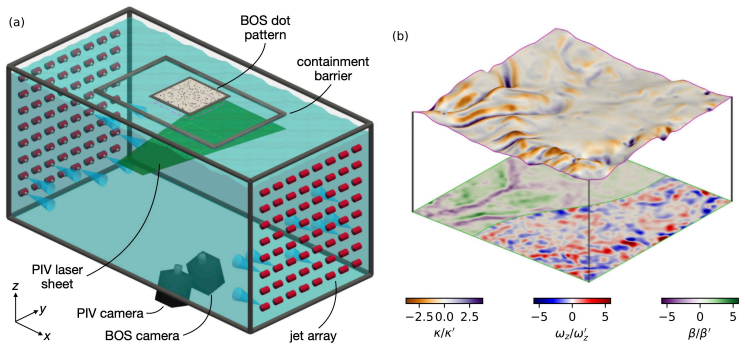
Summary. This paper proposes an Euler-Laplace framework, Eq. (2.1), that relates the free-surface curvature of a turbulent water surface to the subsurface velocity field and its gradients, and tests it with simultaneous BOS surface topography and PIV velocity measurements in a zero-mean-flow turbulent water tank over a range of Reynolds and Froude numbers. The central claims are: (i) the instantaneous surface curvature can be modeled from the velocity field at z = -2 mm, with a Pearson correlation of 0.54 between measured and modeled curvature; (ii) the r.m.s. curvature scales as kappa'^2 ~ c (beta'^2)^2 / g^2 with c = 7.15; (iii) the correlation between surface and subsurface fields decreases with depth and is restricted to increasingly large spatial scales as the measurement depth increases. The authors further discuss implications for remote sensing of near-surface turbulence and gas transfer.
Significance. If the central claims hold after revision, this is a valuable contribution to free-surface turbulence and remote sensing. The experimental dataset is unusually rich: simultaneous high-resolution BOS and PIV measurements at multiple depths, over a wide range of forcing conditions, provide a rare opportunity to test first-principles models of surface-sub-surface coupling. The derivation of the Euler-Laplace equation is a useful formal step, and the spectral comparisons in Figs. 11-12 are informative. The paper also makes a concrete, falsifiable statistical prediction in the form of the kappa'^2 - beta'^2 scaling law. The main limitations are the moderate correlation level supporting the instantaneous claim, the fitted prefactor in the scaling law, and a sign inconsistency in the printed equations that must be resolved before the signed comparisons can be interpreted.
major comments (4)
- [§2, Eq. (2.5); §4.2, Eq. (4.2)] The printed equations contain a global sign inconsistency for the gravity-dominated steady curvature. Starting from Eq. (2.1) and setting the unsteady and surface-tension terms to zero gives kappa_gs = (beta^2 - 2q)/g, which is also what Eq. (2.5) reduces to in the steady limit. Equation (4.2), however, prints kappa_gs = -beta^2/g + 2q/g, the exact opposite. The sign inconsistency propagates into the physical interpretation: the text following Eq. (2.5) states that vorticity leads to positive curvature (dimples), but Eq. (2.5) gives a negative contribution from omega_z^2/(2g). Since the headline instantaneous comparison is a signed Pearson correlation (Fig. 12g) and Figs. 7, 9, and 10 rely on the sign of kappa to distinguish dimples from bulges, the side of the q = beta^2/2 boundary that is labeled positive is reversed between the two equation sets. The authors must state which sign convention was actually implemented in the analysis, correct one of the equation sets, and re-check the sign labeling in the figures; as printed, the local/instantaneous agreement claim cannot be evaluated.
- [§4.3-4.4, Figs. 8, 12(g)] The central claim of close quantitative agreement between measured and modeled instantaneous curvature rests on a Pearson correlation of r = 0.54, which leaves roughly 71% of the variance unexplained. The compared fields are also spatially Gaussian-filtered (sigma = 1 mm), temporally smoothed (30 ms), and the velocity is measured at z = -2 mm rather than at the surface, so it is not clear how much of the correlation reflects true physical agreement as opposed to filtering or interpolation effects. Please provide an uncertainty analysis for the reported correlations, such as confidence intervals across independent realizations, correlations against temporally shuffled velocity fields, or a noise-injection test on the PIV data, and temper the wording of 'close quantitative agreement' accordingly.
- [§4.2, Eq. (4.1), Fig. 6] The scaling law kappa'^2 ~ c (beta'^2)^2/g^2 is presented as a quantitative prediction of the framework, but the prefactor c = 7.15 is fitted to the same data shown in Fig. 6, and Eq. (4.1) assumes without direct evidence that the ratios of (Dbeta/Dt)^2, beta^4, q^2, and the cross terms are universal across the range of Froude numbers. As written, Fig. 6 demonstrates the exponent and the order of magnitude, not a parameter-free prediction. Please state explicitly that c is empirical, and if possible derive or bound c from the measured single-point statistics or from a DNS of free-surface turbulence.
- [§4.1, §2] The framework is derived from the inviscid Euler equation, but the velocity field is measured at z = -2 mm, which the authors describe as 'roughly at the edge of the viscous layer.' Viscous stresses at that depth, as well as the small-slope approximation for surface-parallel derivatives, could systematically bias the modeled pressure field and hence the modeled curvature. The present data alone do not directly validate the inviscid approximation at this depth. A quantitative check would be to compare the model error against the depth-dependent correlation in Fig. 13(a) and test whether the residual is consistent with viscous corrections, or to validate the model against a DNS of shear-free free-surface turbulence with comparable Reynolds and Froude numbers.
minor comments (5)
- [Fig. 8 caption] The caption refers to 'the entire RHS of EQ (1)', but the equation number should be (2.2) or (2.3); please correct the cross-reference.
- [Eq. (4.1)] The expansion of the square of Eq. (2.5) is not complete as written: the full square contains terms such as -4 beta^2 q and -2 (Dbeta/Dt)(beta^2 - 2q), which are of the same order as the displayed terms and should either be written explicitly or shown to be negligible.
- [§3.2] The temporal Gaussian smoothing with standard deviation 30 ms significantly modifies the unsteady term Dbeta/Dt; please state how this filter width compares with the Taylor timescale T_T and test the sensitivity of the correlation in Fig. 12(g) to the smoothing time.
- [Fig. 7] The statement that the boundary q = p^2/2 is 'in agreement with (2.5)' needs to be revisited after the sign inconsistency in the major comments is resolved, because the side of the boundary that corresponds to positive curvature is reversed between Eq. (2.5) and Eq. (4.2).
- [References] The reference entry for Laxague et al. (2026) contains a duplicated author name; please correct it.
Circularity Check
No significant circularity: the Euler-Laplace model and its statistical scaling are independently validated against BOS/PIV measurements, with only non-load-bearing self-citations.
full rationale
The Euler-Laplace framework is derived from the Euler equation and the Laplace-pressure boundary condition (Eq. 2.1), then specialized to measured velocity gradients at z=-2 mm (Eqs. 2.3-2.5). The modeled curvature field is compared with independent BOS-measured curvature; no model parameter is fitted to that curvature. The r.m.s. scaling κ'^2 ≈ c(β'^2)^2/g^2 follows from squaring Eq. 2.5 and using universality of moment ratios; the prefactor c is fitted (c=7.15) and is not claimed to be predicted. Self-citations (Ruth & Coletti 2024 for the facility; Qi et al. 2025a for kurtosis weakness; Qi et al. 2025b/Wu et al. 2026 for JPDF symmetry) provide contextual or externally falsifiable support and do not supply the central derivation. The sign discrepancy between Eq. (2.5) and Eq. (4.2) is an internal-consistency/correctness issue, not a circularity: it does not make the model's output an input. Thus no circular step is identified.
Assumptions & free parameters
free parameters (1)
- c (scaling prefactor) =
7.15
assumptions (5)
- domain assumption Incompressible, inviscid Euler equation governs the flow at the free surface.
- domain assumption Small surface slopes (|grad eta|' <= O(10^-2)) so horizontal derivatives equal surface-parallel derivatives.
- domain assumption Zero-mean homogeneous turbulence with negligible mean shear.
- domain assumption Linear relationship between BOS dot displacement and surface gradient.
- standard math Kolmogorov's theory for the second-order structure function to estimate dissipation rate.
Cite this review
Pith. "Pith review of Free-surface curvature and its relation to subsurface turbulence." pith.science (2026). https://pith.science/paper/RJFGLPMD
@misc{pith2026260804687,
  author       = {Pith},
  title        = {Pith review of: Free-surface curvature and its relation to subsurface turbulence},
  year         = {2026},
  howpublished = {\url{https://pith.science/paper/RJFGLPMD}},
  note         = {Machine review of arXiv:2608.04687}
}
read the original abstract
The free surface atop a turbulent liquid flow is deformed by the underlying fluid motion, with the turbulence imprinting its geometry on the surface. Here we develop a theoretical framework to model such deformations based on the Euler equation with gravity and surface tension, and evaluate it against simultaneous high-resolution measurements of surface topography and subsurface velocity fields in a zero-mean-flow turbulent water tank. We consider a range of Reynolds and Froude numbers, focusing on regimes in which the surface is unbroken. Over a range of spatial and temporal scales, we find close quantitative agreement between the measured surface curvature and that which is modeled based on the velocity field a few millimeters beneath the surface, both from the statistical and the local/instantaneous standpoints. Importantly, we verify a strong correlation between the magnitudes of the surface curvature and the divergence of the near-surface horizontal velocity, which in turn is directly related to gas and heat transfer at the air-water interface. We discuss how the sub-surface motion at increasing depths decorrelates from the surface shape, and does so more rapidly at smaller spatial scales. These findings demonstrate that measurements of surface deformations may be used to sense the state of the flow beneath the surface and provide a foundation to make optically-based inferences of processes controlled by near-surface turbulence.
Figures


Figures from the paper (12 more)


Reference graph
Works this paper leans on
-
[1]
Aarnes, Jørgen R. , Babiker, Omer M. , Xuan, Anqing , Shen, Lian & Ellingsen, Simen Å. 2025 Vortex structures under dimples and scars in turbulent free-surface flows . Journal of Fluid Mechanics 1007 , A38
work page 2025
-
[2]
Babiker, Omer M. , Aarnes, Jørgen R. , Semati, Ali , Ferran, Amélie , Tee, Yi Hui , Hearst, R. Jason & Ellingsen, Simen Å. 2026 Experimental investigation relating free-surface features to subsurface turbulence . Physical Review Fluids 11 (5), 054802
work page 2026
-
[3]
, Bjerkebæk, Ivar , Xuan, Anqing , Shen, Lian & Ellingsen, Simen Å
Babiker, Omer M. , Bjerkebæk, Ivar , Xuan, Anqing , Shen, Lian & Ellingsen, Simen Å. 2023 Vortex imprints on a free surface as proxy for surface divergence . Journal of Fluid Mechanics 964 , R2
work page 2023
-
[4]
2014 Homogeneity and isotropy in a laboratory turbulent flow
Bellani, Gabriele & Variano, Evan A. 2014 Homogeneity and isotropy in a laboratory turbulent flow . Experiments in Fluids 55 (1), 1646
work page 2014
-
[5]
Benetazzo, A. , Fedele, F. , Gallego, G. , Shih, P.-C. & Yezzi, A. 2012 Offshore stereo measurements of gravity waves . Coastal Engineering 64 , 127--138
work page 2012
-
[6]
Free-surface deformations induced by three-dimensional turbulence
Berhanu, Michaël & Falcon, Eric 2026 Free-surface deformations induced by three-dimensional turbulence. ArXiv:2605.13654 [physics.flu-dyn]
work page Pith review arXiv 2026
-
[7]
2023 Comparison of schlieren-based techniques for measurements of a turbulent and wavy free surface
Bheeroo, Vivek & Mandel, Tracy L. 2023 Comparison of schlieren-based techniques for measurements of a turbulent and wavy free surface . Experiments in Fluids 64 (6), 114
work page 2023
-
[8]
Brocchini, M. & Peregrine, D. H. 2001 The dynamics of strong turbulence at free surfaces. Part 2. Free -surface boundary conditions . Journal of Fluid Mechanics 449 , 255--290
work page 2001
Show all 47 references
-
[9]
, Weichert, Stefan , Nore, Astri , Li, Leon , Ellingsen, Simen A
Bullee, Pim A. , Weichert, Stefan , Nore, Astri , Li, Leon , Ellingsen, Simen A. & Hearst, R. Jason 2024 The influence of water turbulence on surface deformations and the gas transfer rate across an air–water interface . Experiments in Fluids 65 (9), 132
2024
-
[10]
Journal of Fluid Mechanics 1025 , A52
Calado, Andre & Balaras, Elias 2025 Interfacial deformation and energy exchange in free-surface turbulence . Journal of Fluid Mechanics 1025 , A52
2025
-
[11]
Cardesa, J. I. , Mistry, D. , Gan, L. & Dawson, J. R. 2013 Invariants of the reduced velocity gradient tensor in turbulent flows . Journal of Fluid Mechanics 716 , 597--615
2013
-
[12]
Experiments in Fluids 57 (12), 189
Carter, Douglas , Petersen, Alec , Amili, Omid & Coletti, Filippo 2016 Generating and controlling homogeneous air turbulence using random jet arrays . Experiments in Fluids 57 (12), 189
2016
-
[13]
Experiments in Fluids 46 (6), 1037--1047
Cobelli, Pablo Javier , Maurel, Agnès , Pagneux, Vincent & Petitjeans, Philippe 2009 Global measurement of water waves by Fourier transform profilometry . Experiments in Fluids 46 (6), 1037--1047
2009
-
[14]
, Chiarini, A
Foggi Rota, G. , Chiarini, A. & Rosti, M. E. 2026 Effect of Submerged Vegetation on Water Surface Geometry and Air – Water Momentum Transfer . Geophysical Research Letters 53 (1), e2025GL119671
2026
-
[15]
& Ouellette, Nicholas T
Gakhar, Saksham , Koseff, Jeffrey R. & Ouellette, Nicholas T. 2022 Extracting free-surface expressions of underwater features . Experiments in Fluids 63 (9), 138
2022
-
[16]
& Yue, Dick K.P
Gaylo, Declan B. & Yue, Dick K.P. 2026 Quantifying the surface layer generated by strong free-surface turbulence . Journal of Fluid Mechanics 1035 , A10
2026
-
[17]
, Chatellier, L
Gomit, G. , Chatellier, L. & David, L. 2022 Free-surface flow measurements by non-intrusive methods: a survey . Experiments in Fluids 63 (6), 94
2022
-
[18]
Journal of Fluid Mechanics 658 , 33--62
Guo, Xin & Shen, Lian 2010 Interaction of a deformable free surface with statistically steady homogeneous turbulence . Journal of Fluid Mechanics 658 , 33--62
2010
-
[19]
& Wissink, J
Herlina, H. & Wissink, J. G. 2014 Direct numerical simulation of turbulent scalar transport across a flat surface . Journal of Fluid Mechanics 744 , 217--249
2014
-
[20]
Hopfinger, E. J. & Toly, J.-A. 1976 Spatially decaying turbulence and its relation to mixing across density interfaces . Journal of Fluid Mechanics 78 (1), 155--175
1976
-
[21]
Hunt, J. C. R. & Graham, J. M. R. 1978 Free-stream turbulence near plane boundaries . Journal of Fluid Mechanics 84 (02), 209
1978
-
[22]
Physical Review Fluids 10 (3), 034608
Jamin, Timothée , Berhanu, Michael & Falcon, Eric 2025 Experimental study of three-dimensional turbulence under a free surface . Physical Review Fluids 10 (3), 034608
2025
-
[23]
Kolmogorov, A. N. 1941 The local structure of turbulence in incompressible viscous fluid for very large Reynolds numbers . Dokl. Akad. Nauk SSSR 30 , 301
1941
-
[24]
Laxague, Nathan J M , Laxague, Nathan J M , Duvarcı, Z Göksu , Hogan, Lindsay , Liu, Junzhe , Bouillon, Christopher , Zappa, Christopher J & Laxague, Nathan 2026 E- PSS : the Extended Polarimetric Slope Sensing technique for measuring ocean surface waves
2026
-
[25]
Journal of Fluid Mechanics 993 , R2
Li, Yaxing , Wang, Yifan , Qi, Yinghe & Coletti, Filippo 2024 Relative dispersion in free-surface turbulence . Journal of Fluid Mechanics 993 , R2
2024
-
[26]
1996 Surface manifestations of turbulent flow
Longuet-Higgins, Michael S. 1996 Surface manifestations of turbulent flow . Journal of Fluid Mechanics 308 , 15--29
1996
-
[27]
, Dolcetti, G
Luo, Q. , Dolcetti, G. , Stoesser, T. & Tait, S. 2023 Water surface response to turbulent flow over a backward-facing step . Journal of Fluid Mechanics 966 , A18
2023
-
[28]
Journal of Fluid Mechanics 484 , 167--196
Magnaudet, Jacques 2003 High- Reynolds -number turbulence in a shear-free boundary layer: revisiting the HuntGraham theory . Journal of Fluid Mechanics 484 , 167--196
2003
-
[29]
, Gakhar, Saksham , Chung, Hayoon , Rosenzweig, Itay & Koseff, Jeffrey R
Mandel, Tracy L. , Gakhar, Saksham , Chung, Hayoon , Rosenzweig, Itay & Koseff, Jeffrey R. 2019 On the surface expression of a canopy-generated shear instability . Journal of Fluid Mechanics 867 , 633--660
2019
-
[30]
& McGillis, W.R
McKenna, S.P. & McGillis, W.R. 2004 The role of free-surface turbulence and surfactants in air–water gas transfer . International Journal of Heat and Mass Transfer 47 (3), 539--553
2004
-
[31]
, Aarnes, Jørgen R
Moen, Kristoffer S. , Aarnes, Jørgen R. , Ellingsen, Simen Å. & Kutz, J. Nathan 2025 Mapping surface height dynamics to subsurface flow physics in free-surface turbulent flow using a shallow recurrent decoder. Version Number: 2
2025
-
[32]
Experiments in Fluids 46 (6), 1021--1036
Moisy, Frédéric , Rabaud, Marc & Salsac, Kévin 2009 A synthetic Schlieren method for the measurement of the topography of a liquid interface . Experiments in Fluids 46 (6), 1021--1036
2009
-
[33]
Annual Review of Fluid Mechanics 19 (1), 125--155
Perry, A E & Chong, M S 1987 A Description of Eddying Motions and Flow Patterns Using Critical - Point Concepts . Annual Review of Fluid Mechanics 19 (1), 125--155
1987
-
[34]
Journal of Fluid Mechanics 1007 , A3
Qi, Yinghe , Li, Yaxing & Coletti, Filippo 2025 a\/ Small-scale dynamics and structure of free-surface turbulence . Journal of Fluid Mechanics 1007 , A3
2025
-
[35]
Journal of Fluid Mechanics 1002 , A38
Qi, Yinghe , Xu, Zhenwei & Coletti, Filippo 2025 b\/ Restricted Euler dynamics in free-surface turbulence . Journal of Fluid Mechanics 1002 , A38
2025
-
[36]
& Coletti, Filippo 2024 Structure and energy transfer in homogeneous turbulence below a free surface
Ruth, Daniel J. & Coletti, Filippo 2024 Structure and energy transfer in homogeneous turbulence below a free surface . Journal of Fluid Mechanics 1001 , A46
2024
-
[37]
Journal of Fluid Mechanics 619 , 95--125
Savelsberg, Ralph & van de Water, Willem 2009 Experiments on free-surface turbulence . Journal of Fluid Mechanics 619 , 95--125
2009
-
[38]
, Æsøy, Eirik , Hearst, R
Semati, Ali , Shankaran, Adharsh , Smeltzer, Benjamin K. , Æsøy, Eirik , Hearst, R. Jason & Ellingsen, Simen Å. 2026 Simultaneous free-surface profilometry and subsurface velocimetry with fringe projection and PIV . Experiments in Fluids 67 (9), 120
2026
-
[39]
Shen, Lian , Yue, Dick K. P. & Triantafyllou, George S. 2004 Effect of surfactants on free-surface turbulent flows . Journal of Fluid Mechanics 506 , 79--115
2004
-
[40]
2014 PIVlab – Towards User -friendly, Affordable and Accurate Digital Particle Image Velocimetry in MATLAB
Thielicke, William & Stamhuis, Eize J. 2014 PIVlab – Towards User -friendly, Affordable and Accurate Digital Particle Image Velocimetry in MATLAB . Journal of Open Research Software 2
2014
-
[41]
& Banerjee, Sanjoy 2013 Air–water gas transfer and near-surface motions
Turney, Damon E. & Banerjee, Sanjoy 2013 Air–water gas transfer and near-surface motions . Journal of Fluid Mechanics 733 , 588--624
2013
-
[42]
& Cowen, Edwin A
Variano, Evan A. & Cowen, Edwin A. 2008 A random-jet-stirred turbulence tank . Journal of Fluid Mechanics 604 , 1--32
2008
-
[43]
& Cowen, Edwin A
Variano, Evan A. & Cowen, Edwin A. 2013 Turbulent transport of a high- Schmidt -number scalar near an air–water interface . Journal of Fluid Mechanics 731 , 259--287
2013
-
[44]
PhD thesis, Norwegian University of Science and Technology
Weichert, Stefan 2024 Error sources in wave-based remote sensing and free-surface synthetic schlieren . PhD thesis, Norwegian University of Science and Technology
2024
-
[45]
Journal of Fluid Mechanics 1026 , A51
Wu, Guotao , Li, Yaxing & Coletti, Filippo 2026 Localised inter-scale energy cascades in free-surface turbulence . Journal of Fluid Mechanics 1026 , A51
2026
-
[46]
Journal of Fluid Mechanics 959 , A34
Xuan, Anqing & Shen, Lian 2023 Reconstruction of three-dimensional turbulent flow structures using surface measurements for free-surface flows based on a convolutional neural network . Journal of Fluid Mechanics 959 , A34
2023
-
[47]
Journal of Fluid Mechanics 1031 , A2
Yang, Rui , Liu, Zehua , Farsoiya, Palas Kumar , Popinet, Stéphane & Deike, Luc 2026 Surfactant effects on gravity-capillary waves . Journal of Fluid Mechanics 1031 , A2
2026
Reviewed August 6, 2026 · model on record in the stance chip above.
Discussion (0). Continue with ORCID to comment.