REVIEW 3 major objections 6 minor 26 references
Diff-Symbo: Text-Controlled Long-Duration Symbolic Music Generation Using Autoregressive Latent Diffusion Model
T0 review · 3 major / 6 minor · reviewed 2026-08-08 · deepseek-v4-flash
Pith's one-line read Autoregressive latent diffusion yields coherent multi-minute MIDI from text descriptions.
desk verdict A genuine new combination—autoregressive latent diffusion for text-to-symbolic music—with a clean architecture and real gains, but the long-duration claim outruns the evidence. read the letter →
The pith
A machine-rendered reading of the paper's core claim, the machinery that carries it, and where it could break.
The reading
What carries the argument
The key mechanism is the autoregressive context loop built on top of a latent diffusion model. A Multi-view MidiVAE encodes each 8-bar segment into a latent $z$; a music information encoder (MI-Encoder) turns the text description into $m$ learnable attribute queries $C_{txt}\in\mathbb{R}^{m\times d}$, which serve as cross-attention conditions. A Transformer-based diffusion model is trained with classifier-free guidance to denoise latents, then fine-tuned so that each new segment's latent $z$ is generated conditioned additionally on the latent $z'$ of the previous segment via cross-attention layers. This lets the model extend music segment by segment, with the preceding latent carrying style, emotion, and instrumentation forward.
What would settle it
Generate a piece by recursively feeding each generated segment back as context for 16 or more segments, then compare instrumentation, tempo, and melody consistency across early versus late segments; if coherence or quality scores degrade substantially as the loop continues beyond the lengths tested, the long-duration consistency claim fails.
Extended reading notes
Core claim
The paper's central claim is that an autoregressive latent diffusion model, Diff-Symbo, can generate symbolic music of much longer duration than prior text-conditioned systems while retaining quality, diversity, and text controllability. The model encodes 8-bar MIDI segments into latents with a Multi-view MidiVAE, conditions a Transformer-based diffusion model on attribute queries extracted from text by a music information encoder, and then fine-tunes the diffusion model to accept the latent of the preceding segment as an additional context condition. At inference, the first segment is generated from text alone, then each subsequent segment is generated conditioned on both the text and the latent of the segment just produced, and the segments are decoded and concatenated. The authors report that this contextual loop supports consistent music up to several minutes, and their experiments show higher melodic, qualitative, and controllability scores than GPT-4, MuseCoco, and MMT, alongside better objective distribution-matching metrics.
Load-bearing premise
The autoregressive context module is fine-tuned using ground-truth previous segments as context, but at inference the context is the model's own previous generations; the paper does not fine-tune on model-generated context, so the claim of consistent multi-minute generation assumes that small errors in early segments do not accumulate and destabilize later segments.
Editorial extensions
If this is right
- Text-to-symbolic generation can exceed the fixed 8-bar length of the VAE, producing multi-minute pieces by iterative segment generation.
- Music continuation becomes possible: an existing piece can be extended by encoding it as context and providing a text description.
- The music information encoder reduces the burden on the diffusion model by compressing text into attribute-specific queries, improving controllability without full text encoding.
- Classifier-free guidance boosts text controllability, with a modest trade-off in generated music quality.
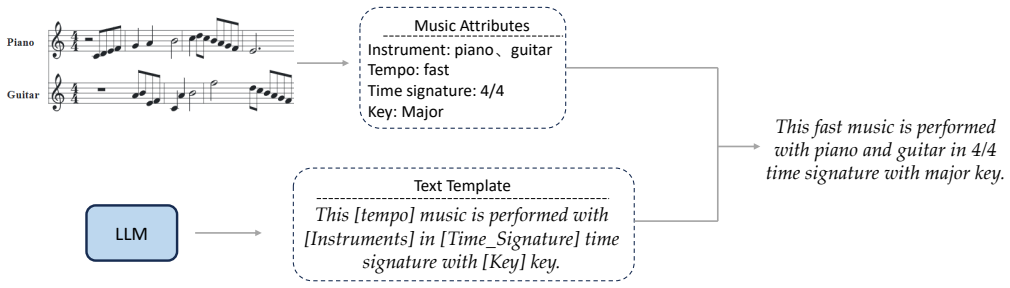
- The template dataset of 19,345 text descriptions covers combinations of musical attributes, supporting training without large curated text-MIDI pairs.
Reading between the lines
- A testable extension is to apply the same segment-level autoregressive conditioning to other fixed-length generative models (e.g., audio diffusion) to extend duration beyond the training window.
- The MI-Encoder's attribute-specific queries could enable attribute-level editing, where modifying a single query changes one musical attribute (e.g., tempo) without regenerating the whole piece, though the paper does not test this.
- The template-based dataset only covers attribute combinations expressible by the templates, so real-world text with novel phrasing or abstract musical concepts likely remains a gap for general text understanding.
Editorial analysis
A structured set of objections, weighed in public.
Referee Report
Summary. The paper presents Diff-Symbo, a text-to-symbolic-music generation system that couples a latent diffusion model (LDM) with an autoregressive context module. The system uses Multi-view MidiVAE to encode 8-bar MIDI segments, a Music Information Encoder built on frozen BERT with learnable queries to produce a compact text condition, and a cross-attention context module that conditions generation on a previous segment's latent. Training is split into an LDM stage and a fine-tuning stage that teaches the model to condition on the previous segment. The authors construct a dataset of 19,345 text templates via GPT-4 and evaluate against GPT-4, MuseCoco, and MMT on 8-bar generation, music continuation, and 32-bar generation using ASA, FD/MMD, and MOS. The central claims are higher quality, diversity, controllability, and duration.
Significance. If the results hold, Diff-Symbo would be a useful contribution, as it is among the first to combine latent diffusion with autoregressive context for long text-to-symbolic-music generation. The MI-Encoder and the large template dataset are practical contributions, and the architecture is clearly described. However, the long-duration claim rests on an unverified exposure-bias assumption, and the objective evaluation is weakened by the use of the model's own VAE latent space and by missing error bars/significance tests for ASA, FD, and MMD. The subjective MOS results are a positive sign, but they do not fully compensate for these gaps. The contribution is promising but not yet established at the level claimed.
major comments (3)
- [Section 3.4, Eq. (9), Figure 4] The fine-tuning objective in Eq. (9) conditions the denoiser on C_cont = E(x'), where x' is the ground-truth previous 8-bar segment from a 16-bar training pair. At inference, however, Figure 4 and the accompanying text show that C_cont is the model's own previously generated latent, which is not drawn from the training distribution. The paper does not describe fine-tuning with model-generated context, scheduled sampling, or any other mechanism to close this train/inference gap. Because the only long-generation experiment (Table 5) exercises just three autoregressive steps (four 8-bar segments), it cannot reveal error accumulation over dozens of steps. The claim that users can obtain 'consistent music up to several minutes' is therefore not established by the reported evidence. I suggest either fine-tuning with scheduled sampling or evaluating the model on longer generations, such as 64, 128, and 256 bars, with coherence/consistency reported at each horizon.
- [Section 4.2, Tables 2 and 3] FD and MMD are computed in the latent space of the Multi-view MidiVAE, which is also the VAE used as the backbone of Diff-Symbo. Since Diff-Symbo's diffusion process is trained to produce latents in precisely this space, while the autoregressive baselines are not, the comparison may be biased in favor of the proposed model. Additionally, the ASA, FD, and MMD values in Tables 2 and 3 are reported without error bars or significance tests; the abstract's phrase 'significant improvements' is thus not statistically supported. Please report confidence intervals or bootstrap significance tests for all objective metrics, and consider computing FD/MMD with an independent feature extractor or with symbolic-domain features as a robustness check.
- [Section 4.3 (Baselines), Table 2] The GPT-4 baseline was evaluated on only 20 manually generated samples, selected from the test set and produced through the official web page. With n=20, the ASA and MOS estimates in Table 2 have wide confidence intervals, and the absence of FD/MMD values for GPT-4 makes the comparison incomplete. To make the comparison to GPT-4 reliable, please increase the sample size and use an automated, reproducible generation pipeline (e.g., via API) rather than manual web-page generation.
minor comments (6)
- [Equations (1)-(2)] The notation for alpha_t is inconsistent: if alpha_t is the cumulative product as defined in the text, then q(z_t|z_{t-1}) in Eq. (1) should use sqrt(alpha_t/alpha_{t-1}) and (1 - alpha_t/alpha_{t-1}); otherwise Eq. (2) does not use the cumulative product. Please clarify the notation.
- [Section title] The section title 'Relative Work' appears to be a typo; it should be 'Related Work'.
- [Figure 3 caption] The caption mentions a 'dummy module' that is never defined in the text; please replace this with the actual module name.
- [Equations (8) and (12)] Equations (8) and (12) use an arrow '←' instead of an equality sign; this looks like a typo and should be corrected.
- [Table 3, Section 4.4] The row labels 'w/ BERT' and 'w/ CFG' are ambiguous because the main model already uses CFG during training. Please specify the exact variant (e.g., 'MI-encoder replaced by fine-tuned BERT' and 'CFG scale omega=7.5') and clarify the surrounding text, which currently states that fine-tuning BERT improves ASA while Table 3 shows the opposite (83.15 vs. 80.45).
- [Section 4.1 (Experiment Setup)] The setup does not state how many generated samples were used for ASA/FD/MMD or how many random seeds were used; please add this information for reproducibility.
Circularity Check
No construction-level circularity; minor self-citation to Multi-view MidiVAE is not load-bearing.
full rationale
The claimed derivation chain is not circular. Diff-Symbo's components are trained with standard objectives: Eq. (3) and Eq. (4) are conditional and unconditional denoising losses, and Eq. (9) adds a context condition Ccont supplied by the VAE encoder of the ground-truth previous segment. The long-duration claim is supported by human MOS evaluations in Tables 4 and 5, which are independent of the model's fitted parameters. The only self-citation is the Multi-view MidiVAE backbone (Lin et al. 2024), used as a fixed autoencoder; its use is a design choice, and no uniqueness theorem or ansatz is imported from that citation to forbid alternatives. The FD/MMD metrics are computed in the latent space of that same VAE, which could mildly favor the proposed model because it operates natively in that space, but this is an evaluation-metric choice, not a prediction that reduces to a fitted input by construction. A genuine robustness concern, not circularity, is the exposure-bias gap: Eq. (9) trains Ccont on ground-truth x' while Figure 4 inference uses the model's own previous generation, and the 32-bar experiment (Table 5) covers only three autoregressive steps, so the 'several minutes' claim is not fully established. Overall, no step in the paper's derivation is equivalent to its inputs by definition, so the circularity burden is low.
Assumptions & free parameters
free parameters (4)
- CFG guidance scale omega =
7.5
- Text condition dropout probability =
20%
- Attribute removal probability =
5%
- Number of learnable MI encoder queries m =
not specified in the paper
assumptions (5)
- domain assumption Multi-view MidiVAE from prior work faithfully reconstructs 8-bar symbolic music from latents.
- domain assumption GPT-4 generated text templates preserve the meaning of the underlying attribute combinations.
- domain assumption FD and MMD computed in the Multi-view MidiVAE latent space measure music quality and diversity fairly across models.
- domain assumption The rule-based extraction of musical attributes (pitch range, rhythm, key) from MIDI files is accurate.
- standard math Standard denoising diffusion and classifier-free guidance equations are correct and applicable to symbolic music latents.
invented entities (2)
-
MI Encoder with learnable attribute queries
-
Musical context module (cross-attention layers over previous segment latent)
Cite this review
Pith. "Pith review of Diff-Symbo: Text-Controlled Long-Duration Symbolic Music Generation Using Autoregressive Latent Diffusion Model." pith.science (2026). https://pith.science/paper/MD2A4KYC
@misc{pith2026260805222,
  author       = {Pith},
  title        = {Pith review of: Diff-Symbo: Text-Controlled Long-Duration Symbolic Music Generation Using Autoregressive Latent Diffusion Model},
  year         = {2026},
  howpublished = {\url{https://pith.science/paper/MD2A4KYC}},
  note         = {Machine review of arXiv:2608.05222}
}
read the original abstract
Text-controlled symbolic music generation has recently gained research attention due to its versatile, flexible and straightforward approach to music composition. However, previous approaches tend to generate symbolic music with compromising quality, diversity, controllability and limited duration. In this paper, we present Diff-Symbo, an innovative method that uses latent diffusion model (LDM) to generate high-quality, diverse and long-duration symbolic music. To address the lack of text-symbolic music dataset, we develop a comprehensive dataset with 19,345 text templates by employing large language model. Furthermore, we design a music information encoder to reduce the training overhead while extracting more effective control representations. Given textual descriptions, our proposed method leverages LDM to improve the quality and diversity of music generation. Our method also improves the duration and the compositional consistency of music generation through an autoregressive approach. Experimental results show significant improvements of Diff-Symbo in text controllability, duration, and the quality of generated music compared to the baseline models such as GPT-4, MuseCoco and Multitrack Music Transformer (MMT). As one of the pioneer models in this field, Diff-Symbo paves the way towards controllable and high-quality symbolic music composition based on LDM, offering valuable contributions to both music amateurs and practitioners.
Figures


Figures from the paper (1 more)

Reference graph
Works this paper leans on
-
[2]
Musiclm: Generating music from text.arXiv preprint arXiv:2301.11325. Bar-Tal, O.; Chefer, H.; Tov, O.; Herrmann, C.; Paiss, R.; Zada, S.; Ephrat, A.; Hur, J.; Li, Y .; Michaeli, T.; et al
-
[4]
Chen, K.; Wu, Y .; Liu, H.; Nezhurina, M.; Berg-Kirkpatrick, T.; and Dubnov, S
Stable video diffusion: Scaling la- tent video diffusion models to large datasets.arXiv preprint arXiv:2311.15127. Chen, K.; Wu, Y .; Liu, H.; Nezhurina, M.; Berg-Kirkpatrick, T.; and Dubnov, S
-
[5]
MusicLDM: Enhancing nov- elty in text-to-music generation using beat-synchronous mixup strategies. InICASSP 2024-2024 IEEE Interna- tional Conference on Acoustics, Speech and Signal Process- ing (ICASSP), 1206–1210. IEEE. Copet, J.; Kreuk, F.; Gat, I.; Remez, T.; Kant, D.; Synnaeve, G.; Adi, Y .; and D´efossez, A
work page 2024
-
[8]
Multitrack music transformer. InICASSP 2023-2023 IEEE International Conference on Acoustics, Speech and Signal Processing (ICASSP), 1–5. IEEE. Elizalde, B.; Deshmukh, S.; Al Ismail, M.; and Wang, H
work page 2023
-
[9]
Clap learning audio concepts from natural language supervision. InICASSP 2023-2023 IEEE International Conference on Acoustics, Speech and Signal Processing (ICASSP), 1–5. IEEE. Evans, Z.; Carr, C.; Taylor, J.; Hawley, S. H.; and Pons, J. 2024a. Fast Timing-Conditioned Latent Audio Diffusion. arXiv preprint arXiv:2402.04825. Evans, Z.; Parker, J. D.; Carr,...
arXiv 2023
-
[10]
Ho, J.; Jain, A.; and Abbeel, P
Text-to-audio generation using instruction-tuned llm and la- tent diffusion model.arXiv preprint arXiv:2304.13731. Ho, J.; Jain, A.; and Abbeel, P
-
[11]
Huang, Q.; Jansen, A.; Lee, J.; Ganti, R.; Li, J
Classifier-free diffusion guid- ance.arXiv preprint arXiv:2207.12598. Huang, Q.; Jansen, A.; Lee, J.; Ganti, R.; Li, J. Y .; and Ellis, D. P
-
[12]
Hung, H.-T.; Ching, J.; Doh, S.; Kim, N.; Nam, J.; and Yang, Y .-H
Mulan: A joint embedding of music audio and natural language.arXiv preprint arXiv:2208.12415. Hung, H.-T.; Ching, J.; Doh, S.; Kim, N.; Nam, J.; and Yang, Y .-H
Show all 26 references
-
[15]
Liu, H.; Chen, Z.; Yuan, Y .; Mei, X.; Liu, X.; Mandic, D.; Wang, W.; and Plumbley, M
Multi-view Midi- V AE: Fusing Track-and Bar-view Representations for Long Multi-track Symbolic Music Generation.arXiv preprint arXiv:2401.07532. Liu, H.; Chen, Z.; Yuan, Y .; Mei, X.; Liu, X.; Mandic, D.; Wang, W.; and Plumbley, M. D. 2023a. Audioldm: Text- to-audio generation...
-
[16]
Lu, P.; Xu, X.; Kang, C.; Yu, B.; Xing, C.; Tan, X.; and Bian, J
Symphony generation with permutation in- variant language model.arXiv preprint arXiv:2205.05448. Lu, P.; Xu, X.; Kang, C.; Yu, B.; Xing, C.; Tan, X.; and Bian, J
-
[17]
arXiv preprint arXiv:2306.00110
Musecoco: Generating symbolic music from text. arXiv preprint arXiv:2306.00110. Melechovsky, J.; Guo, Z.; Ghosal, D.; Majumder, N.; Herremans, D.; and Poria, S
-
[18]
Min, L.; Jiang, J.; Xia, G.; and Zhao, J
Mustango: To- ward controllable text-to-music generation.arXiv preprint arXiv:2311.08355. Min, L.; Jiang, J.; Xia, G.; and Zhao, J
-
[19]
Mittal, G.; Engel, J.; Hawthorne, C.; and Simon, I
Polyffusion: A diffusion model for polyphonic score generation with inter- nal and external controls.arXiv preprint arXiv:2307.10304. Mittal, G.; Engel, J.; Hawthorne, C.; and Simon, I
-
[20]
M¨uller-Franzes, G.; Niehues, J
Symbolic music generation with diffusion models.arXiv preprint arXiv:2103.16091. M¨uller-Franzes, G.; Niehues, J. M.; Khader, F.; Arasteh, S. T.; Haarburger, C.; Kuhl, C.; Wang, T.; Han, T.; Nolte, T.; Nebelung, S.; et al
-
[21]
Raffel, C
Sdxl: Im- proving latent diffusion models for high-resolution image synthesis.arXiv preprint arXiv:2307.01952. Raffel, C. 2016.Learning-based methods for comparing se- quences, with applications to audio-to-midi alignment and matching. Columbia University. Raffel, C.; Shazeer,...
2016 arXiv
-
[22]
Van Den Oord, A.; Vinyals, O.; et al
Mo\ˆ usai: Text-to-music generation with long-context la- tent diffusion.arXiv preprint arXiv:2301.11757. Van Den Oord, A.; Vinyals, O.; et al
-
[24]
Wu, S.; and Sun, M
Whole-song hierarchi- cal generation of symbolic music using cascaded diffusion models.arXiv preprint arXiv:2405.09901. Wu, S.; and Sun, M
-
[25]
Zeghidour, N.; Luebs, A.; Omran, A.; Skoglund, J.; and Tagliasacchi, M
Exploring the efficacy of pre- trained checkpoints in text-to-music generation task.arXiv preprint arXiv:2211.11216. Zeghidour, N.; Luebs, A.; Omran, A.; Skoglund, J.; and Tagliasacchi, M
-
[26]
Masked Au- dio Generation using a Single Non-Autoregressive Trans- former.arXiv preprint arXiv:2401.04577
-
[2013]
Lin, Z.; Chen, J.; Tang, B.; Sha, B.; Yang, J.; Ju, Y .; Fan, F.; Kang, S.; Wu, Z.; and Meng, H
Auto-encoding varia- tional bayes.arXiv preprint arXiv:1312.6114. Lin, Z.; Chen, J.; Tang, B.; Sha, B.; Yang, J.; Ju, Y .; Fan, F.; Kang, S.; Wu, Z.; and Meng, H
-
[2018]
Dong, H.-W.; Chen, K.; Dubnov, S.; McAuley, J.; and Berg-Kirkpatrick, T
Bert: Pre-training of deep bidirectional transformers for lan- guage understanding.arXiv preprint arXiv:1810.04805. Dong, H.-W.; Chen, K.; Dubnov, S.; McAuley, J.; and Berg-Kirkpatrick, T
-
[2020]
Wang, Z.; Min, L.; and Xia, G
Pop909: A pop-song dataset for music arrangement generation.arXiv preprint arXiv:2008.07142. Wang, Z.; Min, L.; and Xia, G
2008 arXiv
-
[2021]
arXiv preprint arXiv:2108.01374
EMOPIA: A multi-modal pop piano dataset for emotion recognition and emotion-based music generation. arXiv preprint arXiv:2108.01374. Kingma, D. P.; and Welling, M
-
[2022]
Devlin, J.; Chang, M.-W.; Lee, K.; and Toutanova, K
High fidelity neural audio compression.arXiv preprint arXiv:2210.13438. Devlin, J.; Chang, M.-W.; Lee, K.; and Toutanova, K
-
[2023]
Agostinelli, A.; Denk, T
Gpt-4 technical report.arXiv preprint arXiv:2303.08774. Agostinelli, A.; Denk, T. I.; Borsos, Z.; Engel, J.; Verzetti, M.; Caillon, A.; Huang, Q.; Jansen, A.; Roberts, A.; Tagliasacchi, M.; et al
-
[2024]
Blattmann, A.; Dockhorn, T.; Kulal, S.; Mendelevitch, D.; Kilian, M.; Lorenz, D.; Levi, Y .; English, Z.; V oleti, V .; Letts, A.; et al
Lumiere: A space-time diffusion model for video genera- tion.arXiv preprint arXiv:2401.12945. Blattmann, A.; Dockhorn, T.; Kulal, S.; Mendelevitch, D.; Kilian, M.; Lorenz, D.; Levi, Y .; English, Z.; V oleti, V .; Letts, A.; et al
Reviewed August 8, 2026 · model on record in the stance chip above.
Discussion (0). Continue with ORCID to comment.