REVIEW 3 major objections 4 minor 31 references
Soprano voices in opera seria: a corpus-based inquiry into eighteenth-century vocal types
T0 review · 3 major / 4 minor · reviewed 2026-08-08 · deepseek-v4-flash
Pith's one-line read The paper claims that in eighteenth-century Italian opera seria, composers encoded the dramatic gender of characters in the melodic fabric of soprano arias, while the biological sex of the singer is only weakly recoverable from the…
desk verdict A careful, reusable corpus study whose central interpretive claim about dramatic vs. physiological gender coding outruns the statistics, because singer sex and character gender are never jointly modeled. read the letter →
The pith
A machine-rendered reading of the paper's core claim, the machinery that carries it, and where it could break.
The reading
What carries the argument
The machinery is a corpus of 1,682 symbolic scores of soprano arias from the five most frequently reset Metastasio drammi, reduced to 86 vocal-part features covering range, highest and lowest notes, interval sizes and qualities, note durations, and vocal presence, then preprocessed to 34 or 35 standardized predictors. The chosen model is ridge logistic regression, a regularized classifier whose coefficients estimate how each standardized feature shifts the odds of the masculine/male class and come with asymptotically valid, Bonferroni-corrected confidence intervals; it is selected because its accuracy is statistically comparable to lasso and random forest while allowing interpretation and uncertainty quantification. The classification targets are character gender in two case studies and the singer's sex inferred from given names in libretti in a third. The decisive quantities are the standardized coefficients, and comparing these coefficients across case studies is what reveals the asymmetry.
What would settle it
A decisive check would be to obtain archival documentation of the actual sex of the 303 premiere singers, from payrolls, chapel records, or castrato contracts, instead of inferring it from given names, and rerun Case study 3 on the same features. If held-out accuracy then rises well above the 0.585 ridge result toward the 0.61-0.64 range seen for character gender, or if a physiology-linked feature such as long-note duration or coloratura density becomes significantly predictive while character gender is held constant, the paper's asymmetry claim would be in doubt.
Extended reading notes
Core claim
The paper's core discovery is that gender was written into the notes, while the singer's body was not. Across three binary classification case studies on 1,682 soprano arias, ridge logistic regression identifies significant, interpretable associations between musical features and the character's gender, with held-out accuracy around 0.61 for character-gender classification and around 0.60 when only cast-aligned arias are used, both above the majority-class baseline. The same model applied to the premiering singer's inferred biological sex attains only about 0.58, with weaker coefficients and only a modest edge over the baseline. Specific features tell the same story: the highest note of the aria loses more than half of its predictive weight when the target changes from character gender to singer sex, and the interval-size features that flag masculinity also weaken. The paper reads this as evidence that the flexibility long documented in casting practice was sustained by sharply gendered composition, and that the celebrated castrato difference was a difference in sound, not in notated notes.
Load-bearing premise
The paper assumes that a singer's biological sex can be inferred from whether their given name in a libretto is traditionally male or female, and the authors themselves flag that this method is susceptible to inaccuracies; if many labels are wrong, the case-study-3 conclusion that singer sex is barely recoverable could be an artifact of noisy labels rather than a property of the music.
Editorial extensions
If this is right
- If the conclusion is right, claims that opera seria register carried no dramatic connotation must be revised: gender marking demonstrably sits in the melodic fabric.
- The documented flexibility of casting did not imply neutral writing; composers wrote gender-coded lines while planning for a market in which either sex might take a role.
- The weak singer-sex signal indicates that the castrato versus female-soprano distinction, so vivid to contemporaries, was primarily acoustic and performative, and is largely invisible in score-based features.
- Features like vocal presence and average note duration attach to the character rather than the singer, suggesting that endurance and long-held notes belonged to heroic masculinity as a dramatic trait, not to castrato physiology.
- The asymmetry motivates future work with explicit tessitura descriptors and with modeling of dramatic rank, which the authors identify as beyond the present scope.
Reading between the lines
- One consequence the authors do not spell out: if gender coding is dramatic rather than physiological, historically informed staging need not treat these arias as body-locked; casting decisions could follow the dramatic characterization rather than a voice-type requirement.
- A direct perceptual test of the written-code claim would be to play paired excerpts to listeners and ask them to guess character gender versus singer sex; the theory predicts a large gap in accuracy, mirroring the classification gap.
- Because 86% of the known-singer arias align character gender with singer sex, the weak case-study-3 signal may partly reflect label noise from name-based sex inference; a cross-cast-only analysis, though small, would be the sharper comparison and could be run with the deposited dataset.
- The paper's framing suggests a general technique for historical performance conventions with interchangeable bodies: comparing classification accuracy between role-level and performer-level targets isolates which variable the notation actually encodes.
Signed reviews
Editorial analysis
A structured set of objections, weighed in public.
Referee Report
Summary. This paper analyzes a corpus of 1,682 soprano arias from settings of Metastasio’s five most popular drammi per musica (1724–1810). Using musical features extracted from the soprano part, the authors compare ridge and lasso logistic regression and random forest classifiers for three tasks: predicting the gender of the dramatic character (Case study 1), predicting character gender within a subsample of arias where singer sex and character gender align (Case study 2), and predicting the singer’s inferred biological sex (Case study 3). The paper’s central claim is that character gender is more strongly encoded in the notated vocal writing than singer sex, so that gender coding in opera seria was ‘dramatic rather than physiological in origin.’ The reported held-out accuracies are modest (0.58–0.64) but significantly above the majority-class baseline for the main models, and coefficient interpretations identify higher maximum pitches, smaller intervals, and lower intervallic variability with feminine/female classes, and larger ambitus, larger leaps, and higher vocal presence with masculine/male classes.
Significance. If the central claim could be rigorously established, the study would provide important quantitative evidence on a long-debated musicological question, showing that composers encoded gender in the musical text rather than relying on vocal type, and that the documented interchangeability of castrati and female sopranos coexisted with strongly gendered vocal writing. The paper deserves credit for a large, carefully curated corpus; explicit held-out evaluation with bootstrap significance tests; Bonferroni-corrected asymptotic confidence intervals for ridge coefficients; and public deposition of data and code. The main results are transparent with respect to apparent vs. held-out metrics. The significance of the work, however, depends on whether the authors can support the causal interpretation that character gender drives the musical differences beyond the confounded singer-sex signal.
major comments (3)
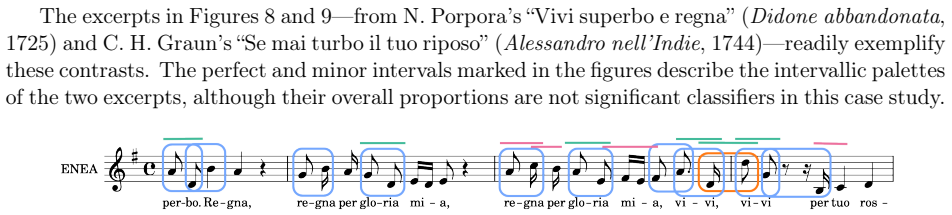
- [Section 3.4, Section 5] The conclusion that composers encoded gender ‘dramatically rather than physiologically’ (Section 5) is not identified by the reported models. Singer sex and character gender coincide in 86.28% of the 1,436 arias with known singers (Section 3.4, Table 2), and the manuscript itself states that ‘this case study cannot fully disentangle the one from the other.’ Yet no model includes both covariates: Case study 1 predicts character gender, Case study 3 predicts singer sex, and the comparison of their accuracies is across different subsets with different sample sizes. The lower held-out accuracy in Case study 3 (0.585 vs. 0.609 in Case study 1) is entirely compatible with a null model in which only character gender matters and singer sex has no independent predictive effect, given the 86% alignment. To support the paper’s causal claim, the authors should either (a) fit a joint model for singer sex that includes character gender as a covariate (or the converse), or (b) analyze the 197 cross-cast arias (74 masculine roles sung by female singers and 123 feminine roles by male singers, Table 2) and test whether, within a fixed character gender, musical features differ by singer sex. Without such an analysis, the abstract’s statement that ‘Female singers sang higher pitches than male sopranos, but this correlates more with character portrayal than with physiology’ overreaches the evidence.
- [Section 4] The interpretation of the feature gradients as gender-coded writing is also confounded with dramaturgical variables such as role rank and affective content. The authors themselves note in Section 4 that ‘pity’ arias are 165 for feminine characters vs. 113 for masculine ones while ‘anger’ arias are 194 for masculine vs. 31 for feminine, and that the association of VoicePresence and AverageDuration with masculine characters may reflect ‘differences in dramatic prominence’ rather than gender. Since the models include no control for role rank, aria type, or emotion, the conclusion that the identified features encode character gender rather than these correlated dramaturgical dimensions is not yet established. At minimum, the causal framing in Sections 4 and 5 should be tempered, or an analysis that adjusts for these variables (or reports the sensitivity of the coefficients to their inclusion) should be added.
- [Section 2.1, Section 3.4] The singer-sex labels are inferred solely from given names in libretti, a procedure the authors themselves flag as ‘susceptible to inaccuracies’ (Section 2.1). Since the central negative result—that singer sex is only weakly recoverable from the music—depends entirely on the validity of these labels, a sensitivity analysis is needed. The authors should, for example, exclude arias whose singers’ names are ambiguous, cross-check a subsample against documented castrato biographies or the CORAGO database, and rerun the Case study 3 classification to demonstrate that the weak signal is not an artifact of label noise. As it stands, the one-sentence acknowledgment of the limitation is not commensurate with the load-bearing role that the singer-sex labels play in the paper’s central claim.
minor comments (4)
- [Section 2.4, Eq. (1)] The notation β−1 is used without definition; it should be explicitly introduced as the coefficient vector β with the intercept β0 removed.
- [Section 3.4] The parenthetical explanation of LargestSemitonesDesc is difficult to parse; it should be rewritten to state clearly that descending intervals are encoded as negative values, so a larger numeric value means a smaller absolute leap.
- [Table 7] The features are not listed in the order in which they are discussed in Sections 3.2–3.3; reordering the rows (e.g., by the Case study 1 effect size) would improve readability.
- [Section 2.6] The statement that the bootstrap ‘does not retrain the models M1 and M2’ is useful, but the text should explicitly note that the resulting intervals therefore cover testing-set variability only, not the variability induced by hyperparameter selection or the CV-based selection of λ̂1SE.
Circularity Check
No significant circularity; the sex/gender confound is an identifiability limitation, not a constructional equivalence.
full rationale
The derivation chain is not circular under the operational definitions used here. The supervised classifiers are evaluated on held-out 30% test splits (Section 2.2; Tables 3-5), so the central predictions—that character gender is better recoverable than singer sex—are not fitted to the target values. Feature reduction by name (Section 2.3) is not data-driven, and the full-data models in Table 6 are explicitly labeled 'apparent performance metrics (i.e., computed on the same arias used to fit the model, and hence slightly optimistic),' so no fitted parameter is renamed as a prediction. The strongest skeptical concern—that singer sex and character gender coincide in 86.28% of the 1,436 arias (Section 3.4), so Case study 3 cannot 'fully disentangle the one from the other'—is a genuine identifiability and correctness limitation of the causal conclusion that the gender coding was 'dramatic rather than physiological in origin' (Section 5), not a circular reduction: the two labels are not defined in terms of each other, and the weak singer-sex signal is an empirical outcome rather than a construction. Self-citations (Llorens, 2024; Llorens et al., 2024, 2026; musif) supply data, catalogues, and code, and are deposited or otherwise independently checkable, so they are not load-bearing theoretical premises.
Assumptions & free parameters
free parameters (2)
- Ridge penalty lambda (lambda_1SE) =
0.106 (Case study 1), 0.157 (Case study 2), 0.288 (Case study 3)
- Preprocessing thresholds =
Near-zero variance, >5% missingness, >0.8 pairwise correlation, <10% rare levels, k=5 for kNN imputation
assumptions (3)
- domain assumption The musif feature extraction correctly represents the notated soprano part.
- domain assumption The libretto metadata assign character gender correctly.
- domain assumption Singers' biological sex can be inferred from given names in libretti.
Cite this review
Pith. "Pith review of Soprano voices in opera seria: a corpus-based inquiry into eighteenth-century vocal types." pith.science (2026). https://pith.science/paper/XPROXWEP
@misc{pith2026260805257,
  author       = {Pith},
  title        = {Pith review of: Soprano voices in opera seria: a corpus-based inquiry into eighteenth-century vocal types},
  year         = {2026},
  howpublished = {\url{https://pith.science/paper/XPROXWEP}},
  note         = {Machine review of arXiv:2608.05257}
}
read the original abstract
Eighteenth-century Italian opera seria was dominated by soprano voices. Although masculine roles were typically performed by castrati and feminine roles by women, cross-casting was common, producing four soprano configurations in which performers of either sex could portray characters of either gender. We hypothesize that composers tailored their writing both to the singers premiering their arias and to the characters' gender. Using statistical models built on approximately 1,700 arias, we analyze relationships between vocal typology, characters' gender, and stylistic choices, comparing supervised learning methods and selecting ridge logistic regression as our primary model, whose performance is competitive with that of the best-performing alternative while allowing for interpretation and uncertainty quantification of its coefficients. Results reveal an asymmetry: character gender is consistently encoded in the writing, while the singer's sex is barely recoverable. Masculine-character arias feature large melodic leaps, intervallic variability, and wider ranges; feminine-character arias favor higher maximum pitches, minor intervals, and melodic stability. Female singers sang higher pitches than male sopranos, but this correlates more with character portrayal than with physiology.
Figures


Figures from the paper (6 more)



Reference graph
Works this paper leans on
-
[1]
Breiman, L. (2001). Random forests. Mach. Learn. , 45:5--32
work page 2001
-
[2]
Breiman, L., Cutler, A., Liaw, A., and Wiener, M. (2024). randomForest: B reiman and C utler's Random Forests for Classification and Regression . R package version 4.7-1.2
work page 2024
-
[3]
Charton, A. (2012). Prima donna, primo uomo, musico. Körper und Stimme: Geschlechterbilder in der Oper . Leipziger Universitätsverlag, Leipzig
work page 2012
-
[4]
The DIDONE project: Dramatic identification of emotions in opera seria
European Research Council (2023). The DIDONE project: Dramatic identification of emotions in opera seria. https://didone.eu. Accessed 2025-05-24
work page 2023
-
[5]
Feldman, M. (2007). Opera and Sovereignty: Transforming Myths in Eighteenth-Century Italy . University of Chicago Press, Chicago
work page 2007
-
[6]
Feldman, M. (2015). The Castrato: Reflections on Natures and Kinds . University of California Press, Berkeley
work page 2015
-
[7]
Freitas, R. (2003). The eroticism of emasculation: Confronting the B aroque body of the castrato. J. Musicol. , 20(2):196--249
work page 2003
-
[8]
Friedman, J., Tibshirani, R., and Hastie, T. (2010). Regularization paths for generalized linear models via coordinate descent. J. Stat. Softw. , 33(1):1--22
work page 2010
Show all 31 references
-
[9]
and Glixon, B
Glixon, J. and Glixon, B. (2006). Inventing the Business of Opera: The Impresario and His World in Seventeenth-Century Venice . Oxford University Press, Oxford
2006
-
[10]
Hastie, T., Tibshirani, R., and Wainwright, M. (2015). Statistical Learning with Sparsity: The Lasso and Generalizations , volume 143 of Chapman & Hall/CRC Monographs on Statistics and Applied Probability . CRC Press, Boca Raton
2015
-
[11]
Heller, W. (1998). Reforming A chilles: Gender, ``opera seria'' and the rhetoric of the enlightened hero. Early Music , 26(4):562--581
1998
-
[12]
Keyser, D. (1987). Cross-sexual casting in B aroque opera musical and theatrical conventions. Opera Q. , 5(4):46--57
1987
-
[13]
Kuhn, M. (2008). Building predictive models in R using the caret package. J. Stat. Softw. , 28(5):1--26
2008
-
[14]
Kuhn, M., Wickham, H., and Hvitfeldt, E. (2024). recipes: Preprocessing and Feature Engineering Steps for Modeling . R package version 1.1.0
2024
-
[15]
and Van Houwelingen , H
Le Cessie , S. and Van Houwelingen , H. C. (1992). Ridge estimators in logistic regression. Appl. Stat. , 41(1):191--201
1992
-
[16]
Lee, J., Sun, D., Sun, Y., and Taylor, J. (2016). Exact post-selection inference, with application to the lasso. Ann. Stat. , 44(3):907--927
2016
-
[17]
Pietro Metastasio’s Operatic Storm: Texts and Musics for Didone abbandonata, Alessandro nell’Indie, Artaserse, Adriano in Siria, and Demofoonte
Llorens, A., editor (2024). Pietro Metastasio’s Operatic Storm: Texts and Musics for Didone abbandonata, Alessandro nell’Indie, Artaserse, Adriano in Siria, and Demofoonte . Brepols, Turnhout
2024
-
[18]
Llorens, A., Anzani, V., Ar \'a ez Santiago , T., Rubiales Zabarte , G., Usula, N., and Torrente, \'A . (2024). DIDONE arias database: Unveiling emotions in 18th-century opera seria. https://doi.org/10.69947/didone
2024 doi
-
[19]
Llorens, A., Garc \'i a-Portug \'e s , E., Vaquero, C., and Torrente, \'A . (2026). Soprano voices in opera seria: dataset of musical features and metadata for 1,682 arias. https://doi.org/10.5281/zenodo.21757127
2026 doi
-
[20]
Llorens, A., Simonetta, F., Serrano, M., and Torrente, \'A . (2023). musif: A Python package for symbolic music feature extraction. In Proceedings of the Sound and Music Computing Conference , pages 132--138
2023
-
[21]
Medina, \'A . (2001). Los atributos del cap \'o n: Imagen hist \'o rica de los cantores castrados en Espa \ n a . Instituto Complutense de Ciencias Musicales, Madrid
2001
-
[22]
Moindrot, I. (1993). L’opéra seria ou le règne des castrats . Fayard, Paris
1993
- [23]
-
[24]
Pompilio, A. (2025). CORAGO : Repertorio e archivio di libretti del melodramma italiano dal 1600 al 1900. https://doi.org/10.6092/UNIBO/CORAGO
2025 doi
-
[25]
Poriss, H. (2015). Divas and divos. In Greenwald, H. M., editor, The Oxford Handbook of Opera , pages 373--394. Oxford University Press, Oxford
2015
-
[26]
Rosselli, J. (1988). The castrati as a professional group and a social phenomenon, 1550--1850. Acta Musicol. , 60(2):143--179
1988
-
[27]
Seedorf, T. (2015). Heldensoprane: Die Stimme der Eroi in der Italienischen Oper von Monteverdi bis Bellini . Wallstein Verlag, Göttingen
2015
-
[28]
Sundberg, J., Trov \'e n, M., and Richter, B. (2007). Sopranos with a singer's formant? historical, physiological, and acoustical aspects of castrato singing. Speech Music Hear. Q. Prog. Status Rep. , 49:1--6
2007
-
[29]
and Dom \'i nguez, J
Torrente, \'A . and Dom \'i nguez, J. M. (2024). The language of emotions from D escartes to M etastasio. In Prats Arolas, I., editor, Cognate Music Theories: The Past and the Other in Musicology (Essays in Honor of John Walter Hill) , pages 139--171. Routledge, New York
2024
-
[30]
and Dom \'i nguez , J
Torrente, \'A . and Dom \'i nguez , J. M. (2025). When the primo uomo is the antagonist: The twofold dramaturgy of M etastasio's operas. Eighteenth-Century Music , 22(1):35--65
2025
-
[31]
van de Geer , S., B \"u hlmann , P., Ritov, Y., and Dezeure, R. (2014). On asymptotically optimal confidence regions and tests for high-dimensional models. Ann. Stat. , 42(3):1166--1202
2014
Reviewed August 8, 2026 · model on record in the stance chip above.
Discussion (0). Continue with ORCID to comment.