REVIEW 4 major objections 5 minor 234 references
Where did all the Little Red Dots go? The abundance of LRD analogues among objects with broad lines at $z < 0.35$
T0 review · 4 major / 5 minor · reviewed 2026-08-08 · deepseek-v4-flash
Pith's one-line read Only 0.08% of local broad-line objects at z<0.35 have LRD-like SEDs, so the Little Red Dot phenomenon has largely vanished by today.
desk verdict A systematic, morphology-free search for local LRD analogues; the rarity result is probably right, but 0.08% is a parent-sample lower limit, not a cosmic abundance. read the letter →
The pith
A machine-rendered reading of the paper's core claim, the machinery that carries it, and where it could break.
The reading
What carries the argument
The load-bearing object is the modified black body (MBB) fit, $f_{\rm MBB}=A_{\rm tot}B_\nu(T)(\nu/\nu_0)^{\beta_{\rm MBB}}$ with pivot $\nu_0=c/5500$ Å, adopted from the high-redshift LRD fits of de Graaff et al. (2025a); it describes the red-optical rise and NIR flattening that define an LRD-like SED. The selection pipeline fits this form to the rest-frame optical spectra of all 14,584 objects in the L19 broad-line catalogue, then applies cuts on the best-fit peak wavelength $\lambda_{\rm peak}$, the modification index $\beta_{\rm MBB}$, the ratio $L_{5100}/L_{\rm MBB}$, the Balmer break strength, the [OIII] $\lambda5007$ equivalent width, and the v-shape condition $\beta_{\rm UV}<-0.2$, $\beta_{\rm OPT}>0$, $\beta_{\rm OPT}-\beta_{\rm UV}>0.5$. The MBB fit is what separates the 2,778 v-shaped objects from the final nine: it encodes the specific SED shape shared by high-redshift LRDs, and the cuts on its parameters carry the abundance argument.
What would settle it
A spectroscopic census of broad-line objects at $z<0.35$ that does not rely on SDSS DR7 target selection—for example a dense slitless or integral-field survey—would settle the claim: if the rate of LRD-like MBB SEDs among broad-line objects were found to be an order of magnitude above 0.08%, or even above the paper's own 0.16% upper bound when cold-peak SEDs are included, the central claim of extreme local rarity would be overturned.
Extended reading notes
Core claim
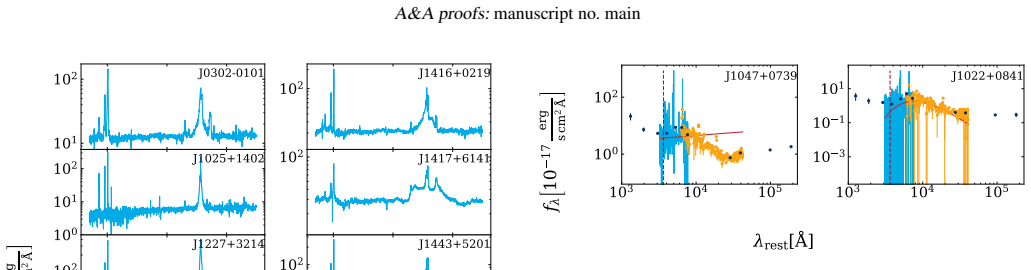
On the paper's own terms, the central discovery is an abundance measurement: among every object in the local universe ($z<0.35$) with a broad H$\alpha$ or H$\beta$ line—14,584 galaxies and quasars in the SDSS DR7-based L19 catalogue—only nine have spectral energy distributions resembling high-redshift LRDs. The selection requires a v-shaped SED, a modified black body (MBB) shape with $\beta_{\rm MBB}>-3$, $\lambda_{\rm peak}>0.5\,\mu$m and $\lambda_{\rm peak}+0.1\,\beta_{\rm MBB}>0.4$, a continuum-to-H$\alpha$ luminosity ratio $\log_{10} L_{5100}-\log_{10} L_{\rm H\alpha}<1.4$, $L_{5100}/L_{\rm MBB}$ consistent with the LRD anti-correlation, and a diagonal cut in [OIII] $\lambda5007$ equivalent width versus Balmer break strength. The paper reports that 19% of broad-line objects show a v-shaped SED and 5% of the luminosity-matched subset do, but the full MBB-like selection leaves nine objects, 0.08% of the parent catalogue (up to 0.16% when SED peaks outside the fitted wavelength range are accounted for). One of the nine, J1025+1402, is the previously identified analogue "The Egg", which the authors take as validation; the others include one object (J0302-0101) that shows every LRD hallmark while embedded in a galaxy core, two double-peaked emitters, two strongly variable objects, and two with heavy host contamination. The claim is that LRD-like objects are extremely rare at low redshift even with the compactness criterion dropped, so the population seen at $z\sim4$–$9$ has largely disappeared by today.
Load-bearing premise
The load-bearing premise is that the L19 catalogue, built from SDSS DR7 spectra of galaxies and quasars whose H$\alpha$ falls in the spectrograph range, is a complete enough census of broad-line objects at $z<0.35$ that the 0.08% fraction measures the true rarity rather than the incompleteness of SDSS target selection.
Editorial extensions
If this is right
- If the abundance claim holds, the LRD phenomenon—whatever physical process produces v-shaped, MBB-like SEDs with broad Balmer lines—has declined by orders of magnitude since $z\approx4$–$9$, and the nine objects constitute a near-complete local census for studying it.
- Dropping the compactness criterion does not change the rarity: even extended objects with broad lines rarely show LRD-like SEDs at $z<0.35$, so the low-redshift absence is not driven by morphology or surface-brightness dimming.
- The nine analogues, and especially J0302-0101 which passes all LRD criteria while embedded in a galaxy core, provide the first practical targets for cheap multi-wavelength follow-up (X-ray, radio, variability, high-resolution spectroscopy) to discriminate between obscured-AGN and dense-gas models of LRDs.
- The paper's own recovery of "The Egg" as one of the nine validates the method, while the failure to select two previously known analogues (J1047+0739 and J1022+0841) due to wavelength coverage and SNR shows that the 0.08% fraction is a lower bound that could rise with better data.
Reading between the lines
- Because the 0.08% fraction is relative to the SDSS DR7-targeted L19 catalogue, a complete magnitude-limited census of broad-line objects (not relying on SDSS target selection) could shift the rate by a factor of a few; the qualitative rarity is likely robust, but the exact number is not yet population-level.
- The two variable objects with photometry-spectrum mismatches (J1302+2949 and J1415+1936) raise the possibility—suggested but not proven in the paper—that LRD-like states are transitory phases; if so, the instantaneous abundance understates how many objects ever pass through the phase, and variability monitoring of the other seven analogues would be a direct test.
- If LRD analogues are the extreme tail of a continuum of AGN properties, as the paper's diagnostic plots hint, then any count-based rarity is cut-dependent; a physically motivated definition (e.g., tied to the Balmer-limit inflection point) might yield a different local census.
- Applying the same MBB-based selection to the complete parent sample once SPHEREx data become fully available would convert the paper's upper estimate of 0.16% into a measured fraction and resolve how many cold-peak analogues were missed.
Editorial analysis
A structured set of objections, weighed in public.
Referee Report
Summary. This paper presents a search for local analogues of high-redshift Little Red Dots (LRDs) using the Liu et al. (2019) catalogue of 14,584 broad-line objects at z<0.35 from SDSS DR7. The authors apply v-shaped SED and modified black body (MBB) selection criteria derived from the high-z LRD sample of de Graaff et al. (2025a), without enforcing the compactness criterion. They report that 19% of broad-line objects have v-shaped SEDs, identify nine objects with MBB-like SEDs (0.08% of the parent sample), and recover the previously known analogue 'The Egg'. They discuss each candidate individually, noting alternative explanations for most, and conclude that LRD-like objects are extremely rare at z<0.35.
Significance. If the quantitative result were robust, the paper would provide a nearly complete local sample for LRD follow-up and a strong constraint on the evolution of the LRD phenomenon. The methodology is commendable: the selection is anchored to an external high-z sample (avoiding circularity), the recovery of the Egg validates the approach, and the authors are transparent about the caveats of individual candidates. However, the headline abundance figure is not currently presented in a self-consistent way, and the parent sample is not an unbiased census of broad-line objects in the local Universe. These issues bear directly on the paper's central claim and must be resolved before the quantitative conclusions can be accepted.
major comments (4)
- [Abstract, Sec. 3.4] The abstract and Conclusions state that 'nine local LRD analogues, corresponding to 0.08% of all objects with broad lines' are found, but the body of the paper gives a different basis for the 0.08% figure. In Sec. 3.4 the authors write that 9110 objects are within the reliable λ_peak range at 1σ and only seven of the nine analogues are among them, and they 'correct the fraction ... up to 0.08%'. This implies 7/9110 ≈ 0.077%, whereas 9/14584 ≈ 0.06%. The numerator and denominator behind the 0.08% need to be stated explicitly; as written, the abstract's association of nine objects with 0.08% of 'all objects with broad lines' is arithmetically inconsistent with both ratios.
- [Sec. 2.1, Abstract] The parent catalogue is described as 'unbiased' and the conclusions claim LRDs are 'extremely rare at z<0.35', but the L19 catalogue is built from SDSS DR7 targeted spectroscopy. SDSS main galaxy selection is flux-limited (r<17.77), quasar targets are selected via colour cuts, and fiber collisions prevent complete spectroscopic coverage. The 0.08% fraction is therefore measured relative to the SDSS DR7 broad-line sample, not to a complete census of broad-line objects at z<0.35. Without completeness corrections or an explicit restriction of the claim to this sample, the quantitative rarity statement is not established.
- [Sec. 3.2.4 vs Table 1] There is a direct inconsistency in the definition of the final selection cut. Sec. 3.2.4 states the cut as log10 EW_λ5007 + 2.2·log10(BBS) > 1.7, while Table 1 lists 'log10 EWλ5007 +1.5·log10 Balmer break strength>1.8'. Since this cut determines the final nine-object sample, readers cannot reproduce the selection without knowing which version was used. Please correct the discrepancy and confirm the exact criterion.
- [Sec. 4.2, 5.1] The paper's own individual-object discussion severely limits the robustness of the headline count of nine analogues. Sec. 5.1 states that two candidates (J1416+0219, J1417+6141) are double-peaked emitters and should be treated with caution; Sec. 4.2.4 notes that J1302+2949 and J1415+1936 show no v-shape in the photometry alone, so their classification is uncertain; and two further objects (J1443+5201, J1602+0950) have possible host contamination. Only J0302−0101 is described as showing all LRD hallmarks. The abundance claim should be presented with a robust subset or a range reflecting these uncertainties, rather than a single count of nine.
minor comments (5)
- [Sec. 3.2.1] The phrase 'using a lower limit as a selection cut' is incorrect because the implemented cut log10 L5100 − log10 LHα < 1.4 is an upper limit on the difference.
- [Sec. 4.2.4] The sentence 'The object be therefore be transition out of an LRD phase' contains a grammatical error; it should read 'The object may therefore be transitioning out of an LRD phase'.
- [Sec. 3.3] 'homogenous' should be 'homogeneous'.
- [Figure 4 and A.1 captions] The x-axis label 'rest[Å]' should be expanded to 'Rest-frame wavelength [Å]' for clarity.
- [Sec. 3.4] The statement 'only seven of the nine local analogues' would benefit from an explicit remark that the remaining two are still retained as candidates, so that the reader understands how the nine-object sample relates to the 0.08% fraction.
Circularity Check
No significant circularity: the LRD-analogue criteria are anchored to external high-redshift samples (dG25, Hviding et al. 2025) and the L19 parent catalogue, so the 0.08% abundance is a direct external-benchmark measurement, not a self-derived prediction.
full rationale
The paper's central result is an abundance measurement, not a prediction derived from its own inputs. The selection criteria are anchored to two external samples: the parent catalogue of broad-line objects comes from Liu et al. (2019, L19), and the LRD 'target region' in the diagnostic diagrams is defined by de Graaff et al. (2025a, dG25) and Hviding et al. (2025), none of which are authored by the present authors. The v-shaped SED cut (Sec. 3.1.1), the luminosity relation cut (Sec. 3.2.1), the MBB parameter region (Sec. 3.2.2), and the [OIII]-Balmer-break diagonal cut (Sec. 3.2.4) are all quantified from the dG25 high-redshift LRD locus after overlaying the local sample; the final count of nine objects that fall inside that externally anchored region is then a direct empirical measurement. The one claimed validation, recovery of the previously known 'Egg' analogue (Sec. 4.1), is against an independently discovered object (Lin et al. 2026b; Ji et al. 2026), providing genuine external confirmation that the selection is not merely re-identifying objects it was engineered to find. The self-citations in the paper (Bosman et al. 2024, 2025; Davies et al. 2026) are contextual comparisons of NIR SED behavior and a mention of a future data pipeline; none of them carries the abundance claim. The main caveat to the 0.08% figure is the SDSS DR7 targeted nature of the L19 parent sample plus the hand-tuned 'empirically quantified' thresholds, which the paper partly acknowledges (relaxing 1-sigma cuts yields 60 candidates; cold MBBs could raise the fraction to 0.16%); these are completeness and robustness concerns, not circularity. No equation in the paper reduces to its own input, and no load-bearing premise rests on a self-citation chain. The derivation chain is self-contained against external benchmarks, so the appropriate circularity score is 0.
Assumptions & free parameters
free parameters (5)
- Continuum-line luminosity cut =
log10 L5100 - log10 LHalpha < 1.4
- MBB shape cuts =
betaMBB > -3; lambda_peak > 0.5 micron; lambda_peak + 0.1 betaMBB > 0.4
- MBB luminosity ratio cut =
log10(L5100/LMBB) + 2 lambda_peak > 0.5
- [OIII] EW versus Balmer break cut =
log10 EW[OIII] + 2.2 log10 BBS > 1.7
- Significance thresholds =
1 sigma for non-v-shape cuts, 2 sigma for v-shape cuts
assumptions (4)
- domain assumption The L19 catalogue is a representative parent sample of all broad-line objects at z<0.35
- domain assumption The modified black body form and the dG25 parameter cuts are appropriate for identifying LRD analogues at low redshift
- domain assumption The LRD high-z sample of dG25 is representative of the LRD population
- standard math Standard flat Lambda CDM cosmology
Cite this review
Pith. "Pith review of Where did all the Little Red Dots go? The abundance of LRD analogues among objects with broad lines at $z < 0.35$." pith.science (2026). https://pith.science/paper/BDPMERJS
@misc{pith2026260805267,
  author       = {Pith},
  title        = {Pith review of: Where did all the Little Red Dots go? The abundance of LRD analogues among objects with broad lines at $z < 0.35$},
  year         = {2026},
  howpublished = {\url{https://pith.science/paper/BDPMERJS}},
  note         = {Machine review of arXiv:2608.05267}
}
abstract
One of the most puzzling discoveries since the launch of the James Webb Space Telescope is a numerous population of sources at high redshift nicknamed ``Little Red Dots'' (LRDs). Characterized by broad Balmer emission lines, compact morphologies and v-shaped spectral energy distributions (SEDs) in the rest-frame optical, the nature of LRDs remains elusive. A major challenge is the high redshift nature of LRDs, which makes observations very expensive and difficult. Finding local LRD analogues is a crucial step in unravelling the physical processes giving rise to LRDs, as cheaper observations with many facilities would become available. In this paper, we conduct a search for local LRD analogues by starting from an unbiased parent catalogue of all SDSS objects with broad H$\alpha$ or H$\beta$ emission lines (both galaxies and quasars) at $0 < z < 0.35$, complemented by archival photometry and spectroscopy. We find that among broad-line objects, $19\%$ show a v-shaped SED. We then select objects whose SED is well described by a modified black body (MBB), and identify nine local LRD analogues, corresponding to $0.08\%$ of all objects with broad lines. Among only objects which match the typical continuum and emission line luminosities of LRDs, $5\%$ display a v-shape and $0.37\%$ display a MBB-like SED. We recover one previously-identified local LRD analogue (the so-called ``Egg''), validating our methodology. Among the other eight analogues, one (J0302$-$0101) shows all the hallmarks of an LRD despite being visibly embedded in the core of a galaxy; another object is ambiguous, and the remaining six may have alternative explanations for their peculiar SEDs. Our study highlights that LRDs are extremely rare at $z < 0.35$; we find very few objects with broad lines which have LRD-like SEDs, even without attempting to match the compactness of LRDs.
Figures


Figures from the paper (3 more)


Reference graph
Works this paper leans on
-
[1]
A Comprehensive and Uniform Sample of Broad-line Active Galactic Nuclei from the SDSS DR7. , keywords =. doi:10.3847/1538-4365/ab298b , archivePrefix =. 1906.05597 , primaryClass =
arXiv 1906
-
[2]
Estimating Black Hole Masses in Active Galaxies Using the H Emission Line. , keywords =. doi:10.1086/431897 , archivePrefix =. astro-ph/0508335 , primaryClass =
-
[3]
COSMOS-Web: The Overabundance and Physical Nature of ``Little Red Dots'' Implications for Early Galaxy and SMBH Assembly. , keywords =. doi:10.3847/1538-4357/ade984 , archivePrefix =. 2406.10341 , primaryClass =
-
[4]
arXiv e-prints , keywords =
Investigating the Growth of Little Red Dot Descendants at z<4 with the JWST. arXiv e-prints , keywords =
-
[5]
What drives the growth of black holes: a decade of progress. arXiv e-prints , keywords =. doi:10.48550/arXiv.2506.19166 , archivePrefix =. 2506.19166 , primaryClass =
-
[6]
The Dust Content and Opacity of Actively Star-forming Galaxies. , keywords =. doi:10.1086/308692 , archivePrefix =. astro-ph/9911459 , primaryClass =
-
[7]
Dust Budget Crisis in Little Red Dots. arXiv e-prints , keywords =. doi:10.48550/arXiv.2505.22600 , archivePrefix =. 2505.22600 , primaryClass =
-
[8]
Overview of the DESI Legacy Imaging Surveys. , keywords =. doi:10.3847/1538-3881/ab089d , archivePrefix =. 1804.08657 , primaryClass =
Show all 234 references
-
[9]
The First Galaxies in the Universe
-
[10]
, keywords =
The Galaxies Missed by Hubble and ALMA: The Contribution of Extremely Red Galaxies to the Cosmic Census at 3 < z < 8. , keywords =. doi:10.3847/1538-4357/ad3f17 , archivePrefix =. 2311.07483 , primaryClass =
-
[11]
, keywords =
A remarkable ruby: Absorption in dense gas, rather than evolved stars, drives the extreme Balmer break of a little red dot at z = 3.5. , keywords =. doi:10.1051/0004-6361/202554681 , archivePrefix =. 2503.16600 , primaryClass =
-
[12]
, keywords =
RUBIES: A complete census of the bright and red distant Universe with JWST/NIRSpec. , keywords =. doi:10.1051/0004-6361/202452186 , archivePrefix =. 2409.05948 , primaryClass =
-
[13]
arXiv e-prints , keywords =
JADES and BlackTHUNDER: rest-frame Balmer-line absorption and the local environment in a Little Red Dot at z = 5. arXiv e-prints , keywords =. doi:10.48550/arXiv.2506.14870 , archivePrefix =. 2506.14870 , primaryClass =
-
[14]
, keywords =
A big red dot at cosmic noon. , keywords =. doi:10.1051/0004-6361/202555946 , archivePrefix =. 2506.12141 , primaryClass =
- [15]
-
[16]
, keywords =
Investigating photometric and spectroscopic variability in the multiply imaged little red dot A2744-QSO1. , keywords =. doi:10.1051/0004-6361/202554110 , archivePrefix =. 2502.07875 , primaryClass =
-
[17]
, keywords =
A high black-hole-to-host mass ratio in a lensed AGN in the early Universe. , keywords =. doi:10.1038/s41586-024-07184-8 , archivePrefix =. 2308.05735 , primaryClass =
-
[18]
, keywords =
UNCOVER: A NIRSpec Identification of a Broad-line AGN at z = 8.50. , keywords =. doi:10.3847/2041-8213/ad037a , archivePrefix =. 2308.11610 , primaryClass =
-
[19]
Nature Astronomy , keywords =
A little red dot at z = 7.3 within a large galaxy overdensity. Nature Astronomy , keywords =. doi:10.1038/s41550-025-02660-1 , archivePrefix =. 2411.11534 , primaryClass =
-
[20]
arXiv e-prints , keywords =
A deep dive down the broad-line region: permitted OI, CaII and FeII emission in an AGN Little Red Dot at z=5.3. arXiv e-prints , keywords =
-
[21]
, keywords =
Little Red Dots as Late-stage Quasi-stars. , keywords =. doi:10.3847/1538-4357/ae274a , archivePrefix =. 2507.09085 , primaryClass =
-
[22]
arXiv e-prints , keywords =
Ruling out dominant electron scattering in Little Red Dots' Rosetta Stone using multiple hydrogen lines. arXiv e-prints , keywords =. doi:10.48550/arXiv.2507.08929 , archivePrefix =. 2507.08929 , primaryClass =
- [23]
-
[24]
arXiv e-prints , keywords =
Little Red Dots from Ultra-Strongly Self-Interacting Dark Matter. arXiv e-prints , keywords =. doi:10.48550/arXiv.2507.03230 , archivePrefix =. 2507.03230 , primaryClass =
-
[25]
arXiv e-prints , keywords =
The Balmer Break and Optical Continuum of Little Red Dots From Super-Eddington Accretion. arXiv e-prints , keywords =. doi:10.48550/arXiv.2507.07190 , archivePrefix =. 2507.07190 , primaryClass =
-
[26]
, keywords =
Supermassive Stars Match the Spectral Signatures of JWST's Little Red Dots. , keywords =. doi:10.3847/1538-4357/ae32f3 , archivePrefix =. 2507.12618 , primaryClass =
-
[27]
, keywords =
Cosmic Outliers: Low-spin Halos Explain the Abundance, Compactness, and Redshift Evolution of the Little Red Dots. , keywords =. doi:10.3847/2041-8213/ade871 , archivePrefix =. 2506.03244 , primaryClass =
- [28]
-
[29]
, keywords =
UNCOVER Spectroscopy Confirms the Surprising Ubiquity of Active Galactic Nuclei in Red Sources at z > 5. , keywords =. doi:10.3847/1538-4357/ad1e5f , archivePrefix =. 2309.05714 , primaryClass =
-
[30]
, keywords =
RUBIES: A spectroscopic census of little red dots: All point sources with v-shaped continua have broad lines. , keywords =. doi:10.1051/0004-6361/202555816 , archivePrefix =. 2506.05459 , primaryClass =
-
[31]
, keywords =
The Rise of Faint, Red Active Galactic Nuclei at z > 4 : A Sample of Little Red Dots in the JWST Extragalactic Legacy Fields. , keywords =. doi:10.3847/1538-4357/adbc7d , archivePrefix =. 2404.03576 , primaryClass =
-
[32]
, keywords =
Dust Extinction from Balmer Decrements of Star-forming Galaxies at 0.75 <= z <= 1.5 with Hubble Space Telescope/Wide-Field-Camera 3 Spectroscopy from the WFC3 Infrared Spectroscopic Parallel Survey. , keywords =. doi:10.1088/0004-637X/763/2/145 , archivePrefix =. 1206.1867 , p...
-
[33]
, keywords =
Correcting for the Effects of Interstellar Extinction. , keywords =. doi:10.1086/316293 , archivePrefix =. astro-ph/9809387 , primaryClass =
-
[34]
, keywords =
Now you see it, now you don't: the disappearing central engine of the quasar J1011+5442. , keywords =. doi:10.1093/mnras/stv2385 , archivePrefix =. 1509.03640 , primaryClass =
-
[35]
, keywords =
Measuring Reddening with Sloan Digital Sky Survey Stellar Spectra and Recalibrating SFD. , keywords =. doi:10.1088/0004-637X/737/2/103 , archivePrefix =. 1012.4804 , primaryClass =
-
[36]
, keywords =
Maps of Dust Infrared Emission for Use in Estimation of Reddening and Cosmic Microwave Background Radiation Foregrounds. , keywords =. doi:10.1086/305772 , archivePrefix =. astro-ph/9710327 , primaryClass =
-
[37]
, keywords =
A Catalog of Quasar Properties from Sloan Digital Sky Survey Data Release 7. , keywords =. doi:10.1088/0067-0049/194/2/45 , archivePrefix =. 1006.5178 , primaryClass =
-
[38]
, keywords =
Empirical extinction coefficients for the GALEX, SDSS, 2MASS and WISE passbands. , keywords =. doi:10.1093/mnras/stt039 , archivePrefix =. 1301.1427 , primaryClass =
-
[39]
Astrophysics of gaseous nebulae and active galactic nuclei
-
[40]
, keywords =
The Discovery of Little Red Dots in the Local Universe: Signatures of Cool Gas Envelopes. , keywords =. doi:10.3847/1538-4357/ae2bdf , archivePrefix =. 2507.10659 , primaryClass =
- [41]
-
[42]
, keywords =
Exploring Changing-look Active Galactic Nuclei with the Sloan Digital Sky Survey V: First Year Results. , keywords =. doi:10.3847/1538-4357/ad2f30 , archivePrefix =. 2401.01933 , primaryClass =
-
[43]
, keywords =
Discovery of a Little Red Dot Candidate at z 10 in COSMOS-web Based on MIRI-NIRCam Selection. , keywords =. doi:10.3847/1538-4357/ae145f , archivePrefix =. 2508.00057 , primaryClass =
-
[44]
, keywords =
Lord of LRDs: insights into a 'Little Red Dot' with a low-ionization spectrum at z = 0.1. , keywords =. doi:10.1093/mnras/staf2235 , archivePrefix =. 2507.23774 , primaryClass =
-
[45]
, keywords =
Little Red Dots as Self-gravitating Disks Accreting on Supermassive Stars: Spectral Appearance and Formation Pathway of the Progenitors to Direct Collapse Black Holes. , keywords =. doi:10.3847/1538-4357/ae4d47 , adsurl =
-
[46]
Spectral properties and evolution
The nature of massive black hole binary candidates - I. Spectral properties and evolution. , keywords =. doi:10.1093/mnras/stt831 , archivePrefix =. 1305.4941 , primaryClass =
-
[47]
, keywords =
Little Red Dots at an Inflection Point: Ubiquitous V-shaped Turnover Consistently Occurs at the Balmer Limit. , keywords =. doi:10.3847/1538-4357/ae1500 , archivePrefix =. 2411.03424 , primaryClass =
-
[48]
, keywords =
The Ninth Data Release of the Sloan Digital Sky Survey: First Spectroscopic Data from the SDSS-III Baryon Oscillation Spectroscopic Survey. , keywords =. doi:10.1088/0067-0049/203/2/21 , archivePrefix =. 1207.7137 , primaryClass =
-
[49]
, keywords =
The Zwicky Transient Facility: Data Processing, Products, and Archive. , keywords =. doi:10.1088/1538-3873/aae8ac , archivePrefix =. 1902.01872 , primaryClass =
1902 arXiv
- [50]
-
[51]
, year = 2025, month = aug, doi =
Little Red Dots as Direct-collapse Black Hole Nurseries. , year = 2025, month = aug, doi =
2025
-
[52]
arXiv e-prints , keywords =
On the Variability Features of Active Galactic Nuclei in Little Red Dots. arXiv e-prints , keywords =
-
[53]
, keywords =
Impact of resonance, Raman, and Thomson scattering on hydrogen line formation in Little Red Dots. , keywords =. doi:10.1093/mnras/staf2131 , archivePrefix =. 2508.08768 , primaryClass =
- [54]
-
[55]
, keywords =
Little Red Dots are Nurseries of Massive Black Holes. , keywords =. doi:10.3847/1538-4357/ae1619 , archivePrefix =. 2509.02664 , primaryClass =
-
[56]
, keywords =
Do Little Red Dots Vary?. , keywords =. doi:10.3847/1538-4357/ae1f08 , archivePrefix =. 2509.03571 , primaryClass =
-
[57]
, keywords =
Little red dots as young supermassive black holes in dense ionized cocoons. , keywords =. doi:10.1038/s41586-025-09900-4 , archivePrefix =. 2503.16595 , primaryClass =
-
[58]
Nature Astronomy , keywords =
Changing-look active galactic nuclei. Nature Astronomy , keywords =. doi:10.1038/s41550-023-02108-4 , archivePrefix =. 2211.05132 , primaryClass =
-
[59]
, keywords =
Unified models for active galactic nuclei and quasars. , keywords =. doi:10.1146/annurev.aa.31.090193.002353 , adsurl =
-
[60]
, keywords =
Extremely Dense Gas around Little Red Dots and High-redshift Active Galactic Nuclei: A Nonstellar Origin of the Balmer Break and Absorption Features. , keywords =. doi:10.3847/2041-8213/adaebd , archivePrefix =. 2409.07805 , primaryClass =
-
[61]
, keywords =
Evolutionary Tracks and Spectral Properties of Quasi-stars and Their Correlation with Little Red Dots. , keywords =. doi:10.3847/2041-8213/ae3713 , archivePrefix =. 2510.17952 , primaryClass =
-
[62]
, keywords =
The Seventh Data Release of the Sloan Digital Sky Survey. , keywords =. doi:10.1088/0067-0049/182/2/543 , archivePrefix =. 0812.0649 , primaryClass =
-
[63]
, keywords =
A Confirmed Deficit of Hot and Cold Dust Emission in the Most Luminous Little Red Dots. , keywords =. doi:10.3847/2041-8213/ade78b , archivePrefix =. 2503.02059 , primaryClass =
-
[64]
Planck 2018 results. VI. Cosmological parameters. , keywords =. doi:10.1051/0004-6361/201833910 , archivePrefix =. 1807.06209 , primaryClass =
2018 arXiv
-
[65]
Changing-state quasars
Understanding extreme quasar optical variability with CRTS - II. Changing-state quasars. , keywords =. doi:10.1093/mnras/stz3244 , archivePrefix =. 1905.02262 , primaryClass =
1905 arXiv
-
[66]
, keywords =
A population of red candidate massive galaxies 600 Myr after the Big Bang. , keywords =. doi:10.1038/s41586-023-05786-2 , archivePrefix =. 2207.12446 , primaryClass =
-
[67]
, keywords =
What Is the Nature of Little Red Dots and what Is Not, MIRI SMILES Edition. , keywords =. doi:10.3847/1538-4357/ad38bb , archivePrefix =. 2401.08782 , primaryClass =
- [68]
-
[69]
Research in Astronomy and Astrophysics , year = 2012, month = sep, volume =
The Large Sky Area Multi-Object Fiber Spectroscopic Telescope (LAMOST). Research in Astronomy and Astrophysics , year = 2012, month = sep, volume =. doi:10.1088/1674-4527/12/9/003 , adsurl =
2012 doi
-
[70]
, keywords =
The Wide-field Infrared Survey Explorer (WISE): Mission Description and Initial On-orbit Performance. , keywords =. doi:10.1088/0004-6256/140/6/1868 , archivePrefix =. 1008.0031 , primaryClass =
- [71]
-
[72]
, keywords =
The Galaxy Evolution Explorer: A Space Ultraviolet Survey Mission. , keywords =. doi:10.1086/426387 , archivePrefix =. astro-ph/0411302 , primaryClass =
- [73]
-
[74]
, keywords =
The Gaia mission. , keywords =. doi:10.1051/0004-6361/201629272 , archivePrefix =. 1609.04153 , primaryClass =
-
[75]
, keywords =
SDSS-III: Massive Spectroscopic Surveys of the Distant Universe, the Milky Way, and Extra-Solar Planetary Systems. , keywords =. doi:10.1088/0004-6256/142/3/72 , archivePrefix =. 1101.1529 , primaryClass =
- [76]
-
[77]
, keywords =
SExtractor: Software for source extraction. , keywords =. doi:10.1051/aas:1996164 , adsurl =
-
[78]
, keywords =
Detailed Structural Decomposition of Galaxy Images. , keywords =. doi:10.1086/340952 , archivePrefix =. astro-ph/0204182 , primaryClass =
-
[79]
PSFEx: Point Spread Function Extractor
-
[80]
, keywords =
Active galactic nuclei-heated dust revealed in ``little red dots''. , keywords =. doi:10.1051/0004-6361/202557164 , archivePrefix =. 2509.07100 , primaryClass =
-
[81]
arXiv e-prints , keywords =
Little Red Dots host Black Hole Stars: A unified family of gas-reddened AGN revealed by JWST/NIRSpec spectroscopy. arXiv e-prints , keywords =. doi:10.48550/arXiv.2511.21820 , archivePrefix =. 2511.21820 , primaryClass =
-
[82]
, keywords =
ATLAS: A High-cadence All-sky Survey System. , keywords =. doi:10.1088/1538-3873/aabadf , archivePrefix =. 1802.00879 , primaryClass =
-
[83]
, keywords =
First Results from the Catalina Real-Time Transient Survey. , keywords =. doi:10.1088/0004-637X/696/1/870 , archivePrefix =. 0809.1394 , primaryClass =
- [84]
-
[85]
, keywords =
The James Webb Space Telescope. , keywords =. doi:10.1007/s11214-006-8315-7 , archivePrefix =. astro-ph/0606175 , primaryClass =
-
[86]
, keywords =
A JWST/NIRSpec First Census of Broad-line AGNs at z = 4-7: Detection of 10 Faint AGNs with M _ BH 10 ^ 6 - 10 ^ 8 M _ and Their Host Galaxy Properties. , keywords =. doi:10.3847/1538-4357/ad029e , archivePrefix =. 2303.11946 , primaryClass =
-
[87]
, keywords =
JWST UNCOVER: Extremely Red and Compact Object at z _ phot = 7.6 Triply Imaged by A2744. , keywords =. doi:10.3847/1538-4357/acdc9d , archivePrefix =. 2212.10531 , primaryClass =
-
[88]
, keywords =
X-Ray View of Little Red Dots: Do They Host Supermassive Black Holes?. , keywords =. doi:10.3847/2041-8213/ad5669 , archivePrefix =. 2404.19010 , primaryClass =
-
[89]
, keywords =
Stacking X-Ray Observations of ``Little Red Dots'': Implications for Their Active Galactic Nucleus Properties. , keywords =. doi:10.3847/2041-8213/ad7eba , archivePrefix =. 2404.13290 , primaryClass =
-
[90]
, keywords =
Dust in Little Red Dots. , keywords =. doi:10.3847/2041-8213/ad7ba7 , archivePrefix =. 2407.05094 , primaryClass =
-
[91]
, keywords =
No [C II] or dust detection in two Little Red Dots at z_ spec > 7. , keywords =. doi:10.1051/0004-6361/202554361 , archivePrefix =. 2503.01945 , primaryClass =
-
[92]
, keywords =
Quasi-stars: accreting black holes inside massive envelopes. , keywords =. doi:10.1111/j.1365-2966.2008.13344.x , archivePrefix =. 0711.4078 , primaryClass =
2008
-
[93]
, keywords =
The SDSS-IV Extended Baryon Oscillation Spectroscopic Survey: Overview and Early Data. , keywords =. doi:10.3847/0004-6256/151/2/44 , archivePrefix =. 1508.04473 , primaryClass =
-
[94]
, keywords =
Inferring the star formation histories of massive quiescent galaxies with BAGPIPES: evidence for multiple quenching mechanisms. , keywords =. doi:10.1093/mnras/sty2169 , archivePrefix =. 1712.04452 , primaryClass =
-
[95]
doi:10.1007/978-3-642-54083-7 , adsurl =
Extragalactic Astronomy and Cosmology: An Introduction. doi:10.1007/978-3-642-54083-7 , adsurl =
-
[96]
The Journal of Open Source Software , keywords =
pysersic: A Python package for determining galaxy structural properties via Bayesian inference, accelerated with jax. The Journal of Open Source Software , keywords =. doi:10.21105/joss.05703 , archivePrefix =. 2306.05454 , primaryClass =
-
[97]
, keywords =
Little Red Dots: An Abundant Population of Faint Active Galactic Nuclei at z 5 Revealed by the EIGER and FRESCO JWST Surveys. , keywords =. doi:10.3847/1538-4357/ad2345 , archivePrefix =. 2306.05448 , primaryClass =
-
[98]
EIGER. I. A Large Sample of [O III]-emitting Galaxies at 5.3 < z < 6.9 and Direct Evidence for Local Reionization by Galaxies. , keywords =. doi:10.3847/1538-4357/acc588 , archivePrefix =. 2211.08254 , primaryClass =
-
[99]
, keywords =
The JWST FRESCO survey: legacy NIRCam/grism spectroscopy and imaging in the two GOODS fields. , keywords =. doi:10.1093/mnras/stad2411 , archivePrefix =. 2304.02026 , primaryClass =
-
[100]
CEERS Key Paper. I. An Early Look into the First 500 Myr of Galaxy Formation with JWST. , keywords =. doi:10.3847/2041-8213/acade4 , archivePrefix =. 2211.05792 , primaryClass =
-
[101]
, keywords =
Extremely Red Galaxies at z = 5 9 with MIRI and NIRSpec: Dusty Galaxies or Obscured Active Galactic Nuclei?. , keywords =. doi:10.3847/1538-4357/ad167e , archivePrefix =. 2305.14418 , primaryClass =
-
[102]
, keywords =
Hidden Little Monsters: Spectroscopic Identification of Low-mass, Broad-line AGNs at z > 5 with CEERS. , keywords =. doi:10.3847/2041-8213/ace5a0 , archivePrefix =. 2302.00012 , primaryClass =
-
[103]
, keywords =
JADES: The diverse population of infant black holes at 4 < z < 11 : Merging, tiny, poor, but mighty. , keywords =. doi:10.1051/0004-6361/202347640 , archivePrefix =. 2308.01230 , primaryClass =
-
[104]
, keywords =
Overview of the JWST Advanced Deep Extragalactic Survey (JADES). , keywords =. doi:10.3847/1538-4365/ae3163 , archivePrefix =. 2306.02465 , primaryClass =
-
[105]
The GLASS-JWST Early Release Science Program. I. Survey Design and Release Plans. , keywords =. doi:10.3847/1538-4357/ac8158 , archivePrefix =. 2206.07978 , primaryClass =
-
[106]
, keywords =
The JWST Early Release Observations. , keywords =. doi:10.3847/2041-8213/ac8a4e , archivePrefix =. 2207.13067 , primaryClass =
-
[107]
, keywords =
UNCOVER: Candidate Red Active Galactic Nuclei at 3 < z < 7 with JWST and ALMA. , keywords =. doi:10.3847/1538-4357/ad3551 , archivePrefix =. 2306.07320 , primaryClass =
-
[108]
, keywords =
JEMS: A Deep Medium-band Imaging Survey in the Hubble Ultra Deep Field with JWST NIRCam and NIRISS. , keywords =. doi:10.3847/1538-4365/acf130 , archivePrefix =. 2301.09780 , primaryClass =
-
[109]
, keywords =
A Census of Photometrically Selected Little Red Dots at 4 < z < 9 in JWST Blank Fields. , keywords =. doi:10.3847/1538-4357/ad4265 , archivePrefix =. 2401.09981 , primaryClass =
-
[110]
, keywords =
The X-Ray Dot: Exotic Dust or a Late-stage Little Red Dot?. , keywords =. doi:10.3847/2041-8213/ae4c88 , archivePrefix =. 2601.09778 , primaryClass =
-
[111]
arXiv e-prints , keywords =
A Critical Evaluation of the Physical Nature of the Little Red Dots. arXiv e-prints , keywords =. doi:10.48550/arXiv.2512.03130 , archivePrefix =. 2512.03130 , primaryClass =
-
[112]
, keywords =
The JWST UNCOVER Treasury Survey: Ultradeep NIRSpec and NIRCam Observations before the Epoch of Reionization. , keywords =. doi:10.3847/1538-4357/ad66cf , archivePrefix =. 2212.04026 , primaryClass =
-
[113]
, keywords =
The Next Generation Deep Extragalactic Exploratory Public (NGDEEP) Survey. , keywords =. doi:10.3847/2041-8213/ad2f31 , archivePrefix =. 2302.05466 , primaryClass =
-
[114]
, keywords =
RUBIES: Evolved Stellar Populations with Extended Formation Histories at z 7 8 in Candidate Massive Galaxies Identified with JWST/NIRSpec. , keywords =. doi:10.3847/2041-8213/ad55f7 , archivePrefix =. 2405.01473 , primaryClass =
-
[115]
, keywords =
COSMOS-Web: An Overview of the JWST Cosmic Origins Survey. , keywords =. doi:10.3847/1538-4357/acc2bc , archivePrefix =. 2211.07865 , primaryClass =
-
[116]
, keywords =
A Comprehensive Photometric Selection of ``Little Red Dots'' in MIRI Fields: An Infrared-Bright Little Red Dot at z = 3.1386 with Warm Dust Emission. , keywords =. doi:10.3847/1538-4357/ae0704 , archivePrefix =. 2412.01887 , primaryClass =
-
[117]
arXiv e-prints , keywords =
From ``The Cliff'' to ``Virgil'': Mapping the Spectral Diversity of Little Red Dots with JWST/NIRSpec. arXiv e-prints , keywords =. doi:10.48550/arXiv.2512.15853 , archivePrefix =. 2512.15853 , primaryClass =
-
[118]
, keywords =
NEXUS: A Spectroscopic Census of Broad-line AGNs and Little Red Dots at 3 z 6. , keywords =. doi:10.3847/1538-4357/ae3612 , archivePrefix =. 2505.20393 , primaryClass =
-
[119]
, keywords =
NEXUS Early Data Release: NIRCam Imaging and WFSS Spectroscopy from the First (Partial) Wide Epoch. , keywords =. doi:10.3847/1538-4365/ae2d05 , archivePrefix =. 2411.06372 , primaryClass =
- [120]
-
[121]
Extending the quest for little red dots to z<4
Euclid Quick Data Release (Q1). Extending the quest for little red dots to z<4. arXiv e-prints , keywords =. doi:10.48550/arXiv.2503.15323 , archivePrefix =. 2503.15323 , primaryClass =
-
[122]
, keywords =
Counting Little Red Dots at z < 4 with Ground-based Surveys and Spectroscopic Follow-up. , keywords =. doi:10.3847/1538-4357/ae4596 , archivePrefix =. 2504.08032 , primaryClass =
-
[123]
, keywords =
Deciphering the JWST spectrum of a 'little red dot' at z 4.53: An obscured AGN and its star-forming host. , keywords =. doi:10.1051/0004-6361/202348857 , archivePrefix =. 2312.03065 , primaryClass =
-
[124]
, keywords =
The Physical Nature of the Off-center Extended Emission Associated with the Little Red Dots. , keywords =. doi:10.3847/2041-8213/adee0a , archivePrefix =. 2505.03183 , primaryClass =
-
[125]
, keywords =
The Host Galaxy (If Any) of the Little Red Dots. , keywords =. doi:10.3847/1538-4357/ada93a , archivePrefix =. 2411.04446 , primaryClass =
-
[126]
, keywords =
Possible environmental quenching in an interacting little red dot pair at z 7. , keywords =. doi:10.1051/0004-6361/202553943 , archivePrefix =. 2501.17925 , primaryClass =
-
[127]
, keywords =
A weak Ly halo for an extremely bright little red dot: Indications of enshrouded supermassive black hole growth. , keywords =. doi:10.1051/0004-6361/202555596 , archivePrefix =. 2505.09542 , primaryClass =
-
[128]
, keywords =
Connecting the Dots: UV-bright Companions of Little Red Dots as Lyman-Werner Sources Enabling Direct-collapse Black Hole Formation. , keywords =. doi:10.3847/2041-8213/ae58a5 , archivePrefix =. 2602.02702 , primaryClass =
- [129]
- [130]
-
[131]
, keywords =
Not Just a Dot: The Complex UV Morphology and Underlying Properties of Little Red Dots. , keywords =. doi:10.3847/1538-4357/adfa10 , archivePrefix =. 2411.14383 , primaryClass =
- [132]
-
[133]
arXiv e-prints , keywords =
VENUS: Two Faint Little Red Dots Separated by 70\,pc Hidden in a Single Lensed Galaxy at z 7. arXiv e-prints , keywords =. doi:10.48550/arXiv.2601.06015 , archivePrefix =. 2601.06015 , primaryClass =
-
[134]
arXiv e-prints , keywords =
The Deepest GLIMPSE of a Dense Gas Cocoon Enshrouding a Little Red Dot. arXiv e-prints , keywords =. doi:10.48550/arXiv.2511.07515 , archivePrefix =. 2511.07515 , primaryClass =
-
[135]
arXiv e-prints , keywords =
Unveiling Extended Components of 'Little Red Dots' in Rest-Frame Optical. arXiv e-prints , keywords =. doi:10.48550/arXiv.2510.25830 , archivePrefix =. 2510.25830 , primaryClass =
-
[136]
, keywords =
The nature of low-luminosity AGNs discovered by JWST based on clustering analysis: progenitors of low-z quasars?. , keywords =. doi:10.1093/mnras/stae2765 , archivePrefix =. 2410.08707 , primaryClass =
-
[137]
, keywords =
The Large-scale Environments of Low-luminosity AGNs at 3.9 < z < 6 and Implications for Their Host Dark Matter Halos from a Complete NIRCam Grism Redshift Survey. , keywords =. doi:10.3847/1538-4357/ae1eef , archivePrefix =. 2505.02896 , primaryClass =
-
[138]
, keywords =
Lack of Rest-frame Ultraviolet Variability in Little Red Dots Based on HST and JWST Observations. , keywords =. doi:10.3847/2041-8213/adc5e3 , archivePrefix =. 2412.05242 , primaryClass =
-
[139]
, keywords =
Challenging the Active Galactic Nucleus Scenario for JWST/NIRSpec Little Red Dot and Non-Little Red Dot Broad H Emitters in Light of Nondetection of NIRCam Photometric Variability and X-Ray. , keywords =. doi:10.3847/1538-4357/ae119e , archivePrefix =. 2407.04777 , primaryClass =
-
[140]
, keywords =
BlackTHUNDER - A non-stellar Balmer break in a black hole-dominated little red dot at z = 7.04. , keywords =. doi:10.1093/mnras/staf1867 , archivePrefix =. 2501.13082 , primaryClass =
-
[141]
arXiv e-prints , keywords =
Little red dot variability over a century reveals black hole envelope via a giant Einstein cross. arXiv e-prints , keywords =. doi:10.48550/arXiv.2512.05180 , archivePrefix =. 2512.05180 , primaryClass =
-
[142]
, keywords =
Analysis of Multi-epoch JWST Images of 300 Little Red Dots: Tentative Detection of Variability in a Minority of Sources. , keywords =. doi:10.3847/1538-4357/adcb3e , archivePrefix =. 2411.02729 , primaryClass =
-
[143]
The Near-infrared Imager and Slitless Spectrograph for the James Webb Space Telescope. II. Wide Field Slitless Spectroscopy. , keywords =. doi:10.1088/1538-3873/ac5158 , archivePrefix =. 2202.01714 , primaryClass =
-
[144]
, keywords =
Chandra Rules Out Super-Eddington Accretion Models for Little Red Dots. , keywords =. doi:10.3847/2041-8213/adf5c8 , archivePrefix =. 2505.09669 , primaryClass =
-
[145]
Relation between X-ray emission and optical spectra
A combined optical and X-ray study of unobscured type 1 active galactic nuclei - II. Relation between X-ray emission and optical spectra. , keywords =. doi:10.1111/j.1365-2966.2012.20847.x , archivePrefix =. 1203.0239 , primaryClass =
2012
-
[146]
arXiv e-prints , keywords =
Discovery of two little red dots transitioning into quasars. arXiv e-prints , keywords =. doi:10.48550/arXiv.2512.02096 , archivePrefix =. 2512.02096 , primaryClass =
-
[147]
, keywords =
Deep silence: Radio properties of little red dots. , keywords =. doi:10.1051/0004-6361/202452422 , archivePrefix =. 2411.19518 , primaryClass =
-
[148]
, keywords =
Another Piece to the Puzzle: Radio Detection of a JWST-detected Active Galactic Nucleus Candidate. , keywords =. doi:10.3847/1538-4357/adddb9 , archivePrefix =. 2501.04912 , primaryClass =
-
[149]
, keywords =
SMILES: A Prototype JWST Multiband Mid-infrared Survey. , keywords =. doi:10.3847/1538-4357/ad6cd2 , archivePrefix =. 2406.03518 , primaryClass =
-
[150]
, keywords =
CAPERS-LRD-z9: A Gas-enshrouded Little Red Dot Hosting a Broad-line Active Galactic Nucleus at z = 9.288. , keywords =. doi:10.3847/2041-8213/ade789 , archivePrefix =. 2505.04609 , primaryClass =
-
[151]
, keywords =
Exploring the Nature of Little Red Dots: Constraints on Active Galactic Nucleus and Stellar Contributions from PRIMER MIRI Imaging. , keywords =. doi:10.3847/1538-4357/adfcce , archivePrefix =. 2411.12005 , primaryClass =
-
[152]
, keywords =
An Upper Limit of 10 ^ 6 M _ in Dust from ALMA Observations in 60 Little Red Dots. , keywords =. doi:10.3847/2041-8213/adfa91 , archivePrefix =. 2505.18873 , primaryClass =
-
[153]
, keywords =
RUBIES: JWST/NIRSpec Confirmation of an Infrared-luminous, Broad-line Little Red Dot with an Ionized Outflow. , keywords =. doi:10.3847/1538-4357/adc1ca , archivePrefix =. 2403.02304 , primaryClass =
- [154]
-
[155]
, keywords =
The Effect of Surface Brightness Dimming in the Selection of High-z Galaxies. , keywords =. doi:10.1088/0004-637X/796/2/102 , archivePrefix =. 1410.2281 , primaryClass =
-
[156]
, keywords =
The Effect of Line-of-Sight Temperature Variation and Noise on Dust Continuum Observations. , keywords =. doi:10.1088/0004-637X/696/2/2234 , archivePrefix =. 0902.3477 , primaryClass =
-
[157]
Extreme Variability Quasars in Their Various States. I. The Sample Selection and Composite SDSS Spectra. , keywords =. doi:10.3847/1538-4357/ac3828 , archivePrefix =. 2111.07057 , primaryClass =
-
[158]
, keywords =
Double-peaked Low-Ionization Emission Lines in Active Galactic Nuclei. , keywords =. doi:10.1086/378367 , archivePrefix =. astro-ph/0307357 , primaryClass =
-
[159]
, keywords =
Two Extreme Double-peaked Line Emitters in the Sloan Digital Sky Survey. , keywords =. doi:10.1086/430850 , archivePrefix =. astro-ph/0504320 , primaryClass =
-
[160]
, year = 1959, month = jan, volume =
A survey of radio sources at a frequency of 159 Mc/s. , year = 1959, month = jan, volume =
1959
-
[161]
, keywords =
Active Galactic Nuclei in Four Metal-poor Dwarf Emission-Line Galaxies. , keywords =. doi:10.1086/591660 , archivePrefix =. 0807.2029 , primaryClass =
-
[162]
Faint Blue Objects in the Field of BD + 29 2348 (The Galactic North Pole)
Studies of Blue Objects at High Galactic Latitudes. Faint Blue Objects in the Field of BD + 29 2348 (The Galactic North Pole). , keywords =. doi:10.1007/BF00642743 , adsurl =
-
[163]
, keywords =
Systematic search for UV-excess quasar candidates in 40 square degrees at the North Galactic Pole. , keywords =
-
[164]
BASS. LII. The Prevalence of Double-peaked Broad Lines at Low Accretion Rates among Hard X-Ray Selected Active Galactic Nuclei. , keywords =. doi:10.3847/1538-4357/adfa25 , archivePrefix =. 2507.05380 , primaryClass =
-
[165]
, keywords =
Narrow-line AGN selection in CEERS: Spectroscopic selection, physical properties, and X-ray and radio analysis. , keywords =. doi:10.1051/0004-6361/202451860 , archivePrefix =. 2408.15615 , primaryClass =
-
[166]
arXiv e-prints , keywords =
The Engine and its Flows: Little Red Dot spectra are shaped by the column densities of their gas envelopes. arXiv e-prints , keywords =. doi:10.48550/arXiv.2603.17667 , archivePrefix =. 2603.17667 , primaryClass =
-
[167]
arXiv e-prints , keywords =
Little Red and Blue Dots: simply stratified Broad Line Regions. arXiv e-prints , keywords =. doi:10.48550/arXiv.2603.22277 , archivePrefix =. 2603.22277 , primaryClass =
- [168]
- [169]
- [170]
- [171]
-
[172]
, keywords =
JADES - the Rosetta stone of JWST-discovered AGN: deciphering the intriguing nature of early AGN. , keywords =. doi:10.1093/mnras/stae2367 , archivePrefix =. 2407.08643 , primaryClass =
- [173]
-
[174]
, keywords =
The Sloan Digital Sky Survey: Technical Summary. , keywords =. doi:10.1086/301513 , archivePrefix =. astro-ph/0006396 , primaryClass =
- [175]
-
[176]
, keywords =
Radio detection of a local little red dot. , keywords =. doi:10.1051/0004-6361/202558326 , archivePrefix =. 2512.03331 , primaryClass =
- [177]
- [178]
-
[179]
, keywords =
Discovery of Local Analogs to JWST's Little Red Dots. , keywords =. doi:10.3847/2041-8213/adaaf1 , archivePrefix =. 2412.08396 , primaryClass =
-
[180]
, keywords =
A z = 0.4 Galaxy Reflecting the High-redshift Little Red Dots: An Extended Starburst with an Overmassive Black Hole. , keywords =. doi:10.3847/1538-4357/ae3683 , archivePrefix =. 2510.02801 , primaryClass =
-
[181]
arXiv e-prints , keywords =
Too Quiet for Comfort: Local Little Red Dots Lack Variability over Decades. arXiv e-prints , keywords =. doi:10.48550/arXiv.2511.16082 , archivePrefix =. 2511.16082 , primaryClass =
-
[182]
, keywords =
Classification parameters for the emission-line spectra of extragalactic objects. , keywords =. doi:10.1086/130766 , adsurl =
-
[183]
, keywords =
What You See Is What You Get: Empirically Measured Bolometric Luminosities of Little Red Dots. , keywords =. doi:10.3847/1538-4357/ae1836 , archivePrefix =. 2509.05434 , primaryClass =
-
[184]
arXiv e-prints , keywords =
A PANORAMIC of UV-optical morphologies of ``Little Red Dots'': Two groups of LRDs distinguished by UV half-light radius. arXiv e-prints , keywords =. doi:10.48550/arXiv.2603.24700 , archivePrefix =. 2603.24700 , primaryClass =
-
[185]
arXiv e-prints , keywords =
Euclid: Scaled-up little red dots and other sources with v-shaped spectral energy distributions at z>4. arXiv e-prints , keywords =
- [186]
- [187]
-
[188]
, keywords =
The warm outer layer of a little red dot as the source of [Fe II] and collisional Balmer lines with scattering wings. , keywords =. doi:10.1051/0004-6361/202557537 , archivePrefix =. 2510.00103 , primaryClass =
-
[189]
, keywords =
The X-ray weakness of little red dots and JWST-selected AGN: Comparison with local AGN in different accretion regimes. , keywords =. doi:10.1051/0004-6361/202557444 , archivePrefix =. 2603.10162 , primaryClass =
- [190]
-
[191]
arXiv e-prints , keywords =
JWST Advanced Deep Extragalactic Survey (JADES) Data Release 5: Catalogs of inferred morphological properties of galaxies from JWST/NIRCam imaging in GOODS-N and GOODS-S. arXiv e-prints , keywords =. doi:10.48550/arXiv.2601.15957 , archivePrefix =. 2601.15957 , primaryClass =
- [192]
- [193]
-
[194]
, keywords =
How was the Hubble sequence 6 Gyr ago?. , keywords =. doi:10.1051/0004-6361/200912704 , archivePrefix =. 0906.2805 , primaryClass =
-
[195]
, keywords =
The PANORAMIC Survey: Pure Parallel Wide Area Legacy Imaging with JWST/NIRCam. , keywords =. doi:10.3847/1538-4357/ad97bc , archivePrefix =. 2410.01875 , primaryClass =
-
[196]
Vast Exploration for Nascent, Unexplored Sources (VENUS)
- [197]
-
[198]
PRIMER: Public Release IMaging for Extragalactic Research
-
[199]
, keywords =
Pulsational Instability of Quasi-stars: Interpreting the Variability of Little Red Dots. , keywords =. doi:10.3847/2041-8213/ae4729 , archivePrefix =. 2512.17997 , primaryClass =
- [200]
-
[201]
arXiv e-prints , keywords =
Non-LTE atmosphere models of very luminous sources and their applicability to Little Red Dots, quasi-stars, and similar objects. arXiv e-prints , keywords =
-
[202]
arXiv e-prints , keywords =
Little Red Dots as Globular Clusters in Formation. arXiv e-prints , keywords =. doi:10.48550/arXiv.2602.15935 , archivePrefix =. 2602.15935 , primaryClass =
- [203]
-
[204]
, keywords =
Little Red Dots as direct-collapse black hole nurseries. , keywords =. doi:10.1093/mnras/staf1362 , archivePrefix =. 2508.14897 , primaryClass =
-
[205]
, keywords =
Little Red Dots and Their Progenitors from Direct Collapse Black Holes. , keywords =. doi:10.3847/1538-4357/ae3725 , archivePrefix =. 2508.14155 , primaryClass =
-
[206]
arXiv e-prints , keywords =
The Little Red Dots Are Direct Collapse Black Holes. arXiv e-prints , keywords =. doi:10.48550/arXiv.2601.14368 , archivePrefix =. 2601.14368 , primaryClass =
-
[207]
, keywords =
Black hole envelopes in Little Red Dots. , keywords =. doi:10.1093/mnras/staf1898 , archivePrefix =. 2505.06965 , primaryClass =
-
[208]
, keywords =
A Black Hole Envelope Interpretation for Cosmological Demographics of Little Red Dots. , keywords =. doi:10.3847/1538-4357/ae4101 , archivePrefix =. 2512.04208 , primaryClass =
-
[209]
arXiv e-prints , keywords =
Supermassive Primordial Black Holes from a Catalyzed Dark Phase Transition for Little Red Dots. arXiv e-prints , keywords =. doi:10.48550/arXiv.2604.01304 , archivePrefix =. 2604.01304 , primaryClass =
-
[210]
arXiv e-prints , keywords =
A Unified Explanation for JWST Little Red Dots and High-Redshift Low-Mass Disk-like Galaxies: Prolate Galaxies Viewed End-on vs Side-on. arXiv e-prints , keywords =. doi:10.48550/arXiv.2603.01668 , archivePrefix =. 2603.01668 , primaryClass =
- [211]
- [212]
- [213]
-
[214]
, keywords =
The Emergence of Little Red Dots from Binary Massive Black Holes. , keywords =. doi:10.3847/1538-4357/ae548d , archivePrefix =. 2505.05322 , primaryClass =
-
[215]
, keywords =
Spectral Uniformity of Little Red Dots: A Natural Outcome of Coevolving Seed Black Holes and Nascent Starbursts. , keywords =. doi:10.3847/1538-4357/ae42ce , archivePrefix =. 2509.19422 , primaryClass =
-
[216]
, keywords =
Hydrogen reionization ends by z = 5.3: Lyman- optical depth measured by the XQR-30 sample. , keywords =. doi:10.1093/mnras/stac1046 , archivePrefix =. 2108.03699 , primaryClass =
-
[217]
Ground-based and Airborne Instrumentation for Astronomy VII , year = 2018, editor =
The preliminary design of the next generation Palomar spectrograph for 200-inch Hale telescope. Ground-based and Airborne Instrumentation for Astronomy VII , year = 2018, editor =. doi:10.1117/12.2312550 , adsurl =
2018 doi
-
[218]
arXiv e-prints , keywords =
A new sample of Little Red Dots at z<0.45 in DESI DR1: Broad Balmer lines, low ionization spectrum and no variability. arXiv e-prints , keywords =
-
[219]
(LRDs) ^2 : The Low-ReDshift Little Red Dots Survey. II. DESI DR1 Sample. arXiv e-prints , keywords =
-
[220]
, keywords =
Ensemble Learning for Independent Component Analysis of Normal Galaxy Spectra. , keywords =. doi:10.1086/498711 , archivePrefix =. astro-ph/0510246 , primaryClass =
-
[221]
, keywords =
The Sloan Digital Sky Survey Quasar Catalog: Sixteenth Data Release. , keywords =. doi:10.3847/1538-4365/aba623 , archivePrefix =. 2007.09001 , primaryClass =
2007 arXiv
-
[222]
arXiv e-prints , keywords =
Three Hundred Quasars from the Couch: A first look at high-redshift quasar discovery with SPHEREx. arXiv e-prints , keywords =. doi:10.48550/arXiv.2603.10135 , archivePrefix =. 2603.10135 , primaryClass =
-
[223]
Nature Astronomy , keywords =
A mature quasar at cosmic dawn revealed by JWST rest-frame infrared spectroscopy. Nature Astronomy , keywords =. doi:10.1038/s41550-024-02273-0 , archivePrefix =. 2307.14414 , primaryClass =
-
[224]
arXiv e-prints , keywords =
A close look at the black hole masses and hot dusty toruses of the first quasars with MIRI-MRS. arXiv e-prints , keywords =. doi:10.48550/arXiv.2511.02902 , archivePrefix =. 2511.02902 , primaryClass =
-
[225]
, keywords =
Quasars and the Intergalactic Medium at Cosmic Dawn. , keywords =. doi:10.1146/annurev-astro-052920-102455 , archivePrefix =. 2212.06907 , primaryClass =
-
[226]
and Haberland, Matt and Reddy, Tyler and Cournapeau, David and Burovski, Evgeni and Peterson, Pearu and Weckesser, Warren and Bright, Jonathan and
Virtanen, Pauli and Gommers, Ralf and Oliphant, Travis E. and Haberland, Matt and Reddy, Tyler and Cournapeau, David and Burovski, Evgeni and Peterson, Pearu and Weckesser, Warren and Bright, Jonathan and. Nature Methods , year =
-
[227]
arXiv , Author =:1307.6212 , Journal =
doi:10.1051/0004-6361/201322068 , Eid =. arXiv , Author =:1307.6212 , Journal =
-
[228]
, keywords =
The Astropy Project: Building an Open-science Project and Status of the v2.0 Core Package. , keywords =. doi:10.3847/1538-3881/aabc4f , archivePrefix =. 1801.02634 , primaryClass =
-
[229]
, keywords =
The Astropy Project: Sustaining and Growing a Community-oriented Open-source Project and the Latest Major Release (v5.0) of the Core Package. , keywords =. doi:10.3847/1538-4357/ac7c74 , archivePrefix =. 2206.14220 , primaryClass =
-
[230]
Harris and K
Charles R. Harris and K. Jarrod Millman and St. Array programming with. 2020 , month = sep, journal =. doi:10.1038/s41586-020-2649-2 , publisher =
2020 doi
-
[231]
Hunter, J. D. , Title =. Computing in Science & Engineering , Volume =
-
[232]
Sculptor: Interactive modeling of astronomical spectra
- [233]
- [234]
Reviewed August 8, 2026 · model on record in the stance chip above.
Discussion (0). Continue with ORCID to comment.