REVIEW 3 major objections 6 minor 84 references
Exact statistical transmutation of quantum mixtures on a ring
T0 review · 3 major / 6 minor · reviewed 2026-08-08 · deepseek-v4-flash
Pith's one-line read A single impurity in a strongly repulsive 1D mixture on a ring with an artificial gauge field acquires exact anyonic exchange statistics, with the statistical angle fixed by the angular-momentum sector.
desk verdict A genuinely exact finite-N anyonization result for single-impurity mixtures on a ring, with a clean parity effect and an observable Tan-contact signature; it deserves peer review after the authors fix a sign error and the n/ℓ/θ convention mess. read the letter →
The pith
A machine-rendered reading of the paper's core claim, the machinery that carries it, and where it could break.
The reading
What carries the argument
The necklace Ansatz is the central object: it organizes the spin configurations of the strongly repulsive mixture into equivalence classes under cyclic permutations, so that amplitudes within a necklace are related by a fixed phase $a_{q,j}=c_q e^{-2\pi i n j/N_q}$. In the single-impurity limit there is exactly one necklace, so every exchange of the impurity with a majority particle multiplies the wavefunction by the same phase, and the cyclic quantum number $n$ is directly identified with the anyonic angle $\theta=2\pi n/N_p$. The artificial flux enters by selecting the angular momentum sector $\ell=n/N_p$, tying the fractionalized momentum to the necklace twist; the same phase then flows through the spin matrix element of the one-body correlator, making the Toeplitz determinant of hard-core anyons coincide with the impurity correlator.
What would settle it
Measure the impurity's momentum distribution in a strongly repulsive two-component gas on a ring with synthetic flux, extract the $k^{-4}$ tail, and compare $C_{T,\downarrow}/C_0$ with $(1+\cos(2\pi n/N_p))/2$ for the predicted sector $n=\ell N_p$; any deviation beyond experimental or numerical error, or an exact-diagonalization check on an odd-$N_p$ ring showing the impurity distribution differing from the anyonic Toeplitz determinant, would falsify the central claim.
Extended reading notes
Core claim
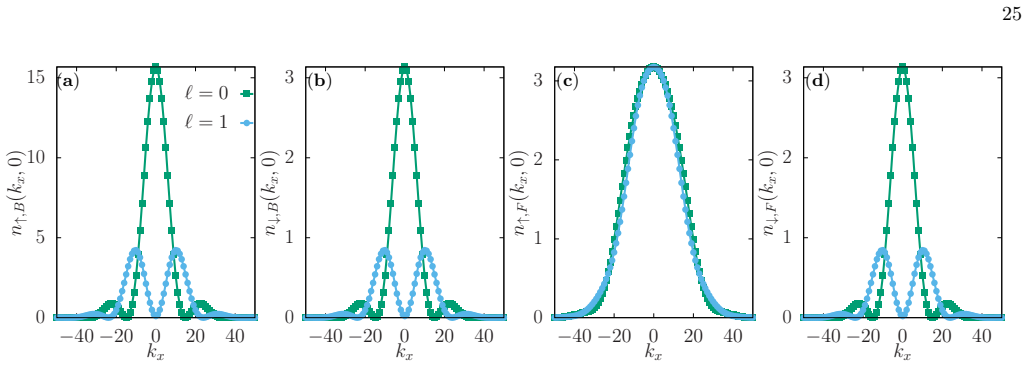
In the strongly repulsive limit the wavefunction factorizes into an orbital part—spinless fermions or a Tonks–Girardeau gas—and a spin part governed by a Heisenberg chain. For a single spin-down impurity among $N_p-1$ spin-up particles, the necklace Ansatz gives one spin eigenstate, $|\chi_n\rangle = N_p^{-1/2}\sum_{j=0}^{N_p-1} e^{-2\pi i n j/N_p}[P_{1\to N_p}]^j|\downarrow\uparrow\cdots\uparrow\rangle$, whose amplitudes wind by $2\pi n/N_p$. Inserted into the many-body wavefunction, this produces the exchange rule $\Psi(\ldots,x_j,x_l,\ldots)=e^{-i2\pi n/N_p}\Psi(\ldots,x_l,x_j,\ldots)$—exactly the anyonic exchange phase with $\theta=2\pi n/N_p$. The same phase appears in the one-body density matrix: the spin matrix element $\omega^\downarrow_{j,l}=e^{-i2\pi n(l-j)/N_p}$ equals the statistical factor $e^{-i\theta(l-j)}$ of a hard-core anyon, so the impurity correlator coincides with the anyonic Toeplitz determinant. Consequently the impurity momentum distribution reproduces the anyonic one at the discrete angles $\theta=2\pi n/N_p$, independently of whether the mixture is bosonic or fermionic for even $N_p$; the Tan contact obeys $C_{T,\downarrow}=C_0[1\pm\cos\theta]/2$; and the anyonic persistent current matches that of the full mixture.
Load-bearing premise
The argument hinges on the ground state of the mixture at each applied flux being the specific spin-wave state whose winding number matches the flux; if a different spin state were lower in energy, the impurity would exchange with a different phase and the exact match to anyons would be lost.
Editorial extensions
If this is right
- The impurity momentum distribution equals the anyonic one for every allowed statistical angle $\theta=2\pi n/N_p$, for both Fermi–Fermi and Bose–Bose mixtures and for odd or even particle number.
- For even $N_p$ the impurity distributions of bosonic and fermionic mixtures are identical, so the impurity's original statistics are fully transmuted and cannot be read off from its momentum distribution.
- Tan's contact of the impurity, measured from the $k^{-4}$ tail, is proportional to $1\pm\cos\theta$, giving a direct experimental readout of the statistical phase.
- The persistent current of the entire mixture coincides with that of anyons, so the fractional statistics is visible in a global transport quantity, not only in impurity correlations.
- A flux quench with a color-selective barrier coherently drives the system between distinct anyonized states, providing a reversible dynamical anyonization protocol.
Reading between the lines
- Because the supplementary analysis shows that species-dependent fluxes shift the spin-wave momentum continuously, unequal fluxes on impurity and majority would plausibly make the statistical angle continuously tunable, at the cost of exact wavefunction matching.
- The exact equivalence at strong coupling suggests a practical cold-atom test: measure $k^4 n_\downarrow(k)$ in a ring with synthetic flux; agreement with $C_0(1+\cos(2\pi/N_p))/2$ would confirm fractional exchange without braiding.
- Adding a second impurity would split the single necklace into multiple necklaces with different coefficients, so exact single-angle anyonization is likely lost; partial anyonic signatures may remain but would require a generalized multi-phase description.
- The Toeplitz-determinant form of the anyonic correlator may let one borrow asymptotic techniques from random-matrix theory to predict finite-size corrections to the impurity momentum distribution beyond the hard-core limit.
Editorial analysis
A structured set of objections, weighed in public.
Referee Report
Summary. The paper claims that a single impurity in a strongly repulsive one-dimensional two-component mixture on a flux-threaded ring acquires exact anyonic exchange statistics in the single-impurity limit. Using the necklace ansatz, the authors show that the many-body wavefunction acquires a fractional phase under exchange of the impurity with a majority particle, with the phase fixed by the angular momentum sector. They decompose the one-body density matrix into orbital and spin contributions and argue that it coincides term by term with the hard-core anyon correlator, yielding exact agreement of the impurity momentum distribution with the anyonic one, a Tan contact relation C_{T,↓} = C_0[1 \pm \cos\theta]/2, and a dynamical quench protocol for reversible anyonization. The supplement contains the Bethe-ansatz and necklace derivations, explicit Toeplitz determinants for the anyon correlators, exact-diagonalization checks, and extensions to lattice systems and persistent currents.
Significance. If the central equivalence holds, the result is significant: it provides an exact, parameter-free realization of anyonic exchange statistics in a continuum one-dimensional setting without introducing anyonic field operators, and it predicts measurable signatures in the momentum distribution, Tan contact, and persistent current. The paper's strengths include the direct algebraic mapping between the necklace spin amplitudes and the anyonic phase strings, exact-diagonalization confirmation for finite systems, and concrete falsifiable predictions. The sign and convention inconsistencies identified below sit at the hinge of the proof, but they appear fixable without changing the underlying physical construction.
major comments (3)
- [Eq. (9) and Supplement B, Eqs. (S.42)-(S.43)] The main-text Eq. (9) writes the anyonic correlator as \rho^\theta(x,x') = \sum_{j,l} (\pm1)^{j+l}\rho_{j,l}(x,x') e^{-i\theta_{B/F}(j-l)}. For x<x' and j<l, the derivation in the supplement gives the statistical factor e^{-i\theta(l-j)} (Eq. S.43), while the spin matrix element for the impurity is \omega_{j,l}^{\downarrow}=e^{-i2\pi n(l-j)/N_p}. Thus Eq. (9) as printed contains the complex-conjugate phase, and the asserted equality between the anyonic factor and the spin contribution does not follow from the displayed equations. This sign discrepancy must be resolved consistently across Eq. (7), Eq. (9), and the supplement before the exact-match claim can be accepted.
- [Eq. (4), Eq. (7), and Supplement S.4] The relation between the necklace quantum number n and the statistical angle \theta is stated inconsistently. The main text and Fig. 1 give exchange phase e^{-i2\pi n/N_p} and state \ell=n/N_p, which suggests \theta=2\pi n/N_p for both bosonic and fermionic mappings. However, Supplement S.4, Fig. 4 caption assigns for N_p=6 the pairs (\ell,n)=(0,3), (1/6,2), (2/6,1), (3/6,0) together with Fermi-mapped angles \theta=-\pi,-2\pi/3,-\pi/3,0. These assignments are incompatible with \ell=n/N_p and involve an additional \pi shift (the \theta_F^0 of Eq. (7)). The paper needs an explicit convention table mapping statistics, parity, \ell, n, and \theta so that the predicted anyonic angle for each flux sector is unambiguous.
- [Main text after Eq. (4)] The selection of the necklace sector for each flux is imported rather than derived: the paper states that "the spin sector is selected by retaining only the necklaces whose cyclic quantum number produces the required phase winding." This step is load-bearing because a different n yields a different exchange phase. I agree that a non-degenerate ground state must be a necklace eigenstate by translational symmetry, but the assignment n(\ell) must be justified either from the strong-coupling Bethe equations (as initiated in Supplement A) or by an explicit citation and verification of the prior results in Refs. [51,52] for the system sizes used in the figures.
minor comments (6)
- [Abstract] The abstract contains subject-verb agreement errors: "wavefunction ... display" should be "wavefunction ... displays," and "momentum distribution coincide" should be "momentum distribution coincides."
- [Eq. (7)] The notation in Eq. (7) is incomplete: the indices \sigma and m in \varphi_{\sigma,\theta}^m(x) are not defined before the determinant is introduced, and the relationship between \theta_B and \theta_F should be stated immediately before the equation rather than later in the text.
- [Reference [39]] Reference [39] contains the placeholder "Refs. FILL"; this must be replaced with the actual supplemental references before publication.
- [Fig. 2] The main text refers to "Young diagrams in Fig. 2(c)" when discussing symmetry sectors, but the Young diagrams appear in panel (b) of Fig. 2; the cross-reference should be corrected.
- [Supplement F, last paragraph] There is a typo in Supplement F: "spin ampltidues" should be "spin amplitudes."
- [Eq. (10) and Supplement C.3] Main-text Eq. (10) writes C_{T,\downarrow}=C_0[1\pm\cos\theta]/2, while the supplement derivation in Eq. (S.58) obtains C_{T,\downarrow}=C_0(1+\cos\theta)/2 with C_0 defined at \theta=0. The meaning of the \pm and the definition of C_0 for fermionic versus bosonic mixtures should be reconciled.
Circularity Check
No circularity: the anyonization claim is established by direct algebra from the necklace spin wavefunction and the hard-core anyon mapping, with no fitted parameters and with independent numerical checks.
full rationale
The paper's central equivalence is not circular. The mixture wavefunction is constructed from the Bethe-ansatz/necklace spin amplitudes (Eqs. 2, 3, S.2, S.3), whose exchange phase e^{-i2πn/Np} is fixed by the cyclic symmetry [H,P]=0 (Supplement D). The anyonic wavefunction is independently built from the reference fermion/TG wavefunction times the ordering factor A(x_j-x_l) (Eqs. 6, S.4-S.7). The claimed 'exact anyonic statistics' is then the identification of these two separately derived phase structures, θ=2πn/Np, rather than an assumption of the result. The one-body correlator comparison (Eqs. 8 vs 9, and Supplement B, S.36-S.43) is an algebraic identity after this identification: the spin matrix element ω^↓_{j,l}=e^{-i2πn(l-j)/Np} equals the anyonic statistical factor e^{-iθ(l-j)}. No parameter is fitted to the momentum distribution or Tan's contact; those quantities are computed from the mapped correlator and checked against exact diagonalization (Figs. 2, 7, 8) and against the derived contact formula Eq. (10). Self-citations ([35] for the necklace ansatz, [51,52] for angular-momentum fractionalization) are used as tools, but the needed spin-wave structure and the n-ℓ relation are rederived in the supplement from BA quantum numbers and the commutator [H,P]=0, so the argument does not reduce to an unverified self-citation. The apparent sign discrepancy between Eq. (9) and Eq. (S.43), and the inconsistent n-ℓ-θ assignments noted in the skeptical summary, are algebraic consistency issues that would affect correctness of the printed equations, not circularity of the derivation; they do not change the structural independence of the mapping. The placeholder '[39] See Supplemental Material which includes Refs. FILL' is a production artifact, not a circular step. Overall, the derivation is self-contained and the claimed equivalence is a genuine result rather than a restatement of the inputs.
Assumptions & free parameters
assumptions (5)
- domain assumption Spin-charge separation in the limit of infinite repulsion: the many-body wavefunction factorizes into an orbital spinless-fermion/TG wavefunction and a spin wavefunction governed by an effective Heisenberg Hamiltonian.
- domain assumption The ground state of the mixture in a given flux sector is the necklace (cyclic) eigenstate with winding number ℓ = n/N_p, i.e., the spin quantum numbers satisfy Eq. (S.8).
- standard math The necklace ansatz coefficients within a necklace are related by pure phase factors fixed by the cyclic permutation operator, a_{q,j} = c_q e^{-2π i n j/N_p}.
- standard math The hard-core anyonic one-body correlator formulas of Santachiara-Calabrese [10,27] and the extension to even particle numbers (with center-of-mass shift) are correct.
- standard math The momentum distribution of the mixture is computed via the exact one-body density matrix Eq. (8) with spin matrix elements ω_{j,l}^↓ = e^{-2π i n(l-j)/N_p}.
Cite this review
Pith. "Pith review of Exact statistical transmutation of quantum mixtures on a ring." pith.science (2026). https://pith.science/paper/U4YCPHON
@misc{pith2026260805290,
  author       = {Pith},
  title        = {Pith review of: Exact statistical transmutation of quantum mixtures on a ring},
  year         = {2026},
  howpublished = {\url{https://pith.science/paper/U4YCPHON}},
  note         = {Machine review of arXiv:2608.05290}
}
read the original abstract
One-dimensional strongly repulsive quantum mixtures exhibit non-trivial exchange statistics arising from the interplay between orbital and spin degrees of freedom. Using an exact solution, we demonstrate that in the single-impurity limit the wavefunction of Fermi-Fermi and Bose-Bose mixtures on a ring threaded by an artificial gauge field display exact anyonic statistics under exchange of the impurity with the majority particles. The resulting fractional exchange phase is fixed by the angular momentum sector selected through the applied flux. We find that the impurity momentum distribution coincide exactly with the anyonic one, independently of the bosonic or fermionic nature of the mixture, with the large-momentum tails encoding a direct signature of the anyonic statistical angle. Finally, we devise a quench protocol for reversible dynamical anyonization. Our results provide a path for realizing and manipulating anyonized states with ultracold atoms.
Figures


Figures from the paper (16 more)




Reference graph
Works this paper leans on
- [39]
-
[1]
P. A. M. Dirac, Proceedings of the Royal Society of Lon- don. Series A112, 661 (1926)
1926
-
[2]
J. M. Leinaas and J. Myrheim, Il Nuovo Cimento B (1971-1996)37, 1 (1977)
1977
-
[3]
Wilczek, Physical Review Letters49, 957 (1982)
F. Wilczek, Physical Review Letters49, 957 (1982)
1982
-
[4]
Khare,Fractional Statistics and Quantum Theory, 2nd ed
A. Khare,Fractional Statistics and Quantum Theory, 2nd ed. (World Scientific, 2005)
2005
-
[5]
Kundu, Physical Review Letters83, 1275 (1999)
A. Kundu, Physical Review Letters83, 1275 (1999)
work page 1999
-
[6]
M. D. Girardeau, Physical Review Letters97, 100402 (2006)
work page 2006
- [7]
Show all 84 references
-
[8]
M. T. Batchelor, X.-W. Guan, and N. Oelkers, Physical Review Letters96, 210402 (2006)
2006
-
[9]
M. T. Batchelor, X.-W. Guan, and J.-S. He, Journal of Statistical Mechanics: Theory and Experiment2007, P03007 (2007)
2007
-
[10]
Santachiara and P
R. Santachiara and P. Calabrese, Journal of Statisti- cal Mechanics: Theory and Experiment2008, P06005 (2008). 6
2008
-
[11]
Amico, A
L. Amico, A. Osterloh, and U. Eckern, Physical Review B58, R1703(R) (1998)
1998
-
[12]
Osterloh, L
A. Osterloh, L. Amico, and U. Eckern, Journal of Physics A: Mathematical and General33, L87 (2000)
2000
-
[13]
Greschner and L
S. Greschner and L. Santos, Physical Review Letters115, 053002 (2015)
2015
-
[14]
Bonkhoff, K
M. Bonkhoff, K. J¨ agering, S. Hu, A. Pelster, S. Eggert, and I. Schneider, Physical Review Letters135, 036601 (2025)
2025
-
[15]
Forte, Reviews of Modern Physics64, 193 (1992)
S. Forte, Reviews of Modern Physics64, 193 (1992)
1992
-
[16]
Stern, Annals of Physics323, 204 (2008), january Spe- cial Issue 2008
A. Stern, Annals of Physics323, 204 (2008), january Spe- cial Issue 2008
2008
-
[17]
Greiter and F
M. Greiter and F. Wilczek, Annual Review of Condensed Matter Physics15, 131–157 (2024)
2024
-
[18]
Wilczek,Fractional Statistics and Anyon Supercon- ductivity(World Scientific, 1990)
F. Wilczek,Fractional Statistics and Anyon Supercon- ductivity(World Scientific, 1990)
1990
-
[19]
Nayak, S
C. Nayak, S. H. Simon, A. Stern, M. Freedman, and S. Das Sarma, Reviews of Modern Physics80, 1083 (2008)
2008
-
[20]
Arovas, J
D. Arovas, J. R. Schrieffer, and F. Wilczek, Physical Review Letters53, 722 (1984)
1984
-
[21]
Kitaev, Annals of Physics303, 2 (2003)
A. Kitaev, Annals of Physics303, 2 (2003)
2003
-
[22]
Bartolomei, M
H. Bartolomei, M. Kumar, R. Bisognin, A. Marguerite, J.-M. Berroir, E. Bocquillon, B. Pla¸ cais, A. Cavanna, Q. Dong, U. Gennser, Y. Jin, and G. F` eve, Science368, 173 (2020)
2020
-
[23]
J. Kwan, P. Segura, Y. Li, S. Kim, A. V. Gorshkov, A. Eckardt, B. Bakkali-Hassani, and M. Greiner, Sci- ence386, 1055 (2024)
2024
-
[24]
F. D. M. Haldane, Physical Review Letters67, 937 (1991)
1991
-
[25]
Ha, Nuclear Physics B435, 604 (1995)
Z. Ha, Nuclear Physics B435, 604 (1995)
1995
-
[26]
Scopa, L
S. Scopa, L. Piroli, and P. Calabrese, Journal of Statis- tical Mechanics: Theory and Experiment2020, 093103 (2020)
2020
-
[27]
Santachiara, F
R. Santachiara, F. Stauffer, and D. C. Cabra, Journal of Statistical Mechanics: Theory and Experiment2007, L05003 (2007)
2007
-
[28]
O. I. Pˆ at ¸u, V. E. Korepin, and D. V. Averin, Journal of Physics A: Mathematical and Theoretical40, 14963 (2007)
2007
-
[29]
Y. Hao, Y. Zhang, and S. Chen, Physical Review A78, 023631 (2008)
2008
-
[30]
Y. Hao, Y. Zhang, and S. Chen, Physical Review A79, 043633 (2009)
2009
-
[31]
Gamayun, O
O. Gamayun, O. Lychkovskiy, and M. Zvonarev, SciPost Physics8, 053 (2020)
2020
-
[32]
Gamayun, E
O. Gamayun, E. Quinn, K. Bidzhiev, and M. B. Zvonarev, Physical Review A109, 012209 (2024)
2024
-
[33]
S. Dhar, B. Wang, M. Horvath, A. Vashisht, Y. Zeng, M. B. Zvonarev, N. Goldman, Y. Guo, M. Landini, and H.-C. N¨ agerl, Nature642, 53 (2025)
2025
-
[34]
B. Wang, A. Vashisht, Y. Guo, S. Dhar, M. Landini, H.- C. N¨ agerl, and N. Goldman, Physical Review Letters 135, 253403 (2025)
2025
-
[35]
Aupetit-Diallo, G
G. Aupetit-Diallo, G. Pecci, A. G. Volosniev, M. Albert, A. Minguzzi, and P. Vignolo, SciPost Physics Core8, 022 (2025)
2025
-
[36]
Gaudin, Physics Letters A24, 55 (1967)
M. Gaudin, Physics Letters A24, 55 (1967)
1967
-
[37]
C. N. Yang, Physical Review Letters19, 1312 (1967)
1967
-
[38]
Oelkers, M
N. Oelkers, M. T. Batchelor, M. Bortz, and X.-W. Guan, Journal of Physics A: Mathematical and General39, 1073 (2006)
2006
-
[40]
Ogata and H
M. Ogata and H. Shiba, Physical Review B41, 2326 (1990)
1990
-
[41]
Deuretzbacher, K
F. Deuretzbacher, K. Fredenhagen, D. Becker, K. Bongs, K. Sengstock, and D. Pfannkuche, Physical Review Let- ters100, 160405 (2008)
2008
-
[42]
Deuretzbacher, D
F. Deuretzbacher, D. Becker, and L. Santos, Physical Review A94, 023606 (2016)
2016
-
[43]
Osterloh, J
A. Osterloh, J. Polo, W. J. Chetcuti, and L. Amico, SciPost Physics15, 006 (2023)
2023
-
[44]
Girardeau, Journal of Mathematical Physics1, 516 (1960)
M. Girardeau, Journal of Mathematical Physics1, 516 (1960)
1960
-
[45]
Amico, M
L. Amico, M. Boshier, G. Birkl, A. Minguzzi, C. Miniatura, L.-C. Kwek, D. Aghamalyan, V. Ahufinger, D. Anderson, N. Andrei,et al., A VS Quantum Science3, 039201 (2021)
2021
-
[46]
Amico, D
L. Amico, D. Anderson, M. Boshier, J.-P. Brantut, L.-C. Kwek, A. Minguzzi, and W. von Klitzing, Reviews of Modern Physics94, 041001 (2022)
2022
-
[47]
Dalibard, F
J. Dalibard, F. Gerbier, G. Juzeli¯ unas, and P. ¨Ohberg, Reviews of Modern Physics83, 1523 (2011)
2011
-
[48]
J. Polo, W. Chetcuti, T. Haug, A. Minguzzi, K. Wright, and L. Amico, Physics Reports1137, 1 (2025), persistent currents in ultracold gases
2025
-
[49]
Dephasing and Non-Dephasing Collisions in Nanostructures,
A. J. Leggett, “Dephasing and Non-Dephasing Collisions in Nanostructures,” inGranular Nanoelectronics, edited by D. K. Ferry, J. R. Barker, and C. Jacoboni (Springer US, Boston, MA, 1991) pp. 297–311
1991
-
[50]
Yu and M
N. Yu and M. Fowler, Physical Review B45, 11795 (1992)
1992
-
[51]
W. J. Chetcuti, T. Haug, L.-C. Kwek, and L. Amico, SciPost Physics12, 033 (2022)
2022
-
[52]
Pecci, G
G. Pecci, G. Aupetit-Diallo, M. Albert, P. Vignolo, and A. Minguzzi, Comptes Rendus. Physique24, 87 (2023)
2023
-
[53]
Equivalently, the algebra may be formulated utilizing bosonic anyonic commutation rules, which differ from the fermionic ones by aπshift of the statistical parameter
-
[54]
Interferometric probe for the zeros of the many-body wavefunction,
W. J. Chetcuti, A. Minguzzi, J. Polo, and L. Amico, “Interferometric probe for the zeros of the many-body wavefunction,” (2025), arXiv:2512.13795
2025
-
[55]
This loss of statistical identity is confined to the impu- rity, as the momentum distributions of the majority com- ponent remain distinguishable in bosonic and fermionic mixtures
-
[56]
Musolino, M
S. Musolino, M. Albert, A. Minguzzi, and P. Vignolo, Physical Review Letters133, 183402 (2024)
2024
-
[57]
Musolino, M
S. Musolino, M. Albert, P. Vignolo, and A. Minguzzi, Physical Review A112, 063308 (2025)
2025
-
[58]
J. Polo, W. J. Chetcuti, A. Minguzzi, A. Osterloh, and L. Amico, Physical Review Research8, L022015 (2026)
2026
-
[59]
P. Lunt, P. Hill, J. Reiter, P. M. Preiss, M. Ga lka, and S. Jochim, Physical Review A110, 063315 (2024)
2024
-
[60]
P. Lunt, P. Hill, J. Reiter, P. M. Preiss, M. Ga lka, and S. Jochim, Physical Review Letters133, 253401 (2024)
2024
-
[61]
Deguchi, F
T. Deguchi, F. Essler, F. G¨ ohmann, A. Kl¨ umper, V. Ko- repin, and K. Kusakabe, Physics Reports331, 197 (2000)
2000
-
[62]
The Quantum Inverse Scattering Method,
V. E. Korepin, N. M. Bogoliubov, and A. G. Izergin, “The Quantum Inverse Scattering Method,” inQuan- tum Inverse Scattering Method and Correlation Func- tions, Cambridge Monographs on Mathematical Physics (Cambridge University Press, 1993) p. 115–136
1993
-
[63]
F. H. L. Essler, H. Frahm, F. G¨ ohmann, A. Kl¨ umper, 7 and V. E. Korepin,The One-Dimensional Hubbard Model (Cambridge University Press, 2005)
2005
-
[64]
Here, we restrict the discussion to even Np that will be addressed later
This correspondence depends crucially on particle- number parity. Here, we restrict the discussion to even Np that will be addressed later
-
[65]
P. J. Forrester, N. E. Frankel, T. M. Garoni, and N. S. Witte, Physical Review A67, 043607 (2003)
2003
-
[66]
B. S. Shastry and B. Sutherland, Physical Review Letters 65, 243 (1990)
1990
-
[67]
W. J. Chetcuti, A. Osterloh, L. Amico, and J. Polo, SciPost Physics15, 181 (2023)
2023
-
[68]
Keilmann, S
T. Keilmann, S. Lanzmich, I. McCulloch, and M. Roncaglia, Nature Communications2(2011), 10.1038/ncomms1353
2011 doi
-
[69]
Peierls, Zeitschrift f¨ ur Physik80, 763 (1933)
R. Peierls, Zeitschrift f¨ ur Physik80, 763 (1933). 8 SUPPLEMENT AL MA TERIAL FOR ‘EXACT ST A TISTICAL TRANSMUT A TION OF QUANTUM MIXTURES ON A RING A. Many-body and conditional wavefunctions In this section, we begin with the Bethe Ansatz many-body wavefunction and show how i...
1933
-
[70]
, αNp ), which play the role of an effective spin [36–38, 61]
Bethe Ansatz wavefunction for imbalanced Bose-Bose and Fermi-Fermi mixtures To begin, we consider the Bethe Ansatz wavefunction for a mixture ofNp bosons or fermions in a one-dimensional ring with two internal states, denoted byα= (α 1, . . . , αNp ), which play the role of an...
-
[71]
For fixed magnetizationM, the spin Hilbert space containsN q = Np M snippets (sectors)
Necklace Ansatz wavefunction for imbalanced Fermi-Fermi and Bose-Bose mixtures An equivalent but alternative construction to Bethe Ansatz is provided by the necklace Ansatz [35], which groups together all snippets connected by successive application of the full cyclic permutat...
-
[72]
, xNp ) = Y j<l Aθ(xj −x l) ΨR 0 (x1,
Link of the hard-core anyons wavefunction to the necklace Ansatz one The ground-state wavefunction of hard-core anyons [8, 10, 27], constructed through either a Fermi- or Bose-anyon mapping, can be written as Ψθ 0(x1, . . . , xNp ) = Y j<l Aθ(xj −x l) ΨR 0 (x1, . . . , ...
-
[73]
Conditional one-particle wavefunctions Further insight is provided by the conditional one-particle wavefunction shown in Fig. 4. Focusing on Fermi-mapped anyons, atθ= 0 the wavefunction exhibits the characteristicN p −1 nodes associated with fermionic statistics. At θ=π, corre...
-
[74]
Comparison between mixtures and anyons In this section, we present the momentum distributions of the spin-up and spin-down components, calculated exactly for both bosonic and fermionic mixtures using Eq. (S.36). We compare these results with the anyonic momentum distribution o...
-
[75]
Anyonization at finite interactions and lattice fillings The comparison presented so far between the impurity momentum distribution and that of hard-core anyons has focused on the strongly interacting regime, where the correspondence becomes exact. At weak and intermediate int...
-
[76]
The following derivation follows Ref
Large momentum tails and Tan ’s relation Momentum-distribution tails provide a direct probe of the anyonic phase acquired under particle exchange. The following derivation follows Ref. [56], where these arguments are presented in greater detail. After integrating out the orbit...
-
[77]
Hence, u↓ j (Pj,j+1 +I)|l⟩= 0, l̸=j, l̸=j+ 1.(S.52)
The down spin is neither at sitejnor at sitej+ 1:| · · · ↑j↑j+1 · · · ⟩. Hence, u↓ j (Pj,j+1 +I)|l⟩= 0, l̸=j, l̸=j+ 1.(S.52)
-
[78]
Therefore, u↓ j (Pj,j+1 +I)|j⟩=|j+ 1⟩+|j⟩.(S.53)
The down spin is at sitej:| · · · ↓j↑j+1 · · · ⟩. Therefore, u↓ j (Pj,j+1 +I)|j⟩=|j+ 1⟩+|j⟩.(S.53)
-
[79]
Therefore, u↓ j (Pj,j+1 +I)|j+ 1⟩=|j⟩+|j+ 1⟩.(S.54) Combining these three cases, u↓ j (Pj,j+1 +I)|l⟩= 0, l̸=j, l̸=j+ 1, |j⟩+|j+ 1⟩, l=j, |j⟩+|j+ 1⟩, l=j+ 1
The down spin is at sitej+ 1:| · · · ↑j↓j+1 · · · ⟩. Therefore, u↓ j (Pj,j+1 +I)|j+ 1⟩=|j⟩+|j+ 1⟩.(S.54) Combining these three cases, u↓ j (Pj,j+1 +I)|l⟩= 0, l̸=j, l̸=j+ 1, |j⟩+|j+ 1⟩, l=j, |j⟩+|j+ 1⟩, l=j+ 1. (S.55) Equivalently, for a fixed impurity positionl, on...
-
[80]
In the main text, we considered a symmetry-breaking barrier and demonstrated the transition from theℓ= 0 branch to theℓ= 1/6 branch
Dynamical anyonization Dynamical anyonization is induced by suddenly quenching the flux to an avoided crossing opened by a localized barrier. In the main text, we considered a symmetry-breaking barrier and demonstrated the transition from theℓ= 0 branch to theℓ= 1/6 branch. He...
-
[81]
Ring geometry Exact anyonization relies on the periodic geometry of the ring, which endows the spin sector with cyclic translational symmetry. The necklace states are eigenstates of the full cyclic permutation operatorP 1→Np and can be chosen as simultaneous eigenstates of the...
-
[82]
Artificial gauge field In our setup, the flux threading the ring couples identically to the spin-up and spin-down particles, a necessary requirement for exact anyonization. If the flux acts on only one component, or has different strengths for the two, the system may still exh...
-
[83]
Statistical transmutation: odd versus even particle numbers As discussed previously, the correspondence between the impurity momentum distributions of bosonic and fermionic mixtures depends on the parity of the particle number. For evenN p, exact statistical transmutation occu...
-
[84]
All configurations belong to a single necklace, and each exchange of the impurity with a background particle multiplies the spin amplitude by the same phase
Single impurity Exact anyonization is restricted to the single-impurity limit because every spin configuration is then specified solely by the position of the impurity in the ordered particle chain. All configurations belong to a single necklace, and each exchange of the impur...
Reviewed August 8, 2026 · model on record in the stance chip above.
Discussion (0). Continue with ORCID to comment.