REVIEW 3 major objections 5 minor 62 references
Expanding stellar associations as Galactic accelerometers
T0 review · 3 major / 5 minor · reviewed 2026-08-08 · deepseek-v4-flash
Pith's one-line read Expanding young star clusters can be rewound to weigh the Milky Way's gravitational potential.
desk verdict A clean, honest proof-of-concept for a new local potential probe; read the abstract precision numbers as in-sample, not yet as Milky Way constraints. read the letter →
The pith
A machine-rendered reading of the paper's core claim, the machinery that carries it, and where it could break.
The reading
What carries the argument
The central object is the position covariance matrix C of the association's member stars, summarized by the trace tr = Tr(C)^(1/2) and the determinant det = det(C)^(1/6), which measure the association's size as it evolves backward. The machinery is orbit integration in trial parametric potentials, namely a spherical NFW dark halo, a Miyamoto-Nagai disk, a bulge, and a nucleus, with the minimum of tr or det as the objective function. The trace behaves smoothly under noise; the determinant responds to contraction in any dimension but is numerically stiff and dominated by sample variance. The same covariance evolution defines the traceback ages tau_tr and tau_det, making the potential and the age jointly inferable.
What would settle it
Run the inference on synthetic associations generated from a simulated Milky-Way-like galaxy that includes a bar and spiral arms, fitting only the static axisymmetric family; if the recovered halo mass and concentration are offset from the true input values by more than the quoted uncertainties, the central premise fails in realistic potentials. A purely observational check is to take a real association with an independent isochronal age and near-future data, and test whether the potential that minimizes the covariance also makes the traceback age agree with the isochronal age to within the combined uncertainty.
Extended reading notes
Core claim
The central discovery is a new inference criterion: the true Galactic potential is the one that minimizes the trace or determinant of the position covariance matrix of an expanding young stellar association when its member orbits are integrated backward to birth. The same observed present-day positions and velocities are used in every trial potential; only the potential changes. In the true potential the members reconverge to the most compact configuration, and the time of that minimum is the dynamical traceback age. With near-future data the minimum-trace criterion can distinguish halo masses, concentrations, and disk masses, though with strong degeneracies; the determinant is sharper for true three-dimensional focusing but noisier. A second, complementary route infers the potential by requiring the dynamical traceback age to match an independently measured stellar age.
Load-bearing premise
The inference is only valid if the true Milky Way potential is well described by the assumed static, axisymmetric family, namely a spherical NFW dark halo plus a single smooth Miyamoto-Nagai disk, over the association's 20 to 60 million year lifetime, and the paper itself concedes that the single-disk treatment is 'certainly not accurate'.
Editorial extensions
If this is right
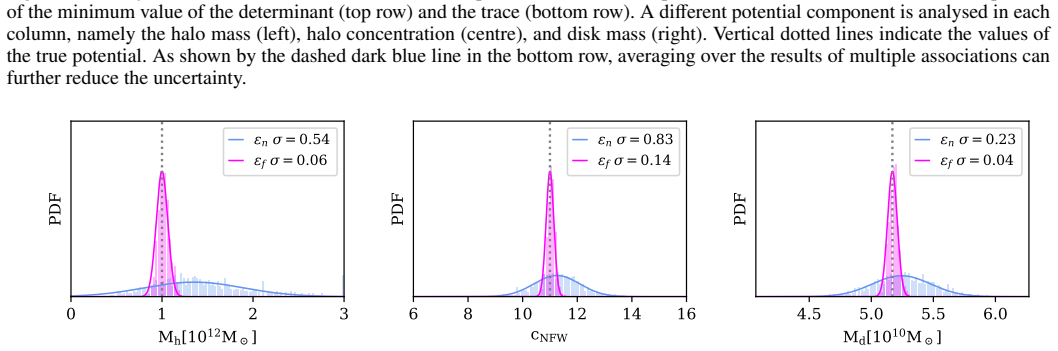
- With 'next'-generation errors (astrometry at the 10 microarcsecond level and radial velocities at 0.2 km/s), a single association can constrain the halo mass with an uncertainty of about 5.4 x 10^11 solar masses, the halo concentration with an uncertainty of about 0.83, and the disk mass with an uncertainty of about 2.3 x 10^9 solar masses, when each parameter is fitted alone.
- With further-improved 'future' errors (2.5 microarcsecond astrometry and 0.025 km/s radial velocities), these single-association uncertainties drop to about 6 x 10^10 solar masses, 0.14, and 4 x 10^8 solar masses respectively.
- The inferred dynamical traceback age depends on the assumed potential; at 'next' precision the systematic age error from potential uncertainty can exceed the statistical error, so traceback-age estimates are not independent of the potential.
- An independent age measurement, such as an isochronal age, can be used as a second likelihood: the correct potential is the one in which the traceback age best matches the independent age.
- Degeneracies between halo mass, halo concentration, and disk mass persist, but they align with physically meaningful local quantities such as the circular velocity at the Sun, the radial tidal tensor, and the Oort constant, so combining multiple associations or independent priors can break them.
Reading between the lines
- As an extension of the paper's logic, the covariance-minimum criterion is effectively a measurement of the local acceleration and tidal tensor, so any departure from the assumed parametric potential family, such as a bar, spiral arms, or disequilibrium disk motions, would bias the results regardless of observational precision.
- The same criterion could be applied to older structures or to cluster families that share a common origin, allowing radial velocities to be averaged over many members and relaxing the per-star precision requirement.
- The potential-dependence of traceback ages implies that published dynamical ages carry hidden model dependence; a systematic comparison with isochronal ages across many associations could map local variations in the Galactic potential rather than merely measuring a global halo.
- If an independent age is available, the two inference routes of minimum size and age matching become a powerful consistency test, and a significant disagreement between them would flag missing physics such as non-axisymmetric forces or kinematic contamination.
Editorial analysis
A structured set of objections, weighed in public.
Referee Report
Summary. The paper proposes a novel method to constrain the Milky Way's gravitational potential using expanding young stellar associations. The method relies on the physical prior that association members share a compact birth region: when the observed stellar orbits are integrated backward in a trial potential, the true potential is argued to be the one that minimizes a measure of the association's concentration, specifically the trace or determinant of the position covariance matrix. The authors generate synthetic associations by forward integration in a parametric static, axisymmetric potential (NFW halo plus Miyamoto-Nagai disk, bulge, and nucleus) and add observational errors according to three budgets ('current', 'next', 'future'). They show that with 'next' errors (Gaia DR4-like astrometry plus radial velocities of 0.2 km/s) a single association can recover the halo mass and concentration to within roughly 0.5e12 Msun and 0.8, respectively, under one-parameter variations, while current errors are too large. They also demonstrate that the dynamical traceback age depends on the assumed potential and can itself be used to constrain the potential when an independent age is available.
Significance. If the forecast precision were robust to real-world model misspecification, the method would offer a genuinely complementary probe of the local gravitational acceleration and tidal field, with systematics very different from rotation curves, stellar streams, and satellite dynamics. The paper is notable for its careful synthetic experiments: it uses Monte Carlo sampling to propagate three explicit observational error budgets, publishes documented reproduction code, and is unusually transparent about the limitations of the adopted potential model in Section 5.3. The demonstration that traceback ages are not independent of the assumed potential is a valuable and transferable result. However, the headline precision estimates are currently in-sample quantities, derived from the same parametric potential family and integrator used to generate the mock data, and the paper does not test the method against an independent, more realistic Galactic potential. This gap prevents the quantitative claims from being taken at face value for the real Milky Way.
major comments (3)
- [§4.1, Fig. 5, §5.3] The quoted precisions for the halo mass and concentration (σ(M_h)=5.4×10^11 M⊙, σ(c_NFW)=0.83 with 'next' errors) are derived from mock associations generated by forward integration in the same parametric potential model (Table 3) and then fitted with the same parametric family and the same Gala integration code. This is a closed-box test: the data-generation and inference procedures share the same model family and the same numerical machinery. As the authors note in §5.3, the assumed static, axisymmetric, single-disk model is 'certainly not accurate' for the Milky Way, and constraints on the potential are dependent on the assumed parametrisation. The covariance-minimum criterion responds to the local tidal tensor along the association's orbit, so any unmodelled contributions from the bar, spiral arms, non-axisymmetric halo, or non-equilibrium disk motions will shift the best-fit parameters, potentially by more than the quoted statistical uncertainties regardless of per-star measurement precision. The authors should validate the method on mock data generated from an independent, more realistic potential model (e.g., including a bar or spiral arms or a multi-component disk), or with an independent integrator, to quantify the systematic bias. At minimum, the abstract and §4.1 must clearly state that the quoted precisions are in-sample and conditional on the assumed parametric family. This is the central load-bearing issue for the paper's main claim.
- [§4.1, Fig. 5] The histograms in Figure 5 are labelled 'posterior distributions', but no likelihood is defined for the size-based inference. The text describes drawing 1000 samples from a uniform distribution over each potential parameter and fitting Gaussian curves to the 'raw data', which is more consistent with an ensemble of best-fit parameter values (the argmin of trmin across sampled potentials for each Monte Carlo realization of the data) than with a Bayesian posterior. The quoted 1σ widths therefore do not have the usual posterior-probability interpretation. The authors should either derive a proper likelihood for the covariance-minimum statistic (for example via the sampling distribution of trmin as a function of the potential parameters) or explicitly relabel these as 'distributions of inferred parameters' and explain that the σ values represent the scatter of the point estimate over data realizations. Because the abstract's precision numbers are drawn from these σ values, the statistical interpretation needs to be corrected.
- [Abstract, §4.1] The abstract states that with Gaia DR4 astrometry and radial velocities below 0.2 km/s, 'the halo mass can be constrained with a precision of <0.6×10^12 M⊙ and the concentration with a precision of <0.8 using a single association'. In §4.1, however, these are explicitly described as idealized one-parameter constraints, obtained with all other potential parameters fixed, and the text notes that these values 'should be interpreted as idealised one-parameter constraints'. The abstract should carry this qualification as well; without it, the reader may reasonably interpret the numbers as joint constraints on the full potential, which the paper itself shows are not achievable even with 'next' errors due to the degeneracies described in §4.2. Adding a short phrase such as 'in the idealized case where the other potential parameters are known' would resolve the discrepancy.
minor comments (5)
- [Abstract] The abstract in the arXiv version states a precision of '0.6 trillion solar masses' while the full-text abstract says '<0.6×10^12 M⊙'; the two versions should be made consistent, and the '<' symbol should be used consistently with the reported σ values in §4.1.
- [§3.2 / Conclusion] The 'next' error budget in Table 2 sets σ_RV=0.2 km/s, but the abstract says 'below 0.2 km/s' and the conclusion says 'to the level of ~0.2 km/s'; please unify the threshold language.
- [§2.1] The symbols 'tr' and 'det' are used both for the linearized size measures (tr=Tr^{1/2}, det=Det^{1/6}) and for the time-dependent functions in Figures 1 and 2; a distinct notation would avoid confusion.
- [Table 4] The two blocks of Table 4 share identical default rows, and the note explains this, but the layout makes it easy to misread the 'Effects of the potential' rows as independent from the 'Intrinsic properties' rows; consider merging or adding a separate default row with a clear label.
- [Figure 3] The panels of Figure 3 are not labelled (a)-(f) etc.; adding panel labels and referring to them individually in the text would significantly improve readability.
Circularity Check
No significant circularity: the synthetic recovery experiment forward-generates associations in a known potential and then infers that potential by backward integration, so the headline precision figures are in-sample forecasts rather than fitted inputs renamed as predictions.
full rationale
The paper's inference chain is not circular. In Section 3, mock associations are generated by integrating the association centre backward in the assumed true potential to the birth time, sampling member positions and velocities with specified dispersions, then integrating forward again in the same potential, and finally convolving with assumed observational errors. The backwards inference then uses the same observed phase-space coordinates in different trial potentials and compares the minima of trace and determinant of the position covariance matrix. The 'true potential' is the one used in the forward generation, so its recovery is a genuine test of the method rather than a definitional tautology. No fitted parameter is renamed as a prediction: the quoted uncertainties, such as sigma(M_h)=5.4e11 Msun with 'next' errors, are derived from Monte Carlo realisations and Gaussian fits to posterior distributions obtained by varying trial potentials while holding the true potential fixed; they are not calibrated to force agreement. Self-citations (Sawala et al. 2016, 2023a,b, 2025; Miret-Roig et al. 2018, 2020, 2022, 2024) are contextual and not load-bearing. The acknowledged caveats in Section 5.3, notably that the static axisymmetric single-disk parametrisation is 'certainly not accurate' and that constraints are 'dependent on the assumed parametrisation', are robustness/correctness concerns about applying the method to the real Milky Way, not circularity in the demonstrated synthetic inference. The paper itself is transparent that this is a proof-of-concept with synthetic associations, and it does not claim external validation beyond its own forward model.
Assumptions & free parameters
free parameters (4)
- Default halo mass M_h =
1.0 x 10^12 Msun
- Default halo concentration c_NFW =
11
- Default disk mass M_d =
5.2 x 10^10 Msun
- Future observational error budget =
sigma_RV = 0.025 km/s, sigma_astrometry = 2.5 uas
assumptions (4)
- domain assumption The Galactic potential is static and axisymmetric over the association's lifetime
- domain assumption The halo is spherical and the disk is a single smooth Miyamoto-Nagai disk
- domain assumption Stars in an association share a common, compact origin much smaller than the present extent
- domain assumption Observational errors are independent and Gaussian
Cite this review
Pith. "Pith review of Expanding stellar associations as Galactic accelerometers." pith.science (2026). https://pith.science/paper/2JFJXWOM
@misc{pith2026260805297,
  author       = {Pith},
  title        = {Pith review of: Expanding stellar associations as Galactic accelerometers},
  year         = {2026},
  howpublished = {\url{https://pith.science/paper/2JFJXWOM}},
  note         = {Machine review of arXiv:2608.05297}
}
read the original abstract
The gravitational potential of the Milky Way is fundamental for understanding the evolution of our Galaxy and the nature of dark matter. We introduce a new method to constrain the Galactic potential using expanding young stellar associations. We exploit the physical constraint that these stars share a common, compact origin to reconstruct their most likely orbits and infer the gravitational potential in which they have evolved. We define the size of an association using the trace and determinant of its position covariance matrix. By integrating synthetic associations backward in different trial potentials, we show how the true potential can be identified as the one that minimises these metrics. We demonstrate that, while current observational errors are still too large, upcoming observations will allow us to distinguish between different potentials. Our results suggest that with Gaia DR4 astrometry and radial velocity errors below 0.2 km/s, the halo mass can be constrained with a precision of 0.6 trillion solar masses and the concentration with a precision of < 0.8 using a single association, albeit with significant degeneracies. In addition, we show that the inferred dynamical traceback age is sensitive to the gravitational potential, suggesting that independent age information can help break existing degeneracies, but also that traceback-age estimates are not independent of the assumed potential. Expanding stellar associations carry information about the gravitational potential in which they have evolved. With the arrival of next-generation astrometry and high-precision radial velocities, they will provide a complementary tool for constraining the Galactic potential.
Figures


Figures from the paper (5 more)



Reference graph
Works this paper leans on
-
[1]
Ablimit, I., Zhao, G., Flynn, C., & Bird, S. A. 2020, ApJ, 895, L12
work page 2020
-
[2]
Ambartsumian, V . A. 1947, Stellar Evolution and Astrophysics (Armenian Academy of Sciences)
work page 1947
-
[3]
2018, Nature, 561, 360
Antoja, T., Helmi, A., Romero-Gómez, M., et al. 2018, Nature, 561, 360
2018
-
[4]
2023, A&A, 673, A115
Antoja, T., Ramos, P., García-Conde, B., et al. 2023, A&A, 673, A115
2023
- [5]
-
[6]
& Price-Whelan, A
Bonaca, A. & Price-Whelan, A. M. 2025, New A Rev., 100, 101713
2025
- [7]
-
[8]
K., & Kallivayalil, N
Bovy, J., Bahmanyar, A., Fritz, T. K., & Kallivayalil, N. 2016, ApJ, 833, 31
2016
Show all 62 references
-
[9]
M., Cautun, M., Deason, A
Callingham, T. M., Cautun, M., Deason, A. J., et al. 2019, MNRAS, 484, 5453
2019
-
[10]
J., et al
Cantat-Gaudin, T., Jordi, C., Wright, N. J., et al. 2019, A&A, 626, A17
2019
-
[11]
J., et al
Cautun, M., Benítez-Llambay, A., Deason, A. J., et al. 2020, MNRAS, 494, 4291
2020
-
[12]
2023, ApJ, 946, 6
Couture, D., Gagné, J., & Doyon, R. 2023, ApJ, 946, 6
2023
-
[13]
2026, ApJ, 997, 129
Couture, D., Gagné, J., & Doyon, R. 2026, ApJ, 997, 129
2026
-
[14]
C., et al
Dalton, G., Trager, S., Abrams, D. C., et al. 2014, in Society of Photo-Optical Instrumentation Engineers (SPIE) Conference Series, V ol. 9147, Ground- based and Airborne Instrumentation for Astronomy V , ed. S. K. Ramsay, I. S. McLean, & H. Takami, 91470L de Jong, R. S., Ager...
2014
-
[15]
K., Di Cintio, A., Battaglia, G., Brook, C., & Taibi, S
Fritz, T. K., Di Cintio, A., Battaglia, G., Brook, C., & Taibi, S. 2020, MNRAS, 494, 5178 Gagné, J., Moranta, L., Faherty, J. K., et al. 2026, arXiv e-prints, arXiv:2602.15695 Gagné, J., Mamajek, E. E., Malo, L., et al. 2018, ApJ, 856, 23
2020
-
[16]
Galli, P. A. B., Miret-Roig, N., Bouy, H., Olivares, J., & Barrado, D. 2023, MN- RAS, 520, 6245
2023
-
[17]
Galli, P. A. B., Miret-Roig, N., Bouy, H., Olivares, J., & Barrado, D. 2024, A&A, 689, A11
2024
-
[18]
Gibbons, S. L. J., Belokurov, V ., & Evans, N. W. 2014, MNRAS, 445, 3788
2014
-
[19]
& Portegies Zwart, S
Gieles, M. & Portegies Zwart, S. F. 2011, MNRAS: Letters, 410, L6 Grosbøl, P. & Carraro, G. 2018, A&A, 619, A50
2011
-
[20]
2010, MNRAS, 404, 1111
Guo, Q., White, S., Li, C., & Boylan-Kolchin, M. 2010, MNRAS, 404, 1111
2010
-
[21]
R., Millman, K
Harris, C. R., Millman, K. J., van der Walt, S. J., et al. 2020, Nature, 585, 357
2020
-
[22]
2024, The Open Journal of Astrophysics, 7, 74
Hayati, E., Behroozi, P., & Patel, E. 2024, The Open Journal of Astrophysics, 7, 74
2024
-
[23]
2021, Experimental Astronomy, 51, 783
Hobbs, D., Brown, A., Høg, E., et al. 2021, Experimental Astronomy, 51, 783
2021
-
[24]
2016, arXiv e-prints, arXiv:1609.07325
Hobbs, D., Høg, E., Mora, A., et al. 2016, arXiv e-prints, arXiv:1609.07325
2016 arXiv
-
[25]
Hunt, E. L. & Reffert, S. 2023, A&A, 673, A114
2023
-
[26]
Hunt, J. A. S. & Vasiliev, E. 2025, New A Rev., 100, 101721
2025
-
[27]
Hunter, J. D. 2007, Computing in Science & Engineering, 9, 90
2007
-
[28]
2025, arXiv e-prints, arXiv:2501.14868
Hussein, A., Necib, L., Kaplinghat, M., et al. 2025, arXiv e-prints, arXiv:2501.14868
2025 arXiv
-
[29]
A., Lewis, G
Ibata, R. A., Lewis, G. F., Thomas, G., Martin, N. F., & Chapman, S. 2017, ApJ, 842, 120
2017
-
[30]
V ., Zhao, H., Spergel, D
Johnston, K. V ., Zhao, H., Spergel, D. N., & Hernquist, L. 1999, ApJ, 512, L109
1999
-
[31]
V ., Benito, M., Iocco, F., Trotta, R., & Geringer-Sameth, A
Karukes, E. V ., Benito, M., Iocco, F., Trotta, R., & Geringer-Sameth, A. 2020, J. Cosmology Astropart. Phys., 2020, 033
2020
-
[32]
2014, MNRAS, 442, 2487
Kennedy, R., Frenk, C., Cole, S., & Benson, A. 2014, MNRAS, 442, 2487
2014
-
[33]
L., Murphy, S
Kerr, R., Kraus, A. L., Murphy, S. J., et al. 2022, ApJ, 941, 143
2022
-
[34]
F., Blanc, G
Kollmeier, J., Anderson, S. F., Blanc, G. A., et al. 2019, in Bulletin of the Amer- ican Astronomical Society, V ol. 51, 274
2019
-
[35]
Leane, R. K. 2020, arXiv e-prints, arXiv:2006.00513
2020 arXiv
-
[36]
2020, ApJ, 894, 10
Li, Z.-Z., Qian, Y .-Z., Han, J., et al. 2020, ApJ, 894, 10
2020
-
[37]
I., Brinchmann, J., et al
Mainieri, V ., Anderson, R. I., Brinchmann, J., et al. 2024, arXiv e-prints, arXiv:2403.05398
2024 arXiv
-
[38]
2023, MNRAS, 520, 5225
Mateu, C. 2023, MNRAS, 520, 5225
2023
-
[39]
2024, Nature Astronomy, 8, 216
Miret-Roig, N., Alves, J., Barrado, D., et al. 2024, Nature Astronomy, 8, 216
2024
-
[40]
2018, A&A, 615, A51
Miret-Roig, N., Antoja, T., Romero-Gómez, M., & Figueras, F. 2018, A&A, 615, A51
2018
-
[41]
Miret-Roig, N., Galli, P. A. B., Brandner, W., et al. 2020, A&A, 642, A179
2020
-
[42]
Miret-Roig, N., Galli, P. A. B., Olivares, J., et al. 2022, A&A, 667, A163
2022
-
[43]
& Nagai, R
Miyamoto, M. & Nagai, R. 1975, PASJ, 27, 533
1975
-
[44]
F., Frenk, C
Navarro, J. F., Frenk, C. S., & White, S. D. M. 1996, ApJ, 462, 563
1996
-
[45]
& Bonaca, A
Nibauer, J. & Bonaca, A. 2025, ApJ, 985, L22
2025
-
[46]
Olivares, J., Miret-Roig, N., Galli, P. A. B., & Bouy, H. 2025, A&A, 699, A122
2025
-
[47]
G., Wang, W., & Han, J
Palau, C. G., Wang, W., & Han, J. 2025, MNRAS, 539, 2718
2025
-
[48]
& Helmi, A
Posti, L. & Helmi, A. 2019, A&A, 621, A56
2019
-
[49]
Price-Whelan, A. M. 2017, The Journal of Open Source Software, 2, 388
2017
-
[50]
M., Hogg, D
Price-Whelan, A. M., Hogg, D. W., Johnston, K. V ., & Hendel, D. 2014, ApJ, 794, 4
2014
-
[51]
J., Lemasle, B., et al
Prudil, Z., Koch-Hansen, A. J., Lemasle, B., et al. 2022, A&A, 664, A148 Rodriguez Wimberly, M. K., Cooper, M. C., Baxter, D. C., et al. 2022, MNRAS, 513, 4968
2022
-
[52]
J., et al
Sawala, T., Delhomelle, J., Deason, A. J., et al. 2025, Nature Astronomy, 9, 1206
2025
-
[53]
S., Fattahi, A., et al
Sawala, T., Frenk, C. S., Fattahi, A., et al. 2016, MNRAS, 457, 1931
2016
-
[54]
Sellwood, J. A. 2014, Reviews of Modern Physics, 86, 1
2014
-
[55]
Sellwood, J. A. & Masters, K. L. 2022, ARA&A, 60, 73
2022
-
[56]
M., Murray, N., et al
Shen, J., Eadie, G. M., Murray, N., et al. 2022, ApJ, 925, 1
2022
-
[57]
Song, I., Zuckerman, B., & Bessell, M. S. 2003, ApJ, 599, 342
2003
-
[58]
2024, Nature, 631, 49 The MSE Science Team, Babusiaux, C., Bergemann, M., et al
Swiggum, C., Alves, J., Benjamin, R., et al. 2024, Nature, 631, 49 The MSE Science Team, Babusiaux, C., Bergemann, M., et al. 2019, arXiv e- prints, arXiv:1904.04907
2024 arXiv
-
[59]
2022, A&A, 659, A95
Tsantaki, M., Pancino, E., Marrese, P., et al. 2022, A&A, 659, A95
2022
-
[60]
E., et al
Virtanen, P., Gommers, R., Oliphant, T. E., et al. 2020, Nature Methods, 17, 261
2020
-
[61]
Wang, W., Han, J., Cautun, M., Li, Z., & Ishigaki, M. N. 2020, Science China
2020
-
[62]
L., van der Marel, R
Watkins, L. L., van der Marel, R. P., Sohn, S. T., & Evans, N. W. 2019, ApJ, 873, 118 Page 13
2019
Reviewed August 8, 2026 · model on record in the stance chip above.
Discussion (0). Continue with ORCID to comment.