REVIEW 3 major objections 4 minor 110 references
The Zero-Age Massive Stellar Population of W49A from VLA Observations
T0 review · 3 major / 4 minor · reviewed 2026-08-08 · deepseek-v4-flash
Pith's one-line read A deep VLA census of W49A finds its embedded massive stars fall short of the standard IMF at the high-mass end.
desk verdict Solid new census of W49A H II regions, but the 10–13 sigma IMF claim overstates significance; the high-mass deficit is directionally plausible, yet completeness of the diffuse flux is the load-bearing assumption. read the letter →
The pith
A machine-rendered reading of the paper's core claim, the machinery that carries it, and where it could break.
The reading
What carries the argument
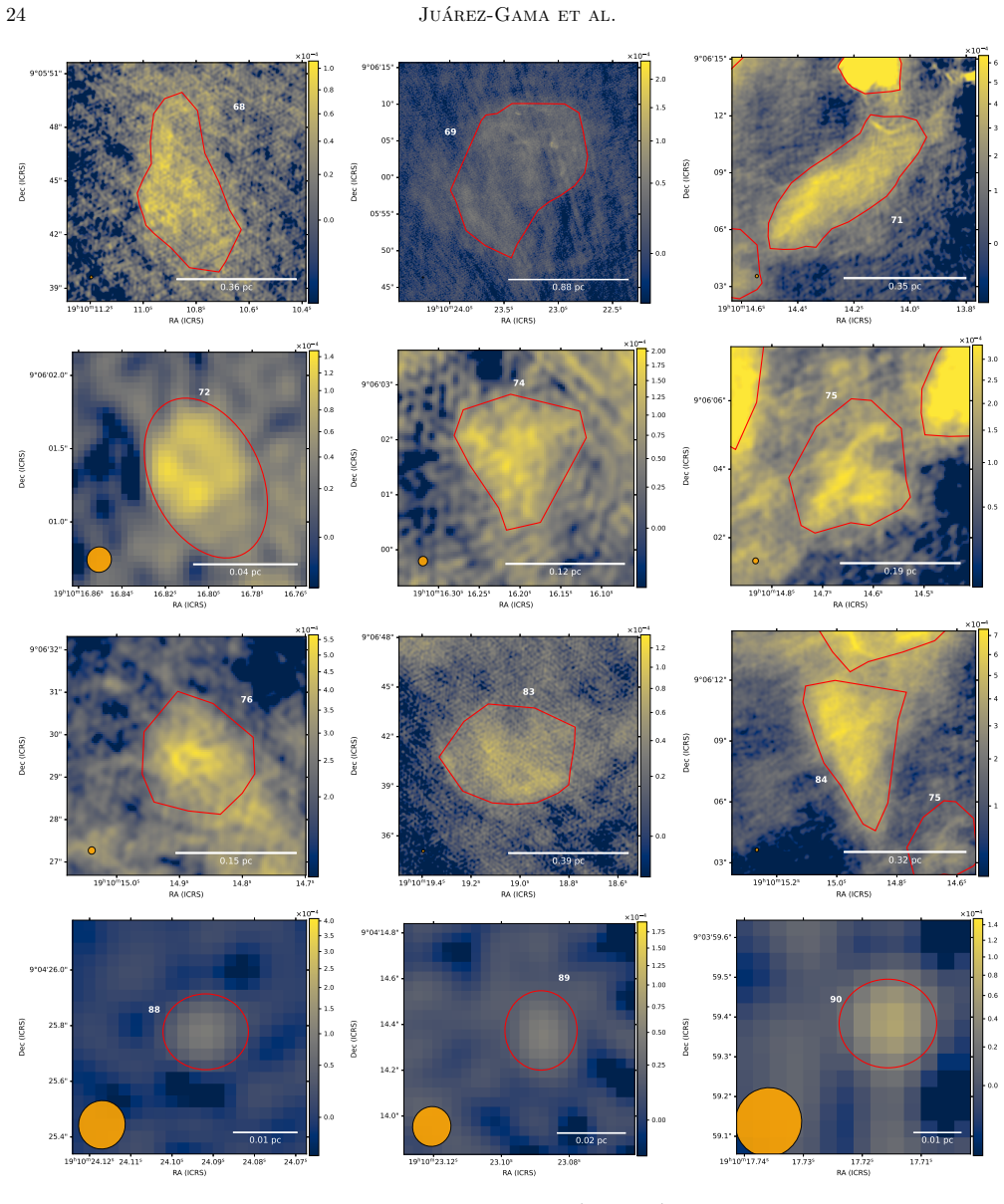
The central object is the sample of 101 H II regions identified by visual inspection of the VLA 3.3 cm map, with deconvolved sizes from roughly 0.005 to 0.97 pc. The argument runs through four steps: flux and deconvolved area give emission measure and Lyman-continuum photon rate $Q_0$; the CB19 stellar-population models, a revised Bruzual-Charlot synthesis using PARSEC tracks and Tlusty non-LTE atmospheres, convert $Q_0$ to a zero-age main-sequence mass at solar metallicity; Monte Carlo propagation turns flux and calibration uncertainties into mass errors; and the plfit maximum-likelihood procedure fits a power-law slope to masses above a minimum threshold. An empirical optical-depth correction using 7 mm data adjusts the most optically thick sources before the final slope is quoted.
What would settle it
Resolve the ionizing stars of the 101 detected H II regions with JWST and measure their spectral types; if the spectroscopically determined masses above about 11 solar masses follow the Salpeter slope, the radio-derived steep IMF would be a selection or calibration artifact.
Extended reading notes
Core claim
The central discovery is that the zero-age massive stellar population of W49A, as traced by its H II regions, does not follow the canonical high-mass initial mass function. Using maximum-likelihood power-law fits to the masses inferred from the 3.3 cm continuum, the authors find $\Gamma = 2.56 \pm 0.12$ for the single-star, all-source sample and $\Gamma = 3.57 \pm 0.17$ for the compact non-elongated sources, with even steeper slopes under an equal-mass binary assumption. Correcting the most optically thick sources with 7 mm photometry flattens the slopes to $\Gamma = 1.85 \pm 0.06$ for all sources and $2.37 \pm 0.10$ for the compact subsample, still several $\sigma$ above the Salpeter value. The authors interpret this as a genuine deficit of the most massive embedded stars, most likely because higher-mass stars destroy or expand their H II regions faster, or because W49A is still assembling its most massive members.
Load-bearing premise
The entire mass scale rests on the assumption that each detected H II region is ionized by a single or equal-mass binary zero-age main-sequence star of solar metallicity, so that the radio brightness maps onto stellar mass through one calibration; if the ionizing stars are metal-poor, bloated while still accreting, or actually small clusters, the inferred masses and the steep slope would change.
Editorial extensions
If this is right
- If the steep slope is real, the high-mass IMF in an extreme embedded protocluster is not Salpeter-like at birth, and radio-selected H II region samples are biased against the most massive stars.
- The observed population accounts for only about 5.5 to 7.2 million solar luminosities of the cloud's roughly 37 million solar bolometric luminosity, so a large fraction of W49A's luminosity comes from stars not seen as compact H II regions.
- If the deficit is a lifetime effect, the observable lifetime of compact H II regions must scale roughly as $t_{\mathrm{HII}} \propto M^{-a}$ with $a \gtrsim 0.5$, which would change how surveys convert counts of H II regions into star-formation rates.
- If the deficit is an assembly effect, W49A should contain about half a dozen accreting massive stars that will grow by more than about 10 solar masses over the next few hundred thousand years.
- Deep near- and mid-infrared observations with JWST should reveal the massive stars missing from the radio census if the lifetime explanation is correct.
Reading between the lines
- A direct test would be to apply the same $Q_0$-to-mass pipeline to another well-studied protocluster such as W51A; a similarly steep slope would point to a universal mass-dependent H II region lifetime, whereas a Salpeter slope there would suggest something specific to W49A.
- The paper's solar-metallicity assumption is untested: recomputing masses with the CB19 grid at sub- or super-solar metallicity could shift the $Q_0$-$M$ relation enough to flatten or steepen the slope, so the claimed deficit should be re-evaluated once metallicity is measured.
- The paper's dust argument implies the true slope may be even steeper than reported, because dust inside ultracompact H II regions would make the least luminous, most compact sources appear even less massive; this could be tested by mid-infrared observations of dust emission inside individual H II regions.
- If the lifetime scaling $t_{\mathrm{HII}} \propto M^{-a}$ is confirmed, counts of ultracompact H II regions would systematically underpredict the formation rate of the most massive stars, a correction relevant to extragalactic radio recombination line surveys.
Editorial analysis
A structured set of objections, weighed in public.
Referee Report
Summary. This paper presents a census of compact, ultracompact, and hypercompact H II regions in W49A from all-configuration VLA 3.3 cm observations at ~0.17 arcsec resolution. The authors identify 101 sources, measure fluxes and deconvolved sizes, derive emission measures and Lyman-continuum photon rates assuming an electron temperature of 10,000 K, and convert Q0 to stellar masses with the CB19/Tlusty ZAMS solar-metallicity calibration under single-star and equal-mass binary assumptions. Maximum-likelihood power-law fits to dN/dlogM for M > M_min yield Gamma = 2.56 +/- 0.12 for the full single-star sample, Gamma = 3.57 +/- 0.17 for compact sources, and Gamma = 1.85 +/- 0.06 after optical-depth corrections using 7 mm data. The paper interprets these slopes as evidence for a high-mass deficit relative to the Salpeter slope Gamma = 1.35 and proposes shorter radio H II region lifetimes for higher-mass stars or ongoing mass assembly as explanations.
Significance. If the inferred steep slope is correct, this is a significant result: it would be one of the first direct measurements of the high-mass end of the stellar IMF in a deeply embedded protocluster, with implications for feedback and massive-star formation timescales. The paper's strengths include careful all-configuration VLA imaging and self-calibration, source catalogs with photometry and derived properties in tabular form, Monte Carlo propagation of mass uncertainties, and explicit tests of binarity, source selection, and optical-depth corrections. However, the quantitative significance claim (10-13 sigma) is based only on Monte Carlo mass errors, and the completeness of the high-mass end is not established because ~30% of the total 3.3 cm flux is diffuse and excluded from the source catalog. These issues affect the central claim and need to be addressed before the result can be taken at face value.
major comments (3)
- [Section 5.1 and Section 4.3] The central claim of a high-mass deficit depends on the completeness of the compact-source census, but the paper excludes the ~30% of the total 3.3 cm flux that is diffuse (F_compact = 17.7 Jy versus F_tot = 25.4 Jy; Section 5.1). The assumption that this diffuse emission traces only more evolved H II regions whose ionizing stars are no longer compact radio sources is not tested. Because power-law slopes are highly sensitive to the most massive members, a modest number of unresolved or diffuse zero-age massive stars would flatten the fitted slope toward Salpeter; the luminosity budget (L_tot ~ 5.5-7.2e6 L_sun versus L_bol ~ 3.7e7 L_sun) leaves room for such a population. I request a quantitative analysis of this selection effect, for example by adding plausible massive sources drawn from the diffuse flux and recomputing Gamma, or an upper limit on the missing high-mass population from the diffuse flux and bolometric luminosity.
- [Section 4.3 and Table 1] The reported 10-13 sigma inconsistency with the Salpeter slope propagates only the Monte Carlo mass errors and not systematic uncertainties in the assumed electron temperature (T_e = 10,000 K, Section 4.1), the distance (11.1 kpc), or the metallicity (solar Z = 0.017 CB19 calibration, Section 4.2). Distance enters as Q0 proportional to d^2, and T_e affects the optical-depth and emission-measure conversion; sub-solar or super-solar metallicity changes the Q0-M relation. The slopes may remain steep under plausible variations, but the authors should either propagate these terms into the significance statement or explicitly limit the claim to statistical errors. At minimum, report the slope and significance under a range of (T_e, d, Z) to demonstrate robustness.
- [Section 4.2 and Section 5.2] The mass inference assumes that every detected H II region is ionized by a single ZAMS star (or an equal-mass binary) on the solar-metallicity CB19/Tlusty relation. The possibility that some sources are powered by non-ZAMS, bloated accreting protostars with suppressed ionizing-photon output is mentioned in Section 5.2 but not quantified. If such objects are present, their masses would be underestimated, and the inferred high-mass slope would be biased. I ask for a sensitivity test or model calculation showing how a plausible population of bloated protostars (e.g., the accretion rates cited in Section 5.2) would change Gamma, or for a clear statement that the conclusions apply only to ZAMS-ionized H II regions.
minor comments (4)
- [Abstract and Appendix A] The text states 101 robust detections (Abstract, Section 4.1), but the Appendix A introduction says the catalog contains 99 unique H II regions; please reconcile this discrepancy and clarify how blended components (e.g., idx 51, 58, 59, 60) are counted in the sample size.
- [Table 1] In Table 1, the binary-scenario row for 'All sources' lists N(>M_min) = 126, which exceeds the 101 source detections; state explicitly that this is the number of individual stars after splitting into binaries, and explain why it is not 202 given the equal-mass assumption.
- [Section 5.1] The statement that the remaining ~30% of the flux is 'distributed in extended structures that are not decomposed into compact components' would benefit from a description of how the source masks and the 3-sigma contour choice exclude these structures, since this is the main completeness criterion.
- [Section 4.2 and Figure 5] The optical-depth correction relation f_M versus tau_3.3cm is based on 15 sources with Pearson r = 0.61 and p = 0.02; the text should state the scatter about the fit and how that scatter is included in the Monte Carlo error propagation, since the current description mentions the correlation statistics but not the residual scatter.
Circularity Check
No significant circularity: the W49A high-mass IMF slope is an empirical transformation of independent VLA photometry through external stellar calibrations.
full rationale
The derivation chain is: observed 3.3 cm flux -> emission measure -> ionizing photon rate Q0 -> stellar mass via the CB19/Tlusty ZAMS calibration. That calibration is published externally (Plat et al. 2019; Lanz & Hubeny 2003, 2007), is parameter-free with respect to W49A data, and does not incorporate any of this paper's fitted values; the paper also cross-checks it against Martins et al. (2005). The power-law slope Gamma is a maximum-likelihood fit to the resulting mass distribution, not an input assumption. The optical-depth correction uses an empirical relation between tau_3.3cm and M_7mm/M_3.3cm fitted to 15 sources and applied to 14 others, but the steep slope is present before the correction (Gamma = 2.56) and remains steep after it (Gamma = 1.85), so the correction is not load-bearing and no 'prediction' reduces to that fit. The acknowledged incompleteness from diffuse flux (about 30% of the total) and the untested metallicity, ZAMS, and single-star assumptions are important correctness and robustness limitations, but they are not circularity. The author overlap with the CB19 models (Bruzual) is a normal citation of an independent stellar library and does not make the derivation circular under the stated independence criteria.
Assumptions & free parameters
free parameters (2)
- M_min (power-law fit threshold) =
13.9 Msun (single, all); 12.2 Msun (tau-corrected); other values for subsets
- Optical-depth correction relation f_M versus tau_3.3cm =
Linear fit; slope and intercept shown in Figure 5 but not quoted in text
assumptions (5)
- domain assumption W49A is at distance d = 11.1 kpc (Zhang et al. 2013).
- domain assumption Electron temperature Te = 10,000 K for all H II regions.
- domain assumption Q0 versus M calibration from CB19 models at solar metallicity (Z=0.017) for single ZAMS stars is correct.
- domain assumption Line-of-sight depth of each H II region equals its deconvolved equivalent diameter.
- domain assumption The detected sources are mostly thermal free-free H II regions, not background extragalactic contaminants or non-thermal sources.
Cite this review
Pith. "Pith review of The Zero-Age Massive Stellar Population of W49A from VLA Observations." pith.science (2026). https://pith.science/paper/27CPHF3V
@misc{pith2026260805453,
  author       = {Pith},
  title        = {Pith review of: The Zero-Age Massive Stellar Population of W49A from VLA Observations},
  year         = {2026},
  howpublished = {\url{https://pith.science/paper/27CPHF3V}},
  note         = {Machine review of arXiv:2608.05453}
}
read the original abstract
We use all-configuration VLA data at 3.3 cm with a physical resolution of ~2000 AU to infer the embedded zero-age massive stellar population of the W49A protocluster, as traced by its compact, ultracompact (UC), and hypercompact (HC) H II regions. Our method consists of visual source identification, the derivation of stellar ionizing-photon rates from the observed emission measure, and the further derivation of spectral types and stellar masses using state-of-the-art stellar calibrations. Considering the 101 robust detections, maximum-likelihood estimation fitting of the high-mass end (M > 11 M_\odot) of the sample yields power-law slopes Gamma >= 2.56 for the logarithmic representation of the stellar initial mass function (IMF): dN/d(log M) proportional to M^{-Gamma}. The result is robust considering different assumptions for the ionizing stellar systems. The slopes remain at Gamma >= 1.85 after correction for optical depth effects at 3.3 cm. Therefore, the inferred distribution of stellar masses presents a clear deficit in the high-mass end as compared to the standard stellar IMF (Gamma = 1.35). We propose that this is due to a shorter lifetime of the radio-detected H II regions produced by higher-mass stars, but evolutionary effects in the mass distribution of star formation within embedded protoclusters cannot be discarded.
Figures


Figures from the paper (7 more)



Reference graph
Works this paper leans on
-
[1]
Evolutionary sequences of stellar models with semiconvection and convective overshoot. I. Z=0.008. , keywords =
-
[2]
Uncovering the Beast: Discovery of Embedded Massive Stellar Clusters in W49A. , keywords =. doi:10.1086/375801 , archivePrefix =. astro-ph/0304279 , primaryClass =
-
[3]
Spectral Indices of Centimeter Continuum Sources in Star-forming Regions: Implications on the Nature of the Outflow Exciting Sources. , keywords =. doi:10.1086/300637 , adsurl =
-
[4]
ALMA-IMF. X. The core population in the evolved W33-Main (G012.80) protocluster. , keywords =. doi:10.1051/0004-6361/202347595 , archivePrefix =. 2401.09203 , primaryClass =
-
[5]
The Effects of Dust on Compact and Ultracompact H II Regions. , keywords =. doi:10.1086/386366 , adsurl =
-
[6]
Which feedback mechanisms dominate in the high-pressure environment of the central molecular zone?. , keywords =. doi:10.1093/mnras/staa2719 , archivePrefix =. 2009.03901 , primaryClass =
arXiv 2009
-
[7]
LEGO - II. A 3 mm molecular line study covering 100 pc of one of the most actively star-forming portions within the Milky Way disc. , keywords =. doi:10.1093/mnras/staa1814 , archivePrefix =. 2007.11005 , primaryClass =
arXiv 2007
-
[8]
A Universal Stellar Initial Mass Function? A Critical Look at Variations. , keywords =. doi:10.1146/annurev-astro-082708-101642 , archivePrefix =. 1001.2965 , primaryClass =
Show all 110 references
-
[9]
, keywords =
Model atmospheres broad-band colors, bolometric corrections and temperature calibrations for O - M stars. , keywords =
-
[10]
, keywords =
A Multiwavelength Look at Galactic Massive Star-forming Regions. , keywords =. doi:10.3847/1538-4357/aad7b2 , archivePrefix =. 1808.00454 , primaryClass =
-
[11]
Evolutionary Sequences of Stellar Models with New Radiative Opacities. II. Z = 0.02. , keywords =
-
[12]
, keywords =
Stellar population synthesis at the resolution of 2003. , keywords =. doi:10.1046/j.1365-8711.2003.06897.x , archivePrefix =. astro-ph/0309134 , primaryClass =
2003
-
[13]
, keywords =
CASA, the Common Astronomy Software Applications for Radio Astronomy. , keywords =. doi:10.1088/1538-3873/ac9642 , archivePrefix =. 2210.02276 , primaryClass =
-
[14]
, keywords =
PARSEC evolutionary tracks of massive stars up to 350 M _ ☉ at metallicities 0.0001 Z 0.04. , keywords =. doi:10.1093/mnras/stv1281 , archivePrefix =. 1506.01681 , primaryClass =
-
[15]
Investigations of Massive Filaments and Star Formation (INFANT). I. Core Identification and Core Mass Function. , keywords =. doi:10.3847/1538-4357/ad3c41 , archivePrefix =. 2404.03858 , primaryClass =
-
[16]
, keywords =
Ultra-Compact HII Regions and Massive Star Formation. , keywords =. doi:10.1146/annurev.astro.40.060401.093845 , adsurl =
-
[17]
SIAM Review , keywords =
Power-Law Distributions in Empirical Data. SIAM Review , keywords =. doi:10.1137/070710111 , adsurl =
-
[18]
Compact source catalog: Fragmentation statistics and physical evolution of the core population
ALMAGAL: III. Compact source catalog: Fragmentation statistics and physical evolution of the core population. , keywords =. doi:10.1051/0004-6361/202452706 , archivePrefix =. 2503.05663 , primaryClass =
-
[19]
Astrophysics in the Far Ultraviolet: Five Years of Discovery with FUSE , year = 2006, editor =
Properties of Hot, Massive Stars: The Impact of FUSE. Astrophysics in the Far Ultraviolet: Five Years of Discovery with FUSE , year = 2006, editor =
2006
-
[20]
, keywords =
Multifrequency, High-Resolution Radio Recombination Line Observations of the Massive Star-forming Region W49A. , keywords =. doi:10.1086/304119 , adsurl =
-
[21]
, keywords =
Ultracompact H II Regions in W49N at 500 AU Scales: Shells, Winds, and the Water Maser Source. , keywords =. doi:10.1086/309315 , adsurl =
-
[22]
, keywords =
Flux Density Variations at 3.6 cm in the Massive Star-forming Region W49A. , keywords =. doi:10.3847/2041-8213/aad631 , archivePrefix =
-
[23]
, keywords =
Time-variable Radio Recombination Line Emission in W49A. , keywords =. doi:10.3847/1538-3881/abba27 , archivePrefix =. 2010.04656 , primaryClass =
2010 arXiv
-
[24]
, keywords =
The Morphologies of Ultracompact H II Regions in W49A and Sagittarius B2: The Prevalence of Shells and a Modified Classification Scheme. , keywords =. doi:10.1086/430738 , archivePrefix =. astro-ph/0504230 , primaryClass =
-
[25]
Surveying the Giant H II Regions of the Milky Way with SOFIA. III. W49A. , keywords =. doi:10.3847/1538-4357/ac2d25 , archivePrefix =. 2111.01859 , primaryClass =
-
[26]
Evolutionary sequences of stellar models with new radiative opacities. III. Z=0.0004 and Z=0.05. , keywords =
-
[27]
Evolutionary sequences of stellar models with new radiative opacities. IV. Z=0.004 and Z=0.008. , keywords =
-
[28]
, keywords =
VLA Observations of Strong IRAS Point Sources Associated with Compact H II Regions. , keywords =. doi:10.1086/173396 , adsurl =
-
[29]
ALMA-IMF. XIV. Free Free Templates Derived from H41 and Ionized Gas Content in 15 Massive Protoclusters. , keywords =. doi:10.3847/1538-4365/ad61e6 , archivePrefix =. 2407.07359 , primaryClass =
-
[30]
MUSCLE W49: A Multi-Scale Continuum and Line Exploration of the Most Luminous Star Formation Region in the Milky Way. I. Data and the Mass Structure of the Giant Molecular Cloud. , keywords =. doi:10.1088/0004-637X/779/2/121 , archivePrefix =. 1309.4129 , primaryClass =
-
[31]
, keywords =
Clustered Formation of Massive Stars within an Ionized Rotating Disk. , keywords =. doi:10.3847/2041-8213/aca9cb , archivePrefix =. 2212.05633 , primaryClass =
-
[32]
, keywords =
When H II regions are complicated: considering perturbations from winds, radiation pressure, and other effects. , keywords =. doi:10.1093/mnras/stz3491 , archivePrefix =. 1906.05649 , primaryClass =
1906 arXiv
-
[33]
, keywords =
The MUSTANG Galactic Plane Survey (MGPS90) Pilot. , keywords =. doi:10.3847/1538-4365/ab8b5c , archivePrefix =. 2004.09555 , primaryClass =
2004 arXiv
-
[34]
Evolutionary sequences of stellar models with new radiative opacities. VI. Z=0.0001. , keywords =
-
[35]
, keywords =
Toward gas exhaustion in the W51 high-mass protoclusters. , keywords =. doi:10.1051/0004-6361/201628318 , archivePrefix =. 1605.09402 , primaryClass =
-
[36]
, keywords =
Time variability in simulated ultracompact and hypercompact H II regions. , keywords =. doi:10.1111/j.1365-2966.2011.19101.x , archivePrefix =. 1105.1348 , primaryClass =
2011
-
[37]
, keywords =
The SARAO MeerKAT 1.3 GHz Galactic Plane Survey. , keywords =. doi:10.1093/mnras/stae1166 , archivePrefix =. 2312.07275 , primaryClass =
-
[38]
Protostars and Planets V , year = 2007, editor =
Ultracompact Hii Regions and the Early Lives of Massive Stars. Protostars and Planets V , year = 2007, editor =
2007
-
[39]
, keywords =
Formation of OB clusters: VLA observations. , keywords =. doi:10.1086/159188 , adsurl =
-
[40]
, keywords =
Massive star formation in the W49 giant molecular cloud: Implications for the formation of massive star clusters. , keywords =. doi:10.1051/0004-6361:20040447 , archivePrefix =. astro-ph/0409410 , primaryClass =
-
[41]
, keywords =
Evolution of Massive Protostars with High Accretion Rates. , keywords =. doi:10.1088/0004-637X/691/1/823 , archivePrefix =. 0806.4122 , primaryClass =
-
[42]
, keywords =
Evolution of Massive Protostars Via Disk Accretion. , keywords =. doi:10.1088/0004-637X/721/1/478 , archivePrefix =. 1005.2827 , primaryClass =
-
[43]
A Census of the Deep Radio Sky with the VLA. I. 10 GHz Survey of the GOODS-N Field. , keywords =. doi:10.3847/1538-4357/ad5b5c , archivePrefix =. 2406.13801 , primaryClass =
-
[44]
The coordinated radio and infrared survey for high-mass star formation. III. A catalogue of northern ultra-compact H II regions. , keywords =. doi:10.1051/0004-6361/201832734 , archivePrefix =. 1803.09334 , primaryClass =
-
[45]
, keywords =
The Formation of Massive Stars by Accretion through Trapped Hypercompact H II Regions. , keywords =. doi:10.1086/379545 , archivePrefix =. astro-ph/0309131 , primaryClass =
-
[46]
, keywords =
Observations on the Formation of Massive Stars by Accretion. , keywords =. doi:10.1086/498611 , archivePrefix =. astro-ph/0510176 , primaryClass =
-
[47]
, keywords =
The Formation of Massive Stars: Accretion, Disks, and the Development of Hypercompact H II Regions. , keywords =. doi:10.1086/520320 , archivePrefix =. astro-ph/0603856 , primaryClass =
-
[48]
, keywords =
The Early Evolution of Massive Stars: Radio Recombination Line Spectra. , keywords =. doi:10.1086/522570 , archivePrefix =. 0708.3388 , primaryClass =
-
[49]
The evolution of young HII regions. I. Continuum emission and internal dynamics. , keywords =. doi:10.1051/0004-6361/201731727 , adsurl =
-
[50]
, keywords =
First hydrodynamics simulations of radiation forces and photoionization feedback in massive star formation. , keywords =. doi:10.1051/0004-6361/201832638 , archivePrefix =. 1804.10211 , primaryClass =
-
[51]
, keywords =
On the variation of the initial mass function. , keywords =. doi:10.1046/j.1365-8711.2001.04022.x , archivePrefix =. astro-ph/0009005 , primaryClass =
2001
-
[52]
Ultracompact H II Regions. II. New High-Resolution Radio Images. , keywords =. doi:10.1086/191952 , adsurl =
-
[53]
Massive Star Birth: A Crossroads of Astrophysics , year = 2005, editor =
Hypercompact HII regions. Massive Star Birth: A Crossroads of Astrophysics , year = 2005, editor =. doi:10.1017/S1743921305004424 , adsurl =
2005 doi
-
[54]
Encyclopedia of Astrophysics , year = 2026, volume =
The initial mass function of stars. Encyclopedia of Astrophysics , year = 2026, volume =. doi:10.1016/B978-0-443-21439-4.00035-3 , adsurl =
2026 doi
-
[55]
, keywords =
A Grid of Non-LTE Line-blanketed Model Atmospheres of O-Type Stars. , keywords =. doi:10.1086/374373 , archivePrefix =. astro-ph/0210157 , primaryClass =
-
[56]
, keywords =
A Grid of NLTE Line-blanketed Model Atmospheres of Early B-Type Stars. , keywords =. doi:10.1086/511270 , archivePrefix =. astro-ph/0611891 , primaryClass =
-
[57]
, keywords =
Cloud Structure of Galactic OB Cluster-forming Regions from Combining Ground- and Space-based Bolometric Observations. , keywords =. doi:10.3847/0004-637X/828/1/32 , archivePrefix =. 1606.07645 , primaryClass =
-
[58]
, keywords =
Investigating Fragmentation of Gas Structures in OB Cluster-forming Molecular Clump G33.92+0.11 with 1000 au Resolution Observations of ALMA. , keywords =. doi:10.3847/1538-4357/aaf6b4 , archivePrefix =. 1808.07702 , primaryClass =
-
[59]
Catalogues of candidate hot molecular cores and hyper/ultra compact H II regions
ATOMS: ALMA three-millimeter observations of massive star-forming regions - III. Catalogues of candidate hot molecular cores and hyper/ultra compact H II regions. , keywords =. doi:10.1093/mnras/stab1352 , archivePrefix =. 2105.03554 , primaryClass =
-
[60]
Core mass function in the high-mass star formation regime
ALMA-IMF: XV. Core mass function in the high-mass star formation regime. , keywords =. doi:10.1051/0004-6361/202345986 , archivePrefix =. 2407.18719 , primaryClass =
-
[61]
The COLIBRI code
Evolution of thermally pulsing asymptotic giant branch stars - I. The COLIBRI code. , keywords =. doi:10.1093/mnras/stt1034 , archivePrefix =. 1305.4485 , primaryClass =
-
[62]
, keywords =
A new calibration of stellar parameters of Galactic O stars. , keywords =. doi:10.1051/0004-6361:20042386 , archivePrefix =. astro-ph/0503346 , primaryClass =
-
[63]
The physical and chemical structure of Sagittarius B2. VI. UCHii regions in Sgr B2. , keywords =. doi:10.1051/0004-6361/202243674 , archivePrefix =. 2208.07796 , primaryClass =
-
[64]
Galactic H II Regions. I. Observations of Their Continuum Radiation at the Frequency 5 GHz. , year = 1967, month = feb, volume =. doi:10.1086/149030 , adsurl =
1967 doi
-
[65]
, keywords =
Star burst in W 49 N presumably induced by cloud-cloud collision. , keywords =. doi:10.1093/pasj/psab113 , archivePrefix =. 2111.04929 , primaryClass =
-
[66]
, keywords =
A Large-Scale ^ 13 CO Mapping of the W 49 A Molecular Cloud Complex. , keywords =. doi:10.1093/pasj/61.1.39 , adsurl =
-
[67]
, keywords =
W 49 N MCN-a: A disk-accreting massive protostar embedded in an early-phase hot molecular core. , keywords =. doi:10.1093/pasj/psac030 , archivePrefix =. 2204.04617 , primaryClass =
-
[68]
, keywords =
High-Mass Star and Massive Cluster Formation in the Milky Way. , keywords =. doi:10.1146/annurev-astro-091916-055235 , archivePrefix =. 1706.00118 , primaryClass =
-
[69]
, keywords =
The RMS Survey: The Luminosity Functions and Timescales of Massive Young Stellar Objects and Compact H II Regions. , keywords =. doi:10.1088/2041-8205/730/2/L33 , archivePrefix =. 1102.4702 , primaryClass =
-
[70]
Nature Astronomy , keywords =
The unexpectedly large proportion of high-mass star-forming cores in a Galactic mini-starburst. Nature Astronomy , keywords =. doi:10.1038/s41550-018-0452-x , archivePrefix =. 1804.02392 , primaryClass =
-
[71]
ALMA-IMF. V. Prestellar and protostellar core populations in the W43 cloud complex. , keywords =. doi:10.1051/0004-6361/202244762 , archivePrefix =. 2301.07238 , primaryClass =
-
[72]
, keywords =
Core to ultracompact HII region evolution in the W49A massive protocluster. , keywords =. doi:10.1051/0004-6361/202449279 , archivePrefix =. 2404.02250 , primaryClass =
-
[73]
, keywords =
Evolution of Stellar Feedback in H II Regions. , keywords =. doi:10.3847/1538-4357/abd24a , archivePrefix =. 2009.10079 , primaryClass =
2009 arXiv
-
[74]
Astrophysics of gaseous nebulae and active galactic nuclei
-
[75]
, keywords =
Compact H II Regions as Clocks of Massive-star Formation: Evidence for Long Formation Timescales. , keywords =. doi:10.3847/2041-8213/ae6c23 , archivePrefix =. 2602.06196 , primaryClass =
-
[76]
, keywords =
The Origin of Massive Stars: The Inertial-inflow Model. , keywords =. doi:10.3847/1538-4357/abaa47 , archivePrefix =. 1911.04465 , primaryClass =
1911 arXiv
-
[77]
, keywords =
Spitzer and Herschel Multiwavelength Characterization of the Dust Content of Evolved H II Regions. , keywords =. doi:10.1088/0004-637X/760/2/149 , archivePrefix =. 1210.3631 , primaryClass =
-
[78]
, year = 1973, month = nov, volume =
Some Physical parameters of early-type stars. , year = 1973, month = nov, volume =. doi:10.1086/111498 , adsurl =
1973 doi
-
[79]
Radiation-driven winds of hot luminous stars. XIII. A description of NLTE line blocking and blanketing towards realistic models for expanding atmospheres. , keywords =. doi:10.1051/0004-6361:20010805 , adsurl =
-
[80]
, keywords =
Constraints on the production and escape of ionizing radiation from the emission-line spectra of metal-poor star-forming galaxies. , keywords =. doi:10.1093/mnras/stz2616 , archivePrefix =. 1909.07386 , primaryClass =
1909 arXiv
-
[81]
, keywords =
H II Regions: Witnesses to Massive Star Formation. , keywords =. doi:10.1088/0004-637X/711/2/1017 , archivePrefix =. 1001.2470 , primaryClass =
-
[82]
, keywords =
Understanding Spatial and Spectral Morphologies of Ultracompact H II Regions. , keywords =. doi:10.1088/0004-637X/719/1/831 , archivePrefix =. 1003.4998 , primaryClass =
-
[83]
, keywords =
The Perils of Clumpfind: The Mass Spectrum of Substructures in Molecular Clouds. , keywords =. doi:10.1088/0004-637X/699/2/L134 , archivePrefix =. 0906.0331 , primaryClass =
-
[84]
ALMA-IMF. VI. Investigating the origin of stellar masses: Core mass function evolution in the W43-MM2&MM3 mini-starburst. , keywords =. doi:10.1051/0004-6361/202244776 , archivePrefix =. 2212.09307 , primaryClass =
-
[85]
, keywords =
A search for ionized jets towards massive young stellar objects. , keywords =. doi:10.1093/mnras/stw1027 , archivePrefix =. 1605.01200 , primaryClass =
-
[86]
, keywords =
Recombination Lines and Molecular Gas from Hypercompact HII regions in W51 A. , keywords =. doi:10.3847/1538-4357/aba749 , archivePrefix =. 2007.12276 , primaryClass =
2007 arXiv
-
[87]
, keywords =
Structural Analysis of Molecular Clouds: Dendrograms. , keywords =. doi:10.1086/587685 , archivePrefix =. 0802.2944 , primaryClass =
-
[88]
, keywords =
A Massive Young Runaway Star in W49 North. , keywords =. doi:10.3847/1538-4357/ab7011 , archivePrefix =. 2002.02894 , primaryClass =
2002 arXiv
-
[89]
, keywords =
Feedback in W49A diagnosed with radio recombination lines and models. , keywords =. doi:10.1051/0004-6361/201834068 , archivePrefix =. 1812.00758 , primaryClass =
-
[90]
, keywords =
SDSS-IV MaNGA: pyPipe3D Analysis Release for 10,000 Galaxies. , keywords =. doi:10.3847/1538-4365/ac7b8f , archivePrefix =. 2206.07062 , primaryClass =
-
[91]
The ALMA Survey of 70 m Dark High-mass Clumps in Early Stages (ASHES). I. Pilot Survey: Clump Fragmentation. , keywords =. doi:10.3847/1538-4357/ab45e9 , archivePrefix =. 1909.07985 , primaryClass =
1909 arXiv
-
[92]
, keywords =
Young Stellar Objects in the Massive Star-forming Region W49. , keywords =. doi:10.1088/0004-637X/813/1/25 , archivePrefix =. 1509.05749 , primaryClass =
-
[93]
The Astrophysical Journal , year = 1955, month = jan, volume =
The Luminosity Function and Stellar Evolution. The Astrophysical Journal , year = 1955, month = jan, volume =. doi:10.1086/145971 , adsurl =
1955 doi
-
[94]
, keywords =
The galactic abundance gradient. , keywords =. doi:10.1093/mnras/204.1.53 , adsurl =
-
[95]
Dust emission from star forming regions. I. The W 49A and W 51A complexes. , keywords =
-
[96]
, keywords =
A Core Mass Function Indistinguishable from the Salpeter Stellar Initial Mass Function Using 1000 au Resolution ALMA Observations. , keywords =. doi:10.3847/1538-4357/ac1bb9 , archivePrefix =. 2107.14288 , primaryClass =
-
[97]
, keywords =
Spherical Infall in G10.6-0.4: Accretion through an Ultracompact H II Region. , keywords =. doi:10.1086/430270 , archivePrefix =. astro-ph/0410604 , primaryClass =
-
[98]
Outflow-confined HII Regions. I. First Signposts of Massive Star Formation. , keywords =. doi:10.3847/0004-637X/818/1/52 , archivePrefix =. 1509.06754 , primaryClass =
-
[99]
, keywords =
The Lyman-Continuum Fluxes and Stellar Parameters of O and Early B-Type Stars. , keywords =. doi:10.1086/177020 , adsurl =
-
[100]
, keywords =
Hierarchical Structure in Nearly Pressureless Flows as a Consequence of Self-similar Statistics. , keywords =. doi:10.1086/173847 , adsurl =
-
[101]
Science , keywords =
Star Formation in W49A: Gravitational Collapse of the Molecular Cloud Core toward a Ring of Massive Stars. Science , keywords =. doi:10.1126/science.238.4833.1550 , adsurl =
-
[102]
, keywords =
Hot Cores in W49N and the Timescale for Hot Core Evolution. , keywords =. doi:10.1086/319498 , adsurl =
-
[103]
doi:10.1007/978-3-642-39950-3 , adsurl =
Tools of Radio Astronomy. doi:10.1007/978-3-642-39950-3 , adsurl =
-
[104]
, keywords =
The Morphologies and Physical Properties of Ultracompact H II Regions. , keywords =. doi:10.1086/191329 , adsurl =
-
[105]
, keywords =
The massive stellar population of W49: A spectroscopic survey. , keywords =. doi:10.1051/0004-6361/201527823 , archivePrefix =. 1602.05190 , primaryClass =
-
[106]
, keywords =
Parallaxes for W49N and G048.60+0.02: Distant Star Forming Regions in the Perseus Spiral Arm. , keywords =. doi:10.1088/0004-637X/775/1/79 , archivePrefix =. 1312.3856 , primaryClass =
-
[107]
Tobin and Patrick Sheehan and Rui Xue and Austen Fourkas , title =
John J. Tobin and Patrick Sheehan and Rui Xue and Austen Fourkas , title =. doi:10.5281/zenodo.17871742 , url =
-
[108]
High fidelity deconvolution of moderately resolved sources
-
[109]
, keywords =
A JWST NIRCam/MIRI View of the W51A High-mass Star-forming Region. , keywords =. doi:10.3847/1538-3881/ae40b7 , archivePrefix =. 2602.00229 , primaryClass =
-
[110]
doi:10.5281/zenodo.3377984 , version =
CARTA: The Cube Analysis and Rendering Tool for Astronomy. doi:10.5281/zenodo.3377984 , version =
Reviewed August 8, 2026 · model on record in the stance chip above.
Discussion (0). Continue with ORCID to comment.