REVIEW 2 major objections 5 minor 49 references
Reconnection Jets Detected during the Footpoint Drift of a CME Flux Rope: New Signatures of Ongoing 3D Arcade-Flux Rope Reconnection
T0 review · 2 major / 5 minor · reviewed 2026-08-08 · deepseek-v4-flash
Pith's one-line read This paper reports the first imaging detection of reconnection jets produced by arcade-flux rope reconnection during the footpoint drift of an erupting CME flux rope in a 2014 X1.6 flare.
desk verdict A credible first imaging detection of jets tied to flux-rope footpoint drift, with an interpretive arcade-flux-rope attribution that the authors themselves hedge; worth refereeing. read the letter →
The pith
A machine-rendered reading of the paper's core claim, the machinery that carries it, and where it could break.
The reading
What carries the argument
The load-bearing mechanism is the arcade-flux rope (ar–rf) reconnection geometry from the three-dimensional extension of the standard flare model, in which a leg of an erupting flux rope reconnects with overlying or neighboring coronal side arcades, converting arcade and rope into new rope and flare-loop field lines. The observable machinery is multi-wavelength SDO/AIA imaging in 131, 94, 304, 171, and 1600 Å together with HMI magnetograms, analyzed through time-distance diagrams, ribbon-hook contours, and light curves of footpoint regions. These data show jets launching in tight correlation with the drifting footpoints and hook morphology, sequential rather than simultaneous footpoint brightenings, and footpoint interchange between the flux rope and side arcades, which the authors read as successive ar–rf reconnection events. The jets themselves, with their sub-jets, blobs, and backflow, are the marker that identifies the reconnection site and its bursty time behavior.
What would settle it
A decisive test would be to observe an eruptive flare with ribbon-hook footpoint drift and determine whether the jets' triggering brightenings occur sequentially at single arcade footpoints, as ar–rf reconnection predicts, or simultaneously at all four footpoints of two interacting arcades, which would indicate pure arcade-arcade reconnection. A coronal magnetic field extrapolation or forward MHD model of this event that reproduces the observed brightening sequence and jet sites without invoking ar–rf reconnection would also falsify the attribution, as would a search of other hook-drifting eruptions finding that such jets never coincide with the drift.
Extended reading notes
Core claim
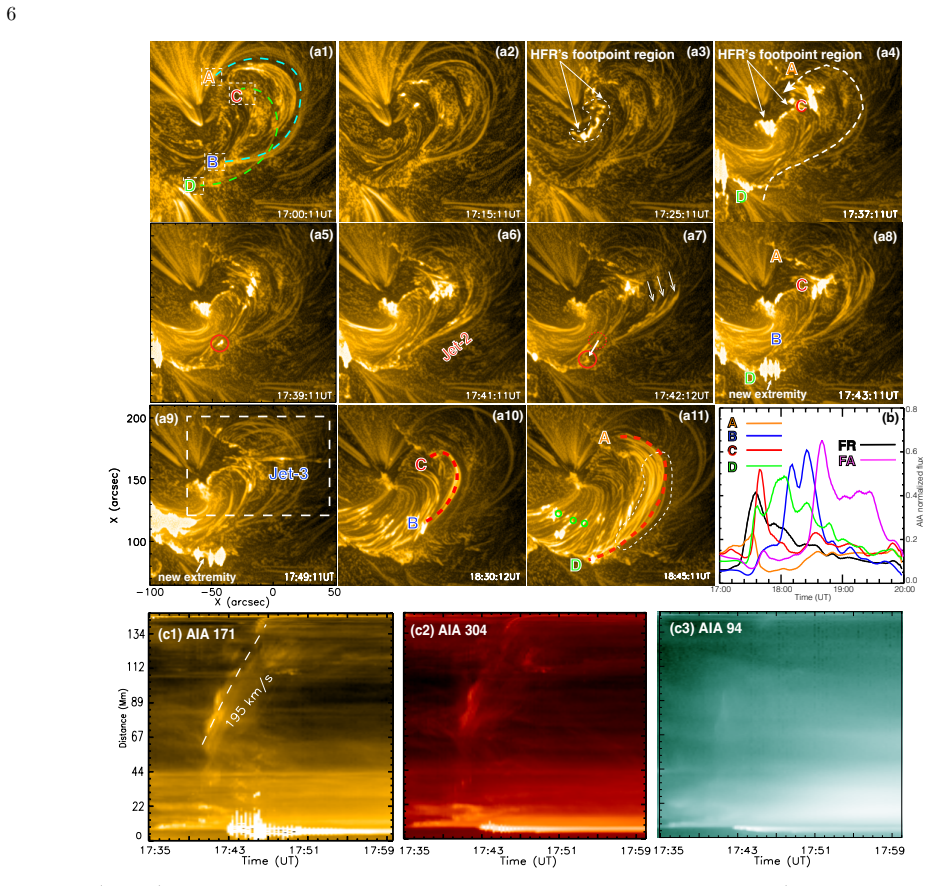
The central claim is that the jets observed during the eruption of the hot-channel flux rope in AR NOAA 12158 are imaging signatures of ongoing three-dimensional arcade-flux rope (ar–rf) reconnection, detected for the first time during the footpoint drift of an erupting CME flux rope. Three jet groups are identified: Jet-1 above the S-hook, Jet-2 along the right-side coronal arcades, and Jet-3 above the N-hook. Each is a cluster of fine-scale, collimated ejecta with speeds of roughly $180$–$202$ km s$^{-1}$, lengths of 5–35 Mm, and lifetimes of 3–8 min, with multi-thermal emission and, in Jet-3, embedded blobs and a backflow of about 222 km s$^{-1}$. The jets lack the inverted-Y shape and photospheric flux-emergence or flux-cancellation association of standard coronal jets, and they coincide with sequential EUV brightenings at discrete arcade footpoints and with footpoint interchange. The paper interprets this as the expanding flux rope interacting with ambient side arcades through ar–rf reconnection, eroding the rope on one side and enlarging it on the other, which drives the footpoint drift; the jets therefore localize the reconnection site and show the process is episodic and bursty.
Load-bearing premise
The attribution of the jets to arcade-flux rope reconnection rests on an inferred magnetic topology built from sequential EUV brightenings and footpoint drift, without direct coronal magnetic field measurements; the paper itself concedes that arcade-arcade reconnection cannot be entirely ruled out, so if the brightenings trace a different geometry the jets would not be direct ar–rf signatures.
Editorial extensions
If this is right
- Ar–rf reconnection is episodic and bursty: the jets are built from discrete sub-jets and blobs, not one monolithic ejection, so the reconnection that drives footpoint drift proceeds in repeated small events.
- The jets pinpoint the reconnection site in real time, so the ongoing 3D reconnection process can be tracked and located during the eruption rather than inferred afterward from ribbon hooks and newly formed arcades.
- The observed jets form a distinct class: they share the kinematics of standard coronal jets ($180$–$200$ km s$^{-1}$, 5–35 Mm, 3–8 min) but lack inverted-Y morphology and photospheric driving, and they are field-aligned like jets rather than perpendicular like nanojets.
- The multi-thermal nature of the jets and the estimated localized field-strength decrease of about 9 G imply ar–rf reconnection takes place low in the corona where a hot flux rope meets cooler side arcades.
- The chronological ordering from Jet-1 to Jet-3 reflects the magnetic configuration: reconnection begins with lower-lying arcades near the active-region core and moves to higher arcades, with Jet-2's northward footpoint drift enabling Jet-3 above the N-hook.
Reading between the lines
- If these jets are standard products of ar–rf reconnection, surveys of other eruptive flares with ribbon-hook footpoint drift should find similar jet clusters; their absence in high-cadence EUV data would mean the process requires special conditions, as the authors themselves suggest.
- The about 9 G field estimate could be checked against coronal magnetic field extrapolations or radio and microwave diagnostics of the same reconnection sites, turning a single-event estimate into a quantitative constraint.
- High-resolution spectroscopy of such jets should reveal flows and line broadening near 200 km s$^{-1}$ co-spatial with the ejecta, and the predicted sequential brightenings could be forward-modeled to distinguish ar–rf from arcade-arcade reconnection.
- Because the paper leaves arcade-arcade reconnection as a partial alternative for Jet-2, an MHD simulation of this specific active-region topology could compute distinguishable jet and brightening patterns, giving a testable way to decide between the two geometries.
Editorial analysis
A structured set of objections, weighed in public.
Referee Report
Summary. This paper reports the detection of three groups of small-scale EUV jets (Jet-1, Jet-2, Jet-3) during the X1.6-class flare SOL2014-09-10T17:45 in AR 12158, associated with the footpoint drift of an erupting hot-channel flux rope (HFR). Using SDO/AIA imaging in multiple passbands (131, 171, 304, 94 Å) and HMI magnetograms, the authors analyze the jets' morphology, kinematics, and multi-thermal structure, finding projected velocities of 180–200 km/s, lengths of 5–35 Mm, and lifetimes of 3–8 min. They interpret the jets as direct consequences of successive 3D arcade–flux-rope (ar–rf) reconnection events between the expanding HFR and ambient coronal side arcades, and they estimate that a localized magnetic field change of ~9 G is required to power the jets. The paper contrasts these jets with standard coronal jets and nanojets and claims the first imaging detection of ar–rf reconnection jets during footpoint drift.
Significance. The multi-wavelength imaging analysis is careful and reproducible in the sense that the jets are identified in repeated time–distance diagrams across AIA 171, 304, and 94 Å passbands, and the spatiotemporal correlation with the drifting ribbon hooks is visually convincing. The distinction from standard coronal jets (no inverted-Y morphology, no flux cancellation at the footpoints) is a useful observational clarification. If the ar–rf interpretation is accepted, the jets would constitute a new observational diagnostic of the ongoing 3D reconnection process predicted by the Aulanier–Dudík extension of the standard flare model. However, the significance of the paper is contingent on the uniqueness of that interpretation, which is not yet demonstrated.
major comments (2)
- [Section 3.2.2 and Section 3.3] The argument against direct arcade–arcade reconnection for Jet-2 is not sufficient to establish the ar–rf geometry. In Section 3.2.2 the authors reject simultaneous reconnection between arcades 'AB' and 'CD' because it would produce simultaneous brightenings at all four footpoints, whereas the observed brightenings at A, C, D are sequential. However, time-lagged or slipping arcade–arcade reconnection, kinematically driven by the expanding hot flux rope, would produce the same sequence of footpoint brightenings; the authors themselves concede in Section 3.3 that 'the involvement of arcade–arcade reconnection cannot be entirely ruled out.' Since no coronal magnetic field model (e.g., NLFFF QSL mapping or MHD simulation) is provided to discriminate between the two geometries, the data do not uniquely determine the reconnection type. Consequently, the statement in Section 4.1 that these jets 'provide direct and immediate markers of ongoing ar–rf reconnection' is overclaimed. The authors should either provide quantitative field-topology evidence or revise the claim to 'consistent with' ar–rf reconnection.
- [Section 4.2 (magnetic field estimate)] The ~9 G field estimate is asserted without derivation. The text says 'Assuming these propagation speeds are comparable to the local Alfvén speed' but gives no formula, no assumed mass density, and no uncertainty. Moreover, the abstract states that 'a decrease of approximately 9 G in localized magnetic field strength is required,' while Section 4.2 states that 'field strengths required to power each individual jet are approximately 9 G.' These are different quantities: a change in field strength versus an absolute field strength. The authors must provide the full calculation (including the density and the conversion from projected velocity to Alfvén speed) and reconcile the abstract-body discrepancy.
minor comments (5)
- [Section 2] The reference time used for co-alignment of the AIA and HMI images is not given; please specify it.
- [Sections 3.2.1–3.2.3] The projected velocities are quoted without uncertainties or a description of the fitting procedure for the time–distance diagrams; please add these details.
- [Figure 1] The colored arrows marking Jet-1 to Jet-3 in panels (e) and (f) are difficult to discern at the printed scale; consider adding a zoomed inset or larger arrowheads.
- [Section 4.2] The acronym 'MGN' is used without definition; please define it (e.g., multi-scale Gaussian normalization) on first use.
- [Throughout] 'ar–rf' is sometimes written with a hyphen and sometimes with an en dash; please standardize. Also, the introductory definition of 'Aulanier footpoint drift effect' could be moved to the abstract or first mention for clarity.
Circularity Check
No circularity: the jets are independent imaging detections, and the ar-rf attribution is a post hoc, explicitly caveated interpretation rather than a fitted or self-referential derivation.
full rationale
The claimed derivation chain is observational rather than model-derived. The jets (Jet-1, Jet-2, Jet-3) are identified directly in SDO/AIA 131, 171, 304, and 94 Å images, and their velocities (about 180–202 km/s), propagation lengths, lifetimes, and multi-thermal appearance are measured via time-distance diagrams (Figures 2(c), 3(c), 4(c)). These measurements are not produced by the ar-rf model, and no equation in the paper defines the jets in terms of the model output or vice versa. The ar-rf interpretation in Section 3.3 and Figure 5 is applied post hoc to the observed brightenings and footpoint interchange, following the independent MHD-based prediction of Aulanier and Dudík (2019); that prediction is external to this paper's data and is not a self-citation. The paper explicitly states in Section 3.3 that 'the involvement of arcade–arcade reconnection cannot be entirely ruled out,' which is a limitation on interpretive uniqueness, not a circular reduction. The only notable self-citation is H. Chen et al. (2019), used as prior observational support for footpoint drift and atypical flare arcades; the central jet detection does not depend on that paper's results, so the citation is not load-bearing. The roughly 9 G field decrease is a back-of-envelope Alfvén-speed estimate (v approximately v_A), not a fitted parameter later renamed as a prediction. No fitted-input-called-prediction, self-definitional, or imported-uniqueness pattern is present.
Assumptions & free parameters
free parameters (1)
- local coronal plasma density =
not stated
assumptions (4)
- domain assumption The 3D ar-rf reconnection scenario of Aulanier and Dudik (2019) applies to this event
- domain assumption Jet propagation speeds are comparable to the local Alfven speed
- domain assumption AIA 304/171/94 passbands map to the cool and hot plasma components as interpreted
- domain assumption Absence of photospheric flux emergence or cancellation can be judged from visual inspection of HMI magnetograms
Cite this review
Pith. "Pith review of Reconnection Jets Detected during the Footpoint Drift of a CME Flux Rope: New Signatures of Ongoing 3D Arcade-Flux Rope Reconnection." pith.science (2026). https://pith.science/paper/KY27BACT
@misc{pith2026260805645,
  author       = {Pith},
  title        = {Pith review of: Reconnection Jets Detected during the Footpoint Drift of a CME Flux Rope: New Signatures of Ongoing 3D Arcade-Flux Rope Reconnection},
  year         = {2026},
  howpublished = {\url{https://pith.science/paper/KY27BACT}},
  note         = {Machine review of arXiv:2608.05645}
}
abstract
Utilizing multi-wavelength data from the Solar Dynamics Observatory, we report the first imaging detection of reconnection jets driven by the footpoint drift of an erupting hot-channel flux rope (HFR) during an X1.6-class solar flare. Our results demonstrate that these jets are inherent byproducts of the HFR eruption, exhibiting strong spatiotemporal coupling with the HFR footpoint drift and the morphological evolution of the associated flare ribbon hooks. Unlike standard coronal jets, these ejections lack an inverted-Y morphology and show no association with underlying photospheric flux cancellation or emergence. They manifest as clusters of small-scale, collimated ejecta (180-200 km s$^{-1}$) featuring co-existing cool and hot emission components visible in both cool (304 and 171 Angstrom) and hot (94 Angstrom) EUV channels. The imaging observations reveal that these jets are triggered by successive 3D arcade-flux rope (ar-rf) reconnection as the expanding HFR interacts with the ambient coronal side arcades. The morphological and dynamic complexity of these observed jets implies that the ongoing ar-rf reconnection in solar eruptions is episodic and bursty in nature. Our estimates show that a decrease of approximately 9 G in localized magnetic field strength is required to power these individual jets. As direct signatures of 3D magnetic reconnection, these observed jets pinpoint the exact site and characterize the nature of the process, providing new observational insight into 3D numerical simulation extensions of the standard flare model. Further observational case studies of these jets are required to fully understand their prevalence across solar eruptions.
Figures


Figures from the paper (2 more)


Reference graph
Works this paper leans on
-
[1]
2021, Nature Astronomy, 5, 54, doi: 10.1038/s41550-020-1199-8
Antolin, P., Pagano, P., Testa, P., Petralia, A., & Reale, F. 2021, Nature Astronomy, 5, 54, doi: 10.1038/s41550-020-1199-8
-
[2]
Aulanier, G., Démoulin, P., Schrijver, C. J., et al. 2013, A&A, 549, A66, doi: 10.1051/0004-6361/201220406 11
-
[3]
2019, A&A, 621, A72, doi: 10.1051/0004-6361/201834221
Aulanier, G., & Dudík, J. 2019, A&A, 621, A72, doi: 10.1051/0004-6361/201834221
-
[4]
2012, A&A, 543, A110, doi: 10.1051/0004-6361/201219311
Aulanier, G., Janvier, M., & Schmieder, B. 2012, A&A, 543, A110, doi: 10.1051/0004-6361/201219311
-
[5]
2020, ApJ, 895, 18, doi: 10.3847/1538-4357/ab893d
Masson, S. 2020, ApJ, 895, 18, doi: 10.3847/1538-4357/ab893d
-
[6]
2021, Scientia Sinica Physica, Mechanica & Astronomica, 51, 099531, doi: 10.1360/SSPMA-2021-0101
Chen, H. 2021, Scientia Sinica Physica, Mechanica & Astronomica, 51, 099531, doi: 10.1360/SSPMA-2021-0101
-
[7]
2018, ApJ, 869, 78, doi: 10.3847/1538-4357/aaead1
Chen, H., Duan, Y., Yang, J., Yang, B., & Dai, J. 2018, ApJ, 869, 78, doi: 10.3847/1538-4357/aaead1
-
[8]
2019, ApJ, 887, 118, doi: 10.3847/1538-4357/ab527e
Chen, H., Yang, J., Ji, K., & Duan, Y. 2019, ApJ, 887, 118, doi: 10.3847/1538-4357/ab527e
Show all 49 references
-
[9]
2020, ApJ, 899, 19, doi: 10.3847/1538-4357/ab9cad
Chen, H., Zhang, J., De Pontieu, B., et al. 2020, ApJ, 899, 19, doi: 10.3847/1538-4357/ab9cad
2020 doi
-
[10]
R., et al
Chen, H., Tian, H., Priest, E. R., et al. 2025, ApJ, 995, 94, doi: 10.3847/1538-4357/ae12e9
2025 doi
-
[11]
2015, ApJ, 815, 71, doi: 10.1088/0004-637X/815/1/71
Chen, J., Su, J., Yin, Z., et al. 2015, ApJ, 815, 71, doi: 10.1088/0004-637X/815/1/71
2015 doi
-
[12]
Cheng, X., & Ding, M. D. 2016, ApJL, 823, L4, doi: 10.3847/2041-8205/823/1/L4
2016 doi
- [13]
-
[14]
2024, ApJL, 962, L38, doi: 10.3847/2041-8213/ad24f3 Dudík, J., Aulanier, G., Lörinčík, J., & Zemanová, A
Duan, Y., Tian, H., Chen, H., et al. 2024, ApJL, 962, L38, doi: 10.3847/2041-8213/ad24f3 Dudík, J., Aulanier, G., Lörinčík, J., & Zemanová, A. 2025, SoPh, 300, 139, doi: 10.1007/s11207-025-02549-2 Dudík, J., Lörinčík, J., Aulanier, G., Zemanová, A., &
2024 doi
-
[15]
2019, ApJ, 887, 71, doi: 10.3847/1538-4357/ab4f86 Dudík, J., Polito, V., Janvier, M., et al
Schmieder, B. 2019, ApJ, 887, 71, doi: 10.3847/1538-4357/ab4f86 Dudík, J., Polito, V., Janvier, M., et al. 2016, ApJ, 823, 41, doi: 10.3847/0004-637X/823/1/41
2019 doi
-
[16]
A., Davies, J
Fu, H., Harrison, R. A., Davies, J. A., et al. 2020, ApJL, 900, L18, doi: 10.3847/2041-8213/abb083
2020 doi
-
[17]
2025, ApJL, 985, L12, doi: 10.3847/2041-8213/add33a
Gao, Y., Tian, H., Berghmans, D., et al. 2025, ApJL, 985, L12, doi: 10.3847/2041-8213/add33a
2025 doi
-
[18]
M., et al
Gou, T., Liu, R., Veronig, A. M., et al. 2023, Nature Astronomy, 7, 815, doi: 10.1038/s41550-023-01966-2
2023 doi
-
[19]
T., Liu, Y., Hayashi, K., et al
Hoeksema, J. T., Liu, Y., Hayashi, K., et al. 2014, SoPh, 289, 3483, doi: 10.1007/s11207-014-0516-8
2014 doi
-
[20]
2011, ApJL, 738, L20, doi: 10.1088/2041-8205/738/2/L20
Hong, J., Jiang, Y., Zheng, R., et al. 2011, ApJL, 738, L20, doi: 10.1088/2041-8205/738/2/L20
2011 doi
-
[21]
2013, A&A, 555, A77, doi: 10.1051/0004-6361/201321164
Janvier, M., Aulanier, G., Pariat, E., & Démoulin, P. 2013, A&A, 555, A77, doi: 10.1051/0004-6361/201321164
2013 doi
-
[22]
C., Chen, H
Jiang, Y. C., Chen, H. D., Li, K. J., Shen, Y. D., & Yang, L. H. 2007, A&A, 469, 331, doi: 10.1051/0004-6361:20053954
2007 doi
-
[23]
2025, A&A, 698, A301, doi: 10.1051/0004-6361/202554011
Chandra, R. 2025, A&A, 698, A301, doi: 10.1051/0004-6361/202554011
2025 doi
-
[24]
R., Title, A
Lemen, J. R., Title, A. M., Akin, D. J., et al. 2012, SoPh, 275, 17, doi: 10.1007/s11207-011-9776-8
2012 doi
-
[25]
J., & Zhang, Q
Li, D., Ning, Z. J., & Zhang, Q. M. 2015, ApJ, 807, 72, doi: 10.1088/0004-637X/807/1/72
2015 doi
-
[26]
2015, ApJL, 804, L8, doi: 10.1088/2041-8205/804/1/L8
Li, T., & Zhang, J. 2015, ApJL, 804, L8, doi: 10.1088/2041-8205/804/1/L8
2015 doi
-
[27]
Lin, J., Soon, W., & Baliunas, S. L. 2003, NewAR, 47, 53, doi: 10.1016/S1387-6473(02)00271-3
2003 doi
-
[28]
2022, ApJ, 930, 130, doi: 10.3847/1538-4357/ac63ac Lörinčík, J., Dudík, J., & Aulanier, G
Liu, Y., Su, Y., Liu, R., et al. 2022, ApJ, 930, 130, doi: 10.3847/1538-4357/ac63ac Lörinčík, J., Dudík, J., & Aulanier, G. 2019, ApJ, 885, 83, doi: 10.3847/1538-4357/ab4519 Lörinčík, J., Dudík, J., & Aulanier, G. 2021a, ApJL, 909, L4, doi: 10.3847/2041-8213/abe7f7 Lörinčík, J...
2022 doi
-
[29]
2021b, ApJ, 906, 62, doi: 10.3847/1538-4357/abc8f6 Lörinčík, J., Dudík, J., Sainz Dalda, A., et al
Golub, L. 2021b, ApJ, 906, 62, doi: 10.3847/1538-4357/abc8f6 Lörinčík, J., Dudík, J., Sainz Dalda, A., et al. 2025, Nature Astronomy, 9, 45, doi: 10.1038/s41550-024-02396-4
2025 doi
-
[30]
D., et al
Miao, Y., Liu, Y., Shen, Y. D., et al. 2019, ApJ, 877, 61, doi: 10.3847/1538-4357/ab1a42
2019 doi
-
[31]
2025, ApJ, 988, 14, doi: 10.3847/1538-4357/addec9
Ou, Y., Su, Y., Zhang, Q., et al. 2025, ApJ, 988, 14, doi: 10.3847/1538-4357/addec9
2025 doi
-
[32]
2016, ApJL, 832, L7, doi: 10.3847/2041-8205/832/1/L7
Chakrapani, P. 2016, ApJL, 832, L7, doi: 10.3847/2041-8205/832/1/L7
2016 doi
-
[33]
D., Thompson, B
Pesnell, W. D., Thompson, B. J., & Chamberlin, P. C. 2012, SoPh, 275, 3, doi: 10.1007/s11207-011-9841-3
2012 doi
-
[34]
E., Patsourakos, S., Pariat, E., et al
Raouafi, N. E., Patsourakos, S., Pariat, E., et al. 2016, SSRv, 201, 1, doi: 10.1007/s11214-016-0260-5
2016 doi
-
[35]
2025, A&A, 699, A106, doi: 10.1051/0004-6361/202453595
Sen, S., & Moreno-Insertis, F. 2025, A&A, 699, A106, doi: 10.1051/0004-6361/202453595
2025 doi
-
[36]
2022, Research in Astronomy and Astrophysics, 22, 015019, doi: 10.1088/1674-4527/ac389b
Shen, J., Ji, H., & Su, Y. 2022, Research in Astronomy and Astrophysics, 22, 015019, doi: 10.1088/1674-4527/ac389b
2022 doi
-
[37]
2021, Proceedings of the Royal Society of London Series A, 477, 217, doi: 10.1098/rspa.2020.0217
Shen, Y. 2021, Proceedings of the Royal Society of London Series A, 477, 217, doi: 10.1098/rspa.2020.0217
2021
-
[38]
2012, ApJ, 745, 164, doi: 10.1088/0004-637X/745/2/164
Shen, Y., Liu, Y., Su, J., & Deng, Y. 2012, ApJ, 745, 164, doi: 10.1088/0004-637X/745/2/164
2012 doi
-
[39]
D., Su, J., Qu, Z., & Tian, Z
Shen, Y., Liu, Y. D., Su, J., Qu, Z., & Tian, Z. 2017, ApJ, 851, 67, doi: 10.3847/1538-4357/aa9a48
2017 doi
-
[40]
C., Moore, R
Sterling, A. C., Moore, R. L., Falconer, D. A., et al. 2016, ApJ, 821, 100, doi: 10.3847/0004-637X/821/2/100
2016 doi
-
[41]
2024, ApJ, 974, 205, doi: 10.3847/1538-4357/ad738d
Sun, Z., Tian, H., Li, T., Liu, R., & Duan, Y. 2024, ApJ, 974, 205, doi: 10.3847/1538-4357/ad738d
2024 doi
-
[42]
2025, A&A, 702, A189, doi: 10.1051/0004-6361/202555297 12
Tan, S., Warmuth, A., Schuller, F., et al. 2025, A&A, 702, A189, doi: 10.1051/0004-6361/202555297 12
2025 doi
-
[43]
R., Reeves, K
Tian, H., Young, P. R., Reeves, K. K., et al. 2015, ApJ, 811, 139, doi: 10.1088/0004-637X/811/2/139
2015 doi
-
[44]
Xing, C., Cheng, X., & Ding, M. D. 2020, The Innovation, 1, 100059, doi: 10.1016/j.xinn.2020.100059
2020
-
[45]
2023, ApJ, 942, 86, doi: 10.3847/1538-4357/aca66f
Yang, J., Hong, J., Yang, B., Bi, Y., & Xu, Z. 2023, ApJ, 942, 86, doi: 10.3847/1538-4357/aca66f
2023 doi
-
[46]
2025, ApJ, 987, 193, doi: 10.3847/1538-4357/addac1 Zemanová, A., Dudík, J., Aulanier, G., Thalmann, J
Yang, L., Yan, X., Zhang, J., et al. 2025, ApJ, 987, 193, doi: 10.3847/1538-4357/addac1 Zemanová, A., Dudík, J., Aulanier, G., Thalmann, J. K., & Gömöry, P. 2019, ApJ, 883, 96, doi: 10.3847/1538-4357/ab3926 Zemanová, A., Karlický, M., Dudík, J., Kašparová, J., & Rybák, J. 2024...
2025 doi
-
[47]
M., Su, Y
Zhang, Q. M., Su, Y. N., & Ji, H. S. 2017, A&A, 598, A3, doi: 10.1051/0004-6361/201629477
2017 doi
-
[48]
A., Aulanier, G., et al
Zhao, J., Gilchrist, S. A., Aulanier, G., et al. 2016, ApJ, 823, 62, doi: 10.3847/0004-637X/823/1/62
2016 doi
-
[49]
P., Zhang, J., & Wang, J
Zhou, G. P., Zhang, J., & Wang, J. X. 2016, ApJL, 823, L19, doi: 10.3847/2041-8205/823/1/L19
2016 doi
Reviewed August 8, 2026 · model on record in the stance chip above.
Discussion (0). Continue with ORCID to comment.