REVIEW 3 major objections 3 minor 20 references
Spin Physics at NICA SPD
T0 review · 3 major / 3 minor · reviewed 2026-08-07 · deepseek-v4-flash
Pith's one-line read NICA's Spin Physics Detector aims to deliver the first direct measurements of gluon TMDs—Sivers, Boer-Mulders, and deuteron gluon transversity—by measuring J/psi, prompt-photon, and open-charm spin asymmetries, with about five million…
desk verdict A transparent status report on the SPD program rather than a new result; the projections are readable and the caveats are honestly stated, but the flagship factor-2 Δg claim rests on a 2014 PDF prior and on factorization assumptions the paper itself flags as open. read the letter →
The pith
A machine-rendered reading of the paper's core claim, the machinery that carries it, and where it could break.
The reading
What carries the argument
The carrying objects are the leading-twist gluon transverse-momentum-dependent distributions: the unpolarized gluon density $f_1^g(x,k_T^2)$, the gluon Sivers function $f_{1T}^{\perp g}(x,k_T^2)$ (spin–momentum correlation in a transversely polarized proton), the gluon Boer-Mulders function $h_1^{\perp g}(x,k_T^2)$ (linear polarization of gluons in an unpolarized hadron), and, for the spin-1 deuteron, the gluon transversity $h_1^g$ and tensor-polarized gluon distributions. The measurement machinery is the matched set of three production channels—charmonium, prompt photons, and open charm—whose spin asymmetries $A_N$ and $A_{LL}$ isolate different combinations of these distributions. The quantitative argument runs through detector-level signal estimates (for example, the $J/\psi\to\mu^+\mu^-$ reconstruction and the $\chi_{c1}$, $\chi_{c2}$, and $\psi(3686)$ feed-down samples) and pseudodata studies that use Bayesian reweighting of polarized-PDF replicas to forecast the improvement in $x\Delta g$ and in the gluon Sivers function uncertainty.
What would settle it
Take the first year of SPD data: extract the gluon Sivers function from prompt-photon $A_N$ and from inclusive $J/\psi$ $A_N$ using the same theoretical framework. If the two disagree by more than the combined statistical uncertainties, the inclusive-$J/\psi$ channel is not a clean gluon-TMD probe as assumed. A simpler early check is the comparison of the total $J/\psi$ yield and its $x_F$ dependence at the top collision energy with the gluon-gluon-fusion-dominated expectation: a large excess would indicate quark-initiated contamination.
Extended reading notes
Core claim
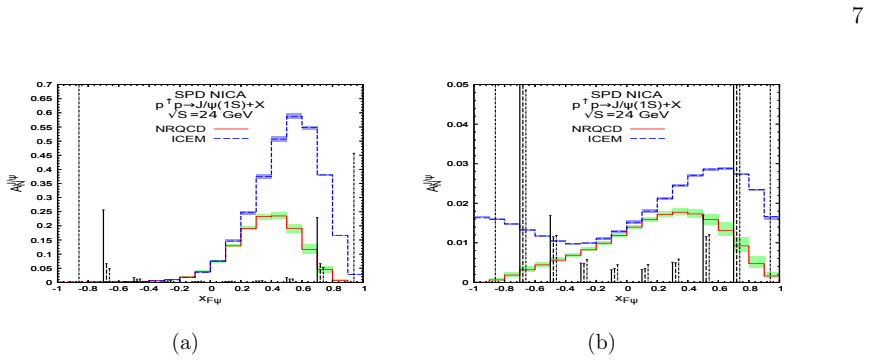
The paper's central claim is that SPD will turn an energy range that currently has no polarized-proton data into a laboratory for gluon spin physics. The mechanism is a set of complementary probes—inclusive $J/\psi$ production, prompt photons, and $D$-meson (open charm) production—whose single-spin asymmetry $A_N$ and double-spin asymmetry $A_{LL}$ carry information about the unpolarized gluon TMD $f_1^g$, the gluon Sivers function $f_{1T}^{\perp g}$, the gluon Boer-Mulders function $h_1^{\perp g}$, and, for the deuteron, the gluon transversity $h_1^g$ and tensor-polarized distributions. The paper presents projections in which one year of SPD data yields roughly $5\times10^6$ reconstructed $J/\psi\to\mu^+\mu^-$ events and, through Bayesian reweighting of a published set of polarized-PDF replicas, reduces the uncertainty of $x\Delta g$ by a factor of two for $0.2<x<0.3$; it also shows statistical uncertainties small enough to discriminate between two published extractions of the gluon Sivers function. The paper is explicit that inclusive $J/\psi$ production is a TMD factorization-breaking process and that the size of the violation must be studied experimentally, so the program is framed as a first look whose interpretation will need validation.
Load-bearing premise
The load-bearing premise is that charmonium production at NICA energies is dominated by gluon-gluon fusion and that the measured spin asymmetries can be translated into gluon distributions through a factorization scheme, even though the paper itself says inclusive J/psi production is a factorization-breaking process whose violation size still has to be measured.
Editorial extensions
If this is right
- If the projections hold, SPD will provide the first experimental constraints on several gluon TMDs in the $x$ range around 0.2–0.3, a region not covered by existing polarized experiments.
- The claimed factor-of-two reduction in the $x\Delta g$ uncertainty would make the measurement competitive with higher-energy polarized experiments and narrow the gap in our knowledge of the gluon helicity at large $x$.
- Deuteron measurements could establish a nonzero gluon transversity, which would be direct evidence of non-nucleonic degrees of freedom in the spin-1 deuteron.
- The planned reconstruction of $\chi_c$ and $\psi(3686)$ feed-down contributions would allow inclusive $J/\psi$ asymmetries to be corrected for excited-state contamination, reducing the model dependence of the charmonium channel.
Reading between the lines
- Editorial extension: because the paper flags inclusive $J/\psi$ as TMD factorization breaking, a joint extraction of the gluon Sivers function from $J/\psi$ and prompt-photon $A_N$ would provide a direct in-situ test of how large the violation is.
- Editorial extension: Phase I low-energy data, taken before the full detector is installed, could be used to compare charmonium and open-charm yields against hadronization-model predictions, effectively calibrating the gluon-dominance assumption that Phase II asymmetry interpretations rely on.
- Editorial extension: if the claimed factor-of-two improvement materializes, the same pseudodata reweighting method could be extended to a joint fit of proton and deuteron tensor observables, turning the detector into a source of tensor-PDF constraints rather than only a TMD probe.
Editorial analysis
A structured set of objections, weighed in public.
Referee Report
Summary. This manuscript, prepared on behalf of the SPD Collaboration, summarizes the detector design and the Phase II physics program of the Spin Physics Detector at the NICA collider, with emphasis on measuring gluon collinear PDFs and gluon TMDs in polarized proton and deuteron collisions. The paper presents three complementary probes—charmonium production, prompt photon production, and open charm production—and reports concrete projections: about 5 million reconstructed J/psi->mu+mu- events per year, a factor-of-2 reduction of the x*Delta g uncertainty in x in [0.2,0.3] from Bayesian reweighting of NNPDFpol1.1 replicas with J/psi A_LL pseudodata, and statistical sensitivity bands for single-spin asymmetries A_N in J/psi and prompt photon production compared with model predictions. The manuscript also describes the Phase I program and the deuteron physics opportunities.
Significance. The paper provides a useful, compact statement of the SPD's physics case and its expected reach in a kinematic region not covered by existing or planned facilities. The quoted event yields and sensitivity projections, if robust, would make SPD the first experiment able to constrain several gluon TMDs and to extend gluon helicity measurements to high x. The authors are honest about several limitations—systematic uncertainties are ignored in the A_LL impact estimate, and inclusive J/psi production is noted to be a TMD factorization-breaking process. However, the central quantitative claim, the factor-of-2 reduction in x*Delta g, is prior-dependent and is computed with a 2014 PDF set while the paper cites the 2025 NNPDFpol2.0 determination; this needs to be addressed before the reach is presented as established.
major comments (3)
- [III.B.1 and Fig. 2(b)] The factor-of-2 reduction of the x*Delta g uncertainty is obtained by Bayesian reweighting of the NNPDFpol1.1 set [11], while the paper cites NNPDFpol2.0 [5] as the current global determination of polarized PDFs. Since the relative improvement from reweighting depends directly on the prior uncertainty, the headline factor is not robust to the choice of the PDF ensemble. Please repeat the reweighting with NNPDFpol2.0 replicas, or at least quantify how the claimed reduction changes when the modern prior is used. If the newer set already constrains Delta g more tightly, the advertised reach may be substantially smaller than a factor of 2.
- [III.B.1] The paper correctly states that inclusive J/psi production is a TMD factorization-breaking process and that the size of the violation should be studied experimentally, but the quoted A_LL impact and the A_N sensitivity comparison implicitly assume that the J/psi asymmetry is dominated by the gluon-initiated contribution. Please state explicitly the assumed fraction of the yield from gluon-gluon fusion, how feed-down from chi_c and psi(3686) (whose yields are given in Fig. 4) is treated in the asymmetry extraction, and how a factorization-breaking contribution would alter the projected constraints. This is load-bearing for the central claim that SPD accesses gluon TMDs through the inclusive J/psi channel.
- [III.B.1 and Fig. 2(b)] The statement that systematic uncertainties are ignored appears only in parentheses in the text, while the factor-of-2 improvement is presented as the headline result. For a projection intended to advertise the physics reach, this caveat needs to be elevated and, ideally, accompanied by a preliminary systematic budget for the asymmetry measurement (background subtraction, muon identification, relative luminosity, and beam polarization uncertainties). Without this, the quoted factor-of-2 reduction is an upper limit rather than an expected sensitivity.
minor comments (3)
- [Abstract] The phrase 'collision energies up to 27 GeV' would be clearer as 'collision energy up to 27 GeV' since the quoted value refers to the maximum center-of-mass energy of the pp collisions.
- [Fig. 2(b)] The horizontal axis of the PDF-uncertainty plot is not labeled in the figure; please add an 'x' axis label and a y-axis label for the x*Delta g uncertainty to make the figure self-contained.
- [III.B.1] In the sentence 'The PHENIX collaboration measuredJ/psi ALL at 510 GeV', the energy should be written as sqrt(s) = 510 GeV for consistency with the rest of the text.
Circularity Check
No significant circularity: the SPD projections are expected-sensitivity estimates built on external PDF replicas and explicitly stated model assumptions, not on fitted parameters or self-citation chains.
full rationale
The paper's quantitative claims are self-contained projection estimates. The event yields (e.g., about 5 million reconstructed J/psi per year) follow from assumed cross-sections, luminosity, and detector performance, and are not fitted inputs subsequently relabeled as predictions. The factor-2 reduction in the x*Delta_g uncertainty (Fig. 2b) is obtained by generating pseudodata from assumed asymmetries and applying Bayesian reweighting to the external NNPDFpol1.1 replica set [11]; this is a standard expected-constraint calculation, and the output posterior is not identical to the prior by construction. Similarly, the prompt-photon projection (Fig. 5a) is credited to external authors and uses the external DSSV14 set. The gluon Sivers comparisons use external GPM predictions [14] and external phenomenological extractions. Self-citations to the SPD Conceptual Design Report [3] and the collaboration physics-potential paper [9] provide context and detector details, but they are not the load-bearing support for the factor-2 or asymmetry-reach numbers; those rest on independent, published external inputs. The paper also explicitly acknowledges that inclusive J/psi production is a TMD factorization-breaking process and that charmonium production is model-dependent, so the underlying interpretive assumptions are disclosed rather than smuggled in. No uniqueness theorem from the authors is invoked, and no known result is merely renamed. The outdated-prior concern regarding NNPDFpol1.1 versus NNPDFpol2.0 is a validity or reproducibility caveat, not a circularity, because the projection does not claim to have used NNPDFpol2.0. Therefore, no circular step can be exhibited, and the appropriate finding is no significant circularity.
Assumptions & free parameters
free parameters (6)
- Assumed pp luminosity 10^32 cm^-2 s^-1 =
10^32 cm^-2 s^-1 (NICA design goal)
- Assumed beam polarization at least 70% =
>= 70% (design goal)
- Annual J/psi to mu+mu- yield 5x10^6 events =
5x10^6 per year
- Annual chi_c1+chi_c2 yield 5x10^5 and psi(3686) yield 10^5 events =
5x10^5 and 10^5 per year
- Expected inclusive J/psi A_LL level of 1-10% =
1-10% (assumed range)
- Prompt photon transverse momentum cut pT > 4 GeV/c =
pT > 4 GeV/c
assumptions (5)
- domain assumption Charmonium production at SPD energies is dominated by gluon-gluon fusion
- domain assumption TMD factorization and the generalized parton model apply to inclusive J/psi and D-meson production at NICA energies
- domain assumption NRQCD or Color Evaporation Model hadronization gives reliable charmonium yields and signal shapes
- domain assumption The NNPDFpol1.1 and DSSV14 replica sets represent the current uncertainty on helicity PDFs
- domain assumption Standard collinear factorization for prompt photon production with isolation cuts sufficient at pT > 4 GeV/c
Cite this review
Pith. "Pith review of Spin Physics at NICA SPD." pith.science (2026). https://pith.science/paper/K2WCCQCJ
@misc{pith2026260805772,
  author       = {Pith},
  title        = {Pith review of: Spin Physics at NICA SPD},
  year         = {2026},
  howpublished = {\url{https://pith.science/paper/K2WCCQCJ}},
  note         = {Machine review of arXiv:2608.05772}
}
abstract
The Spin Physics Detector (SPD) is a universal detector at the NICA collider under commissioning at JINR, Dubna. The SPD is intended to study the spin structure of the proton and deuteron and other spin-related phenomena using a unique possibility to operate with polarized proton and deuteron beams at a collision energies up to 27~GeV and a luminosity up to 10$^{32}$cm$^{-2}$s$^{-1}$. As the primary goal, the experiment aims to provide access to the gluon TMD PDFs in the proton and deuteron, as well as the gluon transversity distribution and tensor PDFs in the deuteron, via the measurements of relevant single and double spin asymmetries using different complementary probes such as charmonia, open charm, and prompt photon production processes. Other polarized and unpolarized physics studies are possible, especially at the first stage of NICA operation with reduced luminosity and collision energy of the proton and ion beams. The physics program of the SPD and the design of the SPD setup will be presented.
Figures


Figures from the paper (3 more)


Reference graph
Works this paper leans on
-
[11]
U.D’Alesio, C.Flore, F.Murgia, C.Pisano,andP.Taels,UnravelingtheGluonSiversFunction in Hadronic Collisions at RHIC, Phys. Rev. D99, 036013 (2019), arXiv:1811.02970 [hep-ph]. 11
arXiv 2019
-
[5]
V. V. Abramovet al., Possible Studies at the First Stage of the NICA Collider Operation with Polarized and Unpolarized Proton and Deuteron Beams, Phys. Part. Nucl.52, 1044 (2021), arXiv:2102.08477 [hep-ph]
work page Pith review arXiv 2021
-
[1]
Measurements with charmonia The description of charmonium production at SPD is model-dependent. Usually, two models (or their modifications) forc¯cquark pair hadronization to charmonium are used: Non-relativistic QCD (NRQCD) and the Color Evaporation Model (CEM). For all models at SPD Phase II energies charmonium production is dominated by the gluon-gluon...
work page 2000
-
[2]
Measurements with prompt photons Theoretically, prompt photon production is the cleanest probe of gluon structure. At the same time, measurements of this process are extremely challenging experimentally: the 8 0.2 0.3 0.4 0.5 0.6 0.7 0.8 ) (GeV) -μ+μ)-M(γ-μ+μM(0 100 200 300 400 500 600 3 10×Events / 6 MeV Total c2 χc1 χbackground > 0.35 GeV γ) < 3.2 GeV, ...
-
[3]
Measurements with open charm D-mesons at the SPD can be reconstructed via decays toKπ(D0/ ¯D0) andKππ(D ±). The major experimental difficulty is the small boost at SPD energies resulting in a strong combinatorial background. At the same time, the large process cross-section allows the application of aggressive cut strategy. The SPD vertex detector resolut...
-
[4]
Abazovet al.(SPD), Technical Design Report of the Spin Physics Detector at NICA, Natural Sci
V. Abazovet al.(SPD), Technical Design Report of the Spin Physics Detector at NICA, Natural Sci. Rev.1, 1 (2024), arXiv:2404.08317 [hep-ex]
arXiv 2024
-
[6]
V. M. Abazovet al.(SPD proto), Conceptual design of the Spin Physics Detector, (2021), arXiv:2102.00442 [hep-ex]
arXiv 2021
-
[7]
Boussarieet al., TMD Handbook, (2023), arXiv:2304.03302 [hep-ph]
R. Boussarieet al., TMD Handbook, (2023), arXiv:2304.03302 [hep-ph]
arXiv 2023
Show all 20 references
-
[8]
Cruz-Martinez, T
J. Cruz-Martinez, T. Hasenack, F. Hekhorn, G. Magni, E. R. Nocera, T. R. Rabemananjara, J. Rojo, T. Sharma, and G. van Seeventer, NNPDFpol2.0: a global determination of polarised PDFs and their uncertaintiesat next-to-next-to-leading order, JHEP07, 168, arXiv:2503.11814 [hep-ph]
-
[9]
Anedda, V
S. Anedda, V. Bertone, G. Bozzi, and M. Cerutti, A first extraction of gluon TMDs from Higgs data at the LHC, (2026), arXiv:2605.28216 [hep-ph]
2026 arXiv
-
[10]
D’Alesio, F
U. D’Alesio, F. Murgia, and C. Pisano, Towards a first estimate of the gluon Sivers function from AN data in pp collisions at RHIC, JHEP09, 119, arXiv:1506.03078 [hep-ph]
-
[12]
Arbuzovet al., On the physics potential to study the gluon content of proton and deuteron at NICA SPD, Prog
A. Arbuzovet al., On the physics potential to study the gluon content of proton and deuteron at NICA SPD, Prog. Part. Nucl. Phys.119, 103858 (2021), arXiv:2011.15005 [hep-ex]
2021 arXiv
-
[13]
Adareet al.(PHENIX), Measurements of double-helicity asymmetries in inclusiveJ/ψ production in longitudinally polarizedp+pcollisions at √s= 510GeV, Phys
A. Adareet al.(PHENIX), Measurements of double-helicity asymmetries in inclusiveJ/ψ production in longitudinally polarizedp+pcollisions at √s= 510GeV, Phys. Rev. D94, 112008 (2016), arXiv:1606.01815 [hep-ex]
2016 arXiv
-
[14]
E. R. Nocera, R. D. Ball, S. Forte, G. Ridolfi, and J. Rojo (NNPDF), A first unbiased global determination of polarized PDFs and their uncertainties, Nucl. Phys. B887, 276 (2014), arXiv:1406.5539 [hep-ph]
2014 arXiv
-
[15]
Adareet al.(PHENIX), Measurement of Transverse Single-Spin Asymmetries forJ/ψ Production in Polarizedp+pCollisions at √s= 200GeV, Phys
A. Adareet al.(PHENIX), Measurement of Transverse Single-Spin Asymmetries forJ/ψ Production in Polarizedp+pCollisions at √s= 200GeV, Phys. Rev. D82, 112008 (2010), [Erratum: Phys.Rev.D 86, 099904 (2012)], arXiv:1009.4864 [hep-ex]
2010 arXiv
-
[16]
Aidalaet al.(PHENIX), Single-spin asymmetry ofJ/ψproduction inp+p,p+Al, and p+Au collisions with transversely polarized proton beams at√sN N= 200GeV, Phys
C. Aidalaet al.(PHENIX), Single-spin asymmetry ofJ/ψproduction inp+p,p+Al, and p+Au collisions with transversely polarized proton beams at√sN N= 200GeV, Phys. Rev. D 98, 012006 (2018), arXiv:1805.01491 [hep-ex]
2018
-
[17]
Karpishkov, M
A. Karpishkov, M. Nefedov, and V. Saleev, Estimates for the single-spin asymmetries in the p↑p→J/ψX process at PHENIX RHIC and SPD NICA, Phys. Rev. D104, 016008 (2021), arXiv:2008.07232 [hep-ph]
2021 arXiv
-
[18]
Xie and S
Y.-P. Xie and S. V. Goloskokov, ExclusiveJ/ψproduction in proton–proton collisions adopting GPD approach, Eur. Phys. J. C85, 680 (2025), arXiv:2502.17743 [hep-ph]
2025 arXiv
-
[19]
D. L. Adamset al.(E704), Measurement of single spin asymmetry for direct photon production in p p collisions at 200-GeV/c, Phys. Lett. B345, 569 (1995)
1995
-
[20]
U. A. Acharyaet al.(PHENIX), Probing Gluon Spin-Momentum Correlations in Trans- versely Polarized Protons through Midrapidity Isolated Direct Photons inp↑ +pCollisions at √s=200 GeV, Phys. Rev. Lett.127, 162001 (2021), arXiv:2102.13585 [hep-ex]
2021
Reviewed August 7, 2026 · model on record in the stance chip above.
Discussion (0). Continue with ORCID to comment.