REVIEW 3 major objections 4 minor 62 references
Phase-resolved QPO Analysis of GX 339-4: Improved Technique and Consistent Behaviors between QPOs and Broadband Noise
T0 review · 3 major / 4 minor · reviewed 2026-08-07 · deepseek-v4-flash
Pith's one-line read QPOs and broadband noise behave identically in GX 339-4
desk verdict Improved VMD is a genuinely useful technique; the QPO/BBN consistency claim is interesting but rides on an untested filter-width choice that a sensitivity test can settle. read the letter →
The pith
A machine-rendered reading of the paper's core claim, the machinery that carries it, and where it could break.
The reading
What carries the argument
The load-bearing tool is an improved variational mode decomposition (VMD). Standard VMD requires tuning the number of modes K and a bandwidth-balance parameter alpha case by case; the new version fixes each intrinsic-mode function's central frequency and half-width directly from Lorentzian fits to the power spectral density, then solves for alpha analytically from a linear system. This yields a deterministic narrow-band filter, and the Hilbert transform of each intrinsic mode function gives instantaneous phases for phase-resolved spectroscopy. The same machinery is applied on the broadband noise by placing mode functions at frequencies where the noise dominates, with an additional mode holding the QPO signal so that no power leaks between the two.
What would settle it
Take one of the 19 observations and re-extract the broadband-noise mode functions with widths measured directly from the local power spectrum rather than borrowed from the QPO; if the resulting photon-index versus rate relation departs significantly from the QPO's, the claimed consistency is an artifact of the assumed width. Alternatively, a longer exposure of GX 339-4 with a high-throughput X-ray instrument that reveals a >3-sigma excess or deficit in the power-spectrum ratio within the QPO frequency range would directly falsify the featureless-ratio claim.
Extended reading notes
Core claim
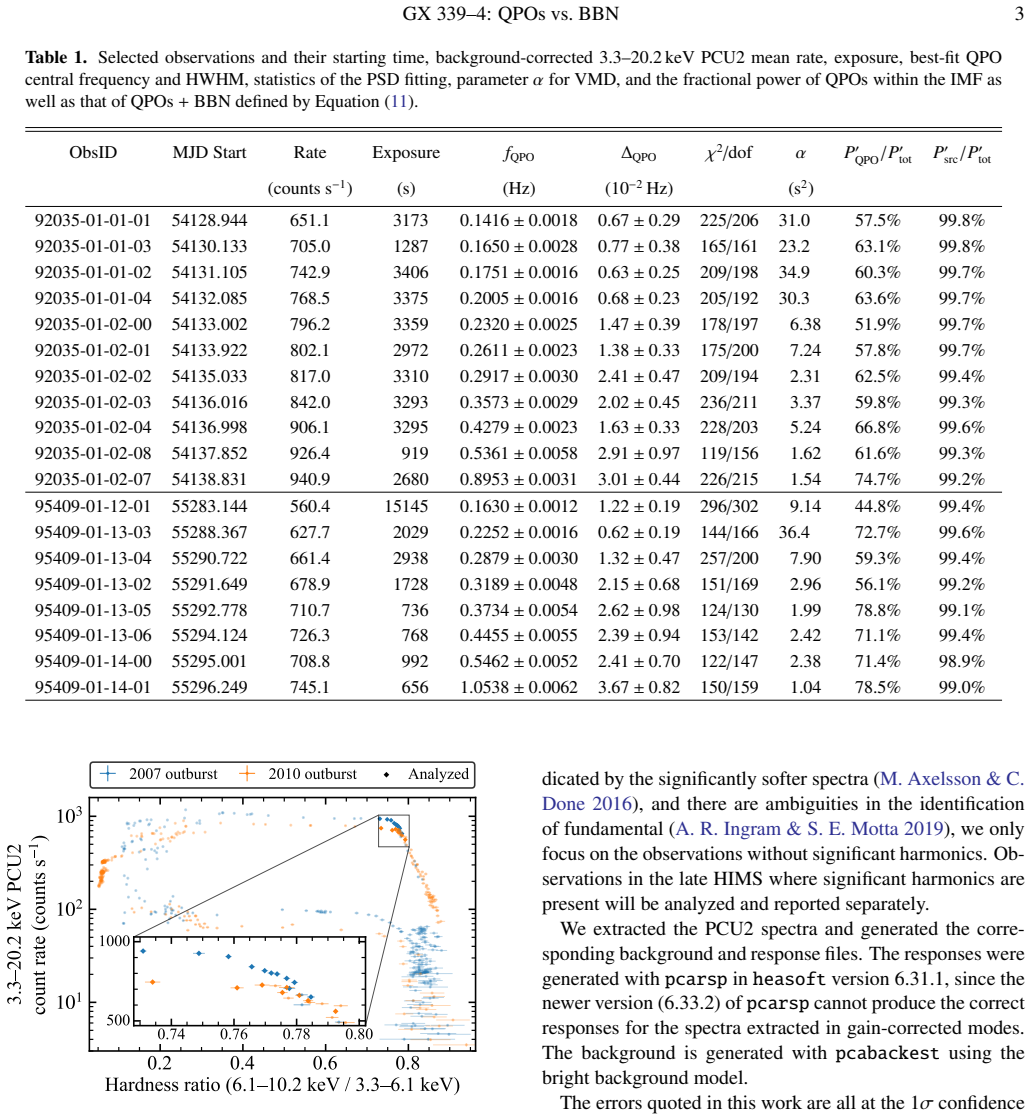
The paper establishes, for 19 RXTE observations of GX 339-4 with type-C QPOs below 1 Hz and without significant harmonics, that the QPO and broadband-noise components are statistically consistent in spectral behavior. The photon-index versus count-rate relations of the two components are indistinguishable, with the Chow test (a test of whether two linear relations share the same parameters) giving p>0.05 in every observation, and the PSD ratio spectra between the 2-5, 5-10, 10-15, and 15-30 keV bands show no significant QPO-like structure within the QPO's width (all deviations below 2 sigma). The natural reading, argued in the discussion, is that these QPOs are amplified narrowband oscillations of the same physical process that generates the broadband noise, so models relying on geometric modulation (precession) are disfavored while corona oscillation models are favored.
Load-bearing premise
The broadband-noise phase analysis forces each noise mode to have the same Q-factor as the QPO, a width chosen by analogy with harmonic Q-factors rather than measured from the noise power spectrum; if the true local coherence differs, the phase assignment and the photon-index comparison could be biased toward similarity.
Editorial extensions
If this is right
- For type-C QPOs below 1 Hz without harmonics, phase-resolved spectral fits can treat the QPO and broadband noise as a single variability process, simplifying the spectral decomposition.
- Geometric models that predict a phase lag between flux and photon index, or a step in the energy-dependent power-spectrum ratio at the QPO frequency, would need revision to fit these observations.
- Corona oscillation models, especially those with a cooler-corona-at-brighter-phase cycle, gain a direct observational anchor.
- The automatic VMD parameterization removes the human-tuning bottleneck, making systematic phase-resolved QPO surveys over large archival datasets feasible.
- The shared photon-index versus rate relation connects variability amplitude to spectral index through one cooling mechanism, a new diagnostic for accretion-flow models.
Reading between the lines
- If QPOs are amplified broadband-noise modes, harmonic-rich QPOs above 1 Hz might show a transition where the two components decouple; the authors' planned follow-up on harmonic observations will test this directly.
- The consistency claim could be sharpened by measuring the local broadband-noise coherence width from the power spectrum instead of borrowing the QPO's Q-factor; a different width could split the two photon-index relations.
- Extending this analysis to other black hole X-ray binaries across a range of inclinations would reveal whether the shared behavior is universal or specific to GX 339-4's geometry.
- The positive photon-index versus rate correlation at both components' phases implies that spectral softening tracks flux increases at all variability timescales, which can be compared with fluctuation-propagation models that predict specific phase relations between flux and hardness.
Editorial analysis
A structured set of objections, weighed in public.
Referee Report
Summary. The paper presents an improved variational mode decomposition (VMD) method for QPO phase-resolved spectroscopy, fixing the IMF central frequencies and bandwidths using PSD-fit QPO parameters and deriving the bandwidth-control parameter alpha analytically. It applies the method to 19 RXTE/PCA observations of GX 339-4 with type-C QPOs below 1 Hz and no significant harmonics. The main scientific claim is that the QPO and broadband noise (BBN) components show consistent spectro-timing behavior: photon index is positively correlated with count rate as a function of phase for both, with Chow tests giving p>0.05 for identical Gamma-rate relations, and PSD ratio spectra show no significant QPO-like structures near the QPO frequency. The authors conclude that the QPO may be an amplified mode of the BBN and favor corona-oscillation models over geometric precession models.
Significance. If the result holds, it is a significant step toward unifying QPO and broadband-noise mechanisms in black hole X-ray binaries, and the improved VMD algorithm is a practical methodological contribution. The paper is careful in several respects: phases are determined from PCUs independent of those used for spectroscopy to avoid Poisson-noise artifacts (Appendix A); contamination of the QPO IMF by BBN is quantified via P'_src/P'_tot and checked against P'_QPO/P'_tot (Table 3); and the limitations of the Chow test are acknowledged. The release of the implementation on GitHub/Zenodo is a strength. However, the central BBN comparison relies on an untested assumption about the BBN IMF width, so the scientific conclusion is not yet fully established.
major comments (3)
- [Section 3.4, Eq. (8)] The BBN IMF width is set to the QPO's Q factor rather than measured from the BBN power spectrum, and the text justifies this only by an analogy between fundamental and harmonic Q factors (F. Rao et al. 2010). This is load-bearing because Delta_BBN enters Eq. (8) and fixes alpha, which determines the effective band-pass transfer function of Eq. (7) and therefore the phase progression used to bin the BBN spectra. If the true local BBN coherence differs from the QPO's, the derived BBN Gamma-rate relation could be biased toward the quasi-sinusoidal QPO behavior, potentially manufacturing the 'consistent' result. I request a sensitivity test varying Delta_BBN (for example, using the local BBN Lorentzian widths from the PSD model or scaling the QPO Q-factor by factors of 2-3 in either direction) and reporting the resulting changes in the Table 2 slopes and Chow-test p-values, together with an injection/recovery simulation in which QPO and BBN have genuinely different Gamma-rate relations to demonstrate that the pipeline can detect such differences.
- [Section 3.2, text after Eq. (8)] The statement that the calibration coefficients 1/4 and 3 in the condition P_k(f_k+3*Delta_k) = P/4 'have no significant impact on the result' is not demonstrated. These coefficients set alpha through Eq. (8), and alpha is the bandwidth control in Eq. (6); for the BBN IMFs this is the same alpha used in the central comparison. The paper should show stability of the phase-resolved slopes and Chow-test p-values when the calibration condition is changed (for example, 1/2 at 2*Delta_k or 1/8 at 4*Delta_k), or provide an analytical argument for why the phase extraction is insensitive to these coefficients.
- [Section 4, PSD ratio test] The BBN reference regions for the ratio test are fixed to 0.4-0.5 f_QPO and 2-2.5 f_QPO. If the ratio spectrum is smoothly varying, these particular windows could underestimate or dilute a QPO feature. The claim that no QPO-like structures are present would be stronger if the significance were shown as a function of frequency across the QPO region or if the reference windows were varied to demonstrate that the conclusion is not an artifact of the chosen bands.
minor comments (4)
- [Section 4] There is a duplicated 'the' in 'To further investigate if the the QPOs and BBN share the same spectro-timing behaviors.'
- [Section 3.2, Eq. (8)] The notation 2*delta_ik - 1 is mathematically clear but could be confusing to some readers; writing +1 for i=k and -1 otherwise would improve readability.
- [Section 5] The sentence 'It would be coincidental to explain the same relation presented in Figure 2(b)' should be rephrased to clarify that the coincidence argument applies to geometric models rather than to the data themselves.
- [Table 2 caption] The caption says 'differences' but lists slope and intercept differences; adding units and a note that the quoted errors are 1-sigma would help.
Circularity Check
No direct circularity; the QPO/BBN consistency claim is empirically measured, though the BBN IMF width is imported from the QPO's Q factor via a partly self-cited analogy and merits a robustness test.
full rationale
The derivation chain is not circular. The QPO central frequency and HWHM are independently measured from PSD fits in Section 3.2 and are used only to set the VMD balance parameter through Eq. (8); the resulting phase-resolved photon-index versus count-rate relations for QPOs and BBN, and the PSD ratio spectra, are empirical quantities fitted from data rather than algebraic consequences of those inputs. The BBN IMF width is set to match the QPO's Q factor in Section 3.4, motivated by the statement that the Q factors of the fundamental and second harmonic are similar, citing F. Rao et al. (2010) which shares co-author S.-N. Zhang with the present paper. This is a methodological assumption that could bias the BBN filter, and a sensitivity test would strengthen the paper, but it does not make the target conclusion equivalent to the input: there is no equation in which the asserted Gamma-rate consistency or the featureless PSD ratios are defined to be the QPO width. The paper also cautions that p>0.05 does not prove that the relations are identical and checks for BBN contamination of the QPO IMF in Table 3. Therefore no circular step is established; the score of 2 reflects only the one minor, non-load-bearing self-citation.
Assumptions & free parameters
free parameters (3)
- Bandwidth calibration coefficients (1/4, 3) in the VMD alpha constraint
- BBN IMF Q-factor =
same as QPO Q
- Zero-frequency IMF HWHM Delta_0 =
set to HWHM of the narrowest QPO
assumptions (4)
- standard math VMD objective (Equation 6) and its Fourier-domain solution (Equation 7) correctly describe the light curve decomposition
- domain assumption Spectral model TBabs*edge(nthComp+diskbb+gaussian) with fixed NH, kTe, and iron-line parameters is adequate for the 3-30 keV PCA spectra
- domain assumption The selected 19 observations contain a single significant type-C QPO without harmonics, so phase extraction isolates a clean QPO signal
- ad hoc to paper BBN can be meaningfully decomposed into narrowband quasi-sinusoidal modes with the same coherence structure as the QPO
Cite this review
Pith. "Pith review of Phase-resolved QPO Analysis of GX 339-4: Improved Technique and Consistent Behaviors between QPOs and Broadband Noise." pith.science (2026). https://pith.science/paper/W3MOXO3I
@misc{pith2026260805916,
  author       = {Pith},
  title        = {Pith review of: Phase-resolved QPO Analysis of GX 339-4: Improved Technique and Consistent Behaviors between QPOs and Broadband Noise},
  year         = {2026},
  howpublished = {\url{https://pith.science/paper/W3MOXO3I}},
  note         = {Machine review of arXiv:2608.05916}
}
read the original abstract
The nature of low-frequency quasi-periodic oscillations (QPOs) in black hole X-ray binaries remains unclear, and their relationship with the accompanying broadband noise (BBN) is still under debate. Here, we propose an improved variational mode decomposition (VMD) technique. Compared with the original algorithm that requires iterative, case-by-case parameter tuning, the new algorithm automatically and consistently determines the relevant VMD parameters based on the QPO central frequency and width measured from the power spectral density (PSD). This enables a more robust phase determination for QPOs and can also be applied to the study of BBN. We found that, for low-frequency type-C QPOs without significant harmonics in the black hole X-ray binary GX 339-4, the spectral properties of the QPOs and BBN are statistically consistent with each other: (1) the photon index is positively correlated with count rate as a function of phase, and (2) the PSD ratio spectra across different energy bands show no statistically significant QPO-like structures near the QPO frequencies, indicating that both components share the same energy dependence. These suggest that QPOs and BBN may be driven by the same physical processes. The QPO models based on geometric modulation struggle to account for the results, while those invoking corona oscillations are favored.
Figures


Figures from the paper (4 more)


Reference graph
Works this paper leans on
-
[1]
Compact stellar X-ray sources , year = 2006, editor =
Black hole binaries. Compact stellar X-ray sources , year = 2006, editor =. doi:10.48550/arXiv.astro-ph/0306213 , adsurl =
-
[2]
Lecture Notes in Physics, Berlin Springer Verlag , year = 2010, editor =
States and Transitions in Black Hole Binaries. Lecture Notes in Physics, Berlin Springer Verlag , year = 2010, editor =. doi:10.1007/978-3-540-76937-8_3 , adsurl =
-
[3]
Towards a unified model for black hole X-ray binary jets. , keywords =. doi:10.1111/j.1365-2966.2004.08384.x , archivePrefix =. astro-ph/0409360 , primaryClass =
arXiv 2004
-
[4]
Magnetic Accretion Flow Explains the Hysteresis Q-diagram Seen in Outbursts of Black Hole Low-mass X-Ray Binaries. , keywords =. doi:10.3847/1538-4357/add5e8 , archivePrefix =. 2410.22661 , primaryClass =
-
[5]
EUV, X-Ray, and Gamma-Ray Instrumentation for Astronomy VII , year = 1996, editor =
In-orbit performance and calibration of the Rossi X-ray Timing Explorer (RXTE) Proportional Counter Array (PCA). EUV, X-Ray, and Gamma-Ray Instrumentation for Astronomy VII , year = 1996, editor =. doi:10.1117/12.256034 , adsurl =
-
[6]
RXTE Observations of QPOs in the Black Hole Candidate GRS 1915+105. , keywords =. doi:10.1086/304191 , adsurl =
doi:10.1086/304191 1915
-
[7]
The Complex Phase-Lag Behavior of the 3-12 HZ Quasi-Periodic Oscillations during the Very High State of XTE J1550-564. , keywords =. doi:10.1086/312365 , archivePrefix =. astro-ph/9909515 , primaryClass =
-
[8]
Characterizing the Quasi-periodic Oscillation Behavior of the X-Ray Nova XTE J1550-564. , keywords =. doi:10.1086/324276 , archivePrefix =. astro-ph/0105508 , primaryClass =
Show all 62 references
-
[9]
, keywords =
Correlated X-Ray Spectral and Timing Behavior of the Black Hole Candidate XTE J1550-564: A New Interpretation of Black Hole States. , keywords =. doi:10.1086/318954 , archivePrefix =. astro-ph/0001163 , primaryClass =
-
[10]
, keywords =
The evolution of the timing properties of the black-hole transient GX 339-4 during its 2002/2003 outburst. , keywords =. doi:10.1051/0004-6361:20042457 , archivePrefix =. astro-ph/0504577 , primaryClass =
2002 arXiv
-
[11]
, keywords =
The ABC of Low-Frequency Quasi-periodic Oscillations in Black Hole Candidates: Analogies with Z Sources. , keywords =. doi:10.1086/431174 , archivePrefix =. astro-ph/0504318 , primaryClass =
-
[12]
, keywords =
Probing the origin of quasi-periodic oscillations: the short-time-scale evolution of phase lags in GRS 1915+105. , keywords =. doi:10.1093/mnras/stw610 , archivePrefix =. 1603.03392 , primaryClass =
1915 arXiv
-
[13]
A Powerful Local Shear Instability in Weakly Magnetized Disks. I. Linear Analysis. , keywords =. doi:10.1086/170270 , adsurl =
-
[14]
, keywords =
Tracing the power-law component in the energy spectrum of black hole candidates as a function of the QPO frequency. , keywords =. doi:10.1051/0004-6361:20021542 , archivePrefix =. astro-ph/0210517 , primaryClass =
-
[15]
, keywords =
Precise mass and spin measurements for a stellar-mass black hole through X-ray timing: the case of GRO J1655-40. , keywords =. doi:10.1093/mnras/stt2068 , archivePrefix =. 1309.3652 , primaryClass =
-
[16]
, keywords =
Constraining black hole spins with low-frequency quasi-periodic oscillations in soft states. , keywords =. doi:10.1093/mnras/stw3363 , archivePrefix =. 1701.01760 , primaryClass =
-
[17]
, keywords =
Spins of black holes in X-ray binaries and the tension with the gravitational wave measurements. , keywords =. doi:10.1016/j.newar.2025.101746 , archivePrefix =. 2506.00623 , primaryClass =
2025
-
[18]
, keywords =
A review of quasi-periodic oscillations from black hole X-ray binaries: Observation and theory. , keywords =. doi:10.1016/j.newar.2020.101524 , archivePrefix =. 2001.08758 , primaryClass =
2020
-
[19]
, keywords =
Can Lense-Thirring Precession Produce QPOs in Supersonic Accretion Flows?. , keywords =. doi:10.3847/1538-4357/abcbf9 , archivePrefix =. 2011.09032 , primaryClass =
2011 arXiv
-
[20]
, keywords =
Phase-resolved spectroscopy of low-frequency quasi-periodic oscillations in GRS 1915+105. , keywords =. doi:10.1093/mnras/stu2373 , archivePrefix =. 1411.1967 , primaryClass =
1915 arXiv
-
[21]
, keywords =
The X-Ray Properties of Low-Frequency Quasi-periodic Oscillations from GRS 1915+105 Up to 120 KEV. , keywords =. doi:10.1086/318683 , archivePrefix =. astro-ph/0009354 , primaryClass =
1915 arXiv
-
[22]
Proceedings of the Royal Society of London Series A , year = 1998, month = mar, volume =
The empirical mode decomposition and the Hilbert spectrum for nonlinear and non-stationary time series analysis. Proceedings of the Royal Society of London Series A , year = 1998, month = mar, volume =. doi:10.1098/rspa.1998.0193 , adsurl =
1998
-
[23]
, keywords =
Characterizing Intermittency of 4-Hz Quasi-periodic Oscillation in XTE J1550-564 Using Hilbert-Huang Transform. , keywords =. doi:10.1088/0004-637X/815/1/74 , archivePrefix =. 1510.09122 , primaryClass =
-
[25]
, keywords =
Low-frequency Oscillations in XTE J1550-564. , keywords =. doi:10.1088/0004-637X/714/2/1065 , archivePrefix =. 1003.3285 , primaryClass =
-
[26]
, keywords =
The Evolution of the Phase Lags Associated with the Type-C Quasi-periodic Oscillation in GX 339-4 during the 2006/2007 Outburst. , keywords =. doi:10.3847/1538-4357/aa8138 , archivePrefix =. 1707.06228 , primaryClass =
2006 arXiv
- [27]
-
[28]
, keywords =
Energy dependence in the quasi-periodic oscillations and noise of black hole candidates in the very high state. , keywords =
-
[29]
, keywords =
Phase-resolved spectroscopy of Type B quasi-periodic oscillations in GX 339-4. , keywords =. doi:10.1093/mnras/stw1093 , archivePrefix =. 1605.01753 , primaryClass =
-
[30]
, keywords =
Revealing the nature of the QPO and its harmonic in GX 339-4 using frequency-resolved spectroscopy. , keywords =. doi:10.1093/mnras/stw464 , archivePrefix =. 1506.01102 , primaryClass =
-
[31]
Proceedings of High Energy Phenomena in Relativistic Outflows IX
Non-Equilibrium Thermodynamics of Black-Hole Coronae: QPOs, Turbulence, and Jets. Proceedings of High Energy Phenomena in Relativistic Outflows IX. doi:10.22323/1.510.0048 , archivePrefix =. 2512.09026 , primaryClass =
-
[32]
, keywords =
The First Polarimetric View on Quasiperiodic Oscillations in a Black Hole X-Ray Binary. , keywords =. doi:10.3847/2041-8213/ad1e6c , archivePrefix =. 2401.08970 , primaryClass =
-
[33]
, keywords =
Phase-resolved spectroscopy of a quasi-periodic oscillation in the black hole X-ray binary GRS 1915+105 with NICER and NuSTAR. , keywords =. doi:10.1093/mnras/stab3803 , archivePrefix =. 2201.01765 , primaryClass =
1915 arXiv
-
[34]
, keywords =
Inclination-dependent spectral and timing properties in transient black hole X-ray binaries. , keywords =. doi:10.1093/mnras/stv240 , archivePrefix =. 1405.2026 , primaryClass =
2026 arXiv
-
[35]
, keywords =
Geometrical constraints on the origin of timing signals from black holes. , keywords =. doi:10.1093/mnras/stu2579 , archivePrefix =. 1404.7293 , primaryClass =
-
[36]
, keywords =
Inclination dependence of QPO phase lags in black hole X-ray binaries. , keywords =. doi:10.1093/mnras/stw2634 , archivePrefix =. 1610.03469 , primaryClass =
-
[37]
, keywords =
Low-frequency quasi-periodic oscillations spectra and Lense-Thirring precession. , keywords =. doi:10.1111/j.1745-3933.2009.00693.x , archivePrefix =. 0901.1238 , primaryClass =
2009
-
[38]
, keywords =
A physical model for the continuum variability and quasi-periodic oscillation in accreting black holes. , keywords =. doi:10.1111/j.1365-2966.2011.18860.x , archivePrefix =. 1101.2336 , primaryClass =
2011
-
[39]
, keywords =
Variability of X-ray binaries from an oscillating hot corona. , keywords =. doi:10.1111/j.1365-2966.2010.16340.x , archivePrefix =. 1001.2116 , primaryClass =
2010
-
[40]
, keywords =
Tracing the Accretion Geometry of H1743-322 with Type C Quasiperiodic Oscillations in Multiple Outbursts. , keywords =. doi:10.3847/1538-4357/aca7b8 , archivePrefix =. 2211.16679 , primaryClass =
-
[41]
X-Ray Quasi-periodic Oscillations in the Lense-Thirring Precession Model. I. Variability of Relativistic Continuum. , keywords =. doi:10.3847/1538-4357/aabd33 , archivePrefix =. 1801.04028 , primaryClass =
-
[42]
, keywords =
Quasi-periodic Oscillations in Black Hole Candidates as an Indicator of Transition between Low and High States. , keywords =. doi:10.1086/313251 , archivePrefix =. astro-ph/9807235 , primaryClass =
-
[43]
, keywords =
Flicker noise in accretion discs. , keywords =. doi:10.1093/mnras/292.3.679 , adsurl =
-
[44]
, keywords =
Low-frequency Oscillations in Global Simulations of Black Hole Accretion. , keywords =. doi:10.1088/0004-637X/736/2/107 , archivePrefix =. 1009.1882 , primaryClass =
-
[45]
, keywords =
The Broadband Power Spectra of X-Ray Binaries. , keywords =. doi:10.1086/306993 , archivePrefix =. astro-ph/9810342 , primaryClass =
-
[46]
, keywords =
Relativistic Reflection and Reverberation in GX 339-4 with NICER and NuSTAR. , keywords =. doi:10.3847/1538-4357/ab9ec3 , archivePrefix =. 1910.01245 , primaryClass =
1910 arXiv
-
[47]
IEEE Transactions on Signal Processing , keywords =
Variational Mode Decomposition. IEEE Transactions on Signal Processing , keywords =. doi:10.1109/TSP.2013.2288675 , adsurl =
2013
-
[48]
IEEE Journal of Biomedical and Health Informatics , keywords =
Variational Mode Extraction: A New Efficient Method to Derive Respiratory Signals from ECG. IEEE Journal of Biomedical and Health Informatics , keywords =. doi:10.1109/JBHI.2017.2734074 , adsurl =
2017
-
[49]
, keywords =
A Phase-resolved View of the Low-frequency Quasiperiodic Oscillations from the Black Hole Binary MAXI J1820+070. , keywords =. doi:10.3847/1538-4357/acfc42 , archivePrefix =. 2311.03635 , primaryClass =
-
[50]
, keywords =
Non-Linear Variability of Quasi-Periodic Oscillations in GX 339--4. , keywords =. doi:10.1093/mnras/stz1052 , archivePrefix =. 1904.05895 , primaryClass =
1904 arXiv
-
[51]
, keywords =
State Transitions of GX 339--4 During Its Outburst Rising Phase. , keywords =. doi:10.1093/mnras/stab2521 , archivePrefix =. 2109.02088 , primaryClass =
-
[52]
, keywords =
Evolution of Iron K Line Emission in the Black Hole Candidate GX 339-4. , keywords =. doi:10.1086/320634 , archivePrefix =. astro-ph/0101459 , primaryClass =
-
[53]
, keywords =
Coronal-temporal correlations in GX 339-4: hysteresis, possible reflection changes and implications for advection-dominated accretion flows. , keywords =. doi:10.1046/j.1365-8711.2002.05353.x , archivePrefix =. astro-ph/0201383 , primaryClass =
2002
-
[54]
, keywords =
Stingray: A Modern Python Library for Spectral Timing. , keywords =. doi:10.3847/1538-4357/ab258d , archivePrefix =. 1901.07681 , primaryClass =
1901 arXiv
-
[55]
The Journal of Open Source Software , keywords =
Stingray 2: A fast and modern Python library for spectral timing. The Journal of Open Source Software , keywords =. doi:10.21105/joss.07389 , adsurl =
-
[56]
doi:10.5281/zenodo.13974481 , version =
StingraySoftware/stingray: Stingray v2.2. doi:10.5281/zenodo.13974481 , version =
-
[57]
PyXspec: Python interface to XSPEC spectral-fitting program
-
[58]
, keywords =
The Astropy Project: Sustaining and Growing a Community-oriented Open-source Project and the Latest Major Release (v5.0) of the Core Package. , keywords =. doi:10.3847/1538-4357/ac7c74 , archivePrefix =. 2206.14220 , primaryClass =
-
[59]
, keywords =
The Astropy Project: Building an Open-science Project and Status of the v2.0 Core Package. , keywords =. doi:10.3847/1538-3881/aabc4f , archivePrefix =. 1801.02634 , primaryClass =
-
[60]
, keywords =
Astropy: A community Python package for astronomy. , keywords =. 2013. doi:10.1051/0004-6361/201322068 , archivePrefix =. 1307.6212 , primaryClass =
2013 arXiv
-
[61]
Carvalho and Márcio F.D
Vinícius R. Carvalho and Márcio F.D. Moraes and Antônio P. Braga and Eduardo M.A.M. Mendes , title =. Biomedical Signal Processing and Control , volume =. 2020 , issn =. doi:https://doi.org/10.1016/j.bspc.2020.102073 , url =
2020
-
[62]
Chow , title =
Gregory C. Chow , title =. Econometrica , number =. 1960 , doi =
1960
-
[63]
doi:10.5281/zenodo.20068625 , url =
Qin, Jin and Feng, Hua , title =. doi:10.5281/zenodo.20068625 , url =
Reviewed August 7, 2026 · model on record in the stance chip above.
Discussion (0). Continue with ORCID to comment.