REVIEW 2 major objections 5 minor 33 references
A Search for GeV Emission from Magnetar Giant Flare Candidates with Fermi-LAT
T0 review · 2 major / 5 minor · reviewed 2026-08-10 · deepseek-v4-flash
Pith's one-line read The paper finds that six of seven nearby magnetar giant flare candidates have no detectable 0.1–10 GeV emission, and reads the silence as the predicted faintness of baryonic-poor fireball outflows.
desk verdict A genuinely new null result from a careful Fermi-LAT search, but the abstract and conclusion overstate the sample coverage for three events with zero early exposure. read the letter →
The pith
A machine-rendered reading of the paper's core claim, the machinery that carries it, and where it could break.
The reading
What carries the argument
The argument is carried by the relativistic fireball model of gamma-ray bursts applied to magnetar giant flares. The prompt spike's quasi-thermal peak energy $E_p$ is tied to the fireball's initial temperature, hence to its dimensionless entropy $\eta = L_0/(\dot{M} c^2)$; requiring the photosphere to lie in the acceleration phase gives $\eta > \eta_*$, where $\eta_* = (L_0\sigma_T/4\pi m_p c^3 r_0)^{1/4}$ is the critical Lorentz factor at transparency. In this baryonic-poor regime the kinetic energy of the ejecta is suppressed by the factor $\eta_*/\eta$, so the isotropic baryonic mass is bounded by $M_b^{\rm BP} = E_{\gamma,\rm iso}/(\xi_\gamma \eta_* c^2)$. Comparing this bound with the mass implied by the LAT flux, $M_b^{\rm LAT} = E_{\rm LAT,iso}/(\xi_L \eta_* c^2)$, decides whether a predicted GeV afterglow is observable. The photon-triplet waiting-time analysis provides a model-independent cross-check, using the Erlang-2 distribution of consecutive-photon intervals to flag unusually compact triplets.
What would settle it
A concrete falsifier would be the detection of a 0.1–10 GeV counterpart from any of the six non-detected candidates at a flux above the baryonic-poor prediction, using longer exposure or a more sensitive instrument, especially covering the unobserved early epochs (GRBs 180128A, 120616A, and 200423A first enter the LAT field of view at about 148 s, 1447 s, and 619 s). Alternatively, establishing that one of the five 'quasi-thermal' candidates has a non-thermal prompt spectrum, for instance a low-energy index $\alpha \leq -2/3$ with high confidence, would remove the baryonic-poor constraint and invalidate the predicted faintness.
Extended reading notes
Core claim
The central discovery is a null result with a physical interpretation. Among seven nearby extragalactic magnetar giant flare (MGF) candidates selected from Fermi-GBM data, only GRB 200415A shows delayed GeV emission; the other six yield no significant detection in post-trigger windows spanning $10^2$ to $10^4$ seconds. Individual 95% confidence upper limits on the 0.1–10 GeV energy flux are of order $10^{-9}$ erg cm$^{-2}$ s$^{-1}$, and the stacked population-averaged limit is $\approx 2\times10^{-10}$ erg cm$^{-2}$ s$^{-1}$. For the five candidates with hard quasi-thermal prompt spectra, the baryonic-poor fireball condition $\eta > \eta_*$ restricts the ejecta mass to $M_b \lesssim 1$\textendash$4\times10^{22}$ g; since the LAT limits correspond to much larger allowed masses, the non-detections are naturally explained by intrinsically faint afterglows rather than by insufficient exposure alone. GRB 200415A, by contrast, requires a baryonic load near the critical value $\eta\sim\eta_*$, consistent with a marginally baryonic-poor outflow.
Load-bearing premise
The load-bearing premise is that the hard, quasi-thermal prompt spectra of five candidates really do come from baryonic-poor fireballs obeying $E_p \propto E_{\rm iso}^{1/4}$; if any of those events instead produces its prompt emission by non-thermal processes, the derived mass limits and the conclusion that their GeV afterglows are too faint to detect no longer follow.
Editorial extensions
If this is right
- GeV afterglows from magnetar giant flares are not a common feature: one of seven candidates shows one, and the stacked limit places the population average more than an order of magnitude below the measured GRB 200415A flux.
- The five baryonic-poor candidates have predicted GeV afterglows below Fermi-LAT sensitivity, so detecting them would require larger effective area or longer exposures than the current instrument provides.
- GRB 200415A sits near the critical regime $\eta\sim\eta_*$, implying that a detectable GeV afterglow needs a finely tuned baryon load: clean enough for a high-$E_p$ prompt spike, yet loaded enough to power a shock.
- The two candidates whose spectral indices allow a non-thermal prompt origin (GRBs 200423A and 231024A) may be baryonic-rich; their non-detections are consistent with late LAT exposure or low isotropic energy.
Reading between the lines
- If baryonic-poor outflows are the norm, MGF GeV afterglows are intrinsically rare, and the single detection among seven suggests that current instruments see only the bright end; instruments with larger effective area could test this by pushing below the $\sim 2\times10^{-10}$ erg cm$^{-2}$ s$^{-1}$ stacked limit.
- Four of the seven flares come from the same host galaxy, NGC 253, and likely the same magnetar; the fact that only the most energetic of them produced GeV emission hints that GeV brightness tracks isotropic energy, a trend that future flares from that galaxy could confirm or refute.
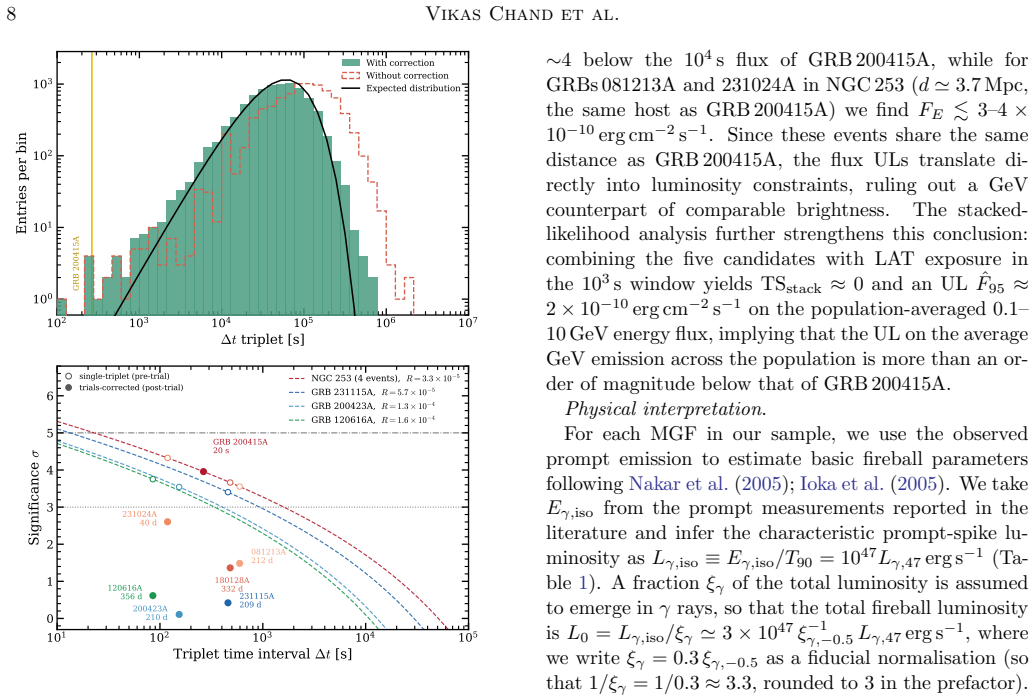
- The photon-triplet analysis shows that a single compact triplet is weak evidence once trials are accounted for: GRB 231024A's best triplet drops to $1.9\sigma$ after a Bonferroni correction, so future transient searches should fix the search window a priori rather than scan for the most compact triplet.
- If the non-thermal interpretation for GRBs 200423A and 231024A is correct, their GeV silence may reflect magnetic dissipation of energy during the prompt phase rather than low baryon mass; measuring prompt-to-afterglow efficiency in such events would distinguish the two channels.
Editorial analysis
A structured set of objections, weighed in public.
Referee Report
Summary. This paper presents a systematic Fermi-LAT search for GeV (0.1–10 GeV) emission from seven nearby extragalactic magnetar giant flare (MGF) candidates, using unbinned likelihood analyses in 10^2, 10^3, and 10^4 s post-trigger windows, 500 s SED scans, a stacked-likelihood analysis, and a photon-triplet waiting-time search. The authors recover the known delayed GeV signal from GRB 200415A (TS ~ 25 in the 10^3 s window, hard spectrum Γ ≈ −1.7) and report non-detections with 95% C.L. upper limits of order 10^-9 erg cm^-2 s^-1 for the other six candidates, with a stacked limit of about 2×10^-10 erg cm^-2 s^-1 over the events with LAT exposure. They explicitly note that GRBs 180128A, 120616A, and 200423A have zero exposure in the 10^2 s window, with first exposures at about 148, 1447, and 619 s, so their earliest emission is unconstrained. In the fireball interpretation, the quasi-thermal prompt spectra imply baryon-poor outflows (η > η*), limiting ejecta mass to about 1–4×10^22 g for the fainter candidates; the LAT upper limits are weaker than these baryonic mass limits, which the authors argue makes the non-detections a natural expectation rather than evidence against the model.
Significance. The central observational result—a clean, multi-method null for a rare class of transients—is valuable and appears methodologically sound. The analysis follows standard Fermi-LAT procedures (P8R3 event classes, 12-degree ROI, profile-likelihood upper limits with fixed Γ = −2), and the consistency across four independent tests (likelihood, SED, stacking, triplet) strengthens confidence in the non-detections. The photon-time scramble used to compute trials-corrected triplet probabilities is a thoughtful treatment of the look-elsewhere effect, especially for the four NGC 253 events sharing one sky position. If the result holds, it provides the first population-level LAT constraints on MGF GeV afterglows and sharpens the exceptionality of GRB 200415A. The main limitations are the small sample and the exposure gaps for three events, which narrow the scope of the astrophysical interpretation; these are acknowledged in the text but should be reflected more consistently in the headline and concluding claims.
major comments (2)
- [§4, §5, Table 2] The concluding claim that the lack of GeV counterparts in the broader population is "a natural prediction of the baryonic-poor fireball model rather than an observational limitation alone" is not supported for three of the six non-detected candidates. As Table 2 reports, GRBs 180128A, 120616A, and 200423A have zero exposure in the 10^2 s window and first LAT exposures at about 148, 1447, and 619 s, respectively. The GeV signal of GRB 200415A peaked at roughly 19–380 s (Section 1), so for these three events the most relevant epoch is entirely unobserved. GRB 200423A has E_iso = 8.5×10^45 erg (Table 1), comparable to GRB 200415A; a 200415A-like early afterglow would be missed. The model conclusion can be drawn only for the subset with meaningful early-time LAT coverage (principally the quasi-thermal candidates GRBs 081213A and 231115A); for the other three non-detections the data cannot distinguish baryonic-poor suppression from lack of exposure. Please qualify the abstract and conclusions accordingly.
- [§2.2, §4, Figure 1] The stacked-likelihood upper limit of about 2×10^-10 erg cm^-2 s^-1 is computed from individual likelihoods over heterogeneous GTIs (Equation 1). For the 10^3 s window the stacked events include GRB 200423A with only about 380 s of coverage beginning at 619 s and GRB 180128A with coverage beginning at 148 s; for the 10^2 s window only two events effectively contribute. The abstract and Section 4 should therefore state explicitly that the stacked limit applies to the population-averaged flux during the observed intervals, not to the full 10^2–10^4 s post-trigger range. Without this qualification, the comparison with GRB 200415A's flux, which is measured over a fully covered window, is not apples-to-apples.
minor comments (5)
- [§2.3] There is a typo in the sentence about cross-contamination: "photons from one flare may spuriously appear as appear as delayed triplets" should read "may spuriously appear as delayed triplets".
- [Abstract] The abstract contains the literal LaTeX control sequence "\chng{a waiting time}"; this should be rendered as plain text such as "a waiting-time analysis".
- [Table 4] M_b^(BP) entries are listed for GRBs 200423A and 231024A even though Section 4 states that the baryonic-poor requirement η > η* is not enforced for these two events; the table should mark these entries as not applicable or add a clear footnote explaining that the baryonic-poor limit does not apply under the non-thermal prompt interpretation.
- [Table 1] For GRB 081213A the reference is given as Bissaldi & von Kienlin (2008), which is a GCN circular; please verify whether the E_p, α, and E_iso values in Table 1 come from that circular or from a later spectral analysis (e.g., Trigg et al. 2024/2026), and cite the appropriate source.
- [Figure 2] The caption says the stacked SED combines the four non-detected events with LAT exposure in the 500 s interval, but the four events are not named; please list them explicitly for reproducibility.
Circularity Check
No significant circularity: the GeV search is independent of the fireball model, which enters only as a post-hoc interpretation.
full rationale
The central measurement — the absence of GeV emission from six MGF candidates and the recovery of GRB 200415A — is obtained from standard Fermi-LAT unbinned likelihood, stacking, and photon-triplet analyses; none of these use the fireball model as an input. The upper limits in Table 2 are profile-likelihood values with a fixed photon index, derived directly from LAT exposure and counts. The fireball interpretation in Section 4 is applied after the fact: prompt E_gamma,iso and Ep values from GBM literature determine eta* and the baryonic-poor upper bound M_b^(BP), and the LAT ULs are separately converted to M_b^(LAT) under an assumed GeV efficiency. The comparison M_b^(BP) << M_b^(LAT) is a consistency check, not a fit to the GeV data, so the statement that faint GeV afterglows are a natural prediction of the baryonic-poor model is not equivalent to the input. The paper does rely on the authors' own Trigg et al. (2026) for the candidate list and the Ep-Eiso scaling, but this is a normal, non-circular use of prior published work: the GeV measurements would stand even if the candidates were later reclassified, and the scaling is also attributed to external work (Zhang et al. 2020). The explicit concession that three events (GRBs 180128A, 120616A, and 200423A) have zero early exposure and that their earliest emission is unconstrained is a scope limitation, not a circular step. No equation in the derivation reduces to its own input.
Assumptions & free parameters
free parameters (3)
- Prompt radiative efficiency xi_gamma =
0.3 (fiducial)
- GeV-band radiative efficiency xi_L =
0.1 (fiducial)
- Initial fireball radius r0 =
10^6 cm
assumptions (4)
- domain assumption The prompt spectral peak energy of these MGFs follows Ep proportional to Eiso^(1/4), implying baryon-poor outflows (eta > eta*) for quasi-thermal events.
- domain assumption The fireball model with r0 = 10^6 cm, xi_gamma = 0.3, and xi_L = 0.1 describes MGF outflows.
- domain assumption The host galaxy coordinates adopted in Table 1 are the true positions of the MGFs.
- domain assumption Any GeV emission is powered by baryonic kinetic energy in the external shock.
Cite this review
Pith. "Pith review of A Search for GeV Emission from Magnetar Giant Flare Candidates with Fermi-LAT." pith.science (2026). https://pith.science/paper/6ZAXD2WN
@misc{pith2026260806527,
  author       = {Pith},
  title        = {Pith review of: A Search for GeV Emission from Magnetar Giant Flare Candidates with Fermi-LAT},
  year         = {2026},
  howpublished = {\url{https://pith.science/paper/6ZAXD2WN}},
  note         = {Machine review of arXiv:2608.06527}
}
abstract
The discovery of delayed GeV emission from the extragalactic magnetar giant flare (MGF) GRB 200415A, located in the nearby Sculptor galaxy, revealed for the first time that these rare transients can launch relativistic outflows that power high-energy afterglows. Motivated by the recent identification of additional nearby MGF candidates in the archival data of the Fermi Gamma-ray Burst Monitor, we conduct a search for GeV counterparts with the Fermi Large Area Telescope (LAT). We analysed post-trigger time intervals taken in the range $10^{2}$--$10^{4}$\,s using a maximum-likelihood approach and performed a stacking analysis of all candidates with LAT coverage. In addition, we searched for photon triplets through \chng{a waiting time} analysis to identify events potentially associated with MGFs. We recover the known delayed signal from GRB\,200415A but find no GeV emission from the remaining six candidates. For three events, the earliest emission is unconstrained because the $10^{2}$\,s interval contains zero exposure after standard selections. For the events with LAT coverage, we obtain upper limits at 95\% confidence level of order $F_E \sim 10^{-9}\,\mathrm{erg\,cm^{-2}\,s^{-1}}$ for the individual events, and a stacked population-averaged limit of $\approx2\times10^{-10}\,\mathrm{erg\,cm^{-2}\,s^{-1}}$. We interpret these upper limits within the relativistic fireball framework, where the prompt spectral peaks favor a baryonic-poor regime ($\eta > \eta_*$). For the candidates with hard prompt spectrum and early LAT coverage, the baryonic-poor condition restricts the mass of relativistic ejecta to $M_b \lesssim 1\text{--}4 \times 10^{22}$\,g; the LAT upper limits confirm that the predicted GeV afterglow from such clean outflows falls below current instrumental sensitivity.
Figures


Reference graph
Works this paper leans on
-
[1]
2022, ApJS, 260, 53, doi: 10.3847/1538-4365/ac6751
Abdollahi, S., Acero, F., Baldini, L., et al. 2022, ApJS, 260, 53, doi: 10.3847/1538-4365/ac6751
-
[2]
2019, ApJ, 878, 52, doi: 10.3847/1538-4357/ab1d4e
Ajello, M., Arimoto, M., Axelsson, M., et al. 2019, ApJ, 878, 52, doi: 10.3847/1538-4357/ab1d4e
-
[3]
2013, arXiv e-prints, arXiv:1303.3514, doi: 10.48550/arXiv.1303.3514
Atwood, W., Albert, A., Baldini, L., et al. 2013, arXiv e-prints, arXiv:1303.3514, doi: 10.48550/arXiv.1303.3514
-
[4]
Atwood, W. B., Abdo, A. A., Ackermann, M., et al. 2009, ApJ, 697, 1071, doi: 10.1088/0004-637X/697/2/1071
-
[5]
H., Lott, B., & The Fermi-LAT collaboration
Ballet, J., Bruel, P., Burnett, T. H., Lott, B., & The Fermi-LAT collaboration. 2023, arXiv e-prints, arXiv:2307.12546, doi: 10.48550/arXiv.2307.12546
-
[6]
2008, GRB Coordinates Network, 8668, 1
Bissaldi, E., & von Kienlin, A. 2008, GRB Coordinates Network, 8668, 1
work page 2008
-
[7]
Bruel, P., Burnett, T. H., Digel, S. W., et al. 2018, arXiv e-prints, arXiv:1810.11394, doi: 10.48550/arXiv.1810.11394
-
[8]
Chand, V., Joshi, J. C., Gupta, R., et al. 2021, Research in Astronomy and Astrophysics, 21, 236, doi: 10.1088/1674-4527/21/9/236 Fermi-LAT Collaboration, Ajello, M., Atwood, W. B., et al. 2021, Nature Astronomy, 5, 385, doi: 10.1038/s41550-020-01287-8 Fermi Science Support Development Team. 2019, Fermitools: Fermi Science Tools, Astrophysics Source Code ...
Show all 33 references
-
[9]
M., Kouveliotou, C., Gelfand, J
Gaensler, B. M., Kouveliotou, C., Gelfand, J. D., et al. 2005, Nature, 434, 1104, doi: 10.1038/nature03498
2005 doi
-
[10]
D., Lyubarsky, Y
Gelfand, J. D., Lyubarsky, Y. E., Eichler, D., et al. 2005, ApJL, 634, L89, doi: 10.1086/498643
2005 doi
-
[11]
B., et al
Granot, J., Ramirez-Ruiz, E., Taylor, G. B., et al. 2006, ApJ, 638, 391, doi: 10.1086/497680
2006 doi
-
[12]
1999, Nature, 397, 41, doi: 10.1038/16199
Hurley, K., Cline, T., Mazets, E., et al. 1999, Nature, 397, 41, doi: 10.1038/16199
1999 doi
-
[13]
2005, ApJ, 633, 1013, doi: 10.1086/466514
Ioka, K., Razzaque, S., Kobayashi, S., & M´ esz´ aros, P. 2005, ApJ, 633, 1013, doi: 10.1086/466514
2005 doi
-
[14]
M., & Beloborodov, A
Kaspi, V. M., & Beloborodov, A. M. 2017, ARA&A, 55, 261, doi: 10.1146/annurev-astro-081915-023329
2017 doi
-
[15]
1983, ApJ, 272, 317, doi: 10.1086/161295
Li, T.-P., & Ma, Y.-Q. 1983, ApJ, 272, 317, doi: 10.1086/161295
1983 doi
-
[16]
2006, MNRAS, 367, 1594, doi: 10.1111/j.1365-2966.2006.10069.x
Lyutikov, M. 2006, MNRAS, 367, 1594, doi: 10.1111/j.1365-2966.2006.10069.x
2006
-
[17]
R., Bertsch, D
Mattox, J. R., Bertsch, D. L., Chiang, J., et al. 1996, ApJ, 461, 396, doi: 10.1086/177068
1996 doi
-
[18]
P., Golentskii, S
Mazets, E. P., Golentskii, S. V., Ilinskii, V. N., Aptekar, R. L., & Guryan, I. A. 1979, Nature, 282, 587, doi: 10.1038/282587a0
1979 doi
-
[19]
N., et al
Meegan, C., Lichti, G., Bhat, P. N., et al. 2009, ApJ, 702, 791, doi: 10.1088/0004-637X/702/1/791
2009 doi
-
[20]
2005, ApJ, 635, 516, doi: 10.1086/497296
Nakar, E., Piran, T., & Sari, R. 2005, ApJ, 635, 516, doi: 10.1086/497296
2005 doi
-
[21]
2024, Frontiers in Astronomy and Space Sciences, 11, 1388953, doi: 10.3389/fspas.2024.1388953
Negro, M., Younes, G., Wadiasingh, Z., et al. 2024, Frontiers in Astronomy and Space Sciences, 11, 1388953, doi: 10.3389/fspas.2024.1388953
2024
-
[22]
S., Dom ´ ınguez, A., Ajello, M., Franckowiak, A., & Hartmann, D
Paliya, V. S., Dom ´ ınguez, A., Ajello, M., Franckowiak, A., & Hartmann, D. 2019, ApJL, 882, L3, doi: 10.3847/2041-8213/ab398a
2019 doi
-
[23]
M., Barthelmy, S., Gehrels, N., et al
Palmer, D. M., Barthelmy, S., Gehrels, N., et al. 2005, Nature, 434, 1107, doi: 10.1038/nature03525
2005 doi
-
[24]
D., Briggs, M
Preece, R. D., Briggs, M. S., Mallozzi, R. S., et al. 1998, ApJL, 506, L23, doi: 10.1086/311644
1998 doi
-
[25]
2023, A&A, 675, A99, doi: 10.1051/0004-6361/202346492
Principe, G., Di Venere, L., Negro, M., et al. 2023, A&A, 675, A99, doi: 10.1051/0004-6361/202346492
2023 doi
-
[26]
2021, Nature, 589, 211, doi: 10.1038/s41586-020-03076-9
Svinkin, D., Frederiks, D., Hurley, K., et al. 2021, Nature, 589, 211, doi: 10.1038/s41586-020-03076-9
2021 doi
-
[27]
C., Burns, E., Roberts, O
Trigg, A. C., Burns, E., Roberts, O. J., et al. 2024, A&A, 687, A173, doi: 10.1051/0004-6361/202348858
2024 doi
-
[28]
C., Stewart, R., Van Kooten, A., et al
Trigg, A. C., Stewart, R., Van Kooten, A., et al. 2025, A&A, 694, A323, doi: 10.1051/0004-6361/202452268
2025 doi
-
[29]
C., Burns, E., Negro, M., et al
Trigg, A. C., Burns, E., Negro, M., et al. 2026, A&A, 710, A139, doi: 10.1051/0004-6361/202558217
2026 doi
-
[30]
2016, gtburst: Release for Zenodo, 02-01-03, Zenodo, doi: 10.5281/zenodo.59783
Vianello, G. 2016, gtburst: Release for Zenodo, 02-01-03, Zenodo, doi: 10.5281/zenodo.59783
2016 doi
- [31]
-
[32]
2020, ApJ, 899, 106, doi: 10.3847/1538-4357/aba745
Yang, J., Chand, V., Zhang, B.-B., et al. 2020, ApJ, 899, 106, doi: 10.3847/1538-4357/aba745
2020 doi
-
[33]
2020, ApJL, 903, L32, doi: 10.3847/2041-8213/abc2c9 GeV Emission Search in Magnetar Giant Flares13 16° 14° 12° 10° 8° -22° -24° -26° -28° -30° R.A
Zhang, H.-M., Liu, R.-Y., Zhong, S.-Q., & Wang, X.-Y. 2020, ApJL, 903, L32, doi: 10.3847/2041-8213/abc2c9 GeV Emission Search in Magnetar Giant Flares13 16° 14° 12° 10° 8° -22° -24° -26° -28° -30° R.A. (J2000) Decl. (J2000) without GRB200415A in model J0037.2-2653 J0038.2-2459...
2020 doi
Reviewed August 10, 2026 · model on record in the stance chip above.
Discussion (0). Continue with ORCID to comment.