REVIEW 4 major objections 5 minor 56 references
Plan-and-Avoid: Real-Time Aircraft Trajectory Coordination in a Multi-Agent Environment
T0 review · 4 major / 5 minor · reviewed 2026-08-10 · deepseek-v4-flash
Pith's one-line read A two-stage plan-and-avoid loop resolves every predicted well-clear conflict in its 575-encounter benchmark, with a worst-case end-to-end time of 5.7 seconds.
desk verdict A genuine two-stage priority-trajectory coordination architecture with sound uncertainty math and a large real-data benchmark, but the all-575 well-clear claim is only established on a 1 Hz sampled grid, not in continuous time. read the letter →
The pith
A machine-rendered reading of the paper's core claim, the machinery that carries it, and where it could break.
The reading
What carries the argument
The load-bearing device is the uncertainty-deflated separation metric $\delta_H(t)=\max(0,\|\hat{r}_H(t)\|-\Delta\bar{e}_H)$ and $\delta_V(t)=\max(0,|\hat{r}_V(t)|-\Delta\bar{e}_V)$, which converts confidence-bounded position errors into deterministic buffers using the reverse triangle inequality and the union bound. This lets both the planner and the advisory optimizer check well-clear separation with a distribution-free confidence guarantee, replacing probabilistic position uncertainty with inflated separation thresholds. The advisory side is carried by a rank-ordered action set $\mathcal{R}=\{R_{Halt},R_{Speed},R_{Alt},R_{Extend},R_{Divert}\}$, where each action is a trajectory transformation solved as a quadratic program subject to two constraints: $\psi_1$ enforces robust well-clear separation with the priority ego including its speed-tracking time window, and $\psi_2$ requires that the advised trajectory does not increase cumulative or peak interaction risk against remaining nominal traffic.
What would settle it
Run the released implementation on the same 575-encounter benchmark with an added simulation layer in which intruders execute their advisories with small tracking errors, such as a 5 knot speed error or a 0.5 degree heading error, while the ego stays within its declared speed bounds; any resulting loss of well-clear separation would show the advisory pipeline is not robust to execution noise within the assumed envelope.
Extended reading notes
Core claim
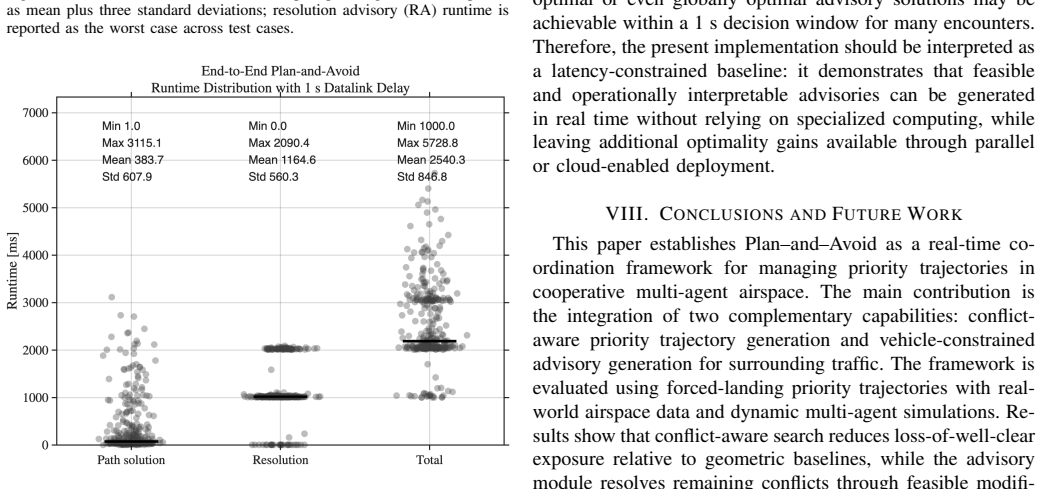
On its own terms, the paper establishes that Plan-and-Avoid (PAA) can turn an emergency landing trajectory into a system-level coordination event. The Plan stage extends a gradient-guided contingency landing planner with spatiotemporal conflict cost, using uncertainty-deflated separation buffers derived from confidence bounds on position error; the Avoid stage then issues rank-ordered unilateral advisories, halt, speed, altitude, extend, and divert, to conflicting intruders, each formulated as a quadratic program that must keep well-clear separation with the priority aircraft and not worsen interaction risk with other nominal traffic. The benchmark over more than 900 forced-landing cases using real ADS-B traffic from the Washington, D.C., airspace yielded feasible advisories for all 575 unique conflict encounters, with worst-case end-to-end response time 5.7 seconds including a 1 second two-way datalink delay, and 93.5% of advisories meeting the 35 second RTCA DO-365 alerting threshold.
Load-bearing premise
The framework assumes intruders share accurate time-stamped intent and will follow the issued advisories; if an intruder deviates from its declared intent or ignores an advisory, well-clear separation is not guaranteed, which the paper acknowledges by positioning Detect-and-Avoid as a downstream safety layer.
Editorial extensions
If this is right
- Conflict-aware search planning reduces loss-of-well-clear exposure by 45.5% in accumulated severity and increases conflict-free cases from 50.4% to 60% compared with a Dubins baseline.
- All 575 unique conflict encounters in the benchmark received feasible advisories, and speed regulation was the most common resolution (36.2%), suggesting that many conflicts can be resolved by modest timing changes.
- The 1 second optimizer limit preserves the overall distribution of advisory types compared with 15 seconds of optimization, with speed remaining dominant and only a moderate shift from extend to divert advisories.
- Worst-case end-to-end runtime of 5.7 seconds on a personal computer, including path planning, advisory generation, and a 1 second datalink delay, means the coordination loop closes within seconds of the priority trajectory being declared.
- A large majority, 93.5%, of advisories are issued at least 35 seconds before the predicted conflict, the RTCA DO-365 alerting threshold.
Reading between the lines
- The same architecture could invert the priority: instead of a distressed aircraft, the protected trajectory could be a time-critical delivery, a VIP route, or a corridor closure, and the advisory set would apply with unchanged logic.
- The interaction-risk constraint $\psi_2$ is what makes the approach scalable; without it, resolving one conflict could cascade into new conflicts, and the paper's benchmark implicitly tests this through the requirement that all 575 encounters be resolved sequentially.
- Because 6.5% of advisories fall inside the 35 second DAA horizon, those cases would already be in the reactive DAA regime; a testable improvement would be to pre-plan candidate priority trajectories before declaration, shortening the effective response time.
- The 1 second optimizer limit trades optimality for latency; the paper's own 15 second comparison shows a modest total benefit, suggesting that parallel or cloud computing could close the gap without violating the real-time bound.
Signed reviews
Editorial analysis
A structured set of objections, weighed in public.
Referee Report
Summary. The paper introduces Plan-and-Avoid (PAA), a two-stage framework for coordinating cooperative airspace traffic around a declared priority trajectory. The Plan stage extends a previously developed contingency landing planner with multi-agent intent and uncertainty-inflated well-clear constraints, while the Avoid stage generates rank-ordered unilateral advisories (halt, speed, altitude, extend, divert) for surrounding traffic, formulated as quadratic programs with a robust time-window well-clear constraint and an interaction-risk constraint. The framework is evaluated on more than 900 forced-landing scenarios built from real ADS-B data, resolving all 575 predicted conflict encounters within a reported worst-case end-to-end time of 5.7 s, with 93.5% of advisories satisfying the RTCA DO-365 35 s temporal threshold. Two representative 6-DOF dynamic simulations are also presented to check that the kinematic advisories remain dynamically realizable.
Significance. If the claims are fully validated, PAA is a useful and original contribution to cooperative multi-agent contingency coordination: it couples conflict-aware priority planning with an advisory hierarchy for surrounding traffic, and it is evaluated on a large public-data benchmark rather than only on hand-picked cases. The paper is honest about the suboptimality of the planner, explicitly reports cases where the Dubins baseline performs better, and makes the software openly available. The probabilistic separation-buffer propositions (Propositions 1 and 2) are mathematically sound and provide a distribution-free way to convert position uncertainty into deterministic separation margins. However, the headline claims currently outrun what is verified: the all-575 feasibility result is checked only on 1 Hz sampled trajectories, the abstract's "well-clear separation for all traffic" is stronger than the interaction-risk constraint actually enforced, and the reported "worst-case" end-to-end time mixes a mean-plus-3-sigma planning time with a worst-case advisory time. These issues are local and fixable, but they are load-bearing for the paper's central claims.
major comments (4)
- [Section VI, Eq. (51)] The claim that all 575 conflicts are feasibly resolved is verified only on trajectories sampled at 1 Hz, as stated in Section VI and Section V, whereas the constraint ψ1 in Eq. (44) is defined as a maximum over continuous time t and the continuous timing window ξ∈W_e(t). At the benchmark airspeeds of 70–350 kts, an aircraft moves 36–180 m between consecutive 1 Hz samples, so a well-clear violation can occur between samples even if every sample satisfies the constraint. Since the two 6-DOF simulations are explicitly representative cases, the universal "feasible for all 575" statement is not currently established for continuous-time trajectories. Please add a post-hoc dense re-check or an analytic inter-sample bound, and either report the continuous-time result or restrict the claim to the sampled trajectory representation.
- [Abstract and Section IV, Eq. (49)] The abstract states that the framework maintains "well-clear separation for all traffic," but the interaction constraint ψ2 in Eq. (49) only requires that the advised intruder trajectory not increase the cumulative and peak interaction-risk functionals I_J and J_max relative to the nominal trajectory. It does not require well-clear separation between the modified intruder and the remaining nominal traffic, and Table II only counts conflicts with the ego priority trajectory. The benchmark therefore does not evaluate well-clear separation among all pairs of traffic. Please either add a post-advisory well-clear check against all remaining traffic, or soften the claim to "resolves predicted well-clear conflicts with the priority trajectory while not increasing interaction risk with other traffic."
- [Section VI.E and Abstract] The paper calls 5.7 s a "worst-case end-to-end response time," but Section VI.E reports that path-planning runtime is the mean plus three standard deviations, while resolution-advisory runtime is the worst case across test cases. A mean-plus-3σ planning time added to a worst-case advisory time and a fixed 1 s datalink delay is not a rigorous worst-case upper bound for the end-to-end pipeline. Please report the true maximum from the distribution in Fig. 17, or rename the claim to a "high-confidence end-to-end time" and justify the statistical aggregation.
- [Sections III.B and VII] The all-575 feasibility result is computed against nominal declared trajectory intent and assumes that intruders will execute the issued advisories. The paper acknowledges in Section VII that DAA is needed as a downstream safety layer for stochastic deviations, but the abstract and conclusions do not carry this qualification. Because noncompliance or intent deviation voids the separation guarantee, the central claim should be qualified as holding only for cooperative intruders that follow their declared intent and accept the advisory; otherwise the abstract's wording is stronger than the model supports.
minor comments (5)
- [Section IV.E, Eq. (70)] The holding-point tuple is written as q=(φ, λ, h, h, χ), which contains the altitude h twice; this appears to be a typo, since the surrounding text describes an admissible altitude interval with a floor and ceiling.
- [Section IV.E, Eq. (72)] In the definition of γ̃, the first fraction (−γ_thr−γ)/(−γ_thr−γ) is identically 1, so the expression as written does not encode the intended penalty for operating outside the preferred flight-path-angle range. Please re-check the normalization formula.
- [Section IV.D, text near Eq. (66)] The sentence saying the final advisory state "may lie backward in time compared to initial advisory state" is confusing and appears inconsistent with τ_e(t_rec−t_on) = s'_rec, which requires t_rec ≥ t_on for a nonnegative extension duration. Please clarify or correct the intended meaning.
- [References] References [9] and [10] appear to be the same paper by the same authors with the same title and page range; one of them should be removed or replaced with a distinct source.
- [Title] The title uses "Plan-and-Avoid" with a hyphen while the text uses "Plan–and–Avoid" with en dashes; please use a single consistent spelling across the paper.
Circularity Check
No circular derivation chain found; the framework's evaluation is self-consistent with its own well-clear model, but that is a validation-gap issue rather than circularity.
full rationale
The paper's central claims—feasible advisories for all 575 conflicts, 5.7 s worst-case runtime, and 93.5% DO-365 threshold compliance—are computed from an explicit optimization (Eq. 51) subject to constraints ψ1 and ψ2. Feasibility is defined by the same well-clear predicate used to detect conflicts (Eqs. 35 and 44), so the 100% success rate is a self-consistency result rather than a circular derivation: the advisory solver can fail, and the paper reports rank-ordered outcomes and runtime limits. Position-error bounds come from external FAA certification documents [48, 49], not from fitted outputs. The Plan stage builds on the authors' open-source contingency planner [36–39], but it is cited as prior implementation, and the dynamic multi-agent extension in Section III.B is new content; no load-bearing argument reduces to a self-citation. Propositions 1 and 2 are proven from triangle-inequality and union-bound arguments. The main caveat is sampling: Section V states trajectories are 'discrete, sampled at a finite frequency' and Section VI sets 'a constant rate of 1 Hz'; hence the all-575 feasibility result is established on the sampled time grid, not proven in continuous time. This is a correctness and validation limitation, not a circular step. No fitted parameter is relabeled as a prediction, and no author-imported uniqueness theorem is invoked.
Assumptions & free parameters
free parameters (5)
- k_H =
1
- k_V =
0.005
- gamma_thr =
3 deg
- t_limit =
1 s
- pH, pV
assumptions (6)
- domain assumption Cooperative intruders share time-stamped position intent over the prediction horizon.
- domain assumption Intruders accept and execute the issued advisories.
- domain assumption Position-error confidence bounds from FAA certification are valid with the prescribed probabilities.
- domain assumption ADS-B trajectories from conventional air traffic are a representative proxy for future sUAS/AAM traffic.
- domain assumption The 35 s advisory lead time is a meaningful proxy for RTCA DO-365 modified tau compliance.
- domain assumption The derivative-free multi-start optimizer finds a feasible advisory if one exists within t_limit.
Cite this review
Pith. "Pith review of Plan-and-Avoid: Real-Time Aircraft Trajectory Coordination in a Multi-Agent Environment." pith.science (2026). https://pith.science/paper/SDH2UKWW
@misc{pith2026260806648,
  author       = {Pith},
  title        = {Pith review of: Plan-and-Avoid: Real-Time Aircraft Trajectory Coordination in a Multi-Agent Environment},
  year         = {2026},
  howpublished = {\url{https://pith.science/paper/SDH2UKWW}},
  note         = {Machine review of arXiv:2608.06648}
}
read the original abstract
This paper presents a real-time Plan-and-Avoid (PAA framework for coordinating cooperative multi-agent airspace operations around a declared priority trajectory. The priority trajectory represents an aircraft flight plan that must be preserved because of constrained maneuverability, an emergency, a mission-critical task, or assigned operational priority. The framework predicts uncertainty-aware, well-clear separation violations with surrounding traffic and, when the priority plan alone cannot maintain separation, generates vehicle-constrained unilateral advisories that modify nearby aircraft trajectories to maintain well-clear separation for all traffic. The approach is applicable to any declared priority trajectory. This paper demonstrates the Plan component using a contingency landing planner to generate candidate priority trajectories. PAA then identifies nearby aircraft passing too close to this priority trajectory and issues Avoid resolution advisories to these aircraft. The framework is tested using real-world Automatic Dependent Surveillance-Broadcast (ADS-B) traffic from the Washington, D.C., airspace across more than 900 forced-landing cases, totaling over 140 hours of simulated flight. The PAA framework generates feasible cooperative advisories for all 575 unique conflict encounters, with a worst-case end-to-end response time of 5.7 s on a personal computer, including priority trajectory planning, advisory generation, and 1 s two-way datalink delay. In total, 93.5% of generated advisories satisfy the 35 s RTCA DO-365 Detect-and-Avoid temporal threshold. These results demonstrate low-latency coordination for preserving priority trajectories while maintaining well-clear separation through real-time automated advisory generation. Future work will quantify advisory-induced delays and their operational impacts.
Figures


Figures from the paper (14 more)


Reference graph
Works this paper leans on
-
[1]
Multi-uav col- laborative dynamic task allocation method based on isom and attention mechanism,
J. Wu, J. Zhang, Y . Sun, X. Li, L. Gao, and G. Han, “Multi-uav col- laborative dynamic task allocation method based on isom and attention mechanism,”IEEE Transactions on Vehicular Technology, vol. 73, no. 5, pp. 6225–6235, 2024
work page 2024
-
[2]
X. Wang, Z. Ma, S. Shi, and H. Gong, “Real-time task allocation for uav swarms in complex environments via dynamic hierarchical attention gnn (dha-gnn),”IEEE Transactions on Automation Science and Engineering, vol. 23, pp. 2573–2591, 2026
work page 2026
-
[3]
Advanced air mobility: Innovations, applications, challenges, and future potential,
W. Raza, J. Renkhoff, O. Ogirimah, G. K. Bawa, and R. S. Stansbury, “Advanced air mobility: Innovations, applications, challenges, and future potential,”Journal of Air Transportation, vol. 33, no. 2, p. 169–187, Apr. 2025. [Online]. Available: http://dx.doi.org/10.2514/1.D0440
doi:10.2514/1.d0440 2025
-
[4]
D. Liu, L. Dou, R. Zhang, X. Zhang, and Q. Zong, “Multi-agent rein- forcement learning-based coordinated dynamic task allocation for het- erogenous uavs,”IEEE Transactions on Vehicular Technology, vol. 72, no. 4, pp. 4372–4383, 2022
work page 2022
-
[5]
F. Yan, J. Chu, J. Hu, and X. Zhu, “Cooperative task allocation with simultaneous arrival and resource constraint for multi-uav using a genetic algorithm,”Expert Systems with Applications, vol. 245, p. 123023, 2024
work page 2024
-
[6]
Multi-uav coverage path planning: A distributed online cooperation method,
W. Hu, Y . Yu, S. Liu, C. She, L. Guo, B. Vucetic, and Y . Li, “Multi-uav coverage path planning: A distributed online cooperation method,”IEEE Transactions on Vehicular Technology, vol. 72, no. 9, pp. 11 727–11 740, 2023
work page 2023
-
[7]
M. Ramezani, M. A. Amiri Atashgah, and A. Rezaee, “A fault-tolerant multi-agent reinforcement learning framework for unmanned aerial vehicles–unmanned ground vehicle coverage path planning,”Drones, vol. 8, no. 10, 2024. [Online]. Available: https://www.mdpi.com/ 2504-446X/8/10/537
work page 2024
-
[8]
An improved artificial potential field method for path planning and formation control of the multi-uav systems,
Z. Pan, C. Zhang, Y . Xia, H. Xiong, and X. Shao, “An improved artificial potential field method for path planning and formation control of the multi-uav systems,”IEEE Transactions on Circuits and Systems II: Express Briefs, vol. 69, no. 3, pp. 1129–1133, 2021
2021
Show all 56 references
-
[9]
Comprehensive review of drones collision avoidance schemes: Chal- lenges and open issues,
M. R. Rezaee, N. A. W. A. Hamid, M. Hussin, and Z. A. Zukarnain, “Comprehensive review of drones collision avoidance schemes: Chal- lenges and open issues,”IEEE Transactions on Intelligent Transportation Systems, vol. 25, no. 7, pp. 6397–6426, 2024
2024
-
[10]
Comprehensive review of drones collision avoidance schemes: Challenges and open issues,
——, “Comprehensive review of drones collision avoidance schemes: Challenges and open issues,”IEEE Transactions on Intelligent Trans- portation Systems, vol. 25, no. 7, pp. 6397–6426, 2024
2024
-
[11]
Conflict detection and resolution method for cooperating unmanned aerial vehicles,
R. Conde, D. Alejo, J. A. Cobano, A. Viguria, and A. Ollero, “Conflict detection and resolution method for cooperating unmanned aerial vehicles,”Journal of Intelligent &; Robotic Systems, vol. 65, no. 1-4, p. 495–505, Aug. 2011. [Online]. Available: http://dx.doi.org/10.1007/ ...
2011
-
[12]
A real-time collision avoidance strategy in dynamic airspace based on dynamic artificial potential field algorithm,
Y . Du, X. Zhang, and Z. Nie, “A real-time collision avoidance strategy in dynamic airspace based on dynamic artificial potential field algorithm,” IEEE Access, vol. 7, pp. 169 469–169 479, 2019
2019
-
[13]
Real-time trajectory generation for collision avoidance with obstacle uncertainty,
C. K. Lai and J. Whidborne, “Real-time trajectory generation for collision avoidance with obstacle uncertainty,” inAIAA Guidance, Navigation, and Control Conference. American Institute of Aeronautics and Astronautics, Jun. 2011. [Online]. Available: http://dx.doi.org/10. 2514/...
2011
-
[14]
Real-time drone anti- collision avoidance systems: an edge artificial intelligence application,
I. Lahsen-Cherif, H. Liu, and C. Lamy-Bergot, “Real-time drone anti- collision avoidance systems: an edge artificial intelligence application,” in2022 IEEE Radar Conference (RadarConf22), 2022, pp. 1–6
2022
-
[15]
Ensuring uav safety: A vision-only and real-time framework for collision avoidance through object detection, tracking, and distance estimation,
V . Karampinis, A. Arsenos, O. Filippopoulos, E. Petrongonas, C. Skliros, D. Kollias, S. Kollias, and A. V oulodimos, “Ensuring uav safety: A vision-only and real-time framework for collision avoidance through object detection, tracking, and distance estimation,” 2024. [Online...
2024 arXiv
-
[16]
Reactive col- lision avoidance for safe agile navigation,
A. Saviolo, N. Picello, J. Mao, R. Verma, and G. Loianno, “Reactive col- lision avoidance for safe agile navigation,” in2025 IEEE International Conference on Robotics and Automation (ICRA), 2025, pp. 16 125– 16 132
2025
-
[17]
Real-time directed rapidly exploring random tree path planning for air collision avoidance,
M. Lee, G. Noh, J. Park, and D. Lee, “Real-time directed rapidly exploring random tree path planning for air collision avoidance,” Journal of Aerospace Information Systems, vol. 19, no. 5, p. 330–343, May 2022. [Online]. Available: http://dx.doi.org/10.2514/1.I011016
2022 doi
-
[18]
Sampling-based path planning for uav collision avoidance,
Y . Lin and S. Saripalli, “Sampling-based path planning for uav collision avoidance,”IEEE Transactions on Intelligent Transportation Systems, vol. 18, no. 11, pp. 3179–3192, 2017
2017
-
[19]
Probabilistically safe motion planning to avoid dynamic obstacles with uncertain motion patterns,
G. S. Aoude, B. D. Luders, J. M. Joseph, N. Roy, and J. P. How, “Probabilistically safe motion planning to avoid dynamic obstacles with uncertain motion patterns,”Autonomous Robots, vol. 35, no. 1, p. 51–76, May 2013. [Online]. Available: http: //dx.doi.org/10.1007/s10514-013-9334-3
2013 doi
-
[20]
3d path planning and real-time collision resolution of multirotor drone operations in complex urban low-altitude airspace,
N. Zhang, M. Zhang, and K. H. Low, “3d path planning and real-time collision resolution of multirotor drone operations in complex urban low-altitude airspace,”Transportation Research Part C: Emerging Technologies, vol. 129, p. 103123, 2021. [Online]. Available: https://www.sci...
2021
-
[21]
A fast markov decision process- based algorithm for collision avoidance in urban air mobility,
J. Bertram, P. Wei, and J. Zambreno, “A fast markov decision process- based algorithm for collision avoidance in urban air mobility,”IEEE Transactions on Intelligent Transportation Systems, vol. 23, no. 9, pp. 15 420–15 433, 2022
2022
-
[22]
Real-time traffic simulation and management for large-scale urban air mobility: Integrating route guidance and collision avoidance,
C. Weng, C. Chen, J. Tan, T. Pan, and R. Zhong, “Real-time traffic simulation and management for large-scale urban air mobility: Integrating route guidance and collision avoidance,” 2025. [Online]. Available: https://arxiv.org/abs/2412.01235
2025 arXiv
-
[23]
Reciprocal velocity obsta- cles for real-time multi-agent navigation,
J. Van den Berg, M. Lin, and D. Manocha, “Reciprocal velocity obsta- cles for real-time multi-agent navigation,” in2008 IEEE international conference on robotics and automation. Ieee, 2008, pp. 1928–1935
2008
-
[24]
Reciprocal velocity obstacle spatial-temporal network for distributed multirobot navigation,
L. Chen, Y . Wang, Z. Miao, M. Feng, Z. Zhou, H. Wang, and D. Wang, “Reciprocal velocity obstacle spatial-temporal network for distributed multirobot navigation,”IEEE Transactions on Industrial Electronics, vol. 71, no. 11, pp. 14 470–14 480, 2024
2024
-
[25]
Reciprocal n- body collision avoidance,
J. Van Den Berg, S. J. Guy, M. Lin, and D. Manocha, “Reciprocal n- body collision avoidance,” inRobotics research: the 14th international symposium ISRR. Springer, 2011, pp. 3–19
2011
-
[26]
Online trajectory generation with distributed model predictive control for multi-robot motion planning,
C. E. Luis, M. Vukosavljev, and A. P. Schoellig, “Online trajectory generation with distributed model predictive control for multi-robot motion planning,”IEEE Robotics and Automation Letters, vol. 5, no. 2, pp. 604–611, 2020
2020
-
[27]
Dynamic control barrier function-based model predictive control to safety-critical obstacle-avoidance of mobile robot,
Z. Jian, Z. Yan, X. Lei, Z. Lu, B. Lan, X. Wang, and B. Liang, “Dynamic control barrier function-based model predictive control to safety-critical obstacle-avoidance of mobile robot,” in2023 IEEE International Con- ference on Robotics and Automation (ICRA), 2023, pp. 3679–3685
2023
-
[28]
A tcas-ii resolution advisory detection algorithm,
C. Munoz, A. Narkawicz, and J. Chamberlain, “A tcas-ii resolution advisory detection algorithm,” inAIAA Guidance, Navigation, and Control (GNC) Conference. American Institute of Aeronautics and Astronautics, Aug. 2013. [Online]. Available: http://dx.doi.org/10.2514/ 6.2013-4622
2013
-
[29]
Optimizing the next generation collision avoidance system for safe, suitable, and acceptable operational performance,
J. E. Holland, M. J. Kochenderfer, and W. A. Olson, “Optimizing the next generation collision avoidance system for safe, suitable, and acceptable operational performance,”Air Traffic Control Quarterly, vol. 21, no. 3, pp. 275–297, 2013
2013
-
[30]
Uncertainty- aware reinforcement learning for collision avoidance,
G. Kahn, A. Villaflor, V . Pong, P. Abbeel, and S. Levine, “Uncertainty- aware reinforcement learning for collision avoidance,”arXiv preprint arXiv:1702.01182, 2017
2017 arXiv
-
[31]
Efficient unmanned aerial systems navigation with collision avoidance in dense urban environments,
J. Bertram, J. Zambreno, and P. Wei, “Efficient unmanned aerial systems navigation with collision avoidance in dense urban environments,”IEEE Transactions on Intelligent Transportation Systems, vol. 24, no. 8, pp. 8163–8173, 2023. [32]Minimum Operational Performance Standards ...
2023
-
[33]
Decentralized robust collision-avoidance for cooperative multirobot systems: A gaussian process-based control barrier function approach,
Y . Hu, J. Fu, and G. Wen, “Decentralized robust collision-avoidance for cooperative multirobot systems: A gaussian process-based control barrier function approach,”IEEE Transactions on Control of Network Systems, vol. 10, no. 2, pp. 706–717, 2022
2022
-
[34]
Decentralized model predictive control of cooperating uavs,
A. Richards and J. How, “Decentralized model predictive control of cooperating uavs,” in2004 43rd IEEE Conference on Decision and Control (CDC)(IEEE Cat. No. 04CH37601), vol. 4. IEEE, 2004, pp. 4286–4291
2004
-
[35]
Decentralized model predictive control,
A. Bemporad and D. Barcelli, “Decentralized model predictive control,” Networked control systems, pp. 149–178, 2010
2010
-
[36]
Airspace-aware contingency landing planning,
H. E. Tekaslan and E. M. Atkins, “Airspace-aware contingency landing planning,” 2026. [Online]. Available: https://arxiv.org/abs/2602.07074
2026
-
[37]
Gradient-Guided Search for Autonomous Contingency Landing Planning,
——, “Gradient-Guided Search for Autonomous Contingency Landing Planning,”Drones, vol. 9, no. 9, 2025
2025
-
[38]
Airspeed forward-invariance for unpowered fixed-wing aircraft,
——, “Airspeed forward-invariance for unpowered fixed-wing aircraft,”
-
[39]
Feasibility assurance for search-based emergency landings,
H. E. Tekaslan and E. Atkins, “Feasibility assurance for search-based emergency landings,” inAIAA SciTech 2026 Forum, 2026
2026
-
[40]
Department of defense world geodetic system 1984, its definition and relationships with local geodetic sys- tems,
N. Imagery and M. A. (NIMA), “Department of defense world geodetic system 1984, its definition and relationships with local geodetic sys- tems,” National Imagery and Mapping Agency, Bethesda, MD, Tech. Rep. TR8350.2, 2000
1984
-
[41]
Defining well clear for unmanned aircraft systems,
S. P. Cook, D. Brooks, R. Cole, D. Hackenberg, and V . Raska, “Defining well clear for unmanned aircraft systems,” inAIAA Infotech @ Aerospace. American Institute of Aeronautics and Astronautics, Jan. 2015. [Online]. Available: http://dx.doi.org/10.2514/6.2015-0481
2015 doi
-
[42]
Investigating detect-and-avoid surveillance performance for unmanned aircraft systems,
C. Park, S. M. Lee, and E. R. Mueller, “Investigating detect-and-avoid surveillance performance for unmanned aircraft systems,” in14th AIAA Aviation Technology, Integration, and Operations Conference. American Institute of Aeronautics and Astronautics, June 2014. [Online]. Ava...
2014 doi
-
[43]
Evaluating noncooperative detect-and-avoid well clear definitions with alerting performance and surveillance requirement,
S. Lee, M. G. Wu, and A. C. Cone, “Evaluating noncooperative detect-and-avoid well clear definitions with alerting performance and surveillance requirement,”Journal of Air Transportation, vol. 29, no. 4, p. 171–183, Oct 2021. [Online]. Available: http://dx.doi.org/10.2514/1. D0246
2021 doi
-
[44]
Cooperative multi-agent planning: A survey,
A. Torre ˜no, E. Onaindia, A. Komenda, and M. ˇStolba, “Cooperative multi-agent planning: A survey,”ACM Comput. Surv., vol. 50, no. 6, Nov. 2017. [Online]. Available: https://doi.org/10.1145/3128584
2017 doi
-
[45]
Emergency Flight Planning Applied to Total Loss of Thrust,
E. M. Atkins, I. A. Portillo, and M. J. Strube, “Emergency Flight Planning Applied to Total Loss of Thrust,”AIAA Journal of Aircraft, vol. 43, no. 4, pp. 1205–1216, 2006
2006
-
[46]
On Curves of Minimal Length with a Constraint on Average Curvature, and with Prescribed Initial and Terminal Positions and Tangents,
L. E. Dubins, “On Curves of Minimal Length with a Constraint on Average Curvature, and with Prescribed Initial and Terminal Positions and Tangents,”American Journal of Mathematics, vol. 79, no. 3, pp. 497–516, 1957
1957
-
[47]
Bringing up OpenSky: A large-scale ADS-B sensor network for re- search,
M. Sch ¨afer, M. Strohmeier, V . Lenders, I. Martinovic, and M. Wilhelm, “Bringing up OpenSky: A large-scale ADS-B sensor network for re- search,” inIPSN-14 Proceedings of the 13th International Symposium on Information Processing in Sensor Networks, 2014, pp. 83–94
2014
-
[48]
Airworthiness Approval of Posi- tioning and Navigation Systems,
Federal Aviation Administration, “Airworthiness Approval of Posi- tioning and Navigation Systems,” U.S. Department of Transportation, Federal Aviation Administration, Advisory Circular AC 20-138D, Apr 2016
2016
-
[49]
Airworthiness Approval of Automatic Dependent Surveillance– Broadcast OUT Systems,
——, “Airworthiness Approval of Automatic Dependent Surveillance– Broadcast OUT Systems,” U.S. Department of Transportation, Federal Aviation Administration, Washington, DC, USA, Advisory Circular AC 20-165B, Dec. 2015
2015
-
[50]
Nasa langley’s airstar testbed: A subscale flight test capability for flight dynamics and control system experiments,
T. Jordan and R. Bailey, “Nasa langley’s airstar testbed: A subscale flight test capability for flight dynamics and control system experiments,” inAIAA Guidance, Navigation and Control Conference and Exhibit. American Institute of Aeronautics and Astronautics, June 2008. [Onli...
2008 doi
-
[51]
Design of a flight envelope protection system for nasa’s transport class model,
N. Tekles, J. Chongvisal, E. Xargay, R. Choe, D. A. Talleur, N. Hovakimyan, and C. M. Belcastro, “Design of a flight envelope protection system for nasa’s transport class model,”Journal of Guidance, Control, and Dynamics, vol. 40, no. 4, p. 863–877, Apr
-
[52]
Trajectory planning for contingency landing using optimal control,
H. S. Kim and E. M. Atkins, “Trajectory planning for contingency landing using optimal control,” inIEEE American Control Conference (ACC), 2026
2026
-
[53]
Toward uav control via cellular networks: Delay profiles, delay modeling, and a case study within the 5-mile range,
J. Morales, G. Rodriguez, G. Huang, and D. Akopian, “Toward uav control via cellular networks: Delay profiles, delay modeling, and a case study within the 5-mile range,”IEEE Transactions on Aerospace and Electronic Systems, vol. 56, no. 5, pp. 4132–4151, 2020
2020
-
[54]
Potential data link candidates for civilian unmanned aircraft systems: A survey,
M. Zolanvari, R. Jain, and T. Salman, “Potential data link candidates for civilian unmanned aircraft systems: A survey,”IEEE Communications Surveys & Tutorials, vol. 22, no. 1, pp. 292–319, 2020
2020
-
[55]
Detect-and-avoid closed- loop evaluation of noncooperative well clear definitions,
M. G. Wu, S. Lee, C. C. Serres, B. Gill, M. W. M. Edwards, S. Smearcheck, T. Adami, and S. Calhoun, “Detect-and-avoid closed- loop evaluation of noncooperative well clear definitions,”Journal of Air Transportation, vol. 28, no. 4, p. 195–206, Oct. 2020. [Online]. Available: ht...
2020 doi
-
[2017]
Available: http://dx.doi.org/10.2514/1.G001728
[Online]. Available: http://dx.doi.org/10.2514/1.G001728
-
[2026]
Available: https://arxiv.org/abs/2604.22860
[Online]. Available: https://arxiv.org/abs/2604.22860
Reviewed August 10, 2026 · model on record in the stance chip above.
Discussion (0). Continue with ORCID to comment.