REVIEW 6 minor 82 references
Acoustic fluctuations of two-dimensional dipolar supersolids
T0 review · 0 major / 6 minor · reviewed 2026-08-10 · deepseek-v4-flash
Pith's one-line read In two-dimensional dipolar supersolids, the long-wavelength density, phase, current, and lattice-displacement fluctuations of all three acoustic modes are quantitatively described by hydrodynamic theory whose only inputs are the…
desk verdict A credible, carefully checked extension of the 1D supersolid fluctuation program to 2D; the hydrodynamic comparison is a consistency check rather than an independent test, but the new mode-resolved signatures are worth having. read the letter →
The pith
A machine-rendered reading of the paper's core claim, the machinery that carries it, and where it could break.
The reading
What carries the argument
The central object is the lattice displacement field $\mathbf{u}(\boldsymbol{\rho},t)$, extracted from the microscopic density perturbation by solving $\nabla\varrho = 0$ at each shifted lattice site (Eqs. (20)--(24)): with the Hessian $H$ of the ground-state density at the site, the displacement amplitude is $\tilde{\mathbf{u}} = -A H^{-1} \nabla\delta\varrho$. This field carries the argument because it lets the total density fluctuation be decomposed as $\delta\tilde{\varrho} = \delta\tilde{\varrho}_u + \delta\tilde{\varrho}_\Delta$, where $\delta\tilde{\varrho}_u = -i\rho\,\mathbf{q}\cdot\tilde{\mathbf{u}}$ is the strain-induced piece and $\delta\tilde{\varrho}_\Delta$ is the defect-density piece from particle transport relative to the lattice. The same displacement, together with the phase fluctuation, resolves the current into superfluid ($\propto \nabla\theta$) and normal ($\propto \partial_t \mathbf{u}$) components a la Andreev--Lifshitz. The hydrodynamic predictions (Eqs. (39)--(49)) express all long-wavelength fluctuation amplitudes in terms of elastic coefficients and sound speeds, and the paper verifies them against the BdG matrix elements.
What would settle it
A direct falsifier would be a long-wavelength measurement of the dynamical structure factor of a 2D dipolar supersolid resolving the two longitudinal branches: if the lower branch's density response were comparable to the upper branch's instead of strongly suppressed, the predicted strain/defect cancellation would be wrong. Alternatively, a numerical BdG calculation in which the quasimomentum is pushed to where the density stationary points of neighboring cells merge (large displacement) should show the $q\to 0$ hydrodynamic asymptotes (Eqs. (39)--(49)) failing as the displacement extraction becomes ill-defined.
Extended reading notes
Core claim
The central claim is that the long-wavelength limits of the Bogoliubov–de Gennes fluctuation amplitudes—for the areal density, phase, planar current, and lattice displacement—match the predictions of supersolid hydrodynamics, whose input parameters are the superfluid density, the density stiffness, the density-strain coupling, and the Lamé elastic coefficients. The match is verified in the insets of Figs. 4 and 5 for both a triangular and a honeycomb supersolid, and it covers the asymptotic $q\to 0$ behavior of the density, strain, defect-density, phase, longitudinal-current, and transverse-current fluctuations. Along the way the paper introduces a displacement-extraction procedure: at each lattice site the displacement is found by requiring that the perturbed density's gradient vanish at the shifted site, giving $\mathbf{u} = -H^{-1}\,\nabla\delta\varrho$. This turns the density fluctuation into a sum of a strain part and a defect-density part, and it reveals that the three acoustic bands organize identically in both geometries: a transverse shear mode ($\nu=0$), a lower longitudinal counterflow mode ($\nu=1$) whose strain and defect parts cancel, and an upper longitudinal coflow mode ($\nu=2$) that dominates density and phase response.
Load-bearing premise
The decomposition into strain and defect-density fluctuations assumes each lattice cell keeps a single identifiable density stationary point that moves smoothly under the perturbation, i.e., the lattice displacement must stay small compared to the lattice constant and the Hessian at that point must remain invertible; if the perturbation is strong enough to merge or wipe out these stationary points, the displacement field and the mode identification break down.
Editorial extensions
If this is right
- In a density-sensitive probe (e.g., Bragg spectroscopy), the upper longitudinal band will dominate the low-momentum response; the lower longitudinal band will be almost invisible despite carrying large internal strain and counterflow.
- A transverse, shear-sensitive probe (measuring the transverse current) is the only way to see the $\nu=0$ mode at long wavelengths; density and phase probes are blind to it.
- The strain/defect decomposition gives a direct microscopic definition of "defect density" in a supersolid, making the Andreev--Lifshitz two-fluid picture—superflow plus lattice motion—computable from first-principles BdG wavefunctions.
- The same machinery transfers to any 2D supersolid with a periodic ground state, including soft-core models and tilted-dipole systems, as long as the density stationary points remain trackable.
- Sum-rule verification (the $f$-sum rule, the compressibility sum rule, and the transverse-current response) means the computed fluctuations can serve as a quantitative benchmark for interpreting current experiments in box traps and toroidal geometries.
Reading between the lines
- If the cancellation in the lower longitudinal mode survives at finite temperature, the mode would appear as a "dark" density excitation that carries momentum and energy but almost no density contrast—an analogue of second sound in superfluid helium, potentially observable through velocity or displacement imaging rather than density imaging.
- The displacement-extraction procedure suggests a practical data-analysis recipe for experiments: from a time series of high-resolution in-situ density images of a 2D supersolid, one could fit the per-cell density peaks to obtain $\mathbf{u}(\boldsymbol{\rho},t)$ and then separate strain from defect motion, turning images into a direct readout of the two-fluid currents.
- Since the hydrodynamic parameters are determined by elastic coefficients, the fluctuation amplitudes provide a new route to measure those elastic coefficients: rather than measuring sound speeds alone, one can fit the $q\to 0$ amplitudes of density and current fluctuations to extract $\rho_s$, $\alpha_{\rho u}$, and the Lamé parameters.
- The avoided crossing between the $\nu=2$ and $\nu=4$ bands at larger $q$ suggests that the simple three-mode hydrodynamic description will fail before the Brillouin zone edge; the paper's sum-rule analysis indicates where higher bands must be included, which may set the momentum scale for when supersolid hydrodynamics breaks down.
Editorial analysis
A structured set of objections, weighed in public.
Referee Report
Summary. This paper studies the long-wavelength acoustic excitations of two-dimensional dipolar supersolids with triangular and honeycomb order. Using Bogoliubov–de Gennes (BdG) calculations, the authors compute the density, phase, current, and lattice-displacement fluctuations of the three acoustic modes. They develop a procedure to extract the lattice displacement from stationary points of the density, which allows a decomposition of density fluctuations into strain and defect-density contributions. The mode analysis identifies one transverse shear branch and two longitudinal branches, with the lower longitudinal branch showing large strain and defect-density fluctuations that substantially cancel in the total density response. The long-wavelength fluctuation amplitudes are compared with hydrodynamic theory specified entirely by the elastic coefficients, and good agreement is found for both crystal types. The calculations also satisfy the f-sum rule, compressibility sum rule, and transverse-current sum rule.
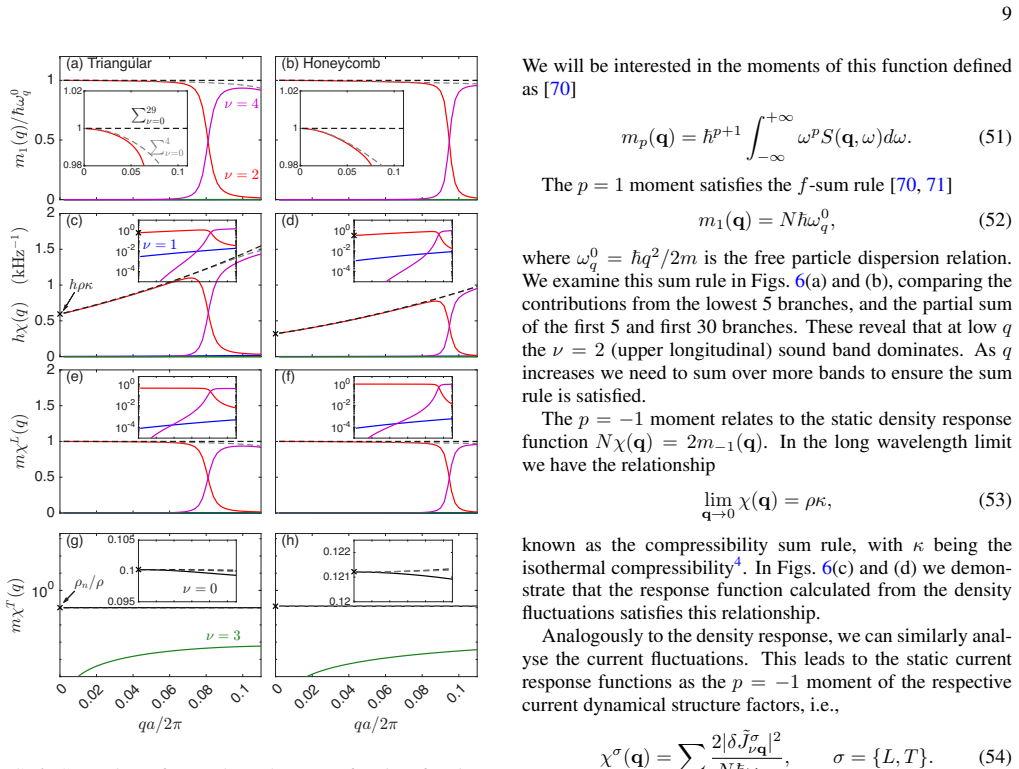
Significance. If the results are correct, this is a significant advance in the microscopic understanding of 2D supersolids. The paper provides the first detailed decomposition of acoustic modes into strain and defect-density contributions, and it identifies experimental signatures in density- and current-sensitive probes. A key strength is that the central claim rests on multiple independent checks: the long-wavelength asymptotes are compared across four observable channels for two different lattice structures; the f-sum rule (52), compressibility sum rule (53), and transverse-current sum rule (56) are all verified numerically; and the two-fluid current relations (32)–(33) are tested using matrix elements computed from different quantities. The displacement-extraction method is a methodological contribution, and its validity is explicitly verified up to about 5% of the lattice constant in Fig. 3. A caveat is that the hydrodynamic coefficients and the BdG modes are computed from the same eGPE ground state, so the agreement is a strong consistency check rather than an independent ab initio prediction; the paper should state this more clearly.
minor comments (6)
- [Sec. IV.C, Eqs. (39)–(49)] The correlation-length formulas are quoted from the 1D theory of Ref. [27] without a derivation for the 2D case; please provide a brief derivation or explicitly state that the numerical agreement presented here is the verification of the 2D forms.
- [Sec. II.D.1] The sentence about the density maximum being unique applies to the triangular lattice; for honeycomb the tracked points are density minima. Please clarify this and justify that the minimum follows the acoustic displacement rather than an optical internal distortion.
- [Eq. (14) and Sec. II.C] The phase fluctuation is defined with a denominator \Psi_0(\rho,0); please comment on the numerical stability of this quantity in regions of low density, even though the density does not vanish.
- [Sec. IV.C after Eq. (48)] The derivation of the transverse current fluctuation amplitude from the sum rule (56) is only sketched; a few lines of explanation would make the logic transparent.
- [Footnote 1] There is a typo: 'by vitue' should be 'by virtue'.
- [Insets of Figs. 4 and 5] The hydrodynamic asymptotes are marked with crosses, but the figure labels do not make clear which cross corresponds to which band; please label the asymptotes directly.
Circularity Check
No significant circularity: the BdG fluctuation amplitudes are independent matrix elements compared, not fitted, against hydrodynamic asymptotes and sum rules.
full rationale
The paper's central comparison is between BdG fluctuation amplitudes (Eqs. 13-15) and hydrodynamic asymptotes (Eqs. 39-49) that are parameter-free functions of elastic coefficients obtained from separate energy-derivative calculations (Eqs. 30, 35-36). No elastic coefficient or sound speed is fitted to the fluctuation data. The two-fluid current relations (32)-(33) are checked by evaluating independent matrix elements for the current, phase, and displacement fields, and the f-sum rule (52), compressibility sum rule (53), and transverse-current sum rule (56) are verified from the same BdG states as exact consistency conditions rather than imposed fits. The hydrodynamic correlation-length formulas are cited from the same group's prior 1D work (Ref. [27]), but this self-citation is not load-bearing because the formulas are deterministic and are independently verified here against the BdG results across two crystal orders and several observable channels. The displacement-extraction assumption in Eqs. (20)-(24) is a methodological premise, not a circular one, and it is separately validated by the linearity check in Fig. 3 and by the two-fluid current consistency check. No predicted quantity reduces to an input by construction, so there is no significant circularity.
Assumptions & free parameters
assumptions (5)
- domain assumption The extended Gross-Pitaevskii equation including the Lee-Huang-Yang quantum fluctuation term describes the 2D dipolar supersolid ground state.
- domain assumption Bogoliubov-de Gennes linearization around the stationary ground state gives the excitation modes and fluctuation amplitudes.
- domain assumption Supersolid hydrodynamics with coarse-grained fields (density, superfluid phase, lattice displacement) and a quadratic energy density is valid at long wavelengths.
- ad hoc to paper The lattice displacement can be extracted by tracking stationary points of the density, assuming small displacement and a unique stationary point per unit cell.
- domain assumption Triangular and honeycomb states have isotropic elastic tensors and a scalar superfluid density.
Cite this review
Pith. "Pith review of Acoustic fluctuations of two-dimensional dipolar supersolids." pith.science (2026). https://pith.science/paper/ZDQDWSUD
@misc{pith2026260806800,
  author       = {Pith},
  title        = {Pith review of: Acoustic fluctuations of two-dimensional dipolar supersolids},
  year         = {2026},
  howpublished = {\url{https://pith.science/paper/ZDQDWSUD}},
  note         = {Machine review of arXiv:2608.06800}
}
read the original abstract
We investigate the microscopic structure of the long-wavelength acoustic excitations of two-dimensional dipolar supersolids with triangular and honeycomb crystal order. Using Bogoliubov--de Gennes calculations, we determine the density, phase, current, and lattice-displacement fluctuations associated with the three acoustic modes. We develop a procedure to extract the lattice displacement directly from the microscopic density perturbation, allowing the modes to be identified as one transverse and two longitudinal branches. The displacement field further separates the density fluctuations into contributions from crystal strain and particle transport relative to the lattice. This reveals that the lower longitudinal mode can have large strain and defect-density fluctuations that substantially cancel in the total density response. We show that the long-wavelength fluctuation amplitudes agree with hydrodynamic theory, which is specified entirely by the elastic coefficients of the supersolid. Our analysis provides a microscopic connection between Bogoliubov excitations and the crystalline and superfluid degrees of freedom of two-dimensional supersolids, and identifies their signatures in density- and current-sensitive probes.
Figures


Figures from the paper (3 more)


Reference graph
Works this paper leans on
-
[1]
Lattice site identification We begin by identifying the equilibrium lattice-site loca- tions. For the triangular supersolid, the lattice sites are nat- urally defined as the planar positions where the areal density attains its maxima within each unit cell [e.g., this occurs at the origin for the system shown in Fig. 3(a)]. In the regime con- sidered here,...
-
[2]
Displacement field The presence of a quasiparticle causes the lattice-site posi- tions to shift in time toρj(t). The corresponding displacement vectors are defined as uj(t) =ρ j(t)−ρ 0 j .(17) To determine these displacements we analyze the perturbed areal density ϱ(ρ, t) =ϱ0(ρ) + cνq δϱνq(ρ)e−iωνq t + c.c. ,(18) where ϱ0 = Z dz|Ψ 0|2, δϱ νq = Z dzΨ 0 uνq...
-
[3]
8qj2=N 0 0.2 0.4 0.6(g) 10-4 10-2 100 j/~%
Displacement results In Fig. 3 we analyze the displacement amplitudeu 0 of the central lattice site for triangular [subplots (a)–(d)] and honey- comb [subplots (e)–(h)] supersolids. The results correspond to adding an excitation from each of theν= 0,1,2bands. Subplots (b) and (f) show the magnitude of the displacement as a function of the excitation ampli...
-
[4]
M. A. Norcia, C. Politi, L. Klaus, E. Poli, M. Sohmen, M. J. Mark, R. N. Bisset, L. Santos, and F. Ferlaino, Two- dimensional supersolidity in a dipolar quantum gas, Nature596, 357 (2021)
work page 2021
- [5]
- [6]
-
[7]
F. Böttcher, J.-N. Schmidt, M. Wenzel, J. Hertkorn, M. Guo, T. Langen, and T. Pfau, Transient supersolid properties in an ar- ray of dipolar quantum droplets, Phys. Rev. X9, 011051 (2019)
work page 2019
- [8]
Show all 82 references
-
[9]
Natale, R
G. Natale, R. M. W. van Bijnen, A. Patscheider, D. Petter, M. J. Mark, L. Chomaz, and F. Ferlaino, Excitation spectrum of a trapped dipolar supersolid and its experimental evidence, Phys. Rev. Lett.123, 050402 (2019)
2019
-
[10]
M. Guo, F. Böttcher, J. Hertkorn, J.-N. Schmidt, M. Wenzel, H. P. Büchler, T. Langen, and T. Pfau, The low-energy Gold- stone mode in a trapped dipolar supersolid, Nature564, 386 (2019)
2019
-
[11]
Tanzi, S
L. Tanzi, S. M. Roccuzzo, E. Lucioni, F. Famà, A. Fioretti, C. Gabbanini, G. Modugno, A. Recati, and S. Stringari, Su- persolid symmetry breaking from compressional oscillations in a dipolar quantum gas, Nature574, 382 (2019)
2019
-
[12]
Zhang, F
Y .-C. Zhang, F. Maucher, and T. Pohl, Supersolidity around a critical point in dipolar Bose-Einstein condensates, Phys. Rev. Lett.123, 015301 (2019)
2019
-
[13]
E. Poli, T. Bland, C. Politi, L. Klaus, M. A. Norcia, F. Ferlaino, R. N. Bisset, and L. Santos, Maintaining supersolidity in one and two dimensions, Phys. Rev. A104, 063307 (2021)
2021
-
[14]
Hertkorn, J.-N
J. Hertkorn, J.-N. Schmidt, M. Guo, F. Böttcher, K. S. H. Ng, S. D. Graham, P. Uerlings, H. P. Büchler, T. Langen, M. Zwier- lein, and T. Pfau, Supersolidity in two-dimensional trapped dipolar droplet arrays, Phys. Rev. Lett.127, 155301 (2021)
2021
-
[15]
Zhang, T
Y .-C. Zhang, T. Pohl, and F. Maucher, Phases of supersolids in confined dipolar Bose-Einstein condensates, Phys. Rev. A104, 013310 (2021)
2021
-
[16]
Zhang and F
Y .-C. Zhang and F. Maucher, Variational approaches to two- dimensionally symmetry-broken dipolar Bose–Einstein con- densates, Atoms11, 102 (2023)
2023
-
[17]
B. T. E. Ripley, D. Baillie, and P. B. Blakie, Two-dimensional supersolidity in a planar dipolar Bose gas, Phys. Rev. A108, 053321 (2023)
2023
-
[18]
D. Lima, M. Grossklags, V . Zampronio, F. Cinti, and A. Mendoza-Coto, Supersolid dipolar phases in planar geom- etry: Effects of tilted polarization, Phys. Rev. A111, 063311 (2025)
2025
-
[19]
Cook, A.-C
R. Cook, A.-C. Lee, and P. B. Blakie, Excitations and anisotropic sound in planar dipolar supersolids with tilted dipoles, Phys. Rev. A113, 063308 (2026)
2026
-
[20]
A. F. Andreev and I. M. Lifshitz, Quantum theory of defects in crystals, Sov. Phys. JETP29, 1107 (1969)
1969
-
[21]
superfluid
A. J. Leggett, Can a solid be "superfluid"?, Phys. Rev. Lett.25, 1543 (1970)
1970
-
[22]
G. V . Chester, Speculations on Bose-Einstein condensation and quantum crystals, Phys. Rev. A2, 256 (1970)
1970
-
[23]
Leggett, On the superfluid fraction of an arbitrary many- body system atT= 0, J
A. Leggett, On the superfluid fraction of an arbitrary many- body system atT= 0, J. Stat. Phys.93, 927 (1998)
1998
-
[24]
Watanabe and T
H. Watanabe and T. Brauner, Spontaneous breaking of continu- ous translational invariance, Phys. Rev. D85, 085010 (2012)
2012
-
[25]
Rakic, A
M. Rakic, A. F. Ho, and D. K. K. Lee, Elastic properties and thermodynamic anomalies of supersolids, Phys. Rev. Res.6, 043040 (2024)
2024
-
[26]
E. Poli, D. Baillie, F. Ferlaino, and P. B. Blakie, Excitations of a two-dimensional supersolid, Phys. Rev. A110, 053301 (2024)
2024
-
[27]
P. B. Blakie, Dirac points and shear instability induced crys- tal transitions in honeycomb supersolids, Phys. Rev. Lett.134, 013401 (2025)
2025
-
[28]
Senarath Yapa and T
P. Senarath Yapa and T. Bland, Anomalous dispersion of shear waves in dipolar supersolids, Phys. Rev. A112, L021303 (2025)
2025
-
[29]
Šindik, T
M. Šindik, T. Zawi ´slak, A. Recati, and S. Stringari, Sound, su- perfluidity, and layer compressibility in a ring dipolar super- solid, Phys. Rev. Lett.132, 146001 (2024)
2024
-
[30]
L. M. Platt, D. Baillie, and P. B. Blakie, Sound waves and fluctuations in one-dimensional supersolids, Phys. Rev. A110, 023320 (2024)
2024
-
[31]
Mukherjee, M
K. Mukherjee, M. Schubert, R. Klemt, T. Bland, T. Pfau, and S. M. Reimann, Quantum carpets of higgs quasiparticles in a supersolid, Phys. Rev. Lett.135, 223402 (2025)
2025
-
[32]
G. A. Bougas, T. Bland, H. R. Sadeghpour, and S. I. Mistakidis, Signatures of rigidity and second sound in dipolar supersolids, Phys. Rev. A113, L041305 (2026)
2026
-
[33]
Liebster, M
N. Liebster, M. Sparn, E. Kath, J. Duchene, H. Strobel, and M. K. Oberthaler, Supersolid-like sound modes in a driven quantum gas, Nature Physics21, 1064 (2025)
2025
-
[34]
Baillie and P
D. Baillie and P. B. Blakie, A general theory of flattened dipolar condensates, New J. Phys.17, 033028 (2015)
2015
-
[35]
Hofmann and W
J. Hofmann and W. Zwerger, Hydrodynamics of a superfluid smectic, J. Stat. Mech.: Theory Exp.2021(3), 033104
2021
-
[36]
E. Poli, G. I. Martone, S. Stringari, and A. Recati, Sound prop- agation in striped supersolid cold gases at zero temperature (2026), arXiv:2604.01751 [cond-mat.quant-gas]
2026
-
[37]
A. R. P. Lima and A. Pelster, Quantum fluctuations in dipolar Bose gases, Phys. Rev. A84, 041604 (2011)
2011
-
[38]
Ferrier-Barbut, H
I. Ferrier-Barbut, H. Kadau, M. Schmitt, M. Wenzel, and T. Pfau, Observation of quantum droplets in a strongly dipolar Bose gas, Phys. Rev. Lett.116, 215301 (2016)
2016
-
[39]
Wächtler and L
F. Wächtler and L. Santos, Quantum filaments in dipolar Bose- Einstein condensates, Phys. Rev. A93, 061603(R) (2016)
2016
-
[40]
R. N. Bisset, R. M. Wilson, D. Baillie, and P. B. Blakie, Ground-state phase diagram of a dipolar condensate with quan- tum fluctuations, Phys. Rev. A94, 033619 (2016)
2016
-
[41]
Navon, R
N. Navon, R. P. Smith, and Z. Hadzibabic, Quantum gases in optical boxes, Nat. Phys.17, 1334 (2021)
2021
-
[42]
Juhász, M
P. Juhász, M. Krstaji´c, D. Strachan, E. Gandar, and R. P. Smith, How to realize a homogeneous dipolar Bose gas in the roton regime, Phys. Rev. A105, L061301 (2022)
2022
-
[43]
Kadau, M
H. Kadau, M. Schmitt, M. Wenzel, C. Wink, T. Maier, I. Ferrier- Barbut, and T. Pfau, Observing the Rosensweig instability of a quantum ferrofluid, Nature530, 194 (2016)
2016
-
[44]
Baillie and P
D. Baillie and P. B. Blakie, Droplet crystal ground states of a dipolar Bose gas, Phys. Rev. Lett.121, 195301 (2018)
2018
-
[45]
Zhang, T
Y .-C. Zhang, T. Pohl, and F. Maucher, Metastable patterns in one- and two-component dipolar Bose-Einstein condensates, Phys. Rev. Res.6, 023023 (2024)
2024
-
[46]
P. B. Blakie, Superfluid fraction tensor of a two-dimensional supersolid, J. Phys. B57, 115301 (2024)
2024
-
[47]
D. T. Son, Effective lagrangian and topological interactions in supersolids, Phys. Rev. Lett.94, 175301 (2005)
2005
-
[48]
Yoo and A
C.-D. Yoo and A. T. Dorsey, Hydrodynamic theory of super- solids: Variational principle, effective lagrangian, and density- density correlation function, Phys. Rev. B81, 134518 (2010)
2010
-
[49]
W. M. Saslow, Microscopic and hydrodynamic theory of super- fluidity in periodic solids, Phys. Rev. B15, 173 (1977)
1977
-
[50]
Liu, Two possible types of superfluidity in crystals, Phys
M. Liu, Two possible types of superfluidity in crystals, Phys. Rev. B18, 1165 (1978)
1978
-
[51]
Josserand, Y
C. Josserand, Y . Pomeau, and S. Rica, Coexistence of ordinary elasticity and superfluidity in a model of a defect-free super- solid, Phys. Rev. Lett.98, 195301 (2007)
2007
-
[52]
Josserand, Y
C. Josserand, Y . Pomeau, and S. Rica, Patterns and supersolids, Eur. Phys. J.: Spec.146, 47 (2007)
2007
-
[53]
Ye, Elementary excitation in a supersolid, Europhys
J. Ye, Elementary excitation in a supersolid, Europhys. Lett.82, 16001 (2008)
2008
-
[54]
Bühler, T
C. Bühler, T. Ilg, and H. P. Büchler, Quantum fluctuations in one-dimensional supersolids, Phys. Rev. Res.5, 033092 (2023). 12
2023
-
[55]
W. M. Saslow, Superfluidity of periodic solids, Phys. Rev. Lett. 36, 1151 (1976)
1976
-
[56]
Sepúlveda, C
N. Sepúlveda, C. Josserand, and S. Rica, Superfluid density in a two-dimensional model of supersolid, Euro. Phys. J. B78, 439 (2010)
2010
-
[57]
Biagioni, N
G. Biagioni, N. Antolini, B. Donelli, L. Pezzè, A. Smerzi, M. Fattori, A. Fioretti, C. Gabbanini, M. Inguscio, L. Tanzi, and G. Modugno, Measurement of the superfluid fraction of a supersolid by Josephson effect, Nature629, 773 (2024)
2024
-
[58]
L. M. Platt, D. Baillie, and P. B. Blakie, Supersolid spec- troscopy, Phys. Rev. A111, 053305 (2025)
2025
-
[59]
Pérez-Cruz, G
D. Pérez-Cruz, G. E. Astrakharchik, and P. Massignan, Super- fluid fraction of interacting bosonic gases, Phys. Rev. A111, L011302 (2025)
2025
-
[60]
J. Tao, M. Zhao, and I. B. Spielman, Observation of anisotropic superfluid density in an artificial crystal, Phys. Rev. Lett.131, 163401 (2023)
2023
-
[61]
Chauveau, C
G. Chauveau, C. Maury, F. Rabec, C. Heintze, G. Brochier, S. Nascimbene, J. Dalibard, J. Beugnon, S. M. Roccuzzo, and S. Stringari, Superfluid fraction in an interacting spatially mod- ulated Bose-Einstein condensate, Phys. Rev. Lett.130, 226003 (2023)
2023
-
[62]
Rabec, G
F. Rabec, G. Brochier, S. Wattellier, G. Chauveau, Y . Li, S. Nascimbene, J. Dalibard, and J. Beugnon, Superfluid fraction of a 2d bose-einstein condensate in a triangular lattice, Phys. Rev. Lett.136, 133401 (2026)
2026
-
[63]
W. M. Saslow, Dynamics of supersolid state: Normal fluid, su- perfluid, and supersolid velocities, Phys. Rev. A112, 033303 (2025)
2025
-
[64]
Preti, N
N. Preti, N. Antolini, C. Drevon, P. Lombardi, A. Fioretti, C. Gabbanini, G. Ferioli, G. Modugno, and G. Biagioni, Single- fluid model for rotating annular supersolids and its experimen- tal implications, Phys. Rev. Lett.136, 036001 (2026)
2026
-
[65]
Bavaud, P
F. Bavaud, P. Choquard, and J. R. Fontaine, Statistical mechan- ics of elastic moduli, J. Stat. Phys.42, 621 (1986)
1986
-
[66]
L. D. Landau, L. P. Pitaevskii, E. M. Lifshitz, and A. M. Ko- sevich,Theory of Elasticity, 3rd ed. (Butterworth-Heinemann, 1986)
1986
-
[67]
P. B. Blakie, L. Chomaz, D. Baillie, and F. Ferlaino, Compress- ibility and speeds of sound across the superfluid-to-supersolid phase transition of an elongated dipolar gas, Phys. Rev. Res.5, 033161 (2023)
2023
-
[68]
Petter, A
D. Petter, A. Patscheider, G. Natale, M. J. Mark, M. A. Baranov, R. van Bijnen, S. M. Roccuzzo, A. Recati, B. Blakie, D. Bail- lie, L. Chomaz, and F. Ferlaino, Bragg scattering of an ultracold dipolar gas across the phase transition from Bose-Einstein con- densate to supersoli...
2021
-
[69]
Bismut, B
G. Bismut, B. Laburthe-Tolra, E. Maréchal, P. Pedri, O. Gor- ceix, and L. Vernac, Anisotropic excitation spectrum of a dipo- lar quantum Bose gas, Phys. Rev. Lett.109, 155302 (2012)
2012
-
[70]
Petter, G
D. Petter, G. Natale, R. M. W. van Bijnen, A. Patscheider, M. J. Mark, L. Chomaz, and F. Ferlaino, Probing the roton excitation spectrum of a stable dipolar Bose gas, Phys. Rev. Lett.122, 183401 (2019)
2019
-
[71]
Zambelli, L
F. Zambelli, L. Pitaevskii, D. M. Stamper-Kurn, and S. Stringari, Dynamic structure factor and momentum distribu- tion of a trapped Bose gas, Phys. Rev. A61, 063608 (2000)
2000
-
[72]
P. B. Blakie, R. J. Ballagh, and C. W. Gardiner, Theory of coher- ent Bragg spectroscopy of a trapped Bose-Einstein condensate, Phys. Rev. A65, 033602 (2002)
2002
-
[73]
Pitaevskii and S
L. Pitaevskii and S. Stringari,Bose-Einstein Condensation and Superfluidity, V ol. 164 (Oxford University Press, 2016)
2016
-
[74]
Pines and P
D. Pines and P. Nozières,The Theory of Quantum Liquids: Nor- mal Fermi Liquids, V ol. 1 (W. A. Benjamin, New York, 1966)
1966
-
[75]
Hertkorn, J.-N
J. Hertkorn, J.-N. Schmidt, F. Böttcher, M. Guo, M. Schmidt, K. S. H. Ng, S. D. Graham, H. P. Büchler, T. Langen, M. Zwier- lein, and T. Pfau, Density fluctuations across the superfluid- supersolid phase transition in a dipolar quantum gas, Phys. Rev. X11, 011037 (2021)
2021
-
[76]
Schmidt, J
J.-N. Schmidt, J. Hertkorn, M. Guo, F. Böttcher, M. Schmidt, K. S. H. Ng, S. D. Graham, T. Langen, M. Zwierlein, and T. Pfau, Roton excitations in an oblate dipolar quantum gas, Phys. Rev. Lett.126, 193002 (2021)
2021
-
[77]
J. J. A. Houwman, D. Baillie, P. B. Blakie, G. Natale, F. Fer- laino, and M. J. Mark, Measurement of the excitation spectrum of a dipolar gas in the macrodroplet regime, Phys. Rev. Lett. 132, 103401 (2024)
2024
-
[78]
M. Zhao, J. Tao, and I. B. Spielman, Kolmogorov scaling in turbulent 2D Bose-Einstein Condensates, Phys. Rev. Lett.134, 083402 (2025)
2025
-
[79]
Sohmen, C
M. Sohmen, C. Politi, L. Klaus, L. Chomaz, M. J. Mark, M. A. Norcia, and F. Ferlaino, Birth, life, and death of a dipolar super- solid, Phys. Rev. Lett.126, 233401 (2021)
2021
-
[80]
Sánchez-Baena, C
J. Sánchez-Baena, C. Politi, F. Maucher, F. Ferlaino, and T. Pohl, Heating a dipolar quantum fluid into a solid, Nat. Com- mun.14, 1868 (2023)
2023
-
[81]
Peotta, G
S. Peotta, G. Spada, S. Giorgini, S. Pilati, and A. Recati, Super- solid phase in two-dimensional soft-core bosons at finite tem- perature, Phys. Rev. B112, 184506 (2025)
2025
-
[82]
E. B. Linscott and P. B. Blakie, Thermally activated local col- lapse of a flattened dipolar condensate, Phys. Rev. A90, 053605 (2014)
2014
Reviewed August 10, 2026 · model on record in the stance chip above.
Discussion (0). Continue with ORCID to comment.