REVIEW 4 major objections 5 minor 54 references
Extracting the pairing gap from van Hove singularities in rf spectra of the Fermi Hubbard model
T0 review · 4 major / 5 minor · reviewed 2026-08-10 · deepseek-v4-flash
Pith's one-line read Van Hove singularities in rf spectra pin down the pairing gap and chemical potential of the 3D Fermi Hubbard model
desk verdict A genuinely new set of vHS-based markers for gap extraction in the lattice Fermi Hubbard model, but the paper never demonstrates the actual extraction on its own broadened spectra; worth refereeing, needs a real inversion test. read the letter →
The pith
A machine-rendered reading of the paper's core claim, the machinery that carries it, and where it could break.
The reading
What carries the argument
The load-bearing object is the van Hove singularity of the cubic-lattice dispersion, a momentum point where $\nabla_{\mathbf{k}}\xi_{\mathbf{k}}=0$ and the density of states is non-analytic. The lattice has four such points (labelled $M_0,\dots,M_3$, realised at $\Gamma$, $X$, $M$, $R$), and the rf resonance condition $\xi_{\mathbf{k}}-\nu+E_{\mathbf{k}}=0$ maps each one to a sharp feature in the rf current. The argument is carried by the kinematic relation $\nu_i=(\epsilon_i-\mu)+\sqrt{(\epsilon_i-\mu)^2+\Delta^2}$, which converts measured detunings into the two pairing parameters.
What would settle it
Measure the rf spectrum of a 3D attractive Fermi Hubbard gas at known density and interaction strength, resolve at least two van Hove features, and solve the two corresponding equations of Eq. (6) for $\Delta$ and $\mu$. If the resulting pair disagrees between different choices of vHS markers, or fails to match an independent measurement of $\mu$ (for example from band mapping), the single-gap assumption is falsified.
Extended reading notes
Core claim
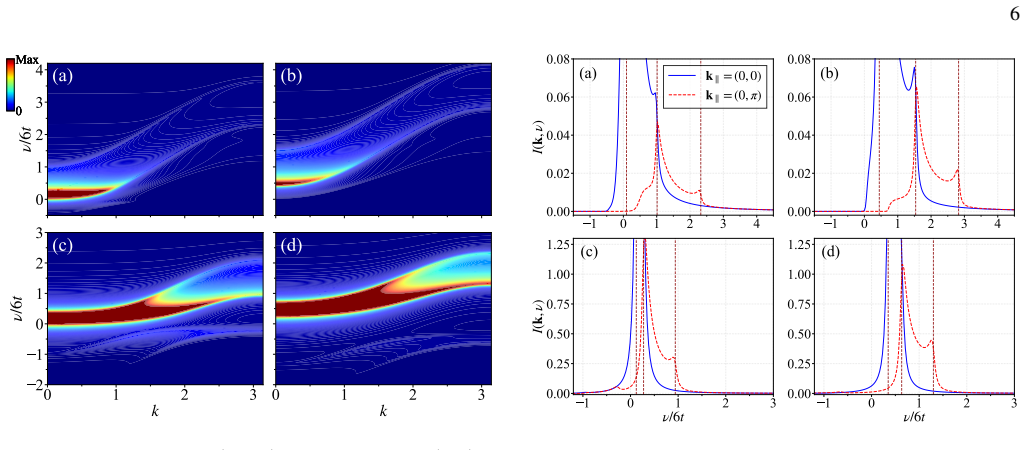
Within the $G_0G$ T-matrix pair-fluctuation scheme, the spectral function of the attractive Fermi Hubbard model is taken to have the BCS two-branch form $A(\mathbf{k},\omega)=2\pi[u_{\mathbf{k}}^2\delta(\omega-E_{\mathbf{k}})+v_{\mathbf{k}}^2\delta(\omega+E_{\mathbf{k}})]$ with $E_{\mathbf{k}}=\sqrt{\xi_{\mathbf{k}}^2+\Delta^2}$. The paper shows that when this is fed into the rf response $I(\nu)=\frac{1}{2\pi}\sum_{\mathbf{k}} A(\mathbf{k},\omega)f(\omega)|_{\omega=\xi_{\mathbf{k}}-\nu}$, the lattice critical points—$\Gamma(0,0,0)$, $X(\pi,0,0)$, $M(\pi,\pi,0)$, and $R(\pi,\pi,\pi)$—produce four singular features whose detunings obey $\nu_i=(\epsilon_i-\mu)+\sqrt{(\epsilon_i-\mu)^2+\Delta^2}$ with $\epsilon_i=0,\,2/3,\,4/3,\,2$ in units of $6t$. Inverting any two of these relations yields $\Delta$ and $\mu$ algebraically, and numerical spectra with phenomenological broadenings confirm that the features stay near these kinematic positions. At half filling, particle-hole symmetry fixes $\mu=1$, reducing the extraction to a single vHS measurement.
Load-bearing premise
The extraction rests on the spectral function keeping its BCS-like two-branch form with one momentum-independent gap $\Delta$; if pairing fluctuations distort that form, the kinematic relations for the vHS detunings no longer hold.
Editorial extensions
If this is right
- Two resolved vHS features determine both $\Delta$ and $\mu$ from a single dataset, with no dispersion fitting.
- The scheme remains usable in $k_z$-integrated spectra, where the strongest signal appears at $\mathbf{k}_\parallel=(0,\pi)$.
- At half filling, one well-resolved vHS fixes $\Delta$ because particle-hole symmetry pins $\mu=1$.
- The features sharpen relative to the background at stronger coupling, exactly where back-bending loses sensitivity.
- Because the detuning–gap map is kinematic, it can serve as a cross-method benchmark for comparing gap values from different many-body theories.
Reading between the lines
- If a fully self-consistent treatment introduces frequency-dependent pair-fluctuation self-energy, the vHS positions may shift or soften; this can be tested by computing spectra with finite pair momentum included and comparing extracted $(\Delta,\mu)$ with the kinematic map.
- The same reasoning should transfer to other lattice geometries whenever the band has critical points and pairing is nearly momentum-independent, though the band-energy offsets $\epsilon_i$ would change.
- A consistency check within one dataset—extracting $(\Delta,\mu)$ from two different vHS pairs—would reveal whether a single-gap description actually holds; disagreement would signal momentum-dependent pairing beyond the BCS-like ansatz.
Editorial analysis
A structured set of objections, weighed in public.
Referee Report
Summary. The paper proposes a spectroscopic diagnostic for the 3D attractive Fermi Hubbard model: the rf detunings of four van Hove singularities are claimed to depend only on the pairing gap Δ and the effective chemical potential μ through the algebraic relations in Eq. (6), ν_i = ε_i − μ + sqrt((ε_i − μ)^2 + Δ^2), with ε_i = 0, 2/3, 4/3, 2 in units of 6t. The authors solve the G0G T-matrix pair-fluctuation equations self-consistently for μ, Δ_sc, and Δ_pg, then compute momentum-integrated and k_z-integrated rf spectra with phenomenological broadening parameters Γ0 and Γ1. They argue that two well-resolved vHS features determine Δ and μ algebraically, and that at half filling a single feature suffices because particle-hole symmetry fixes μ = 1. The numerical section shows broadened spectra with vHS features at positions consistent with Eq. (6) and argues that the features remain identifiable under realistic broadening. The paper explicitly acknowledges that the results are obtained within a particular approximation and that other many-body schemes may give different quantitative relations.
Significance. If the central claim is established, this is a useful and experimentally practical diagnostic: vHS-based markers survive partial momentum integration, become more prominent at strong coupling, and avoid full spectral fitting. The derivation of Eq. (6) is transparent and the algebraic inversion is simple. The paper also gives credit for being self-consistent: it solves the G0G equations numerically, identifies concrete observable EDCs at k_∥ = (0, π) as the most favorable, and candidly states the approximation-dependent limitations in the conclusion. However, the numerical support is substantially internal to the same BCS-like/G0G framework used to derive the kinematic relations, and the central extraction step is not actually performed on the broadened spectra. This currently limits the strength of the 'robust route' claim and requires additional numerical demonstration before the protocol can be regarded as validated.
major comments (4)
- [Sec. III.E, Eq. (10)] The proposed two-marker inversion is never actually applied to positions read from broadened spectra. The text states that 'using the parameters of Fig. 4(c) ... the M1 and M2 detunings extracted from the spectrum' yield μ ≈ 1.0 and Δ ≈ 0.5, but no algorithm (peak detection, local maximum, or fit) is described, and the values coincide with the kinematic detunings obtained from the known self-consistent (μ, Δ). For the central claim to be supported, the authors must demonstrate the full pipeline: compute the broadened I(ν) and I(k, ν), identify feature positions with a specified operational definition, invert Eq. (10), and compare the resulting (Δ, μ) with the self-consistent input values for representative (U, n) and for several Γ0, Γ1 values, reporting the bias and any associated uncertainty.
- [Sec. III.B and Sec. II.D] Broadening-induced shifts of the vHS feature positions are asserted but not quantified. The paper claims that features 'remain centered close to the kinematic detunings' and are 'only weakly sensitive' to Γ0 and Γ1, but no numerical measure of the shift is given. Because the un-broadened features are logarithmic divergences (M1, M2) or square-root onsets (M0, M3), the maxima of the broadened asymmetric features can shift by an amount of order Γ. With Δ = 0.207 at U_c, n = 0.1 (Fig. 1) and Γ0 = Γ1 = 0.05, such a shift is a substantial fraction of Δ and of the inter-marker spacing; for overlapping features such as M0 and M1 in Fig. 4(c,d) the bias is likely larger. This directly affects the accuracy of the inversion, so a quantitative analysis is needed.
- [Sec. IV and Eq. (9)] The validation is circular with respect to the spectral-function ansatz. The broadened spectra are generated from Eq. (9), which is based on the same BCS-like two-branch quasiparticle form used to derive Eq. (6); the numerical results therefore cannot test whether a more general spectral function, such as one with a frequency-dependent pair-fluctuation self-energy or one obtained from the GG or G0G0 schemes, would place the vHS features at the same detunings. The conclusion explicitly acknowledges this limitation. The paper should state more prominently, including in the abstract, that the protocol is established within the G0G/BCS-like approximation, and should either provide independent benchmarks (e.g., spectra from a different approximation or from quantum Monte Carlo data where available) or clearly frame the results as a consistency check rather than a validation of the kinematic relations.
- [Eq. (8) and Eq. (9)] The phenomenological self-energy in Eq. (8) has a nonzero real part, but its effect on the vHS detuning positions is not analyzed. The kinematic relations in Eq. (6) are derived from the resonance condition ξ_k − ν + E_k = 0 with E_k = sqrt(ξ_k^2 + Δ^2), which ignores the real part of Σ^R_pg. In the full spectral function of Eq. (9), the quasiparticle dispersion is modified by ReΣ^R_pg, so the actual peak locations in Figs. 4–7 may differ from Eq. (6) not only through broadening but also through a real energy shift. The paper should either show that ReΣ^R_pg produces a negligible shift at the vHS momenta, or include this shift in the inversion formula.
minor comments (5)
- [Fig. 4 caption] The vertical lines in Fig. 4 are labeled collectively as 'M0–M3 vHSs'; since some of these detunings nearly coincide at n = 1, please distinguish the individual markers with different line styles or a legend.
- [Eq. (7)] The k_z-integrated expression contains an unexplained factor [1 − f(...)]^3 and a prefactor 1/π^3; please provide the full derivation or correct the expression, since Eq. (7) is used to generate the k_z-integrated spectra in Figs. 5–7.
- [Sec. II.D] The statement that Γ0 and Γ1 'become negligible at low temperatures due to the formation of stable pairing' is not supported by any temperature-dependent calculation; please clarify whether all presented results use fixed Γ0 = Γ1 = 0.05 and how the parameters are expected to scale with temperature.
- [Sec. III (terminology)] After broadening, the features are no longer true van Hove singularities but rounded maxima; consider using 'van Hove features' or 'vHS remnants' when referring to the broadened spectra to avoid overstating the singularity.
- [Reference [48]] The Supplemental Material citation lacks an arXiv identifier or DOI, which makes it difficult for readers to locate the self-consistent equations and the additional numerical results for n = 0.2, 0.4, 0.6, and 0.8.
Circularity Check
The kinematic relation itself is a legitimate model derivation, but the extraction validation in Sec. III.E is circular: the M1/M2 detunings are computed from the same self-consistent Δ,μ via Eq. (5), so inverting Eq. (10) returns exactly those inputs; broadening robustness is asserted, not measured.
-
fitted input called prediction
[Section III.E, 'Extraction protocol for Δ and μ', near Eqs. (10)-(11)]
"For concreteness, using the parameters of Fig. 4(c) (n=1, U=Uc), the M1 and M2 detunings extracted from the spectrum yield µ≈1.0 and ∆≈0.5, in quantitative agreement with the self-consistent input values."
The 'detunings extracted from the spectrum' are the vertical-line positions shown in Fig. 4(c), which are computed from Eq. (5)/(6) using the self-consistent input (µ,∆) from the G0G calculation. No peak-finding algorithm for the broadened EDCs is described, and no broadened peak positions are reported. Substituting those input-derived ν_i into the inversion formula Eq. (10) identically gives back the same ∆ and µ. The quoted 'quantitative agreement' is therefore an algebraic identity, not a validation that features measured in broadened spectra can be inverted to recover ∆ and µ. The central protocol is thus checked only against the very parameters that generated the markers.
-
self definitional
[Section III.B, 'rf current and sensitivity to broadening']
"The apparent peak maxima may change slightly when features overlap, but the underlying vHS markers are only weakly sensitive to Γ0 and Γ1 within the parameter range at low temperature."
If the 'underlying vHS markers' are defined as the kinematic detunings of Eq. (5) (the vertical lines), then their insensitivity to Γ0 and Γ1 holds by definition, because Eq. (5) contains no broadening parameters. The paper never measures or tabulates the positions of the broadened spectral maxima in Figs. 4-7 and compares them to ν_i. Thus the statement that the features remain 'centered close to the kinematic detunings' is an assertion that the observed marker equals the defined marker, not a quantitative result from the broadened spectra. The shift of the observable peak under broadening—which is what matters for the claimed extraction—is left unquantified.
full rationale
The paper's core derivation of the vHS detuning relations, Eq. (6): ν_i = ε_i - μ + sqrt((ε_i-μ)^2 + Δ^2), is a standard algebraic consequence of the assumed BCS-like two-branch spectral function A(k,ω) = 2π[u_k^2 δ(ω-E_k)+v_k^2 δ(ω+E_k)] with E_k = sqrt(ξ_k^2+Δ^2), together with the rf resonance condition ξ_k - ν + E_k = 0. That part is self-contained and not circular: given the stated quasiparticle ansatz, the kinematic locations are determined solely by μ and Δ. The paper also acknowledges (in the Conclusion) that this ansatz is approximation-dependent and that different schemes (G0G0, G0G, GG) give different Δ values, which is an honest limitation rather than a circular move. The circularity lies in the validation of the proposed extraction protocol. In Sec. III.E, the authors claim that the M1 and M2 detunings 'extracted from the spectrum' give back the input μ≈1.0 and Δ≈0.5. But the spectra are computed from the same G0G self-consistent solution, and the vertical markers in Fig. 4 are placed at the Eq. (5) detunings computed from those same input parameters. Inverting Eq. (10) with these exact input-derived ν_i is a tautology. The paper does not demonstrate that the positions of the broadened, overlapping features in Figs. 4-7 actually coincide with those kinematic detunings to within the claimed accuracy; no error bars, bias estimates, or independent extraction from the broadened curves are given. The broadening-robustness claim in Sec. III.B is likewise definitional if 'vHS markers' means the Eq. (5) locations. The self-citations to the G0G formalism (Refs. [39,45,52]) are not load-bearing for this circularity, because the BCS-like spectral structure is independently standard and the experimental support cited includes external measurements. Overall, the central mathematical relation is independent, but the paper's headline practical claim—that two well-resolved singularities in a real broadened spectrum determine Δ and μ—is validated only by construction. Score 5 reflects one concrete by-construction validation step while the underlying derivation retains independent content.
Assumptions & free parameters
free parameters (3)
- Γ0 (pair lifetime broadening) =
0, 0.05 (in units of 6t)
- Γ1 (single-particle scattering background) =
0, 0.05 (in units of 6t)
- Δpg (pseudogap energy scale) =
self-consistent, e.g., Δ=0.207 (units of 6t) for U=Uc, n=0.1
assumptions (4)
- domain assumption The fermionic self-energy can be decomposed into a superfluid condensate part and a pseudogap part, with the pseudogap captured by Σ_pg(K) ≈ -Δ_pg^2 G0(-K) (Q≈0 dominance).
- domain assumption The spectral function retains BCS-like two-branch quasiparticle form with a single, momentum-independent gap Δ.
- domain assumption The rf response is given by the lowest-order (T-matrix) expression in Eq. (3), with the final state being a non-interacting state.
- ad hoc to paper The phenomenological broadening parameters Γ0 and Γ1 are constant (not frequency-dependent) and have a limited effect on vHS positions.
Cite this review
Pith. "Pith review of Extracting the pairing gap from van Hove singularities in rf spectra of the Fermi Hubbard model." pith.science (2026). https://pith.science/paper/Y434CPD4
@misc{pith2026260806883,
  author       = {Pith},
  title        = {Pith review of: Extracting the pairing gap from van Hove singularities in rf spectra of the Fermi Hubbard model},
  year         = {2026},
  howpublished = {\url{https://pith.science/paper/Y434CPD4}},
  note         = {Machine review of arXiv:2608.06883}
}
abstract
We show that van Hove singularities in rf spectra of the 3D attractive Fermi Hubbard model provide a robust route to extracting the pairing gap. Four types of singularities are classified, and their spectral positions are shown to depend solely on the pairing gap $\Delta$ and chemical potential $\mu$ through simple algebraic relations. Measuring two well-resolved singularities therefore determines both parameters without requiring full spectral fitting. Numerical simulations incorporating phenomenological lifetime and scattering broadenings confirm that these features remain visible in both momentum-integrated and $k_z$-integrated spectra, and become more pronounced at stronger coupling where conventional back-bending methods lose sensitivity. At half filling, particle-hole symmetry fixes $\mu$, reducing the extraction to a single singularity measurement. These results establish vHS analysis as a practical spectroscopic diagnostic for pairing in quantum-simulated 3D Fermi Hubbard systems.
Figures


Figures from the paper (2 more)

Reference graph
Works this paper leans on
-
[1]
Q. J. Chen, J. Stajic, S. N. Tan, and K. Levin, BCS–BEC crossover: From high-temperature superconductors to ultracold superfluids, Phys. Rep.412, 1 (2005). 8
work page 2005
-
[2]
Bloch, J
I. Bloch, J. Dalibard, and W. Zwerger, Many-body physics with ultracold gases, Rev. Mod. Phys.80, 885 (2008)
2008
-
[3]
Zwerger(ed.),The BCS-BEC crossover and the unitary Fermi gas, V ol
W. Zwerger(ed.),The BCS-BEC crossover and the unitary Fermi gas, V ol. 836 (Springer Science & Business Media, 2011)
work page 2011
- [4]
-
[5]
R. A. Hart, P. M. Duarte, T.-L. Yang, X. Liu, T. Paiva, E. Khatami, R. T. Scalettar, N. Trivedi, D. A. Huse, and R. G. Hulet, Observation of antiferromagnetic correlations in the Hubbard model with ultracold atoms, Nature519, 211 (2015)
work page 2015
-
[6]
Gross and I
C. Gross and I. Bloch, Quantum simulations with ultracold atoms in optical lattices, Science357, 995 (2017)
2017
-
[7]
Jaksch, C
D. Jaksch, C. Bruder, J. I. Cirac, C. W. Gardiner, and P. Zoller, Cold bosonic atoms in optical lattices, Phys. Rev. Lett.81, 3108 (1998)
1998
-
[8]
C. Chin, R. Grimm, P. Julienne, and E. Tiesinga, Feshbach res- onances in ultracold gases, Rev. Mod. Phys.82, 1225 (2010)
2010
Show all 54 references
-
[9]
Timusk and B
T. Timusk and B. Statt, The pseudogap in high-temperature su- perconductors: an experimental survey, Rep. Prog. Phys.62, 61 (1999)
1999
-
[10]
Q. J. Chen, I. Kosztin, B. Jank ´o, and K. Levin, Pairing fluc- tuation theory of superconducting properties in underdoped to overdoped cuprates, Phys. Rev. Lett.81, 4708 (1998)
1998
-
[11]
Q. J. Chen, Z. Q. Wang, R. Boyack, S. L. Yang, and K. Levin, When superconductivity crosses over: From BCS to BEC, Rev. Mod. Phys.96, 025002 (2024)
2024
-
[12]
R. T. Scalettar, E. Y . Loh, J. E. Gubernatis, A. Moreo, S. R. White, D. J. Scalapino, R. L. Sugar, and E. Dagotto, Phase dia- gram of the two-dimensional negative-UHubbard model, Phys. Rev. Lett.62, 1407 (1989)
1989
-
[13]
Kyung, S
B. Kyung, S. Allen, and A.-M. S. Tremblay, Pairing fluctuations and pseudogaps in the attractive Hubbard model, Phys. Rev. B 64, 075116 (2001)
2001
-
[14]
Honerkamp and W
C. Honerkamp and W. Hofstetter, Ultracold Fermions and the SU(N)Hubbard model, Phys. Rev. Lett.92, 170403 (2004)
2004
-
[15]
Mondaini, P
R. Mondaini, P. Nikoli ´c, and M. Rigol, Mott-insulator–to– superconductor transition in a two-dimensional superlattice, Phys. Rev. A92, 013601 (2015)
2015
-
[16]
Moreo and D
A. Moreo and D. J. Scalapino, Cold attractive spin polarized Fermi lattice gases and the doped positiveUHubbard model, Phys. Rev. Lett.98, 216402 (2007)
2007
-
[17]
Paiva, R
T. Paiva, R. R. dos Santos, R. T. Scalettar, and P. J. H. Den- teneer, Critical temperature for the two-dimensional attractive Hubbard model, Phys. Rev. B69, 184501 (2004)
2004
-
[18]
V . B. Shenoy, Phase diagram of the attractive Hubbard model with inhomogeneous interactions, Phys. Rev. B78, 134503 (2008)
2008
-
[19]
Micnas, J
R. Micnas, J. Ranninger, and S. Robaszkiewicz, Superconduc- tivity in narrow-band systems with local nonretarded attractive interactions, Rev. Mod. Phys.62, 113 (1990)
1990
-
[20]
Gor’kov and T
L. Gor’kov and T. Melik-Barkhudarov, Contribution to the the- ory of superfluidity in an imperfect Fermi gas, Sov. Phys. JETP 13, 1018 (1961)
1961
-
[21]
Nozieres and S
P. Nozieres and S. Schmitt-Rink, Bose condensation in an at- tractive fermion gas: From weak to strong coupling supercon- ductivity, J. Low Temp. Phys.59, 195 (1985)
1985
-
[22]
L. P. Kadanoff and P. C. Martin, Theory of many-particle sys- tems. II. Superconductivity, Phys. Rev.124, 670 (1961)
1961
-
[23]
Q. J. Chen,Generalization of BCS theory to short coher- ence length superconductors: A BCS-BEC crossover sce- nario, Ph.D. thesis, University of Chicago (2000), see also arXiv:1801.06266
2000 arXiv
-
[24]
Tchernyshyov, Noninteracting cooper pairs inside a pseudo- gap, Phys
O. Tchernyshyov, Noninteracting cooper pairs inside a pseudo- gap, Phys. Rev. B56, 3372 (1997)
1997
-
[25]
Haussmann, Properties of a Fermi liquid at the superfluid transition in the crossover region between BCS superconduc- tivity and Bose-Einstein condensation, Phys
R. Haussmann, Properties of a Fermi liquid at the superfluid transition in the crossover region between BCS superconduc- tivity and Bose-Einstein condensation, Phys. Rev. B49, 12975 (1994)
1994
-
[26]
Haussmann, M
R. Haussmann, M. Punk, and W. Zwerger, Spectral functions and rf response of ultracold fermionic atoms, Phys. Rev. A80, 063612 (2009)
2009
-
[27]
Schneider, L
U. Schneider, L. Hackerm ¨uller, J. P. Ronzheimer, S. Will, S. Braun, T. Best, I. Bloch, E. Demler, S. Mandt, D. Rasch, et al., Fermionic transport and out-of-equilibrium dynamics in a homogeneous Hubbard model with ultracold atoms, Nat. Phys. 8, 213 (2012)
2012
-
[28]
Mitra, P
D. Mitra, P. T. Brown, E. Guardado-Sanchez, S. S. Kondov, T. Devakul, D. A. Huse, P. Schauß, and W. S. Bakr, Quantum gas microscopy of an attractive Fermi–Hubbard system, Nat. Phys.14, 173 (2018)
2018
-
[29]
Hackerm ¨uller, U
L. Hackerm ¨uller, U. Schneider, M. Moreno-Cardoner, T. Kita- gawa, T. Best, S. Will, E. Demler, E. Altman, I. Bloch, and B. Paredes, Anomalous expansion of attractively interacting Fermionic atoms in an optical lattice, Science327, 1621 (2010)
2010
-
[30]
M. Gall, C. F. Chan, N. Wurz, and M. K ¨ohl, Simulating a Mott insulator using attractive interaction, Phys. Rev. Lett.124, 010403 (2020)
2020
-
[31]
P. T. Brown, E. Guardado-Sanchez, B. M. Spar, E. W. Huang, T. P. Devereaux, and W. S. Bakr, Angle-resolved photoemission spectroscopy of a Fermi–Hubbard system, Nat. Phys.16, 26 (2020)
2020
-
[32]
Zhu et al
D.-Z. Zhu et al. , Observation of superfluidity in a 3D attractive fermionic Hubbard model (2026), submitted to Nature
2026
-
[33]
T ¨orm¨a, Physics of ultracold Fermi gases revealed by spectro- scopies, Phys
P. T ¨orm¨a, Physics of ultracold Fermi gases revealed by spectro- scopies, Phys. Scr.91, 043006 (2016)
2016
-
[34]
C. J. Vale and M. Zwierlein, Spectroscopic probes of quantum gases, Nat. Phys.17, 1305 (2021)
2021
-
[35]
T ¨orm¨a and P
P. T ¨orm¨a and P. Zoller, Laser probing of atomic cooper pairs, Phys. Rev. Lett.85, 487 (2000)
2000
-
[36]
C. Chin, M. Bartenstein, A. Altmeyer, S. Riedl, S. Jochim, J. Denschlag, and R. Grimm, Observation of the pairing gap in a strongly interacting Fermi gas, Science305, 1128 (2004)
2004
-
[37]
C. H. Schunck, Y .-i. Shin, A. Schirotzek, and W. Ketterle, De- termination of the fermion pair size in a resonantly interacting superfluid, Nature454, 739 (2008)
2008
-
[38]
Schirotzek, Y .-i
A. Schirotzek, Y .-i. Shin, C. H. Schunck, and W. Ketterle, Determination of the superfluid gap in atomic Fermi gases by quasiparticle spectroscopy, Phys. Rev. Lett.101, 140403 (2008)
2008
-
[39]
Q. J. Chen, Y . He, C.-C. Chien, and K. Levin, Theory of radio frequency spectroscopy experiments in ultracold Fermi gases and their relation to photoemission in the cuprates, Rep. Prog. Phys.72, 122501 (2009)
2009
-
[40]
J. T. Stewart, J. P. Gaebler, and D. S. Jin, Using photoemission spectroscopy to probe a strongly interacting Fermi gas, Nature 454, 744 (2008)
2008
-
[42]
Y . Sagi, T. E. Drake, R. Paudel, R. Chapurin, and D. S. Jin, Breakdown of the Fermi liquid description for strongly inter- acting Fermions, Phys. Rev. Lett.114, 075301 (2015)
2015
-
[43]
X. Li, S. Wang, X. Luo, Y .-Y . Zhou, K. Xie, H.-C. Shen, Y .- Z. Nie, Q. J. Chen, H. Hu, Y .-A. Chen,et al., Observation and quantification of the pseudogap in unitary Fermi gases, Nature 626, 288 (2024). 9
2024
-
[44]
Datta, V
S. Datta, V . N. Singh, and P. Majumdar, Radio-frequency spec- troscopy of the attractive Hubbard model in a trap, Phys. Rev. A89, 053609 (2014)
2014
-
[45]
Q. J. Chen, I. Kosztin, B. Jank´o, and K. Levin, Superconducting transitions from the pseudogap state:d-wave symmetry, lattice, and low-dimensional effects, Phys. Rev. B59, 7083 (1999)
1999
-
[46]
Q. J. Chen, K. Levin, and I. Kosztin, Superconducting phase coherence in the presence of a pseudogap: Relation to specific heat, tunneling, and vortex core spectroscopies, Phys. Rev. B 63, 184519 (2001)
2001
-
[47]
Q. J. Chen and K. Levin, Momentum resolved Radio Frequency spectroscopy in trapped Fermi gases, Phys. Rev. Lett.102, 190402 (2009)
2009
-
[48]
(2026), see Supplemental Material for details of the pairing fluctuation theory, and additional numerical results for differ- ent densities
2026
-
[49]
Czycholl,Solid State Theory, V olume 1: Basics: Phonons and Electrons in Crystals(Springer Nature, 2023)
G. Czycholl,Solid State Theory, V olume 1: Basics: Phonons and Electrons in Crystals(Springer Nature, 2023)
2023
-
[50]
pairing approxima- tion
J. Maly, B. Jank ´o, and K. Levin, Numerical studies of thes- wave pseudogap state and relatedT c: the “pairing approxima- tion” theory, Physica C321, 113 (1999)
1999
-
[51]
M. R. Norman, M. Randeria, H. Ding, and J. C. Campuzano, Phenomenology of the low-energy spectral function in high-Tc superconductors, Phys. Rev. B57, R11093 (1998)
1998
-
[52]
C. Li, L. Sun, K. Zhang, J. Wu, Y . Wu, D. Yuan, P. Chen, and Q. Chen, rf spectra and pseudogap in ultracold Fermi gases across the BCS-BEC crossover from pairing fluctuation theory (2026), arXiv:2604.06004 [cond-mat.quant-gas]
2026 arXiv
-
[53]
J. P. Gaebler, J. T. Stewart, T. E. Drake, D. S. Jin, A. Perali, P. Pieri, and G. C. Strinati, Observation of pseudogap behaviour in a strongly interacting Fermi gas, Nat. Phys.6, 569 (2010)
2010
-
[54]
Shao, Y .-X
H.-J. Shao, Y .-X. Wang, D.-Z. Zhu, Y .-S. Zhu, H.-N. Sun, S.-Y . Chen, C. Zhang, Z.-J. Fan, Y . Deng, X.-C. Yao,et al., Antifer- romagnetic phase transition in a 3D fermionic Hubbard model, Nature632, 267 (2024)
2024
-
[55]
K. K. Nielsen, M. Zwierlein, and G. M. Bruun, Dual spec- troscopy of quantum simulated Fermi-Hubbard systems, Phys. Rev. Lett.135, 043401 (2025)
2025
Reviewed August 10, 2026 · model on record in the stance chip above.
Discussion (0). Continue with ORCID to comment.