REVIEW 4 minor 23 references
Real morsifications via the trace map
T0 review · 0 major / 4 minor · reviewed 2026-08-10 · deepseek-v4-flash
Pith's one-line read The paper proves that every reduced real plane curve germ, in any real form, admits a real nodal deformation with exactly $\delta(C,0)-\operatorname{imbr}(C,0)$ real hyperbolic nodes and no other singularities.
desk verdict Proves the long-open real morsification conjecture with a genuinely new trace-map construction, and the core counts hold up under scrutiny. read the letter →
The pith
A machine-rendered reading of the paper's core claim, the machinery that carries it, and where it could break.
The reading
What carries the argument
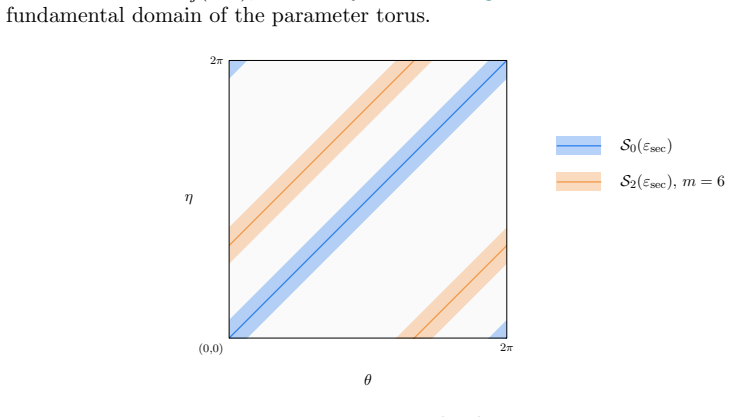
The trace map is the map $\Phi_\gamma(u,v,s)=\gamma_Q(u)+\gamma_{\bar Q}(v)$ on the smoothing $A=\{uv=s\}$ of two normalization disks. Its key property is equivariance with respect to the real structure $(u,v,s)\mapsto(v,u,s)$; the fixed circle $(u,v)=(re^{i\theta},re^{-i\theta})$ maps into the real plane and, for small $r$, is a predivide. The counting engine is the Puiseux-data calculation: with $\gamma_Q(u)=(u^m,\varphi(u))$ and $\kappa(\zeta)=\operatorname{ord}_u(\varphi(u)-\varphi(\zeta u))$ for $\zeta^m=1$, $\zeta\neq1$, the number of double points of the circle is $\sum_{\zeta\neq1}(m+\kappa(\zeta))=2\delta(Q,0)+m^2-1$, so the pair $Q\cup\bar Q$ contributes $\delta(Q\cup\bar Q,0)-1$. Lemma 6.7 extends this to packets of several conjugate pairs at a real infinitely near point and to their intersections with real arcs, which is what makes the global resolution descent work.
What would settle it
Run the full resolution descent on the seven-branch example of Section 7 and check that the final polynomial has exactly 42 real hyperbolic nodes for all sufficiently small positive parameters; any other count would show the $\delta-\operatorname{imbr}$ bound is not attained. A complementary check is to search for a reduced real germ whose resolution has a last common real infinitely near point where a conjugate pair shares a real tangent: there Lemma 6.7 would produce a self-tangency, as in Example 5.27, and the descent count would fail.
Extended reading notes
Core claim
The central claim, Theorem A, is that every reduced real plane curve germ $(C,0)$ admits a real morsification: a real nodal deformation such that, for every sufficiently small positive parameter, the fiber has exactly $\delta(C,0)-\operatorname{imbr}(C,0)$ real hyperbolic nodes and no other singularities. The obstruction to previous approaches was a conjugate pair $Q,\bar Q$ of nonreal branches. The paper removes it with the trace map on the smoothing $A=\{uv=s\}$ of two normalization disks, $\Phi(u,v,s)=\gamma_Q(u)+\gamma_{\bar Q}(v)$. The real structure sends $(u,v,s)$ to $(v,u,s)$, so the fixed locus of the $s=r^2$ fiber is the circle $(re^{i\theta},re^{-i\theta})$, and its image is a real predivide. For distinct tangents, the double points are counted exactly and equal $\delta(Q\cup\bar Q,0)-1$, organized in root-of-unity sectors determined by the Puiseux exponents; for real branches the same construction, after a quotient, recovers the classical Chebyshev parametrizations. Section 6 combines these trace-map circles with real arcs, translations, and contractions along the resolution, and the Euler characteristic of the Milnor fiber forces the node count up to the upper bound $\delta-\operatorname{imbr}$.
Load-bearing premise
The node count rests on the assertion that at every last common real infinitely near point of a conjugate pair, the two tangent lines are distinct and nonreal; the proof states this follows because a common real tangent would create another common real infinitely near point, but the separation step is not proved in detail.
Editorial extensions
If this is right
- Every prescribed real form of a complex plane curve singularity now has a real morsification, so the real-form restriction is no longer an obstacle.
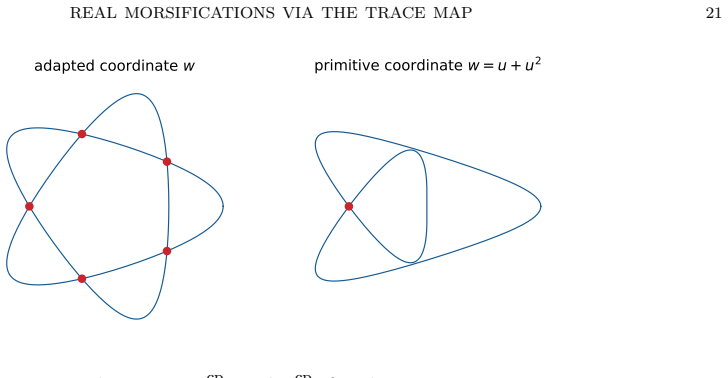
- The divide of the real locus is explicitly assembled from trace-map circles and translated arcs; for conjugate pairs with distinct tangents it is computable from Puiseux data.
- The maximum number $\delta(C,0)-\operatorname{imbr}(C,0)$ of real hyperbolic nodes allowed by the earlier bound is attained for every reduced real germ.
- For any two real forms of the same complex singularity, both now admit real morsifications, so the statement that their associated quivers are mutation equivalent can be tested across all real forms.
- The construction can be made explicit enough to produce a polynomial defining the morsification, as in the worked seven-branch example.
Reading between the lines
- The explicit Puiseux formula for the trace-map circle suggests a direct algorithm for drawing divides from the characteristic exponents alone, bypassing the full resolution; the paper does not draw this algorithmic conclusion.
- When a conjugate pair shares a real tangent, the circle map develops a self-tangency rather than a predivide; a limiting or perturbed version of the trace map might still recover the correct count, but the paper leaves that case to the resolution descent.
- Because a divide encodes the singularity link and monodromy, the new divides for non-totally-real forms may give explicit vanishing-cycle data for those real forms; the paper does not compute such data.
- The seven-branch example's explicit polynomial is a concrete test case for numerical singularity software: the predicted 42 real hyperbolic nodes can be checked for small positive parameter values.
Signed reviews
Editorial analysis
A structured set of objections, weighed in public.
Referee Report
Summary. The paper proves Theorem A: every reduced real plane curve germ (C,0) admits a real morsification, i.e., a real nodal deformation whose nearby fibers have exactly delta(C,0) - imbr(C,0) real hyperbolic nodes and no other singularities. The proof introduces a trace map on a smoothing of two normalization disks. For a conjugate pair of nonreal branches with distinct tangents, the trace map gives an explicit predivide whose double-point count is computed from the Puiseux data; for a real branch it recovers Gusein-Zade's Chebyshev construction. The global construction assembles these local predivides along a real embedded resolution using translations and contractions, and the final node count is verified by an Euler characteristic comparison with the Milnor fiber.
Significance. If correct, Theorem A settles a question of A'Campo and Gusein-Zade and the later conjectures of Leviant--Shustin and of Fomin--Pylyavskyy--Shustin--Thurston. The trace map is a new and explicit mechanism for producing divides for conjugate pairs, and the paper gives a worked example of the previously open Leviant--Shustin case as well as a complete seven-branch example. The main analytic estimates are presented in detail and the final count is checked independently by the Euler characteristic, so the result does not rest on fitted parameters or circular reasoning. The argument is long, but the reliance on standard tools is explicit.
minor comments (4)
- [Lemma 6.1 and Section 5] Several overlines appear to be missing from the typesetting. In Lemma 6.1 the sentence "Since L̸= L, Q_i and Q_j have distinct tangent lines, as do Q_i and Q_j" is inconsistent with the hypothesis that both Q_i and Q_j have tangent L; the intended statement is that Q_i and \bar Q_j have distinct tangents, and likewise \bar Q_i and Q_j. Similarly, (5.2) should display the real structure as (p,q) mapping to (\bar q, \bar p), with the real plane given by q=\bar p. These are notation issues, but they should be corrected to avoid confusion.
- [Theorem 6.8, descent step] The assertion that at a last common real infinitely near point c the two tangent lines of each conjugate pair are distinct and nonreal is stated in one sentence. I verified the argument: if the tangents coincided, the common tangent would be real and, after blowing up c, the strict transforms would meet at the real point of the exceptional divisor corresponding to that tangent, contradicting the choice of c. I recommend adding this one-line explanation explicitly, since Lemma 6.7 depends on it.
- [Theorem 6.8, Euler characteristic comparison] The computation that yields \sum_{q \in \operatorname{Sing}(Y_\lambda)} \delta(Y_\lambda,q) = \delta(C,0)-\operatorname{imbr}(C,0) is summarized in a single sentence. A short derivation, using \chi(Y_\lambda)=\chi(S_\lambda)-n for the n nodes and \chi(\operatorname{Milnor fiber})=\chi(S_\lambda)-2n, would help the reader check the factor of one half, which is load-bearing for the final count.
- [Throughout] There are several typographical errors that should be fixed: "Aknowledgements", "contracions", "with with" in Section 6, "all the and real blow ups" in Section 7, and the reference to "step 6" for the final perturbation in the proof of Theorem 6.8, which appears to mean step 4. In Example 5.29 the displayed formula for f_r(\theta) omits the overline on the second term; it should be w_\theta^2 + \overline{w_\theta}^3.
Circularity Check
No significant circularity: the node count is derived from Puiseux data plus an independent Euler characteristic bound, and the only self-citation is expository.
full rationale
The proof's central numerical claim—that the constructed deformation has δ(C,0)−imbr(C,0) nodes—is not circular. The lower bound is a bookkeeping sum over resolution data: Theorem 5.8 and Proposition 5.19 compute dbl(Γ)=2δ(Q)+(Q·Qbar)_0−1 using Puiseux sector analysis and Wall's semigroup formula (Lemma 5.11), and Lemma 6.7 aggregates these counts along the descent via the standard blow-up formulas (6.11). No constant is fitted to the target number. The matching upper bound comes from an independent Euler characteristic computation: the paper states that the Milnor fiber has Euler characteristic rebr(C,0)+2imbr(C,0)−2δ(C,0) and that the computation yields Σ δ(Yλ,q)=δ(C,0)−imbr(C,0), so the equality n=δ−imbr is forced by a two-sided comparison, not by construction. The only self-citation, [APC25], is explicitly expository ('For a recent account of both constructions, see [APC25]'), and Remark 4.7 says the real-branch Chebyshev construction is not used in the proof of Theorem A. The flagged tangent-separation assertion in Theorem 6.8 follows from the choice of c as the last common real infinitely near point: a common real tangent would survive blow-up as a common real intersection on the exceptional divisor, contradicting that choice. No circularity is present.
Assumptions & free parameters
assumptions (6)
- standard math Wall's formulas for delta invariant, intersection multiplicity, and blowup behavior (Wal04, Lemma 4.4.2, Theorem 6.5.9, Corollary 4.3.7, and Section 6.6)
- standard math Existence and convergence of Newton-Puiseux parametrizations for reduced branches, with characteristic exponents
- standard math Remmert's proper mapping theorem
- standard math Euler characteristic relation between the Milnor fiber and the normalization of a nearby singular fiber
- domain assumption Parametrized A'Campo translations and perturbations from Castellini (Cas15) and Leviant-Shustin (LS18)
- domain assumption Real resolution by iterated blowups at real points separates conjugate pairs into distinct nonreal tangent lines at their last common real infinitely near point
Cite this review
Pith. "Pith review of Real morsifications via the trace map." pith.science (2026). https://pith.science/paper/Q4N3XZ4D
@misc{pith2026260807212,
  author       = {Pith},
  title        = {Pith review of: Real morsifications via the trace map},
  year         = {2026},
  howpublished = {\url{https://pith.science/paper/Q4N3XZ4D}},
  note         = {Machine review of arXiv:2608.07212}
}
read the original abstract
We prove that every reduced real plane curve singularity admits a real morsification. This settles a question of A'Campo and Gusein-Zade, later stated as conjectures by Leviant--Shustin and by Fomin--Pylyavskyy--Shustin--Thurston. In particular we overcome the main obstruction that remained posed by conjugate pairs of nonreal branches. Our new main ingredient is a construction that produces the divide from a nodal smoothing of two normalization disks. This is what we call the trace map. For real branches, it recovers Gusein-Zade's construction using Chebyshev polynomials. For pairs of complex conjugate branches with distinct tangents, the construction gives an explicit formula for the divide in terms of the Puiseux data. The general method consists in a delicate combination of the trace map with A'Campo's translations and contractions to produce divides and real morsifications for all reduced real plane curve singularities.
Figures


Figures from the paper (10 more)




Reference graph
Works this paper leans on
-
[1]
Morsifications of real plane curve singularities
Leviant, Peter and Shustin, Eugenii , title =. Journal of Singularities , volume =. 2018 , doi =. 1703.05510 , archivePrefix =
work page Pith review arXiv 2018
-
[2]
Fomin, Sergey and Pylyavskyy, Pavlo and Shustin, Eugenii and Thurston, Dylan , title =. Journal of the London Mathematical Society , volume =. 2022 , doi =. 1711.10598 , archivePrefix =
work page Pith review arXiv 2022
-
[3]
American Journal of Mathematics , volume =
Scott, Charlotte Angas , title =. American Journal of Mathematics , volume =. 1892 , doi =
-
[4]
American Journal of Mathematics , volume =
Scott, Charlotte Angas , title =. American Journal of Mathematics , volume =. 1893 , doi =
-
[5]
Wall, C. T. C. , title =. 2004 , doi =
work page 2004
-
[6]
A'Campo, Norbert and Portilla Cuadrado, Pablo , title =. 2025 , eprint =
work page 2025
-
[7]
Real deformations and complex topology of plane curve singularities
A'Campo, Norbert , title =. Annales de la Faculte des sciences de Toulouse : Mathematiques , volume =. 1999 , doi =. alg-geom/9710023 , archivePrefix =
work page Pith review arXiv 1999
- [8]
Show all 23 references
-
[9]
Mathematische Annalen , volume =
A'Campo, Norbert , title =. Mathematische Annalen , volume =. 1975 , doi =
1975
-
[10]
Publications Mathematiques de l'IHES , volume =
A'Campo, Norbert , title =. Publications Mathematiques de l'IHES , volume =. 1998 , doi =. math/9803081 , archivePrefix =
1998 arXiv
-
[11]
Journal of Knot Theory and Its Ramifications , volume =
Couture, Olivier and Perron, Bernard , title =. Journal of Knot Theory and Its Ramifications , volume =. 2000 , doi =
2000
-
[12]
Gusein-Zade, S. M. , title =. Functional Analysis and Its Applications , volume =. 1974 , doi =
1974
-
[13]
and Turnwald, Gerhard , title =
Lidl, Rudolf and Mullen, Gary L. and Turnwald, Gerhard , title =. 1993 , isbn =
1993
-
[14]
Tohoku Mathematical Journal , volume =
A'Campo, Norbert , title =. Tohoku Mathematical Journal , volume =. 2001 , doi =. math/0006124 , archivePrefix =
2001 arXiv
-
[15]
Topology , volume =
Balke, Ludwig and Kaenders, Rainer , title =. Topology , volume =. 1996 , doi =
1996
-
[16]
Topology and its Applications , volume =
Hirasawa, Mikami , title =. Topology and its Applications , volume =. 2002 , doi =
2002
-
[17]
Osaka Journal of Mathematics , volume =
Gibson, William and Ishikawa, Masaharu , title =. Osaka Journal of Mathematics , volume =. 2002 , doi =
2002
-
[18]
Topology and its Applications , volume =
Gibson, William and Ishikawa, Masaharu , title =. Topology and its Applications , volume =. 2002 , doi =
2002
-
[19]
Indagationes Mathematicae
Ishikawa, Masaharu , title =. Indagationes Mathematicae. New Series , volume =. 2002 , doi =
2002
-
[20]
Algebraic & Geometric Topology , volume =
Kawamura, Tomomi , title =. Algebraic & Geometric Topology , volume =. 2004 , doi =
2004
-
[21]
Topology and its Applications , volume =
Sugawara, Sakumi and Yoshinaga, Masahiko , title =. Topology and its Applications , volume =. 2022 , doi =. 2103.15262 , archivePrefix =
2022 arXiv
-
[22]
Topology and its Applications , volume =
Sugawara, Sakumi , title =. Topology and its Applications , volume =. 2025 , doi =. 2312.00422 , archivePrefix =
2025 arXiv
-
[23]
Mathematische Annalen , volume =
Remmert, Reinhold , title =. Mathematische Annalen , volume =. 1956 , url =
1956
Reviewed August 10, 2026 · model on record in the stance chip above.
Discussion (0). Continue with ORCID to comment.